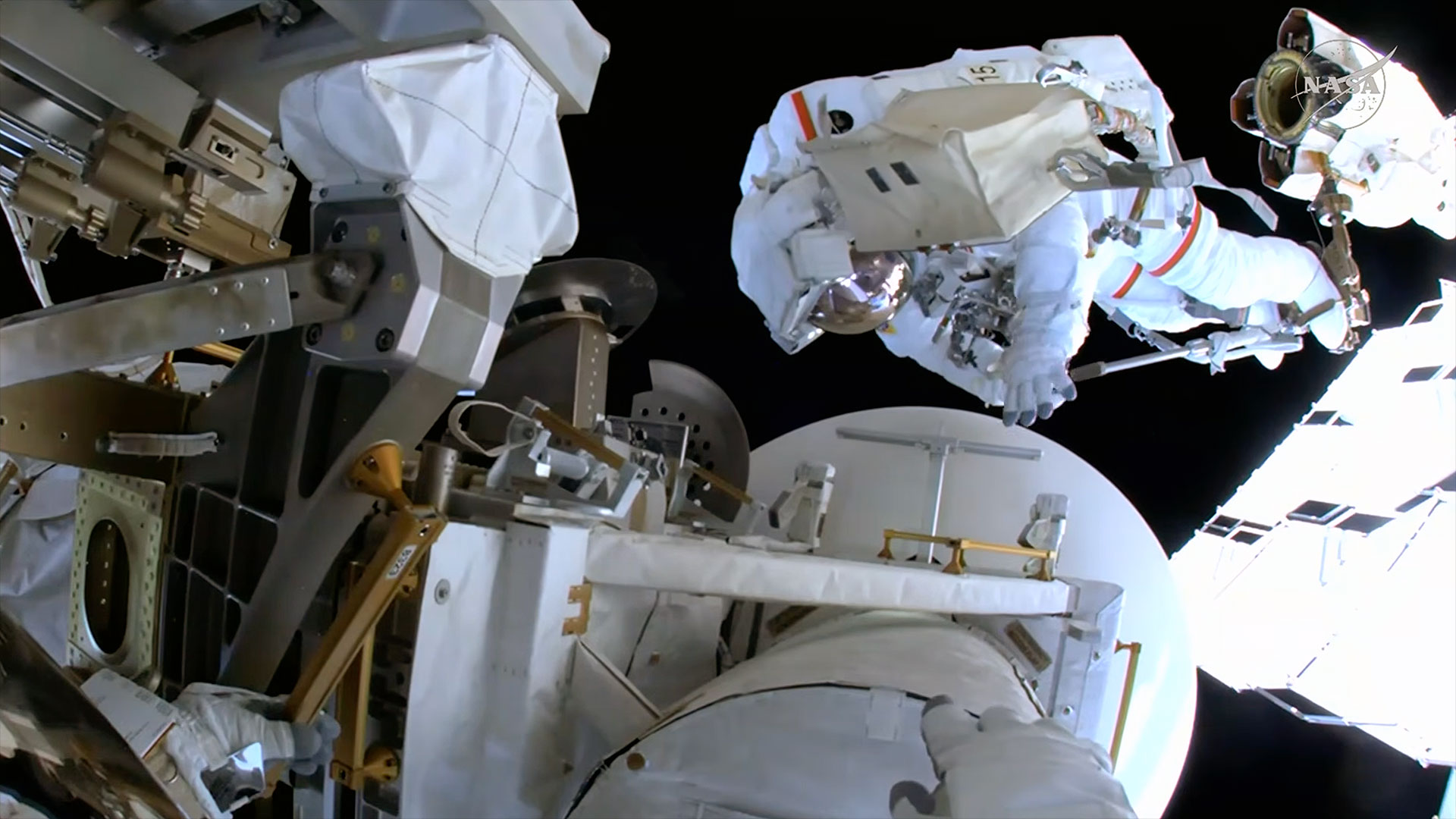
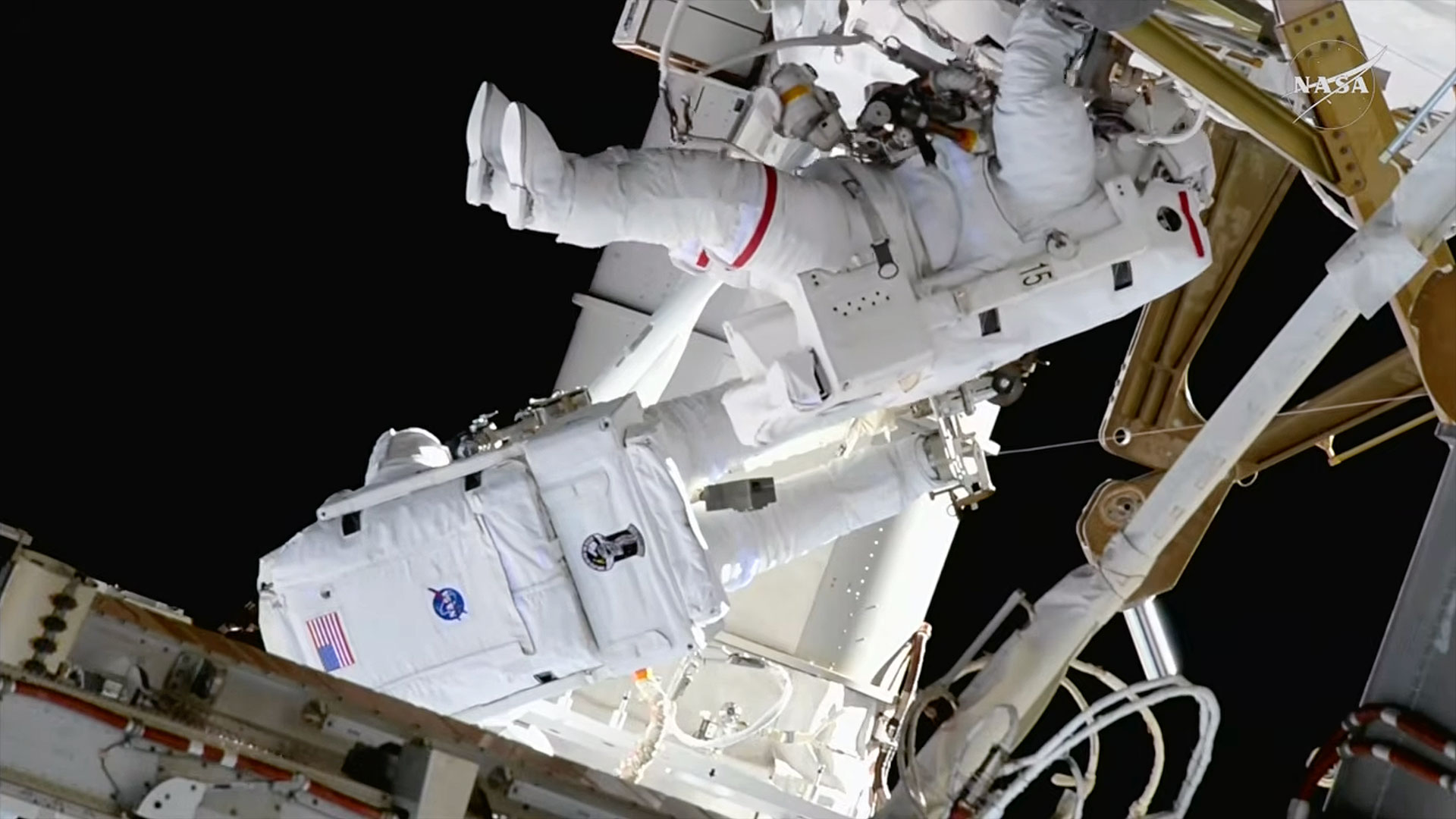
Two astronauts replaced a spacecraft docking aid and a video camera during a successful spacewalk outside of the International Space Station on Tuesday (Sept. 1).
NASA astronaut Jessica Meir and ESA (European Space Agency) astronaut Sophie Adenot got through most of the tasks set out for them even in light of Adenot's spacesuit developing a mobility issue late in the extravehicular activity (EVA), which lasted six hours and 49 minutes.
After beginning the spacewalk from the U.S. Quest airlock at 8:40 a.m. EDT (1240 GMT), Meir and Adenot set about the first and most important activity of the outing: replacing the planar deflector on the forward port of the station's Harmony Node 2. The retroreflector is used to support navigation during rendezvous and docking operations by visiting spacecraft. The older reflector that they replaced had become coated in thruster residue from earlier spacecraft arrivals and departures.
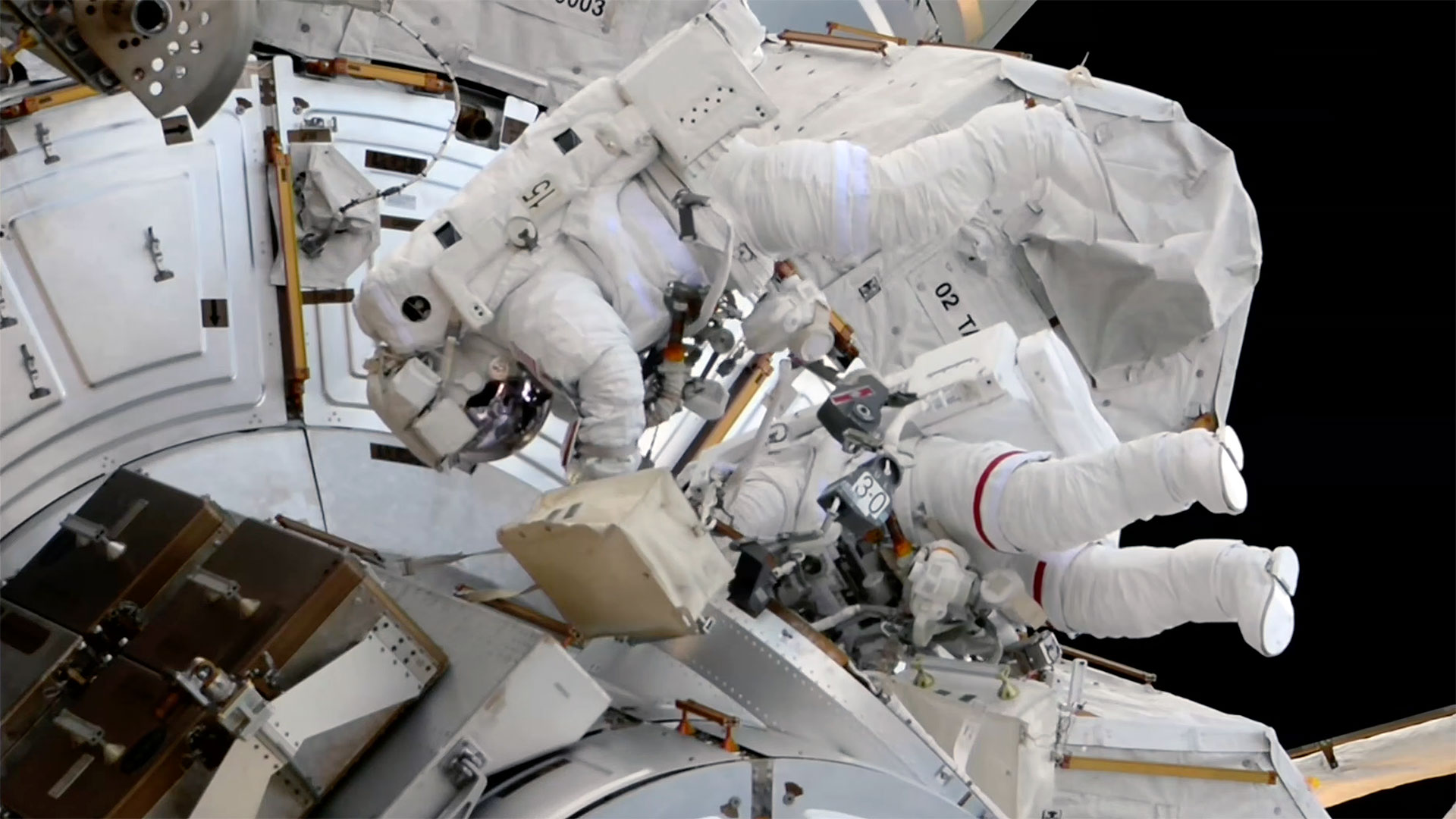
NASA astronaut Jessica Meir (at left) and ESA astronaut Sophie Adenot (in spacesuit with red stripes) are seen outside the Quest airlock during a spacewalk at the International Space Station on Tuesday, Sept. 1, 2026. (Image credit: NASA)
They also replaced the Camera Port 3 (CP3) high-definition (HD) camera on the station's truss.
"And it's off!" reported Meir after freeing the spent camera assembly that was swapped out for spare. Her words were met by applause in Mission Control at NASA's Johnson Space Center in Houston.
"That worked, great!" she said.
From there, Adenot headed off to continue an ongoing scientific study by swabbing areas on the exterior of the airlock and her gloves for possible microorganisms. Meir, meanwhile, rode one end of the Canadarm2 robotic arm to a site near the Alpha Magnetic Spectrometer (AMS), torquing 46 bolts in preparation for future maintenance of the particle physics detector.
Meir also relocated power and thermal jumper cables and an articulating portable foot restraint for use on a later spacewalk.
There were some other tasks planned, time permitting, but toward the end of the EVA, Adenot reported losing mobility in her left shoulder joint. Erring on the side of caution, Mission Control called for Adenot to wait where she was until Meir could follow her back to the airlock.
Once there, Meir was able to unzip a portion of Adenot's extravehicular mobility unit's (EMU's) upper arm assembly to inspect what was happening. In doing so, she freed the kink that had limited Adenot's motion.
"I think it was where the cable got caught in between the shoulder MLI [multi-layer insulation] and the rotation [joint]. I don't think it was held up by anything but some friction," said Meir.
The two Expedition 75 crewmates then proceeded back into the airlock to complete the EVA at 4:29 p.m (2029 GMT).
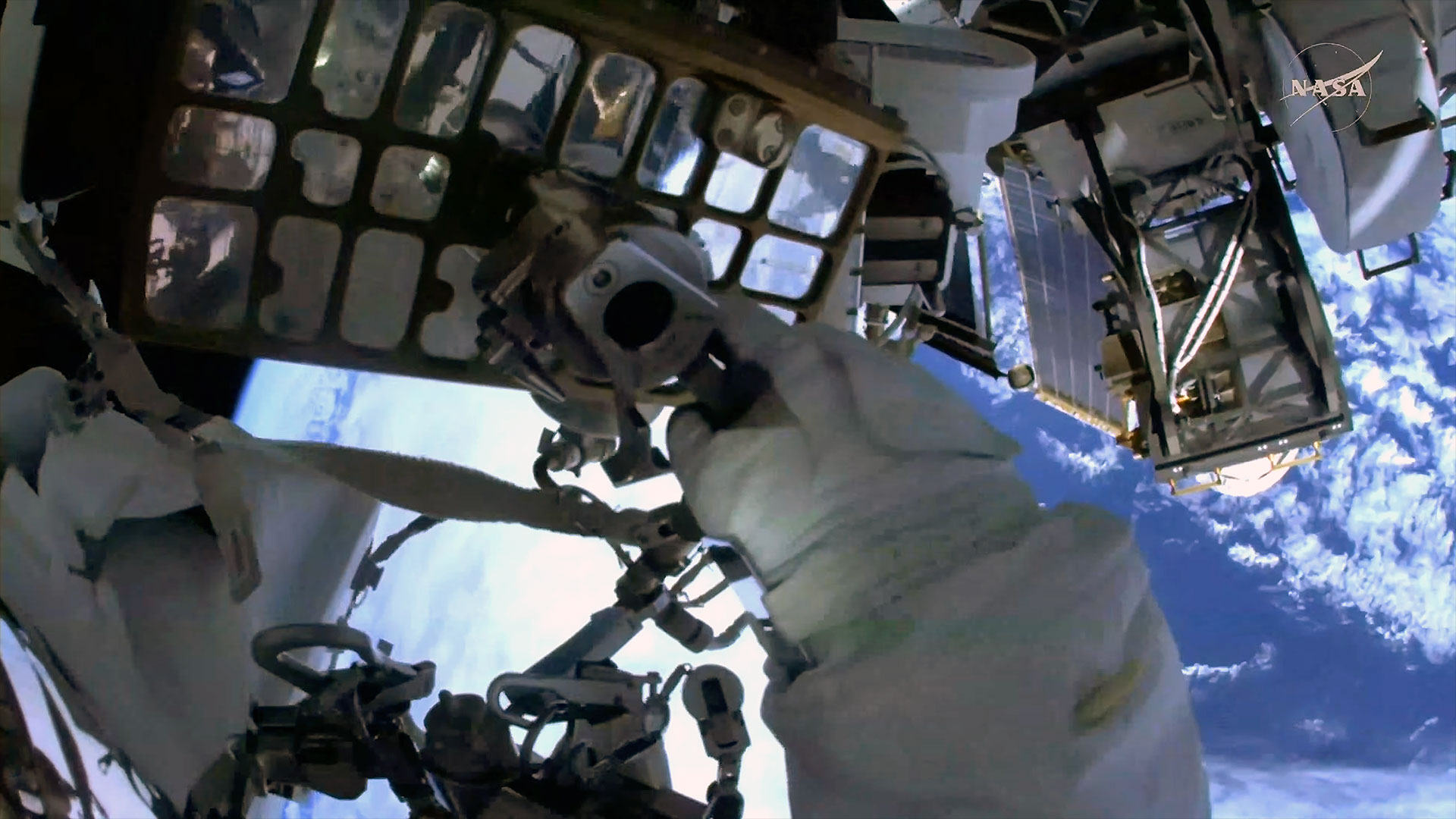
In a view from her helmet-mounted camera, NASA astronaut Jessica Meir holds a spent HD video camera before installing its replacement outside of the International Space Station on Tuesday, Sept. 1, 2026. (Image credit: NASA)
Tuesday's spacewalk was Meir's seventh and Adenot's third. Meir, who has a total of 49 hours and 22 minutes on EVA, now ranks third among all women astronauts at NASA for total number of spacewalks. She trails only Peggy Whitson with 10 and Suni Williams at 9.
Adenot now has spent 19 hours and 42 minutes working in the vacuum of space.
This spacewalk was the 284th supporting the International Space Station's assembly, maintenance and upgrades. It was the seventh spacewalk this year, fifth EVA for Expedition 75 and the sixth all-female spacewalk in history.
The story is very different when it comes to men. For example, NASA's "Great Observatories," which launched between 1990 and 2003, were all named after famous U.S. male astronomers or physicists: the Hubble Space Telescope (Edwin Hubble), the Compton Gamma-Ray Observatory (Arthur Compton), the Chandra X-ray Observatory (Subrahmanyan Chandrasekhar) and the Spitzer Space Telescope (Lyman Spitzer).
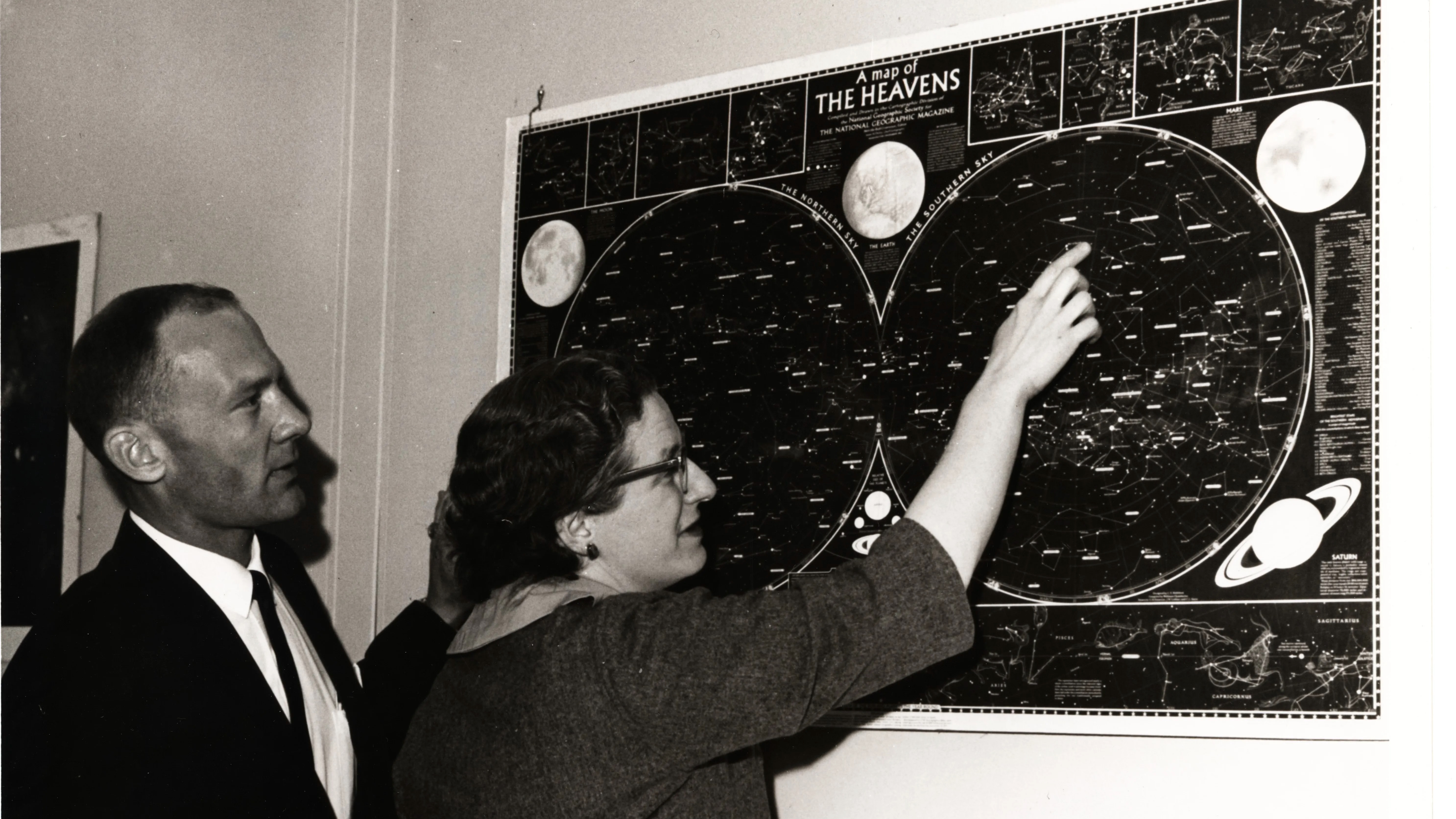
Nancy Grace Roman briefs Edwin (Buzz) Aldrin on celestial objects in Washington, D.C. in 1965. Aldrin would go on to complete three spacewalks and become the second person to walk on the moon. (Image credit: NASA)
Indeed, relatively few spacecraft of any kind have borne female names over the years — and most of the ones that did were not honoring actual, real-life people.
For instance, a number of missions with female names took them from mythology (e.g., NASA's Europa Clipper and China's Chang'e moon probes). Others used female names not attached to particular individuals (such as NASA's Clementine moon mission, and the European Space Agency's LISA, which is an acronym for "Laser Intraferometer Space Antenna.")
A notable exception is Sojourner, the mini-rover on NASA's Mars Pathfinder lander mission that was made famous again by the 2015 film "The Martian;" it's named after Sojourner Truth, a Civil War-era abolitionist. Sojourner's name was selected in 1995 from a worldwide naming contest for students and suggested by 12-year-old Valerie Ambroise of Bridgeport, Connecticut. Some other notable examples of missions honoring real-life women include:
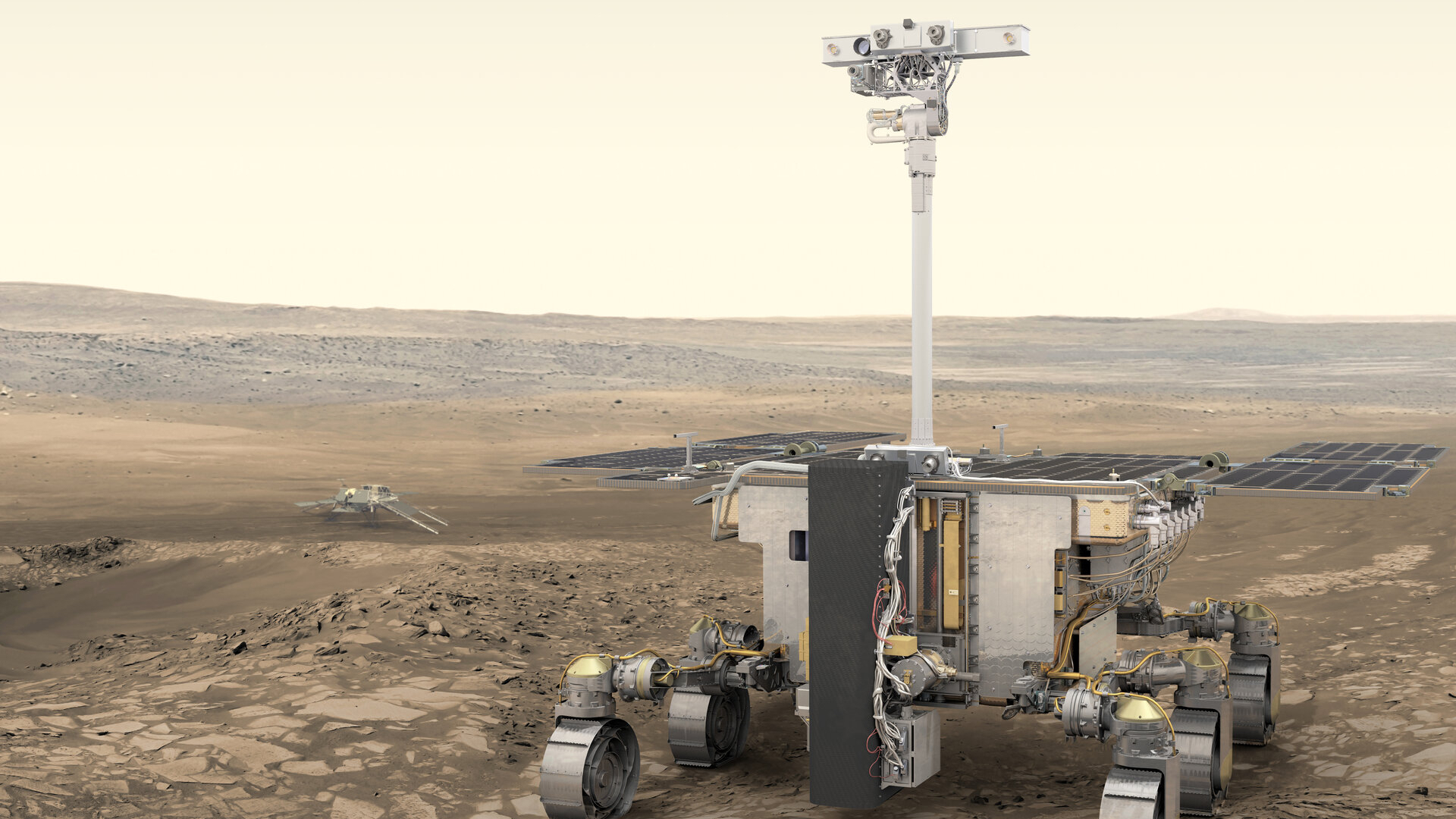
ESA's long-delayed ExoMars rover Rosalind Franklin, which is now set to launch to Mars in 2028. It's named after a British scientist who contributed to discovering the structure of DNA. (Part of the rover's mission is to analyze potential biosignatures on the Red Planet's surface.)
The Cygnus International Space Station (ISS) resupply program, which is managed by Northrop Grumman. Multiple Cygnus freighters have been named after female NASA astronauts, including Janice E. Voss, Sally Ride and Kalpana Chawla, and one of them honored the American mathematician and "hidden figure" Katherine Johnson.
Satellogic's ÑuSat/NewSat series. It has commonly named satellites after female historical figures in science, such as Black American chemist Alice Ball, Polish physicist-chemist Marie Curie and Australian radio astronomer Ruby Payne-Scott.
Canada's GHGSat has a program in which employees name the company's Earth-orbiting satellites after family members, which has generated names from real-life people like Eleonore and Penny.
The U.S. Space Force nicknamed its GPS III Space Vehicle-08 "Ms. Creola Katherine Johnson," another nod to the mathematician
What this means
Throughout history, the names of ocean-going ships — ships on the water, not spaceships — often have associations with women. The U.K.'s Imperial War Museums (IWM) suggests that women's names are used due to two traditions. The first is that, very generally speaking, the word "boat" is a "female" word in some languages that use gendered nouns, but that is by far not universal, even among the imperial sailing powers of the 1400s to 1600s.
The second association, which seems more likely, is the notion of a mother, goddess or similar "female figure" guiding a crew, which we see in theaters right now with "The Odyssey:" Athena helps Odysseus, reflecting the ancient Greek epic story. (For example, figureheads — sculptures on sailing ship prows — were often, although not always, carved in the likeness of women, Royal Museums Greenwich states.)
There are famous sailing ships with female names that many Americans can cite, such as the nicknames for the three Spanish ships — the Niña, Pinta and Santa María — used by Christopher Columbus during his famed first voyage to the New World in 1492.
"There's always been a tradition to name ships — and oftentimes after women," Valerie Neal, emerita curator in the Smithsonian National Air and Space Museum's department of space history, told Space.com. Neal's research includes extensive work on female astronauts.
The U.S. space program has historically leaned upon mythological names of both genders for its missions, she noted, citing the Mercury, Gemini and Apollo human spaceflight programs as examples of male monikers. These days, Neal added, the education system is less tilted toward introducing children to old Greek or Roman myths, which may explain why it's now more common to name missions after real-life individuals.
In the 1970s and 1980s, for example, "there was a big debate at the time of the space shuttle naming whether to name the space shuttles after historic figures, or after concepts," Neal said. "One idea was even after Native American tribes." (For example, Tafuna High School in American Samoa recommended the name "Hōkūle'a" for shuttle, as noted in NASA's 1991 monograph "From Ship to Shuttle: NASA Orbiter-Naming Program")
The space shuttles were ultimately named Columbia, Challenger, Discovery, Atlantis and Endeavour after "historic ships of exploration," Neal said. You can read more about the origins of those names in this piece by The Space Foundation.
The Cygnus spacecraft "USS Janice Voss," which flew to the ISS in 2014, was the first U.S. orbital mission known to Neal to be named after a woman. "She had had an affiliation with the Orbital Sciences Corporation, and so they wanted to honor her," said Neal, referring to a previous company that managed the Cygnus program.
The flock of Cygnuses named after women — at least six of them, according to Neal — is "a good sign that people are starting to think of contemporary figures, or more contemporary, [and] naming spacecraft as a tribute to them, and to their contributions in science and exploration and discovery."
Naming a flagship space telescope after Nancy Grace Roman is another good sign, of course. And choosing her for this honor makes sense; she was in "a class by herself — because her name is so directly associated with astronomy and large space telescopes" like Hubble, Neal said.
"It is recognizing her significance in the history of space exploration as a leader who made so much possible, through her own work as an astronomer, but then as an administrator and manager at NASA made possible the orbiting solar observatories, the orbiting astronomical observatories — and then Hubble and the other great observatories that followed."
Roman's name on the telescope, she added, is "elevated" because "her name coincides exactly with the spacecraft and its purpose, whereas the names of the astronauts that are attached to the [ISS] resupply missions … not all of them had any connection to the International Space Station. Several did, but not all."
Neal said she's hopeful that more women will see their names attached to space missions, including both those historical astronomers who saw "their bosses were getting all the credit" as well as the numerous non-male scientists making impacts in the field today.
"I think it's entirely possible that, in time, there will be another major observatory named for a woman," Neal added. She noted that recommendations from the science community every 10 years form the basis of new space missions, and that the next such "decadal survey" in astrophysics is expected to wrap up around 2030.
In the nearer term, NASA is considering ideas such as an ultraviolet telescope, an advanced X-ray imaging satellite, and the Habitable Worlds Observatory for launch in the 2030s or early 2040s, presenting more opportunities to attach female names to flagship space missions.
Artist's illustration of Europe's ExoMars rover, named Rosalind Franklin, on the surface of the Red Planet. (Image credit: ESA/ATG medialab)
Sidebar: Female mission names
With thousands of flown or planned missions to space, and numerous parts making up each spacecraft, it is difficult to compile a comprehensive list of probes or instruments that have had female names. The following is therefore a partial list, though an extensive one. In no particular order, it includes:
Human spacecraft: Mercury Aurora 7, SpaceX's Crew Dragon Grace.
Satellites/ISS missions: ESRO-1A and 1B's nicknames of Aurora and Boreas, multiple Cygnus ISS resupply spacecraft, much of the Satellogic NuSat/NewSat constellation, several GHGSat spacecraft, Space Force's GPS III Space Vehicle-08 (nicknamed Ms. Creola Katherine Johnson), and the Russian Resurs-DK1 satellite's multinational cosmic-ray module PAMELA (Payload for Antimatter Matter Exploration and Light-nuclei Astrophysics).
Moon: China's Chang'e series, the Soviet Union's Luna series, NASA's Artemis program and missions, Intuitive Machines' IM-2 lander Athena, JAXA's Selene/Kaguya, NASA's Clementine, the NASA ARTEMIS moon-orbiting probe.
Venus: ESA's Venus Express, the Soviet Union's Venera series.
Jupiter/moons: NASA's Juno, NASA's Europa Clipper.
Asteroids: NASA's Lucy, ESA's Hera.
Other hardware: Some spacecraft/rocket parts have female names (e.g. the US military's Juno II rocket, Firefly Aerospace's Miranda engine, ESA's Europa and Ariane rockets).
The following at first glance appear to have female names, but either were not confirmed before this story's deadline or were confirmed to have other origins:
Japan's MUSES Program (Mu Space Engineering Spacecraft), which may or may not reflect the English/Ancient Greek meaning of goddesses of knowledge.
DoD's ALEXIS (the Array of Low Energy X-ray Imaging Sensors) and JAXA's Akatasuki (Venus Climate Orbiter) may not just reflect female names.
NASA's Dawn is meant to reflect the solar system's beginning, and not a person.
The Soviet Vega series to Venus is meant to be VeGa, or as National Geographic once wrote, "a contraction of the Russian words for your dual targets, Venera and Gallei."
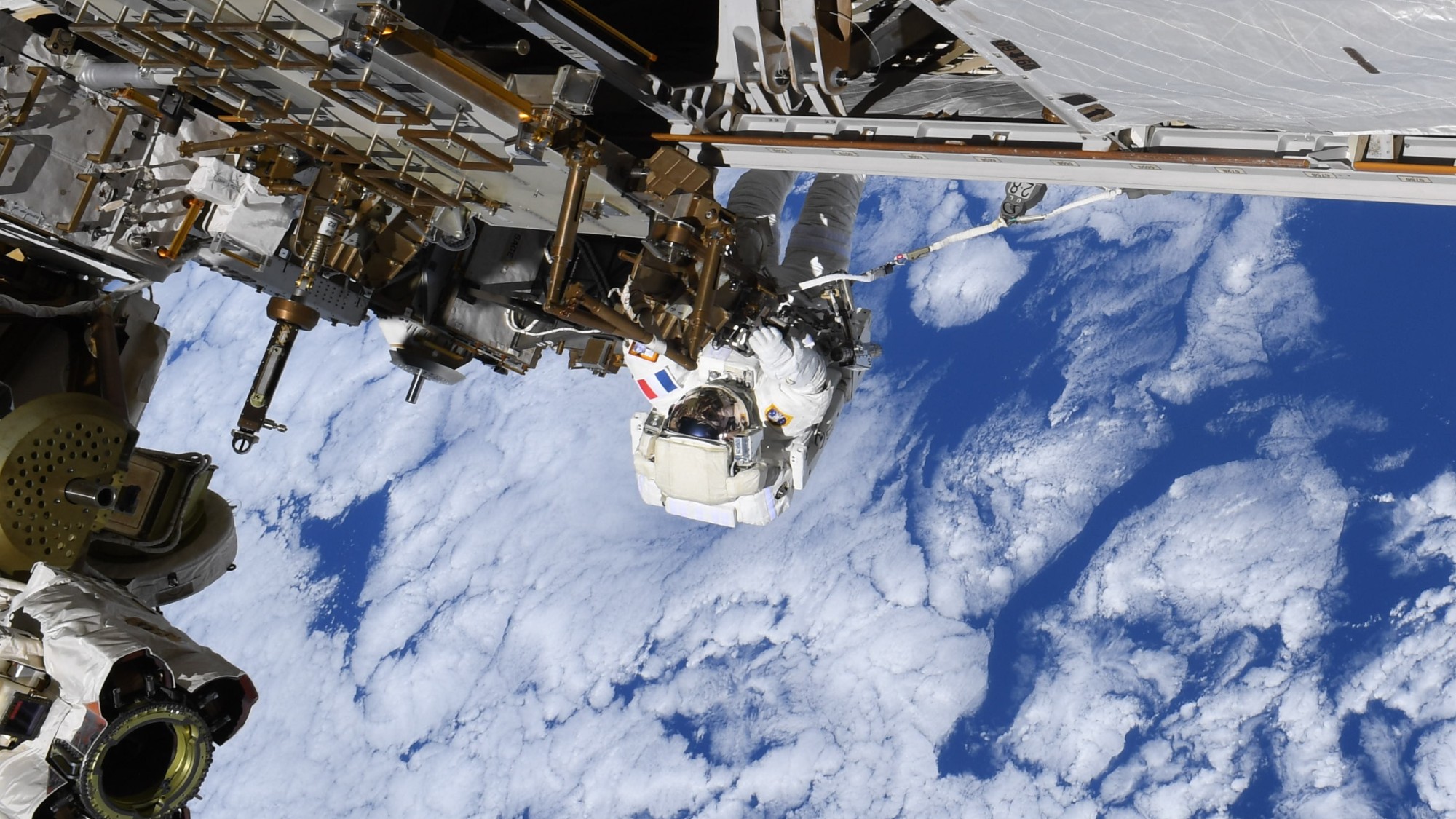
ESA astronaut Sophie Adenot on the outside of the International Space Station during an extravehicular activity on Aug. 25, 2026. (Image credit: ESA/NASA)
Repairing an engineering marvel like the International Space Station is no easy feat by itself, but it's even more impressive when it's done 250 miles (400 kilometers) up.
The photo was taken while Adenot and NASA astronaut Anil Menon were conducting a 6.5-hour spacewalk, or extravehicular activity (EVA), to replace one of two Space-to-Ground antennas on the outside of the ISS.
This was the second EVA that Adenot and Menon performed to replace the antenna. During a previous spacewalk a week earlier, the pair ran out of time before the new antenna could be installed.
With that first spacewalk, Adenot became the first woman from France to ever conduct an EVA.
Why is it incredible?
It can be hard to conceptualize just how high up the ISS orbits until you see a photo like this one; few people on Earth have ever flown as high as 250 miles (400 km), so that altitude can feel a bit abstract. Seeing an astronaut like Adenot clinging to the space station with the clouds and blue oceans of Earth below puts things into perspective.
At that height, the ISS orbits at quite a high rate of speed. The orbital laboratory zips around Earth at 17,500 mph (28,000 kph), meaning it circles the planet 16 times a day. This photo was taken on day 194, or orbit 3010, of Adenot's mission, which began in February when she launched to the ISS as part of NASA's Crew-12 mission.
Two astronauts will conduct history's sixth all-female spacewalk today (Sept. 1), and you can watch it live.
NASA's Jessica Meir and Sophie Adenot of the European Space Agency will venture outside the International Space Station (ISS) at around 8:30 a.m. EDT (1230 GMT) on an excursion expected to last about 6.5 hours.
You can watch it here at Space.com, courtesy of NASA, or directly via the agency. Coverage will start at 7:00 a.m. EDT (1100 GMT).
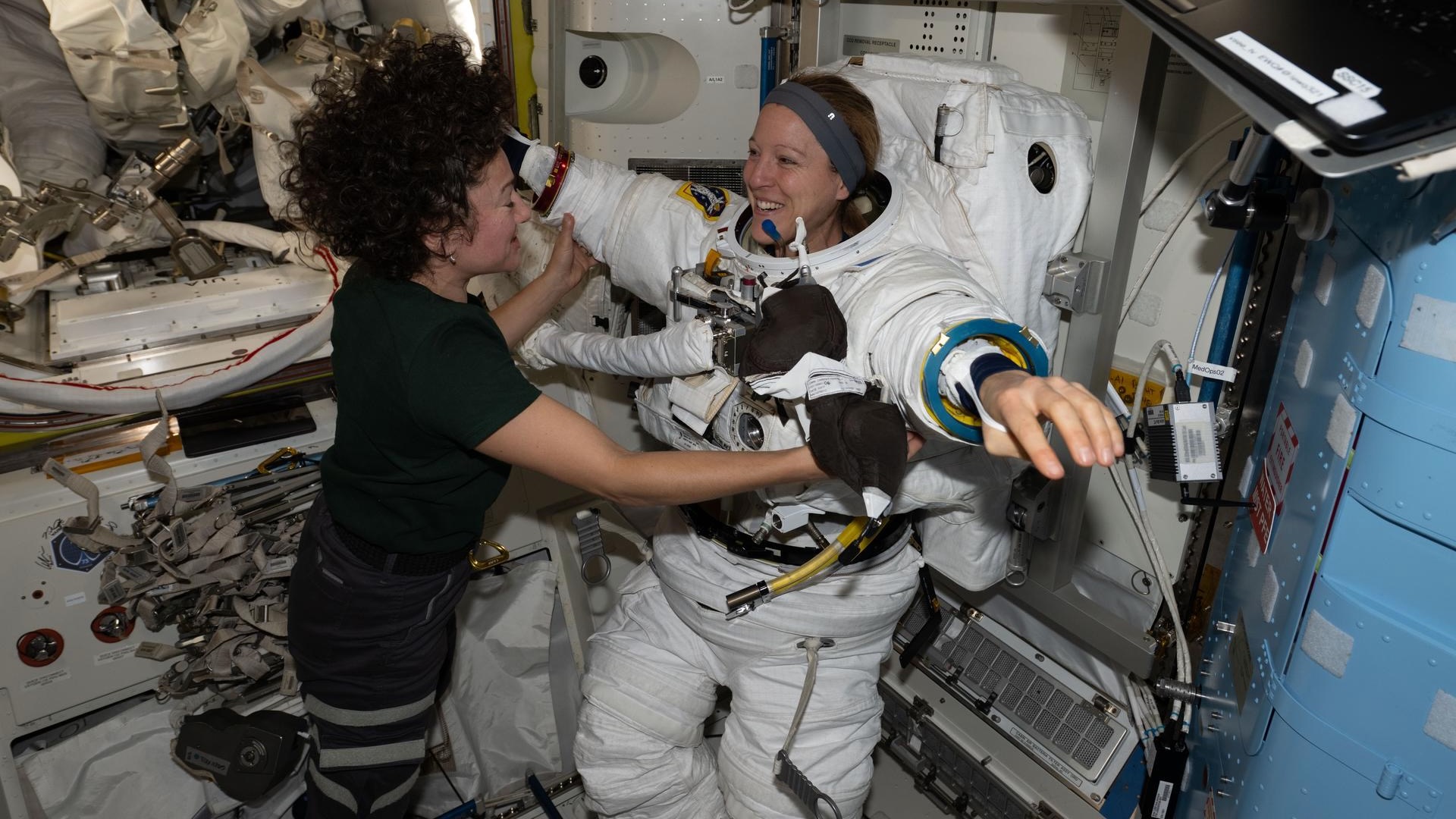
NASA astronaut Jessica Meir and the European Space Agency's Sophie Adenot work together inside the International Space Station’s Quest airlock during spacesuit fit and leak checks. (Image credit: NASA)
During today's spacewalk, Meir and Adenot "will replace a retroreflector on the forward port of the space station's Harmony module to support spacecraft navigation during rendezvous and docking operations," NASA officials said in a media advisory.
"After installing the reflector, the crew will work to install jumper cables for the data-relay systems, prepare the Alpha Magnetic Spectrometer's radiator for future maintenance, and replace a high-definition camera on the station's truss," they added.
Adenot will be "crew member 1" on today's spacewalk and will wear a suit with red stripes, NASA officials said. Meir will wear an unmarked suit and serve as "crew member 2."
It will be the third spacewalk for Adenot, who two weeks ago became the first French woman ever to perform an extravehicular activity (EVA). It will be the seventh for Meir, which will put her third among female NASA astronauts behind Peggy Whitson (10 EVAs) and Suni Williams (nine).
There have been just five all-female ISS spacewalks to date, and Meir has been part of three of them — the first three, in fact. She conducted those with fellow NASA astronaut (and Artemis II crewmember) Christina Koch on Oct. 18, 2019, Jan. 15, 2020 and Jan. 20, 2020.
NASA's Neil Gehrels Swift Observatory is back to studying the universe after spending months in a low-drag configuration while awaiting an orbital rescue mission that ultimately fell short.
Mission controllers restarted two of Swift's three science instruments — its X-ray Telescope (XRT) and Ultraviolet/Optical Telescope (UVOT) — on Aug. 26. Both instruments had been shut down in February as part of an effort to minimize atmospheric drag and keep the aging spacecraft in orbit long enough for another spacecraft to reach and boost it to a higher altitude, according to an Aug. 28 statement from NASA.
Swift's third instrument, the Burst Alert Telescope (BAT), remains offline. Operations of the BAT were halted in April to conserve power, allowing controllers to position Swift's solar panels in a way that further reduced drag from its interaction with Earth's atmosphere. NASA says the mission team hopes to resume data collection with the instrument within the next few weeks.
"Over the last 21 years, Swift has been NASA's multitool for studying the cosmos," NASA officials said in the statement. "It observes a wide range of light, rapidly points at short-lived outbursts, and sends alerts to other facilities in space and on the ground to help coordinate follow-up observations."
The return to science follows NASA's decision to abandon plans to boost Swift's orbit using LINK, a robotic servicing spacecraft built by the Arizona company Katalyst Space. LINK launched July 3 aboard a Northrop Grumman Pegasus XL rocket with the ambitious goal of rendezvousing with Swift, grabbing the observatory and raising its orbit.
However, the rescue mission encountered trouble in late July when LINK developed attitude-control problems that caused it to spin and disrupted communications. Two of the spacecraft's three reaction wheels were found to be inoperable, while its cold-gas thruster system also experienced some loss of functionality.
Although engineers managed to reduce LINK's spin and regain attitude control, NASA and Katalyst announced Aug. 19 that the spacecraft would no longer attempt to capture and boost Swift. Instead, LINK is expected to rendezvous with Swift and perform proximity operations, providing an opportunity to demonstrate technologies that could be used for future in-space satellite servicing missions — leaving Swift without the orbital boost intended to extend its life and its future increasingly uncertain.
Launched in 2004, Swift was originally designed for a two-year mission studying gamma-ray bursts, the most powerful explosions in the universe. More than two decades later, the observatory continues to detect and rapidly follow up on fleeting cosmic events in gamma-ray, X-ray, ultraviolet and visible light, while alerting other observatories so they can turn their attention to the same targets.
Unlike some spacecraft in low Earth orbit, Swift doesn't have a propulsion system capable of counteracting atmospheric drag. Increased solar activity has heated and expanded Earth's upper atmosphere, increasing the drag on Swift and causing its orbit to decay faster than previously expected.
NASA's low-drag operations had been expected to keep Swift above an altitude of about 185 miles (300 kilometers) until October. Below that threshold, operating the observatory becomes increasingly difficult and its descent accelerates, NASA officials said in the statement.
Now that science operations have resumed — and the planned orbital boost is off the table — NASA expects Swift to reach that critical altitude within the next one to two months. Without intervention, the observatory is likely to crash back to Earth later this year, mostly burning up as it reenters the atmosphere, according to the space agency.
For now, the veteran space telescope is making the most of the time it has left — and once again scanning the universe.
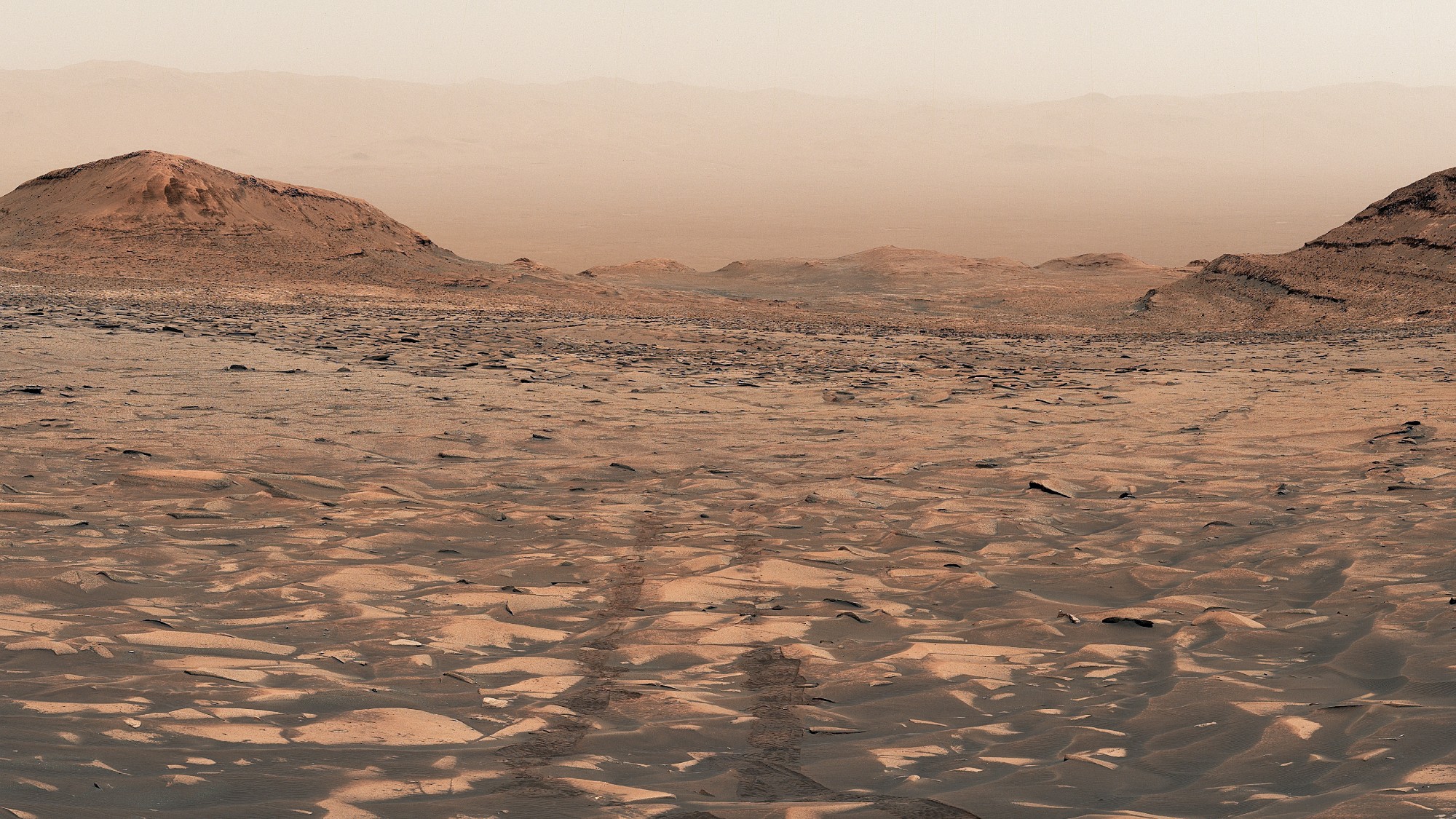
A photograph taken by NASA's Curiosity Mars rover from the floor of Gale Crater, on Aug. 1 and Aug. 2, 2026, the 4,972nd and 4,973rd Martian days, or sols, of the rover's mission. The photo captures a valley on the side of Mount Sharp, the 3-mile-tall (5-kilometer) mountain the rover has been climbing since 2014. (Image credit: NASA/JPL-Caltech/MSSS)
One of NASA's intrepid Mars rovers has notched another impressive milestone during its exploration of the Red Planet.
What is it?
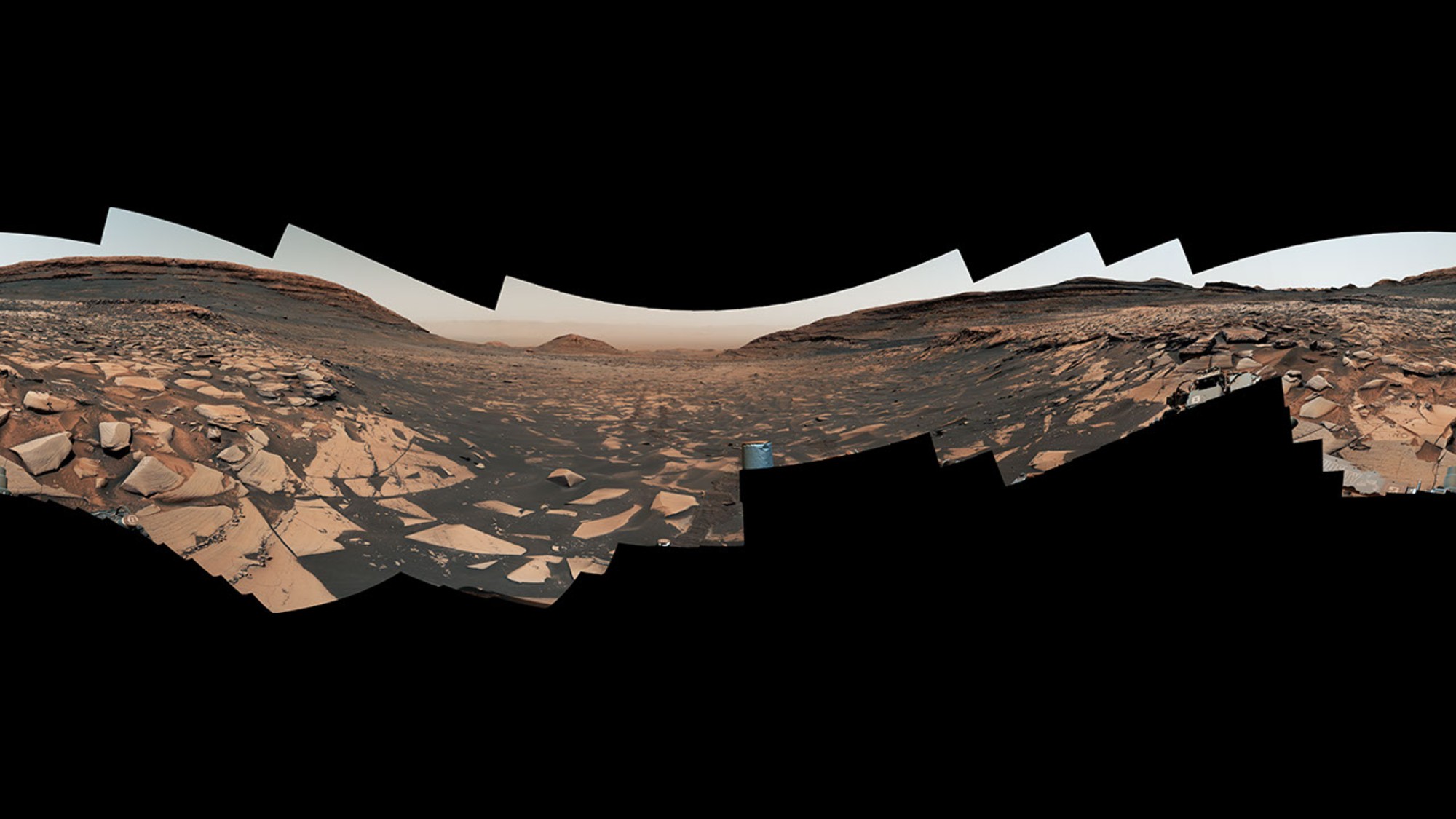
NASA's Curiosity Mars rover used its Mastcam camera to capture a panorama made up of 323 individual images. The images were taken on Aug. 1 and Aug. 2, 2026, the 4,972nd and 4,973rd Martian days (or sols) of the rover's mission, just as Curiosity notched a total of 1 kilometer (0.6 miles) of elevation gain throughout its now 14-year exploration of the Red Planet.
The images show the wide expanse of a broad valley nicknamed "Valle Grande," a depression on the side of Mars' Mount Sharp, the 3-mile-tall (5-kilometer) mountain the rover has been climbing since 2014. The valley's floor and northern rim can be seen in the distance.
Why is it incredible?
A panorama of Mars' Mount Sharp, captured by NASA's Curiosity rover from the floor of Gale Crater, on Aug. 1 and Aug. 2, 2026, the 4,972nd and 4,973rd Martian days, or sols, of the rover's mission. (Image credit: NASA/JPL-Caltech/MSSS)
Curiosity's mission has been incredible for a number of reasons. For one, the daring "sky crane" maneuver that NASA and the Jet Propulsion Laboratory used to land the SUV-sized robot on the Red Planet changed Mars landings forever.
And even after 14 years of traveling across the Red Planet and suffering considerable damage to its wheels, NASA says Curiosity has plenty of exploration and science left to conduct.
Another one of NASA's Mars rovers, Perseverance, recently notched a travel milestone of its own when it surpassed 26.2 miles (42.2 km) of travel — the length of a marathon — across the Martian surface.
Four astronauts just received the United States' highest space honor.
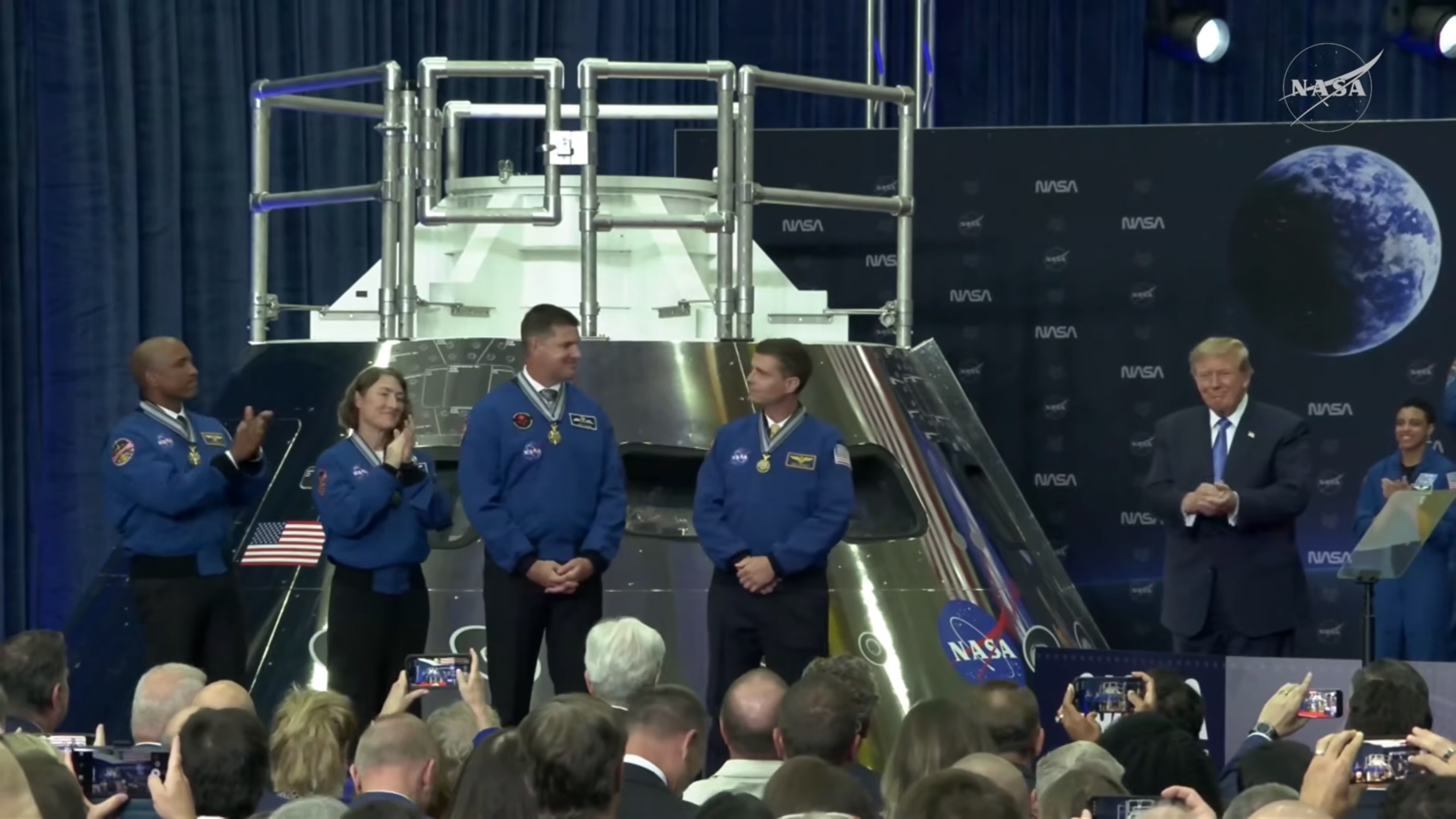
President Donald Trump gave the astronauts of NASA's Artemis II moon mission the Congressional Space Medal of Honor today (Aug. 28) during a ceremony at Johnson Space Center in Houston.
"This is a very rare thing. It's for courageous people, brilliant people, bestowed on astronauts who have distinguished themselves with exceptional service to the nation and all of mankind," Trump said during the event.
President Donald Trump awarded the four astronauts of NASA's Artemis II moon mission the Congressional Space Medal of Honor on Aug. 28, 2026. (Image credit: NASA TV)
Artemis II launched on April 1 and came back to Earth nine days later. It was the first crewed mission of NASA's Artemis program, which aims to establish a long-term base near the moon's south pole in the coming years.
The flight sent four people — NASA's Reid Wiseman, Victor Glover and Christina Koch, as well as Canadian Space Agency astronaut Jeremy Hansen — on a looping journey around the lunar far side. It was the first crewed trip beyond low Earth orbit since Apollo 17 in 1972, and its astronauts got farther from their home planet than any people ever had before.
Artemis II engaged folks around the world thanks to its importance, its historic nature and the charisma of its astronauts. And some fortuitous orbital dynamics didn't hurt, either: The Artemis II crew were lucky enough to observe a total solar eclipse from beyond the moon, something human eyes had never seen firsthand before.
The Congressional Space Medal of Honor is awarded "to any astronaut who in the performance of his duties has distinguished himself by exceptionalIy meritorious efforts and contributions to the welfare of the Nation and of mankind," NASA wrote in a description of the award, citing Congress' stated criteria.
Though the president gives out the medal, he does so on the recommendation of the NASA administrator, the agency added. Before today, just 30 people had received the award, and most of them are pretty big names. Past honorees include Apollo 11 astronaut Neil Armstrong; Alan Shepard and John Glenn, who were the first Americans to reach space and orbit Earth, respectively; Gemini astronaut Ed White, the first American to perform a spacewalk; and Apollo 13 commander Jim Lovell.
The award was also given to each of the 14 astronauts who died in the space shuttle Challenger and Columbia disasters.
Hansen therefore wasn't the first non-American to receive the medal. Ilan Ramon, one of the seven people who perished when Columbia broke apart upon reentry to Earth's atmosphere on Feb. 1, 2003, was from Israel.
The Artemis II astronauts gave President Trump a special flight jacket on Aug. 28, 2026. (Image credit: NASA TV)
During his speech at today's ceremony, Trump said that the United States is entering a golden age of spaceflight and exploration. And he thanked the Artemis II astronauts for being a guiding light.
"Thanks to the crew of Artemis II, those dreams are closer than ever before," the president said. "We're on the cusp of an adventure and something that's so special, people have really not imagined anything. It's really, civilization is into the stars. The stars are up there and they're beautiful, and you're right next to them. You have the courage to be right next to them. Few people do, but you're leading the way. It's great, great bravery."
The astronauts reciprocated the warmth. For example, they gave the president a blue flight jacket commemorating the mission. And Wiseman, Artemis II's commander, thanked Trump for calling the crew during their mission.
"The one thing that really sticks out to us is, you said how proud you are and how proud our nation is of the job that we have just accomplished," Wiseman said during the ceremony. "And for us, that is what we set out to do. We wanted to inspire this nation and inspire the world, and for us, that showed us we were on the right track. So, thank you for that call."
Editor's note: This story was updated at 1:30 p.m. ET on Aug. 28 with quotes and information from the medal ceremony.
A private spacecraft failed to rescue NASA's Swift space telescope, meaning the big observatory will come crashing back to Earth in the near future.
The Neil Gehrels Swift Observatory launched to Earth orbit in November 2004. Over the past two decades, it studied gamma-ray bursts — the most powerful explosions in the universe — and other cosmic objects and events using a trio of telescopes.
But Swift's science work is now done, and its days in orbit are numbered.
Call to action
In September 2025, NASA put out a call to action to save Swift, whose orbit was decaying quickly due to high solar activity. The bottom line: The observatory needed a boost to a higher orbit soon, or it would be dragged down to its death in Earth's atmosphere.
The Arizona-based company Katalyst Space Technologies answered that call, and won a $30 million NASA contract to perform the re-boost. In hurry-and-scurry mode, Katalyst built a robotic spacecraft called LINK, which launched on July 3 to meet up with Swift and haul it to a higher orbit.
But LINK suffered attitude-control issues after launch, causing NASA and Katalyst to wave off the rescue attempt.
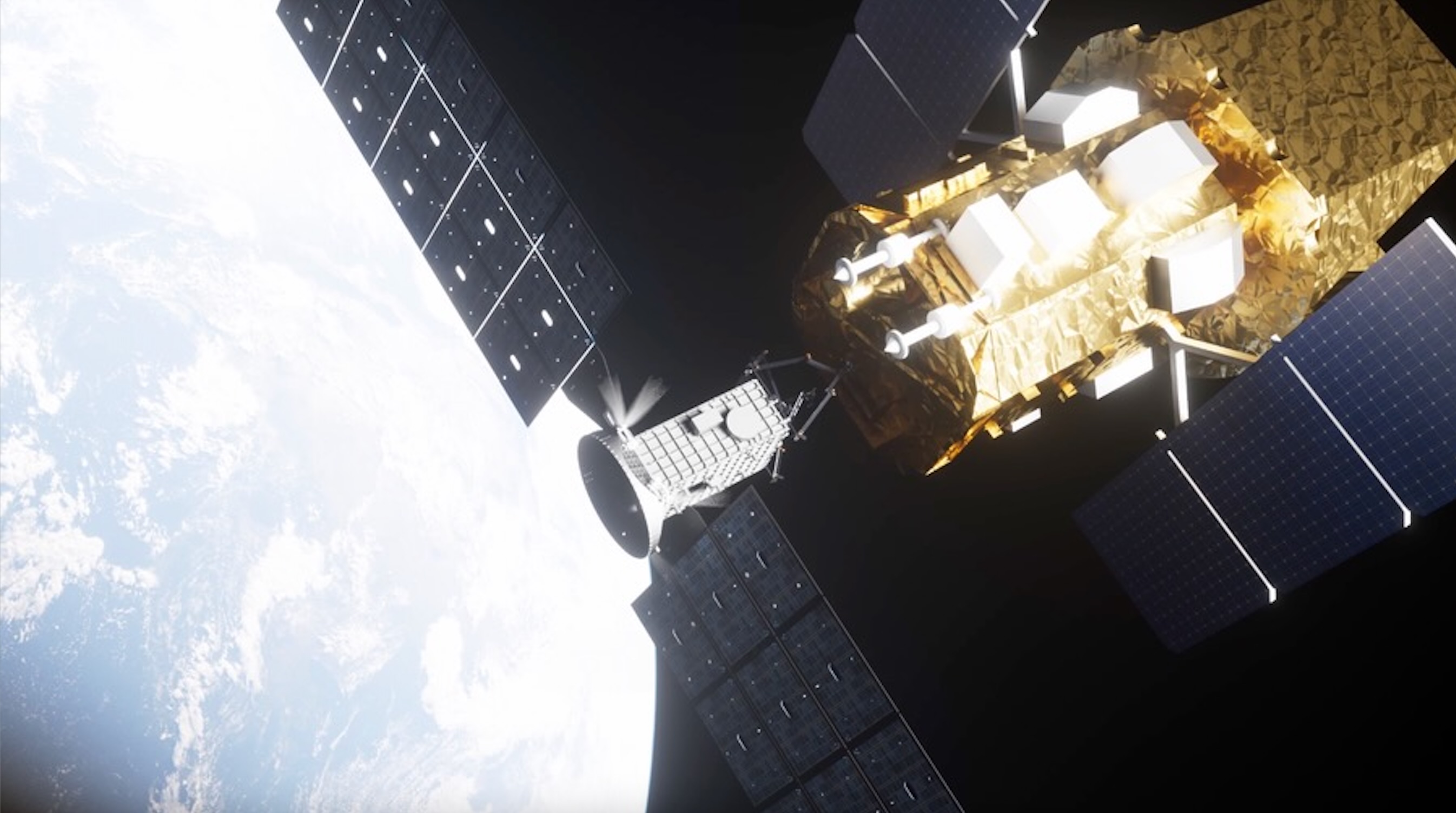
Artist's illustration of Katalyst Space Technologies' LINK spacecraft meeting up with NASA's Swift space telescope in orbit. This did not happen, however; LINK suffered issues after launch and was unable to pull of the rendezvous. (Image credit: NASA)
Timeline troubles
Ghonhee Lee is the CEO of Katalyst Space Technologies.
Speaking to CNN News Central on Aug. 24, Lee said: "You know, this is not the outcome that we wanted, but I think it's very important to recognize the unprecedented scale. This was an ambitious, high-risk, high-reward mission where we designed, built and launched a space robot within nine months."
Lee said that the timeline worked against the group. "I think if we had had 12 months even — just three more months — it would have made a tremendous difference," he told CNN's Kate Bolduan.
Swift is now coming back down to Earth, but it's unclear when and where.
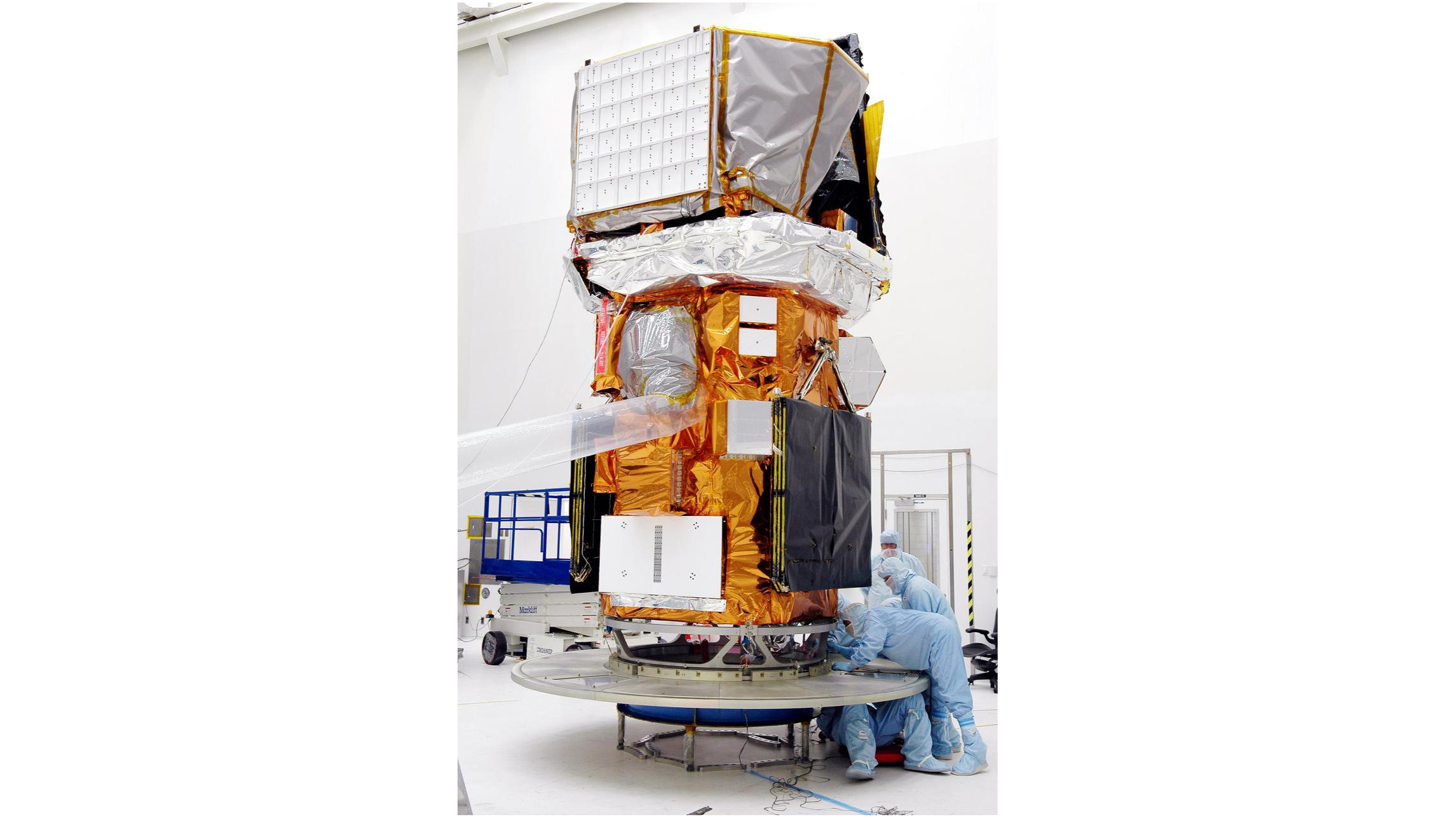
A pre-launch photo showing technicians working on NASA's Swift space telescope. (Image credit: NASA/GSFC)
Uncontrolled reentry
"Yes, Swift will have an uncontrolled reentry," said Alise Fisher, public affairs specialist in astrophysics within the Office of Communications at NASA Headquarters in Washington, D.C.
The spacecraft's specific timing for reentry will depend on a number of factors, Fisher told Space.com. "Swift is not likely to reenter sooner than October. NASA will share more information as reentry approaches, following established interagency procedures for such notifications."
NASA expects most of the Swift spacecraft to burn up as it travels through the atmosphere, Fisher said, "but some components are expected to survive reentry. The risk of harm coming to anyone on Earth is unlikely."
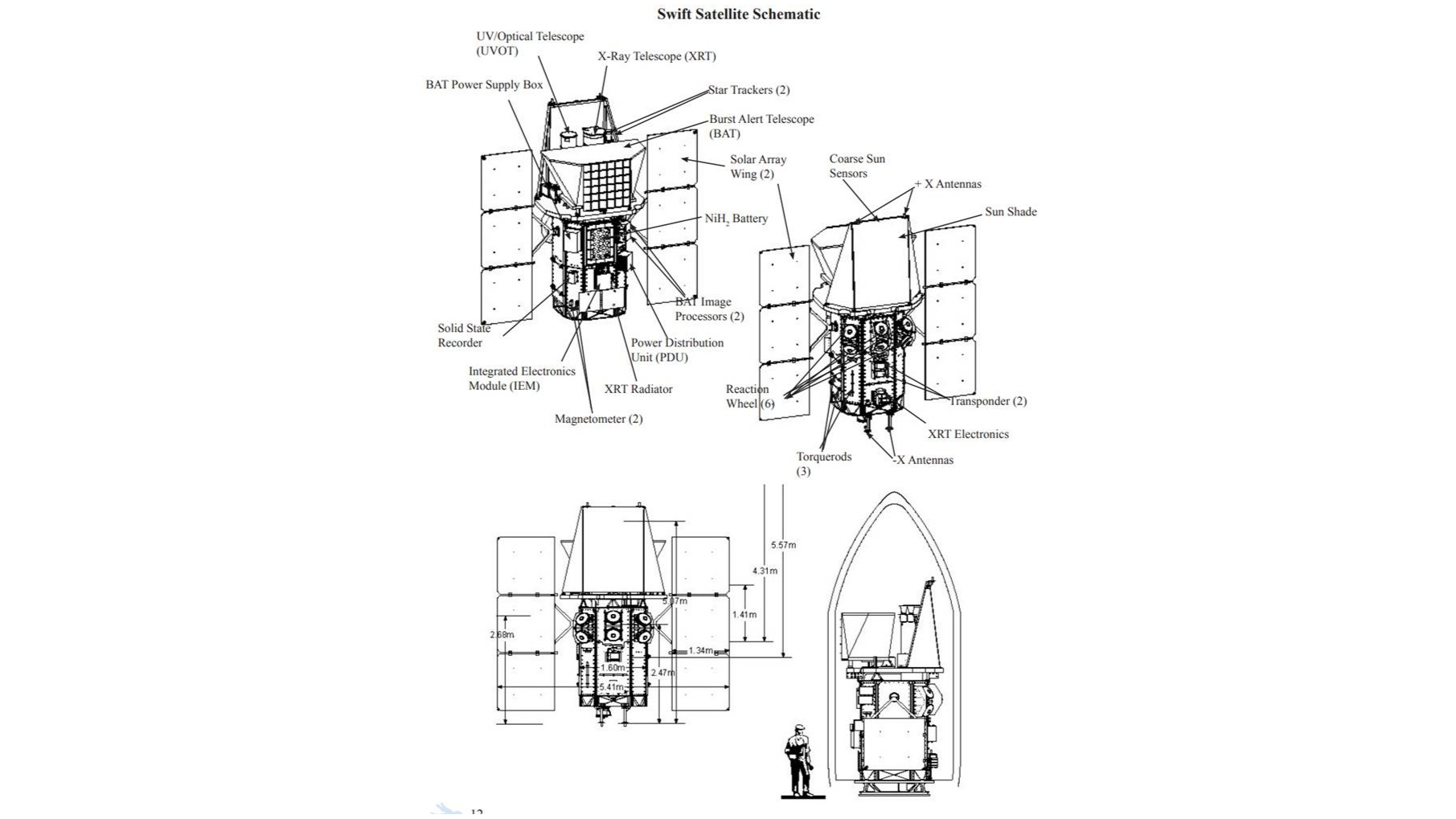
Diagram depicting the Swift observatory. (Image credit: NASA/GSFC)
Survivability analysis
Swift's dry mass is 613 kilograms (1,351 pounds). The spacecraft's science gear includes a Burst Alert Telescope, an Ultraviolet/Optical Telescope and an X-Ray Telescope.
So what might make it to Earth during Swift's speedy fall through the atmosphere?
The observatory's "dry mass and instruments are such that it will likely disintegrate sufficiently upon reentry to not pose a ground casualty hazard," said Darren McKnight, a senior technical fellow at LeoLabs, a company that keeps a persistent eye on what's going on in Earth orbit.
"However, it has both an X-ray telescope and optical telescope, so the internal workings of those devices might survive," McKnight told Space.com. He said that optical lenses, along with titanium tanks, are components that might make it to the ground.
"I am sure that they have done the analysis but have seen no public reporting on the survivability analysis," he said.
A sign of things to come?
Swift is unlikely to burn up entirely upon reentry, given its mass, said Ewan Wright, a Ph.D. student in interdisciplinary studies at the University of British Columbia in Vancouver and a junior fellow at the university's Outer Space Institute.
We also don't know where it will come down, he noted.
"It has an orbital inclination of 21 degrees, so could reenter anywhere in any latitude from 21 North to 21 South," Wright told Space.com. "The most likely outcome is that any surviving debris will land in the sea, but there is a chance it could impact a built-up area and cause a casualty."
Even if Swift's return to Earth is uneventful, "there are more and more uncontrolled reentries of satellites and rockets each year, and the chance that someone will be hit is growing," Wright said.
Thanks to the efforts of two astronauts, such a call is possible again using one of two Space-to-Ground antennas outside the International Space Station (ISS). The pair finished the replacement of a faulty dish assembly during a spacewalk on Tuesday (Aug. 25).
Anil Menon of NASA and Sophie Adenot of the European Space Agency (ESA), who previously removed a faulty dish during a spacewalk on Aug. 18, installed a spare in its place and moved the broken assembly from a temporary to more permanent storage location along the station's backbone truss.
As seen from a camera mounted on ESA astronaut Sophie Adenot's helmet, fellow Expedition 75 crew member Anil Menon of NASA works to mount a replacement Space-to-Ground antenna during a spacewalk outside of the International Space Station on Tuesday, Aug. 25, 2026. (Image credit: NASA)
With Menon positioned at the end of the Canadarm2 robotic arm and Adenot traversing by handrails to join him, the two Expedition 75 crewmates first retrieved a spare Space-to-Ground Antenna (SGANT) from an external stowage position. Menon and the spare dish were then maneuvered to the Z-1 truss, where it was mounted and connected to the station's power and data systems.
Menon and Adenot then retrieved the faulty antenna, which they had stowed on the Z-1 truss during the prior spacewalk. Menon (on the arm) moved it to external stowage platform-3 (ESP-3) on the starboard side of the truss.
The replacement work became necessary after the SGANT ceased being able to track NASA's data and relay satellites, rendering it unusable, beginning last November. A second antenna has been in use since, continuing the transmission of voice and critical data, but this repair re-established redundancy to the system.
"On behalf of CAPCOM and I, we're going to count down like a bolt: '3, 2, 1… You just saved the video dish, you just saved the video dish,'" sang astronaut Anne McClain from Mission Control at NASA's Johnson Space Center in Houston, parodying the The Buggles' 1979 hit "Video Killed the Radio Star."
"Oh my god, it is hard to top that," replied Menon, who could be heard laughing along with Adenot. "I want to thank the entire team on executing this complex, time-critical operation successfully."
Tuesday's spacewalk began at 8:27 a.m. EDT (1227 GMT) and was completed exactly 6.5 hours later, at 2:57 p.m. EDT (1857 GMT).
The extravehicular activity (EVA) was the 283rd in support of ISS assembly, maintenance and upgrades. It was Menon's third EVA, increasing his total spacewalking time to 19 hours and 20 minutes. It was the second time that Adenot worked in the vacuum of space, raising her time on EVA to 12 hours and 53 minutes after becoming the first woman and fifth citizen of France to perform a spacewalk.
This was the sixth outing from the International Space Station this year, the third EVA for Expedition 75 and the 98th spacewalk using U.S. extravehicular mobility unit (EMU) spacesuits at the station.
Two astronauts will do some repair work outside the International Space Station today (Aug. 25), and you can watch the action live.
NASA's Anil Menon and Sophie Adenot of the European Space Agency will conduct a spacewalk today (Aug. 25) to replace a space-to-ground-antenna. The extravehicular activity (EVA) is expected to start around 8:35 a.m. EDT (1235 GMT) and last 6.5 hours.
You can watch it live here at Space.com, courtesy of NASA, or directly via the space agency. Coverage will start at 7:00 a.m. EDT (1100 GMT).
NASA astronauts Jessica Meir (at right) and Anil Menon (facing away from camera) completed a 6.5-hour spacewalk to install solar array mounting hardware outside of the International Space Station on Thursday, Aug. 6, 2026. (Image credit: NASA)
This will be the third spacewalk for Menon and the second for Adenot, the first French woman ever to conduct an EVA. Her history-making first excursion occurred on Aug. 18, when she and Menon removed a failed space-to-ground antenna, a relay link that enables high-speed communications between the International Space Station (ISS) and Mission Control at Johnson Space Center in Houston.
The duo ran out of time before they could install a replacement antenna, however. They'll finish the job today, if all goes to plan.
"If time allows, Menon and Adenot also will attempt a get‑ahead task to replace a retroreflector on the forward port of the space station's Harmony module, which will improve navigation data for visiting spacecraft," NASA officials wrote in a spacewalk preview.
Adenot arrived at the ISS in February as part of SpaceX's Crew-12 mission, which also includes NASA astronauts Jack Hathaway and Jessica Meir and cosmonaut Andrey Fedyaev.
Menon came aboard on July 14, making the trip on a Russian Soyuz spacecraft along with cosmonauts Pyotr Dubrov and Anna Kikina. Menon performed his first-ever spacewalk on Aug. 6, with Meir.
Menon will be "crewmember 1" on today's spacewalk, and Adenot will be "crewmember 2." The EVA will be the 283rd in the history of the ISS, which has been continuously occupied by rotating astronaut crews since November 2000.