A new way to move around Earth's outer atmosphere could soon get a field test.
The Spanish company Kreios Space plans to launch into orbit the world's first satellite that uses scooped-up air to push it forward, the company announced on Tuesday (Aug. 4).
The technology Kreios Space has been developing is called air-breathing electric propulsion (ABEP). It relies on air sourced from Earth's atmosphere, which is then heated up, ionized and expelled to generate thrust.
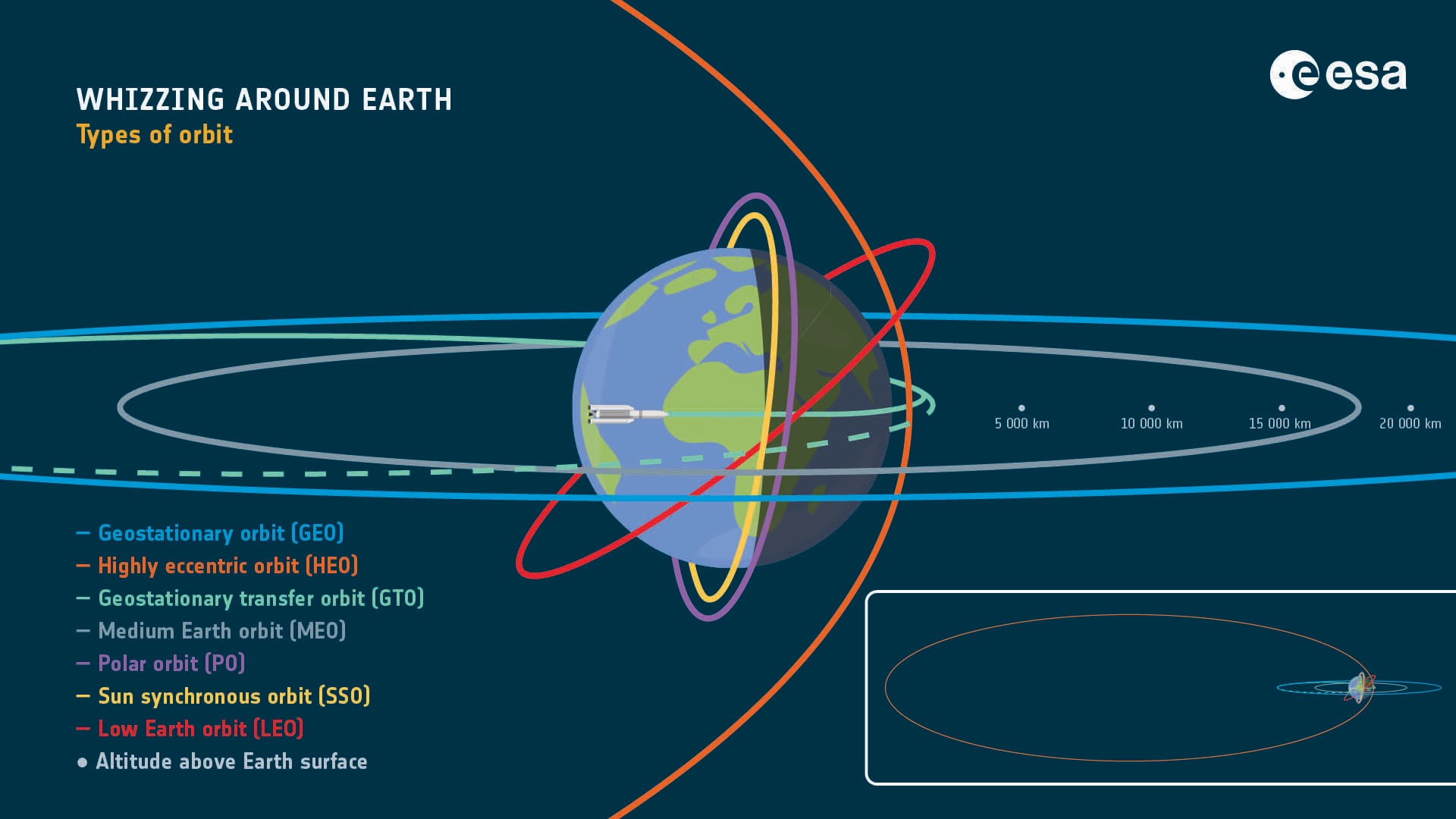
Diagram showing the different types of orbit around Earth. (Image credit: ESA)
This method will allow satellites in very low Earth orbit (VLEO) — the region from roughly 60 miles to 250 miles (100 to 400 kilometers) above our planet — to counteract atmospheric drag without the aid of liquid fuel.
"Kreios is building the satellites that make sustained operations in very low Earth orbit possible," Kreios Space CEO Adrián Senar said in the Aug. 4 announcement.
"By enabling satellites to fly lower, longer and more efficiently, we are enabling higher-resolution Earth observation, much better satellite communications, more responsive and accurate missions and a more sustainable orbital infrastructure," he continued.
Kreios Space chose Lithuanian-based Kongsberg NanoAvionics to provide the satellite bus that will carry the ABEP system into orbit for the test run.
"Kreios is tackling one of the most demanding operating environments in space, and this mission joins a very short list of European VLEO initiatives," Kongsberg NanoAvionics CEO Atle Wøllo said in the same statement.
"Our engineering team has worked closely with Kreios to configure the MP42 satellite bus to the mission's specific requirements and support the integration of Kreios' technology," he added.
Kreios Space did not give a target launch date for the mission in Tuesday's statement, saying that the company will launch it "at a time when interest in and development of VLEO technologies has accelerated." But the company's website identifies 2027 as a notional target for its first space mission.
A new, very low frontier
Satellites in low Earth orbit (LEO) — altitudes of roughly 100 miles to 1,200 miles (160 to 2,000 km) — generally don't need constant propulsion. Usually, a small boost from traditional thrusters here and there is enough to keep a LEO satellite on the right track. To power the thrusters, these satellites usually have some form of fuel built in.
VLEO works differently. It's low enough that there's still some atmosphere present, which generates drag on spacecraft. If you want a satellite to move around VLEO, it'll need to employ propulsion most or all of the time to counteract that drag. Any fuel that the satellite brings with it therefore won't last long.
So, if satellites are going to operate in VLEO, it would be very helpful to have a method of propulsion that doesn't require traditional fuel — a method like ABEP.
Satellites in VLEO have a few advantages over those operating in LEO, like sharper imagery thanks to the closer vantage point. One of the biggest advantages is that VLEO is much less crowded. There are thousands of satellites in LEO — most of them SpaceX's Starlink broadband spacecraft — and the number is growing all the time. But VLEO has plenty of room.
If ABEP technology works and companies start outfitting satellites with this new propulsion method, then we might start seeing satellites operate quite close to Earth, zooming through the atmosphere and using the air around it to stay on course.
Martin Halliwell is a Partner at NewSpace Capital, one of the world's first private equity firms devoted exclusively to growth-stage companies working in the space technology sector. He formerly served as Chief Technology Officer of SES, where he led global technology and R&D from 2011 to 2019. Halliwell contributed this article to Space.com's Expert Voices section.
There are now some 16,000 active satellites in orbit. Market intelligence firms like Novaspace say that up to 43,000 satellites will be built and launched over the coming decade. Others, such as Goldman Sachs, think as many as 70,000 new low-Earth orbit (LEO) satellites could be launched in the next five years alone. The exact number is less important than what these predictions reveal: that satellite constellations are getting bigger.
This is a good thing. Space is a crucial enabling force in the modern world, touching just about every part of ordinary life. But as these constellations grow, it will become increasingly difficult for human operators to run them. A network of a few satellites can be managed from the ground; a network of hundreds, or even thousands, cannot be managed in the same way. These satellites must share data, avoid interfering with one another, meet changes in customer demand, and deal with technical problems. Some decisions must be made in seconds, without waiting for instructions from Earth. This is why onboard processing, automation and artificial intelligence are becoming all-important. Satellites will need to sift through and analyze more information in orbit, then act within clear limits set by human operators.
In-orbit processing
One major use for AI will be processing data in orbit. At present, most satellite data is sent back to Earth before it is cleaned, sorted and analyzed. Earth-observation companies, for example, may collect huge amounts of imagery to track weather, crops, disasters, land use or emissions. They must then process all of it on the ground before they can give customers useful information. If satellites can do more of this work in orbit, they can send back only the data that matters. This would cut costs and save time. In defense, where speed can decide the outcome, it could help people act much faster. Onboard processing could also reduce reliance on ground systems, which may themselves be attacked or disrupted. Satellites remain vulnerable, but moving some analysis into orbit could make the wider system more resilient.
A rendering of one of SpaceX's planned "Starmind" AI satellites in orbit. (Image credit: SpaceX)
Moving capacity
Satellites must be able to spot patterns, respond to changes and adjust their plans in near real time. This makes them well suited to AI. One important use is managing network capacity. Demand for satellite bandwidth is always changing. It may rise over cities at busy times, around major events, in disaster zones, on aircraft and ships or during military operations. AI could track these changes and decide where a satellite’s beams should point, how much power each beam should use and when capacity should be moved elsewhere. This would help satellite networks send more capacity to places where it is needed most, instead of sending the same amount to the same places all the time. The result would be a more efficient use of the satellite’s limited power and available spectrum.
What if AI gets it wrong?
The barriers are not only technical. They are also legal and organizational. Most laws, contracts, insurance policies and operating rules were written for systems controlled by people. They assume that a named person makes each important decision. AI makes responsibility less clear. If an AI system points a beam at the wrong place, disrupts another service or causes damage, it may be difficult to decide who is at fault: the satellite operator, the manufacturer or the software company. Operators must also decide how much control they are willing to give to AI. Many are happy for AI to offer advice. Fewer are ready to let it change a network or move capacity without human approval. For this reason, adoption is likely to be gradual. Operators will need clear rules about which decisions AI can make by itself and which must still be approved by a person.
Spacecraft design and manufacturing
AI will affect more than the way satellites are operated. It could also help engineers design and build them more quickly. Engineers can use AI to write code, search technical documents, test ideas and suggest solutions to design problems. It could produce early versions of spacecraft structures, antennas, power systems, payloads or mission plans. Human engineers would still need to check, test and improve the work, but they would not always have to start from scratch. This could shorten development times, cut costs and allow smaller teams to do work that once required much larger organizations. AI could also help in factories by spotting faults, predicting delays and showing when equipment needs maintenance. It will not replace skilled engineers. Its main value will be in doing routine work quickly, so people can spend more time on difficult decisions, safety and the hardest technical problems.
Building trust
To unlock AI’s full value, the industry will need secure, affordable environments in which organizations can train and deploy models without losing control of information. These environments need strong cyber security, clear access rules and ways to keep each organization’s data separate. Some models may need training inside company or government networks so sensitive data never leaves. Technical safeguards will help, but trust matters, too. The industry will also need better standards, clearer legal responsibility and reliable testing. The technology itself is advancing quickly. The harder task is creating the rules, safeguards and confidence needed to use it. AI may soon be ready to run more of a satellite network. The question is how quickly the industry will be ready to let it.
The U.S. Federal Communications Commission (FCC) can single-handedly green-light massive spaceflight projects that could completely change the view of the night sky for the entire world. Despite the outcry these projects have caused, space law experts say there is very little other nations and the international community can do to thwart them if the FCC were to grant them licenses.
On July 10, the FCC approved an application by California-based Reflect Orbital to launch a 59-by-59-foot (18-by-18 meters) space mirror to test how to reflect sunlight onto solar farms on Earth after dusk. The decision has sparked outcry among astronomers and environmentalists who are concerned about the impact on global light pollution levels that Reflect Orbital's plans might have.
Opponents see the FCC's approval, despite hundreds of objections filed in response to the application, as an indication that the agency might eventually grant Reflect Orbital a license to fly an entire constellation of 50,000 such sun-reflecting mirrors. On top of Reflect Orbital's plans, companies including SpaceX, Blue Origin and Starcloud are awaiting the FCC's decisions on respective applications to deploy their own massive fleets of orbiting data centers and internet-beaming satellites. If all those projects come to fruition, the view of the night sky could change beyond recognition all over the world.
"The technology is outpacing the regulatory environment."
The United Nations' Outer Space Treaty conceived in the late 1960s lays down the international framework for the use and exploration of outer space. The document states that approvals for satellite projects are the domain of the nation in which those satellites are registered.
"The U.N. Treaty for Uses of Outer Space very well specifies that how many satellites are shot into space and how they are registered is a prerogative of the country in which they are registered," a source familiar with the operations of the United Nations Office of Outer Space Affairs (UNOOSA), who didn't wish to be named, told Space.com.
The states from which they launch, however, are responsible for any damage the satellites registered under their flags cause to other countries. But Ruskin Hartley, the CEO and Executive Director of the advocacy group DarkSky International, told Space.com that this liability provision only covers physical damage such as satellites colliding in space or spacecraft crashing down on Earth and damaging property.
"It hasn't been tested at all but most people don't think this damage extends to optical interference," Hartley said. "It would have to be physical damage. If a satellite reflects sunlight down and damages someone's observatory, that probably doesn't count as damage under the Outer Space Treaty."
In its Article I, the Outer Space Treaty states that "the exploration and use of outer space, including the moon and other celestial bodies, shall be carried out for the benefit and in the interests of all countries." But what exactly that means and what could be done if there is no consensus about those benefits is not clear at all.
The anonymous source told Space.com that UNOOSA and the UN-wide Committee on the Peaceful Uses of Outer Space (COPUOS) may discuss the issue, but despite the global consequences, are unlikely to come up with a mechanism to stop the corporations from doing what they want if the FCC backs them.
"These UN institutions were all started in the last century and are very slow," the source said. "They require unanimous consensus to pass anything and that obviously hardly ever happens. So nothing gets passed. By the time UN COPUOS and UNOOSA are done discussing anything, SpaceX will have launched another thousands satellites."
A rendering of Reflect Orbital's proposed constellation of mirror satellites. (Image credit: Reflect Orbital)
The European state of Slovakia in cooperation with the International Astronomical Union (IAU), in fact, submitted a paper to UN COPUOS in June calling for a "general prohibition on the use of space mirrors" or the development of "strong oversight mechanisms."
Aaron Boley, an astronomer at the University of British Columbia, who has been involved with the initiative, admits that these efforts are not likely to progress fast enough.
"There is indeed a major challenge right now with single states being able to create large changes to the sky and the orbital environment," Boley told Space.com in an email. "At the U.N. COPUOS, there are important steps being taken. But these agreements can be slow to achieve."
Hartley added that the companies pushing for grandiose space projects are taking advantage of existing legal loopholes that are not being effectively closed.
"These entrepreneurs that are pursuing these projects, either in the U.S. context as private entrepreneurs or in some instances in Europe and in China as government-level projects, clearly demonstrate that the regulatory environment and regulatory framework has significant gaps and holes in it," Hartley said. "Essentially, the technology is outpacing the regulatory environment."
Unilateral U.S. decisions
According to international space law and policy expert and former NASA legal council Robin J. Frank, this is not the first time the U.S. has pushed ahead with its agenda regardless of the concerns of the international community.
"This is not the first time the FCC has started down the route of unilateral decisions," Frank told Space.com. "Recently, for example, the FCC has approved direct-to-cell communication systems, which connect from a satellite directly to your phone, to use parts of the radio frequency spectrum that have not been authorized for that use by the International Communications Union. Their argument is that they are giving the U.S. industry a leg up."
The U.S., responsible for roughly 25 percent of the global GDP, has historically been reluctant to agree to binding international mechanisms that could restrict its actions, Frank added. Other major global powers, such as China or Russia tend to have a similar attitude, she said.
Currently, the U.S. is not even a party to the Paris Agreement, an international treaty that binds nations to work toward reducing their greenhouse gas emissions in order to curb global warming.
Frank added that individual nations could, for example, take action against constellations of orbiting mirrors by banning them from beaming light onto their territory at a threat of hefty fines. That however, is still not going to stop the development and mitigate the overall light pollution these satellites cause as they inadvertently reflect light as they zoom around Earth.
DarkSky International previously sued the FCC at the District Court of Columbia, challenging its decision to grant SpaceX a license to launch tens of thousands of satellites without conducting an environmental review. The court eventually rejected the non-profit's arguments, but Hartley said the advocacy group would consider filing another lawsuit if the FCC were to green-light the full Reflect Orbital constellation of 50,000 space mirrors or SpaceX's million orbiting data centers.
Despite the massive growth in the past decade, the satellite industry is exempt from the U.S. National Environmental Policy Act, meaning neither the FCC nor the satellite companies are obliged to prove their technologies will not be detrimental to the environment. That exclusion was put in place in the 1980s when satellite launches were few and far between. Many argue it's more than a high time to do away with it.
"It's a regulatory failure," Hartley said. "The ultimate fix is probably a legislative fix, or an administration that directs them to act differently. But this administration is not going to do that."
One hour of satellites over the northern Atacama Desert in Chile in October 2025. (Image credit: F. Kamphues, ESO/M. Kornmesser)
"This is an issue that's going to affect the quality of life for everybody on Earth."
A recent study by astronomers from the European Southern Observatory found that the brightness of the night sky would rise by up to 300 percent if all the currently planned constellations were to get deployed. That, the astronomers say, would be an end to astronomy as we know it.
Other experts pointed out that the need to have access to constant sunshine would force all orbital data center operators into a single narrow region of space, creating a bright "Saturn's ring" of satellites around the planet.
In its justification for granting the Reflect Orbital test flight license, the FCC stated that arguments about light pollution are outside its merit to judge. No other U.S. government agency, however, currently has a say over granting licenses to satellite companies.
On top of that, the air pollution from large quantities of re-entering satellites and the rockets that launch them risks damaging the ozone layer and altering the thermal balance of Earth's atmosphere, according to ongoing research. Greenhouse gas emissions released during launch and the manufacturing of the satellites may offset the advantages of putting data centers to space, extolled by the companies behind those plans.
"The industrialization of space is going to impact carbon in the atmosphere, through the launch phases of all these rockets, and it's very clear that the deorbit of these satellites is likely to change the composition of the atmosphere," Hartley said.
"This is more than just a niche issue for astronomers. This is an issue that's going to affect the quality of life for everybody on Earth."
The outgoing head of the U.S. Space Force has some stark words for his international partners.
Speaking at the 2026 Global Air and Space Chiefs Conference on July 15, in what was his last public speech as Chief of Space Operations (CSO), Gen. Chance Saltzman told attendees that if an armed conflict ever reaches space, as military leaders have for years been predicting and planning for, no military or nation in the world will be spared.
"If a conflict extends into space, none of us will be able to avoid the war zone. Unlike a combat zone in the air, land or sea, we will not be able to steer clear," Saltzman said in his remarks at the conference, published by the Space Force. "Whether we want to be in the combat zone or not, orbital mechanics will put all of our space capabilities into the space war zone."
Saltzman's warning touches upon the fact that there isn't an unlimited amount of space in Earth orbit; in fact there are some crowded orbital inclinations that contain thousands of spacecraft. When a satellite or other spacecraft breaks up in one of these orbits, it can create hazards for many other spacecraft — even crewed ones.
When Russia destroyed a satellite with a missile in a 2022 test, it left a dangerous debris field in orbit that persists today. The ISS has had to dodge it multiple times.
If a conflict broke out or extended to space, and that conflict involved the destruction of even just one satellite, it could potentially create a runaway effect that leaves parts of Earth's orbit unusable.
But despite the grave nature of his warning, Saltzman stressed that ultimately the shared nature of space means that all spacefaring nations should aim toward cooperation.
"We will share the consequences; therefore, we should share the responsibility for a safe, secure and stable space domain," Saltzman said, adding later in the speech that "these widespread consequences of conflict in space should make deterrence a goal for all of us."
Saltzman has stressed the need for international cooperation in prior speeches. The outgoing CSO called defending the peaceful use of space "the ultimate team sport" when introducing Space Force's International Partnership Strategy in 2025. "The domain is too big, too complex, too dynamic, for a single nation to secure alone," Saltzman said.
While head of the U.S. military's newest branch, Saltzman has seen the Space Force evolve into a fully "combat-credible" force, to use the outgoing CSO's own words.
Saltzman touted the Space Force's contributions to recent U.S. military operations earlier this year at the Space Foundation's 41st Space Symposium in Colorado Springs. "We aren't just talking about theories or plans anymore. We're talking about real operational combat, space effects and the Guardians who deliver them," Saltzman told attendees.
Saltzman is set to retire in August 2026 after serving as the Space Force's second Chief of Space Operations since 2022. President Donald Trump has nominated a replacement, Lt. Gen. Douglas A. Schiess, to serve as Saltzman's successor. Schiess has served as Deputy Chief of Space Operations for Operations since November 2025.
During a recent confirmation hearing, Schiess defended the Space Force's $71 billion budget request, stating the funds are needed to deter China's development of military space capabilities. "The 71.1 billion dollars that the president has asked for is exactly what we need," Schiess said, according to Space News.
The U.S. Space Force is adding three dozen spacecraft to its growing constellation designed to detect and track incoming missiles from orbit. The Space Development Agency (SDA) announced the agreements, worth a combined $1.75 billion, on July 14, naming L3Harris Technologies and Sierra Space as the recipients.
Each company will provide 18 Accelerated Missile Defense Tranche 3 (AMDT3) spacecraft, for a total of 36 satellites that will grow the SDA Proliferated Warfighter Space Architecture's Tranche 3 Tracking Layer constellation, part of the Trump Administration's Golden Dome initiative. All 36 are expected to be ready for launch by the end of 2028, according to an SDA statement.
SDA's contracts with each company differ slightly. One calls for "18 missile warning and missile tracking variant space vehicles" from Sierra Space, while the other requests "18 missile defense variant space vehicles" from L3Harris, all equipped with infrared sensors to add to the constellation's global network.
L3Harris will receive up to $955 million for its 18 satellites, which the Space Force describes as "Hypersonic and Ballistic Tracking Space Sensor-like" (HBTSS) spacecraft. Sierra Space's agreement has the potential to reach $798 million for its 18-satellite contribution. Altogether, the 36 spacecraft will be distributed across four orbital planes as part of a hybrid missile-defense architecture designed to provide "global stereo coverage" of next-generation missile threats.
The Tracking Layer uses infrared imaging in low Earth orbit to detect and track missiles, and it transfers that data in real time through a low-latency communications network to military forces on the ground. According to the agency, the new satellites will increase the constellation's coverage and integrate into the spacecraft of SDA's first three Tranches.
“AMDT3 expands upon SDA’s previous and current Tracking Layer generations — Tranches 1, 2 and 3," said SDA Director G.P. Sandhoo, "marking another milestone in delivering a resilient, global missile warning, missile tracking, and missile defense capability.”
Sierra Space will base its satellites on the Horizon vehicle, from the company's Eclipse satellite series, which it also used in the design of the spacecraft it provided for the Tranche 2 Tracking Layer program, according to a Sierra Space release.
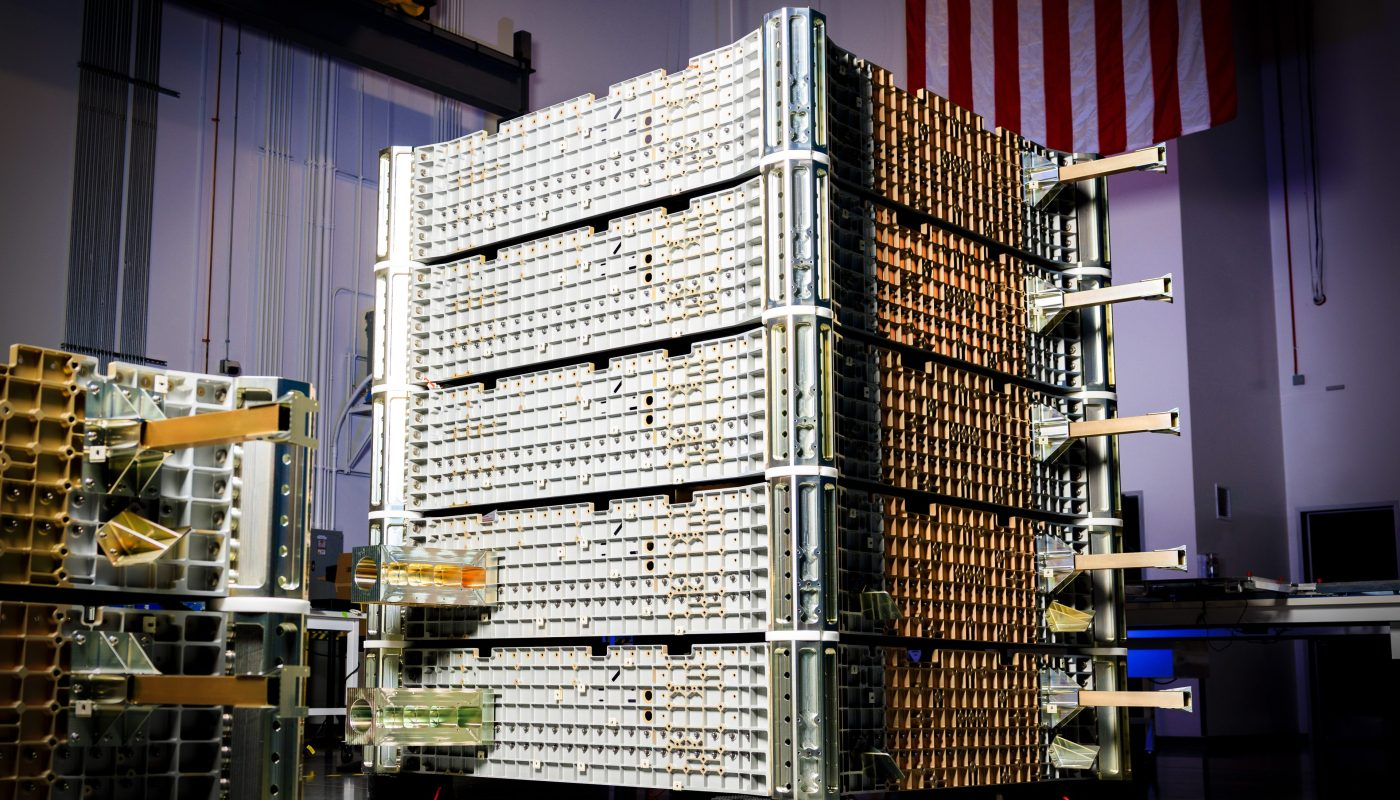
Stack of Satellites from Sierra Space. (Image credit: Sierra Space)
L3Harris plans to build on the success of the HBTSS satellites the company developed for the Military Defense Agency, according to an L3Harris release. The company "has more than 70 missile tracking and defense satellites on order, including five on orbit, between MDA’s HBTSS program and SDA’s Tracking Layer across Tranche 0, 1, 2 and 3," the company said.
The 36 satellites from L3Harris and Sierra Space are in addition to the 72 Tranche 3 Tracking Layer spacecraft SDA ordered in December 2025, via contracts worth $3.5 billion. L3Harris was included in those agreements as well, along with Lockheed Martin, Rocket Lab and Northrop Grumman. In total, the two rounds of awards bring the Tranche 3 constellation to a planned 108 satellites, worth about $5.25 billion. If all goes to plan, all of them will be available to launch by the end of 2029.
The newly contracted satellites from L3Harris and Sierra Space could begin heading to space sooner than that, however. SDA describes the new contracts as "accelerated," though a launch timeline has not been established to the overall group. Once in orbit, the Space Force will assume responsibility for the satellites' operation and integration "in support of joint force operations and delivering warfighting capabilities," the SDA statement said.
A bright "Saturn's ring" of satellites could circle the night sky if plans to launch a million data center spacecraft and tens of thousands of space mirrors come to pass. This ring, traversing the sky for hours after dusk and before dawn, would outshine every star and planet, and be visible from every spot on Earth.
Hugh Lewis, a professor of astronautics at the University of Birmingham in, the U.K., told Space.com that the only way to accommodate the high number of data center constellations that have been proposed is to stack them above another in orbit above the boundary between day and night, creating an artificial "Saturn's Ring" of satellites around the planet. That ring would show in the sky as a luminous band much brighter than any star or planet and even the full moon.
"If you were to look up at night, they would be all in one plane, really close together, going in the same direction," said Lewis. "The impact on the night sky would be absolutely catastrophic."
The next time you're away from urban light pollution, spend some time outdoors after dark and enjoy the view of the Milky Way and the constellations that have inspired awe since humankind woke to consciousness. Chances are those views are not here to stay forever.
Such a notion would have seemed like science fiction only a few years ago, but since the orbital data center frenzy kicked off last year, the once-fanciful prospect has become a distinct possibility.
On top of those projects, California-based Reflect Orbital wants to launch 50,000 orbiting mirrors into space to reflect sunlight to solar power plants on Earth after dusk. Reflect Orbital received its license from the Federal Communications Commission (FCC) on Friday, July 10, to fly the first of these mirrors — a 60 by 60 feet (18 by 18 meter) demonstration satellite named Eärendil-1, which is expected to launch by the end of this year.
A rendering of Reflect Orbital's proposed constellation of mirror satellites. (Image credit: Reflect Orbital)
Lewis explained that all these data centers and mirrors would have to orbit Earth in the same orbital plane to have access to constant sunshine. This orbital plane follows the terminator line — the boundary between day and night — and takes the satellites over the planet's north and south poles.
"Orbital data centers and Reflect Orbital all tend to rely upon what these operators call 24 hours of sunlight in space," Lewis said. "To have that, you have to be in a particular orbit, which follows the dawn-dusk line. It's not like the Starlink megaconstellation, which is distributed around the Earth."
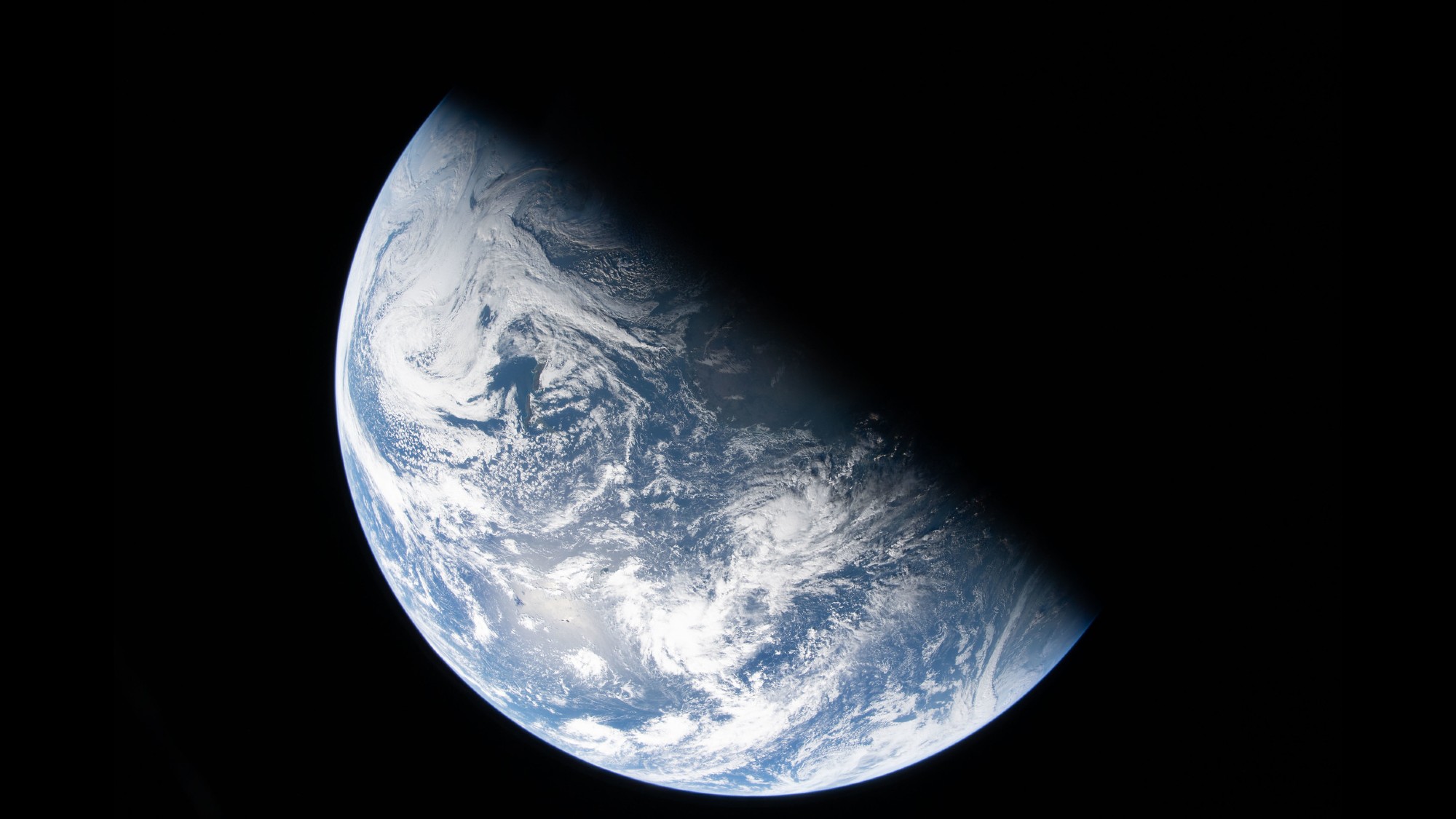
A view of Earth taken by an Artemis II astronaut from one of the Orion spacecraft's four windows after completing the mission's translunar injection burn on April 2, 2026. (Image credit: NASA)
Samantha Lawler, an astronomer at University of Regina in the Canadian province of Saskatchewan, agrees with Lewis. Lawler and her colleagues used computer modelling to visualize the impact of several of the proposed data center fleets including SpaceX's Starmind, Blue Origin's Project Sunrise and the Stampede constellation proposed by Cowboy Space.
In those visualizations, satellites visible from the planet's surface not just outshine the visible stars, they also outnumber them. Lawler explained that as Earth turns under the terminator orbit, the Saturn's ring of satellites would move across the sky twice a day — in the early evening hours between 6 and 8 p.m. and just before dawn.
"[The ring] would pass overhead at the same time every night," Lawler said. "That means its effect would be worse during winter time than the summer time."
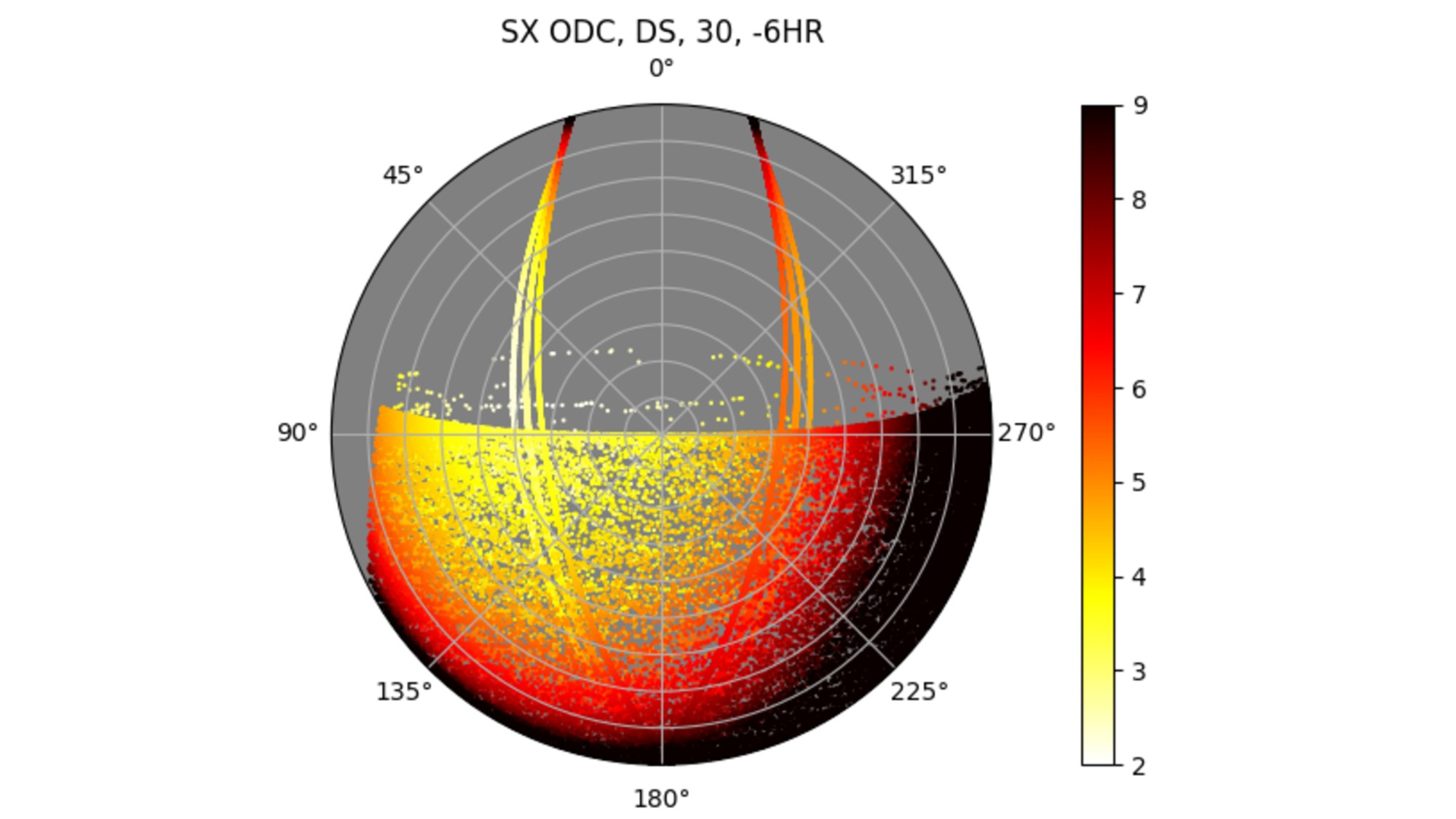
A visualization of the the brightness (measured in magnitude) of SpaceX's planned orbital data center constellation as it might appear in the night sky based on publicly available data. The researchers caution the work has not yet been peer-reviewed and doesn't reflect precise technical specifications of the satellites. (Image credit: Boley, Lawler, & Rein)
Lawler cautions that the visualizations are based on publicly available data and may not reflect the exact technical specifications of the satellites involved. The work has also not yet been peer-reviewed.
However, Lawler added that the scattered light from that ring would continue brightening the sky for up to two hours after it would sink below the horizon, just like the sun keeps illuminating the firmament after it sets.
"It would make our taxpayer-funded telescope time much less effective," Lawler said. "We could do a lot less science for the same cost, and many science cases, including the search for dangerous near Earth asteroids, would be seriously compromised."
There would be no escape from the view of the ring anywhere in the world.
The modelling shows that some of these constellations — Blue Origin's Project Sunrise in particular — would fly their satellites in an additional orbital inclination that would create the shape of X on top of the main "Saturn's ring."
"If you were close to the equator, you would virtually have this X shape of crawling satellites come up in the sky early in the morning and after sunset," said Lawler. Further up north, you would see this as two separate bands. One band would come up in the morning and the other would emerge as the sun sets."
The actual brightness of this "Saturn's ring" would depend on the exact number of the satellites in it. But researchers warn that as each Reflect Orbital's space mirror is bound to be at least as bright as Venus — the brightest object in the sky after the full moon — the luminosity of this band would be extreme.
"Humanity has already fundamentally altered the cosmos to the point where Earth is now an artificial 'ringed planet' choked by satellites and space debris," astronomer and dark sky advocate John Barentine, told Space.com. "But projects like Reflect Orbital will turn those mostly now invisible rings into bright reflective tracks. We aren't talking about a just scattered field of bright, moving dots anymore.
"Rather, this is a permanent, artificial 'ring of Saturn' effect cutting right through the most critical twilight observing windows for global astronomy."
On paper, many of these projects seem to make sense. Data centers on Earth take up precious land. They require enormous amounts of water for cooling, strain power grids and generate greenhouse gas emissions. In space, cooling and access to electrical power would be free.
Reflect Orbital wants to deliver sunlight to Earth after dark to increase the yield of solar plants and agricultural farms, provide free, sustainable lighting to construction sites and illuminate disaster zones in search of missing persons. The company maintains that it works to minimize disruption to astronomy and intends to cooperate with the scientific community.
"Every stage of our development is guided by data — testing, measuring, listening and adapting," the company's spokesperson said in an email. "We are actively commissioning independent, third-party research on the impacts of our technology."
The astronomers who spoke to Space.com, however, unanimously claim that the Reflect Orbital constellation and astronomy cannot coexist. "If we have mirrors in orbit, astronomy is over," Lawler said .
The American Astronomical Society (AAS), issued a statement criticizing the FCC's decision to grant Reflect Orbital a license to fly its test satellite.
"Reflect Orbital's proposed satellite, which would reflect sunlight back to Earth at night, carries the potential for significant harm to our members and the broader community of those who depend on a dark night sky," the AAS wrote. "This harm could include damage to sensitive research telescope equipment, potential flash-blinding of pilots and drivers, and — as Reflect Orbital stated in its own FCC filings — potential permanent eye damage to anyone looking through a mid-sized telescope."
In the past, astronomers praised SpaceX for attempts to dim the Starlink satellites by using dark paint and special visors to reduce reflectiveness. But Lawler said that many of these attempts have been undone by SpaceX's gradual increase of the satellites' size. While first generation Starlinks were about 570 pounds (260 kilograms) in mass, the latest generation weigh more than 4,400 pounds (2,000 kilograms) each.
"They did a lot of work to make the satellites darker, but then they also made them bigger and put them on lower orbits, and that has made them much, much brighter," Lawler said. "You can see Starlink satellites everywhere even with the naked eye. They are very visible and they are all over the sky."
In its Order and Justification of Reflect Orbital's mission license, the FCC stated that "impacts on optical astronomy fall outside [FCC's] review and authorization."
"The Commission's rules do not address the protection of optical astronomy, and thus we decline to interpret commenters' concerns in connection with the Commission's mandate," the FCC wrote.
The astronomers, however, point out that no other regulatory body in the U.S. and outside has a say in awarding satellite licenses to US companies and reviewing applications with respect to impacts on the night sky and the wider environment.
"The FCC is the only agency that's regulating American satellite launches," said Lawler. "But if the FCC says that this is not their problem, then whose problem is it?"
The AAS in its statement called on the FCC to "consider all of the impacts of the satellite's use case."
"In the absence of another licensing agency that could take these considerations into account, we believe that it is critical for the FCC to consider all of the impacts of the satellite's use case," the AAS wrote.
Robert Massey, the executive director of the U.K. Royal Astronautical Society added: " This is setting a bad precedent and opening up to the full deployment of the constellation that could get to the 50,000 satellites in a few years. It's really disappointing that the FCC authorized this."
SpaceX's Starlink satellites made over 355,000 collision avoidance maneuvers throughout the past year, with each satellite now dodging debris and other spacecraft on an almost weekly basis.
The numbers are based on disclosures made by SpaceX in its latest semiannual report to the Federal Communications Commission (FCC). According to the latest report, Starlink satellites performed an overall 207,152 avoidance maneuvers between December 2025 and May 2026, up nearly 60,000 from the 148,696 reported in the previous half year. That brings the yearly total to over 355,000, more than three times as many as the constellation performed in 2024. On average, each Starlink satellite performed more than 40 space dodging maneuvers per year between June 1, 2025 and May 31, 2026.
Experts fear the situation might soon get out of hand. "I think we're heading towards a situation where there will be a collision involving an operational satellite in the constellation," Hugh Lewis, a space sustainability expert and professor of astronautics at the University of Birmingham in the U.K., told Space.com. "And it will not be for the lack of trying to avoid those things. It will be in spite of all those maneuvers."
The increase coincides with the growth of the internet-beaming constellation and the overall number of satellites in space in the past five years. Starlink grew from about 6,000 satellites in 2024 to more than 10,000 as of June 2026. Over the same time period, the overall number of operational spacecraft in orbit rose from around 10,000 to about 16,000.
The SpaceX constellation orbits at altitudes between 298 miles (480 km) and 342 miles (550 kilometers) and uses an autonomous collision avoidance system that initiates a maneuver when the probability of a collision appears higher than 3 in 10 million. Lewis says that although SpaceX is "doing an excellent job" managing orbital traffic, the steep growth cannot continue without risks.
"The avoidance maneuvers reduce the probability of a collision to about one in a million, which is so small that it's negligible," Lewis said. "The problem is that if you make a million maneuvers and you have a residual probability of one in a million, you end up with an aggregate risk across your entire constellation that you can't get rid of."
Lewis points out that with the expected continued rise in avoidance maneuvers (SpaceX has applied to the FCC to increase the size of its constellation to 100,000 satellites), SpaceX will have made a million avoidance maneuvers over the lifetime of the Starlink constellation as early as June 2027. By 2030, the constellation may be making more than a million maneuvers every year. At that point, the one in a million risk of a collision may no longer be negligible at all.
NASA astronaut Don Pettit captured SpaceX Starlink satellites below the International Space Station on November 2024. (Image credit: NASA/Don Pettit)
Tommaso Sgobba, the Director of the International Association for the Advancement of Space Safety, told Space.com that the increase in collision avoidance maneuvers is a predictable certainty.
"The more satellites you pack into [an orbital] shell, the more pairs of satellites exist that could potentially cross paths," Sgobba wrote in an email. "Adding satellites does not just add risk one unit at a time, it multiplies the number of possible pairings. Double the satellites in a shell and you roughly quadruple the number of pairs that need to be watched."
Sgobba also said that the collision probabilities predicted are highly inaccurate as the effects of air drag, which change frequently with space weather, are currently impossible to predict.
He said that due to the vast uncertainties in satellite trajectory predictions "operators lack tools to tell a real threat from statistical confusion," adding that "satellites are frequently dodging ghosts, burning fuel and shortening their operational lives in the process."
SpaceX, being the largest constellation currently in orbit, takes the bulk of responsibilities for orbital maneuvering. Instead of communicating with the other operator to decide who will make the dodge, Starlink satellites automatically avoid other objects — both space debris fragments or operational satellites — whenever there is a conjunction alert.
Other ambitious constellations, such as Amazon LEO or China's Thousand Sails, or Qianfan, are currently being deployed, actively adding to the high number of satellites operating in low Earth orbit.
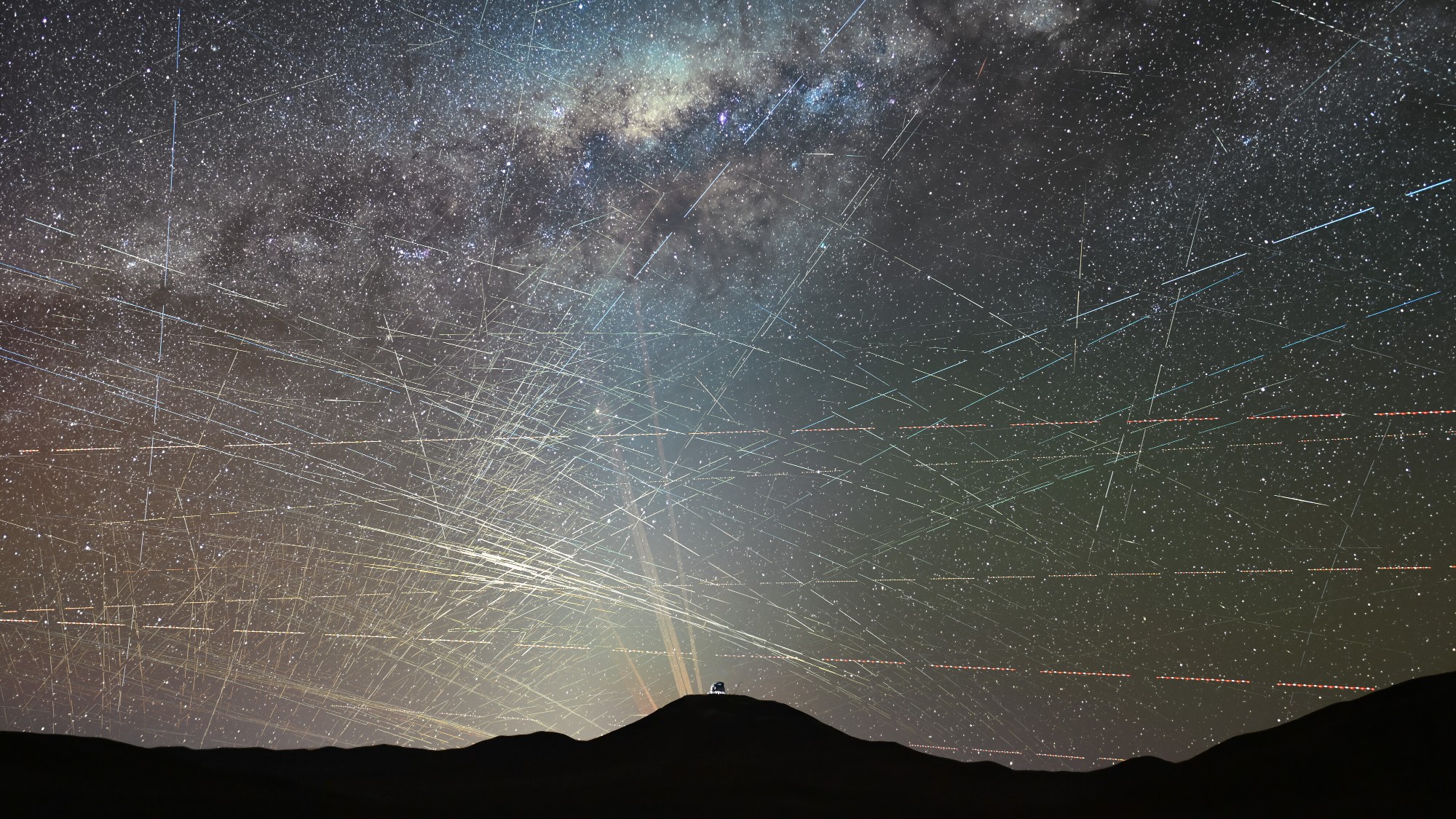
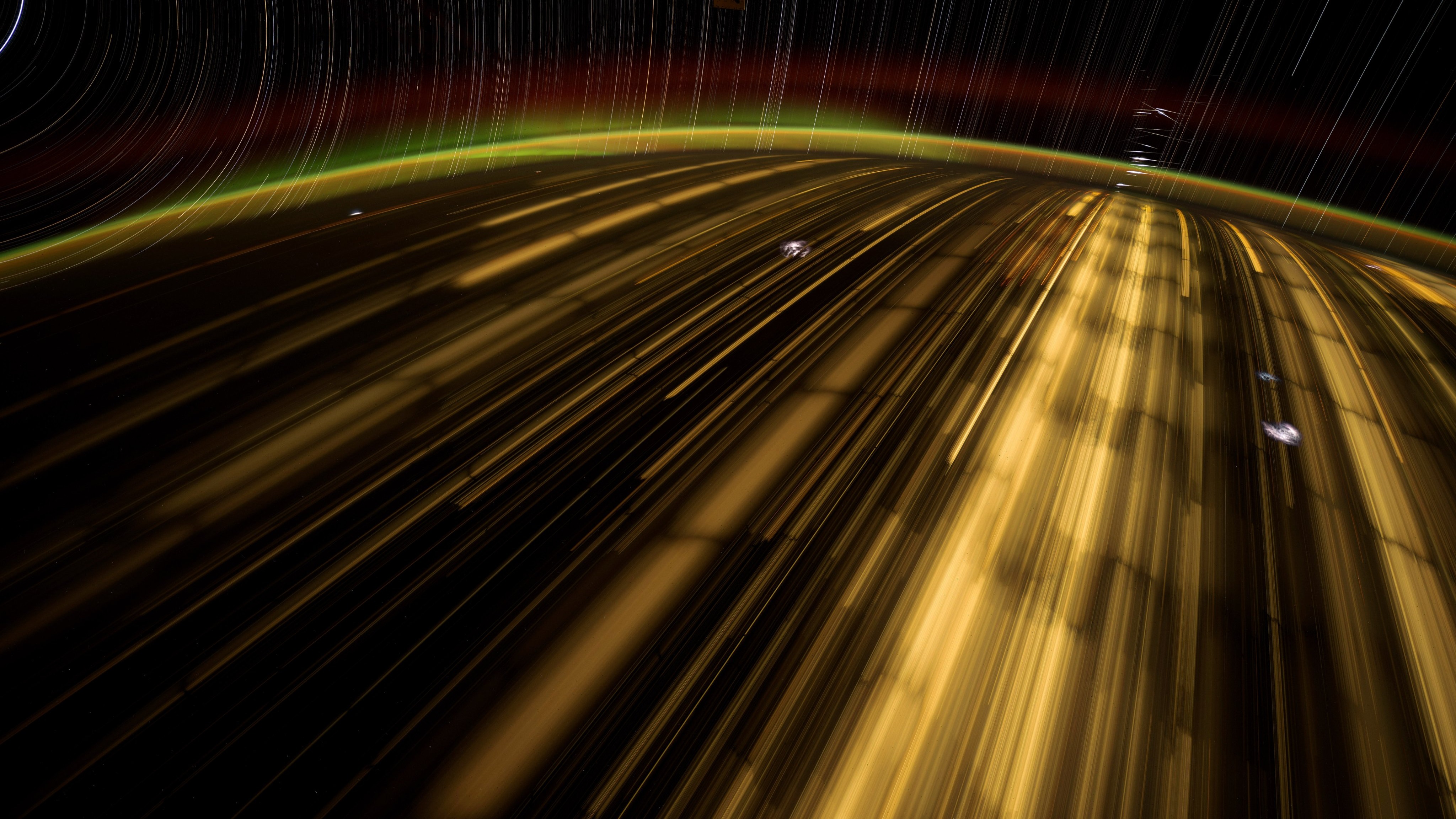
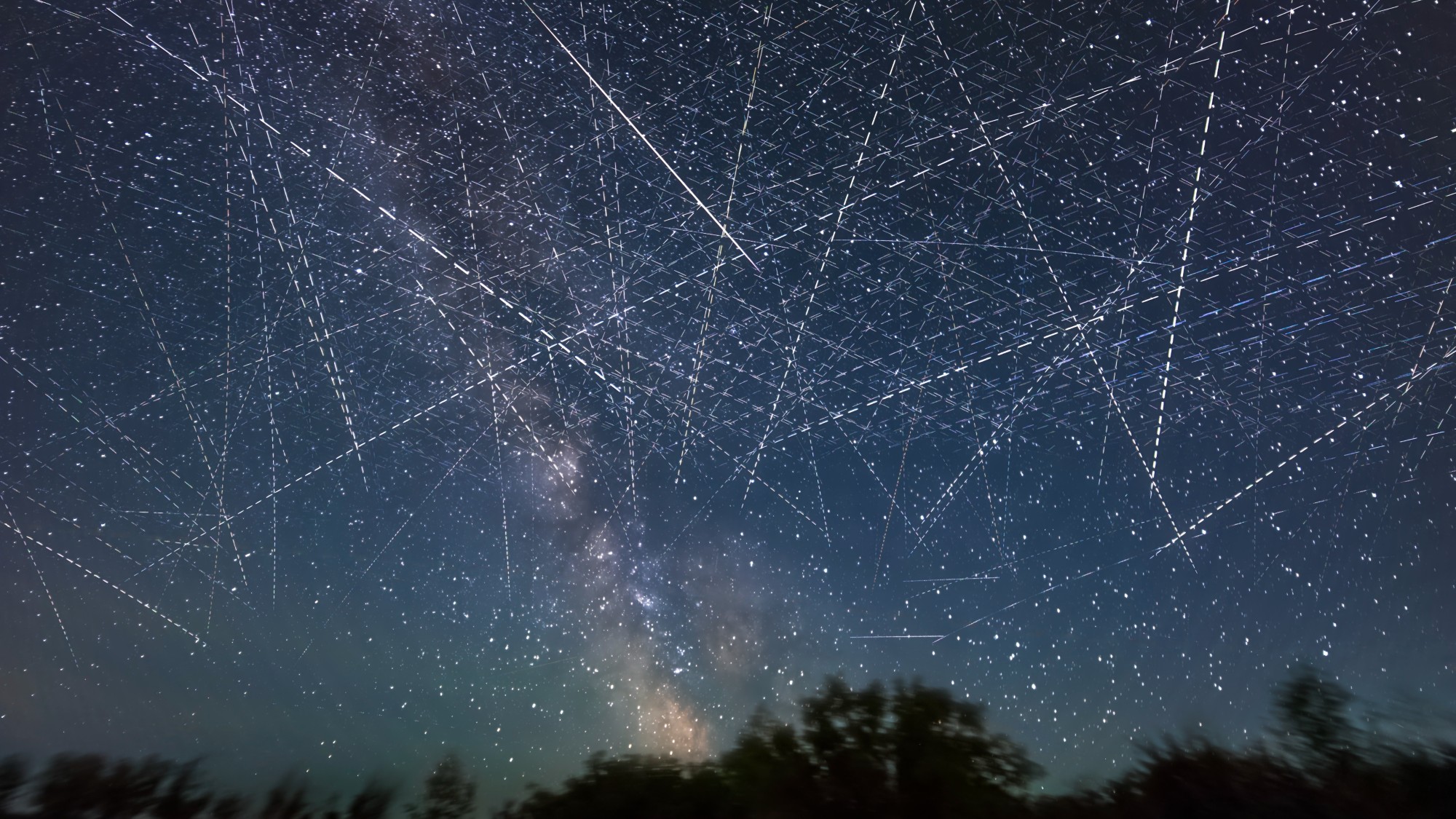
A 30-minute exposure of the night sky showing the high number of satellites in orbit as of June 2024. (Image credit: Alan Dyer/VWPics/Universal Images Group via Getty Images)
Lewis said that the only way to safely manage multiple constellations is to make sure their orbits do not intersect. That, however, is not the case based on available information. The Thousand Sails constellation, in particular, is expected to occupy similar regions as Starlink. Many of the recently announced orbital data center projects want to launch into particular orbital regions that are convenient for their operations and are therefore likely to overlap.
"The safe thing to do is to separate the constellations," Lewis said. "But then you are talking about orbital carrying capacity and the first mover benefit, because if I go into a particular altitude with my constellation, then nobody else can use it."
Sgobba calls for predicted numbers of collision avoidance maneuvers based on satellite numbers to be mandatorily disclosed to regulators before applications are granted.
"Right now, there is no clear requirement for a company to say, before launch, how many collision avoidance maneuvers a constellation of this size and density will need every year and whether the satellites carry enough fuel and automation to actually perform them all," Sgobba wrote.
"In short, the crowding of orbit is not an accident waiting to happen. It is a manageable, predictable engineering workload and the argument worth making publicly is that regulators should be treating it that way, by asking for these numbers up front rather than reacting to headlines about near misses after the fact."
Tiny pieces of space junk only 2 inches (5 centimeters) in size are cluttering a valuable orbital region where some of the costliest satellites reside, a new study has found.
Researchers from the University of Warwick in the U.K. found that the geostationary orbit — a region of space at the altitude of 22,000 miles (36,000 kilometers) — is full of dangerous, previously unseen bits of space junk that could destroy satellites.
The geostationary orbit is quite unique. Satellites at this altitude circle Earth in sync with the planet's rotation, appearing permanently suspended above a fixed spot on the equator. A single satellite in the geostationary ring has a constant view of a vast portion of the globe. This feature has been taken advantage of for decades for things like TV broadcasting, internet delivery, Earth observation and weather monitoring. But, as it appears, those satellites might not be safe up there at all.
"The debris in geosynchronous orbit is a potential minefield," Stuart Eves, the study’s co-author and space consultant at SJE Space, said in a statement. "No one in their right mind would enter a terrestrial minefield without a mine detector. Similarly, no one in their right mind should launch a satellite to GEO without an adequate debris survey."
The researchers uncovered the previously invisible debris by re-examining a dataset from an earlier space debris survey conducted by astronomers using the 8.3-foot (2.54-meter) Isaac Newton Telescope in La Palma, Canary Islands. They ran the data through new image processing algorithms to distinguish smaller and much fainter fragments than was previously possible in the distant geostationary orbit.
"The blind stacking technique is a very powerful method for improving the sensitivity limit of astronomical datasets," Ben Cooke, a research fellow at the University of Warwick's Center for Space Domain Awareness and co-author of the paper, said in the statement. "It involves testing many potential paths in an image sequence along which hidden targets might be moving and stacking the images to help bring those targets above the noise floor. This project shows a successful, real-world application of the method."
The researchers found 25 previously missed debris tracks in the images, 80% of which were caused by previously unknown objects.
The finding is concerning as space debris at such high altitudes behaves differently from that circling closer to Earth. The residual atmosphere at 22,000 miles is almost non-existent, meaning there is no air drag to force the orbital clutter spiral into the atmosphere and burn up.
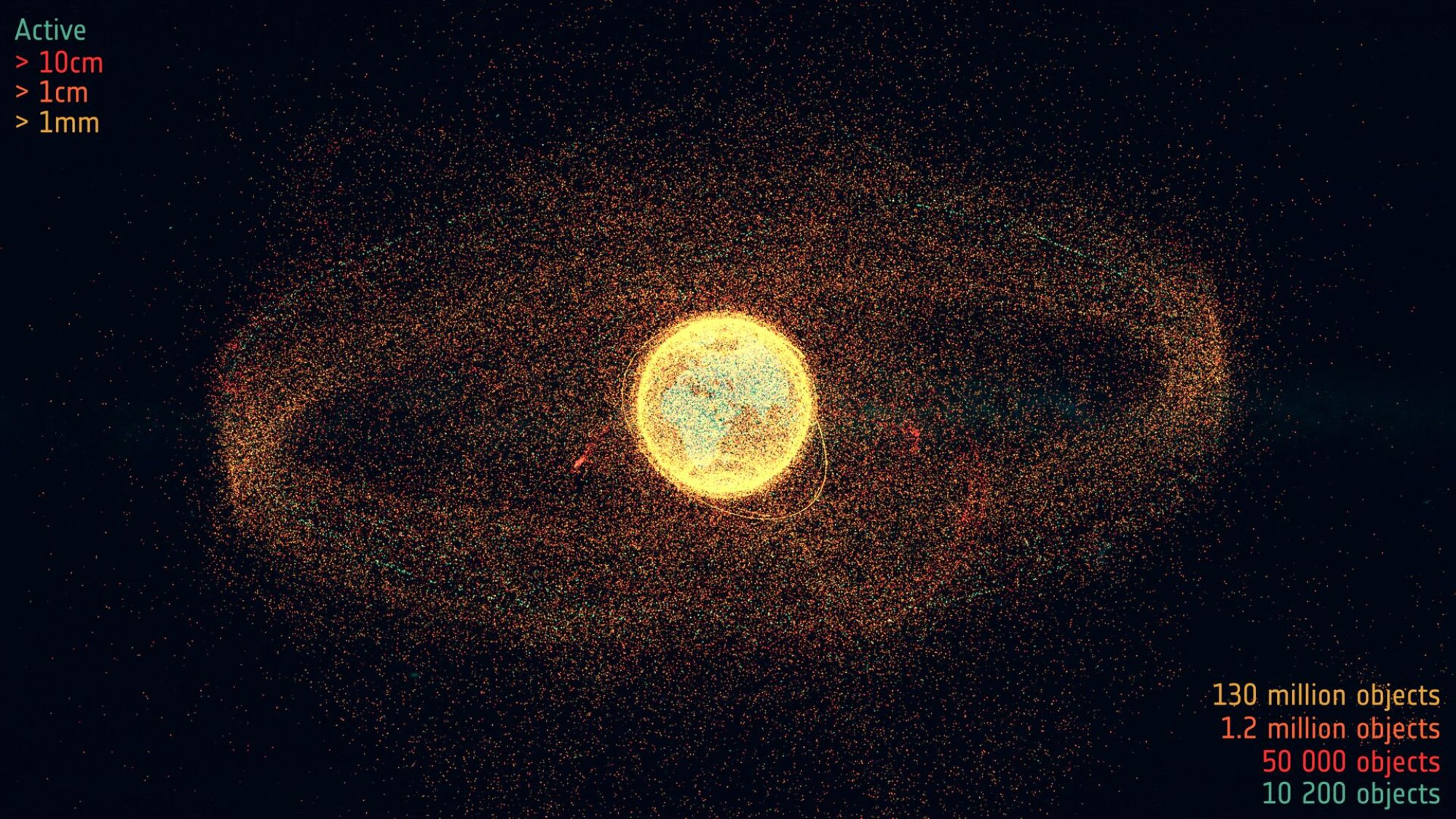
A still image from the short documentary film "Space Debris: Is it a Crisis?" on the state of space debris. (Image credit: ESA)
"Debris in the neighborhood of the geostationary belt is particularly concerning," James Blake, also a Warwick research fellow and the study’s co-author, said in the statement. "It's very far away, well above the Earth's atmosphere, so small objects tend to be incredibly faint and difficult to detect, and any debris that's generated will stick around indefinitely."
While orbits near Earth naturally clear up as the residual air at these altitudes slows the junk fragments down, at the higher altitude, the concentrations of such fragments will forever keep rising, making the region ever more tricky to operate in.
Moreover, the satellites that reside in this unique orbital region tend to be very large and expensive, designed for much longer missions than those making up megaconstellations in low Earth orbit. These satellites, frequently fitted with solar panels spanning 100 feet (30 meters) or more, can suffer substantial damage from a collision with the tiniest piece of junk.
"Pieces of space junk can be moving very quickly relative to one another, as much as several kilometers every second," Blake said. "The energies involved are really high, and even small debris can cause a lot of damage to very expensive satellites, so small things really matter."
The researchers are now looking to analyze additional images obtained by other telescopes around the world to get a fuller understanding of the scale of the debris contamination in the region.
The study was published in the Journal of Astronautical Sciences in June.
The first of perhaps tens of thousands of sunlight-directing space mirrors just got cleared for liftoff.
California-based startup Reflect Orbital just got a license from the U.S. Federal Communications Commission (FCC) to launch and operate its first demonstration satellite, a spacecraft that will unfurl a reflective surface that measures about 60 feet (18 meters) on a side.
That satellite, called Eärendil-1 is targeted to fly later this year. And it could be the first of many: Reflect Orbital aims to operate 50,000 or more such mirror-craft in low Earth orbit by 2035, beaming reflected sunlight down to a variety of customers on the surface.
"We're grateful to the FCC for recognizing the importance of testing novel technologies in space," Ben Nowack, Reflect Orbital's co-founder and CEO, said in an emailed statement on Friday (July 10).
"This license is the first step toward rigorously testing our technology's efficacy and the safeguards we have developed," he added. "We're excited to demonstrate how our technology works and to introduce transformative, clean technology the world urgently needs."
That technology could aid a variety of industries and endeavors, according to Reflect Orbital.
"Imagine the endless possibilities when sunlight is not limited by geography or time of day," the company's website reads. "A search-and-rescue team locates a missing person in minutes. A city has safer, evenly lit streets without the carbon emissions. Construction projects complete in half the time with teams able to work through the night safely."
The planned mirror constellation will also boost the productivity of solar arrays on Earth, allowing them to take more of the electricity-generating load from polluting options such as fossil fuels, according to the company.
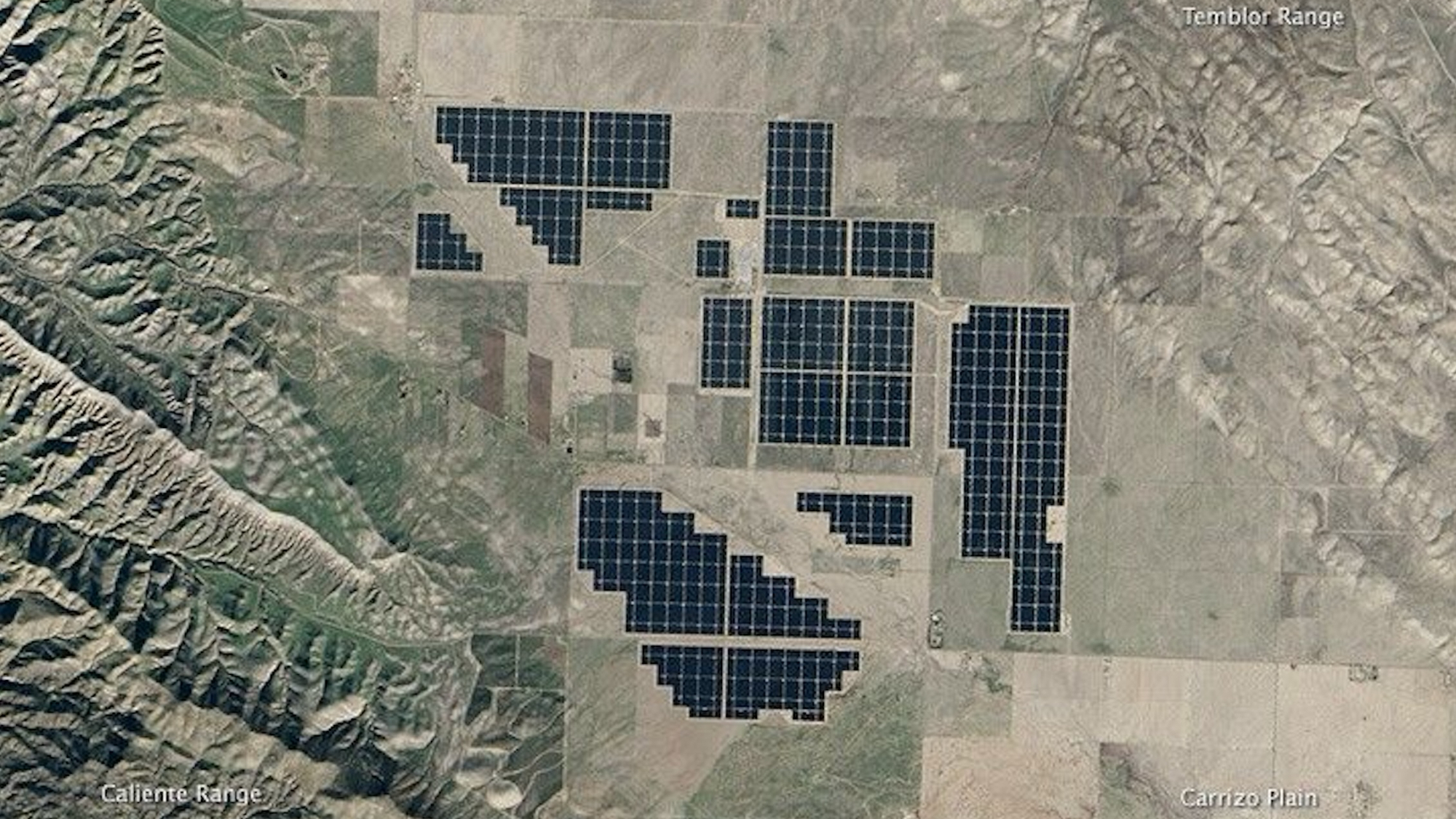
The Topaz Solar Farm in California, which covers 9.5 square miles (25.6 square kilometers), as seen from space. Reflect Orbital's planned space-mirror constellation could make such arrays more productive, according to the company. (Image credit: NASA Earth Observatory image by Jesse Allen, using Landsat data from the U.S. Geological Survey)
Not everybody is thrilled about Reflect Orbital's plans, however. Satellite megaconstellations in general are controversial. Some folks object to how they're changing the night sky, for example, and others worry that deorbiting huge numbers of satellites will pollute Earth's atmosphere with heavy metals.
There are some specific concerns about Reflect Orbital's plans as well — namely, that it will introduce a new type of light pollution for people and ecosystems to deal with.
"The beam reflected by these satellites is very intense, four times brighter than the full moon, and they will be flying multiple satellites in a formation," John Barentine, an astronomer at the Silverado Hills Observatory in Tucson, Arizona and a consultant at Dark Sky Consulting, previously told Space.com.
"That will have an effect on wildlife in the directly illuminated area, but also, through atmospheric scattering, on the surrounding areas as well," he added.
Reflect Orbital stresses that it will do its best to minimize such potential impacts.
"We design for safety in three ways: 1) the light is contained within the spot, 2) the light can be turned off quickly and at any time so that none of it reaches the Earth, and 3) we can intentionally avoid sensitive areas like research observatories or protected habitats," the company's website states.
"The light is not bright enough to start fires or harm eyes, even when viewed through a telescope, and cannot be concentrated past maximum natural sunlight irradiance," it adds.
Imagine you're on a hike in a remote mountain range. Your hyperactive dog catches the scent of a deer and, powered by his hunter's instinct, disappears in the forest. He has a GPS tracker in his collar that can send his coordinates via the cellular network. But where you are, there is no mobile coverage. You keep whistling and calling but to no avail: your dog is nowhere to be seen.
That exact scenario prompted technologist Jonathan Bensamoun to develop what he describes as the world's first satellite-connected wearable device for dogs. Bensamoun is the founder and CEO of Fi, which has been manufacturing dog trackers since 2017. He first conceived the idea to make GPS devices for dogs when he adopted a young German shepherd named Thor and wanted to make sure that his hired dog walker wasn't cutting corners when taking him out for walks.
But even though the company had quickly grown into a market leader, Bensamoun kept hearing customers complain about the device's usefulness. That's where SpaceX's Starlink satellites came in.
"The number one complaint from customers is either 'I live in an area where the cellular network is not really good' or 'I get really worried about my dog when it's away from the typical suburban area. I am worried when it escapes the yard and runs into the woods," Bensamoun told Space.com.
When Starlink began delivering connectivity directly to smartphones in 2024, Bensamoun knew a solution to the problem was on its way. And on July 8, the world's first satellite dog tracking service came online.
The device combines a GPS receiver, which determines the dog's position in real time, and a simple battery-powered modem that connects to T-Mobile's cellular network, which partners with Space's Starlink system. When the dog's position registers outside a pre-defined zone, the owner receives a message via a smartphone app.
When no cell tower is within reach, the device links with an overflying Starlink satellite to complete the task. The dog owner can also set a geo fence around the dog, an area within which the dog is allowed to move without triggering an alert. When the dog crosses that virtual boundary, for example, escapes from the backyard, the tracker sends a message to the owner.
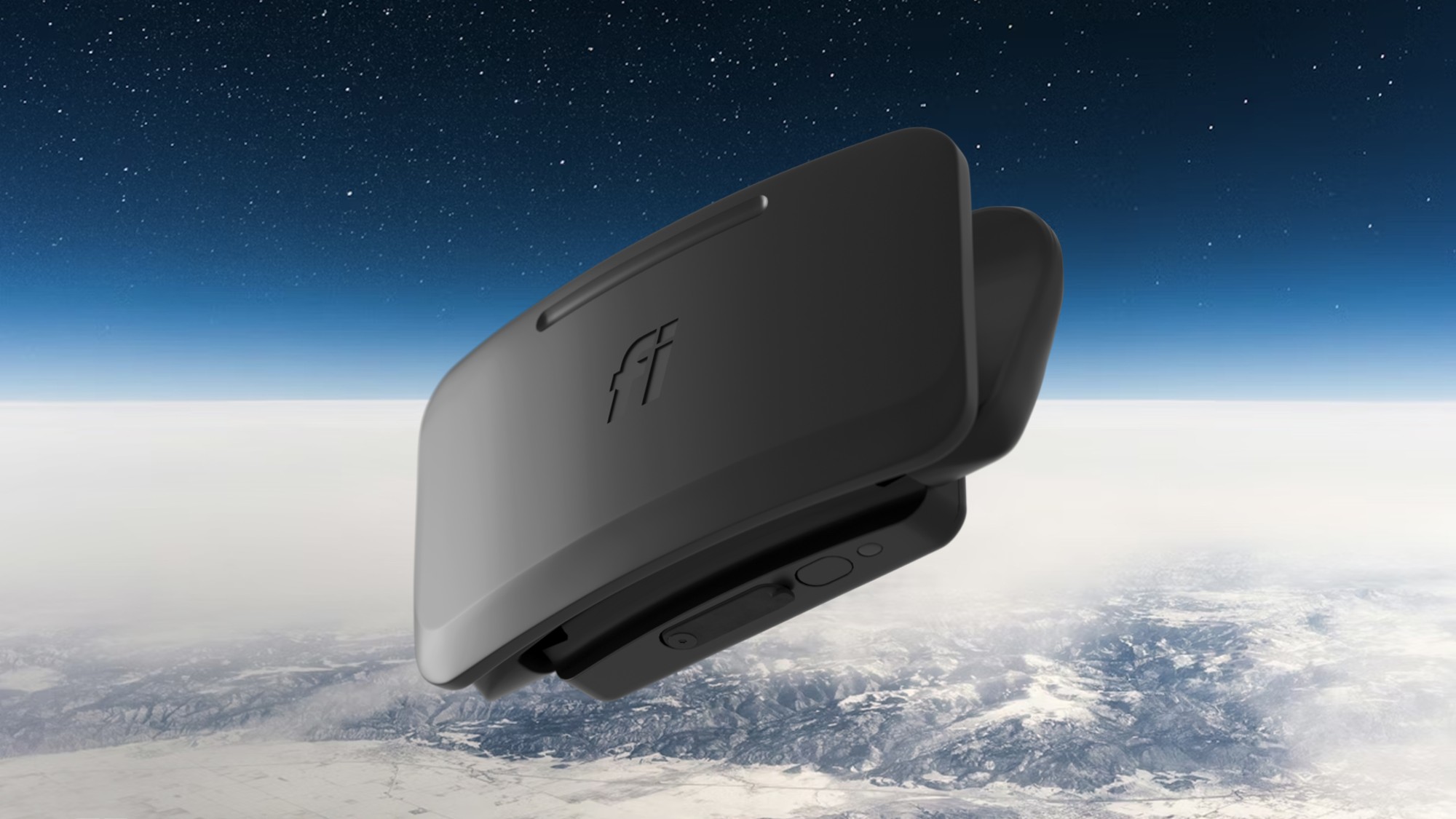
The Fi Ultra GPS tracking collar, powered by SpaceX's Starlink direct-to-mobile network. (Image credit: Fi)
The device's battery lasts "multiple days", according to Fi, giving the desperate pet owner plenty of time to locate the refugee. To speed up the search, Fi enables the owner to send the dog signals — short bursts of vibrations or sounds — to entice it to come home voluntarily.
"You can train your dog with those vibrations and reward it with food every time they receive the vibration," said Bensamoun. "That way, they will start associating the vibration with their food being ready at home."
GPS tracking has been around for decades. In the animal realm, wild, endangered animals became the first to wear them in the 1990s. But those early devices were clunky and expensive, good for large mammals such as moose and caribou, but not fit for commercial use on pets. The technology finally shrunk to small enough dimensions in the early 2010s when first GPS dog trackers entered the market.
Today, some 11 million dogs worldwide are tracked or monitored by GPS in some form. Fi's new tracker — the Fi Ultra Direct-to-Cell tracker — takes the technology another step further by providing "nearly omnipresent connectivity," said Bensamoun.