
Space photos of the week, January 17–23, 2016.
The post Space Photos of the Week: A Galaxy Breakin’ All the Rules appeared first on WIRED.

Science and reality
Space photos of the week, January 17–23, 2016.
The post Space Photos of the Week: A Galaxy Breakin’ All the Rules appeared first on WIRED.

Today, Jeff Bezos' Blue Origin accomplished a first among firsts: It launched and brought back to Earth the same New Shepard rocket that it landed for the first time back in November.
The post Jeff Bezos’ Blue Origin Rocket Took Off and Landed—Again appeared first on WIRED.
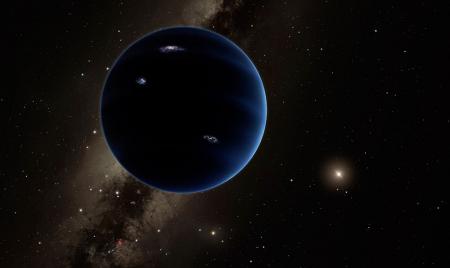
This artistic rendering shows the distant view from Planet Nine back towards the sun. The planet is thought to be gaseous, similar to Uranus and Neptune. Hypothetical lightning lights up the night side. (credit: Caltech/R. Hurt (IPAC))
Caltech researchers have found evidence of a giant planet tracing a bizarre, highly elongated orbit in the outer solar system that the researchers have nicknamed Planet Nine.
It has a mass about ten times that of Earth and orbits about 20 times farther from the sun on average than does Neptune (which orbits the sun at an average distance of 2.8 billion miles). In fact, it would take this new planet between 10,000 and 20,000 years to make just one full orbit around the sun.
The researchers, Konstantin Batygin and Mike Brown (best known for the significant role he played in the demotion of Pluto from a planet to a dwarf planet), discovered the planet’s existence through mathematical modeling and computer simulations but have not yet observed the object directly.
“This would be a real ninth planet,” says Brown, the Richard and Barbara Rosenberg Professor of Planetary Astronomy.
Brown notes that the putative ninth planet—at 5,000 times the mass of Pluto—is sufficiently large that there should be no debate about whether it is a true planet. Unlike the class of smaller objects now known as dwarf planets, Planet Nine gravitationally dominates its neighborhood of the solar system. In fact, it dominates a region larger than any of the other known planets—a fact that Brown says makes it “the most planet-y of the planets in the whole solar system.”
Batygin and Brown describe their work in an open-access paper in the current issue of the Astronomical Journal and show how Planet Nine helps explain a number of mysterious features of the field of icy objects and debris beyond Neptune known as the Kuiper Belt. “For the first time in over 150 years, there is solid evidence that the solar system’s planetary census is incomplete,” said Batygin.
Planet Nine’s existence also helps explain the alignment of distant Kuiper Belt objects and the mysterious orbits that two of them trace.
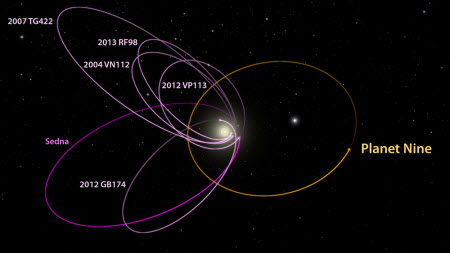
The six most distant known objects in the solar system with orbits exclusively beyond Neptune (magenta) all mysteriously line up in a single direction. Also, when viewed in three dimensions, they tilt nearly identically away from the plane of the solar system. Batygin and Brown show that a planet with 10 times the mass of the earth in a distant eccentric orbit anti-aligned with the other six objects (orange) is required to maintain this configuration. (credit: Caltech/R. Hurt (IPAC); [Diagram created using WorldWide Telescope.])
“But there is no reason that there could not have been five cores, rather than four,” says Brown. Planet Nine could represent that fifth core, and if it got too close to Jupiter or Saturn, it could have been ejected into its distant, eccentric orbit.
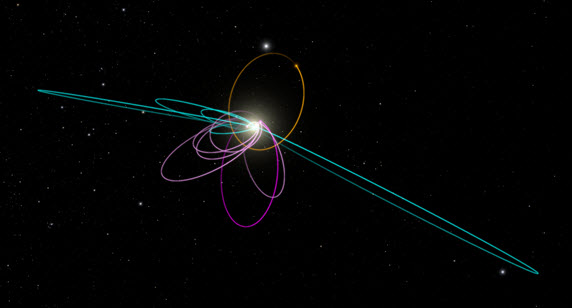
A predicted consequence of Planet Nine is that a second set of confined objects should also exist. These objects are forced into positions at right angles to Planet Nine and into orbits that are perpendicular to the plane of the solar system. Five known objects (blue) fit this prediction precisely. (credit: Caltech/R. Hurt (IPAC) [Diagram was created using WorldWide Telescope.])
Only the planet’s rough orbit is known, not the precise location of the planet on that elliptical path. If the planet happens to be close to its perihelion, Brown says, astronomers should be able to spot it in images captured by previous surveys. If it is in the most distant part of its orbit, the world’s largest telescopes — such as the twin 10-meter telescopes at the W. M. Keck Observatory and the Subaru Telescope, all on Mauna Kea in Hawaii — will be needed to see it. If, however, Planet Nine is now located anywhere in between, many telescopes have a shot at finding it.
“One of the most startling discoveries about other planetary systems has been that the most common type of planet out there has a mass between that of Earth and that of Neptune,” says Batygin. “Until now, we’ve thought that the solar system was lacking in this most common type of planet. Maybe we’re more normal after all.”
“All those people who are mad that Pluto is no longer a planet can be thrilled to know that there is a real planet out there still to be found,” Brown says. “Now we can go and find this planet and make the solar system have nine planets once again.”
Caltech AMT | Caltech’s Konstantin Batygin, an assistant professor of planetary science, and Mike Brown, the Richard and Barbara Rosenberg Professor of Planetary Astronomy, discuss new research that provides evidence of a giant planet tracing a bizarre, highly elongated orbit in the outer solar system.
Abstract of Evidence for a Distant Giant Planet in the Solar System
Recent analyses have shown that distant orbits within the scattered disk population of the Kuiper Belt exhibit an unexpected clustering in their respective arguments of perihelion. While several hypotheses have been put forward to explain this alignment, to date, a theoretical model that can successfully account for the observations remains elusive. In this work we show that the orbits of distant Kuiper Belt objects (KBOs) cluster not only in argument of perihelion, but also in physical space. We demonstrate that the perihelion positions and orbital planes of the objects are tightly confined and that such a clustering has only a probability of 0.007% to be due to chance, thus requiring a dynamical origin. We find that the observed orbital alignment can be maintained by a distant eccentric planet with mass  10 m⊕ whose orbit lies in approximately the same plane as those of the distant KBOs, but whose perihelion is 180° away from the perihelia of the minor bodies. In addition to accounting for the observed orbital alignment, the existence of such a planet naturally explains the presence of high-perihelion Sedna-like objects, as well as the known collection of high semimajor axis objects with inclinations between 60° and 150° whose origin was previously unclear. Continued analysis of both distant and highly inclined outer solar system objects provides the opportunity for testing our hypothesis as well as further constraining the orbital elements and mass of the distant planet.

Based on the weird orbits of a handful of outer solar system worlds, scientists believe they've found a new planet.
The post This Isn’t the First Time Astronomers Have ‘Found’ a Planet Nine appeared first on WIRED.

Today's Falcon 9 tipped over after hitting its drone barge target.
The post SpaceX Botched Its Landing Thanks to a Broken Sea Leg appeared first on WIRED.

Space photos of the week, January 10–16.
The post Space Photos of the Week: A Green Pea Galaxy Gets Groovin’ appeared first on WIRED.

This weekend, get ready to watch the greatest giant-robot rematch of all time, probably.
The post SpaceX Rocket vs. Robot Boat, Round 4! Tune in Live to the Grudge Fight appeared first on WIRED.

As NASA chooses its next cargo haulers for the ISS, a new report says the agency might be repeating the errors of its past.
The post To Cut Costs and Save Time, NASA’s Taking More Risks appeared first on WIRED.

Space walks are always pretty worry-making, but this particular excursion comes with some extra red flags.
The post Watch Two Astronauts Repair the ISS in the Dark appeared first on WIRED.

There are trillions of dollars of raw materials floating around up there inside asteroids. Who has the rights to harvest them?
The post Space Mining Could Set Off a Star War appeared first on WIRED.