
The universe, they say, is dying. And when it goes away, it will take time and space with it.
The post The End of the Universe: A (Slightly Premature) Lament appeared first on WIRED.

Science and reality
The universe, they say, is dying. And when it goes away, it will take time and space with it.
The post The End of the Universe: A (Slightly Premature) Lament appeared first on WIRED.

Yesterday on the ISS, Expedition 44 crew members dined on their first meal of space-grown romaine lettuce.
The post Those Veggies Grown on the ISS Get Humans Closer to Mars appeared first on WIRED.

Even with the best view in the solar system, some people can't help doing a little bit of science.
The post The Satellite That Took This Incredible Photo Almost Didn’t Leave Earth appeared first on WIRED.

Space photos of the week, August 2–8.
The post Space Photos of the Week: Big Ol’ Bubbles of Color appeared first on WIRED.

Space photos of the week, July 26 – August 1.
The post Space Photos of the Week: This Nebula Doesn’t Come in Peace appeared first on WIRED.

Philae's bumpy landing has importance for asteroid mining companies eager to excavate small bodies in space.
The post Asteroid Miners Can Learn a Lot From Philae’s Bumpy Landing appeared first on WIRED.

The Dawn probe is circling in on Ceres and returning new topographic images of its pockmarked surface.
The post Watch: The Mysterious Craters on Ceres Get New Names appeared first on WIRED.
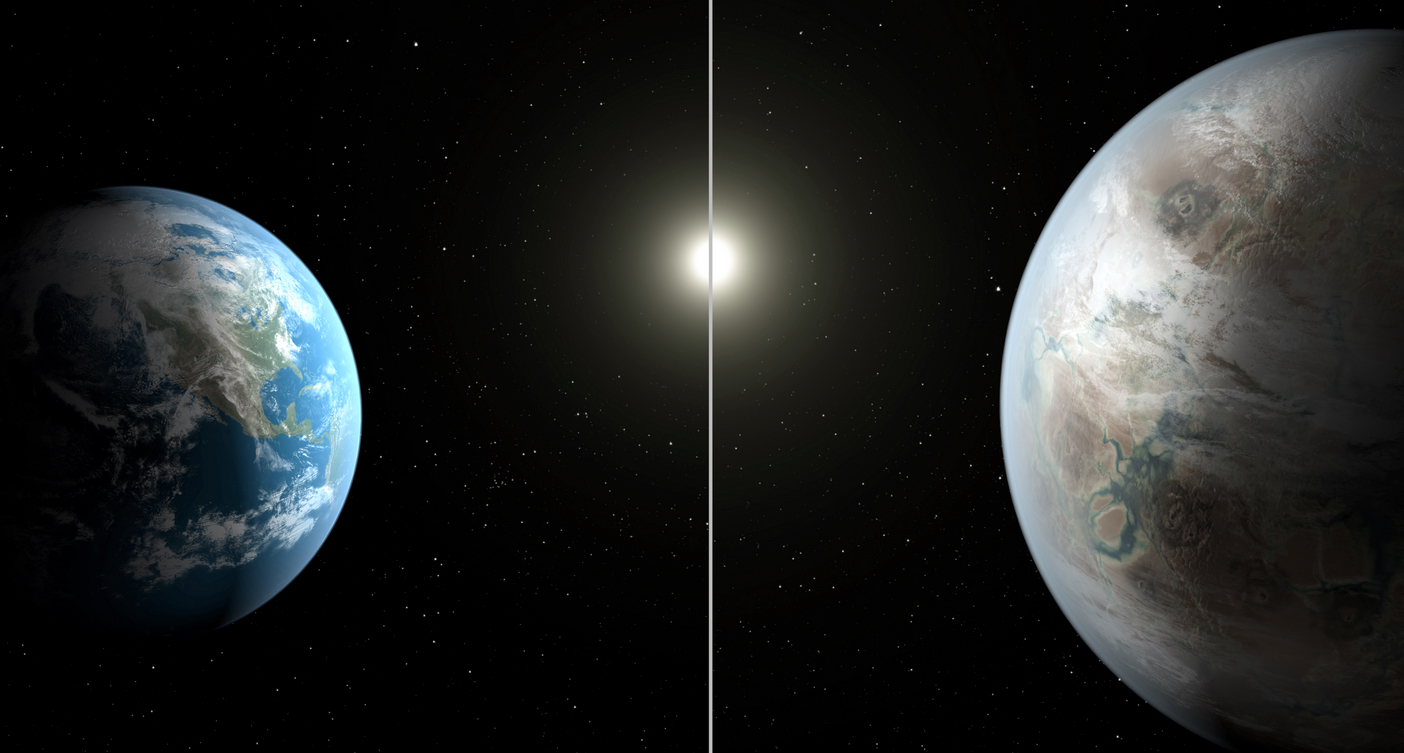
This artist’s concept compares Earth (left) to the new planet, called Kepler-452b, which is about 60 percent larger in diameter (credits: NASA/JPL-Caltech/T. Pyle)
NASA’s Kepler mission has discovered the first near-Earth-size planet in the “habitable zone” around a Sun-like star. This discovery joins 11 other new small habitable zone candidate planets, marking another milestone in the journey to find another “Earth.”
The newly discovered Kepler-452b, located 1,400 light-years away in the constellation Cygnus, is the smallest planet to date discovered orbiting in the habitable zone — the area around a star where liquid water could pool on the surface of an orbiting planet — of a G2-type star, like our sun. The confirmation of Kepler-452b brings the total number of confirmed planets to 1,030.
“It’s awe-inspiring to consider that this planet has spent 6 billion years in the habitable zone of its star; longer than Earth,” said Jon Jenkins, Kepler data analysis lead at NASA’s Ames Research Center, who led the team that discovered Kepler-452b. ” That’s substantial opportunity for life to arise, should all the necessary ingredients and conditions for life exist on this planet.”

Lightweight composite metal foams like this one have been found effective at blocking X-rays, gamma rays and neutron radiation, and are capable of absorbing the energy of high impact collisions — holding promise for use in nuclear safety, space exploration, and medical technology applications (credit: Afsaneh Rabiei, North Carolina State University)
North Carolina State University researchers have found that lightweight composite metal foams they had developed are effective at blocking X-rays, gamma rays, and neutron radiation, and are capable of absorbing the energy of high-impact collisions. The finding holds promise for use in nuclear power plants, space exploration, and CT-scanner shielding.
“This work means there’s an opportunity to use composite metal foam to develop safer systems for transporting nuclear waste, more efficient designs for spacecraft and nuclear structures, and new shielding for use in CT scanners,” says
Afsaneh Rabiei, a professor of mechanical and aerospace engineering at NC State, first developed the strong, lightweight metal foam made of steel, tungsten, and and vanadium for use in transportation and military applications. But she wanted to determine whether the foam could be used for nuclear or space exploration applications — could it provide structural support and protect against high impacts while providing shielding against various forms of radiation?
So she and her colleagues conducted multiple tests to see how effective it was at blocking X-rays, gamma rays, and neutron radiation. She then compared the material’s performance to the performance of bulk materials that are currently used in shielding applications. The comparison was made using samples of the same “areal” density – meaning that each sample had the same weight, but varied in volume.
Better than lead and non-toxic
The researchers found that the high-Z foam was comparable to bulk materials at blocking high-energy gamma rays, but was much better than bulk materials — even bulk steel — at blocking low-energy gamma rays; it outperformed other materials at blocking neutron radiation; and was better than most materials at blocking X-rays. It was not quite as effective as lead, but with the advantages of being lightweight and more environmentally friendly.
“However, we are working to modify the composition of the metal foam to be even more effective than lead at blocking X-rays, and our early results are promising,” Rabiei says. “And our foams have the advantage of being non-toxic, which means that they are easier to manufacture and recycle. In addition, the extraordinary mechanical and thermal properties of composite metal foams, and their energy absorption capabilities, make the material a good candidate for various nuclear structural applications.”
The research paper was published in Radiation Physics and Chemistry. It was supported by DOE’s Office of Nuclear Energy under Nuclear Energy University Program.
Abstract of Attenuation efficiency of X-ray and comparison to gamma ray and neutrons in composite metal foams
Steel-steel composite metal foams (S-S CMFs) and Aluminum-steel composite metal foams (Al-S CMFs) with various sphere sizes and matrix materials were manufactured and investigated for nuclear and radiation environments applications. 316 L stainless steel, high-speed T15 steel and aluminum materials were used as the matrix material together with 2, 4 and 5.2 mm steel hollow spheres to manufacture various types of composite metal foams (CMFs). High-speed T15 steel is selected due to its high tungsten and vanadium concentration (both high-Z elements) to further improve the shielding efficiency of CMFs. This new type of S-S CMF is called High-Z steel-steel composite metal foam (HZ S-S CMF). Radiation shielding efficiency of all types of CMFs was explored for the attenuation of X-ray, gamma ray and neutron. The experimental results were compared with pure lead and Aluminum A356, and verified theoretically through XCOM and Monte Carlo Z-particle Transport Code (MCNP). It was observed that the radiation shielding effectiveness of CMFs is relatively independent of sphere sizes as long as the ratio of sphere-wall thickness to its outer-diameter stays constant. However, the smaller spheres seem to be more efficient in general due to the fine fluctuation in the gray value profile of their 2D Micro-CT images. S-S CMFs and Al-S CMFs are respectively 275% and 145% more effective for X-ray attenuation than Aluminum A356. Compared to pure lead, CMFs show adequate attenuation with additional advantages of being lightweight and more environmentally friendly. The mechanical performance of HZ S-S CMFs under quasi-static compression was compared to that of other classes of S-S CMF. It is observed that the addition of high-Z elements to the matrix of CMFs improved their shielding against X-rays, low energy gamma rays and neutrons, while maintained their low density, high mechanical properties and high-energy absorption capability.
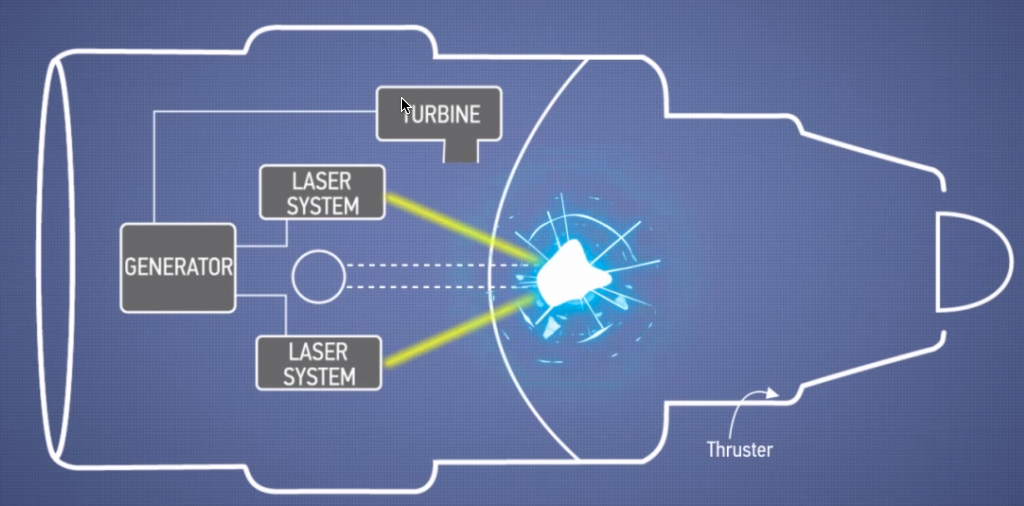
Lasers vaporize radioactive material and cause a fusion reaction — in effect, a small thermonuclear explosion (credit: Patent Yogi/YouTube)
The U.S. Patent and Trademark Office has awarded a patent (US 9,068,562) to Boeing engineers and scientists for a laser- and nuclear-driven airplane engine.
“A stream of pellets containing nuclear material such as Deuterium or Tritium is fed into a hot-stop within a thruster of the aircraft,” Patent Yogi explains. “Then multiple high powered laser beams are all focused onto the hot-spot. The pellet is instantly vaporized and the high temperature causes a nuclear fusion reaction. In effect, it causes a tiny nuclear explosion that scatters atoms and high energy neutrons in all directions. This flow of material is concentrated to exit out of the thruster thus propelling the aircraft forward with great force.
“And this is where Boeing has done something extremely clever. The inner walls of the thurster are coated with a fissile material like Uranium-238 that undergoes a nuclear fission upon being struck by the high energy neutrons. This releases enormous energy in the form of heat. A coolant is circulated along the inner walls to pick up this heat and power a turbine which in turn generates huge amounts of electric power. And guess what this electric power is used for? To power the same lasers that created the electric power! In effect, this space-craft is self-powered with virtually no external energy needed.
“Soon, tiny nuclear bombs exploding inside a plane may be business as usual.”
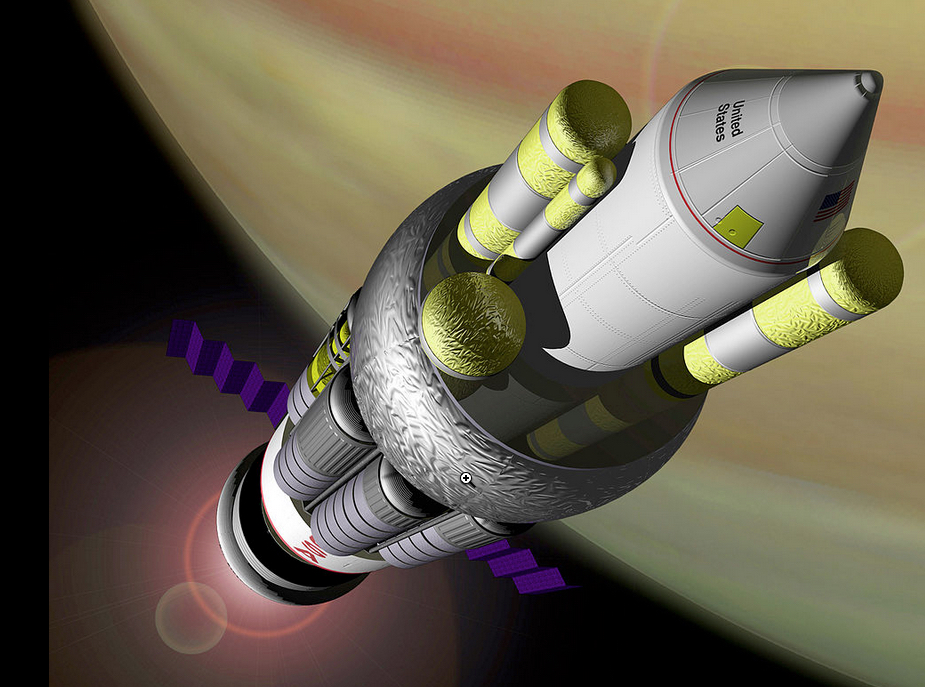
An artist’s conception of the NASA reference design for the Project Orion spacecraft powered by nuclear propulsion (credit: NASA)
The basic concept was initially proposed by physicist Freeman Dyson in his Project Orion concept in 1957 and described on George Dyson’s Project Orion — The Atomic Spaceship 1957-1965 book.