
Space photos of the week, May 31 - June 6.
The post Space Photos of the Week: Mysterious Lunar Swirls appeared first on WIRED.

Science and reality
Space photos of the week, May 31 - June 6.
The post Space Photos of the Week: Mysterious Lunar Swirls appeared first on WIRED.
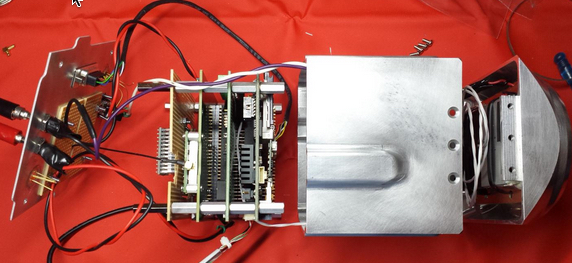
Technologist Jaime Esper and his team are planning to test the stability of a prototype entry vehicle — the Micro-Reentry Capsule (MIRCA) — this summer during a high-altitude balloon mission from Ft. Sumner, New Mexico (credits: NASA/Goddard)
Jaime Esper, a technologist at NASA’s Goddard Space Flight Center has developed a CubeSat concept that would allow scientists to use less-expensive cubesat (tiny-satellite) technology to observe physical phenomena beyond the current low-Earth-orbit limit.
The CubeSat Application for Planetary Entry Missions (CAPE) concept involves a service module that would propel the spacecraft to its target and a separate planetary entry probe that could survive a rapid dive through the atmosphere of an extraterrestrial planet, all while reliably transmitting scientific and engineering data.
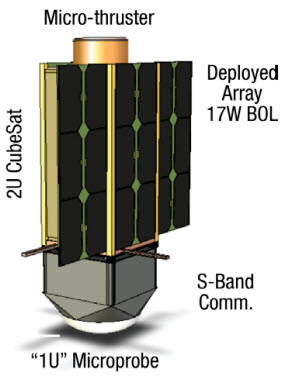
CAPE in its deployed configuration (credit: Jaime Esper/NASA Goddard)
Planetary landings
Esper and his team are planning to test the stability of a prototype entry vehicle, the Micro-Reentry Capsule (MIRCA), this summer during a high-altitude balloon mission from Fort Sumner, New Mexico.
The CAPE/MIRCA spacecraft, including the service module and entry probe, would weigh less than 11 pounds (4.9 kilograms) and measure no more than 4 inches (10.1 centimeters) on a side. After being ejected from a canister housed by its mother ship, the tiny spacecraft would unfurl its miniaturized solar panels or operate on internal battery power to begin its journey to another planetary body.
Once it reached its destination, the sensor-loaded entry vehicle would separate from its service module and begin its descent through the target’s atmosphere. It would communicate atmospheric pressure, temperature, and composition data to the mother ship, which then would transmit the information back to Earth.
The beauty of CubeSats is their versatility. Because they are relatively inexpensive to build and deploy, scientists could conceivably launch multiple spacecraft for multi-point sampling — a capability currently not available with single planetary probes that are the NASA norm today. Esper would equip the MIRCA craft with accelerometers, gyros, thermal and pressure sensors, and radiometers, which measure specific gases; however, scientists could tailor the instrument package depending on the targets, Esper said.
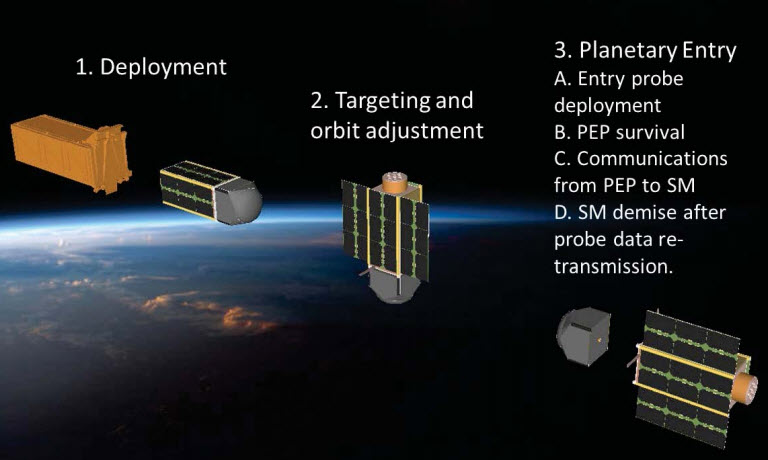
A generic CAPE operations concept, from system deployment to probe release and entry into a given planetary atmosphere. Three mission phases are identified: 1. Deployment, 2. Targeting, and 3. Planetary Entry. (credit: Jaime Esper/NASA Goddard)

One concept for a 3D-printed Moon habitat (credit: NASA)
NASA and the National Additive Manufacturing Innovation Institute (America Makes) are holding a new $2.25 million competition, the 3-D Printed Habitat Challenge, to design and build a 3-D printed habitat for deep space exploration, including the agency’s journey to Mars.
The program is designed to advance the additive construction technology needed to create sustainable housing solutions for Earth and beyond. The idea is to avoid taking along materials and equipment for building a habitat on a distant planet, which would take up valuable cargo space.
The first phase of the competition calls on participants to develop state-of-the-art architectural concepts that take advantage of the unique capabilities 3-D printing offers. A prize purse of $50,000 will be awarded at the 2015 Maker Faire in New York.
“The future possibilities for 3-D printing are inspiring, and the technology is extremely important to deep space exploration,” said Sam Ortega, Centennial Challenges program manager. “This challenge definitely raises the bar from what we are currently capable of, and we are excited to see what the maker community does with it.”

Robot prints a road in front of a hangar for a lunar lander (credit: Behnaz Farahi/NASA)
The second phase of the competition is divided into two levels. The Structural Member Competition (Level 1) focuses on the fabrication technologies needed to manufacture structural components from a combination of indigenous materials (such as Moon regolith) and recyclables, or indigenous materials alone. The On-Site Habitat Competition (Level 2) challenges competitors to actually fabricate full-scale habitats using indigenous materials or indigenous materials combined with recyclables. Both levels are open for registration Sept. 26, and each carries a $1.1 million prize.
Winning concepts and products will help NASA build the technical expertise to send habitat-manufacturing machines to distant destinations, such as Mars, to build shelters for the human explorers who follow. On Earth, these capabilities may be used one day to construct affordable housing in remote locations with limited access to conventional building materials.