NASA provided an Artemis update today (June 30), announcing new lunar landing contracts for its Moon Base initiative and a surprise new possible rover mission that could be headed to the moon's south pole.
During the second monthly update that NASA has provided for its moon base plans, the agency named Astrobotic, Firefly Aerospace and Intuitive Machines as the providers of four robotic landers that will deliver scientific payloads to the surface of the moon, as NASA tests and expands the technologies needed for a permanent human outpost.
"This is this drawing on the playbook that worked very well for NASA during the 1960s," NASA Administrator Jared Isaacman said during the livestreamed update, explaining the experiential approach to a crewed lunar return. "We didn't just jump right to Apollo 11."
Isaacman also announced the potential repurposing of an engineering development model built to mirror the agency's Perseverance and Curiosity rovers on Mars. "There is another," Isaacman said, quoting Yoda's line from "Star Wars: The Empire Strikes Back."
That test rover is called PROMISE, short for "Polar Rover for Observation, Mapping, and In-Situ Exploration" (though it was formerly known as Optimism). PROMISE was developed at NASA's Jet Propulsion Laboratory (JPL) in Southern California, where it has been used as a test platform for fixes or commands that engineers want to try on the ground before permanently sending them to Perseverance and Curiosity. Now, NASA wants to send PROMISE on a mission of its own.
Though sending PROMISE to the moon would leave Perseverance and Curiosity — both of which remain active on Mars — without an Earth-based testbed, Isaacman thinks it would be worth it.
"We've had years now of experience operating the two rovers on the surface of Mars, and we've got this hardware that the taxpayers have invested a lot in," he said. "So the question was posed: 'What if we send it to the moon?'"
With a little refurbishment, PROMISE would help advance NASA's lunar plans, Isaacman added. Like Perseverance and Curiosity, the test rover is powered by a radioisotope thermoelectric generator (RTG), which converts heat from naturally decaying radioactive material into electricity. So it wouldn't require sunlight to operate — a real benefit on the moon, where most locations experience long stretches of darkness. (NASA plans to build its Artemis base near the moon's south pole, which is thought to harbor an abundance of water ice and also has a relatively complex lighting environment.)
The other robots currently in the works to launch on future missions to the moon, including the landers announced during today's update, are all solar powered. Through 2029, NASA hopes to launch up to 20 such missions as part of the CLPS (Commercial Lunar Payload Services) initiative to support the first phase of the agency's moon base plans, and the landers announced today will be some of the first in that lineup.
Already expected this year was Blue Origin's Blue Moon Mark 1 cargo lander. It's slated to launch on the company's New Glenn rocket, which exploded last month during an engine test. That anomaly has complicated the Blue Moon timeline, though Blue Origin CEO Dave Limp has voiced confidence that New Glenn will launch again this year.
Two lunar deliveries were awarded to Astrobotic's Griffin 1 lander, one of which will fly Astrolab's FLIP rover the surface of the moon in the second half of 2026. Contracts to Firefly and Intuitive Machines call for the use of their Blue Ghost and Nova C landers, respectively, on CLPS missions in the next few years.
Three artist renderings depict commercial lunar landers from Astrobotic, Intuitive Machines, and Firefly on the moon. NASA announced June 30 that the landers will deliver more NASA science investigations and technology demonstrations to the lunar surface for NASA’s Moon Base Program. (Image credit: Astrobotic/Intuitive Machines/Firefly)
Each CLPS lander mission will carry at least three NASA payloads. The Stereo Camera for Lunar Plume Surface Studies (SCALPSS) array will study lander engine exhaust plume effects on lunar dust, to better predict landing requirements and prevent erosion and dangerous ejecta; a Laser Retroreflector Array (LRA) will test landers' ability to determine positioning and navigate using lasers and reflectors; and a Linear Energy Transfer Spectrometer (LETS) will measure radiation in the space around the moon and different areas on its surface.
"We know a lot about the moon, some of the south pole, but nothing like what we need to learn before we send humans there and we actually build a moon base," Carlos Garcia-Golan, NASA's Moon Base program manager, said during today's event. "So putting different assets on the surface, prospecting, understanding the environment and the places where we want to go [is] super critical."
Garcia-Golan is on board with the PROMISE moon plan as well. While it might sound crazy to send a spare Mars rover to the moon, it's the kind of crazy that NASA should be doing, he said. After all, JPL's motto is "Dare mighty things."
"We are in the business of the near impossible, so why not?" Garcia-Golan said.
Update for 5:30 p.m. ET on June 30: During its Moon Base update today (June 30), NASA revealed a handful of new lunar-lander contracts and announced that it's considering launching a spare Mars rover to the moon. Read all about it here.
NASA will provide an update about its moon base plans this afternoon (June 30), and you can watch it live.
Agency chief Jared Isaacman and Carlos García-Galán, the manager for NASA's moon base program, "will discuss the next set of awards for new lunar lander missions and preview upcoming opportunities as the agency works toward building a sustained presence on the moon," NASA officials wrote in a media advisory.
The event will begin today at 2:30 p.m. EDT (1830 GMT). You can watch it live here at Space.com, courtesy of NASA, or directly via the agency.
The moon base is a core piece of NASA's Artemis program, which aims to establish a permanent, sustainable human presence on and around Earth's nearest neighbor over the next decade or so.
The Artemis architecture previously called for the assembly of a small space station in lunar orbit called Gateway. In late March, however, Isaacman announced that NASA was pausing its Gateway plans and instead focusing on building a surface outpost.
That base will be constructed near the lunar south pole, which is thought to harbor large amounts of water ice, a key resource that can be used for life support and also be split into hydrogen and oxygen to provide rocket fuel.
Construction of the base will require a variety of work by robotic lunar rovers and landers. Presumably, today's press conference will shine some more light on that work and reveal which companies will be contracted to do it.
NASA has launched two Artemis missions to date. Artemis 1 sent an uncrewed Orion capsule to lunar orbit and back in late 2022, and Artemis 2 launched four astronauts around the moon this past April.
NASA is currently gearing up for Artemis 3, a crewed mission that will test docking procedures between Orion and one or two privately developed lunar landers in Earth orbit.
The agency aims to launch Artemis 3 in mid-2027. If all goes well with that flight, Artemis 4 will land astronauts near the lunar south pole, potentially as early as late 2028.
Earth's moon is due for a human-made impact this August courtesy of a spent SpaceX Falcon 9 upper stage.
The Falcon 9 upper stage is left over from the launch that sent Firefly's Blue Ghost-1 lander to the moon on Jan. 15, 2025 by way of NASA's Commercial Lunar Payload Services (CLPS) initiative. Also sent moonward on that flight was the Hakuto-R Mission 2, called Resilience, a robotic lunar lander developed by the Japanese company ispace.
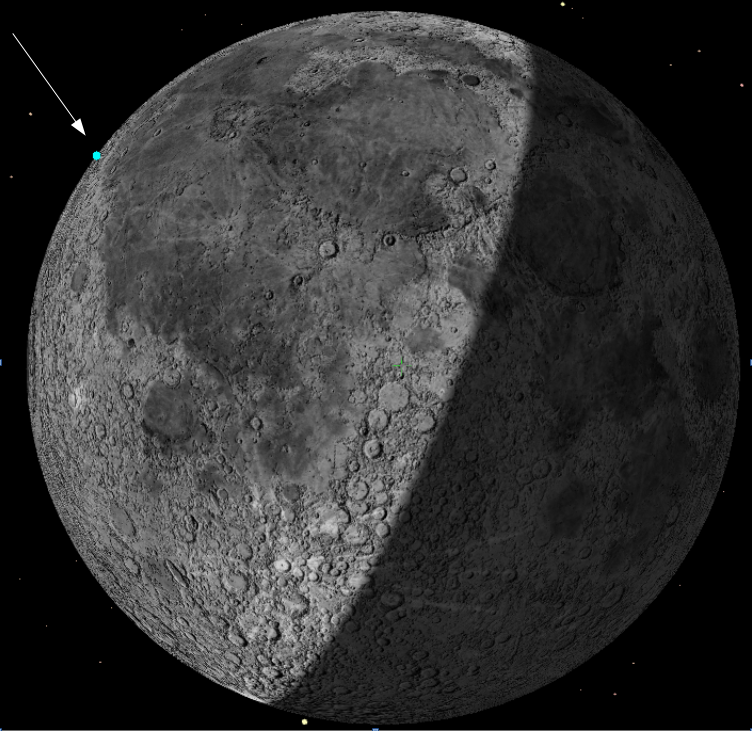
This striking event is expected to occur close to Einstein Crater near the moon's western limb and could be visible by ground and space-based telescopes. Varying forecasts have sparked debate on whether or not we'll be able to see the rocket body slam into the moon on Aug. 5, and, if so, how both citizen scientists and astronomers can best observe it it.
'This wonderful environment of the moon'
The consequences of this rocket mission's leftover hardware is on target for a "limb shot," meaning it could strike the far western edge of the moon. Another possible impact site is Bell Crater, just out of sight on the moon's far side.
Earlier this month, NASA's Solar System Exploration Research Virtual Institute (SSERVI) hosted a discussion with experts regarding the approaching impact. Taking part in the meeting of moon-watching specialists was Brian Day, SSERVI's lead for citizen science and community development.
"One of the things that is really important here with this impact that is coming up is it serves as a reminder to us that the moon is a dynamic environment. We think of it as being static. It is not. It is being whacked. It is changing," Day said.
Citizen scientists can actually get involved to help understand the dynamic environment of the moon thanks to the Impact Flash! program, said Day.
"And that can be done either with instrumentation you have in your own backyard or you can use ours in orbit around the moon," Day added. "This impact is a great reminder of this wonderful environment of the moon."
Moon viewing maybe
But will the impact be visible from Earth? Any assured answer is in a hedge-your-bet, yes/no mind bender.
"I've gone from 'probably' to 'probably not,' and more recently, to 'maybe,'" said Bill Gray of Project Pluto, creator of a telescope-tracking application used worldwide by professional and amateur astronomers alike to keep tabs on asteroids, comets, and other near-Earth objects.
It was Gray's work with Project Pluto that got the word out about the roughly four metric ton Falcon 9 upper stage intersection with the moon at over two kilometers a second. In September 2025, his software for computing orbits analyzed the observations and projected an impact with the moon on Aug. 5, 2026.
"Even though we have tracked it since launch, our idea of when and where it's going to hit are currently fuzzy by minutes and dozens of kilometers," Gray said. "But we will refine that and get an idea of where it's going to hit."
An illustration of the moon with an arrow pointing to a predicted impact site for the Falcon 9 upper stage 2025-010D in August 2026, courtesy of Project Pluto. (Image credit: Project Pluto)
Out on a limb
"I think it's going to be very subtle. I think it's going to be very, very hard to see, if not impossible. But there's always a chance," said William Cooke, program manager of NASA's Meteoroid Environment Office at Marshall Space Flight Center in Huntsville, Alabama.
Cooke quickly added that, along with a rapid-fire impact flash, the upper stage impact will kick up huge amounts of lunar regolith, the dust that coats the surface of the moon.
"It will excavate that out of the crater and this may create a plume that will be illuminated by the sun," Cooke said. "So, it's not only important to look for the impact flash, but if this occurs close enough to the limb, you may be able to see that plume of material rising, and that would be significant as well."
Time and inclination
Still, concerning the spotting of that over-the-limb plume, it remains a guessing game.
How much material might be lofted, and how high will it go? Given the moon's one-sixth gravity, how long will it take for that material to fall back onto the lunar surface?
"So, no good feeling for how long the plume will be up there," Cooke said.
Putting aside all the unknowns, it is Cooke's view that "if you've got the time and the inclination, it might be worth a look."
Regarding the possibility of seeing the ejecta plume, Gray of Project Pluto, later told Space.com he agreed. "We pretty much shrugged about this and said "we dunno' and we should look and see if we can observe it."
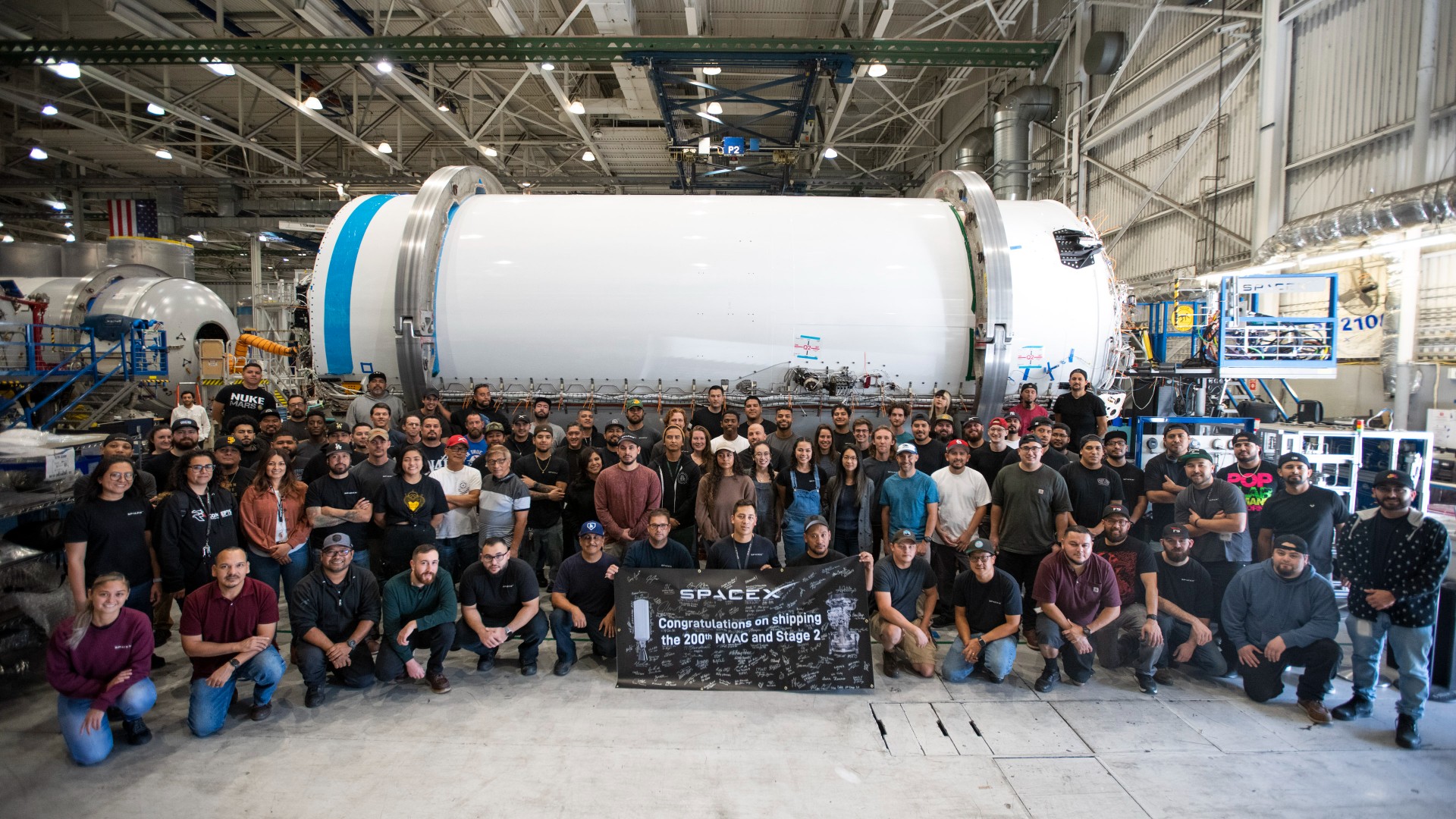
A SpaceX photo of one of the company's Falcon 9 second stages, taken in 2022. A similar second stage is expected to impact the moon in August 2026. (Image credit: SpaceX)
On-location orbiters
Speaking of time and inclination, there is an on-location witness to the before and after results from the rocket stage plummeting into the moon.
Brent Garry is the project scientist for NASA's Lunar Reconnaissance Orbiter (LRO) at Goddard Space Flight Center in Greenbelt, Maryland. LRO will be passing over the projected crash site about seven days prior to the impact and about seven days after the impact, Garry said.
"After the impact we might have a little bit more knowledge of where it is. We can do some additional targeting about a week after the impact and get some targeting over where the site is," said Garry.
Different observers
This event emphasizes that when you're looking for impact flashes on the moon, either anthropogenic or natural, there's a need for as many observers as possible, said SSERVO's Day.
"Because these flashes are so short, they can very much mimic a cosmic ray impact on your detector and just be a sudden blip," said Day.
What really helps researcher's distinguish between cosmic ray impacts and actual flashes on the moon is to have different observers in different locations observing that flash at the same time, Day said.
"And if you see that, if you have that coincidence of events," Day said, "that's one of the reasons why we like to have as many people looking as possible."
If you stand outside the old Corn Exchange in Bristol, you'll see a clock with two minute hands above the entrance. One hand is set to London time, the other to Bristol's — ten minutes behind. The lag is because the sun reaches its peak over the second city a little bit after the first.
Of course, when it comes to scheduling anything with bounds beyond one city, having two poses an issue. This is why, in 1840, the British company Great Western Railway imposed what it called "Railway Time" across its whole network of trains, establishing Greenwich Mean Time as the first standardized time. And it's still the time zone used in the U.K. today. However, when several towns refused to adopt the time established by the Royal Observatory in Greenwich, the solution was to use two minute hands instead of one. And so the three-handed clock came to be.
That compromise could soon repeat itself in a less likely location: the moon.
The U.S. and China, the two largest space powers, disagree on what time it is on the moon. That's a problem because experts say satellites from one country will be unable to coordinate with spacecraft from the other during future space missions — which could risk accidents.
The White House has tasked NASA with establishing Coordinated Lunar Time (LTC) as a universal time on the moon, which would set the standard for NASA's LunaNet satellite system. But China has other ideas.
China's Chang'e Program, named after the Goddess who flew from the Earth to the moon in Chinese folklore, is the only space program with active lunar relay satellites, Queqiao-1 and Queqiao-2. These relay satellites are the first basis of a moon-wide GPS system meant for future space missions could rely on, meaning they compete with NASA's LunaNet — and because of the way GPS works, these satellites will need a standardized time situation. China is also the only space power to have landed spacecraft on the far side of the moon, where radio signals from Earth are blocked, proving it can coordinate landings without relying on commands from home.
In other words, while the U.S. surpasses China in terms of total space missions, the relay satellites could give China the edge when it comes to establishing the first lunar GPS system for future moon landings. China also hasn't agreed to use LTC for this system, raising the prospect that timekeeping standards could diverge.
Moon Race 2.0
Last year, experts warned U.S. Senators that China is set to win the moon race — the 21st century race to secure lunar resources establish a human presence on the moon — unless space operations receive more funding. Scientists further pointed out funding issues that could impact U.S. leadership in the lunar arena and wavering political commitment to Gateway, the space station intended to serve the Artemis moon program.
Private space-faring companies are also looking to governments to set international standards before spending money on expensive equipment. If China sets the standards before the US, private companies might gear with investments for Chinese customers, giving the country the edge over competitors.
"If everybody has their own standards, the complication increases for the user and manufacturers," says Bijunath Patla, a theoretical physicist at the National Institute of Standards and Technology (NIST). "So there is a chance of making some mistakes, errors, and interchanging, and then having a mishap."
GPS works by having satellites broadcast time signals. If the clocks on the satellites disagree, even by a microsecond, the GPS positioning can shift by hundreds of meters. In an emergency landing, that difference could prove expensive, or even fatal in the case of a human spaceflight mission.
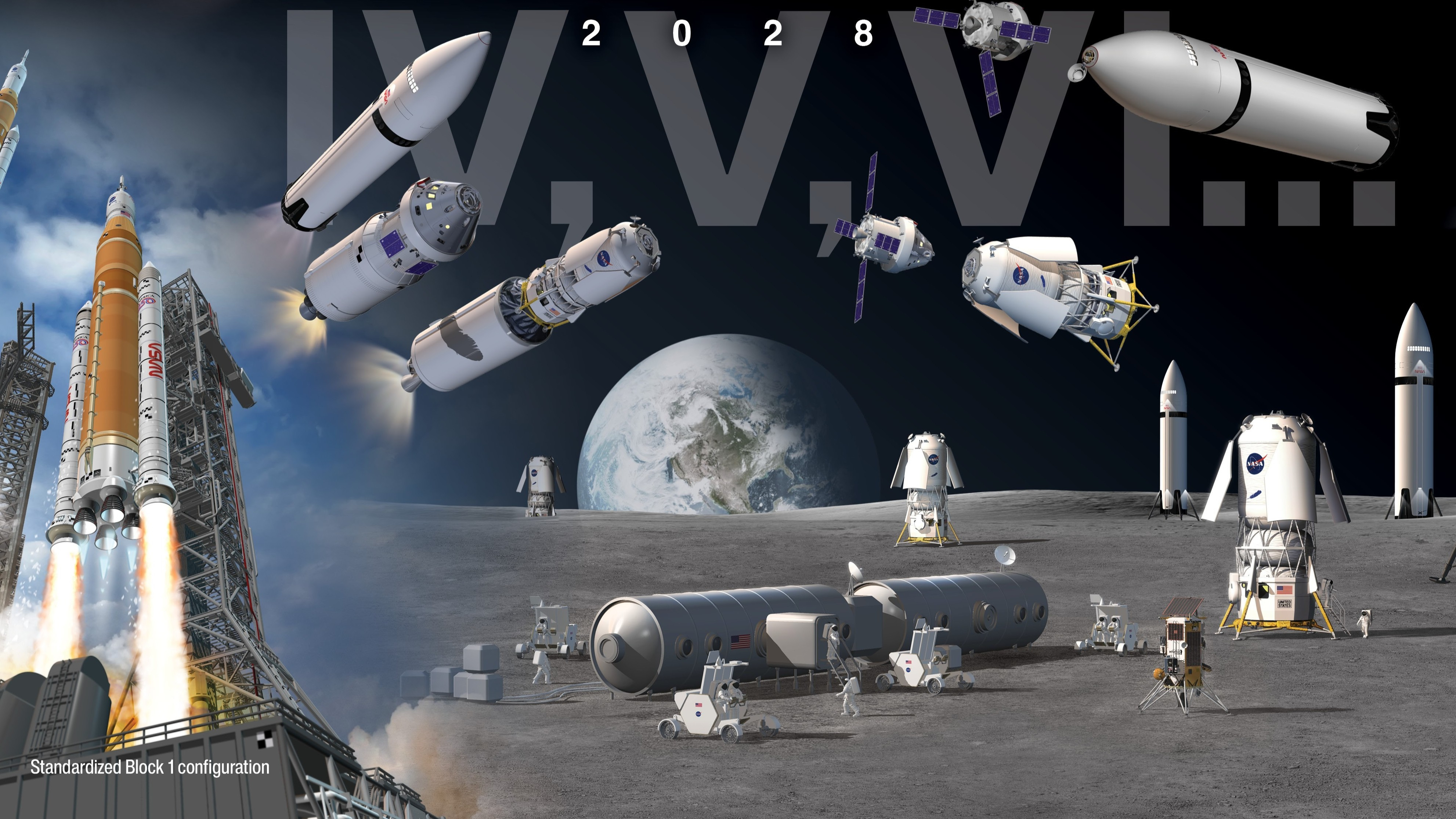
A visualization showing some of the main tenets of NASA's Artemis moon program. (Image credit: NASA)
If you take out the cellphone in your pocket, or look at the right-hand corner of your laptop to check the time, the precise time has been coordinated by hundreds of atomic clocks.
Atomic clocks created by NIST measure the oscillation of microwaves, the upwards and downwards swings of energy. Cesium atoms in the clocks absorb microwave energy only when oscillations reach 9,192,631,770 cycles per second.
Because all cesium atoms are the same, every atomic clock measures the exact same second as every other atomic clock. Their invention led to the universal standard of time we use today, superseding the time set by the Royal Greenwich Observatory in the 1800s.
International Atomic Time developed from the atomic clock, set by NIST’s optical "lattice clocks" and "cesium fountain clocks”, with the recently invented “nuclear clock” set to make the standard even more precise by ticking according to the fluctuations of thorium-229 nuclei.
The time on our screens comes from over 80 countries working with their own atomic clocks to work out the time. The U.S. Naval Observatory is one of these, submitting the time of its atomic clocks in Washington D.C. and Colorado to an international timekeeping organization in France.
Based in a suburb of Paris, the International Bureau of Weights and Measures (BIPM) collects the time from dozens of scientific labs across the world and uses the input from their atomic clocks to produce the weighted average time, what we call Coordinated Universal Time (UTC).
BIPM sends back corrections to each country, which recalibrate their own clocks to UTC. Countries beam these corrections to their satellites, which then transmit the standardised time to cell towers. The result appears on our phones.
But while our timekeeping methods are universal, time itself is not.
The Long March-8 Y3 carrier rocket carrying the relay satellite Queqiao-2 blasts off from the Wenchang Spacecraft Launch Site on March 20, 2024 in Wenchang, Hainan Province of China. (Image credit: Luo Yunfei/China News Service/VCG via Getty Images)
Spacetime
If the international atomic standard had been running since the Big Bang, NIST claims, it would not have gained or lost a single second since the universe began.
The way we experience time depends on gravity. The gravity we feel on Earth is determined by the mass and radius of our planet. Away from the Earth's gravity, spacetime behaves differently.
If one identical twin stayed on Earth, but the other travelled to a black hole, where matter is compressed, then both would experience time differently. Should the twin in the black hole take an atomic clock, and somehow survive, they would return to Earth to find that their twin had died, along with everyone they knew. Hundreds of millions of years would have passed by, according to the clock that remained on Earth, whereas their atomic clock would have ticked away only a short time.
"That person's time is being slowed down by gravity, their time is ticking slower," says Patla. "It's the same thing with the Earth and the moon. The clocks really tick faster."
A view of how spacetime is warped around massive bodies. This has implications for how time is experienced. (Image credit: NASA)
Because of the physics of spacetime, coordinating missions with satellites away from the Earth's gravity gets increasingly difficult.
On the moon, clocks run around 56 microseconds faster than clocks on Earth. While everyone agrees on the math, not everyone agrees on who should wind the clock.
Because of the difference, space powers need to agree to convert the discrepancy into UTC, or an equivalent that works on satellites coordinating space missions. Without agreement, engineering equipment that relies on GPS could diverge, and missions could prove dangerous in the years ahead, particularly with the projected increase in space landings.
Aiming to land a crew on the moon by 2030, the Chinese space agency plans to establish a moon base by 2035, from which asteroid mining operations or future missions to Mars could be prepared. Atomic clocks on Mars tick about 477 microseconds faster per day, leading to suggestions of a Mars time zone. But Patla says a separate time zone for Mars may prove too complicated.
About time
Almost all space powers are targeting the south pole of the moon, where loads of frozen water presumably found there can be converted to hydrogen to use as rocket fuel for future space missions. Exiting the moon is less fuel-consuming than exiting the Earth's atmosphere, though assembling rockets on the moon has never been attempted.
But the south pole of the moon is scarred by impact craters and jagged mountains, which could make landing there more risky. In a historic moment, India was the first nation to land a spacecraft there in 2023 — and hundreds of launches from various countries are scheduled over the coming decades to achieve the same feat. As these launch attempts start to happen, converting between differing satellite times in an emergency could prove dangerous.
Luckily, there's more collaboration between the agencies than some might suspect. NIST has check-ins with China's Purple Mountain Observatory, which according to Patla are purely advisory, so the two countries can better coordinate their activities in space.
China has announced its own mathematical framework for timekeeping, the Lunar Time Ephemeris (or LTE440), which could complement NASA’s Lunar Time, building towards a more robust conversion between the two countries. The math and physics are not in dispute, Patla adds, a fact that should give policymakers some comfort.
"Most of the world uses UTC, and so there is an incentive for everybody to take the best route to get there," says Patla. "If we want to have a lunar economy and if we want to have a sustained presence on the moon, then the standards would be helpful to link moon time to Earth time."
GOLDEN, Colorado — The moon is in need of good and accurate artists!
As NASA's Artemis program hits its stride, and in a few years "reboots" our moon with a human presence, there's an urgent need to guard against artistic misrepresentations of the lunar landscape, experts say.
We've all seen those alluring lunar renderings of vehicles and astronauts bounding about while setting up equipment and putting in place a moon base.
What's wrong with this picture? Missing in this artwork are small craters, dust, dirty equipment and dirty astronauts. (Image credit: NASA)
Reality versus depictions
"We are telling the public the moon is easy — it is not!"
That's the matter-of-fact warning from Daniel Britt, the Pegasus Professor of Astronomy and Planetary Sciences in the Department of Physics at the University of Central Florida. He's also the director of the Center for Lunar and Asteroid Surface Science.
Britt spoke about and showcased artists' misconceptions during a "reality versus depictions of the lunar surface" talk here at a Space Resources Roundtable, held from June 2 to June 5 on the campus of the Colorado School of Mines.
"I wish I could say that engineers and managers know better, but they don't. We are training a generation of engineers to not worry about terrain. If the artists are getting it wrong, it is our fault. Let's stop fooling ourselves," Britt said.
Well versed in what the lunar surface truly offers, Britt scolded a number of arty accounts of lunar territory promulgated by both NASA and commercial space ventures. He spotlighted what's wrong with those pictures — for starters, small craters and ever-present lunar dust, along with dirty astronauts, dirty equipment and dirty habitats.
Dusting off past moonwalker experiences reveals a dusty future on the moon. (Image credit: NASA/Daniel Britt)
Facts of life
A flat, dustless moon is not the one we are sending Artemis astronauts to, said Britt. Crews will experience coarse terrain, pervasive dust, and a surface unlike anything here on Earth. These are the facts of life on the moon, he said.
The Apollo moon-landing missions learned this first hand. But those astronauts explored equatorial areas. The Artemis program is targeting the lunar south polar region, which will be tough to deal with thanks to the low angle of the sun.
"When you look into the sun, it will be blasting into your face. But at least you'll see the shadow of that crater you are about to trip into," said Britt. "But looking down-sun, you won't see diddly squat."
"There's need to stop deluding ourselves," Britt told Space.com, advocating the creation of a 1-to-10 scoring system for lunar art, with prizes for the worst and best visualizations
"What I want to do is land on the moon way safer and easier," he added, "so you need to ask yourself what's missing from these depictions. We are training the public to think this is easy."
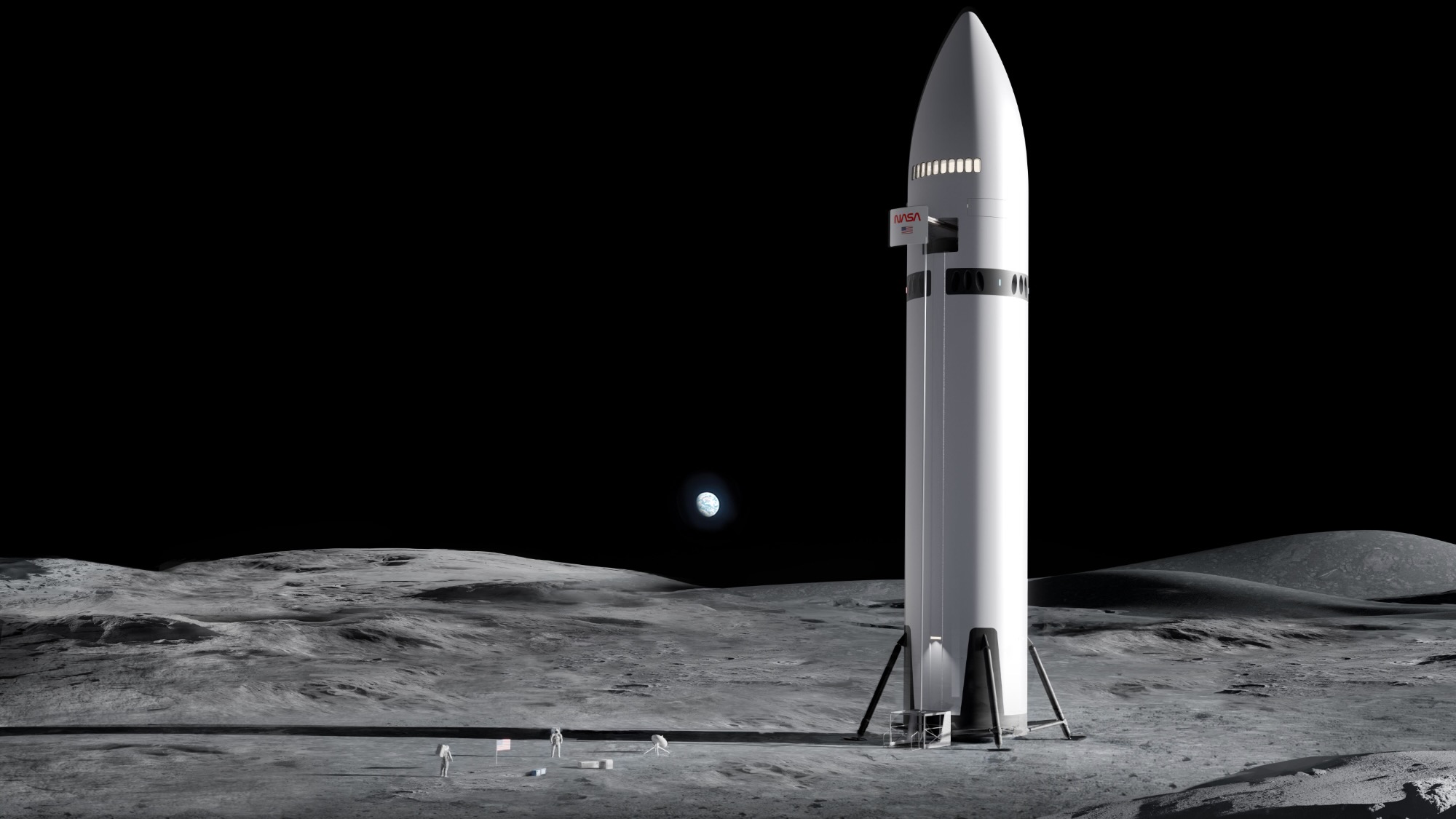
No dust, almost no small craters, no tipping problems. (Image credit: SpaceX)
False impression
To support his concern, Britt spotlighted both Apollo moonwalker-taken imagery and the scenery as projected by artists, be it using paint brush or artificial intelligence-guided computer work.
"The sun angle washes out the rough terrain. Almost all the pictures taken from the surface give the very false impression of a flat, gentle terrain," Britt said. "The reality is that the lunar surface is heavily cratered, rough, very dusty and covered in regolith."
Most Apollo surface images were taken "down-sun" because looking "up-sun" was hard. "This leaves a very false impression of a flat moon with gentle terrain," Britt said.
Why should we care about artist's misconceptions? Because they create false impressions that lunar landings are easier than they actually are. (Image credit: Blue Origin)
Tilt problems
Apollo was pretty lucky, Britt said, observing that several of the six human moon landings experienced tilt problems. For instance, Apollo 14 experienced a 7-degree tilt on landing, and Apollo 15 had an 11-degree tilt on touchdown.
Apollo 11 had to dodge a boulder field. Apollo 12 and Apollo 16 landed on the edge of big craters. "Even small craters can be meters deep," said Britt, recalling problems encountered by astronauts on their descent to the moon.
"The dust went as far as I could see in any direction and completely obliterated craters and anything else … I couldn't tell what was underneath me," astronaut Pete Conrad said during an Apollo 12 debriefing. "I knew I was in a generally good area, and I was just going to have to bite the bullet and land, because I couldn't tell whether there was a crater down there or not."
Similarly, Apollo 16 commander John Young said: "I couldn't judge slope out the window worth a hoot, and that's the truth. Even down low. The ground looks flat, but I'm sure it would look flat if it had been a 6-8 degree slope, too. I don't see any way around that."
Landing on "flat" places on the moon is a dicey situation. This Apollo 15 image shows the 11-degree tilt experienced by that mission during touchdown. (Image credit: NASA)
Getting it wrong
A flat, crater-free, dustless moon is a staple of imagery issued by NASA, the European Space Agency, other space agencies, and even private space firms, said Britt.
"Yes, these are artists' impressions," Britt said, "but somebody is telling the artists what to draw. I love the idea of landing and operating on a moon without dust, small craters, and rough terrain. However, we see the misconception of a flat, gentle moon everywhere."
"Commercial providers are just as bad. No dust, almost no small craters, no tipping problems. Yes, these are artists' impressions, and they are getting it wrong," said Britt. "NASA knows better. All these people should know better, but don't. Let's not fool the public. We owe them better data."
A laser system, previously tested on board the International Space Station, helped to stream video directly from the Artemis 2 mission on its way around the moon.
Scientists propose that a moon base could act as an isolated first line of biological defense against extraterrestrial samples that might be harmful to Earth's biosphere.
NASA envisions its moon base covering hundreds of square miles, and hopping scout drones may mark the facility's perimeter. The agency just awarded $1 billion in contracts to get the ball rolling.