A discarded SpaceX Falcon 9 upper stage is on a collision course with the moon, and skywatchers may be wondering whether they'll be able to witness the rare event firsthand when it slams into the lunar surface early Wednesday morning (Aug. 5).
The 45-foot-long (13.8-meter), 8,000-pound (4,000-kilogram) rocket stage, left over from the January 2025 launch of Firefly Aerospace's Blue Ghost and ispace's Hakuto-R lunar missions, is expected to strike the moon at about 2:35 a.m. EDT (0635 UTC) on Aug. 5. Traveling at roughly 5,400 mph (8,700 km/h), the impact will occur near the moon's western limb, close to Einstein Crater on the moon's Earth-facing side.
While the collision itself is unlikely to be visible from Earth, observers may have a chance to spot what's known as an ejecta plume rising above the lunar surface. Depending on the force of the impact, debris could be blasted high enough above the moon to stand out against the blackness of space, making it briefly visible to observers on Earth, according to Project Pluto. "Maybe we'll see the flash. Maybe we'll see rocks ejected from the crater. Maybe we'll even see both," astronomer Bill Gray, who first identified the rocket stage's eventual lunar collision, wrote on his Project Pluto website.
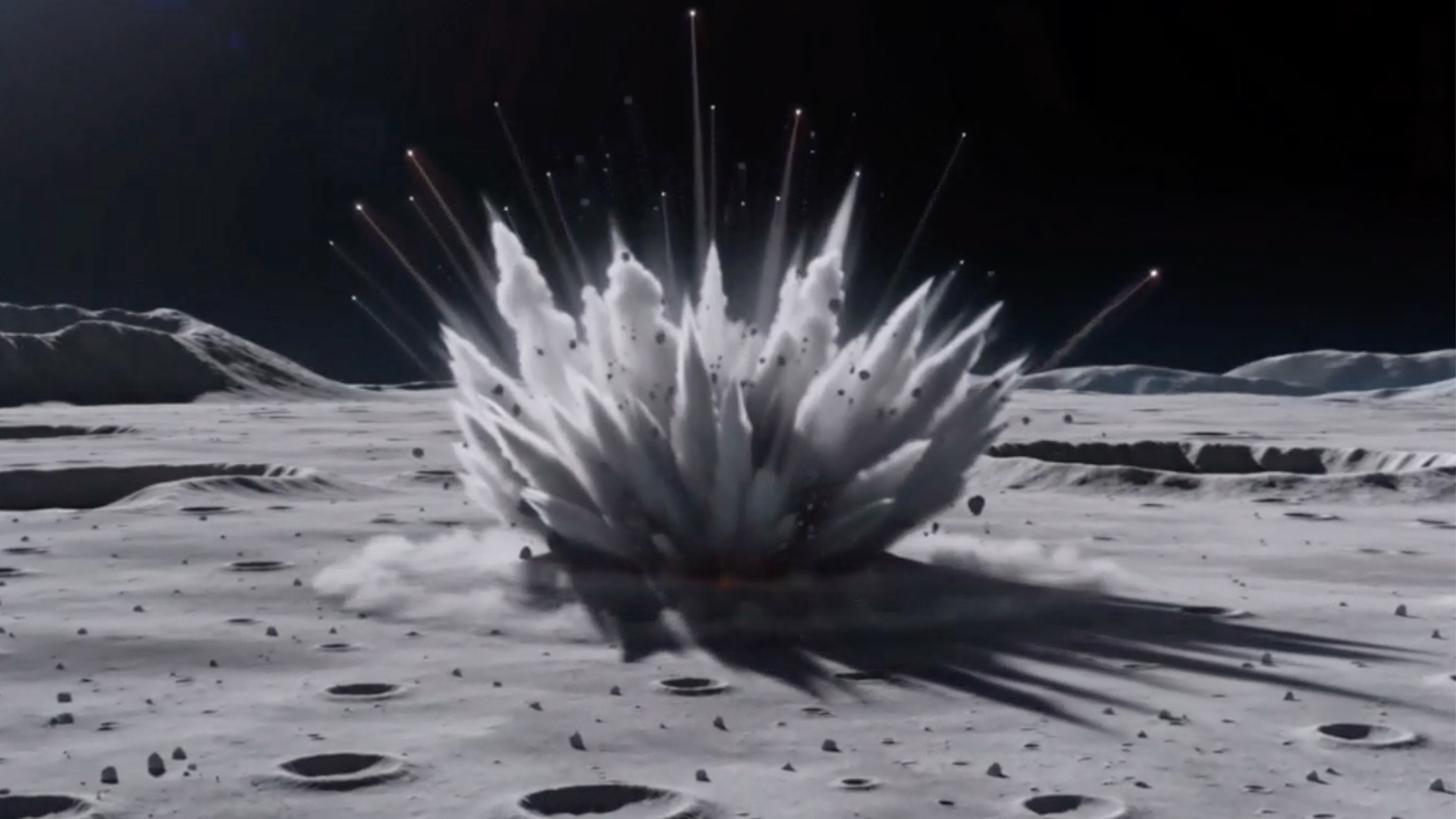
A notional illustration of what a rocket stage impact on the moon might look like. Created by Tony Dunn (Orbitsimulator.com) using Seedance AI. (Image credit: Created by Tony Dunn (Orbitsimulator.com) using Seedance AI)
The rocket is expected to strike a sunlit portion of the moon near its edge as seen from Earth. Any flash from the impact itself is expected to be washed out by the bright lunar surface.
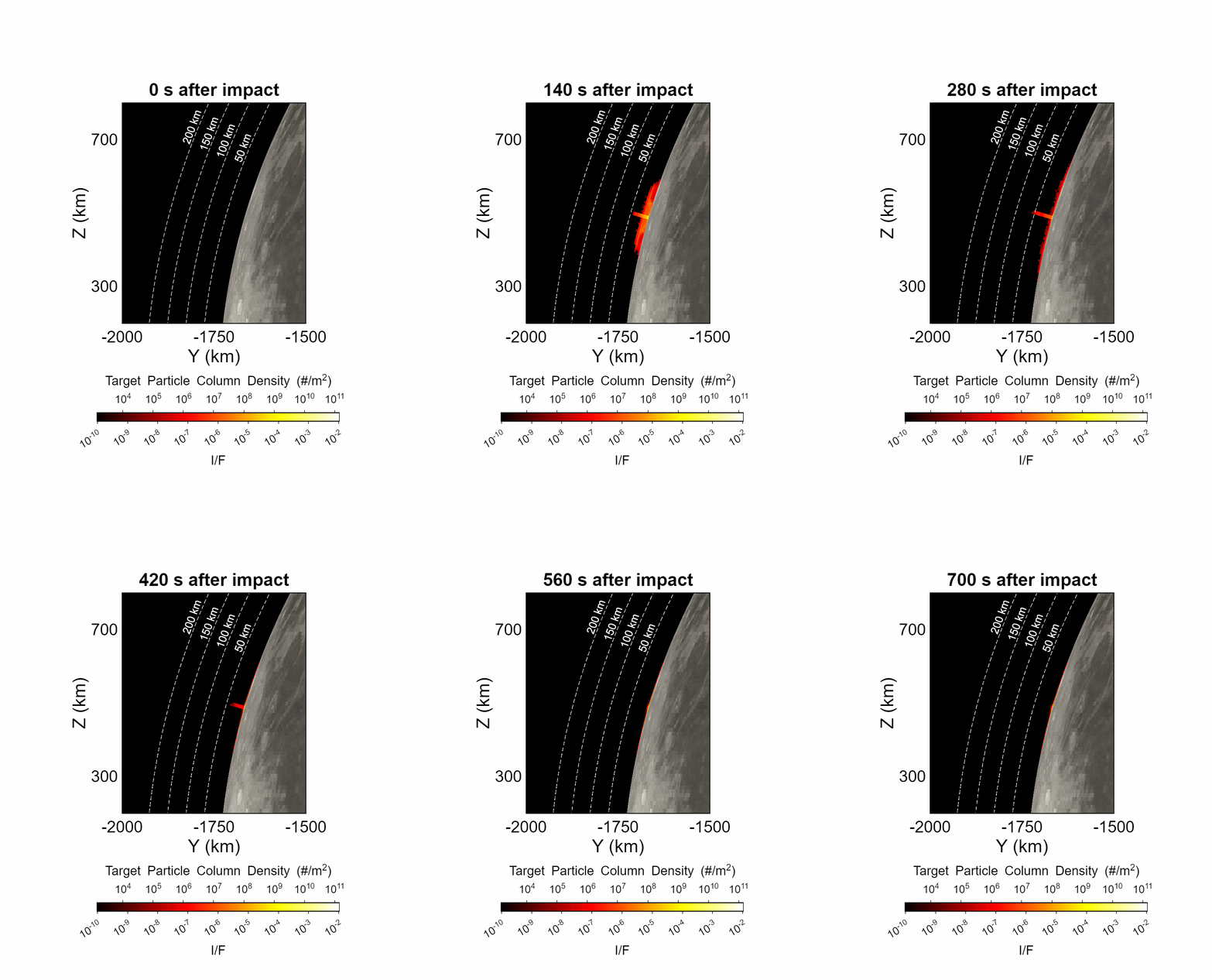
An animation predicting the evolution of the target ejecta column density, rendered on the lunar surface at the predicted impact site near Einstein crater by William Jo et al. (Image credit: William Jo/UT Austin)
However, material blasted high above the lunar horizon could briefly become visible against the darkness of space, creating a faint plume that advanced amateur astronomers may be able to capture with sufficiently large telescopes and cameras. Recent simulations suggest the central ejecta plume could climb as high as 60 miles (100 kilometers), though whether it will be detectable from Earth remains uncertain.
Even if conditions cooperate, viewing won't be ideal for much of North America. At the time of impact, the moon will sit only about 40 degrees above the southeastern horizon for observers along the U.S. East Coast, giving skywatchers a relatively low viewing angle before dawn. Observers in parts of South America may have more favorable viewing conditions, with the moon higher in the sky during the event, according to Project Pluto.
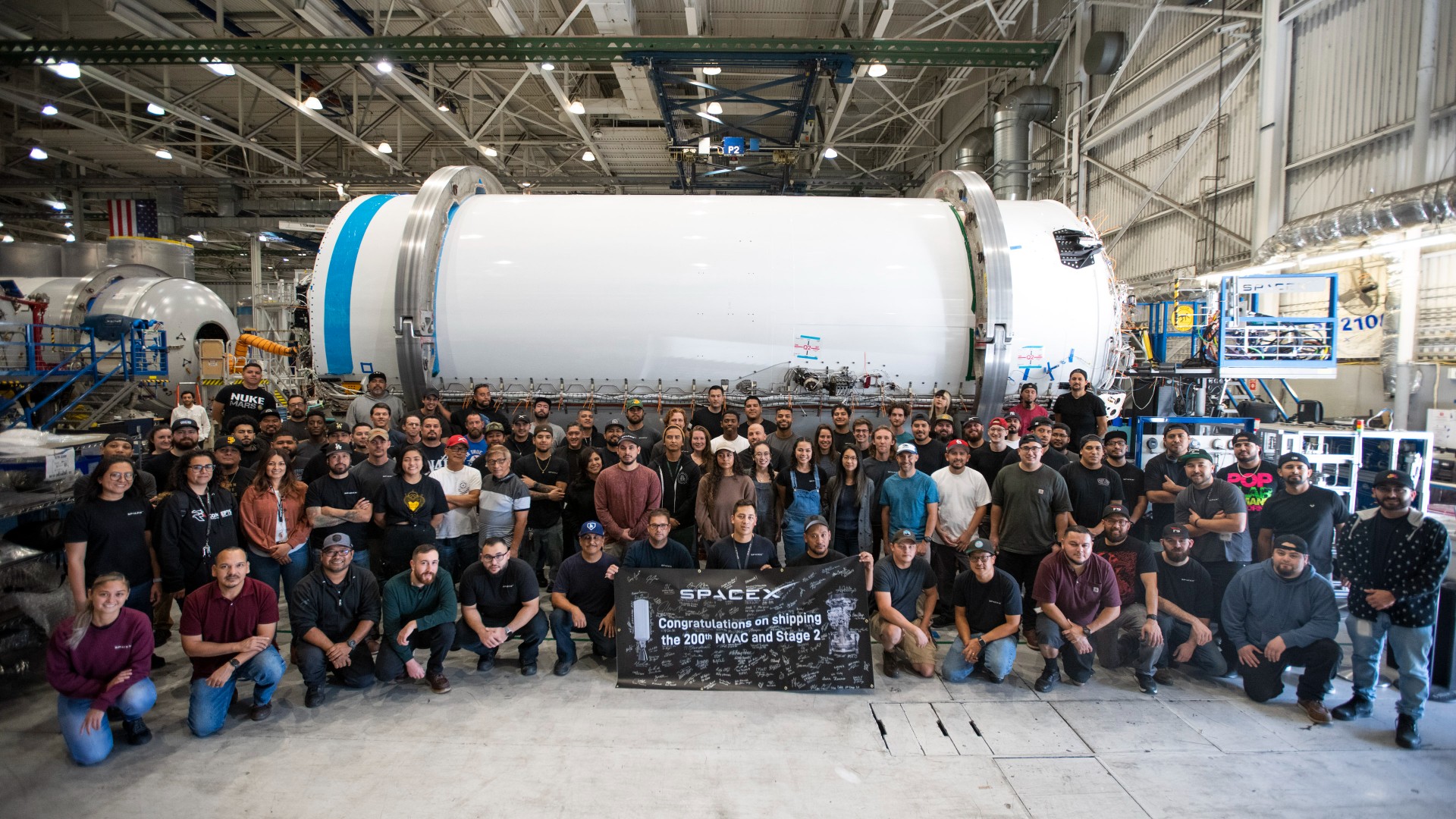
A SpaceX photo of one of the company's Falcon 9 second stages, taken in 2022. A similar second stage is expected to impact the moon on Aug. 5, 2026. (Image credit: SpaceX)
Regardless of whether the impact can be seen from Earth, several spacecraft will be watching from much closer vantage points.
South Korea's Danuri lunar orbiter is expected to observe the impact in real time, offering a unique view from lunar orbit. Meanwhile, NASA's Lunar Reconnaissance Orbiter (LRO) will photograph the impact site before and after the collision, allowing researchers to measure the newly formed crater and compare it with other human-made impacts on the moon.
Whether or not the ejecta plume is spotted from Earth, researchers say the accidental crash represents a valuable scientific opportunity. Unlike natural meteoroids, the hollow aluminum rocket stage will strike the moon with well-known size, mass and velocity, giving scientists a rare chance to test models of how impacts excavate lunar material and create craters.
The observations could also help researchers better understand the hazards posed by space debris as both crewed and robotic missions to the moon become increasingly common, if all goes according to plan.
This rocket wasn't supposed to die so dramatically.
On Wednesday (Aug. 5) at about 2:35 a.m. EDT (0635 GMT), the upper stage of a SpaceX Falcon 9 rocket will slam into the moon, blasting out a crater about 89 feet (27 meters) wide.
The rocket body has been loitering lazily high above Earth for more than 18 months. What jolted it out of its unremarkable senescence and put it on a kamikaze course for the moon?
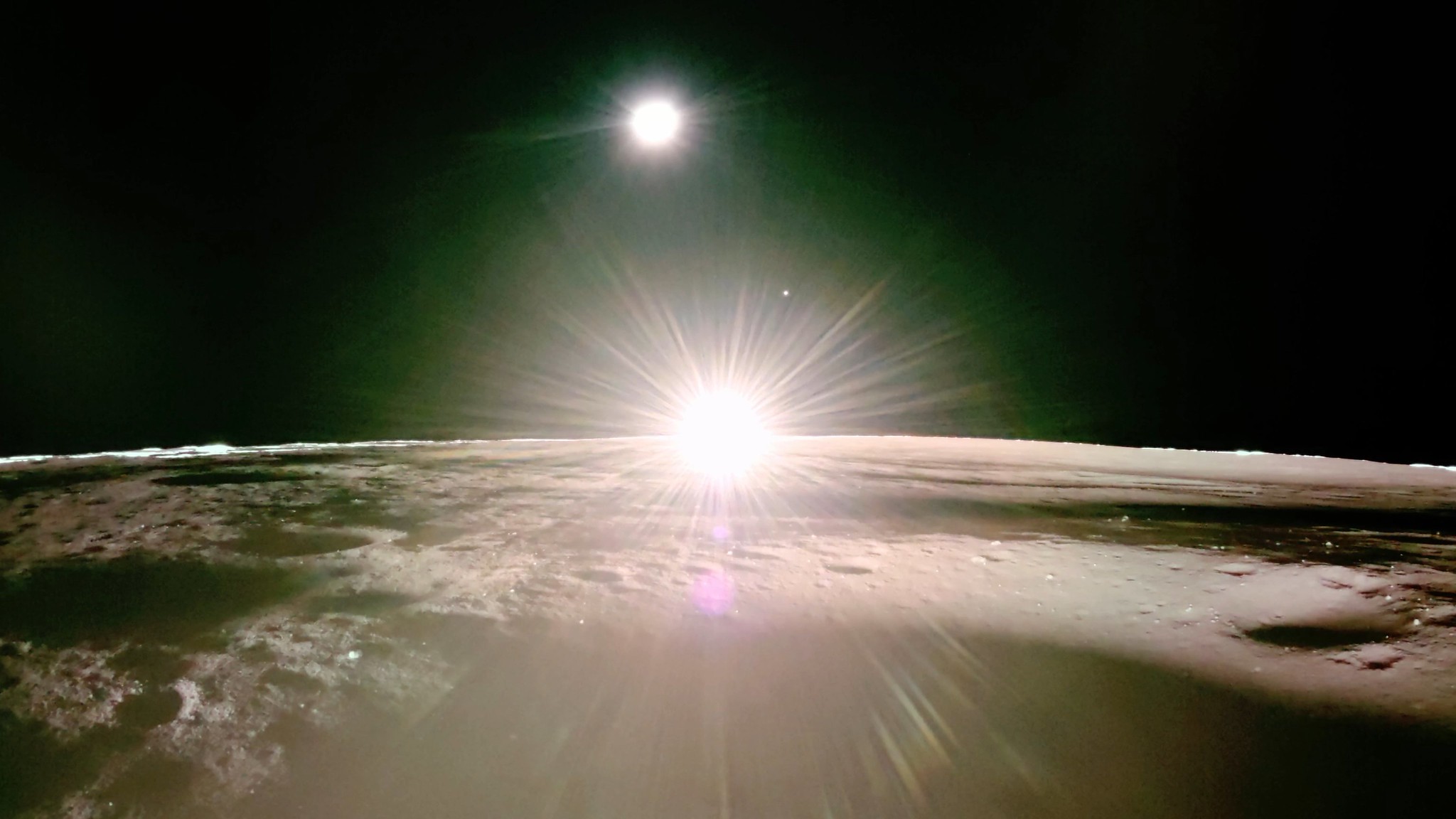
Firefly Aerospace's Blue Ghost moon lander captured this view of a lunar sunset, with Earth and Venus also visible, on March 16, 2025. (Image credit: Firefly Aerospace)
It didn't take much, as the rocket regularly crossed into the moon's neck of the woods.
The Falcon 9 launched in January 2025, carrying aloft two private robotic lunar landers — Firefly Aerospace's Blue Ghost and Resilience, which was built by the Tokyo-based company ispace. (Blue Ghost landed successfully and carried out its historic mission, but Resilience crashed during its touchdown attempt.)
Falcon 9 first stages are famously reusable, but the vehicle's upper stages fly just once. SpaceX usually deorbits these rocket bodies shortly after launch, guiding them back for controlled destruction in Earth's atmosphere. That wasn't possible on the Blue Ghost-Resilience launch, however, as getting the lunar probes to their distant deployment point used up almost all of the upper stage's fuel.
As a result, the 8,800-pound (4,000 kilograms) rocket body "was abandoned in a moon-crossing high-Earth orbit," according to a recent study about the coming impact led by Benjamin Fernando of Los Alamos National Laboratory in New Mexico.
A SpaceX photo of one of the company's Falcon 9 upper stages, taken in 2022. A similar second stage is expected to impact the moon on Aug. 5, 2026. (Image credit: SpaceX)
SpaceX performed "a different maneuver [than deorbiting] to ensure that the second stage itself is safe per the appropriate rules and regulations," Julianna Scheiman, director of NASA science and Dragon programs at SpaceX, said today (Aug. 3) during a press conference discussing the company's Crew-13 astronaut launch to the International Space Station, which is targeted for Sept. 12.
That maneuver did not lock the hunk of space junk into a stable location, however; natural forces still acted upon it and, it turns out, changed its trajectory.
"What has happened is, essentially, a mixture of solar activity and gravity forces have put it on a path towards the moon," Scheiman said.
Astronomers and lunar scientists are looking forward to the upcoming impact, even though it will occur on the sunlit side of the moon and therefore likely won't be visible to most observers here on Earth (though skywatchers with good telescopes might be able to catch a glimpse of the resulting ejecta plume).
The event "provides an opportunity to test pipelines for measuring flash properties to locate impact events seismically, and to better understand the multi-modal hazards posed to future lunar infrastructure and astronauts from space debris impacting the moon," Fernando and his colleagues wrote in their paper.
Those hazards won't be purely hypothetical for much longer, if all goes to plan: NASA aims to build a base near the moon's south pole over the coming decade via its Artemis program, and to keep that outpost staffed over the long haul. Scheiman said that SpaceX is looking into ways to minimize the chances that spent rocket bodies could rain down on an occupied moon in the future.
"It's one of the things that we're working in partnership with NASA and the other appropriate agencies," she said. "What is the best future disposal path for high-energy missions that are in the sun-Earth-moon system?"
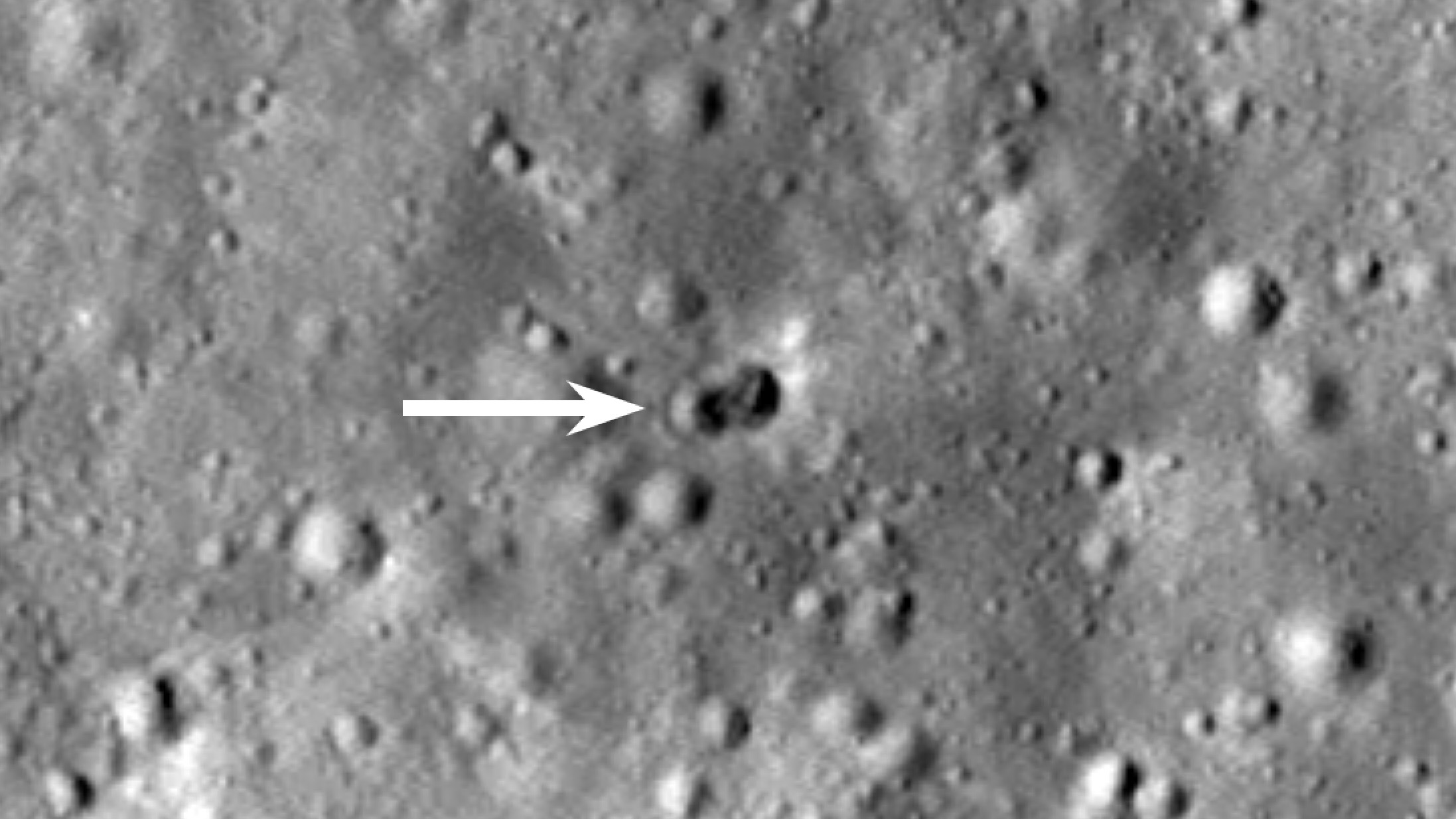
The double crater created on the moon by the March 2022 crash of the upper stage of China's Long March 3C rocket. (Image credit: NASA/Goddard/Arizona State University)
This Falcon 9 won't be blazing an entirely new trail to the moon. The third stage of NASA's Saturn V moon rocket struck the lunar surface on multiple Apollo missions, for example. And, on March 4, 2022, a mysterious rocket body slammed into the moon, blasting out a weird double crater.
That shape revealed the impactor's identity — the upper stage of the Long March 3C rocket that sent China's uncrewed Chang'e 5-T1 mission around the moon in October 2014.
On Aug. 5, Earth's moon is due for a human-made, high-speed impact from an identified flying object: a spent SpaceX Falcon 9 upper stage. The event will lead to a literal "dust up" on the lunar landscape.
That Falcon 9 upper stage is a leftover from the launch that sent Firefly's Blue Ghost-1 lander to the moon on Jan. 15, 2025. Onboard the same flight was the Hakuto-R Mission 2, called Resilience, a robotic lunar lander developed by the Japanese company ispace.
And according to a new study by an international team published on the open-source arXiv server, the resulting impact plume may briefly be bright enough to see against the dark sky near the moon's edge. That means it might be visible to moongazers with sufficiently sensitive telescopes.
This head-on collision of the errant stage is expected to occur near the Einstein and Bell craters near the western lunar limb. It may well be visible to ground and space-based assets. Indeed, putting aside all the unknowns and modeling uncertainties, some specialists suggest if you've got the time and observational prowess, it might be worth a look.
Visible ejecta spike
Using special physics simulations to model the impact, William Jo, a graduate research assistant at the University of Texas, Austin and colleagues predict the debris plume from the impact will have the central ejecta spike reaching roughly 47 miles to over 60 miles (75 kilometers to 100 kilometers) altitude.
"Our calculations suggest the plume should be several orders of magnitude brighter than the dark-sky background for the first few minutes after impact," Jo told Space.com. "So the plume should be visible, though I'd stress this is a single nominal case. The real one will look different, and the numbers are on the optimistic side. But the point worth making is that the flash isn't really the story here."
Jo emphasized that there's great slam-dunk science to be had. "Watching this one gives us a rare chance to open up ejecta-plume science and calibrate those models against a real event, which matters for every future thing we deliver to the moon," Jo said.
An animation predicting the evolution of the target ejecta column density, rendered on the lunar surface at the predicted impact site near Einstein crater by William Jo et al. (Image credit: William Jo/UT Austin)
Implications for future moon missions
According to new research led by Benjamin Fernando of the Los Alamos National Laboratory in New Mexico, the impact flash and resultant ejecta plume are "potentially observable" from ground- and space-based observational facilities.
"This event provides an opportunity to attempt the recording of an artificial impact in real-time; although many of the properties of the event (such as visual magnitude) are imprecisely predicted at present," Fernando and colleagues report.
Moreover, this rocket stage meets moon occasion yields an opportunity to test a pipeline for localizing impacts on the lunar surface for future seismic experiments, investigating the dust and plume dynamics from impact events on the moon, and considering hazards from artificial space debris impacts that future astronauts on the lunar surface might have to avoid, Fernando and team members point out.
"The maximum ballistic range of resolved particles is found to be slightly under 1,000 km, which is far enough to be significant from the perspective of presenting a hazard to future astronauts or infrastructure across much of the lunar surface," Fernando et al wrote in the study.
A SpaceX photo of one of the company's Falcon 9 second stages, taken in 2022. A similar second stage is expected to impact the moon in August 2026. (Image credit: SpaceX)
Before and after
Brent Garry is a project scientist for NASA's Lunar Reconnaissance Orbiter (LRO) at Goddard Space Flight Center in Greenbelt, Maryland. LRO will be passing over the projected rocket stage crash site about seven days prior to the impact and about seven days after the impact, Garry explains.
"After the impact we might have a little bit more knowledge of where it is. We can do some additional targeting about a week after the impact and get some targeting over where the site is," said Garry, as noted in earlier Space.com reporting.
Meanwhile, Jo at the University of Texas, Austin underscores the fact that a spent rocket stage is a hollow, spacecraft-like body, and there are very few impact models for human-made objects like it. They seem to produce very different plumes than natural impactors, like asteroids or comets do. But Jo stresses that the real scientific contributions will come by studying the moments after the impact.
"My concern is that most observers will stop at the sub-second flash and never track down the ejecta, which is the part that should actually be visible, and where the science is."
China's Chang'e-8 moon lander mission scheduled for 2029 could send Africa's first space exploration mission to the lunar south pole.
Under the Africa2Moon venture, the Bounced African Low Lunar Sphere, or BALLS for short, is a technology demonstrator in which a trio of spherical probes on the lunar surface will form a radio astronomy array at the moon's south pole region. Each of the metal spheres contains low-frequency radio telescope antennas that will search for signals from some of the oldest and most distant parts of the universe.
Astronomers say the lunar far side is the most radio-quiet site in Earth's vicinity, a location perfect for "listening" to the universe without interference. The BALLS array will work together to observe low frequency radio signals from space that are not observable from the surface of the Earth, according to Carla Mitchell, mission director of the Africa2Moon initiative and Africa Program manager at the South African Radio Astronomy Observatory (SARAO). The moon is an ideal place to perform such studies, they said, as the low frequency signals to be measured are unobservable from Earth due to interference created by our planet's atmosphere.
Pathfinder
The Africa2Moon project was selected by the Chinese National Space Administration in April 2025 as one of nearly a dozen of Chang'e-8's international payloads.
BALLS will enable observations below 20 megahertz (MHz) that are inaccessible from Earth due to ionospheric distortion and radio interference. Low-frequency radio waves (below about 50 MHz) come from some of the oldest and most distant parts of the universe.
The BALLS array will serve as pathfinder hardware for future lunar technologies and radio astronomy experiments. They will also act as a technology demonstrator for the full Africa2Moon mission, which plans for an array of 55 antennas to be deployed on the far side of the moon.
From paperwork to hardware
"As a little girl I thought space was not possible for people in Africa. I never thought I would be here today, presenting our lunar mission at NASA," said Mitchell.
Mitchell detailed years of team work on the BALLS initiative, rolling forward from paperwork to hardware, speaking July 22 at the NASA Exploration Science Forum 2026, held at NASA's Ames Research Center and staged by the NASA Solar System Exploration Research Virtual Institute (SSERVI).
SARAO is the national radio astronomy facility of South Africa, operating and managing such facilities as MeerKAT and the South African Square Kilometer Array (SKA) project. SARAO is involved in a range of cosmic inquiries, from pulsar research to studying fast radio bursts, dark matter and dark energy.
Carla Mitchell, mission director for Africa's Bounced African Low Lunar Sphere, and South African Radio Astronomy Observatory engineer, Japie Ludick, with one of the BALLS spheres that underwent testing. (Image credit: Africa2Moon)
Spaced out
Once deployed on the moon, the BALLS trio would be spaced out on the lunar surface. Signals captured from the BALLS array are to be communicated to the Chinese lander and then relayed back to Earth for further processing.
Each of the BALLS consists of a spherical gyroscope-like frame made of interlocking rings, encasing two large triangular solar panel arrays with a grid-like surface texture. The panels are oriented in opposite directions — one pointing upward and one downward — giving the structure a tetrahedron-like inner form.
The mission is led by the Foundation for Space Development Africa in collaboration with SARAO, the South African National Space Agency, the National Institute for Theoretical and Computational Sciences, as well as institutions in Kenya, Ghana, Botswana and across the continent.
Teams at Petrawell in Cape Town, Aerospace Systems Research Institute at the University of KwaZulu-Natal and Electronic Systems Laboratory at Stellenbosch University were involved in manufacturing the components of the structural and functional BALLS models. They were assembled in April 2026, to be delivered to China's Chang'e-8 team for testing.
"The power of collaboration, education and hope cannot be underestimated for Africa's future in space science and technology," she said.
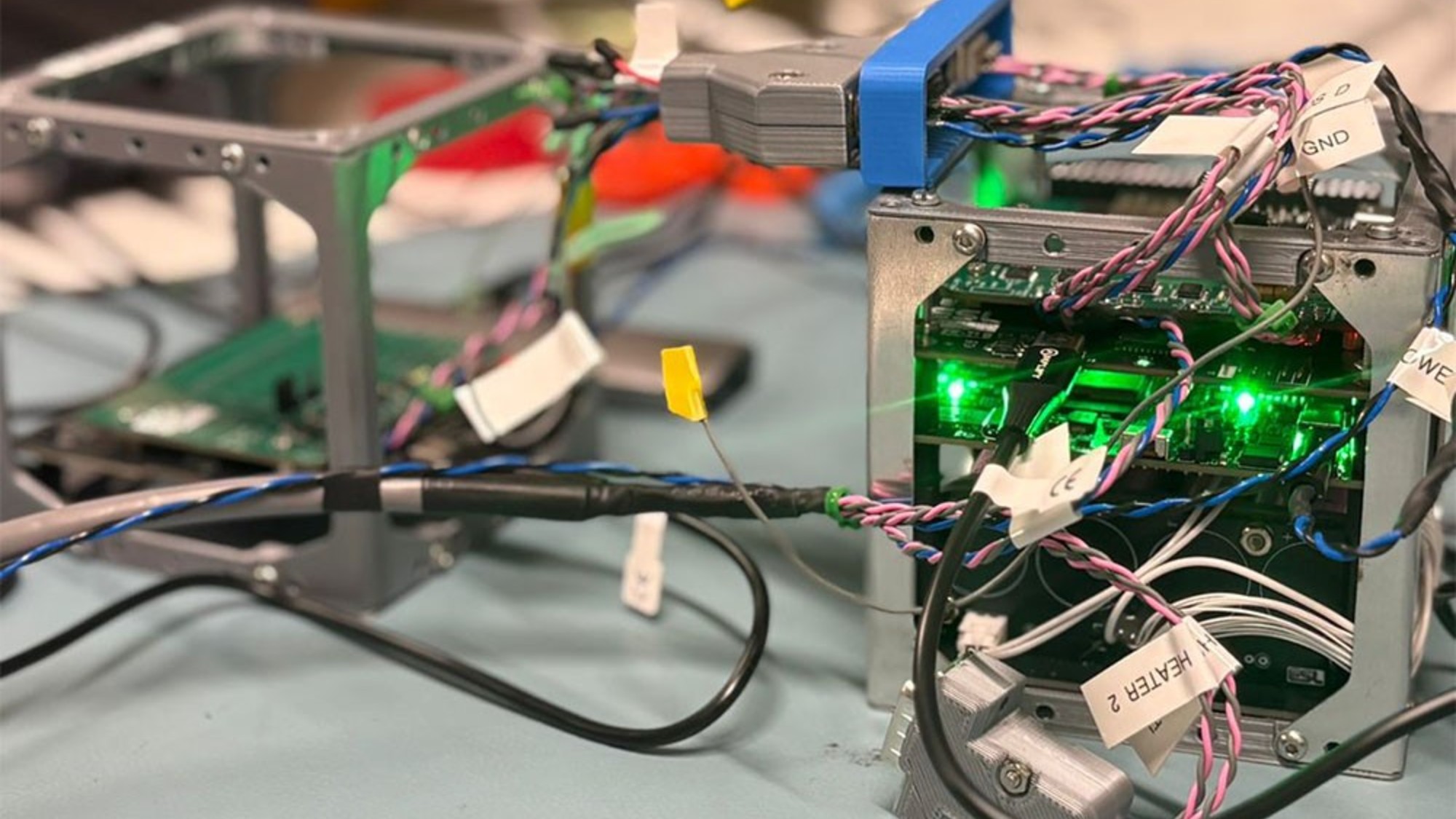
The BALLS electronics functional model built by the Stellenbosch University team. During the testing phase, the test model sent data between the model and a mock lander unit. (Image credit: Africa2Moon)
Looking to a second mission
As for the full Africa2Moon mission consisting of 55 antennas emplaced on the far side of the moon, Mitchell said they would require a launch as with the first mission.
"So yes, it would probably be contingent on China partnering again with us," Mitchell told Space.com.
The design of the second mission instruments would be a little different too.
"We would want to have them a little larger in diameter and so they would have to go in a flat version that will deploy into a ball versus the current version that travels as a ball, due to space constraints," Mitchell said.
"The deployment onto the lunar surface would also be different, as in self-deploying from the lander as opposed to a robot deployment. This would enable a faster and more random and further dispersed deployment pattern, which enhances the science," she said.
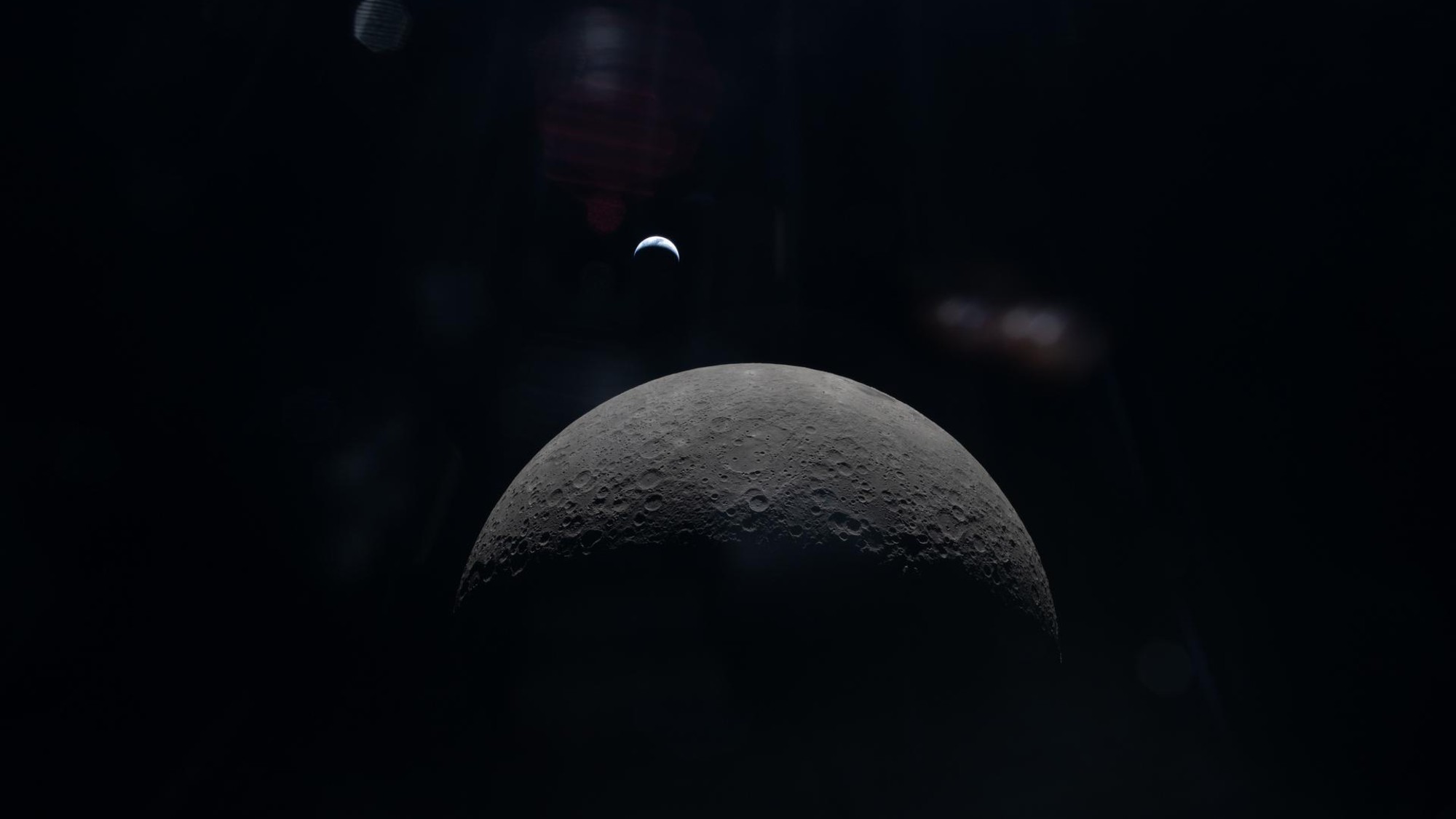
A faint view of a crescent Earth above the horizon on the moons far side as seen by the crew of NASA's Artemis II mission in April 2026. (Image credit: NASA)
Shoe-string budget
"I am amazed that it is being done on a shoe-string budget by volunteers. This demonstrates the inspiration of space and if this is successful, it will ignite the reality of space on the African continent," said Clive Neal, a lunar science exploration specialist and professor in civil and environmental engineering and Earth sciences at the University of Notre Dame.
Attending Mitchell's talk at the recent forum at Ames Research Center, Neal said the broader lunar exploration community is willing to help if needed.
"Her talk was inspirational," Neal said, "especially as the broader planetary science community over here [in the U.S.] is moaning about the lack of funding!"
NEW YORK — Madison Square Park in midtown Manhattan is home to some44 tree species. And on a Thursday afternoon blanketed in wildfire smoke, a small crowd gathered to see one in particular. The slender American sweet gum looked unassuming, especially compared to the enormous English elm neighboring it. But this tree had a secret: it had traveled 1.3 million miles before landing in New York.
The sapling was germinated from one of 1,000 seeds NASA sent aboard the uncrewed Artemis I mission, which saw a space capsule orbit the moon in 2022. Just a few years later, the same kind of capsule would take the famous Artemis II crewmembers on the same journey. Hundreds of these "moon trees" have been planted across the U.S. in the last two years as the space agency drums up excitement forfuture Artemis missions, which aim to return humans — and not just seeds — to the lunar surface by 2028.
Steph Lucas, director of horticulture for the Madison Square Park Conservancy, applied with NASA for a moon tree seedling in 2023. The request was finally granted in 2025. "We were so thrilled," Lucas told Space.com. The tree grew quietly for a year before the conservancy unveiled its presence with a "birthday party" extravaganza on Thursday (July 16).
Madison Square Park's moon tree is part of a legacy spanning back to NASA's original lunar program. In 1971, astronaut Stuart "Smoky" Roosa brought about 500 seeds aboard the Apollo 14 moon mission. These seeds later grew into saplings that NASA distributed to parks, arboretums and historic sites across the globe. A seed from one of these first-generation moon trees even attended the new tree's birthday party.
The event also featured a celestial-themed garden, poetry reading, a gallery of children's artwork, launch-able foam rockets and, of course, birthday cake — enough for about 100 people.
However, the party had fewer guests than expected. A thick plume of smoke from wildfires raging in Canada blew southward and tinted the sky above New York orange. The air quality plummeted, and many people chose to remain indoors for their health. Some of those who did turn up wore KN95 masks.
There were many ways to celebrate the moon tree's birthday. (Image credit: Courtesy of Madison Square Park Conservancy)
The moon tree's birthday cake. (Image credit: Courtesy of Madison Square Park Conservancy)
In a strange way, the atmosphere was fitting. The specter of climate change hung heavy over the city, and it was very much on Lucas' mind as she was vying for the conservancy's moon tree selection. NASA offered five different species of moon tree: Douglas fir, Loblolly pine, Sequoia, London plane and American sweet gum. Lucas requested an American sweet gum over a more cold-hardy London plane tree, even though its current range falls slightly south of New York City. Sweet gums are well-adapted to wet, temperate conditions, and as the climate warms in the coming decades they will likely feel right at home in Manhattan. "We think that this will be a better selection as the future goes on," said Lucas.
Stuart Roosa himself was a former smokejumper for the US Forest Service, a job that involves dropping from a helicopter into the heart of an active wildfire to fight it. He agreed to bring along those first moon seeds as a love letter to future generations on Earth. That's the spirit the Madison Square Park Conservancy hopes to channel.
"Space inspires us, right? And plants can be inspiring too," Lucas said. After a year of growth, the park's moon tree is now firmly rooted and standing tall without supports. Gazing at it through the wildfire haze, Lucas mentioned that the young tree seems by all accounts to be thriving. Its progress, she said, brings her hope. "We can always work towards a better future."
Landing spacecraft on the moon could contaminate ancient clues about how life may have originated on Earth, a new study finds.
As NASA continues on with its plan of sending astronauts back to the moon with the Artemis program, researchers are exploring what possible unintended consequences may arise from humans visiting the lunar surface. For instance, Artemis IV will land astronauts near the moon's south pole and the agency has future plans for building a longer-term moon base on the lunar surface, which would require many more trips. And indeed, a new study has found the exhaust from spacecraft involved with these landings could expel enough methane to contaminate the moon's surface — possibly destroying molecules that could help to explain how life may have originated on Earth.
"We are trying to protect science and our investment in space," senior study author Silvio Sinibaldi, the planetary protection officer at the European Space Agency, said in a statement. "Our activity can actually hinder scientific exploration."
While experts have had concerns for some time about how rocket launches on Earth pollute our planet and atmosphere, scientists have only really considered this issue with our own planet. This is especially because we haven't been to the moon's surface in over 50 years; concerns of accidental effects of a lunar landing simply haven't been top-of-mind. That's what makes this new study so important. It points to a potential issue that could mean that future moon landings might actually be detrimental to science.
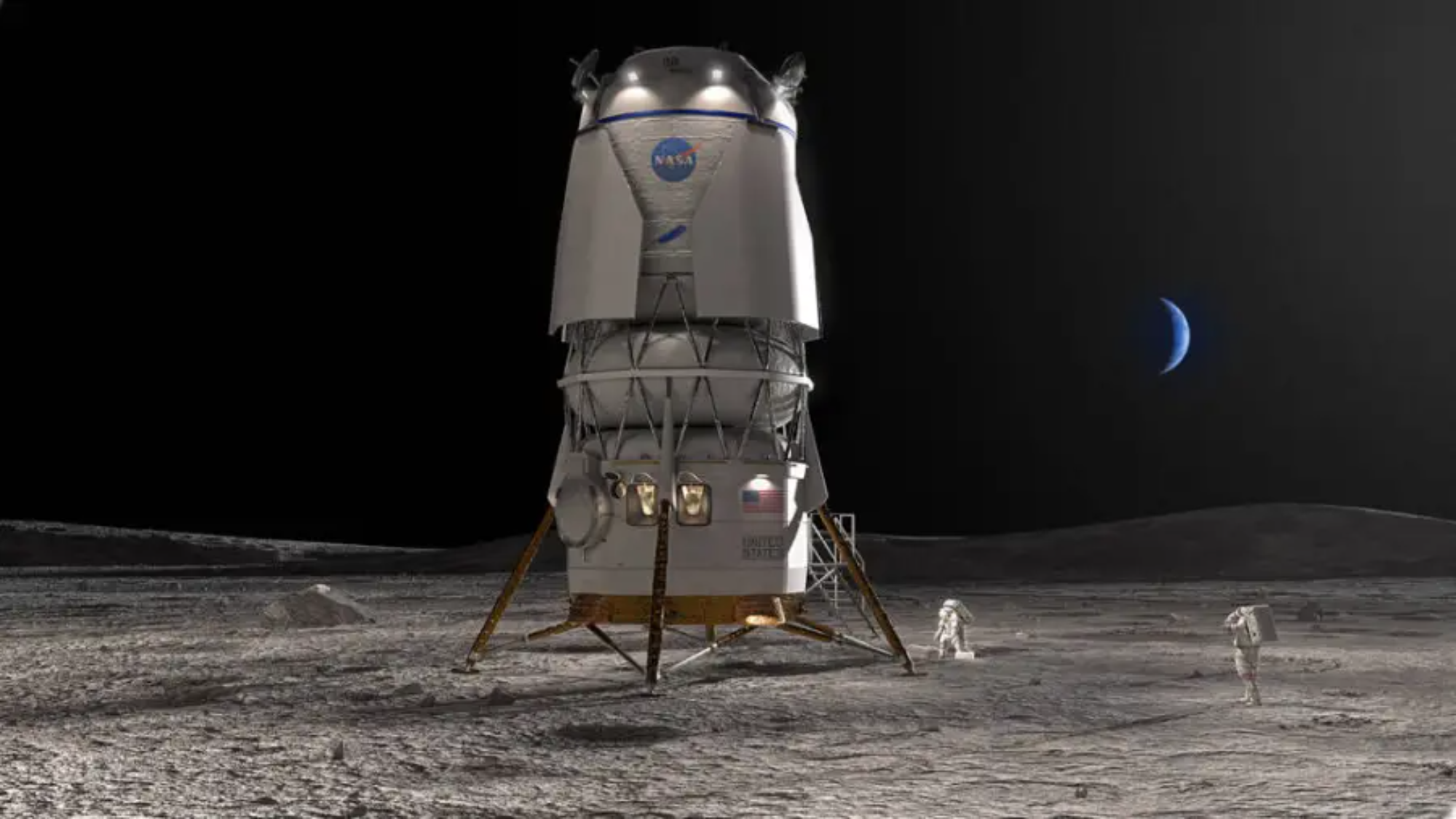
An artist's concept of Blue Origin's lunar lander. Lunar landings could pose a serious issue for science on the moon if methane contaminates ancient polar ices, a new study has found. (Image credit: Blue Origin)
Life's clues on the moon?
So why do we think the signs of life could be hiding on the moon? It's actually hiding in ice. Dark craters near the moon's poles, which exist in perpetual shadow, hold ancient ice. This ice is thought to contain material from asteroids and comets that smashed into the moon billions of years ago. Trapped in lunar ice to this day, these bits of ancient collisions could include what the researchers describe as "prebiotic organic molecules," or molecules that could have preceded life on Earth.
It's thought that these molecules from asteroid and comet visitors could have sparked life on Earth, and by studying those possibly trapped on the moon, researchers could be looking at the molecules that ended up combining and creating life as we know it.
The molecular history of life on Earth is pretty much nonexistent on our own planet, as it was largely destroyed by the billions of years of changes we've experienced. But the moon has remained mostly unchanged, so these wells of ice are a uniquely-preserved sampling of pre-life molecules.
"We know we have organic molecules in the solar system — in asteroids, for example," Sinibaldi said. "But how they came to perform specific functions like they do in biological matter is a gap we need to fill."
This ice exists in a somewhat fragile ecosystem, so left alone in darkness, this ice isn't going anywhere anytime soon. But with Artemis, NASA is planning on sending crewed landers to the moon's south pole. That might pose a problem. With computer models in this new study, researchers have shown that the methane exhaust from these landers could very quickly and permanently contaminate this ancient ice, destroying the molecular evidence sealed within.
Inside the simulations
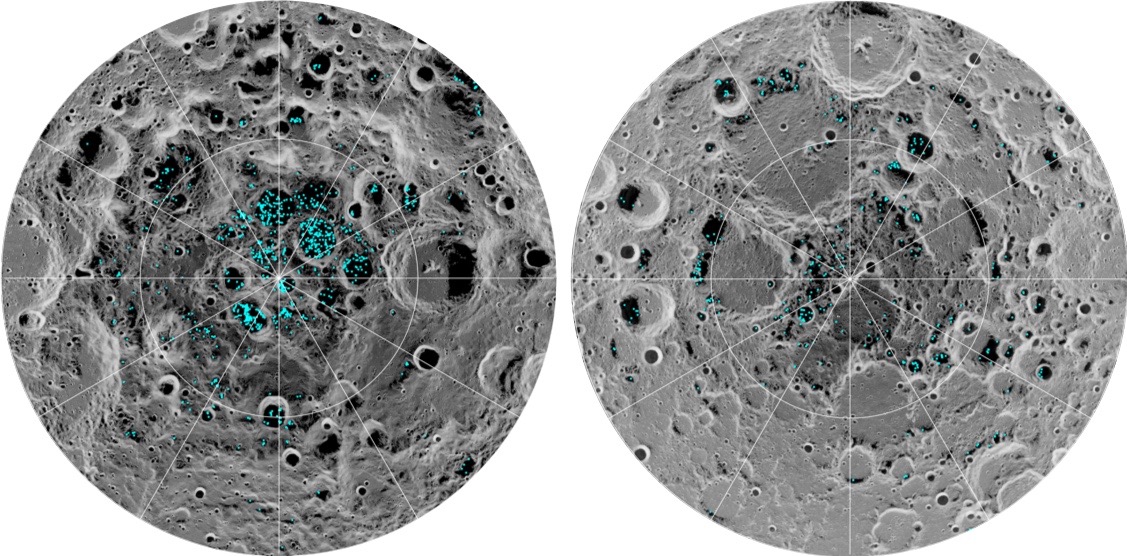
This image shows the distribution of surface ice at the moon’s south pole (left) and north pole (right). Blue represents ice locations, and the gray scale corresponds to surface temperature, with darker gray representing colder areas and lighter shades indicating warmer ones. (Image credit: NASA)
In those computer models, the researchers simulated how methane, the main organic component expelled by planned lunar landers, would spread across the moon's surface after a landing at the south pole. While the simulations included the effects of solar wind and radiation, the moon's lack of an atmosphere caused the methane to spread incredibly quickly, reaching the moon's north pole in under two lunar days.
Within one lunar week (which is roughly seven months on Earth), over half the methane was trapped at the moon's cold polar areas, with a whopping 42% of the substance trapped at the south pole compared to 12% at the north pole. This methane could collect in the same cold pockets where ice and ancient molecules have been collected for billions of years, possibly contaminating this finite, scientific evidence.
"Their trajectories are basically ballistic," lead author Francisca Paiva, a physicist at Instituto Superior Técnico in Portugal, said in the statement. "They just hop around from one point to another."
In better news, there may be a way to circumvent some of this methane disturbance. For instance, the study suggests it's possible that by choosing colder landing sites, scientists can avoid having the methane travel as quickly or as far. Additional simulations are needed to better understand how exhaust compounds travel on the moon, however, as well as the risks that this poses for scientific investigations and if there are other materials lunar trips will involve that could contaminate the environment. Above all, the new study's team emphasizes that as we push toward future lunar exploration, it is key to balance our dreams of settling the moon with preserving its priceless history.
"We have laws regulating contamination of Earth environments like Antarctica and national parks," Paiva said. "I think the moon is an environment as valuable as those."
The success of NASA's future moon base depends in large part on mission design, which should allow astronauts to work together well in a way independent from psychological training, a new study asserts.
The goal of the study was to identify "specific conditions" for mission success and to look for any "red flags" that may stand in the way, lead investigator Anamaria Berea, a computational social scientist at George Mason University (GMU), told Space.com via email. (The first author of the PLOS ONE study, which was published in May, was GMU's Raymond Vera.)
The team conducted the research using agent-based models, which are tools for computational simulations in fields ranging from the study of bird flocks to the spread of disease, Berea said. While a lot of modern-day AI "trains" or "learns" to extrapolate from information provided in a data set, agent-based modeling instead uses a data set to "understand emergent phenomena that don't have one single cause or direct cause," she said.
The study team considered scenarios for how many astronauts would be on the moon base and how often resupply missions would occur. In an "initial case," for example, the assumed mission duration was three months, with a single resupply run at Month 2 with food, water, air and a fresh group of astronauts.
Using a complex probability analysis known as a Monte Carlo simulation, the model astronauts in this scenario showed a productivity rate of about 20% against their expected tasks, "which is acceptable for a typical manufacturing process," the authors noted.
This productivity rate doesn't take into account anything unexpected that may crop up during the mission, the authors added. "The low task completion rate suggests that, on average, teams are having challenges to overcoming psychological stressors and environmental disruptions," they wrote.
Lessons from the International Space Station
NASA tracks productivity a little differently on the International Space Station (ISS). The agency uses a metric called "utilization," which largely refers to the amount of crew time and number of scientific investigations that are performed on the space station during an increment or expedition. As of 2014, the ISS program suggested that ideal utilization should be 35 hours per crew per week when there are three people working on the U.S. part of the space station, and 68.5 hours if there are four or more. (The Russian side of the ISS works largely independently in this respect.)
"NASA has generally met or exceeded this goal and set a high of 120 average hours per week devoted to research from October 2019 to April 2020," NASA's Office of the Inspector General (OIG), which has been tracking all of these productivity figures, stated in a report published in September 2024.
"Starting March 2022 through March 2023, the latest published data, we have seen utilization near 90 hours per week," the OIG noted. "In addition to the hours spent per week on research, the number of scientific investigations performed on-orbit has increased."
Figure 1 of the OIG report also shows both crew time and scientific investigations increasing, as a trend, between 2000 and 2023, suggesting that utilization of the space station is continuing to grow. And this is despite periodic and documented disruptions that required astronauts to take a step back from being productive, such as emergency ammonia leaks requiring spacewalks, the 9/11 disaster, or sheltering in place during brief contingencies such as space debris passing within a few miles of the station.
Not all crew time can be used for utilization even if all goes well, however, as the station requires normal maintenance like cleaning, and astronauts also need daily time for sleep, meals and a little relaxation. Additionally, utilization tends to increase with larger crews on the space station compared with smaller ones, as maintenance becomes less of a burden with more hands to take on these tasks.
But "lack of redundancy" in key supply items to the space station does pose a risk to utilization, the OIG has noted. As just one example, SpaceX Crew Dragon capsules and Roscosmos Soyuz spacecraft are the only two vehicles that bring astronauts to the station right now. "The lack of redundancy and limited capabilities of both cargo and crew transportation increase the risk to NASA's current and future ability to bring critical supplies, science, and crew to and from the station to maintain safe operations and full utilization of the ISS," the OIG wrote in the report.
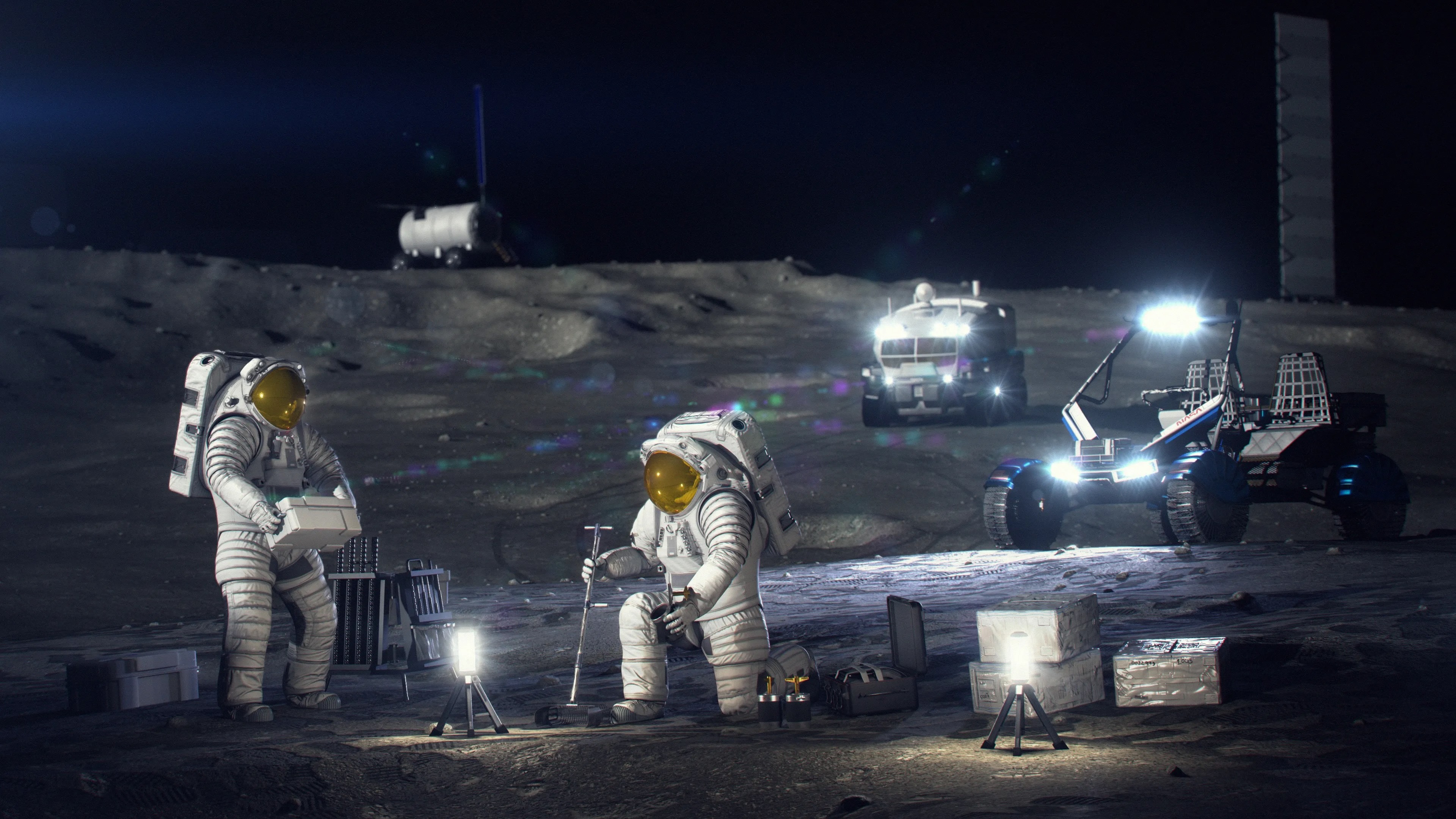
An artist’s concept of astronauts working on the lunar surface. (Image credit: NASA)
Isolated environments
Those of us who have been on long car rides in a group, or who remember being in tight quarters with roommates or family during the pandemic, have some idea of what an isolated, confined environment (ICE) feels like: crowded, with limited resources, and possessing few connections with the outside world. Space serves as just one example of a true ICE; isolated research bases (like in Antarctica) or submarines have also been studied in the literature, according to a separate 2021 study in the journal Neuroscience & Biobehavioral Reviews.
Put simply, ICE refers to a location where humans must work to a high standard in isolated and often dangerous circumstances, with only long-distance support (if possible) from a mission control or its equivalent. And, as the new study points out, a moon base would be a complex example of an isolated environment — one featuring not only resident astronauts but also rovers, other robots and occasional visiting crews.
"The premise for our modeling approach came from trying to understand better the human factors involved in crewed space missions, particularly the deep-space ones, for which we don't have a lot of historical data," Berea said.
That's because only a handful of people have traveled beyond low Earth orbit — the two dozen who flew to lunar realms on Apollo missions in the late 1960s and early 1970s, and the four astronauts of NASA's Artemis 2 flight around the moon this past April.
"We ran various scenarios of space mission durations, number of astronauts, potentially unforeseen circumstances that can happen on the lunar surface or the habitat," she said. The model suggested the missions with the highest probability of success would include six astronauts working on the moon at a time, with fresh supplies coming from Earth every two weeks, and no extreme fluctuations in the environment from things like radiation or a micrometeorite impact.
"In contrast, the worst-case scenario consists of four astronauts on the moon at one time, only one month resupply window between Earth and moon, and moderate to high adverse environmental probabilities," Berea said. And, when asked if training is a factor in mitigating adverse effects, she did not necessarily agree that the years of work NASA and other agency astronauts put in would be more effective than shorter-duration training used for moon base analogs.
"People can be very, very well trained, but for long-duration or deep-space missions, there will always be a human factor involved," she said. "We looked at combinations of skills and personalities in a team of astronauts, and there is a fine line between having a team that is too small and a team that is too large, and there are synergies and emergent behaviors that come from people interacting with each other and with their environment.
"The team is more than the sum of its people," she continued. "The best ways to overcome these is not by more training, but by fine-tuning other aspects of the missions: the duration of the mission, the frequency of resupply missions, and the contingency plans for accidents and unforeseen conditions in extreme environments."
NASA, however, puts its ISS crews through many years of remote environment training long before they float through the space station hatch — and Artemis 2 commander Reid Wiseman told The New Yorker that extensive psychosocial training led to the obvious closeness seen live among his own four lunar crewmates despite tight quarters (and vent line issues that led to occasional toilet trouble).
That psychological intervention during training was by design. "Preparation starts by recruiting mentally healthy people and then providing training to help them deal with potential situations and issues," wrote the Canadian Space Agency of this training, citing NASA protocols. "Astronauts repeat this training often enough that they can anticipate their own reactions and those of their teammates. They also receive constant support from teams on the ground and have access to a variety of tools to help them deal with potentially difficult situations."
Berea noted, however, that psychology forms a part (but is not the focus) of her teams' simulation, including considering NASA TLX (task load index) scores and data, which measures coping and stress for astronauts. The researchers also considered case studies from analogs including Antarctic research missions and time aboard submarines or oil rigs, as some examples.
"We need to pay attention not only to the astronauts, but the team as a whole, and each team and space mission are unique. We will not be able to model these with statistics or AI," she said. "But what we can do is to make sure that before we send any human to live and work on the moon, that we understand well the complexity of interactions and scenarios they will face during the mission, and we can help with that."
Humanity has likely dreamed of flight since the very beginning, marveling at birds soaring overhead and trying to puzzle out their seemingly magical secret.
We made some halting steps over the centuries — getting kites aloft in ancient China, for example, and drawing up ambitious but unrealized flying machines during the Renaissance — but our boots were still firmly rooted on the ground when the United States of America was born on July 4, 1776.
Things changed just a few years later, however. In November 1783, a hot-air balloon designed by the Montgolfier brothers carried two men on a 25-minute flight over Paris, beginning our species' exploration of the heavens.
Another 120 years passed before we managed to fly with a powered, heavier-than-air craft, a milestone notched by the Wright brothers in North Carolina on Dec. 17, 1903. Remarkably, it took us less than half that long to make the jump from the sky to the final frontier, which cosmonaut Yuri Gagarin did for the first time on April 12, 1961.
Eight years later, Apollo 11 astronauts Neil Armstrong and Buzz Aldrin walked on the moon — a remarkable achievement that was the climactic moment of the Cold War space race between the United States and the Soviet Union.
Over the next three and a half years, five more Apollo missions landed on Earth's nearest neighbor, leaving behind flags, footprints and defunct machinery. Now, more than half a century later, our species is gearing up to go back — but this time, in a much different way.
NASA wants to build a base near the moon's south pole over the next decade or so, an ambitious project the agency is undertaking via its Artemis program. And this is not an end in itself; NASA believes the knowledge gained from establishing such an outpost will help humanity make the next giant leap — to Mars.
The ball is rolling on Artemis, with two successful missions already in the books. Artemis I launched an uncrewed Orion capsule to lunar orbit and back in late 2022, and Artemis II sent four astronauts on a loop around the moon this past April. Next up is Artemis III, which will test docking procedures with one or both of the Artemis program's lunar landers (SpaceX's Starship and Blue Origin's Blue Moon) in Earth orbit in 2027. If all goes well with that flight, Artemis IV will put astronauts down near the lunar south pole, possibly as soon as 2028. (That timeline is far from guaranteed, however, as much development work remains. For example, neither Starship nor Blue Moon has yet reached Earth orbit or been cleared to carry humans.)
This is all happening in the context of a new space race, this time with China. The nation plans to land astronauts on the moon by 2030 and has been ticking boxes that keep this timeline within reach. And China aims to build a base of its own — also near the moon's south pole, which is thought to be rich in water ice — in collaboration with Russia and other partners.
What does all of this mean for the United States? Well, the nation came of age industrially after the Wright brothers' historic flight and has been a leader in aerospace tech and exploration ever since. The U.S. can accomplish amazing things in the final frontier, especially when pushed by a rival, so the years just after its 250th birthday may be quite eventful indeed. Stay tuned!
After Americans declared independence on July 4, 1776, a waning gibbous moon rose in the night sky. To the people celebrating the birth of a new nation, it would have looked much the same as the moon we see today. But there was one subtle difference: 250 years ago, the moon was about 31 feet (9.4 meters) closer to Earth than it is now.
"The moon is currently drifting away from Earth at a rate of about 3.8 centimeters [1.5 inches] per year, which is coincidentally roughly the same speed at which human fingernails grow," says Seth McGowan, president of the Adirondack Sky Center & Observatory in Tupper Lake, New York.
That 31 feet may sound significant, but against the moon's average distance from Earth of 238,855 miles (384,400 km), it's effectively nothing. In fact, the moon's elliptical orbit causes its distance from Earth to vary by about 26,000 miles (43,000 km) every month as it moves between perigee, its closest point to Earth, and apogee, its farthest. "The tiny 31-foot shift over 250 years is entirely swallowed up by that massive monthly variance," says McGowan. But while the moon itself looked much as it does today, the world beneath it was very different.
How Americans used the moon in 1776
Colonial Americans depended on the moon in ways that are easy to forget in an age of electric light and digital clocks. Travelers planned journeys around how much moonlight would be available on a given night. Farmers and Indigenous peoples consulted lunar cycles to anticipate seasonal changes. Mariners tracked the moon's pull on the tides. Even military planners considered lunar illumination — during the Revolutionary War, a moonlit night could aid troop movement and navigation, but it could also expose an army's position to enemy forces. The moon helped people organize their activities in an era when daily life remained closely tied to the natural world.
One of the most popular publications of the colonial era was the almanac. Long before weather apps — or even standardized timekeeping — Americans turned to these annual guides for practical information about moon phases, moonrise and moonset times, eclipses, tides, and seasonal events. Publications such as Benjamin Franklin's "Poor Richard's Almanack" helped popularize the format decades before independence, while later titles, such as"The Old Farmer's Almanac," first published in 1792, continued the tradition.
What astronomers knew about the moon in 1776
By the time the Declaration of Independence was signed, astronomers already understood a surprising amount about Earth's nearest neighbor. More than 160 years earlier, Galileo's telescopic observations had revealed mountains, valleys, and craters on the lunar surface, overturning the ancient notion that heavenly bodies were perfect spheres. Isaac Newton's laws of motion and gravitation had since explained why the moon orbited Earth and why tides occurred.
While astronomers could predict eclipses and chart the moon's movements with impressive accuracy, they had never seen the moon's far side, had no idea how it formed, and couldn't say with confidence what it was made of. All of that would come centuries later — and there are still many lunar unknowns today.
How Apollo astronauts revealed the moon's slow escape
During the Apollo missions, we learned an extraordinary amount of new information about the moon, including the rate at which it's moving away from Earth. Apollo astronauts installed retroreflectors — special mirrors designed to bounce light directly back toward its source—on the lunar surface. Scientists then fired lasers at those reflectors to measure how long it takes the light to return, allowing them to calculate the Earth-moon distance with extraordinary precision. (Fun fact: We continue to use the retroreflectors today!) Those measurements revealed that the moon is receding from Earth at about 1.5 inches (3.8 cm) per year.
"The moon's gravity pulls on Earth's oceans, creating a tidal bulge," says McGowan. "Because Earth rotates faster than the moon orbits us, that ocean bulge pulls slightly ahead of the moon, acting like a cosmic gravitational leash that accelerates the moon into a higher, wider orbit. In doing so, the Earth's rotation slows ever so slightly — about 2.3 milliseconds per century. "Back in 1776, a day on Earth was about 5.75 milliseconds shorter than it is now," says McGowan.
This effect is imperceptible on human timescales, but over millions of years, it will have dramatic consequences. Eventually, the moon will appear too small in Earth's sky to completely cover the sun, ending the era of total solar eclipses and leaving only annular, or "ring of fire," eclipses in their place. The moon will never completely free itself from Earth, though — physics dictates that the drift will stop after about 15 billion years. And well before that, in about 5 billion years, the sun will expand into a red giant, consuming both the Earth and the moon entirely.
Jared Isaacman is doing his best to spur his country on to sporting glory.
The NASA chief announced on Tuesday (June 30) that the agency will send a FIFA World Cup 2026 soccer ball to the moon if the U.S. men's national team manages to win the tournament, which is going on right now.
"So, a little bit of motivation for the United States here on this one," Isaacman said during a livestreamed press event on Tuesday. "We're going to one-up Alan Shepard in the golf game on the lunar surface, and we're going to get the soccer ball there."
Shepard famously smuggled two golf balls and an improvised club onto the Apollo 14 mission, which he commanded. On Feb. 6, 1971, the NASA astronaut hit those balls on the moon, becoming the first person ever to play a sport on another world.
The soccer-ball plan, by contrast, would be a sanctioned affair; Isaacman and Carlos García-Galán, manager of NASA's Moon Base program, are both behind it.
"I don't know which lander it'll wind up going in," Isaacman said during Tuesday's event, the second of the agency's monthly updates about its plans to build a crewed outpost near the lunar south pole via its Artemis program.
Turning to García-Galán, he added, "I'll leave that to you guys, to handle the payload."
"We will take on that challenge," García-Galán replied. "It will be super exciting to do that if they win. Good luck."
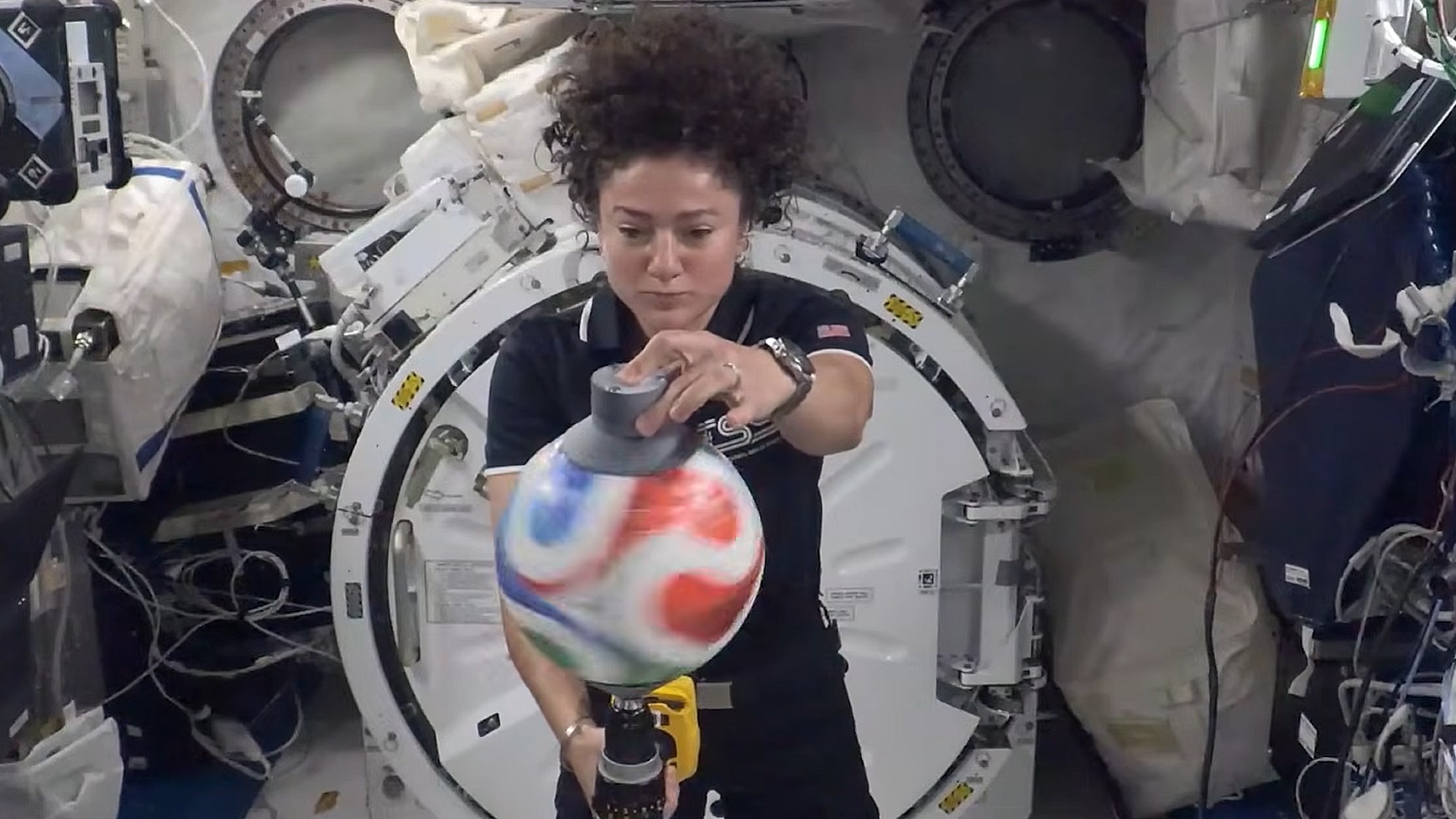
NASA astronaut Jessica Meir spins a FIFA World Cup 2026 soccer ball in microgravity aboard the ISS. (Image credit: NASA)
The U.S. men's team will probably need some luck to win the World Cup, an every-four-year event that's currently being jointly hosted by the U.S., Canada and Mexico. The American men have won just two knockout-round games in the entire history of the tournament, and one of those came in 1930, during the first-ever World Cup.
The 2026 team has performed better than most of its predecessors to this point, however; the Americans won their four-team group to advance to the single-elimination stage, beating both Paraguay and Australia before losing a meaningless game to Turkiye. (The U.S. had already clinched the group win at that point.)
The U.S. plays Bosnia-Herzegovina in a Round of 32 match on Wednesday (July 1). To hoist the World Cup trophy, the Americans would have to win that game, then four more after that, likely against some perennial soccer powers.
If they make it to the quarterfinals, for example, they'll likely face Spain, which won the World Cup in 2010 — a potential matchup flagged by García-Galán, who's from Málaga.
The U.S. women's soccer team has enjoyed a great deal more success at the international level, winning four of the nine FIFA Women's World Cups to date. (The women's tournament, which is also held every four years, was first played in 1991.)
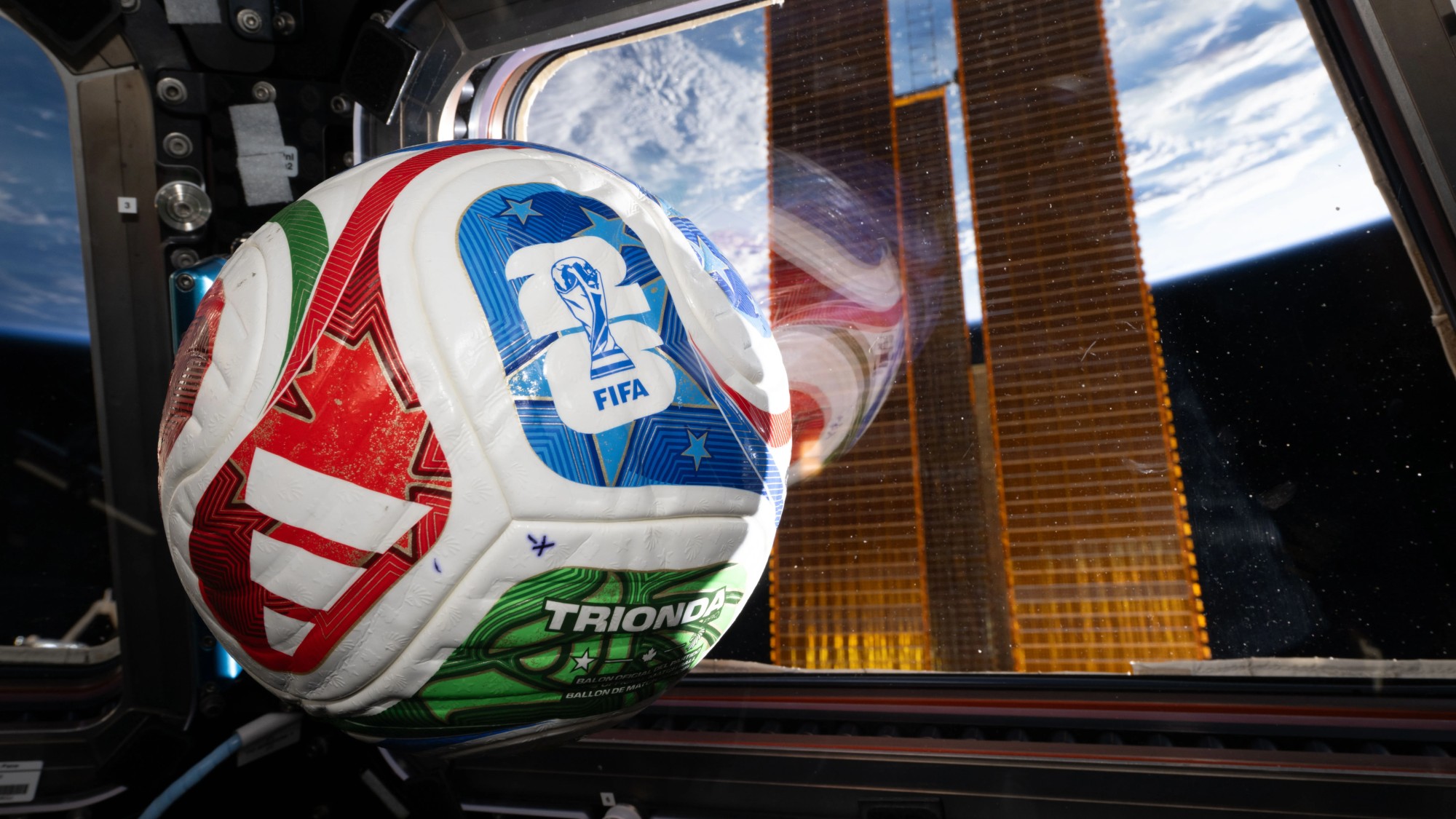
The FIFA World Cup 2026 soccer ball on the International Space Station. (Image credit: NASA)
"We're working to inspire the next generation by showing how space exploration inspires innovation in sports science — and everyday life," the agency said via X on June 20, in a post that included video of the off-Earth action.