No more space race rhetoric: it’s not just about the US any more
Increasingly nationalistic language around space exploration is distracting us from science that we can only do collaboratively, says Lisa Grossman

Science and reality



Synaptic-density images of the human brain, derived from PET scans. The sequential images are coronal slices (from front to back of the brain), sagittal slices (from left to right), and transverse images (from bottom to top). (credit: Video by Yale PET Center)
How many of the estimated 100 trillion synapses in your brain are actually functioning? It’s an important question for diagnosis and treatment of people with common brain disorders, such as epilepsy, Alzheimer’s disease, autism, depression, schizophrenia, and traumatic brain injury (TBI), but one that could not be answered, except in an autopsy (or an invasive surgical sample of a small area).
Now a Yale-led team of researchers has developed a way to measure the density of synapses in the brain using a PET (positron emission tomography) scan. They invented a radioligand (a radioactive tracer that, when injected into the body, binds to a type of protein and “lights up” during a PET scan) called [11C]UCB-J that allows for imaging a protein (called SV2A) that is uniquely present in all synapses in the brain.
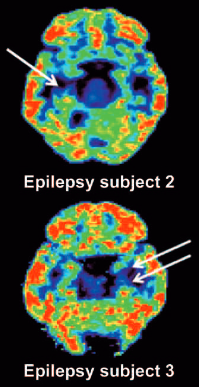
PET scan reveals unilateral mesial temporal sclerosis in epilepsy patients (white arrows indicate loss of [11C]UCB-J binding in the mesial temporal lobe). (credit: Sjoerd J. Finnema et al./Science Translational Medicine)
With this noninvasive method, researchers may now be able to follow the progression of many brain disorders by measuring changes in synaptic density over time or assess how well pharmaceuticals slow the loss of neurons.
Professor of radiology and biomedical imaging Richard Carson and his team plan future studies involving PET imaging of synapses for a variety of brain disorders.
Published July 20 in Science Translational Medicine, the study was supported in part by the Swebilius Foundation, UCB Pharma, and the National Center for Advancing Translational Science, a component of the National Institutes of Health.
Abstract of Imaging synaptic density in the living human brain
Chemical synapses are the predominant neuron-to-neuron contact in the central nervous system. Presynaptic boutons of neurons contain hundreds of vesicles filled with neurotransmitters, the diffusible signaling chemicals. Changes in the number of synapses are associated with numerous brain disorders, including Alzheimer’s disease and epilepsy. However, all current approaches for measuring synaptic density in humans require brain tissue from autopsy or surgical resection. We report the use of the synaptic vesicle glycoprotein 2A (SV2A) radioligand [11C]UCB-J combined with positron emission tomography (PET) to quantify synaptic density in the living human brain. Validation studies in a baboon confirmed that SV2A is an alternative synaptic density marker to synaptophysin. First-in-human PET studies demonstrated that [11C]UCB-J had excellent imaging properties. Finally, we confirmed that PET imaging of SV2A was sensitive to synaptic loss in patients with temporal lobe epilepsy. Thus, [11C]UCB-J PET imaging is a promising approach for in vivo quantification of synaptic density with several potential applications in diagnosis and therapeutic monitoring of neurological and psychiatric disorders.
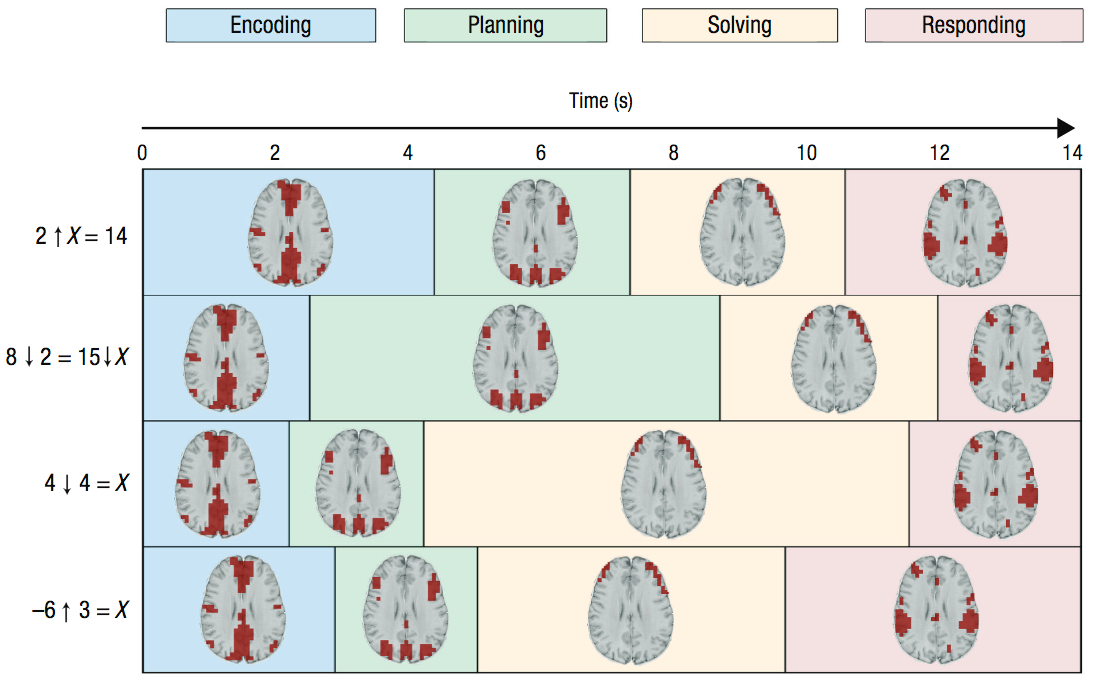
Durations of four stages associated with problem solving and corresponding MRI images. In the four example problems (left), the arrows denote new mathematical operators that participants had learned. Color coding reflects the durations of the stages. (credit: John R. Anderson et al./Psychological Science)
Using neuroimaging data, Carnegie Mellon University researchers have identified four distinct stages of math problem solving, according to a new study published in the journal Psychological Science.
“How students were solving these kinds of problems was a total mystery to us until we applied these techniques,” says psychological scientist John Anderson, lead researcher on the study. “Now, when students are sitting there thinking hard, we can tell what they are thinking each second.”
Insights from this work may eventually be applied to the design of more effective classroom instruction, says Anderson.
Combining pattern analysis and hidden semi-Markov models
Anderson combined two analytical approaches — multivoxel pattern analysis (MVPA) and hidden semi-Markov models (HSMM) — to shed light on the different stages of thinking. MVPA has typically been used to identify momentary patterns of activation; adding HSMM, Anderson hypothesized, would yield information about how these patterns play out over time.
The researchers applied this combined approach to neuroimaging data collected from participants as they solved specific types of math problems. To gauge whether the stages that were identified mapped on to actual stages of thinking, the researchers manipulated different features of the math problems; some problems required more effort in coming up with an appropriate solution plan and others required more effort in executing the solution.
The aim was to test whether these manipulations had the specific effects one would expect on the durations of the different stages.
Stages of cognition
The researchers identified four stages of cognition: encoding, planning, solving, and responding. The planning stage tended to be longer when the problem required more planning, and the solution stage tended to be longer when the solution was more difficult to execute, indicating that the method mapped onto real stages of cognition that were differentially affected by various features of the problems.
“Typically, researchers have looked at the total time to complete a task as evidence of the stages involved in performing that task and how they are related,” says Anderson. “The methods in this paper allow us to measure the stages directly.”
Although the study focused specifically on mathematical problem solving, the method holds promise for broader application, the researchers argue. Using the same method with brain imaging techniques that have greater temporal resolution, such as EEG, could reveal even more detailed information about the various stages of cognitive processing.
This work was supported by a National Science Foundation grant and by a James S. McDonnell Foundation Scholar Award.
Abstract of Hidden Stages of Cognition Revealed in Patterns of Brain Activation
To advance cognitive theory, researchers must be able to parse the performance of a task into its significant mental stages. In this article, we describe a new method that uses functional MRI brain activation to identify when participants are engaged in different cognitive stages on individual trials. The method combines multivoxel pattern analysis to identify cognitive stages and hidden semi-Markov models to identify their durations. This method, applied to a problem-solving task, identified four distinct stages: encoding, planning, solving, and responding. We examined whether these stages corresponded to their ascribed functions by testing whether they are affected by appropriate factors. Planning-stage duration increased as the method for solving the problem became less obvious, whereas solving-stage duration increased as the number of calculations to produce the answer increased. Responding-stage duration increased with the difficulty of the motor actions required to produce the answer.
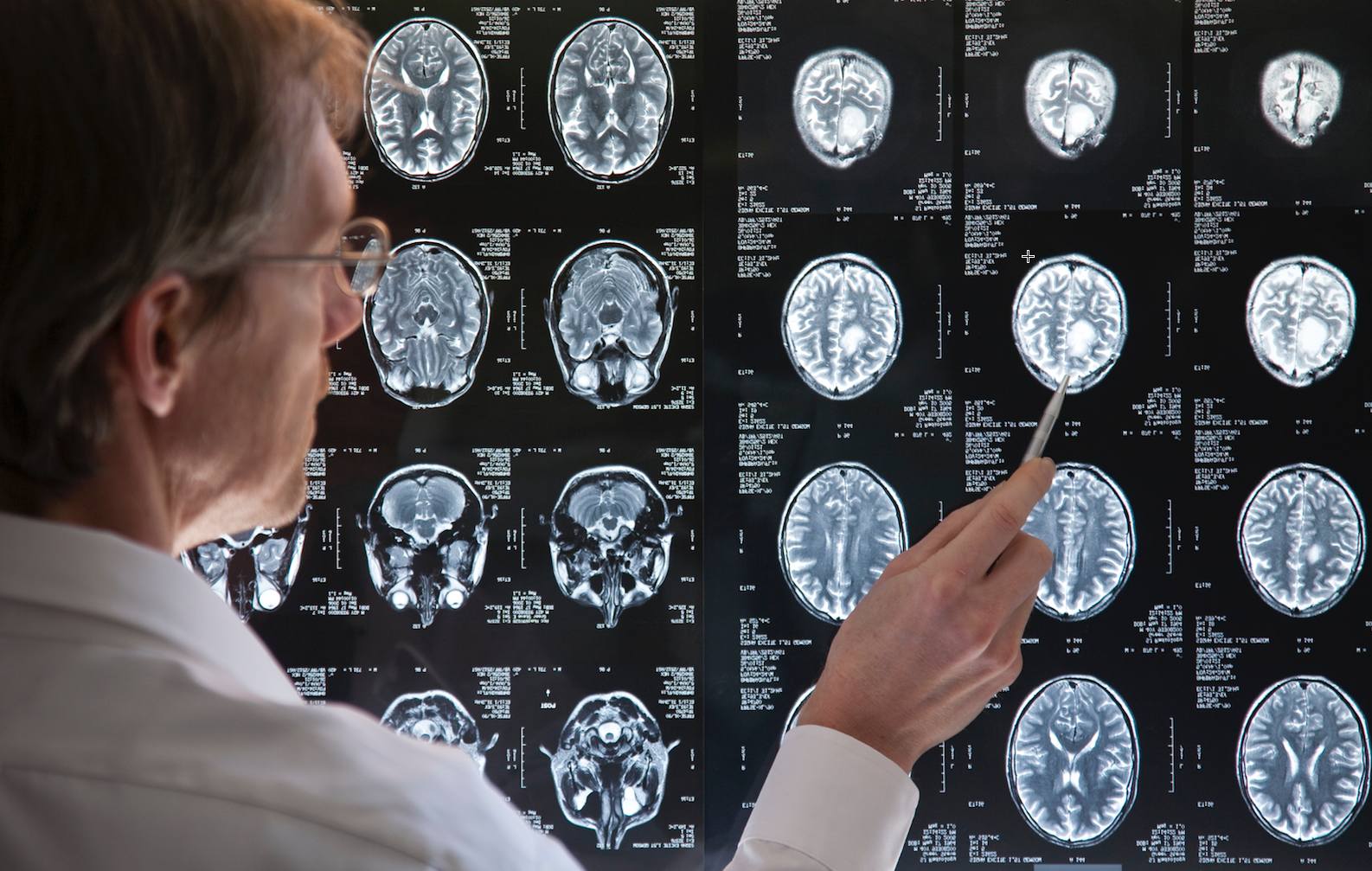
(credit: iStock)
Cognitive brain training improves executive function while aerobic activity improves memory, according to a new study by the Center for BrainHealth at The University of Texas at Dallas.
The study, published in an open-access paper in Frontiers in Human Neuroscience, compared cerebral blood flow and cerebrovascular reactivity data, obtained via MRI, for two groups of healthy sedentary adults ages 56–75 years. The members of both groups participated in training three hours per week over 12 weeks.
Cognitive training group
This group participated in cognitive training called Strategic Memory Advanced Reasoning Training (SMART), developed at the Center for BrainHealth. It focuses on three executive functions: strategic attention (prioritizing brain resources); integrative reasoning (synthesizing information at a deeper level); and innovation (encouraging fluid thinking, diverse perspective-taking, and problem solving).
The group demonstrated positive changes in executive brain function and a 7.9 percent increase in global brain flow.
“We can lose 1–2 percent in global brain blood flow every decade, starting in our 20s. To see almost an 8 percent increase in brain blood flow may be seen as regaining decades of brain health, since blood flow is linked to neural health,” said Sandra Bond Chapman, PhD, study lead author, founder and chief director of the Center for BrainHealth, and Dee Wyly Distinguished University Professor.
“We believe the reasoning training triggered neural plasticity by engaging the brain networks involved in staying focused on a goal, such as writing a brief business proposal, while continuously adapting to new information, such as feedback from a collaborator,” Chapman said.
Aerobic exercise group
The aerobic exercise group completed three, 60-minute sessions per week that included five minutes of warmup and cool down with 50 minutes of either walking on a treadmill or cycling on a stationary bike while maintaining 50–75 percent of maximum heart rate. It was designed to meet health guidelines for adults.
The group showed increases in immediate and delayed memory performance, with higher cerebral blood flow in the bilateral hippocampi, an area underlying memory function and particularly vulnerable to aging and dementia. But the group did not show significant global blood flow gains.
This work was supported by a grant from the National Institutes of Health and by grants from the Lyda Hill Foundation, T. Boone Pickens Foundation, and the Dee Wyly Distinguished University Endowment.
Insidious declines in normal aging are well-established. Emerging evidence suggests that non-pharmacological interventions, specifically cognitive and physical training, may counter diminishing age-related cognitive and brain functions. This randomized trial compared effects of two training protocols: cognitive training (CT) vs. physical training (PT) on cognition and brain function in adults 56–75 years. Sedentary participants (N = 36) were randomized to either CT or PT group for 3 h/week over 12 weeks. They were assessed at baseline-, mid-, and post-training using neurocognitive, MRI, and physiological measures. The CT group improved on executive function whereas PT group’s memory was enhanced. Uniquely deploying cerebral blood flow (CBF) and cerebral vascular reactivity (CVR) MRI, the CT cohort showed increased CBF within the prefrontal and middle/posterior cingulate cortex (PCC) without change to CVR compared to PT group. Improvements in complex abstraction were positively associated with increased resting CBF in dorsal anterior cingulate cortex (dACC). Exercisers with higher CBF in hippocampi bilaterally showed better immediate memory. The preliminary evidence indicates that increased cognitive and physical activity improves brain health in distinct ways. Reasoning training enhanced frontal networks shown to be integral to top-down cognitive control and brain resilience. Evidence of increased resting CBF without changes to CVR implicates increased neural health rather than improved vascular response. Exercise did not improve cerebrovascular response, although CBF increased in hippocampi of those with memory gains. Distinct benefits incentivize testing effectiveness of combined protocols to strengthen brain health.