
After years of government cutbacks, a new government may restore funding–and freedom of speech.
The post Canada’s New Government May Be a New Beginning for Science appeared first on WIRED.

Science and reality
After years of government cutbacks, a new government may restore funding–and freedom of speech.
The post Canada’s New Government May Be a New Beginning for Science appeared first on WIRED.

For a real laugh, look no further than the original patent applications of your favorite old-school novelty products.
The post What’s Inside Silly String: The Secret’s in the Solvent appeared first on WIRED.

Space photos of the week, October 18–24.
The post Space Photos of the Week: These Double Stars Gotta Go appeared first on WIRED.

Complex natural systems defy standard mathematical analysis, so one ecologist is throwing out the equations.
The post Is It Foolish to Model Nature’s Complexity With Equations? appeared first on WIRED.
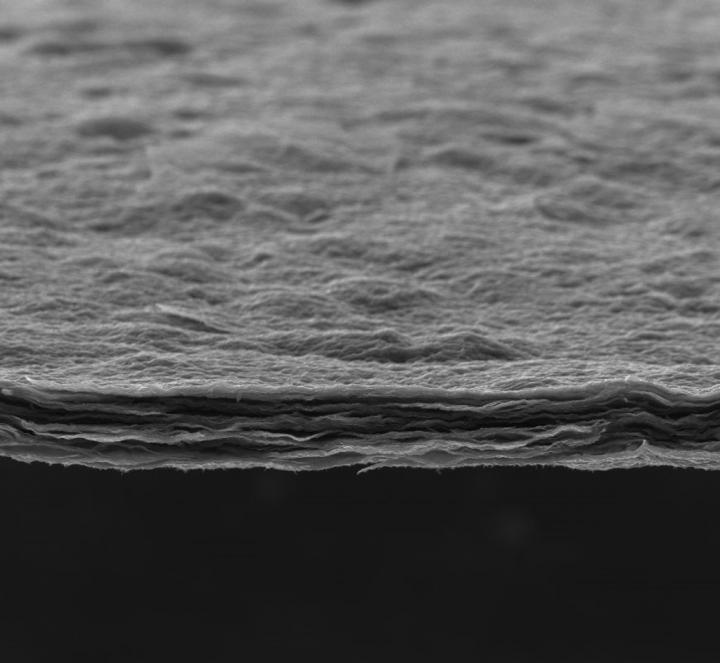
A new catalyst just 15 microns thick has proven nearly as effective as platinum-based catalysts but at a much lower cost, according to scientists at Rice University. The catalyst is made of nitrogen-doped graphene with individual cobalt atoms that activate the process. (credit: Tour Group/Rice University)
Graphene doped with nitrogen and augmented with cobalt atoms has proven to be an effective, durable catalyst for the production of hydrogen from water, according to scientists at Rice University.
The Rice University lab of chemist James Tour and colleagues has developed a robust, solid-state catalyst that shows promise to replace expensive platinum for hydrogen generation. (Catalysts can split water into its constituent hydrogen and oxygen atoms, a process required for fuel cells.)
The latest discovery, detailed in Nature Communications, is a significant step toward lower-cost catalysts for energy production, according to the researchers.

Disordered graphitic carbon doped with nitrogen and augmented with cobalt atoms serves as an efficient, robust catalyst for hydrogen separation from water. The material discovered at Rice University could challenge more expensive platinum-based catalysts. (credit: Tour Group/Rice University)
Cost-effective replacement for platinum
“What’s unique about this paper is that we show … the use of atoms,” Tour said, instead of the conventional use of metal particles or nanoparticles. “The particles doing this chemistry are as small as you can possibly get.”
Even particles on the nanoscale work only at the surface, he explained. “There are so many atoms inside the nanoparticle that never do anything. But in our process, the atoms driving catalysis have no metal atoms next to them. We’re getting away with very little cobalt to make a catalyst that nearly matches the best platinum catalysts.” He said that in comparison tests, the new material nearly matched platinum’s efficiency to begin reacting at a low onset voltage (the amount of electricity it needs to begin separating water into hydrogen and oxygen).
The researchers discovered that heat-treating graphene oxide and small amounts of cobalt salts in a gaseous environment forced individual cobalt atoms to bind to the material. Electron microscope images showed cobalt atoms widely dispersed throughout the samples. They also tested nitrogen-doped graphene on its own and found it lacked the ability to kick the catalytic process into gear. But adding cobalt in very small amounts significantly increased its ability to split acidic or basic water.
The new catalyst is mixed as a solution and can be reduced to a paper-like material or used as a surface coating. Tour said single-atom catalysts have been realized in liquids, but rarely on a surface. “This way we can build electrodes out of it,” he said. “It should be easy to integrate into devices.”

Cobalt atoms shine in an electron microscope image of a new catalyst for hydrogen production invented at Rice University. The widely separated cobalt atoms are bound to a sheet of nitrogen-doped graphene. (credit: Tour Group/Rice University)
“This is an extremely high-performance material,” Tour added. He noted platinum-carbon catalysts still boast the lowest onset voltage. “No question, they’re the best. But this is very close to it and much easier to produce and hundreds of times less expensive.”
Atom-thick graphene is the ideal substrate, Tour said, because of its high surface area, stability in harsh operating conditions, and high conductivity. Samples of the new catalyst showed a negligible decrease in activity after 10 hours of accelerated degradation studies in the lab.
Rice colleagues at the Chinese Academy of Sciences, the University of Texas at San Antonio, and the University of Houston were also involved in the research.
Rice University | H2 evolution
Reduction of water to hydrogen through electrocatalysis holds great promise for clean energy, but its large-scale application relies on the development of inexpensive and efficient catalysts to replace precious platinum catalysts. Here we report an electrocatalyst for hydrogen generation based on very small amounts of cobalt dispersed as individual atoms on nitrogen-doped graphene. This catalyst is robust and highly active in aqueous media with very low overpotentials (30 mV). A variety of analytical techniques and electrochemical measurements suggest that the catalytically active sites are associated with the metal centres coordinated to nitrogen. This unusual atomic constitution of supported metals is suggestive of a new approach to preparing extremely efficient single-atom catalysts.
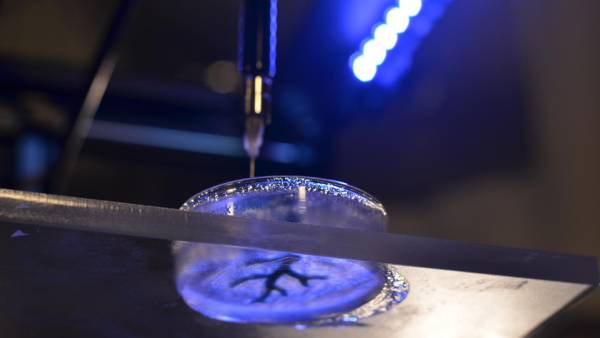
Coronary artery structure being 3-D bioprinted (credit: Carnegie Mellon University College of Engineering)
Carnegie Mellon scientists are creating cutting-edge technology that could one day solve the shortage of heart transplants, which are currently needed to repair damaged organs.
“We’ve been able to take MRI images of coronary arteries and 3-D images of embryonic hearts and 3-D bioprint them with unprecedented resolution and quality out of very soft materials like collagens, alginates and fibrins,” said Adam Feinberg, an associate professor of Materials Science and Engineering and Biomedical Engineering at Carnegie Mellon University.
Feinberg leads the Regenerative Biomaterials and Therapeutics Group, and the group’s study was published in an open-access paper today (Oct. 23) in the journal Science Advances.
College of Engineering, Carnegie Mellon University | Adam Feinberg Demonstrates 3-D Bioprinting Process
“The challenge with soft materials is that they collapse under their own weight when 3-D printed in air,” explained Feinberg. “So we developed a method of printing these soft materials inside a support bath material. Essentially, we print one gel inside of another gel, which allows us to accurately position the soft material as it’s being printed, layer-by-layer.”
A FRESH idea

A schematic of the FRESH process showing the hydrogel (green) — representing an artery — being added to the gelatin slurry support bath (yellow). The 3D object is built layer by layer and, when completed, is released by heating to 37°C and melting the gelatin. (credit: Thomas J. Hinton et al./Science Advances)
With this new FRESH (Freeform Reversible Embedding of Suspended Hydrogels) technique, after printing, the support gel can be easily melted away and removed by heating to body temperature, which does not damage the delicate biological molecules or living cells that were bioprinted.

(Left) A model of a section of a human right coronary arterial tree created from a 3D MRI image is processed at full scale into machine code for FRESH printing. (Right) An example of the arterial tree printed in alginate (black) and embedded in the gelatin slurry support bath. Scale bar: 10 mm. (credit: Thomas J. Hinton et al./Science Advances)
As a next step, the group is working toward incorporating real heart cells into these 3-D printed tissue structures, providing a scaffold to help form contractile muscle.
Accessible bioprinters
Most 3-D bioprinters cost more than $100,000 and/or require specialized expertise to operate, limiting wider-spread adoption. Feinberg’s group, however, has been able to implement their technique on a range of consumer-level 3-D printers, which cost less than $1,000 and use open-source hardware and software.
“Not only is the cost low, but by using open-source software, we have access to fine-tune the print parameters, optimize what we’re doing, and maximize the quality of what we’re printing,” Feinberg said.
More than 4,000 Americans are currently on the waiting list to receive a heart transplant. With failing hearts, these patients have no other options; heart tissue, unlike other parts of the body, is unable to heal itself once it is damaged.

Abstract of Three-dimensional printing of complex biological structures by freeform reversible embedding of suspended hydrogels
We demonstrate the additive manufacturing of complex three-dimensional (3D) biological structures using soft protein and polysaccharide hydrogels that are challenging or impossible to create using traditional fabrication approaches. These structures are built by embedding the printed hydrogel within a secondary hydrogel that serves as a temporary, thermoreversible, and biocompatible support. This process, termed freeform reversible embedding of suspended hydrogels, enables 3D printing of hydrated materials with an elastic modulus <500 kPa including alginate, collagen, and fibrin. Computer-aided design models of 3D optical, computed tomography, and magnetic resonance imaging data were 3D printed at a resolution of ~200 μm and at low cost by leveraging open-source hardware and software tools. Proof-of-concept structures based on femurs, branched coronary arteries, trabeculated embryonic hearts, and human brains were mechanically robust and recreated complex 3D internal and external anatomical architectures.
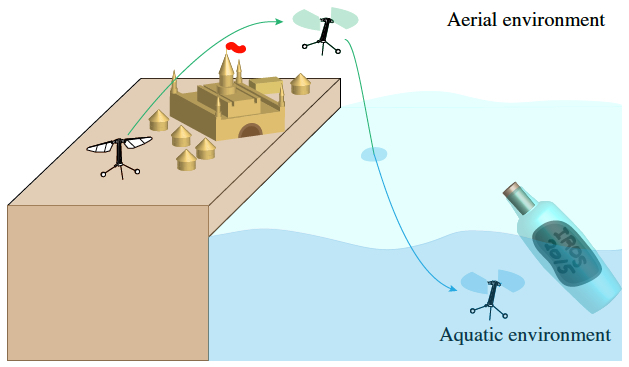
The Harvard RoboBee concept (credit: Harvard Microrobotics Lab)
In 1939, Russian engineer Boris Ushakov proposed a “flying submarine” — a cool James Bond-style vehicle that could seamlessly transition from air to water and back again. Ever since, engineers have been trying to design one, with little success. The biggest challenge: aerial vehicles require large airfoils like wings or sails to generate lift, while underwater vehicles need to minimize surface area to reduce drag.
Engineers at the Harvard John A. Paulson School of Engineering and Applied Science (SEAS) decided to try that a new version of their RoboBee microbot (see “A robotic insect makes first controlled test flight“), taking a clue from puffins. These birds with flamboyant beaks employ flapping motions that are similar in air and water.
Harvard University | RoboBee: From Aerial to Aquatic
But to make that actually work, the team had to first solve four thorny problems:
Surface tension. The RoboBee is so small and lightweight that it cannot break the surface tension of the water. To overcome this hurdle, the RoboBee hovers over the water at an angle, momentarily switches off its wings, and then crashes unceremoniously into the water to make itself sink.
Water’s increased density (1,000 times denser than air), which would snap the wing off the RoboBee. Solution: the team lowered the wing speed from 120 flaps per second to nine but kept the flapping mechanisms and hinge design the same. A swimming RoboBee simply changes its direction by adjusting the stroke angle of the wings, the same way it does in air.
Shorting out. Like the flying version, it’s tethered to a power source. Solution: use deionized water and coat the electrical connections with glue.
Moving from water to air. Problem: it can’t generate enough lift without snapping one of its wings. They researchers say they’re working on that next.
“We believe the RoboBee has the potential to become the world’s first successful dual aerial, aquatic insect-scale vehicle,” the researchers claim in a paper presented at the International Conference on Intelligent Robots and Systems in Germany. The research was funded by the National Science Foundation and the Wyss Institute for Biologically Inspired Engineering.
Hmm, maybe we’ll see a vehicle based on the RoboBee in a future Bond film?


Global climate change and El Niño combined to brew up the strongest hurricane ever recorded.
The post Thank El Niño and Climate Change for Huge Hurricane Patricia appeared first on WIRED.
