
Sometimes, the best places to do science are also the most remote.
The post Scientists Who Tweet From Ridiculously Remote Places appeared first on WIRED.

Science and reality
Sometimes, the best places to do science are also the most remote.
The post Scientists Who Tweet From Ridiculously Remote Places appeared first on WIRED.


October 23 is Mole Day and we celebrate Avogadro's number. But what is a mole and how do you find it?
The post Even Avogadro Didn’t Know Avogadro’s Number appeared first on WIRED.

Let us explore the strange game that is different kinds of parasitic river critters trying to impregnate each other with their offspring.
The post Absurd Creature of the Week: This Crafty Fish Turns Mussels Into Its Surrogate Parents appeared first on WIRED.


SynCav1 gene delivery enhances granule cell neuron dendritic arborization (neuron branching in adult mice. Scale bar: 20 micrometers. (credit: Chitra D. Mandyam et al./Biological Psychiatry)
Using gene therapy to increase a crucial cholesterol-binding membrane protein called caveolin-1 (Cav-1) in neurons in the hippocampus* of the brain improved learning and memory in aged mice, according to findings from a new study led by scientists at The Scripps Research Institute (TSRI), the Veterans Affairs San Diego Healthcare System (VA) and University of California (UC) San Diego School of Medicine.
The result for treated mice was improved neuron growth and better retrieval of contextual memories — they froze in place, an indication of fear, when placed in a location where they’d once received small electric shocks.
The researchers believe that this type of gene therapy may be a path toward treating age-related memory loss, including loss resulting from alcohol and drug use. The researchers are now testing this gene therapy in mouse models of Alzheimer’s disease and expanding it to possibly treat injuries such as spinal cord injury and traumatic brain injury. ”
The study, published recently online ahead of print in the journal Biological Psychiatry, expands scientists’ understanding of neuroplasticity, the ability of neural pathways to grow in response to new stimuli.
* The hippocampus is a structure in the brain thought to participate in the formation of contextual memories — for example, if one remembers a past picnic when later visiting a park.
Abstract of Neuron-targeted caveolin-1 improves molecular signaling, plasticity and behavior dependent on the hippocampus in adult and aged mice
Background: Studies in vitro demonstrate that neuronal membrane/lipid rafts (MLRs) establish cell polarity by clustering pro-growth receptors and tethering cytoskeletal machinery necessary for neuronal sprouting. However, the effect of MLR and MLR-associated proteins on neuronal aging is unknown.
Methods: Here we assessed the impact of neuron-targeted overexpression of a MLR scaffold protein, caveolin-1 (via a synapsin promoter; SynCav1), in the hippocampus in vivo in adult (6-months-old) and aged (20-month-old) mice on biochemical, morphologic and behavioral changes.
Results: SynCav1 resulted in increased expression of Cav-1, MLRs, and MLR-localization of Cav-1 and tropomyosin-related kinase B (TrkB) receptor independent of age and time post gene transfer. Cav-1 overexpression in adult mice enhanced dendritic arborization within the apical dendrites of hippocampal CA1 and granule cell neurons, effects that were also observed in aged mice, albeit to a lesser extent, indicating preserved impact of Cav-1 on structural plasticity of hippocampal neurons with age. Cav-1 overexpression enhanced contextual fear memory in adult and aged mice demonstrating improved hippocampal function.
Conclusions: Neuron-targeted overexpression of Cav-1 in the adult and aged hippocampus enhances functional MLRs with corresponding roles in cell signaling and protein trafficking. The resultant structural alterations in hippocampal neurons in vivo are associated with improvements in hippocampal dependent learning and memory. Our findings suggest Cav-1 as a novel therapeutic strategy in disorders involving impaired hippocampal function.

Mass extinctions occurring over the past 260 million years were likely caused by comet and asteroid showers, a new study concludes. An artist’s illustration of a major asteroid impact on Earth. (credit: NASA/Don Davis)
Mass extinctions occurring over the past 260 million years were likely caused by comet and asteroid showers, scientists conclude in a new study published in an open-access paper in Monthly Notices of the Royal Astronomical Society.
For more than 30 years, scientists have argued about a controversial hypothesis relating to periodic mass extinctions and impact craters — caused by comet and asteroid showers — on Earth.
In their MNRAS paper, Michael Rampino, a New York University geologist, and Ken Caldeira, a scientist in the Carnegie Institution’s Department of Global Ecology, offer new support linking the age of these craters with recurring mass extinctions of life every 26 million years, including the demise of dinosaurs.
This cycle has been linked to periodic motion of the sun and planets through the dense mid-plane of our galaxy. Scientists have theorized that gravitational perturbations of the distant Oort comet cloud that surrounds the sun lead to periodic comet showers in the inner solar system, where some comets strike the Earth.
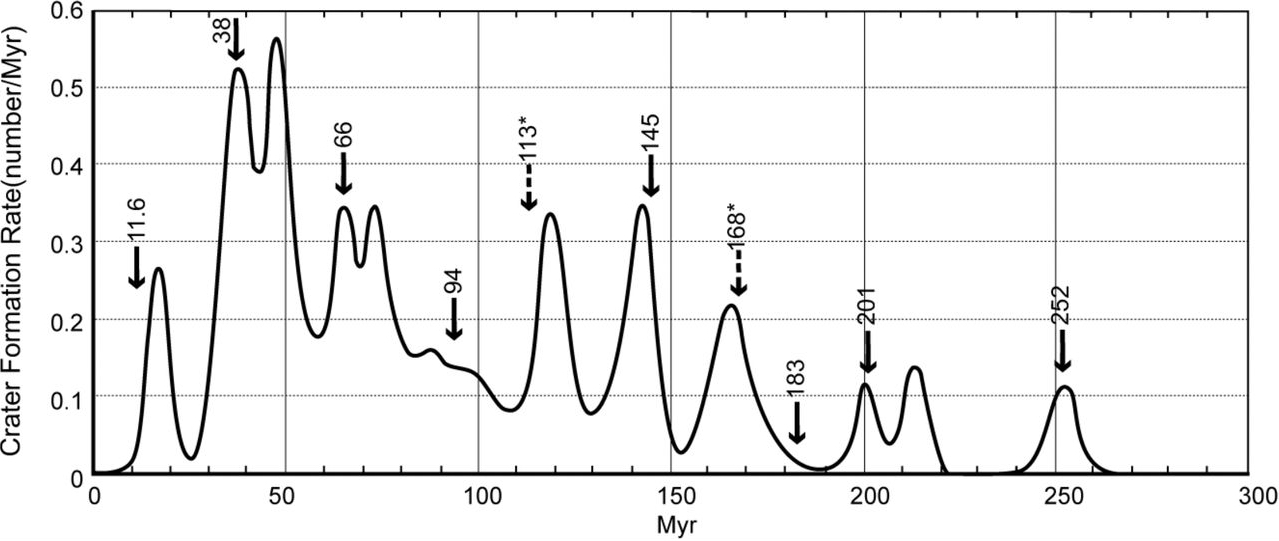
Crater formation rate per million years, with eight significant extinction events shown with solid arrows and two potential extinction events shown with broken arrows (credit: Michael R. Rampino and Ken Caldeira/MNRAS)
To test their hypothesis, Rampino and Caldeira performed time-series analyses of impacts and extinctions using newly available data offering more accurate age estimates. “The correlation between the formation of these impacts and extinction events over the past 260 million years is striking and suggests a cause-and-effect relationship,” says Rampino.

The sinkholes clustered around the trough of the Chicxulub crater suggest a prehistoric oceanic basin in the depression left by the impact. (credit: NASA)
One of the craters considered in the study is the large (180 km diameter) Chicxulub impact structure in the Yucatan, which dates at about 65 million years ago — the time of a great mass extinction that included the dinosaurs. And five out of the six largest impact craters of the last 260 million years on earth correlate with mass extinction events.
Abstract of Periodic impact cratering and extinction events over the last 260 million years
The claims of periodicity in impact cratering and biological extinction events are controversial. A newly revised record of dated impact craters has been analyzed for periodicity, and compared with the record of extinctions over the past 260 Myr. A digital circular spectral analysis of 37 crater ages (ranging in age from 15 to 254 Myr ago) yielded evidence for a significant 25.8 ± 0.6 Myr cycle. Using the same method, we found a significant 27.0 ± 0.7 Myr cycle in the dates of the eight recognized marine extinction events over the same period. The cycles detected in impacts and extinctions have a similar phase. The impact crater dataset shows 11 apparent peaks in the last 260 Myr, at least 5 of which correlate closely with significant extinction peaks. These results suggest that the hypothesis of periodic impacts and extinction events is still viable.

You can't prove science with public relations.
The post OK, Theranos: Here’s the Data the World Needs to See appeared first on WIRED.
You can't prove science with public relations.
The post OK, Theranos: Here’s the Data the World Needs to See appeared first on WIRED.
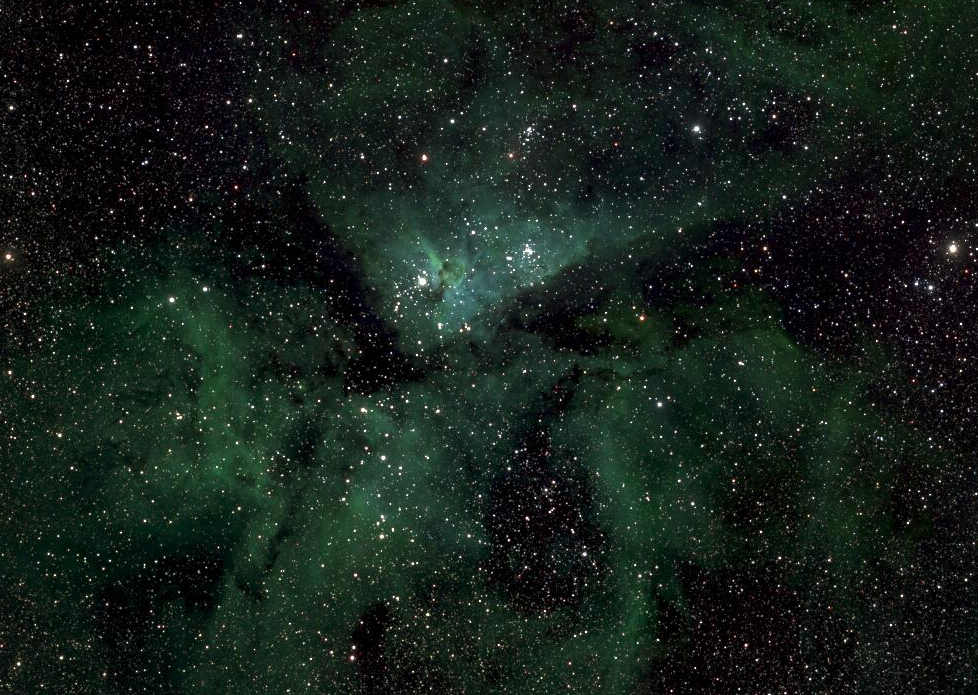
A small section of the Milky Way photo showing the star Eta Carinae (credit: Lehrstuhl für Astrophysik/RUB)
Astronomers at the Ruhr-Universität Bochum in Germany have compiled the largest astronomical image to date: a picture of the Milky Way containing 46 billion pixels, viewable here (you can enter an object name, such as “Eta Carinae,” in the lower-left box).
The image was generated over a period of five years of astronomical observations by two telescopes at Bochum’s university observatory in the Atacama Desert in Chile. It only includes objects with variable brightness, which includes stars with a planet passing in front. The area that the astronomers observed is so large that they had to subdivide it into 268 sections.

False color image of the field containing the Galactic Center (credit: M. Haas et al./Astronomical Notes)
We are monitoring a 6° wide stripe along the southern Galactic disk simultaneously in the r and i bands, using a robotic 15-cm twin telescope of the Universitätsternwarte Bochum near Cerro Armazones in Chile. Utilising the telescope’s 2.7° field of view, the survey aims at observing a mosaic of 268 fields once per month and to monitor dedicated fields once per night. The survey reaches a sensitivity from 10m down to 18m (AB system), with a completeness limit of r ∼ 15.5m and i ∼ 14.5m which – due to the instrumental pixel size of 2.″4 – refers to stars separated by >3″. This brightness range is ideally suited to examine the intermediately bright stellar population supposed to be saturated in deep variability surveys with large telescopes. To connect to deep surveys or to explore faint long term variables, coadded images of several nights reach a depth of ∼ 20m. The astrometric accuracy is better than 1″, as determined from the overlap of neighbouring fields. We describe the survey design, the data properties and our procedures to derive the light curves and to extract variable stars. We present a list of ∼2200 variable stars identified in 50 square degrees with 50-80 observations between May and October 2011. For bright stars the variability amplitude A reaches down to A ∼ 0.05m, while at the faint end variations of A > 1m are detected. About 200 stars were known tobe variable, and their amplitudes and periods – as far as determinable from our six month monitoring – agree with literature values, demonstrating the performance of the Bochum Galactic Disk Survey (© 2012 WILEY-VCH Verlag GmbH & Co. KGaA, Weinheim)
This paper is the second in a series describing the southern Galactic Disk Survey (GDS) performed at the Universitätssternwarte Bochum near Cerro Armazones in Chile. Haas et al. (2012, Paper I) presented the survey design and the characteristics of the observations and data. They identified ∼2200 variable stars in an area of 50 square degrees with more than 50 observations in 2011. Here we present the first complete version of the GDS covering all 268 fields with 1323 square degrees along the Galactic disk including revised data from Paper I. The individual fields were observed up to 272 times and comprise a maximum time span between September 2010 and May 2015. We detect a total of 64 151 variable sources, which are presented in a catalog including some of their properties and their light curves. A comparison with the International Variable Star Index (VSX) and All Sky Automated Survey (ASAS) indicates that 56794 of these sources are previously unknown variables. Furthermore, we present U, B, V, r ′, i ′, z ′ photometry for all sources within the GDS, resulting in a new multi-color catalog of nearly 16×106 sources detected in at least one filter. Both the GDS and the near-infrared VISTA Variables in the Via Lactea survey (VVV) complement each other in the overlap area of about 300 square degrees enabling future comparison studies. (© 2015 WILEY-VCH Verlag GmbH & Co. KGaA, Weinheim)