
The 15-foot waves will help study how manmade structures—breakwaters, seawalls, giant concrete blocks—stand up to crashing waves and giant storms.
The post The Dutch Built a Massive Wave Machine to Study Flooding appeared first on WIRED.

Science and reality
The 15-foot waves will help study how manmade structures—breakwaters, seawalls, giant concrete blocks—stand up to crashing waves and giant storms.
The post The Dutch Built a Massive Wave Machine to Study Flooding appeared first on WIRED.


Lonely Amsterdam Island might be the most remote volcano in the world.
The post The Loneliest Volcano on Earth appeared first on WIRED.


El Niño is here, and so is la lluvia (the rain). Already, the storms are triggering massive mud flows.
The post How Rain Turns Dirt Into Disaster appeared first on WIRED.

Children with under-formed or missing ears can undergo surgeries to fashion a new ear from rib cartilage, as shown in the above photo. But aspiring surgeons lack lifelike practice models. (credit: University of Washington)
A University of Washington (UW) otolaryngology resident and a bioengineering student have used 3-D printing to create a low-cost pediatric rib cartilage model that more closely resembles the feel of real cartilage, which is used in an operation called auricular reconstruction (ear replacement).
The innovation could make it possible for aspiring surgeons to become proficient in the sought-after but challenging procedure. And because the UW models are printed from a CT scan, they mimic an individual’s specific unique anatomy. That offers the opportunity for even an experienced surgeon to practice a particular tricky surgery ahead of time on a patient-specific rib model.
As part of the study, three experienced surgeons practiced carving, bending, and suturing the UW team’s silicone models, which were produced from a 3-D printed mold modeled from a CT scan of an 8-year-old patient. They compared their firmness, feel, and suturing quality to real rib cartilage, and to a more expensive material made out of dental impression material. They preferred the 3-D printed versions.

The UW team used a 3-D printer to create a negative mold of a patient’s ribs from a CT scan. Surgeons take pieces of those ribs and “carve” them into a new ear. (credit: University of Washington)
Co-author Sharon Newman, who graduated from the UW with a bioengineering degree in June, teamed up with lead author Angelique Berens, a UW School of Medicine otolaryngologist, while they both worked in the UW BioRobotics Lab under electrical engineering professor Blake Hannaford.
Newman figured out how to upload and process a CT scan through a series of free, open-source modeling and imaging programs, and ultimately use a 3-D printer to print a negative mold of a patient’s ribs.
Newman had previously tested different combinations of silicone, corn starch, mineral oil and glycerin to replicate human tissue that the lab’s surgical robot could manipulate. She poured them into the molds and let them cure to see which mixture most closely resembled rib cartilage.
The team’s next steps are to get the models into the hands of surgeons and surgeons-in-training, and hopefully to demonstrate that more lifelike practice models can elevate their skills and abilities.
“With one 3-D printed mold, you can make a billion of these models for next to nothing,” said Berens. “What this research shows is that we can move forward with one of these models and start using it.”
Long waiting list
Kathleen Sie, a UW Medicine professor of otolaryngology – head and neck surgery and director of the Childhood Communication Center at Seattle Children’s, said the lack of adequate training models makes it difficult for surgeons to become comfortable performing the delicate technical procedure.
There’s typically a six- to 12-month waiting list for children to have the procedure done at Seattle Children’s, she said.
“It’s a surgery that more people could do, but this is often the single biggest roadblock,” Sie said. “They’re hesitant to start because they’ve never carved an ear before.”
Their study results were presented at the American Academy of Otolaryngology — Head and Neck Surgery conference in Dallas.

A representation of a stable sequential working memory; different information items or memory patterns are shown in different colors. (credit: Image adopted from Rabinovich, M.I. et al. (2014))
Try to remember a phone number. You’re now using “sequential memory,” in which your mind processes a sequence of numbers, events, or ideas. It underlies how people think, perceive, and interact as social beings. To understand how sequential memory works, researchers have built mathematical models that mimic this process.
Cognitive modes
Taking this a step further, Mikhail Rabinovich, a physicist and neurocognitive scientist at the University of California, San Diego, and a group of researchers have now mathematically modeled how the mind switches among different ways of thinking about a sequence of objects, events, or ideas that are based on the activity of “cognitive modes.”
The new model, described in an open-access paper in the journal Chaos, may help scientists understand a variety of human psychiatric conditions that may involve sequential memory, including obsessive-compulsive disorder, bipolar, and attention deficit disorder, schizophrenia and autism.
Cognitive modes are the basic states of neural activity. Thinking, perceiving, and any other neural activity involve various parts of the brain that work together in concert, taking on well-defined patterns.

A pathological case (in particular, schizophrenia). The sequence is unstable — the initial sequence enters a chaotic valley after the purple unit. This happens when cognitive inhibition is weak. (credit: adopted from Rabinovich, M.I. et al. (2014))
Binding process
When the mind has sequential thoughts, the cognitive modes underlying neural activity switch among different modalities. This switching is called a binding process, because the mind “binds” each cognitive mode to a certain modality.
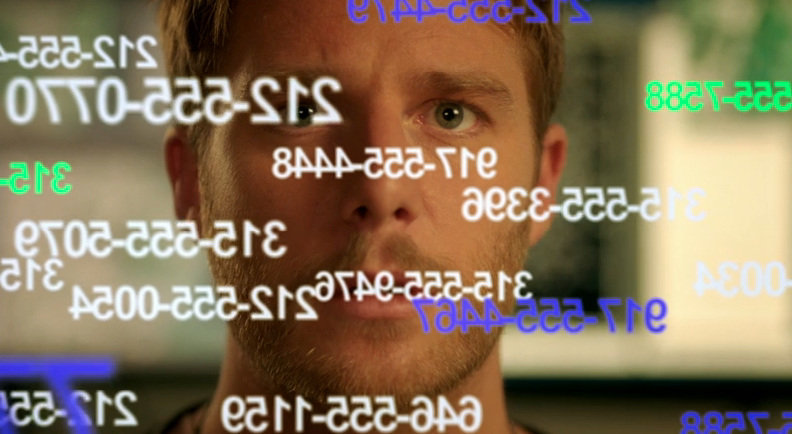
Limitless (credit: CBS)
Consider the TV show Limitless. In the show, FBI consultant Brian Finch, aided by the fictional cognitive enhancer NZT, is able to fluidly switch between complex sets of information (modalities), such as phone numbers, using different cognitive modes — rapidly processing a series of phone numbers of suspects on a screen, or analyzing a complex diagram showing potential criminal connections, then explaining it to colleagues, all without losing a beat.
In the new analysis, the mathematicians proved a theorem to show that in their model, this binding process is robust and able to withstand perturbations from the random disturbances in the brain. Your mind is full of other irregular neural signals — from things like other neural processes or external, sensory stimuli and distractions — but if they’re not too big, they don’t affect the thinking process.
This model could be used to better understand a variety of psychiatric disorders, such as obsessive-compulsive disorder, bipolar disorder, and attention deficit disorder, Rabinovich said. The way the mind binds to different modalities, and how such binding depends on time, may be related to conditions such as autism and schizophrenia. For example, some experiments suggest that for people with these conditions, the capacity of sequential binding memory is smaller.
Rabinovich worked with Valentin Afraimovich and Xue Gong, mathematicians at the Autonomous University of San Luis Potosi in Mexico and Ohio University, respectively.
Temporal order memories are critical for everyday animal and human functioning. Experiments and our own experience show that the binding or association of various features of an event together and the maintaining of multimodality events in sequential order are the key components of any sequential memories—episodic, semantic, working, etc. We study a robustness of binding sequential dynamics based on our previously introduced model in the form of generalized Lotka-Volterra equations. In the phase space of the model, there exists a multi-dimensional binding heteroclinic network consisting of saddle equilibrium points and heteroclinic trajectories joining them. We prove here the robustness of the binding sequential dynamics, i.e., the feasibility phenomenon for coupled heteroclinic networks: for each collection of successive heteroclinic trajectories inside the unified networks, there is an open set of initial points such that the trajectory going through each of them follows the prescribed collection staying in a small neighborhood of it. We show also that the symbolic complexity function of the system restricted to this neighborhood is a polynomial of degree L − 1, where L is the number of modalities.