
We're revisiting our favorite critters, from the deeply unsettling to the funny-looking to the cutest darn things you've ever seen.
The post Absurd Creature of the Week’s Cutest Critters Ever appeared first on WIRED.

Science and reality
We're revisiting our favorite critters, from the deeply unsettling to the funny-looking to the cutest darn things you've ever seen.
The post Absurd Creature of the Week’s Cutest Critters Ever appeared first on WIRED.

As more states legalize recreational and medical marijuana use, the LED business is growing and professionalizing.
The post How LEDs Are Making Weed Better appeared first on WIRED.

Today’s Antarctic research stations are often the only things protecting their inhabitants from the inhospitable outside.
The post Britain’s Antarctic Research Station Looks Like a Spaceship appeared first on WIRED.


Tesla Model S (credit: Tesla)
Tesla Motors will introduce on Thursday (October 15, 2015) an advanced “beta test” set of autonomous driving features, The Wall Street Journal reports.
The software will allow hands- and feet-free driving in everything from stop-and-go traffic to highway speeds, and enables a car to park itself, the journal says. It will be available for 50,000 newer Model S cars world-wide via software download.
However, staying within licensing regulations, the software (at least the current version) requires the driver to grab the steering wheel every 10 seconds or so to avoid having the vehicle slow.
“Over time, long term, you won’t have to keep your hands on the wheel — we explicitly describe this as beta,” said Tesla Motors CEO Elon Musk at a press event. Notably, unlike other car makers, Tesla Motors is pushing the new features via an over-the-air software update.
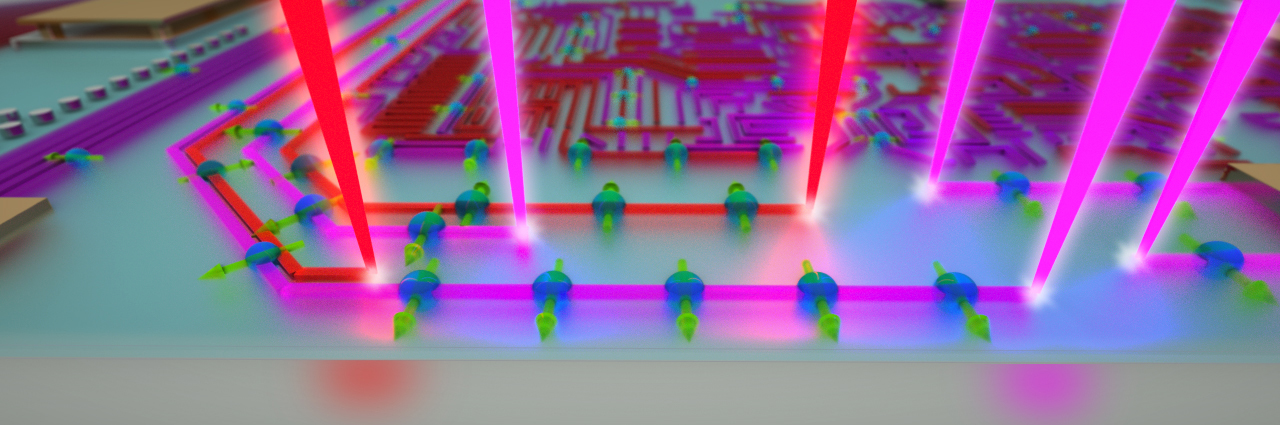
Artist’s rendition of optically defined quantum circuits in a topological insulator (credit: Peter Allen)
Penn State University and University of Chicago researchers say an accidental discovery of a “quantum Etch-a-Sketch” may lead to a new way to use beams of light to draw and erase quantum circuits, and that could lead to the next generation of advanced computers and quantum microchips.
The new technique is based on “topological insulators” (a material that behaves as an insulator in its interior but whose surface contains conducting states, meaning that electrons can only move along the surface of the material). The electrons in topological insulators have unique quantum properties that many scientists believe will be useful for developing spin-based electronics (such as disk drives) and quantum computers.
However, making even the simplest experimental circuits with topological insulators has proved difficult because traditional semiconductor engineering techniques tend to destroy their fragile quantum properties. Even a brief exposure to air can reduce their quality.
The researchers have now discovered a rewriteable “optical fabrication” process that allows them to “tune” the energy of electrons in these materials using light instead of chemicals — without ever having to touch the material itself. They used this effect to draw and erase one of the central components of a transistor — the p-n junction — in a topological insulator for the first time.
An accidental discovery

Optical fabrication (draw/erase) of a topological insulator (credit: Andrew L. Yeats et al./Science Advances)
Curiously, the scientists made the discovery when they noticed that a particular type of fluorescent light in the lab caused the surface of strontium titanate (the substrate material on which they had grown their samples) to become electrically polarized by ultraviolet light. The room lights happened to emit it at just the right wavelength. It turned out that the electric field from the polarized strontium titanate was leaking into the topological insulator layer, changing its electronic properties.
They found by intentionally focusing beams of light on their samples, they could draw electronic structures that persisted long after the light was removed. “It’s like having a sort of quantum Etch-a-Sketch in our lab,” said said David D. Awschalom, Liew Family Professor and deputy director in the Institute of Molecular Engineering at the University of Chicago. They also found that bright red light counteracted the effect of the ultraviolet light, allowing the researchers to both write (with UV) and erase (with red light).
“Instead of spending weeks in the clean room and potentially contaminating our materials, now we can sketch and measure devices for our experiments in real time,” said Awschalom. “When we’re done, we just erase it and make something else. We can do this in less than a second.”
To test whether the new technique might interfere with the unique properties of topological insulators, the team measured their samples in high magnetic fields. They found promising signatures of an effect called “weak anti-localization,” which arises from quantum interference between the different simultaneous paths that electrons can take through a material when they behave as waves.
To better understand the physics behind the effect, the researchers conducted a number of control measurements, which showed that the optical effect is not unique to topological insulators; it can also act on other materials grown on strontium titanate.
“In a way, the most exciting aspect of this work is that it should be applicable to a wide range of nanoscale materials such as complex oxides, graphene, and transition metal dichalcogenides,” said Awschalom. “It’s not just that it’s faster and easier. This effect could allow electrical tuning of materials in a wide range of optical, magnetic, and spectroscopic experiments where electrical contacts are extremely difficult or simply impossible.”
The research was published October 9, 2015 in an open-access paper in a new AAAS journal, Science Advances.
Abstract of Persistent Optical Gating of a Topological Insulator
The spin-polarized surface states of topological insulators (TIs) are attractive for applications in spintronics and quantum computing. A central challenge with these materials is to reliably tune the chemical potential of their electrons with respect to the Dirac point and the bulk bands. We demonstrate persistent, bidirectional optical control of the chemical potential of (Bi,Sb)2Te3 thin films grown on SrTiO3. By optically modulating a space-charge layer in the SrTiO3 substrates, we induce a persistent field effect in the TI films comparable to electrostatic gating techniques but without additional materials or processing. This enables us to optically pattern arbitrarily shaped p- and n-type regions in a TI, which we subsequently image with scanning photocurrent microscopy. The ability to optically write and erase mesoscopic electronic structures in a TI may aid in the investigation of the unique properties of the topological insulating phase. The gating effect also generalizes to other thin-film materials, suggesting that these phenomena could provide optical control of chemical potential in a wide range of ultrathin electronic systems.

Schematic of bio-robotic modeling system (credit: Benjamin D. Robertson and Gregory S. Sawicki/PNAS)
North Carolina State University (NC State) researchers have developed a bio-inspired system that models how human leg locomotion works, by using a computer-controlled nerve stimulator (acting as the spinal cord) to activate a biological muscle-tendon.
The findings could help design robotic devices that begin to merge human and machine to assist human locomotion, serving as prosthetic systems for people with mobility impairments or exoskeletons for increasing the abilities of able-bodied individuals.
The model is based on the natural spring-like physics (mass, stiffness, and leverage) of the ankle’s primary muscle-tendon unit (using a bullfrog’s muscle). The system used a feedback-controlled servomotor, simulating the inertial/gravitational environment of terrestrial gait.
Tuning for natural resonance
The research showed that the natural resonance* of the system is a likely mechanism behind springy leg behavior during locomotion, according to Gregory Sawicki, associate professor at NC State and University of North Carolina at Chapel Hill Joint Department of Biomedical Engineering. He is also co-author of a paper on the work published in Proceedings of the National Academy of Sciences.
In this case, the electrical system — the body’s nervous system — drives the mechanical system (the leg’s muscle-tendon unit) at a frequency that provides maximum power output.
The researchers found that by matching the stimulation frequency to the natural resonance frequency of the passive biomechanical system, muscle-tendon interactions (resulting in spring-like behavior) occur naturally and do not require closed-loop neural control — simplifying system design.
“In locomotion, resonance comes from tuning the interaction between the nervous system and the leg so they work together,” said Sawicki. “It turns out that if I know the mass, leverage, and stiffness of a muscle-tendon unit, I can tell you exactly how often I should stimulate it to get resonance in the form of spring-like, elastic behavior.”
“In the end, we found that the same simple underlying principles that govern resonance in simple mechanical systems also apply to these extraordinarily complicated physiological systems,” said Temple University post-doctoral researcher Ben Robertson, corresponding author of the paper.
“This outcome points to mechanical resonance as an underlying principle governing muscle-tendon interactions and provides a physiology-based framework for understanding how mechanically simple elastic limb behavior may emerge from a complex biological system comprised of many simultaneously tuned muscle-tendons within the lower limb,” the researchers conclude in the paper.
* NC State biomedical engineer Greg Sawicki likened resonance tuning to interacting with a slinky toy. “When you get it oscillating well, you hardly have to move your hand — it’s the timing of the interaction forces that matters.
Abstract of Unconstrained muscle-tendon workloops indicate resonance tuning as a mechanism for elastic limb behavior during terrestrial locomotion
In terrestrial locomotion, there is a missing link between observed spring-like limb mechanics and the physiological systems driving their emergence. Previous modeling and experimental studies of bouncing gait (e.g., walking, running, hopping) identified muscle-tendon interactions that cycle large amounts of energy in series tendon as a source of elastic limb behavior. The neural, biomechanical, and environmental origins of these tuned mechanics, however, have remained elusive. To examine the dynamic interplay between these factors, we developed an experimental platform comprised of a feedback-controlled servo-motor coupled to a biological muscle-tendon. Our novel motor controller mimicked in vivo inertial/gravitational loading experienced by muscles during terrestrial locomotion, and rhythmic patterns of muscle activation were applied via stimulation of intact nerve. This approach was based on classical workloop studies, but avoided predetermined patterns of muscle strain and activation—constraints not imposed during real-world locomotion. Our unconstrained approach to position control allowed observation of emergent muscle-tendon mechanics resulting from dynamic interaction of neural control, active muscle, and system material/inertial properties. This study demonstrated that, despite the complex nonlinear nature of musculotendon systems, cyclic muscle contractions at the passive natural frequency of the underlying biomechanical system yielded maximal forces and fractions of mechanical work recovered from previously stored elastic energy in series-compliant tissues. By matching movement frequency to the natural frequency of the passive biomechanical system (i.e., resonance tuning), muscle-tendon interactions resulting in spring-like behavior emerged naturally, without closed-loop neural control. This conceptual framework may explain the basis for elastic limb behavior during terrestrial locomotion.

The Olympics bring the world together through sports. They also tear it apart through building ski runs, stadiums, and other athletic accoutrements.
The post A Brief History of Olympic Environmental Disasters appeared first on WIRED.


They might not be making headlines, but there is a lot of volcanic unrest in Latin America right now.
The post Lava Flows and Restless Giants in Latin America appeared first on WIRED.