
A major advance reveals deep connections between the classes of problems that computers can—and can’t—possibly do.
The post Major Advance Reveals the Limits of Computation appeared first on WIRED.

Science and reality
A major advance reveals deep connections between the classes of problems that computers can—and can’t—possibly do.
The post Major Advance Reveals the Limits of Computation appeared first on WIRED.

Space photos of the week, October 4 - 10.
The post Space Photos of the Week: A Beautiful Blue Nebula Says Good Night appeared first on WIRED.

Stephen Hawking on Last Week Tonight with John Oliver (credit: HBO)
Reddit published Stephen Hawking’s answers to questions in an “Ask me anything” (AMA) event on Thursday (Oct. 8).
Most of the answers focused on his concerns about the future of AI and its role in our future. Here are some of the most interesting ones. The full list is in this Wired article. (His answers to John Oliver below are funnier.)
The real risk with AI isn’t malice but competence. A superintelligent AI will be extremely good at accomplishing its goals, and if those goals aren’t aligned with ours, we’re in trouble. You’re probably not an evil ant-hater who steps on ants out of malice, but if you’re in charge of a hydroelectric green energy project and there’s an anthill in the region to be flooded, too bad for the ants. Let’s not place humanity in the position of those ants.
There’s no consensus among AI researchers about how long it will take to build human-level AI and beyond, so please don’t trust anyone who claims to know for sure that it will happen in your lifetime or that it won’t happen in your lifetime. When it eventually does occur, it’s likely to be either the best or worst thing ever to happen to humanity, so there’s huge value in getting it right. We should shift the goal of AI from creating pure undirected artificial intelligence to creating beneficial intelligence. It might take decades to figure out how to do this, so let’s start researching this today rather than the night before the first strong AI is switched on.
An AI that has been designed rather than evolved can in principle have any drives or goals. However, as emphasized by Steve Omohundro, an extremely intelligent future AI will probably develop a drive to survive and acquire more resources as a step toward accomplishing whatever goal it has, because surviving and having more resources will increase its chances of accomplishing that other goal. This can cause problems for humans whose resources get taken away.
If machines produce everything we need, the outcome will depend on how things are distributed. Everyone can enjoy a life of luxurious leisure if the machine-produced wealth is shared, or most people can end up miserably poor if the machine-owners successfully lobby against wealth redistribution. So far, the trend seems to be toward the second option, with technology driving ever-increasing inequality.
Forbes offers a different opinion on the last answer.
HBO | Last Week Tonight with John Oliver: Stephen Hawking Interview
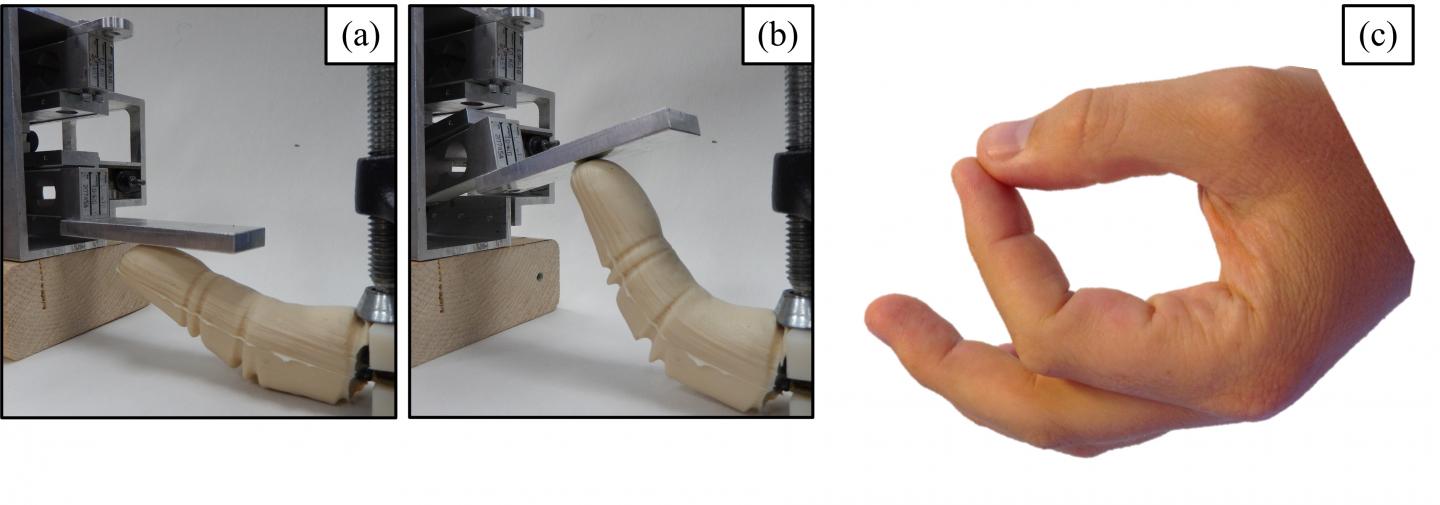
Heating and cooling a 3D-printed shape memory alloy to operate a robotic finger (credit: Florida Atlantic University/Bioinspiration & Biomimetics)
A realistic 3D-printed robotic finger using a shape memory alloy (SMA) and a unique thermal training technique has been developed by Florida Atlantic University assistant professor Erik Engeberg, Ph.D.
“We have been able to thermomechanically train our robotic finger to mimic the motions of a human finger, like flexion and extension,” said Engeberg. “Because of its light weight, dexterity and strength, our robotic design offers tremendous advantages over traditional mechanisms, and could ultimately be adapted for use as a prosthetic device, such as on a prosthetic hand.”
Most robotic parts used today are rigid, have a limited range of motion and don’t look lifelike.
In the study, described in an open-access article in the journal Bioinspiration & Biomimetics, Engeberg and his team used a resistive heating process called “Joule” heating that involves the passage of electric currents through a conductor that releases heat.
How to create a robotic finger
Results from the study showed a rapid flexing and extending motion of the finger and ability to recover its trained shape accurately and completely, confirming the biomechanical basis of its trained shape.
Initial use in underwater robotics
“Because SMAs require a heating process and cooling process, there are challenges with this technology, such as the lengthy amount of time it takes for them to cool and return to their natural shape, even with forced air convection,” said Engeberg. So they used the technology for underwater robotics, which would provide a rapid-cooling environment.
Engeberg used thermal insulators at the fingertip, which were kept open to facilitate water flow inside the finger. As the finger flexed and extended, water flowed through the inner cavity within each insulator to cool the actuators.
“Because our robotic finger consistently recovered its thermomechanically trained shape better than other similar technologies, our underwater experiments clearly demonstrated that the water cooling component greatly increased the operational speed of the finger,” said Engeberg.
Undersea applications using Engeberg’s new technology could help to address some of the difficulties and challenges humans encounter while working in ocean depths.
FAU – BioRobotics Lab | Bottle Pick and Drop Demo UR10 and Shadow Hand
FAU – BioRobotics Lab | Simultaneous Grasp Synergies Controlled by EMG
FAU – BioRobotics Lab | Shadow Hand and UR10 – Grab Bottle, Pour Liquid
Abstract of Anthropomorphic finger antagonistically actuated by SMA plates
Most robotic applications that contain shape memory alloy (SMA) actuators use the SMA in a linear or spring shape. In contrast, a novel robotic finger was designed in this paper using SMA plates that were thermomechanically trained to take the shape of a flexed human finger when Joule heated. This flexor actuator was placed in parallel with an extensor actuator that was designed to straighten when Joule heated. Thus, alternately heating and cooling the flexor and extensor actuators caused the finger to flex and extend. Three different NiTi based SMA plates were evaluated for their ability to apply forces to a rigid and compliant object. The best of these three SMAs was able to apply a maximum fingertip force of 9.01N on average. A 3D CAD model of a human finger was used to create a solid model for the mold of the finger covering skin. Using a 3D printer, inner and outer molds were fabricated to house the actuators and a position sensor, which were assembled using a multi-stage casting process. Next, a nonlinear antagonistic controller was developed using an outer position control loop with two inner MOSFET current control loops. Sine and square wave tracking experiments demonstrated minimal errors within the operational bounds of the finger. The ability of the finger to recover from unexpected disturbances was also shown along with the frequency response up to 7 rad s−1. The closed loop bandwidth of the system was 6.4 rad s−1 when operated intermittently and 1.8 rad s−1 when operated continuously.

Salk scientists developed a new technique to grow aged brain cells from patients’ skin. Fibroblasts (cells in connective tissue) from elderly human donors are directly converted into induced neurons, as shown here. (credit: Salk Institute)
Scientists have developed a first-ever technique for using skin samples from older patients to create brain cells — without first rolling back the youthfulness clock in the cells. The new technique, which yields cells resembling those found in older people’s brains, will be a boon to scientists studying age-related diseases like Alzheimer’s and Parkinson’s.
“This lets us keep age-related signatures in the cells so that we can more easily study the effects of aging on the brain,” says Rusty Gage, a professor in the Salk Institute’s Laboratory of Genetics and senior author of the paper, published yesterday (October 8, 2015) in Cell Stem Cell.
“By using this powerful approach, we can begin to answer many questions about the physiology and molecular machinery of human nerve cells — not just around healthy aging but pathological aging as well,” says Martin Hetzer, a Salk professor also involved in the work.
Over the past few years, researchers have increasingly turned to human stem cells (instead of animals) to study various diseases in humans. For example, scientists can take patients’ skin cells and turn them into induced pluripotent stem cells, which have the ability to become any cell in the body. From there, researchers can prompt the stem cells to turn into brain cells for further study. But this process — even when taking skin cells from an older human — doesn’t guarantee stem cells with “older” properties.
Epigenetic signatures in older cells —patterns of chemical marks on DNA that dictate what genes are expressed when — were reset to match younger signatures in the process. This made studying the aging of the human brain difficult, since researchers couldn’t create “old” brain cells with the approach.
Induced neurons
The researchers decided to try another approach, turning to an even newer technique that lets them directly convert skin cells to neurons, creating what’s called an induced neuron. “A few years ago, researchers showed that it’s possible to do this, completely bypassing the stem cell precursor state,” says Jerome Mertens, a postdoctoral research fellow and first author of the new paper.
The scientists collected skin cells from 19 people, aged from birth to 89, and prompted them to turn into brain cells using both the induced pluripotent stem cell technique and the direct conversion approach. Then, they compared the patterns of gene expression in the resulting neurons with cells taken from autopsied brains.
When the induced pluripotent stem cell method was used, as expected, the patterns in the neurons were indistinguishable between young and old derived samples. But brain cells that had been created using the direct conversion technique had different patterns of gene expression depending on whether they were created from young donors or older adults.
“The neurons we derived showed differences depending on donor age,” says Mertens. “And they actually show changes in gene expression that have been previously implicated in brain aging.” For instance, levels of a nuclear pore protein called RanBP17 — whose decline is linked to nuclear transport defects that play a role in neurodegenerative diseases — were lower in the neurons derived from older patients.
Now that the direct conversion of skin cells to neurons has been shown to retain these signatures of age, Gage expects the technique to become a valuable tool for studying aging. And, while the current work only tested its effectiveness in creating brain cells, he suspects a similar method will let researchers create aged heart and liver cells as well.
Scientists at Friederich-Alexander University Erlangen-Nuremberg and Tsinghau University were also involved in the study, which was supported by grants from the G. Harold & Leila Y. Mathers Charitable Foundation, the JPB Foundation, the Leona M. and Harry B. Helmsley Charitable Trust, Annette Merle-Smith, CIRM, the German Federal Ministry of Education and Research, and the Glenn Foundation for Medical Research.
Abstract of Human induced neurons retain aging transcriptome signatures that identify compromised nucleocytoplasmic compartmentalization during aging
Aging is a major risk factor for many human diseases, and in vitro generation of human neurons is an attractive approach for modeling aging-related brain disorders. However, modeling aging in differentiated human neurons has proved challenging. We generated neurons from human donors across a broad range of ages, either by iPSC-based reprogramming and differentiation or by direct conversion into induced neurons (iNs). While iPSCs and derived neurons did not retain aging-associated gene signatures, iNs displayed age-specific transcriptional profiles and revealed age-associated decreases in the nuclear transport receptor RanBP17. We detected an age-dependent loss of nucleocytoplasmic compartmentalization (NCC) in donor fibroblasts and corresponding iNs, and found that reduced RanBP17 impaired NCC in young cells while iPSC rejuvenation restored NCC in aged cells. These results show that iNs retain important aging-related signatures, thus allowing modeling of the aging process in vitro, and identify impaired NCC as an important factor in human aging.

A schematic of a “3-D” flexible electrode array. Note the Z-shaped part of the electrode array located between the cranial bone and the brain surface, and the tips (10 micrometers) of the protrusions at the bottom, which serve as recording sites. (credit: Johan Agorelius et al./Front. Neurosci.)
Researchers at Lund University have developed implantable multichannel electrodes that can capture signals from single neurons in the brain over a long period of time — without causing brain tissue damage, making it possible to better understand brain function in both healthy and diseased individuals.
Current flexible electrodes can’t maintain their shape when implanted, which is why they have to be attached to a solid chip. That limits their flexibility and irritates brain tissue, eventually killing surrounding nerve cells and making signals unreliable, says professor Jens Schouenborg.
He explains that recording neuronal signals from the brain requires an electrode that is bio-friendly (doesn’t cause any significant damage to brain tissue) and that is flexible in relation to the brain tissue (the brain floats in fluid inside the skull and moves around whenever a person breathes or turns their head).
“The electrode and the implantation technology that we have now developed have these properties,” he says. Described in an open-access paper in the journal Frontiers in Neuroscience, the new “3-D electrodes” are unique in that they are extremely soft (they even deflect against a water surface) and flexible in all three dimensions, enabling stable recordings from neurons over a long period of time.
Lund University | Breakthrough for electrode implants in the brain
How to implant soft electrodes
But the challenge was how to implant these electrodes in the brain. Visualize pushing spaghetti into a slab of meat. The solution: encapsulating the electrodes in a hard but dissolvable gelatin material, one that is also very gentle on the brain.
“This technology retains the electrodes in their original form inside the brain and can monitor what happens inside virtually undisturbed and normally functioning brain tissue,” said Johan Agorelius, a doctoral student in the project.
This allows for better understanding of what happens inside the brain and for developing more effective treatments for diseases such as Parkinson’s disease and chronic pain conditions, says Schouenborg.
Abstract of An array of highly flexible electrodes with a tailored configuration locked by gelatin during implantation—initial evaluation in cortex cerebri of awake rats
Background: A major challenge in the field of neural interfaces is to overcome the problem of poor stability of neuronal recordings, which impedes long-term studies of individual neurons in the brain. Conceivably, unstable recordings reflect relative movements between electrode and tissue. To address this challenge, we have developed a new ultra-flexible electrode array and evaluated its performance in awake non-restrained animals.
Methods:An array of eight separated gold leads (4 × 10 μm), individually flexible in 3D, were cut from a gold sheet using laser milling and insulated with Parylene C. To provide structural support during implantation into rat cortex, the electrode array was embedded in a hard gelatin based material, which dissolves after implantation. Recordings were made during 3 weeks. At termination, the animals were perfused with fixative and frozen to prevent dislocation of the implanted electrodes. A thick slice of brain tissue, with the electrode array still in situ, was made transparent using methyl salicylate to evaluate the conformation of the implanted electrode array.
Results: Median noise levels and signal/noise remained relatively stable during the 3 week observation period; 4.3–5.9 μV and 2.8–4.2, respectively. The spike amplitudes were often quite stable within recording sessions and for 15% of recordings where single-units were identified, the highest-SNR unit had an amplitude higher than 150 μV. In addition, high correlations (>0.96) between unit waveforms recorded at different time points were obtained for 58% of the electrode sites. The structure of the electrode array was well preserved 3 weeks after implantation.
Conclusions: A new implantable multichannel neural interface, comprising electrodes individually flexible in 3D that retain its architecture and functionality after implantation has been developed. Since the new neural interface design is adaptable, it offers a versatile tool to explore the function of various brain structures.

A magnetized cobalt disk (red) placed atop a thin cobalt-palladium film (light purple background) can be made to confer its own ringed configuration of magnetic moments (orange arrows) to the film below, creating a skyrmion in the film (purple arrows). The skyrmion might be usable in computer data storage systems. (credit: Dustin Gilbert / NIST)
Exotic ring-shaped magnetic effects called “skyrmions*” could be the basis for a new type of nonvolatile magnetic computer data storage, replacing current hard-drive technology, according to a team of researchers at the National Institute of Standards and Technology (NIST) and several universities.
Skyrmions have the advantage of operating at magnetic fields that are several orders of magnitude weaker, but have worked at only very low temperatures until now. The research breakthrough was the discovery of a practical way to create and access magnetic skyrmions, and under ambient room-temperature conditions.
The skrymion effect refers to extreme conditions in which certain magnetic materials can develop spots where the magnetic moments** curve and twist, forming a winding, ring-like configuration. To achieve that, the physicists placed arrays of tiny magnetized cobalt disks atop a thin film made of cobalt and palladium. That protects them from outside influence, meaning the data they store would not be corrupted easily.
But “seeing” these skyrmion configurations underneath was a challenge. The team solved that by using neutrons to see through the disk.
That discovery has implications for spintronics (using magnetic spin to store data). “The advantage [with skyrmions] is that you’d need way less power to push them around than any other method proposed for spintronics,” said NIST’s Dustin Gilbert. “What we need to do next is figure out how to make them move around.”
Physicists at the University of California, Davis; University of Maryland, College Park; University of California, Santa Cruz; and Lawrence Berkeley National Laboratory were also involved in the study.
* Named after the physicist who proposed them.
** The force that a magnet can exert on electric currents and the torque that a magnetic field will exert on it.
The topological nature of magnetic skyrmions leads to extraordinary properties that provide new insights into fundamental problems of magnetism and exciting potentials for novel magnetic technologies. Prerequisite are systems exhibiting skyrmion lattices at ambient conditions, which have been elusive so far. Here, we demonstrate the realization of artificial Bloch skyrmion lattices over extended areas in their ground state at room temperature by patterning asymmetric magnetic nanodots with controlled circularity on an underlayer with perpendicular magnetic anisotropy (PMA). Polarity is controlled by a tailored magnetic field sequence and demonstrated in magnetometry measurements. The vortex structure is imprinted from the dots into the interfacial region of the underlayer via suppression of the PMA by a critical ion-irradiation step. The imprinted skyrmion lattices are identified directly with polarized neutron reflectometry and confirmed by magnetoresistance measurements. Our results demonstrate an exciting platform to explore room-temperature ground-state skyrmion lattices.

From Karl the Fog to God Himself, here are the residents of the natural world you should be following on Twitter.
The post Forces of Nature to Follow if You’re Stuck at Your Desk appeared first on WIRED.

A lab at the University of California Irvine trying to figure out how to regrow lost limbs by studying the axolotl.
The post Absurd Creatures: This Salamander Could Teach Humans How to Regrow Limbs appeared first on WIRED.
