
Birth month affects risk of developing dementia later in life
People in Germany born in winter have a 7 per cent lower dementia risk than those born in summer – which may be the result of variable factors like air quality



Science and reality


Would it be better to have a rocket that uses all the fuel at once or to let out a little bit at a time? Here is a closer look at the rocket equation.
The post What’d Make a Better Rocket, Nuclear or Ion Engines? appeared first on WIRED.


The H3N2 subtype is the deadliest of the common flu viruses---and the one vaccines are worst at fighting.
The post Scientists Found a Flu Vaccine Flaw—Now They Have to Fix It appeared first on WIRED.

A virtual brain slice in the rat neocortex (credit: Henry Markram et al./Cell)
The Blue Brain Project, the simulation core of the European Human Brain Project, released today (Oct. 8) a draft digital reconstruction of the neocortical microcircuitry of the rat brain.
The international team, led by Henry Markram of École Polytechnique Fédérale De Lausanne (EPFL) and funded in part by the Swiss government, completed a first-draft computer reconstruction of a piece of the rat-brain neocortex — about a third of a cubic millimeter of brain tissue containing about 30,000 neurons connected by nearly 40 million synapses.
The electrical behavior of the virtual brain tissue was simulated on supercomputers and found to match the behavior observed in a number of experiments on the brain. Further simulations revealed novel insights into the functioning of the neocortex.
The simulation reproduced a range of previous observations made in experiments on the brain, validating its biological accuracy and providing new insights into the functioning of the neocortex. The project has published the full set of experimental data and the digital reconstruction, in a public web portal, allowing other researchers to use them.
EPFL, Blue Brain Project, Human Brain Project | Reconstruction and Simulation of Neocortical Microcircuitry
A long-awaited open-access paper (available online until Oct. 22) describing the digital reconstruction was published today by the journal Cell. The reconstruction represents the culmination of 20 years of biological experimentation that generated the core dataset, and 10 years of computational science work that developed the algorithms and built the software ecosystem required to digitally reconstruct and simulate the tissue.
Some scientists see the 36-page paper as proof that the idea of modeling a brain and all of its components is misguided and a waste of money, Science magazine reports. “There is nothing in it that is striking, except that it was a lot of work,” says Zachary Mainen, a neuroscientist at the Champalimaud Centre for the Unknown in Lisbon.
“The reaction to the paper mirrors a dispute that has divided Europe’s neuroscience community since HBP was picked by the European Commission as a so-called Flagship project eligible for up to €1 billion in funding,” Science notes. “Last year, hundreds of scientists signed an open letter charging that HBP was badly managed and too narrowly focused scientifically.”
Other scientists question the study’s usefulness. Although the resulting data collection is one of the most comprehensive to date on a part of the brain, it remains far from sufficient to reconstruct a complete map of the microcircuitry, admits Markram. “We can’t and don’t have to measure everything. The brain is a well-ordered structure, so once you begin to understand the order at the microscopic level, you can start to predict much of the missing data.”
While a long way from the whole brain, the ambitious and controversial Blue Brain Project study demonstrates that it is feasible to digitally reconstruct and simulate brain tissue … a first step and a significant contribution to Europe’s Human Brain Project (which Markram founded), according to a statement by EPFL.
The reconstruction: a digital approximation of brain tissue

In silico reconstruction of cellular and synaptic anatomy and physiology (credit: Henry Markram et al./Cell)
The study was a massive effort by 82 scientists and engineers at institutions in Switzerland, Israel, Spain, Hungary, USA, China, Sweden, and the UK. The researchers performed tens of thousands of experiments on neurons and synapses in the neocortex of young rats and catalogued each type of neuron and each type of synapse they found. They identified a series of fundamental rules describing how the neurons are arranged in the microcircuit and how they are connected via synapses.
According to Michael Reimann, a lead author who developed the algorithm used to predict the locations of the nearly 40 million synapses in the microcircuitry, “The algorithm begins by positioning realistic 3D models of neurons in a virtual volume, respecting the measured distribution of different neuron types at different depths. It then detects all locations where the branches of the neurons touch each other — over 600 million.
“It then systematically prunes [deletes] all the touches that do not fit with five biological rules of connectivity. That leaves 37 million touches.These are the locations where we constructed our model synapses.” To model the behavior of synapses, the researchers integrated data from their experiments and data from the literature. “It is big step forward that we can now estimate the ion currents flowing through 37 million synapses by integrating data for only a few of them,” says Srikanth Ramaswamy, a lead author.
Researchers found a close match between connectivity statistics for the digital reconstruction and experimental measurements in biological tissue, which had not been used in the reconstruction, including measurements by researchers outside the project. Javier DeFelipe, a senior author from Universidad Politecnica de Madrid (UPM), confirms that the digital reconstruction compares well with data from powerful electron microscopes, obtained independently at his laboratory.
Idan Segev, a senior author, sees the paper as building on the pioneering work of the Spanish anatomist, Ramon y Cajal from more than 100 years ago. “Ramon y Cajal began drawing every type of neuron in the brain by hand. He even drew in arrows to describe how he thought the information was flowing from one neuron to the next. Today, we are doing what Cajal would be doing with the tools of the day — building a digital representation of the neurons and synapses and simulating the flow of information between neurons on supercomputers. Furthermore, the digitization of the tissue allows the data to be preserved and reused for future generations.”.
The simulations: validation against in vivo experiments
The aim of the study was to create a digital approximation of the tissue. The big test is how the circuit behaves when the interactions between all the neurons are simulated on a supercomputer — an enormous challenge for the project’s engineers and scientists.
As reported by Felix Schürmann, a senior author who leads the team that builds the sofware to run on supercomputers: “Building the digital reconstructions, running the simulations and analyzing the results required a supercomputing infrastructure and a large ecosystem of software … [to] solve the billions of equations needed to simulate each 25 microsecond time-step in the simulation”.
The researchers ran simulations on the virtual tissue that mimicked previous biological experiments on the brain. The digital reconstruction was not designed to reproduce any specific circuit phenomenon, but a variety of experimental findings emerged.*
Simulations also helped the team to develop new insights that have not yet been possible in biological experiments. For example, the Cell paper describes how they uncovered an unexpected yet major role for calcium in some of the brain’s most fundamental behaviors. Eilif Muller, a lead author, describes how early simulations produced bursts of synchronized neural activity, similar to the activity found in sleep and very different from the asynchronous activity observed in awake animals. “When we decreased the calcium levels to match those found in awake animals and introduced the effect that this has on the synapses, the circuit behaved asynchronously, like neural circuits in awake animals.” Simulations integrating these biological data revealed a fundamental role of calcium in controlling brain states.
The researchers found that there are, in fact, many cellular and synaptic mechanisms that can shift the circuit from one state of activity to another. This suggests that the circuit can change its state to enable different computing capabilities. If this is so, it could lead to new ways of studying information processing and memory mechanisms in normal brain states, such as wakefulness, drowsiness, and sleep and some of the mechanisms in abnormal states such as epilepsy, and potentially other brain disorders.
What’s next
Now that the Blue Brain team has published the experimental results and the digital reconstruction, other scientists will be able to use the experimental data and reconstruction to test other theories of brain function.
“The reconstruction is a first draft, it is not complete and it is not yet a perfect digital replica of the biological tissue,” says Markram. In fact, the current version explicitly leaves out many important aspects of the brain, such as glia, blood vessels, gap-junctions, plasticity, and neuromodulation. According to Sean Hill, a senior author: “The job of reconstructing and simulating the brain is a large-scale collaborative one, and the work has only just begun. The Human Brain Project represents the kind of collaboration that is required.”
* One such simulation examined how different types of neuron respond when the fibers coming into the neocortex is stimulated by incoming fibers, analogous to touching the skin. The researchers found that the responses of the different types of neurons in the digital reconstruction were very similar to those that had been previously observed in the laboratory. They then searched the reconstruction for exquisitely timed sequences of activity (“triplets”) in groups of three neurons, that other researchers had previously observed in the brain.
They found that the reconstruction did indeed express the triplets and also made a new discovery: the triplets only occur when the circuit is in a very special state of activity. They further tested whether the digital reconstruction could reproduce the recent discovery that some neurons in the brain are closely synchronized with neighboring neurons (“chorists”), while others operate independently from the group (“soloists”). The researchers found the chorists and soloists, and were also able to pinpoint the types of neurons involved and propose cellular and synaptic mechanisms for these behaviors.
Abstract of Reconstruction and Simulation of Neocortical Microcircuitry
We present a first-draft digital reconstruction of the microcircuitry of somatosensory cortex of juvenile rat. The reconstruction uses cellular and synaptic organizing principles to algorithmically reconstruct detailed anatomy and physiology from sparse experimental data. An objective anatomical method defines a neocortical volume of 0.29 ± 0.01 mm3 containing ∼31,000 neurons, and patch-clamp studies identify 55 layer-specific morphological and 207 morpho-electrical neuron subtypes. When digitally reconstructed neurons are positioned in the volume and synapse formation is restricted to biological bouton densities and numbers of synapses per connection, their overlapping arbors form ∼8 million connections with ∼37 million synapses. Simulations reproduce an array of in vitro and in vivo experiments without parameter tuning. Additionally, we find a spectrum of network states with a sharp transition from synchronous to asynchronous activity, modulated by physiological mechanisms. The spectrum of network states, dynamically reconfigured around this transition, supports diverse information processing strategies.
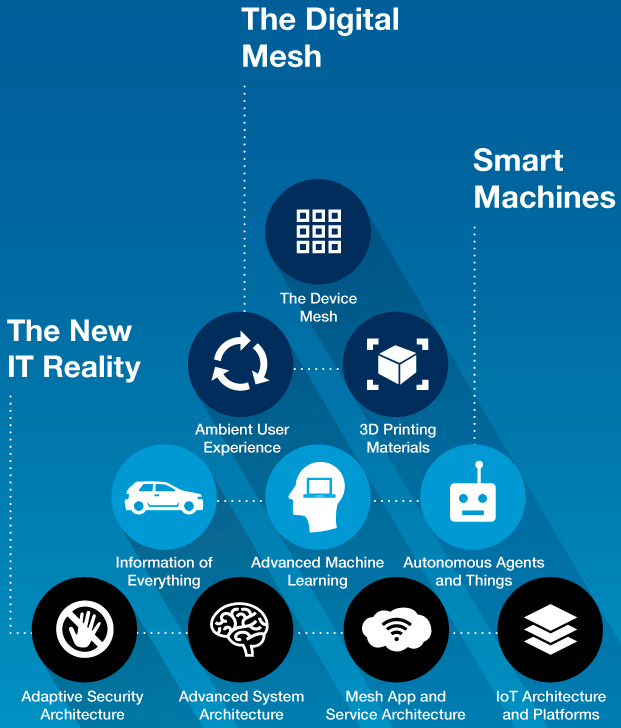
Top 10 strategic trends 2016 (credit: Gartner, Inc.)
At the Gartner Symposium/ITxpo today (Oct. 8), Gartner, Inc. highlighted the top 10 technology trends that will be strategic for most organizations in 2016 and will shape digital business opportunities through 2020.
The Device Mesh
The device mesh refers to how people access applications and information or interact with people, social communities, governments and businesses. It includes mobile devices, wearable, consumer and home electronic devices, automotive devices, and environmental devices, such as sensors in the Internet of Things (IoT), allowing for greater cooperative interaction between devices.
Ambient User Experience
The device mesh creates the foundation for a new continuous and ambient user experience. Immersive environments delivering augmented and virtual reality hold significant potential but are only one aspect of the experience. The ambient user experience preserves continuity across boundaries of device mesh, time and space. The experience seamlessly flows across a shifting set of devices — such as sensors, cars, and even factories — and interaction channels blending physical, virtual and electronic environment as the user moves from one place to another.
3D Printing Materials
Advances in 3D printing will drive user demand and a compound annual growth rate of 64.1 percent for enterprise 3D-printer shipments through 2019, which will require a rethinking of assembly line and supply chain processes to exploit 3D printing.
Information of Everything
Everything in the digital mesh produces, uses and transmits information, including sensory and contextual information. “Information of everything” addresses this influx with strategies and technologies to link data from all these different data sources. Advances in semantic tools such as graph databases as well as other emerging data classification and information analysis techniques will bring meaning to the often chaotic deluge of information.
Advanced Machine Learning
In advanced machine learning, deep neural nets (DNNs) move beyond classic computing and information management to create systems that can autonomously learn to perceive the world on their own, making it possible to address key challenges related to the information of everything trend.
DNNs (an advanced form of machine learning particularly applicable to large, complex datasets) is what makes smart machines appear “intelligent.” DNNs enable hardware- or software-based machines to learn for themselves all the features in their environment, from the finest details to broad sweeping abstract classes of content. This area is evolving quickly, and organizations must assess how they can apply these technologies to gain competitive advantage.
Autonomous Agents and Things
Machine learning gives rise to a spectrum of smart machine implementations — including robots, autonomous vehicles, virtual personal assistants (VPAs) and smart advisors — that act in an autonomous (or at least semiautonomous) manner.
VPAs such as Google Now, Microsoft’s Cortana, and Apple’s Siri are becoming smarter and are precursors to autonomous agents. The emerging notion of assistance feeds into the ambient user experience in which an autonomous agent becomes the main user interface. Instead of interacting with menus, forms and buttons on a smartphone, the user speaks to an app, which is really an intelligent agent.
Adaptive Security Architecture
The complexities of digital business and the algorithmic economy combined with an emerging “hacker industry” significantly increase the threat surface for an organization. Relying on perimeter defense and rule-based security is inadequate, especially as organizations exploit more cloud-based services and open APIs for customers and partners to integrate with their systems. IT leaders must focus on detecting and responding to threats, as well as more traditional blocking and other measures to prevent attacks. Application self-protection, as well as user and entity behavior analytics, will help fulfill the adaptive security architecture.
Advanced System Architecture
The digital mesh and smart machines require intense computing architecture demands to make them viable for organizations. Providing this required boost are high-powered and ultraefficient neuromorphic (brain-like) architectures fueled by GPUs (graphic processing units) and field-programmable gate arrays (FPGAs). There are significant gains to this architecture, such as being able to run at speeds of greater than a teraflop with high-energy efficiency.
Mesh App and Service Architecture
Monolithic, linear application designs (e.g., the three-tier architecture) are giving way to a more loosely coupled integrative approach: the apps and services architecture. Enabled by software-defined application services, this new approach enables Web-scale performance, flexibility and agility. Microservice architecture is an emerging pattern for building distributed applications that support agile delivery and scalable deployment, both on-premises and in the cloud. Containers are emerging as a critical technology for enabling agile development and microservice architectures. Bringing mobile and IoT elements into the app and service architecture creates a comprehensive model to address back-end cloud scalability and front-end device mesh experiences. Application teams must create new modern architectures to deliver agile, flexible and dynamic cloud-based applications that span the digital mesh.
Internet of Things Platforms
IoT platforms complement the mesh app and service architecture. The management, security, integration and other technologies and standards of the IoT platform are the base set of capabilities for building, managing, and securing elements in the IoT. The IoT is an integral part of the digital mesh and ambient user experience and the emerging and dynamic world of IoT platforms is what makes them possible.
* Gartner defines a strategic technology trend as one with the potential for significant impact on the organization. Factors that denote significant impact include a high potential for disruption to the business, end users or IT, the need for a major investment, or the risk of being late to adopt. These technologies impact the organization’s long-term plans, programs and initiatives.

NASA's New Horizons mission keeps sending home the hits. This week: blue skies and frozen water!
The post Pluto Has Skies of Blue and Frozen Water appeared first on WIRED.

