
This Sunday's harvest-supermoon-mega lunar eclipse will be something special.
The post When and Where to Watch This Weekend’s Total Lunar Eclipse appeared first on WIRED.

Science and reality
This Sunday's harvest-supermoon-mega lunar eclipse will be something special.
The post When and Where to Watch This Weekend’s Total Lunar Eclipse appeared first on WIRED.

At last! J. Kenji Lopez-Alt's recipe book finds the right mix of taste and science.
The post The Ultimate Book for Science Nerds Who Cook appeared first on WIRED.
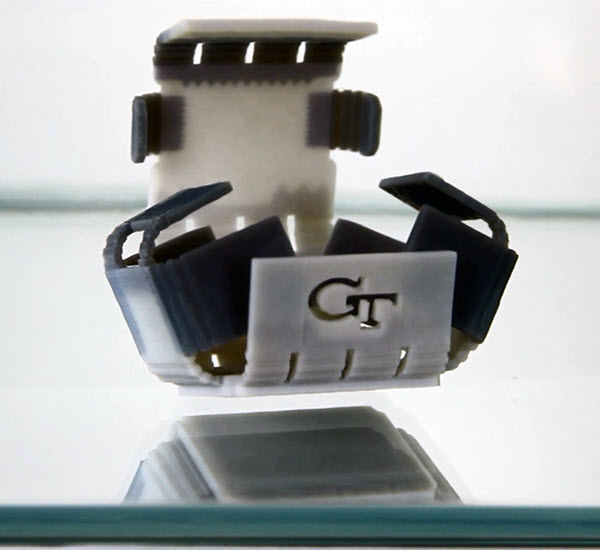
This image shows the self-folding process of smart shape-memory materials with slightly different responses to heat. Using materials that fold at slightly different rates ensures that the components do not interfere with one another during the process. (credit: Qi Laboratory)
Using components made from smart shape-memory materials (which can return to their original shape) with slightly different responses to heat, researchers have demonstrated a “four-dimensional” printing technology that allows for creating complex, self-folding structures.
The technology, developed by researchers at the Georgia Institute of Technology and the Singapore University of Technology and Design (SUTD), could be used to create 3-D structures that sequentially fold themselves from components that had been flat or rolled into a tube for shipment. To achieve that, the components could be designed to respond to stimuli such as temperature, moisture or light in a way that is precisely timed to create space structures, deployable medical devices, robots, toys, and a range of other structures.
Shape memory polymers
The researchers used smart shape memory polymers (SMPs) with the ability to remember one shape and change to another programmed shape when uniform heat is applied. Creating objects that change shape in a controlled sequence over time is enabled by printing multiple materials with different dynamic mechanical properties in prescribed patterns throughout the 3-D object.
When these components are then heated, each SMP responds at a different rate to change its shape, depending on its own internal clock. By carefully timing these changes, 3-D objects can be programmed to self-assemble in desired ways.
The research creates self-folding structures from 3-D printed patterns containing varying amounts of different smart shape-memory polymers. The patterning, done with a 3-D printer, allows the resulting flat components to have varying temporal response to the same stimuli.*
The team demonstrated the approach with a series of examples, including a mechanism that can be switched from a flat strip into a locked configuration as one end and controllably bends and threads itself through a keyhole. They also demonstrated a flat sheet that can fold itself into a 3-D box with interlocking flaps. These examples all require precise control of the folding sequence of different parts of the structure to avoid collisions of the components during folding.**

Using a 3-D printer, researchers produce smart shape-memory materials with slightly different responses to heat. Heat from water in a tank activates the materials and begins the self-folding process. (Credit: Qi Laboratory, Georgia Tech)
“We have exploited the ability to 3-D print smart polymers and integrate as many as ten different materials precisely into a 3-D structure,” said Martin L. Dunn, a professor at Singapore University of Technology and Design who is also the director of the SUTD Digital Manufacturing and Design Centre. “We are now extending this concept of digital SMPs to enable printing of SMPs with dynamic mechanical properties that vary continuously in 3-D space.”
Morphing aircraft
The research team envisions a broad range of applications for their technology. For example, an unmanned air vehicle might change shape from one designed for a cruise mission to one designed for a dive. Also possible would be 3-D components designed to fold flat or be rolled up into tubes so they could be easily transported, and then later deformed into their intended 3D configuration for use.
The research was reported September 8 in an open-access paper in the journal Scientific Reports. The work is funded by the U.S. Air Force Office of Scientific Research, the U.S. National Science Foundation, and the Singapore National Research Foundation.
* “Previous efforts to create sequential shape changing components involved placing multiple heaters at specific regions in a component and then controlling the on-and-off time of individual heaters,” explained Jerry Qi, a professor in the George W. Woodruff School of Mechanical Engineering at Georgia Tech. “This earlier approach essentially requires controlling the heat applied throughout the component in both space and time and is complicated. We turned this approach around and used a spatially uniform temperature which is easier to apply and then exploited the ability of different materials to internally control their rate of shape change through their molecular design.”
** The team used companion finite element simulations to predict the responses of the 3-D printed components, which were made from varying ratios of two different commercially available shape-memory polymers. A simplified reduced-order model was also developed to rapidly and accurately describe the physics of the self-folding process. “An important aspect of self-folding is the management of self-collisions, where different portions of the folding structure contact and then block further folding,” the researchers said in their paper. “A metric is developed to predict collisions and is used together with the reduced-order model to design self-folding structures that lock themselves into stable desired configurations.”
Abstract of Sequential Self-Folding Structures by 3D Printed Digital Shape Memory Polymers
Folding is ubiquitous in nature with examples ranging from the formation of cellular components to winged insects. It finds technological applications including packaging of solar cells and space structures, deployable biomedical devices, and self-assembling robots and airbags. Here we demonstrate sequential self-folding structures realized by thermal activation of spatially-variable patterns that are 3D printed with digital shape memory polymers, which are digital materials with different shape memory behaviors. The time-dependent behavior of each polymer allows the temporal sequencing of activation when the structure is subjected to a uniform temperature. This is demonstrated via a series of 3D printed structures that respond rapidly to a thermal stimulus, and self-fold to specified shapes in controlled shape changing sequences. Measurements of the spatial and temporal nature of self-folding structures are in good agreement with the companion finite element simulations. A simplified reduced-order model is also developed to rapidly and accurately describe the self-folding physics. An important aspect of self-folding is the management of self-collisions, where different portions of the folding structure contact and then block further folding. A metric is developed to predict collisions and is used together with the reduced-order model to design self-folding structures that lock themselves into stable desired configurations.

Iterative search for anti-cancer drug combinations. The procedure starts by generating an initial generation (population) of drug combinations randomly or guided by biological prior knowledge and assumptions. In each iteration the aim is to propose a new generation of drug combinations based on the results obtained so far. The procedure iterates through a number of generations until a stop criterion for a predefined fitness function is satisfied. (credit: M. Kashif et al./Scientific Reports)
A new smart research system developed at Uppsala University accelerates research on cancer treatments by finding optimal treatment drug combinations. It was developed by a research group led by Mats Gustafsson, Professor of Medical Bioinformatics.
The “lab robot” system plans and conducts experiments with many substances, and draws its own conclusions from the results. The idea is to gradually refine combinations of substances so that they kill cancer cells without harming healthy cells.
Instead of just combining a couple of substances at a time, the new lab robot can handle about a dozen drugs simultaneously. The future aim is to handle many more, preferably hundreds.
There are a few such laboratories in the world with this type of lab robot, but researchers “have only used the systems to look for combinations that kill the cancer cells, not taking the side effects into account,” says Gustafsson.
The next step: make the robot system more automated and smarter. The scientists also want to build more knowledge into the guiding algorithm of the robot, such as prior knowledge about drug targets and disease pathways.
For patients with the same cancer type returning multiple times, sometimes the cancer cells develop resistance against the pharmacotherapy used. The new robot systems may also become important in the efforts to find new drug compounds that make these resistant cells sensitive again.
The research is described in an open-access article published Tuesday (Sept. 22, 2015) in Scientific Reports.
Abstract of In vitro discovery of promising anti-cancer drug combinations using iterative maximisation of a therapeutic index
In vitro-based search for promising anti-cancer drug combinations may provide important leads to improved cancer therapies. Currently there are no integrated computational-experimental methods specifically designed to search for combinations, maximizing a predefined therapeutic index (TI) defined in terms of appropriate model systems. Here, such a pipeline is presented allowing the search for optimal combinations among an arbitrary number of drugs while also taking experimental variability into account. The TI optimized is the cytotoxicity difference (in vitro) between a target model and an adverse side effect model. Focusing on colorectal carcinoma (CRC), the pipeline provided several combinations that are effective in six different CRC models with limited cytotoxicity in normal cell models. Herein we describe the identification of the combination (Trichostatin A, Afungin, 17-AAG) and present results from subsequent characterisations, including efficacy in primary cultures of tumour cells from CRC patients. We hypothesize that its effect derives from potentiation of the proteotoxic action of 17-AAG by Trichostatin A and Afungin. The discovered drug combinations against CRC are significant findings themselves and also indicate that the proposed strategy has great potential for suggesting drug combination treatments suitable for other cancer types as well as for other complex diseases.
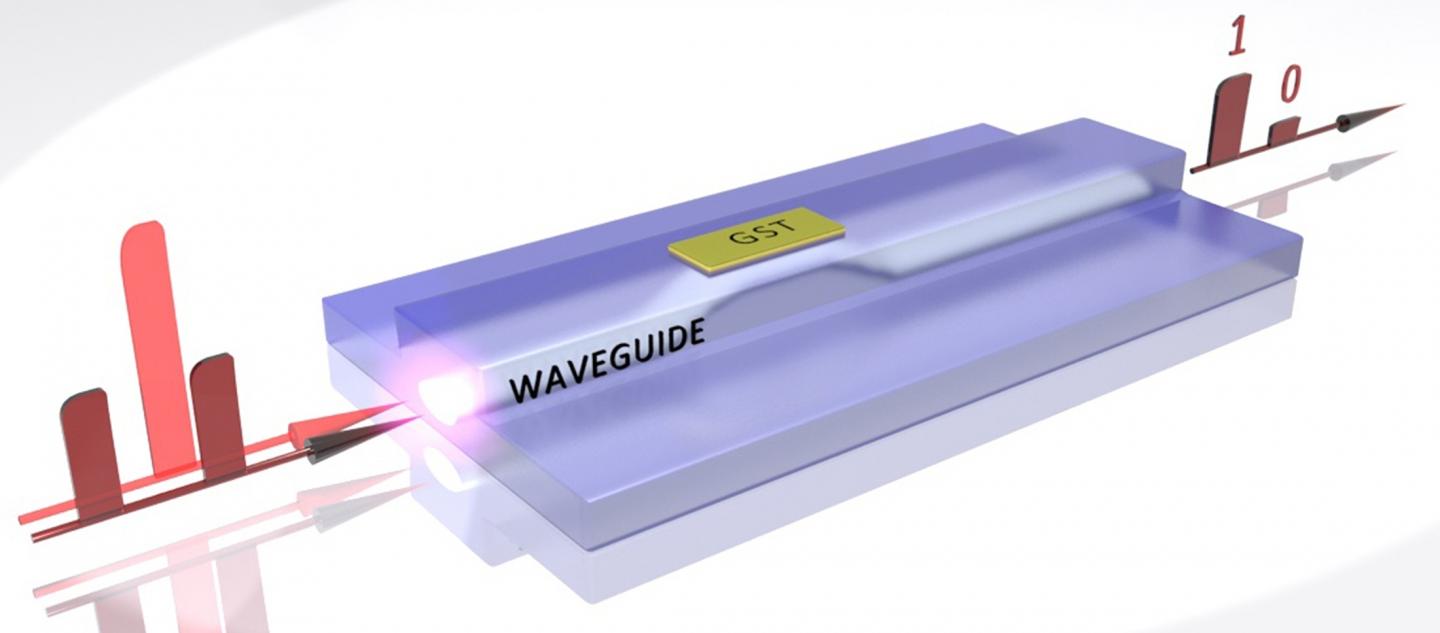
Illustration of all-optical data memory: ultra-short light pulses (left) make a bit in the Ge2Sb2Te5 (GST) material change from crystalline to amorphous (or the reverse), and weak light pulses (right) read out the data (credit: C. Rios/Oxford University)
The first all-optical chip memory has been developed by an international team of scientists. It is capable of writing data to memory at a speed of up to a gigahertz or more and may allow computers to work more rapidly and more efficiently.
The memory is non-volatile (similar to flash memory), and the new memory can store data even when the power is removed, and may persist for decades, the researchers believe.
The scientists, from Oxford, Exeter, Karlsruhe and Münster universities, used a “phase-change material,” Ge2Sb2Te5 (GST). Phase-change materials radically change their optical properties depending on their phase state (arrangement of the atoms) — crystalline (regular) or amorphous (irregular) — initiated by ultrashort light pulses. For reading out the data, weak light pulses are used.
Light is ideally suited for ultra-fast high-bandwidth data transfer (via optical-fiber cables), but until now, it has not been possible to store large quantities of optical data directly on integrated chips. The memory is also compatible with latest processors, the researchers note.
Permanent all-optical on-chip memories promise to considerably increase the speed of computers and reduce their energy consumption. Together with all-optical connections, on-chip memories might also reduce latencies (transmission delays, which can make long-distance two-way communication difficult, for example). In addition, energy-intensive conversion of optical signals into electronic signals and vice versa would no longer be required, reducing bulk and cost.
The research is published in Nature Photonics.
Abstract of Integrated all-photonic non-volatile multi-level memory
Implementing on-chip non-volatile photonic memories has been a long-term, yet elusive goal. Photonic data storage would dramatically improve performance in existing computing architectures by reducing the latencies associated with electrical memories and potentially eliminating optoelectronic conversions. Furthermore, multi-level photonic memories with random access would allow for leveraging even greater computational capability. However, photonic memories have thus far been volatile. Here, we demonstrate a robust, non-volatile, all-photonic memory based on phase-change materials. By using optical near-field effects, we realize bit storage of up to eight levels in a single device that readily switches between intermediate states. Our on-chip memory cells feature single-shot readout and switching energies as low as 13.4 pJ at speeds approaching 1 GHz. We show that individual memory elements can be addressed using a wavelength multiplexing scheme. Our multi-level, multi-bit devices provide a pathway towards eliminating the von Neumann bottleneck and portend a new paradigm in all-photonic memory and non-conventional computing.

Martin Shkreli gave a lot of reasons for raising his drug's price. Is he a rogue actor of pharmaceutical pricing, or did he just take things further than most other companies?
The post How Prescription Drugs Get So Wildly Expensive appeared first on WIRED.


Examples of questions (left column) and interpretations (right column) derived by GEOS (credit: Minjoon Seo et al./Proceedings of EMNLP)
An AI system that can solve SAT geometry questions as well as the average American 11th-grade student has been developed by researchers at the Allen Institute for Artificial Intelligence (AI2) and University of Washington.
This system, called GeoS, uses a combination of computer vision to interpret diagrams, natural language processing to read and understand text, and a geometric solver, achieving 49 percent accuracy on official SAT test questions.
If these results were extrapolated to the entire Math SAT test, the computer roughly achieved an SAT score of 500 (out of 800), the average test score for 2015.
These results, presented at the 2015 Conference on Empirical Methods in Natural Language Processing (EMNLP) in Lisbon, Portugal, were achieved by GeoS solving unaltered SAT questions that it had never seen before and that required an understanding of implicit relationships, ambiguous references, and the relationships between diagrams and natural-language text.
The best-known current test of an AI’s intelligence is the Turing test, which involves fooling a human in a blind conversation. “Unlike the Turing Test, standardized tests such as the SAT provide us today with a way to measure a machine’s ability to reason and to compare its abilities with that of a human,” said Oren Etzioni, CEO of AI2. “Much of what we understand from text and graphics is not explicitly stated, and requires far more knowledge than we appreciate.”
How GeoS Works
GeoS is the first end-to-end system that solves SAT plane geometry problems. It does this by first interpreting a geometry question by using the diagram and text in concert to generate the best possible logical expressions of the problem, which it sends to a geometric solver to solve. Then it compares that answer to the multiple-choice answers for that question.
This process is complicated by the fact that SAT questions contain many unstated assumptions. For example, in top example in the SAT problem above, there are several unstated assumptions, such as the fact that lines BD and AC intersect at E.
GeoS had a 96 percent accuracy rate on questions it was confident enough to answer. AI2 researchers said they are moving to solve the full set of SAT math questions in the next three years.
An open-access paper outlining the research, “Solving Geometry Problems: Combining Text and Diagram Interpretation,” and a demonstration of the system’s problem-solving are available. All data sets and software are also available for other researchers to use.
The researchers say they are also building systems that can tackle science tests, which require a knowledge base that includes elements of the unstated, common-sense knowledge that humans generate over their lives. This Aristo project is described here.
Abstract of Solving geometry problems: Combining text and diagram interpretation
This paper introduces GeoS, the first automated system to solve unaltered SAT geometry questions by combining text understanding and diagram interpretation. We model the problem of understanding geometry questions as submodular optimization, and identify a formal problem description likely to be compatible with both the question text and diagram. GeoS then feeds the description to a geometric solver that attempts to determine the correct answer. In our experiments, GeoS achieves a 49% score on official SAT questions, and a score of 61% on practice questions. Finally, we show that by integrating textual and visual information, GeoS boosts the accuracy of dependency and semantic parsing of the question text.

Very few science fiction stories have perfect science in them. Although they have some problems, the stories can still be used to explain cool science.
The post The Science in The Martian Isn’t Perfect, But That’s OK appeared first on WIRED.
