
How the scariest video games use our own minds to terrify us
Some believe that video games are the best medium for horror we have, using the way we identify with our character to shape our fears



Science and reality

A bold citizen science program keeps hospitals well-stocked with the antivenom that saves dozens every year.
The post Of Course Australia Has Drop-Off Centers for Deadly Spiders appeared first on WIRED.


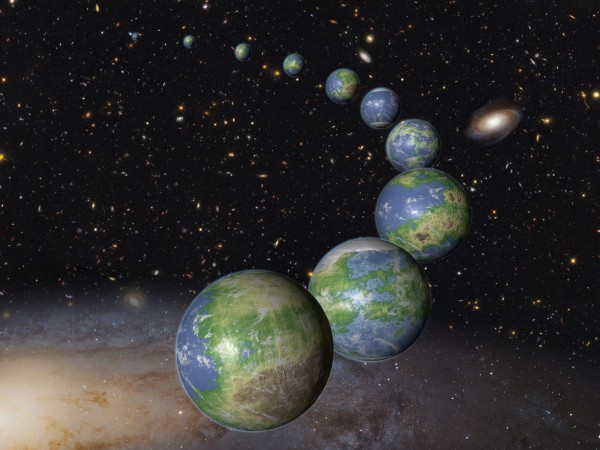
This is an artist’s impression of innumerable Earth-like planets that have yet to be born over the next trillion years in the evolving universe (credit: NASA, ESA, and G. Bacon (STScI); Science: NASA, ESA, P. Behroozi and M. Peeples (STScI))
When our solar system was born 4.6 billion years ago, only eight percent of the potentially habitable planets that will ever form in the universe existed, according to an assessment of data collected by NASA’s Hubble Space Telescope and Kepler space observatory and published today (Oct. 20) in an open-access paper in the Monthly Notices of the Royal Astronomical Society.
In related news, UCLA geochemists have found evidence that life probably existed on Earth at least 4.1 billion years ago, which is 300 million years earlier than previous research suggested. The research suggests life in the universe could be abundant, said Mark Harrison, co-author of the research and a professor of geochemistry at UCLA. The research was published Monday Oct. 19 in the online early edition of the journal Proceedings of the National Academy of Sciences.
The data show that the universe was making stars at a fast rate 10 billion years ago, but the fraction of the universe’s hydrogen and helium gas that was involved was very low. Today, star birth is happening at a much slower rate than long ago, but there is so much leftover gas available after the big bang that the universe will keep making stars and planets for a very long time to come.
A billion Earth-sized worlds
Based on the survey, scientists predict that there should already be 1 billion Earth-sized worlds in the Milky Way galaxy. That estimate skyrockets when you include the other 100 billion galaxies in the observable universe.
Kepler’s planet survey indicates that Earth-sized planets in a star’s habitable zone — the perfect distance that could allow water to pool on the surface — are ubiquitous in our galaxy. This leaves plenty of opportunity for untold more Earth-sized planets in the habitable zone to arise in the future — the last star isn’t expected to burn out until 100 trillion years from now.
The researchers say that future Earths are more likely to appear inside giant galaxy clusters and also in dwarf galaxies, which have yet to use up all their gas for building stars and accompanying planetary systems. By contrast, our Milky Way galaxy has used up much more of the gas available for future star formation.
A big advantage to our civilization arising early in the evolution of the universe is our being able to use powerful telescopes like Hubble to trace our lineage from the big bang through the early evolution of galaxies.
Regrettably, the observational evidence for the big bang and cosmic evolution, encoded in light and other electromagnetic radiation, will be all but erased away 1 trillion years from now, due to the runaway expansion of space. Any far-future civilizations that might arise will be largely clueless as to how or if the universe began and evolved.
Abstract of On The History and Future of Cosmic Planet Formation
We combine constraints on galaxy formation histories with planet formation models, yielding the Earth-like and giant planet formation histories of the Milky Way and the Universe as a whole. In the Hubble volume (1013 Mpc3), we expect there to be ∼1020 Earth-like and ∼1020giant planets; our own galaxy is expected to host ∼109 and ∼1010 Earth-like and giant planets, respectively. Proposed metallicity thresholds for planet formation do not significantly affect these numbers. However, the metallicity dependence for giant planets results in later typical formation times and larger host galaxies than for Earth-like planets. The Solar system formed at the median age for existing giant planets in the Milky Way, and consistent with past estimates, formed after 80 per cent of Earth-like planets. However, if existing gas within virialized dark matter haloes continues to collapse and form stars and planets, the Universe will form over 10 times more planets than currently exist. We show that this would imply at least a 92 per cent chance that we are not the only civilization the Universe will ever have, independent of arguments involving the Drake equation.
Abstract of Potentially biogenic carbon preserved in a 4.1 billion-year-old zircon
Evidence for carbon cycling or biologic activity can be derived from carbon isotopes, because a high12C/13C ratio is characteristic of biogenic carbon due to the large isotopic fractionation associated with enzymatic carbon fixation. The earliest materials measured for carbon isotopes at 3.8 Ga are isotopically light, and thus potentially biogenic. Because Earth’s known rock record extends only to ∼4 Ga, earlier periods of history are accessible only through mineral grains deposited in later sediments. We report 12C/13C of graphite preserved in 4.1-Ga zircon. Its complete encasement in crack-free, undisturbed zircon demonstrates that it is not contamination from more recent geologic processes. Its 12C-rich isotopic signature may be evidence for the origin of life on Earth by 4.1 Ga.

Using computer-generated light patterns, researchers were able to control the direction of spiraling electrical waves in heart cells. (credit: Eana Park)
Researchers from Oxford and Stony Brook universities has found a way to precisely control the electrical waves that regulate the rhythm of our heartbeat — using light. Their results are published in the journal Nature Photonics.
Cardiac cells in the heart and neurons in the brain communicate by electrical signals, and these messages of communication travel fast from cell to cell as “excitation waves.”
For heart patients there are currently two options to keep these waves in check: electrical devices (pacemakers or defibrillators) or drugs (e.g., beta blockers). However, these methods are relatively crude: they can stop or start waves but cannot provide fine control over the wave speed and direction.
Gil Bub, from Oxford University explained: ‘When there is scar tissue in the heart or fibrosis, this can cause part of the wave to slow down. That can cause re-entrant waves which spiral back around the tissue, causing the heart to beat much too quickly, which can be fatal. If we can control these spirals, we could prevent that.
The optogenetics solution
The solution the researchers found was optogenetics, which uses genetic modification to alter cells so that they can be activated by light. Until now, it has mainly been used to activate individual cells or to trigger excitation waves in tissue, especially in neuroscience research. “We wanted to use it to very precisely control the activity of millions of cells,” said Bub.
A light-activated protein called channelrhodopsin was delivered to heart cells using gene therapy techniques so that they could be controlled by light. Then, using a computer-controlled light projector, the team was able to control the speed of the cardiac waves, their direction and even the orientation of spirals in real time — something that never been shown for waves in a living system before.
In the short term, the ability to provide fine control means that researchers are able to carry out experiments at a level of detail previously only available using computer models. They can now compare those models to experiments with real cells, potentially improving our understanding of how the heart works. The research can also be applied to the physics of such waves in other processes. In the long run, it might be possible to develop precise treatments for heart conditions.
“Precise control of the direction, speed and shape of such excitation waves would mean unprecedented direct control of organ-level function, in the heart or brain, without having to focus on manipulating each cell individually,” said Stony Brook University scientist Emilia Entcheva.
The team stresses that there are significant hurdles before this could offer new treatments; a key issue is being able to alter the heart to be light-sensitized and being able to get the light to desired locations. However, as gene therapy moves into the clinic and with miniaturization of optical devices, use of this all-optical technology may become possible.
In the meantime, the research enables scientists to look into the physics behind many biological processes, including those in our own brains and hearts.
University of Oxford | Controlling heart tissue with light
Abstract of Optical control of excitation waves in cardiac tissue
In nature, macroscopic excitation waves are found in a diverse range of settings including chemical reactions, metal rust, yeast, amoeba and the heart and brain. In the case of living biological tissue, the spatiotemporal patterns formed by these excitation waves are different in healthy and diseased states. Current electrical and pharmacological methods for wave modulation lack the spatiotemporal precision needed to control these patterns. Optical methods have the potential to overcome these limitations, but to date have only been demonstrated in simple systems, such as the Belousov–Zhabotinsky chemical reaction. Here, we combine dye-free optical imaging with optogenetic actuation to achieve dynamic control of cardiac excitation waves. Illumination with patterned light is demonstrated to optically control the direction, speed and spiral chirality of such waves in cardiac tissue. This all-optical approach offers a new experimental platform for the study and control of pattern formation in complex biological excitable systems.
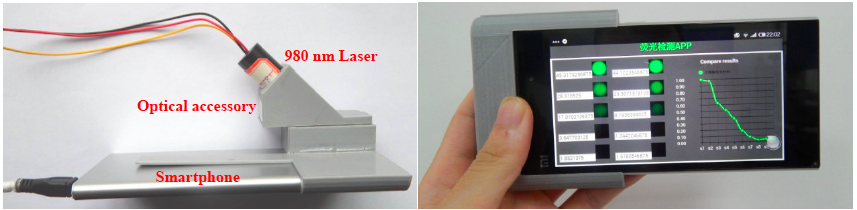
The prototype smartphone-based pesticide-detection system (credit: Qingsong Mei et al./Biosensors and Bioelectronics)
A new system that may allow people to detect pesticides cheaply and rapidly, combining a paper sensor and an Android program on a smartphone, has been developed by researchers in China and Singapore, according to a new study published in Biosensors and Bioelectronics.
As the potential effects of pesticides on health become clearer, it is increasingly important to be able to detect them in the environment and on foods, but existing gear that purpose is large, expensive, and slow.
Smaller detectors have been developed using paper as a sensor material, but they have not produced strong enough signals for detection. Now researchers at Hefei University of Technology in China and the National University of Singapore have developed a portable smartphone-based detection system using a paper sensor that they say produces signals stronger enough to allow for pesticide detection.
The researchers tested it on thiram, which is used to prevent fungal diseases in seed and crops and an animal repellent to protect fruit trees.
The device uses nanoparticles covered with copper ions that are coated onto paper, causing pesticide molecules to attach to the copper ions. A near-infrared mini-laser shines a light onto the paper, the smartphone detects the absorption spectrum, and an Android app then calculates pesticide concentration, down to 0.1 μM (micromolar) concentration.
The researchers are now developing kits that can multiplex (detect different molecules simultaneously), which would allow for testing food before using it in a meal, for example.
This work was supported by the National Natural Science Foundation of China and the Fundamental Research Funds for the Central Universities.
The integration of smartphone with paper sensors recently has been gain increasing attentions because of the achievement of quantitative and rapid analysis. However, smartphone based upconversional paper sensors have been restricted by the lack of effective methods to acquire luminescence signals on test paper. Herein, by the virtue of 3D printing technology, we exploited an auxiliary reusable device, which orderly assembled a 980 nm mini-laser, optical filter and mini-cavity together, for digitally imaging the luminescence variations on test paper and quantitative analyzing pesticide thiram by smartphone. In detail, copper ions decorated NaYF4:Yb/Tm upconversion nanoparticles were fixed onto filter paper to form test paper, and the blue luminescence on it would be quenched after additions of thiram through luminescence resonance energy transfer mechanism. These variations could be monitored by the smartphone camera, and then the blue channel intensities of obtained colored images were calculated to quantify amounts of thiram through a self-written Android program installed on the smartphone, offering a reliable and accurate detection limit of 0.1 μM for the system. This work provides an initial demonstration of integrating upconversion nanosensors with smartphone digital imaging for point-of-care analysis on a paper-based platform.

