Japan’s Hayabusa2 probe captures remarkable photo of a two-headed asteroid 62 million miles away

A Japanese spacecraft has gotten up close and personal with yet another asteroid, beaming home stunning new imagery of the distant space rock.

On Sunday (July 5), the Japan Aerospace Exploration Agency (JAXA)'s Hayabusa2 probe performed a close flyby of asteroid Torifune, a 1,475-foot (450-meter) space rock currently traveling through space some 62 million miles (100 million kilometers) from Earth. It was expected to be one of the closest-ever high-speed passes a spacecraft has had with an asteroid.

During the flyby, Hayabusa2 captured this breathtaking new image of Torifune using its optical camera, and was able to transmit it back to JAXA controllers. The probe captured additional scientific data about the asteroid, but will beam those results home at a later date, according to JAXA.

Hayabusa2 also imaged asteroid Torifune using its Mid-Infrared Camera (TIR), which allows scientists to measure asteroids' surface temperatures, thermal inertia and surface roughness, according to JAXA. This mid-infrared image reveals Torifune to be much cooler in what appear to be shadowed regions seen in the optical image, and much warmer where the surface faces the sun.
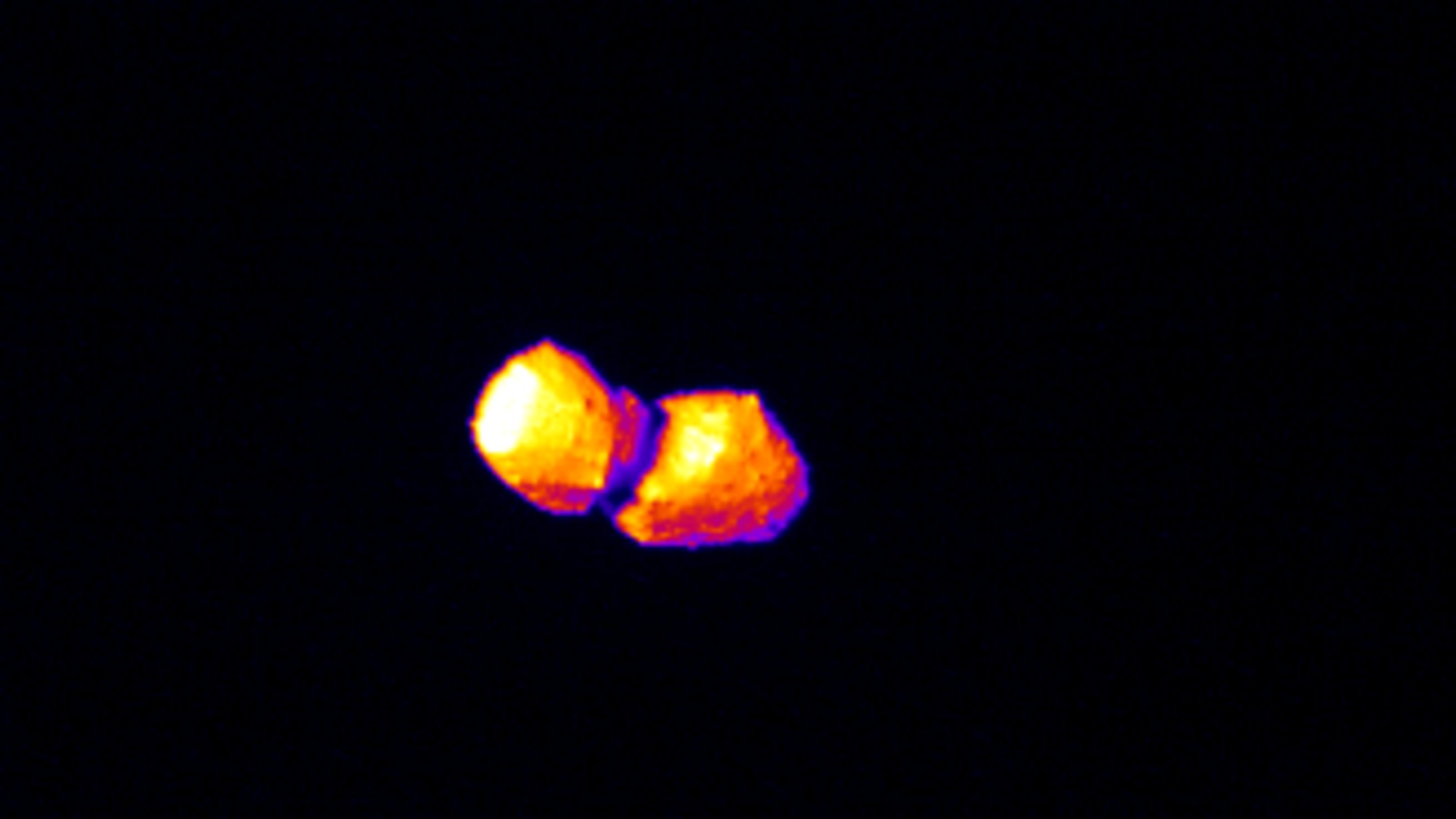
a double-lobed space rock on a black background, depicted in a gradient of false colors ranging from white-yellow to deep violet

Asteroid Torifune as seen by the Hayabusa2 probe's Mid-Infrared Camera (TIR) on July 5, 2026. (Image credit: JAXA)

Torifune orbits the sun every 383 days and rotates every 5 hours. It belongs to the Apollo group, a classification of near-Earth asteroids whose orbits cross Earth's as they make their way around the sun.

Hayabusa2's flyby of Torifune was not part of its original mission, and one of the members of the probe's scientific team previously told Space.com the flyby was a "risky operation" due to the unknowns surrounding the asteroid.

These new images add to the growing list of incredible accomplishments the Hayabusa2 probe has notched on its now nearly 12-year mission.
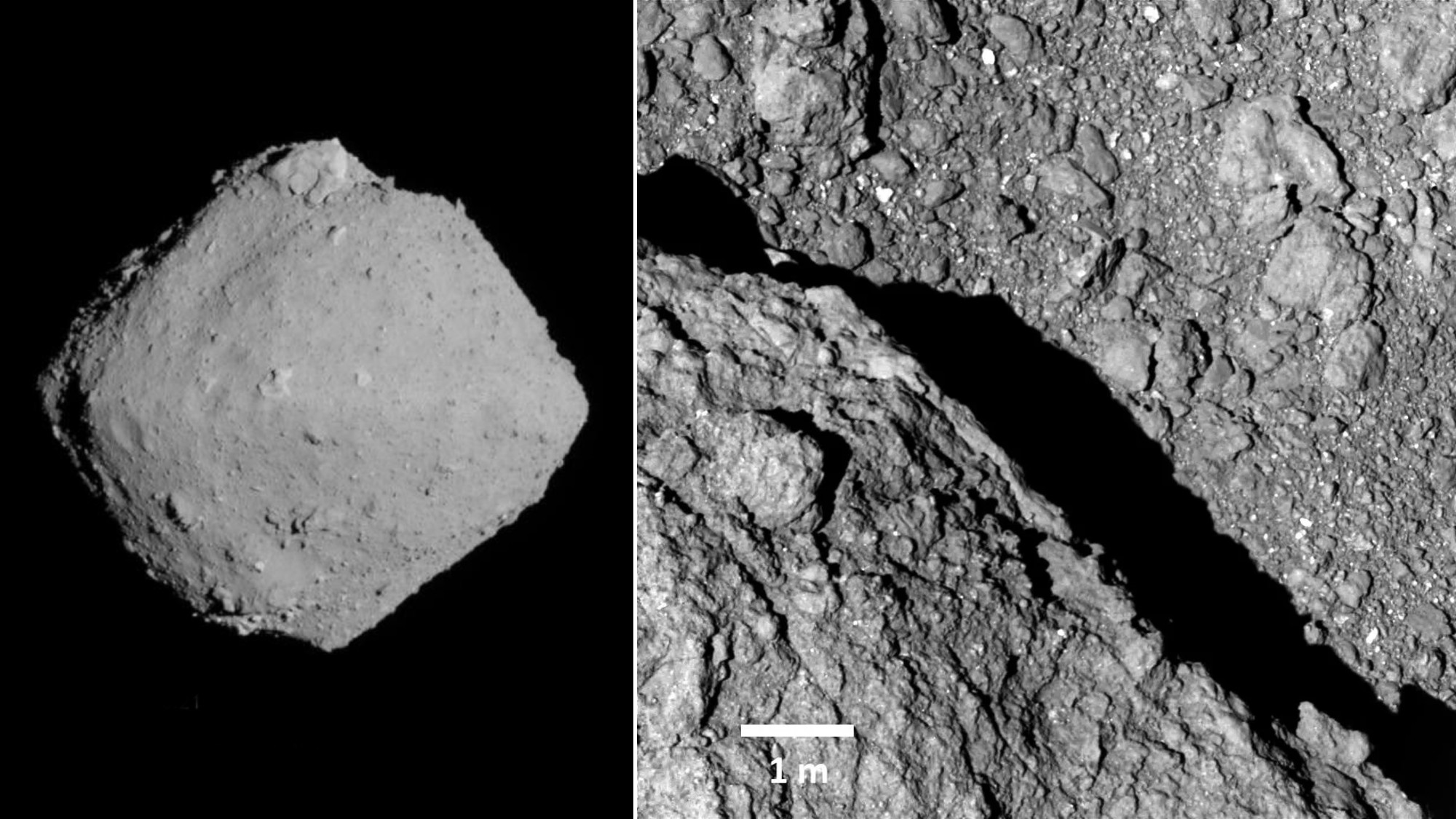
a two panel image of a grey, boulder-covered rock

Asteroid Ryugu, also seen by JAXA's Hayabusa2 spacecraft. (Image credit: JAXA, University of Tokyo, Kochi University, Rikkyo University, Nagoya University, Chiba Institute of Technology, Meiji University, University of Aizu and AIST.)

Hayabusa2 launched in December 2014 on an ambitious mission to collect asteroid samples and return them back to Earth. The probe did just that in December 2020 when JAXA successfully landed samples of asteroid Ryugu in the Australian desert.

Since then, scientists have used the samples to peer back in cosmic time at the history of our solar system and have even discovered that Ryugu contains all five nucleobases found within DNA and RNA.

After collecting its precious samples, Hayabusa2 left Ryugu in 2019. It's ultimate goal is now to flyby asteroid 1998 KY26, which could become the smallest asteroid ever visited by a spacecraft. 1998 KY26 is just 36 feet (11 meters) across, close to the size of the asteroid that exploded above Chelyabinsk, Russia in 2013.
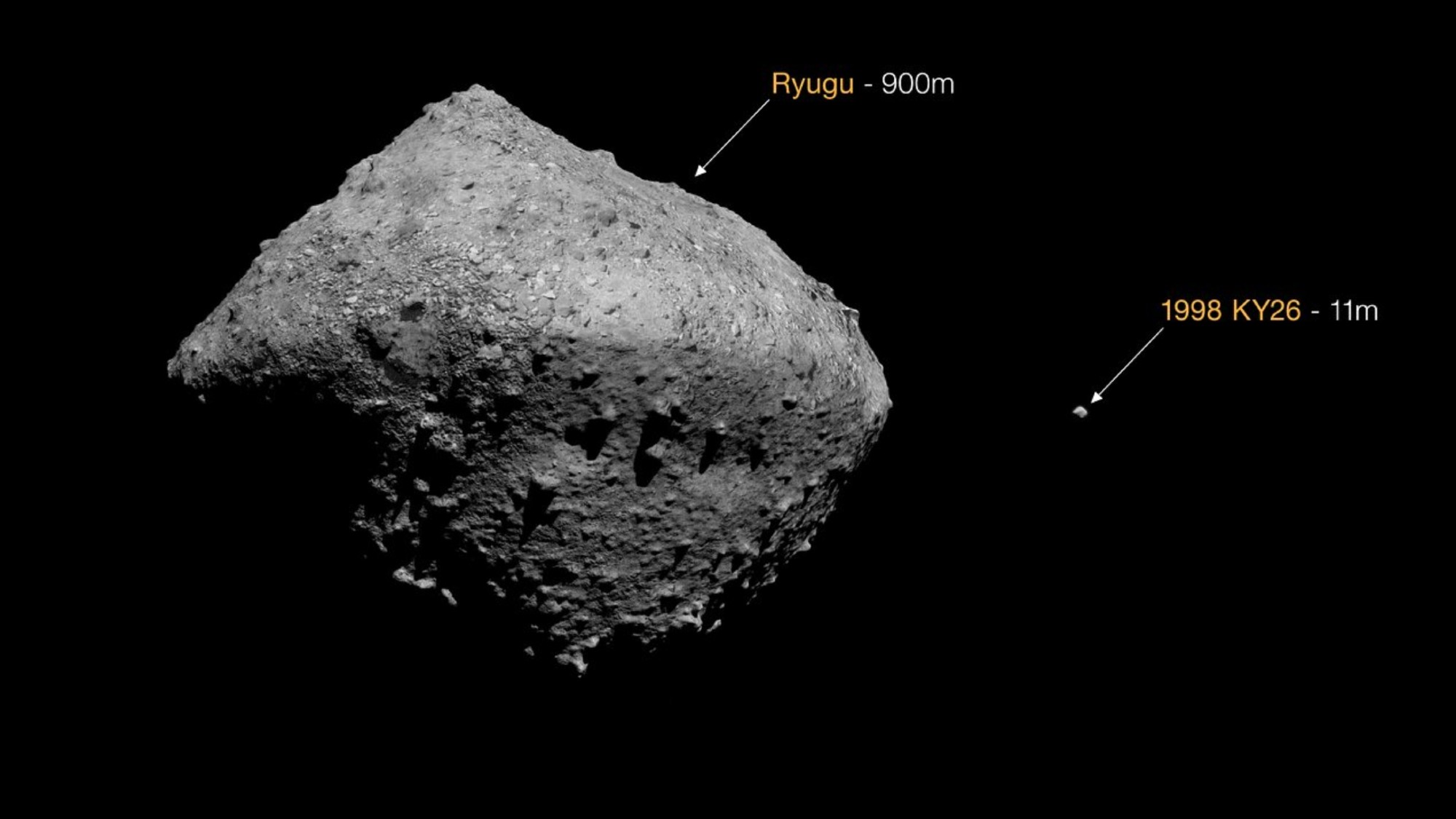
two lumpy grey rocks on a black background; the one on the left is hundreds of times larger than the one on the right

A size comparison between asteroid Ryugu, which was visited by Hayabusa2 in 2020, and its next target, 1998 KY26. (Image credit: ESO/M. Kornmesser. Asteroid models: T. Santana-Ros, JAXA/University of Aizu/Kobe University)

Hayabusa2 is expected to reach 1998 KY26 in the year 2031. Once there, the probe will orbit the space rock before attempting to touch down on its surface. JAXA hopes the mission will help scientists more about the structure and composition of small asteroids.

Stunning new NASA space telescope images reveal the universe in red, white and blue for America 250

NASA's Chandra X-ray Observatory has released four stunning images of cosmic wonders, depicted in red, white and blue to coincide with the United States' 250th anniversary on July 4.

The four images reveal superheated gas in a distant galaxy cluster, the swirling spiral galaxy known as Messier 94, a glowing nebula found in our own Milky Way galaxy, and the Cassiopeia A supernova remnant, respectively.

Along with the colorful cosmic images, the Chandra team produced sonifications in which the data collected by the powerful X-ray telescope was translated into sound. In this case, the sonifications turn these images into celestial music, mapping X-ray data into different audio frequencies and musical instrument sounds.

Galaxy cluster ZwCl 0024+1652

In this image, the galaxy cluster ZwCl 0024+1652 comes alive in vibrant blues and reds. The red in the image is produced from X-ray data collected by Chandra, revealing vast amounts of superheated gas surrounding these galaxies, found some 4 billion light-years from Earth in the Pisces constellation.

This image combines X-ray data from Chandra along with optical data from the Hubble Space Telescope, depicted here in blue. The Hubble data reveals the presence of dark matter, according to a statement from NASA.

Because dark matter does not interact with light, astronomers can't image it directly; its presence can be detected through the gravitational influence it has on surrounding matter that does interact with light.

An image of galaxy cluster ZwCl 0024+1652 that combines X-ray data from Chandra along with optical data from the Hubble Space Telescope. (Image credit: NASA/CXC/SAO; Optical and Dark Matter: NASA/ESA/M.J. Jee; Image Processing: NASA/CXC/SAO/L. Frattare)

Messier 94

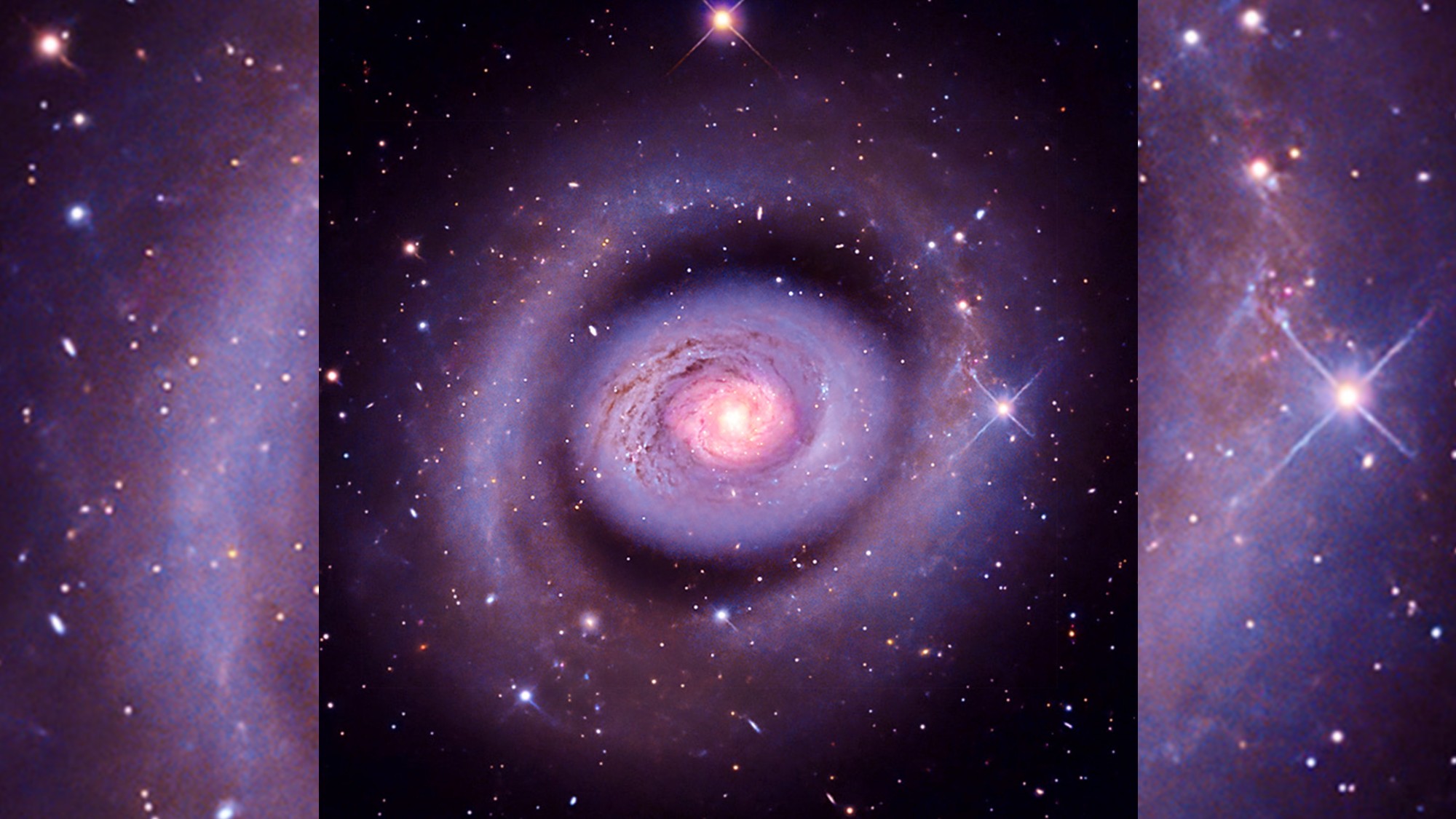
Chandra also peered deep into the 'eye' of the spiral galaxy Messier 94 (M94, or NGC 4736), sometimes colloquially referred to as the Cat's Eye Galaxy. This galaxy is found some 16 million light-years away in the constellation Canes Venatici, the "Hunting Dogs."

In this swirling image, X-ray data collected in space by Chandra was combined with visible light photography taken by telescopes here on Earth. The images show the distinctive inner region of Messier 94, known as a starburst ring, in which new stars are being born.

M94 is also notable for its curious lack of dark matter, according to NASA. "Astronomers do not know why it lacks the normal amount of dark matter, but the galaxy has been the subject of extensive study as a result," the agency wrote in a statement.

An image of galaxy NGC 4736, also known as Messier 94, produced through a combination of visible light telescope imagery and data collected by NASA's Chandra X-ray observatory. (Image credit: X-ray: NASA/CXC/SAO; Optical:Brian Brennan and Remi Lacasse; Image Processing: NASA/CXC/SAO/L. Frattare and K. Arcand)

Nebula NGC 3603

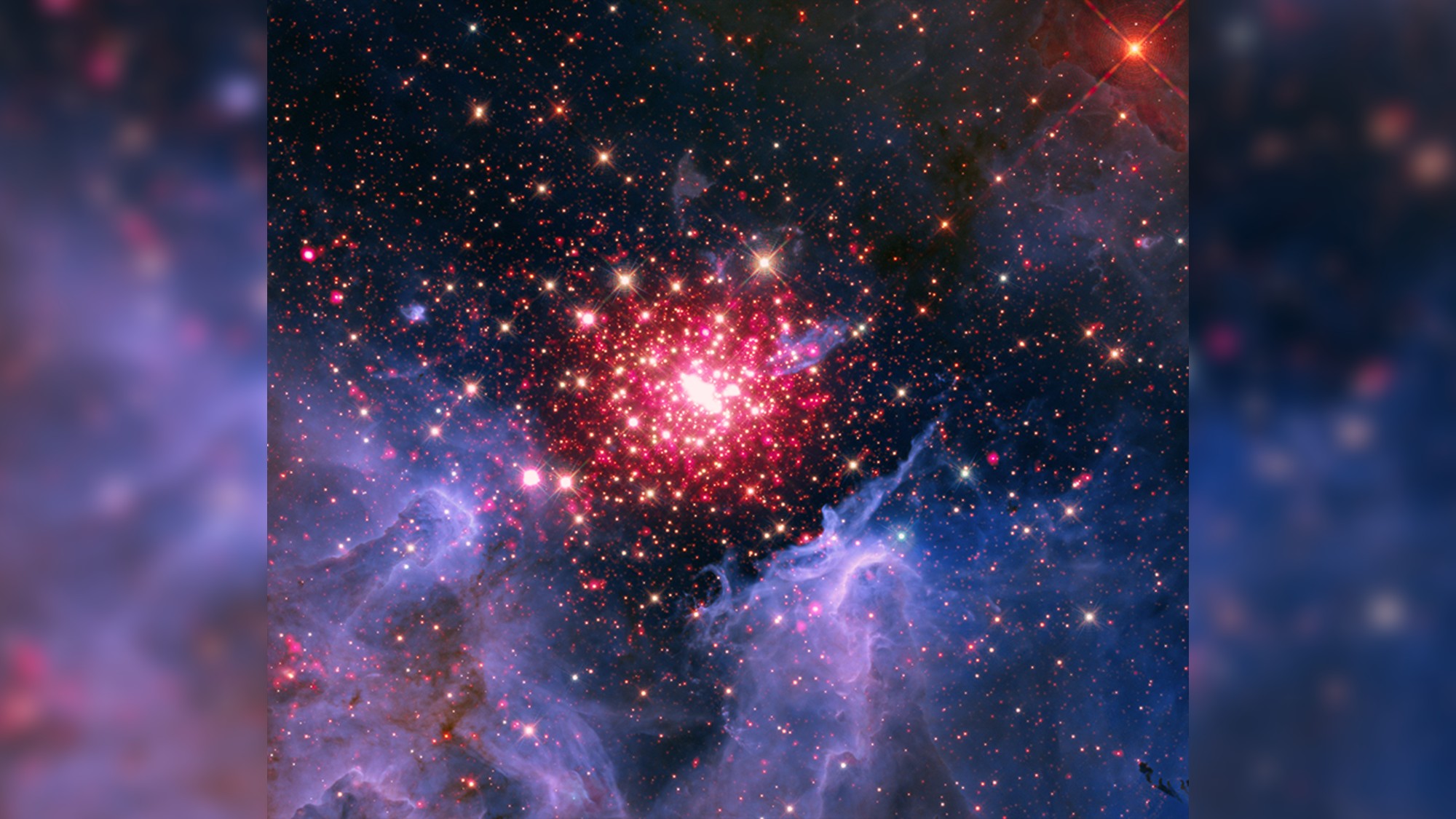
This image combines X-ray data from Chandra with optical, infrared, and ultraviolet light from NASA's Hubble Space Telescope to reveal the twinkling cluster of gases and thousands of stars known as NGC 3603.

This nebula, found in our own Milky Way galaxy, is a vast region of gas and dust surrounding a dense concentration of massive stars. NGC 3603 is located 20,000 light-years away from our solar system in the Carina constellation, a Southern Hemisphere constellation named after the Latin word for a ship's keel.

NGC 3603 contains some of the most massive stars in the known universe, according to NASA. "These huge stars live fast and die young, burning through their hydrogen fuel quickly and ultimately ending their lives in supernova explosions," the agency pointed out in a prior statement about the nebula.

An image of the nebula known as NGC 3603, combining X-ray data from NASA's Chandra X-ray observatory with optical, infrared, and ultraviolet light from NASA's Hubble Space Telescope. (Image credit: NASA/CXC/SAO; Optical and Dark Matter: NASA/ESA/M.J. Jee; Image Processing: NASA/CXC/SAO/L. Frattare)

Cassiopeia A

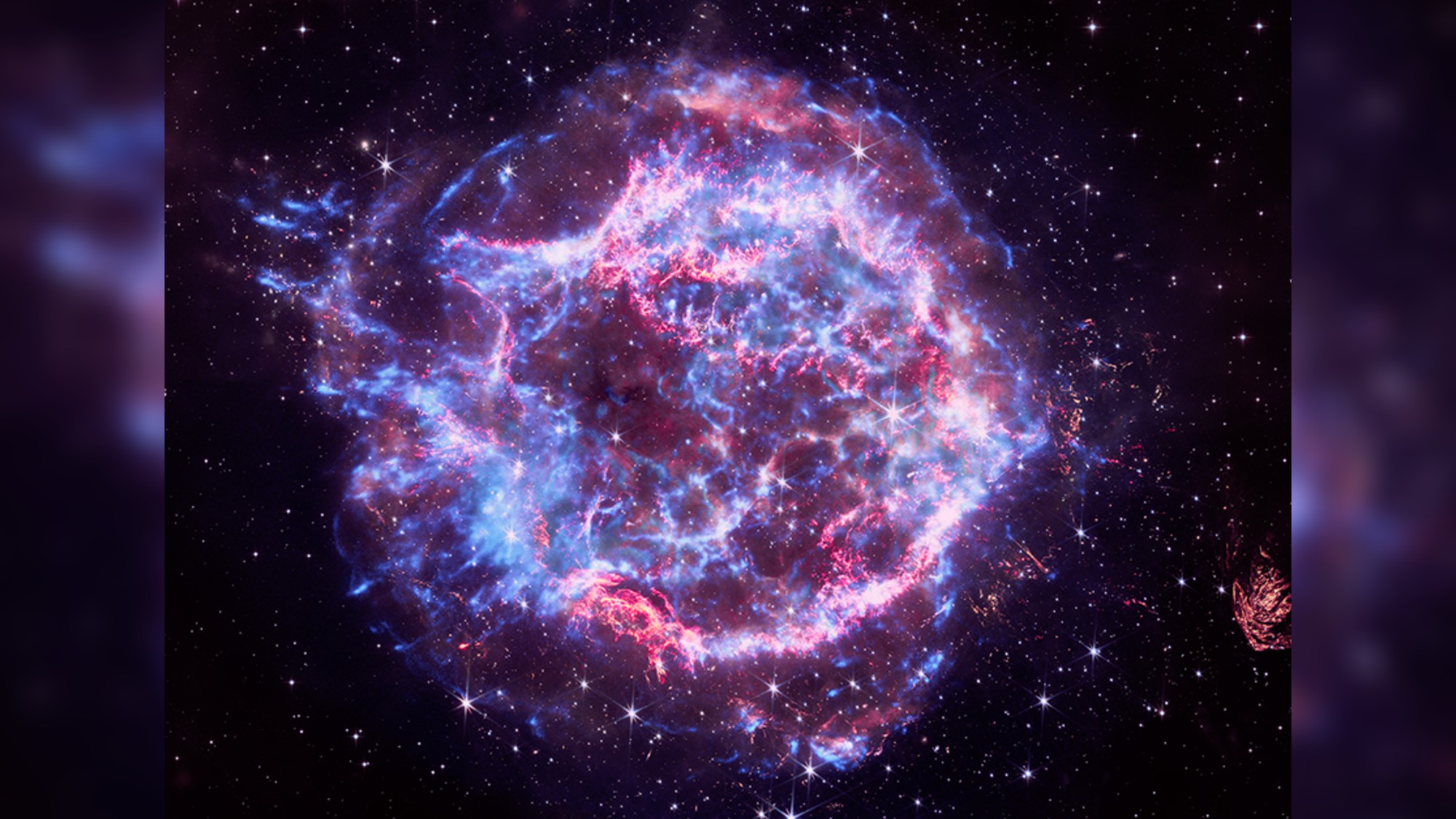
When some stars die, they explode in massive events known as supernovas. The light from one of the most well-known examples of a supernova reached Earth in the 17th century, appearing as a bright point of light in the Cassiopeia constellation. But because this exploded star is located some 11,000 light-years away from Earth, it means that the supernova actually occurred over 10,000 years ago, according to NASA.

Today, the leftover gases from that supernova are known as Cassiopeia A. Astronomers believe the star that produced the supernova was somewhere in the neighborhood of 15 to 25 times more massive than the sun.

In the image below, Chandra's X-ray data was combined with infrared light gathered by the James Webb Space Telescope to help visualize the luminous shell of gas in reds, whites and blues.

A new image of the supernova remnant Cassiopeia A produced by combining infrared light gathered by the James Webb Space Telescope with X-ray data produced by NASA's Chandra X-ray observatory. (Image credit: NASA/CXC/SAO; IR: NASA/ESA/CSA/STScI; Image Processing: NASA/CXC/SAO/L. Frattare and K. Arcand)

Europe’s deadly heat wave seen from space | Space photo of the day for June 30, 2026

Land surface temperature data captured by Europe's Copernicus Sentinel-3 mission on Wednesday, June 23, 2026. The data were captured in the late morning, local time. (Image credit: contains modified Copernicus Sentinel data (2026), processed by ESA)

Over 1,300 deaths have been attributed to a heat wave that swept across Europe and broke temperature records earlier this month.

From its perch in sun-synchronous low Earth orbit, Europe's Sentinel-3 satellite captured data that helps visualize the heat wave and aids researchers in understanding both the causes and effects of the atmospheric phenomena that led to these soaring temperatures.

What is it?

In this image from the European Space Agency (ESA), land surface temperatures are depicted on a scale that depicts hotter temperatures as red and violet. On the date this image was taken, June 23, France recorded its hottest June day ever, according to ESA.

The Sentinel-3 satellite detected surface temperatures as high as 131 degrees Fahrenheit (55 degrees Celsius) in parts of central Spain, western France and northern Africa, while Madrid saw 118 degrees F (48 degrees C), and surface temperatures in Rome reached 111 degrees F (44 degrees C).

Why is it incredible?

Temperatures this high were unprecedented across of much of Europe. Authorities with the World Health Organization (WHO) estimate that over 1,300 deaths may be linked to the heat wave. And things may get worse for the continent.

"Europe is the fastest-warming continent on Earth, heating at twice the global average," WHO chief Tedros Adhanom Ghebreyesus posted on X.

By providing real-time temperature data over both water and land using its Sea and Land Surface Temperature Radiometer instrument, the Sentinel-3 satellite is providing unprecedented data about these extreme weather events and how they affect populations.

China’s space plane appears to have released a mystery object in orbit

China's Shenlong space plane appears to have released a mystery object while in orbit, according to a private space surveillance firm.

Shenlong launched on its fourth mission on Feb. 6, 2026 atop a Long March 2F rocket that lifted off from China's Jiuquan Satellite Launch Center in the Gobi Desert. As with previous flights, the objectives of this mission were not disclosed to the public. But according to recent observations by the commercial orbital intelligence company LeoLabs, one part of Shenlong's latest mission appears to involve releasing an unknown object.

"At 02:30 UTC on 22 June 2026, LeoLabs detected an unknown object in the vicinity of the Chinese Shenlong reusable space plane," LeoLabs posted to X. "This object did not correlate to any other object in our catalog. It was first observed by our Tracker radar in New Zealand."

"Following additional observations across our global network and analysis via LeoLabs Delta, we have independently cataloged this object and assessed with high confidence that it was released from the Chinese space plane," the company added in the post. "This activity is consistent with sub-satellite deployments conducted by the space plane in previous missions."

Space tracker Jonathan McDowell noted on X that the object has now been catalogued by the U.S. Space Force.

Shenlong, or "Divine Dragon," is a reusable space plane that launches atop a rocket but lands on a runway like an aircraft. Its overall design is believed to be similar to the United States Space Force's X-37B, or somewhat like NASA's storied space shuttle. Exact specifications are difficult to come by, given how secretive China's space program remains about Shenlong.

Very few images exist of Shenlong, and most of what we have seen of the space plane are telescopic images of the vehicle taken from ground-based telescopes.

black-and-white images of an aircraft-like object rotating in space

Imagery of China's Shenlong space plane caught on camera in 2024 by Felix Schöfbänker in Upper Austria. (Image credit: Felix Schöfbänker )

This isn't the first time that Shenlong has appeared to release objects while in orbit. In June 2024, observers noticed that the space plane may have released a subsatellite or ejected an unnecessary piece of hardware as it approached the end of its mission.

Six months earlier, observers believed the space plane had ejected six objects at once, but those were later determined to be debris left over from launch.

Observers on the ground have also noticed what appear to be solar arrays extending from Shenlong, based on analysis of telescope imagery.

On previous missions, Shenlong has appeared to conduct what are known as rendezvous and proximity operations (RPO), meaning it tested the capability to maneuver close to other objects in space, according to SpaceNews.

White these RPOs can be conducted for peaceful purposes such as repairing or refueling other spacecraft, it might also be the case that space superpowers such as China and Russia are developing these capabilities to potentially tamper with adversary satellites should warfare ever make it to space. In May, two Russian satellites came within 10 feet (3 meters) of one another in orbit, following a pattern of the country testing the capabilities of these so-called "inspector" spacecraft.

There's no reason to believe the United States isn't developing its own RPO capabilities for similar reasons, and the nation has released official artwork suggesting as much.