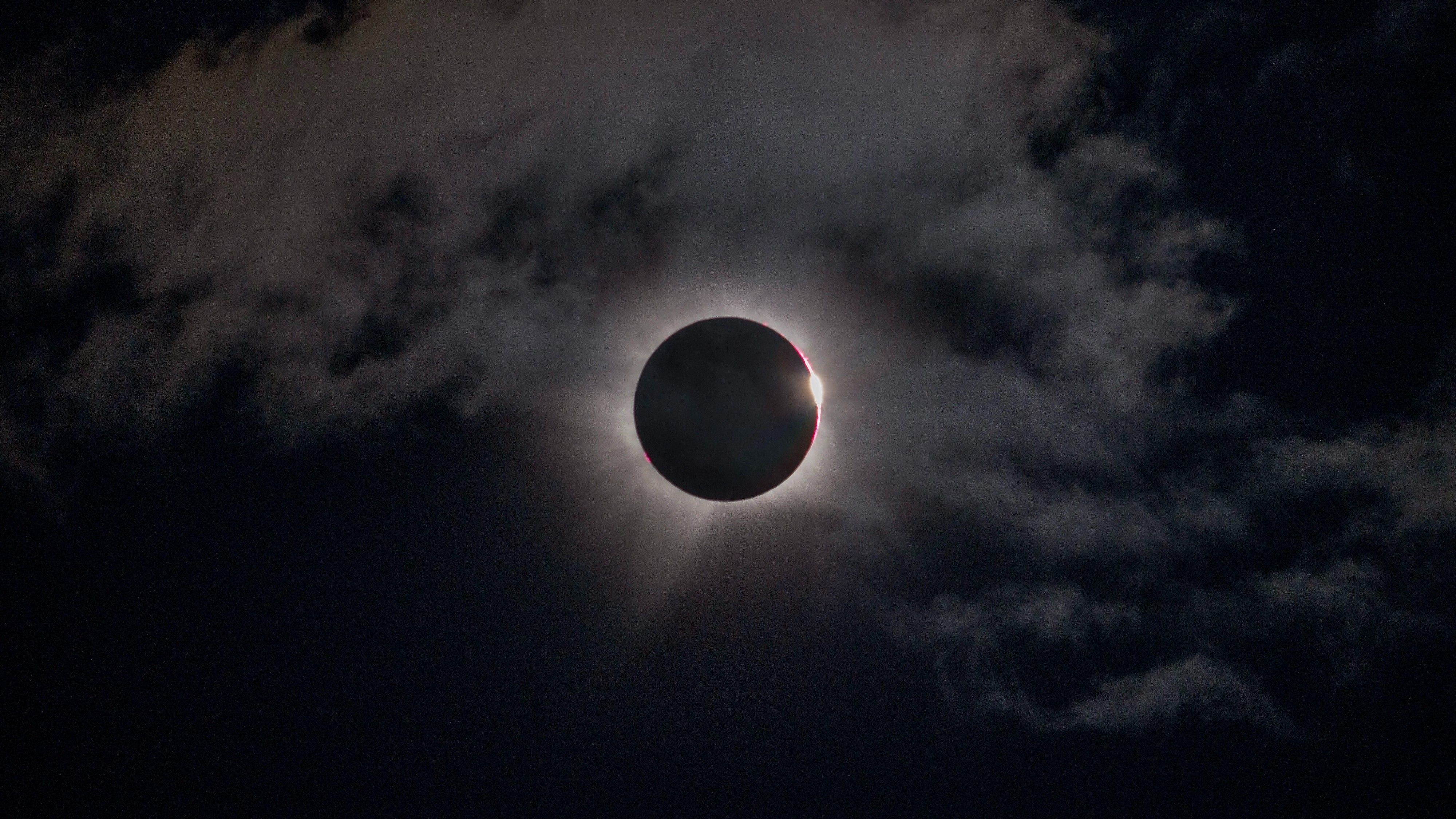
The moment just before totality during the Aug. 12, 2026 total solar eclipse, captured from the deck of the MS Spitsbergen on the HX Expeditions eclipse voyage. (Image credit: Daisy Dobrijevic/Future)
The total solar eclipse of Aug. 12, 2026 was one for the books. And this photo, snapped just as the eclipse was about to enter totality, really captures the drama of the moment.
What is it?
On Aug. 12, 2026, millions of people around the world witnessed a total solar eclipse. This happens when the moon passes in front of the sun, completely blocking it from our perspective here on Earth. (During a partial solar eclipse, only part of the sun's face is blocked by the moon.)
Observers lucky enough to be in the narrow "path of totality" that day got an experience they'll never forget.
Why is it incredible?
The chance to observe a total solar eclipse doesn't come along very often and is truly surreal and magical. While you might logically know that it's a predictable result of orbital dynamics, it's still incredibly strange in the moment to watch the sun disappear behind a black disk.
During totality, you experience a sort of false nighttime in the middle of the day. This can trigger strange responses from wildlife, with animals that are typically nocturnal coming out to see what's going on, confused about why night arrived at what feels like the wrong time.
Space.com skywatching editor Daisy Dobrijevic traveled to the Scoresby Sund off the coast of Greenland to experience the total solar eclipse from the deck of the MS Spitsbergen on the HX Expeditions eclipse voyage, and she's been taking us all along on her journey.
"I couldn't believe my eyes. I knew exactly what to expect — I’ve written about total solar eclipses countless times and given talks about them — but nothing prepared me for the feeling of actually seeing it," Dobrijevic said about her experience watching the eclipse. "I was completely in awe. As thin clouds drifted in towards the end of totality, they only added to the drama and emotion of an already extraordinary sight."
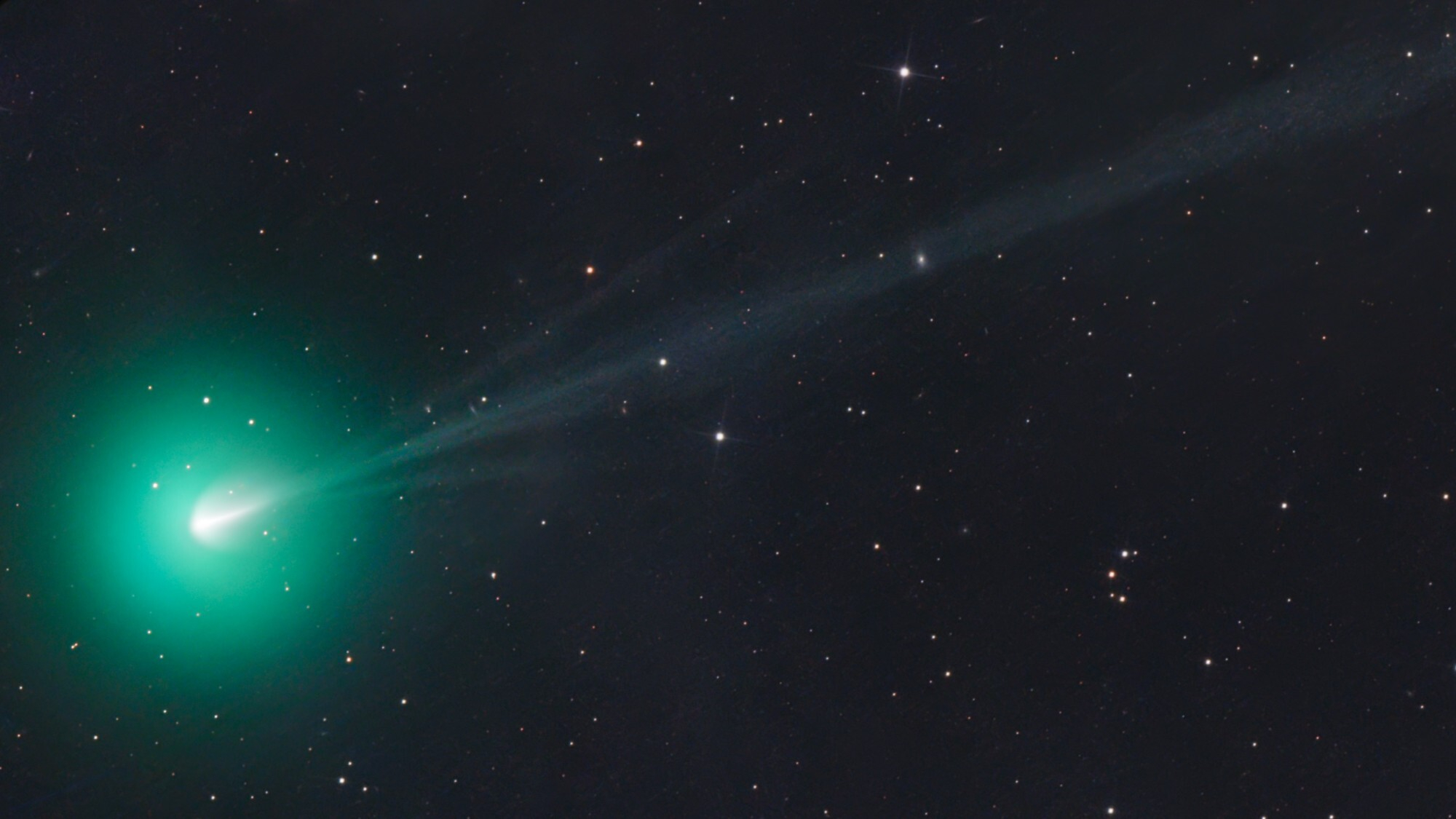
Discovered by Australian astronomer Robert H. McNaught, the comet orbits our sun once every 5.5 years. Back in June, the comet reached perihelion, or the closest point in its orbit around the sun. Around that time, the comet experienced a large outburst, which brightened it about 8,000 times.
The comet brightened back up this August to about 600 times its normal brightness — and it was during this period when astrophotographers Gerald Rhemann and Michael Jäger captured it streaking across the night sky over Namibia.
To capture the moment, the pair used a 12-inch Astrograph telescope with a ZWO ASI 6200 MM Pro camera.
Why is it incredible?
It's not every day you see a comet in the night sky. Even if one is overhead, often they're too tricky or too far away to spot without a telescope, and even then it can be a challenge.
It's also incredible that the moment captured in the new image showcases the comet 220P/McNaught with such spectacular clarity and detail. It must have been something truly special to witness.
While spotting a comet like this might not happen every day, we can sometimes see the debris trailing behind a comet as its tail burns up in our atmosphere. These burnt comet bits are actually the "shooting stars" we see in the night sky during a meteor shower.
Right now, the Perseids meteor shower is on its annual parade across the night sky. This meteor shower is made up of debris shed by the comet Swift-Tuttle as it swoops by on its annual trip across the solar system. Under dark skies, skywatchers can see up to 100 shooting stars thanks to Swift-Tuttle.
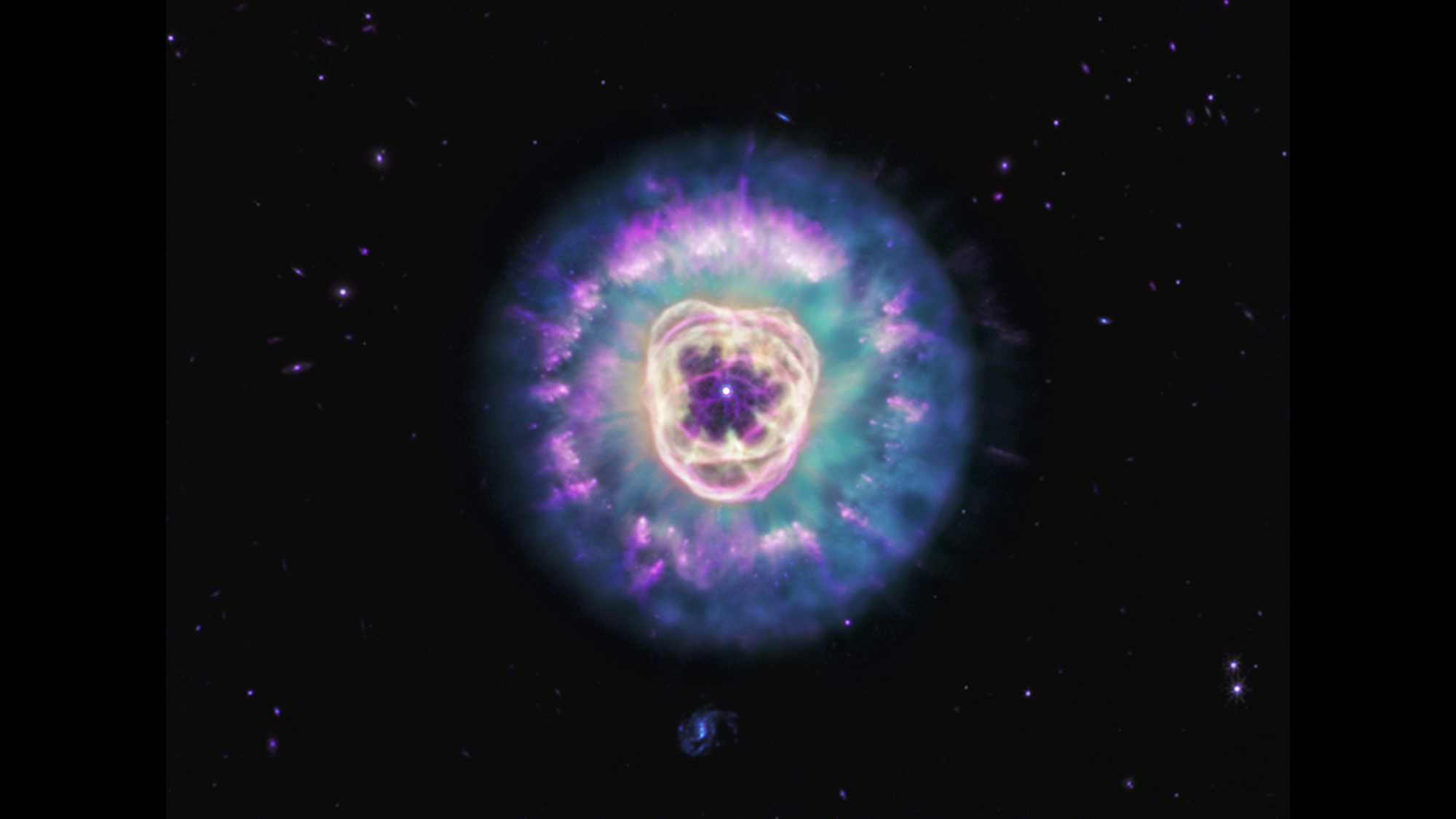
The Lion Nebula glows gloriously in this new snapshot from the James Webb Space Telescope, made using data from the NIRCam and MIRI instruments. Image: NASA, ESA, CSA, STScI; Image Processing: Alyssa Pagan (STScI)The Lion Nebula glows gloriously in this new snapshot by the James Webb Space Telescope using data from JWST's MIRI instrument. Image: NASA, ESA, CSA, STScI; Image Processing: Alyssa Pagan (STScI)
With a glorious mane of glowing purple gas and dust, the Lion Nebula sparkles on the cosmic savanna in this new image captured by the James Webb Space Telescope.
What is it?
This new image highlights the stunning beauty of the Lion Nebula (formally named NGC 2392), which earned its nickname thanks to its vaguely lion-head-shaped "face" and surrounding, fuzzy "mane".
At the center of this lion's face lies its nose, a bright purple spot. This spot is actually the remnant of a dying star that's radiating energy outward and powering the cosmic structure. This oxygen-rich remnant is a white dwarf, or the hot core of a dying star. As a star like this dies, it becomes unstable and sheds its outer layers, blasting gas and dust outward to create a planetary nebula.
The white dwarf got left behind after the nose in the center of the "lion's" face expelled energy and created a big bubble of ionized gas around itself. Over time, the lion's face will continue to expand. Astronomers estimate that in about 10,000 years, the lion might dissipate entirely.
Why is it incredible?
This isn't the first time we've seen the Lion Nebula. Back in 2000, for instance, the Hubble Space Telescope took a close look at the nebula.
However, the JWST snapped this image of the nebula using two of its state-of-the-art instruments: the NIRCam (Near Infrared Camera) and MIRI (Mid Infrared Instrument). And the new view gives us a very detailed look at the nebula.
With these new instruments, we can see details we never saw in the Hubble's view of the Lion Nebula — like certain dust and gas features. Overall, this view gives us a much more accurate view of what the nebula actually looks like, and what cosmic structures hold it up.
This image of the sun — the sharpest ever snapped — was captured by the NSF Inouye solar telescope. (Image credit: NSF, NSO, AURA, MPS, Inouye Tel)
Scientists have captured the sharpest image ever of our sun's surface. This view has revealed incredible new details about the inner mechanisms driving stellar activity.
What is it?
An international team of researchers using the U.S. National Science Foundation's Inouye Solar Telescope has captured the highest-resolution view of the sun's surface.
In analyzing observations from this telescope, the team, made up of researchers from the National Solar Observatory, the NSF NCR High Altitude Observatory and the German Max Planck Institut für Sonnensystemforschung, discovered strange patterns on the sun's surface. The whirling patterns, they found, are actually evidence of what's called Kelvin-Helmholtz instability (KHI), or instability that happens when there is a change in velocity of fluids.
Why is it incredible?
This image is groundbreaking. Capturing the highest-resolution view of the sun's surface is a massive accomplishment, and in the time-lapse video above, you can even see the fluid dynamics on the surface of the sun in motion.
But this view is much more than a beautiful, high-resolution image. These observations have revealed swirls on the sun's surface at the edges of the magnetic areas, allowing the team to identify KHI on the sun's surface. This fluid instability has long been suspected on the sun, but these observations are the first time they have ever been directly seen like this.
“We believe that the discovery of Kelvin-Helmholtz Instability in the solar photosphere, backed up by analysis of numerical simulations, is a major step forward in our understanding of the dynamics and evolution of solar and stellar plasma, and will serve as a basis for future discoveries," David Boboltz, the deputy director at the National Solar Observatory, said in a statement.
A paper describing these findings was published recently in the journal Nature.
Picture it: A swarm of tiny robot helicopters descends through a reddish-brown sky, landing gracefully on the Martian surface. What are they wearing? Tiny capes.
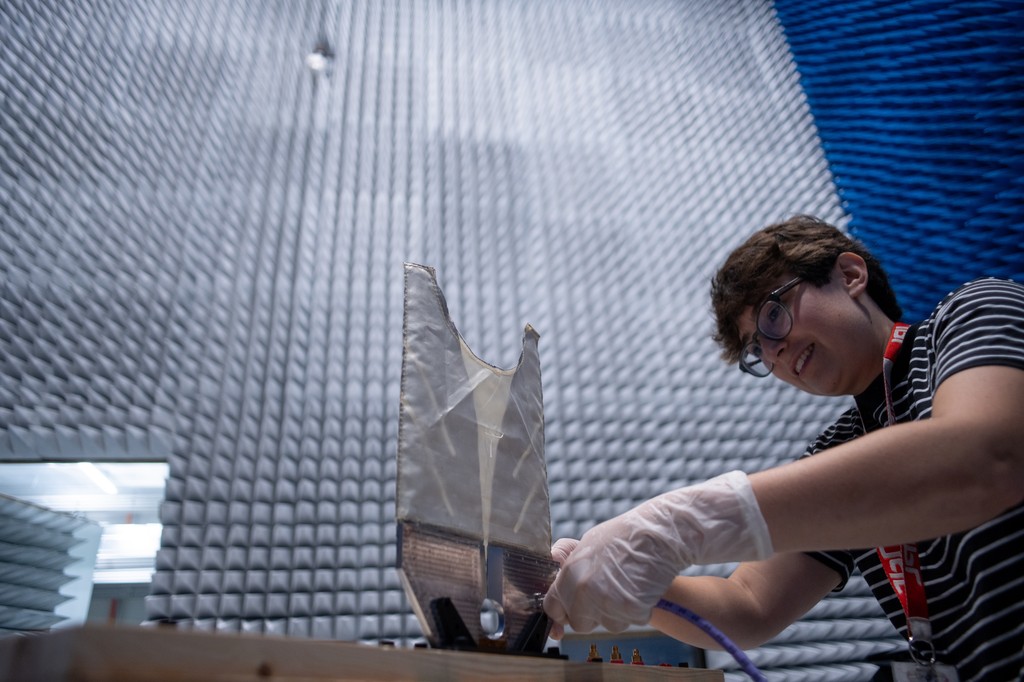
NASA's SkyFall mission will send a trio of mini rotorcraft to Mars equipped with ground penetrating radar technology which happens to look like little capes. These uniquely designed swaths of fabric look decidedly strange or even accidental in new videos from NASA's Jet Propulsion Laboratory (JPL) that show the little drones practice landing. But these capes are actually flexible antennae that will allow the craft to peer beneath the Red Planet's surface in search of water ice.
"The only way to detect shallow subsurface ice remotely is to fly close to the ground," Adrian Tang, SkyFall’s ground-penetrating radar lead instrument scientist at JPL, said in a statement on Thursday (Aug. 6). "By flying low and slow, a SkyFall helicopter could capture radar images that resolve the fine layering where dry soil gives way to ice, detecting its presence and mapping its extent."
Orbiting spacecraft have studied Mars for decades, imaging the planet and mapping it with radar. But from orbit, their radar is unable to see the first few feet of material just below the planet's surface — a zone where scientists expect to find shallow ice deposits mixed in with the rocks and dust. This work could be important for future astronauts who need to better understand the ground below their feet for safety reasons, and for future travelers searching for accessible ice to process for drinking water, oxygen and fuel.
Skyfall will follow in the footsteps of Ingenuity, the first rotorcraft on another world, which hitched a ride to Mars aboard NASA's Perseverance rover. The new choppers are based heavily on Ingenuity, which weighed just 4 pounds (1.8 kilograms) here on Earth. But Skyfall will be more capable than Ingenuity, whose main job was to show that choppers can explore the thin skies of Mars.
SkyFall's tiny cape ground-penetrating radar, which uses a type of flexible antenna called Vivaldi that was invented back in 1978, is designed to survey up to 16 feet (5 meters) below the Martian surface. The radar will be able to reach anywhere from several yards below the planet's surface to the uppermost layers of surface material.
And the antenna's unique design ensures that the SkyFall drones will be able to make these subsurface observations without damaging the equipment during landing.. The antenna is extremely lightweight, and the team miniaturized it to be both the right size and shape to fit the tiny helicopters, which sit just 6 inches (15 centimeters) above the ground at rest. The tricky thing was, the designers had to miniaturize the radar antennae while maintaining functionality. But they did just that, and these tiny radar capes will be able to bend and move out of the way as the rotorcraft do their thing, flying above and landing on the Red Planet.
"Although we managed to shrink the antenna quite a bit, it is about 1.5 times longer than the helicopter’s legs," Christine Gebara, SkyFall ground-penetrating radar mechanical lead at JPL, added in the statement.
"That means during landing, the Vivaldi has to bend out of the way — and if it lands on a rock, it bends even further," she added. "But when the helicopter takes off again, the antenna must spring back into place for data collection. Because SkyFall is expected to make dozens of flights exploring Mars, we needed an antenna that could repeatedly handle those pressures without losing its shape in flight."
A radar engineer at NASA JPL works to test the antenna on the SkyFall helicopter. (Image credit: NASA/JPL-Caltech)
To make these little capes capable of withstanding incredible feats on another world, the engineers behind the helicopters covered the antenna in layers of polyester and Vectran, a flexible (but incredibly strong) material that was previously used for the airbag that cushioned NASA's Spirit and Opportunity Mars rovers during their touchdowns in 2004. The antenna's shape is also reinforced with flexible fiberglass tape springs and a lightweight structure. In total, each antenna weighs a miniscule 5 ounces (142 grams).
But a crafty design isn't enough. Getting to Mars is no small feat, and NASA needs to be sure that these little helicopters and their gear are up to the challenge. So, in JPL's Environmental Test Laboratory, which recreates different elements of environments beyond Earth, the SkyFall team put the rotorcraft and its little radar antenna to the test. They bent and flexed the antenna over and over, recreating multiple landings on the surface, exposed the craft to extreme temperatures, and continually checked to make sure that, throughout this testing, the helicopter could still transmit and receive radar signals. At the end of this testing, the antenna had endured 200 simulated Mars landings and was still working just fine. That is more than twice the number of landings expected from the mission.
"This test checked every box it was supposed to and answered our biggest technical questions," Tang added. "While we still have work ahead of us before the antenna is fully flight-qualified, this was a major milestone, and the hardware performed exactly as expected."
The trio of SkyFall helicopters will put their radar capes to the ultimate test when they fly to Mars. NASA plans to launch this mission to the Red Planet in 2028 aboard NASA's Space Reactor-1 Freedom, the first nuclear fission-powered interplanetary spacecraft.
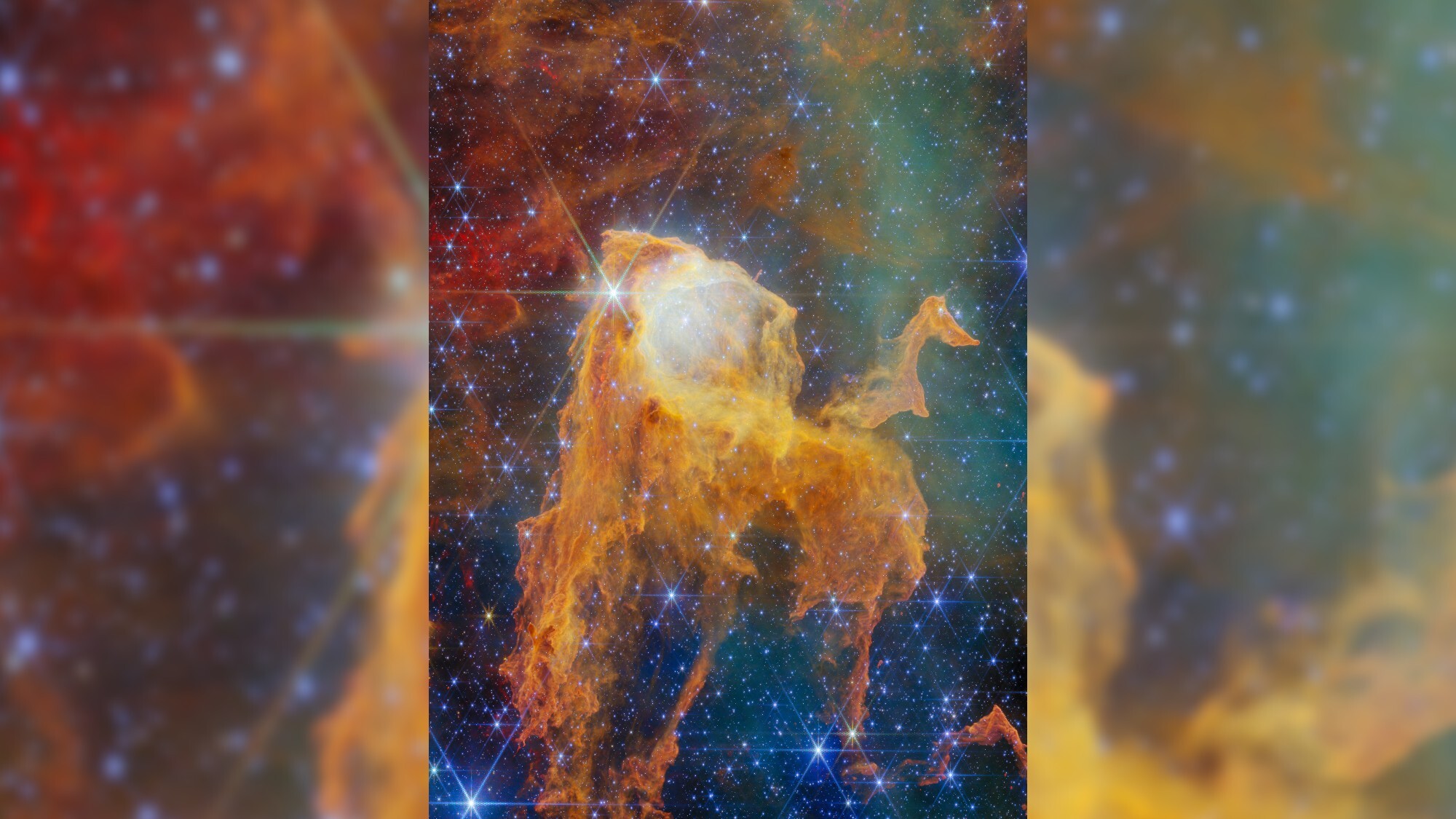
The Carina Nebula's "Treasure Chest" stuns in this new image captured by the James Webb Space Telescope. (Image credit: ESA/Webb, NASA & CSA, M. Reiter)
In a nebula far, far away, colossal clouds of dust and gas tower amongst the stars.
What is it?
This spectacular new image from the James Webb Space Telescope showcases the brilliant majesty of the Carina Nebula, a giant cloud of dust and gas found 7,500 light-years away in the constellation Carina.
In this new image, captured by JWST's Near-Infrared Camera (NIRCam), you can see the nebula in a whole new light. This snapshot captures a specific feature that is being dubbed the "Treasure Chest," as it vaguely resembles a glowing coffer overflowing with stellar jewels.
This "Treasure Chest" contains a cluster of young stars, approximately 70 stars in total. While these might be young, growing stars, the most massive of the bunch is a whopping 19 times more massive than our sun.
Why is it incredible?
While JWST has looked at the Carina Nebula before, new observations can reveal completely new details and help scientists uncover new information about the nebula and the strange ways in which the universe works.
Right now, scientists think that the star cluster in the "Treasure Chest" is about 1.3 million years old. However, previous estimates thought the grouping could be just 100,000 years old. So, new observations by powerful telescopes like JWST can significantly change our understanding of the cosmos.
With each new observation or data point, the history and context of the universe around us could completely transform. And, as this star cluster grows over time, its stars will become more brilliant. They may therefore illuminate more of this star cluster, potentially revealing details and secrets of this "treasure" that scientists might never have predicted.
Early this morning, a SpaceX rocket slammed into the moon at seven times the speed of sound. Now, lunar orbiters are trying to get a look at the aftermath.
This morning (Aug. 5) at about 2:35 a.m. EDT (0635 GMT), the upper stage of a SpaceX Falcon 9 rocket crashed into the moon. To dissect what exactly happened, scientists are looking for imagery of the crash site, with the help of a couple of moon probes.
"NASA’s Lunar Reconnaissance Orbiter and NASA’s ShadowCam instrument on the Korea Pathfinder Lunar Orbiter will look for opportunities to capture before‑and‑after imagery of the impact site," NASA spokesperson Rob Garner, of NASA's Goddard Space Flight Center in Maryland, told Space.com. "Image availability depends on several factors, including the impact location, lighting conditions, and when each spacecraft’s orbit next carries it over the area, which may take a few days to receive any imagery."
While you've likely seen the first stages of Falcon 9 rockets gracefully land back on Earth for reuse, the rocket's 9,000-pound (4,000 kilograms) upper stage is disposable. Typically, it's sent to burn up in our atmosphere after its missions are over.
However, that wasn't possible with this rocket, which launched two private lunar landers — Firefly Aerospace's Blue Ghost and Tokyo-based ispace's Resilience — to a high, moon-crossing Earth orbit in January 2025. The Falcon 9 upper stage used most of its fuel getting to this distant location and couldn't make it back to deorbit in Earth's atmosphere.
So the company performed a different maneuver to take care of this upper stage, Julianna Scheiman, director of NASA science and Dragon programs at SpaceX, said during a press conference on Aug. 3.
"For high-energy missions, we need to perform a different maneuver to ensure the second stage itself is safe per the appropriate rules and regulations, and so we did that here," she said.
But the rocket body was still subject to natural forces, which acted on it over time.
"What has happened is, essentially, a mixture of solar activity and gravity forces have put it on a path towards the moon," Scheiman said.
The Falcon 9 upper stage ended up slamming into the moon this morning at about 5,400 mph (8,690 kph). It likely blasted out a crater up to 89 feet (27 meters) wide, according to scientists' calculations.
This was certainly not the original intended outcome for this rocket. But it presents an opportunity for researchers, who plan to take advantage of it to learn more about the moon.
"NASA’s Meteoroid Environments Office will attempt to image the impact around the predicted time using ground‑based telescopes at the agency's Marshall Space Flight Center in Huntsville [Alabama]," Garner added. "Because the impact flash and plume are expected to be faint, the chance of seeing anything from Earth remains low, and local weather can affect observations as well. Any data collected will help scientists better understand impacts from artificial objects and the potential effects on future lunar exploration."
Today's impact took place on the sunlit side of the moon, the brightness of which made observations difficult for skywatchers hoping to watch the crash from afar with telescopes. But the two lunar orbiters might be able to see not just the crash and impact crater but also the plume of dust kicked up by the rocket's death dive.
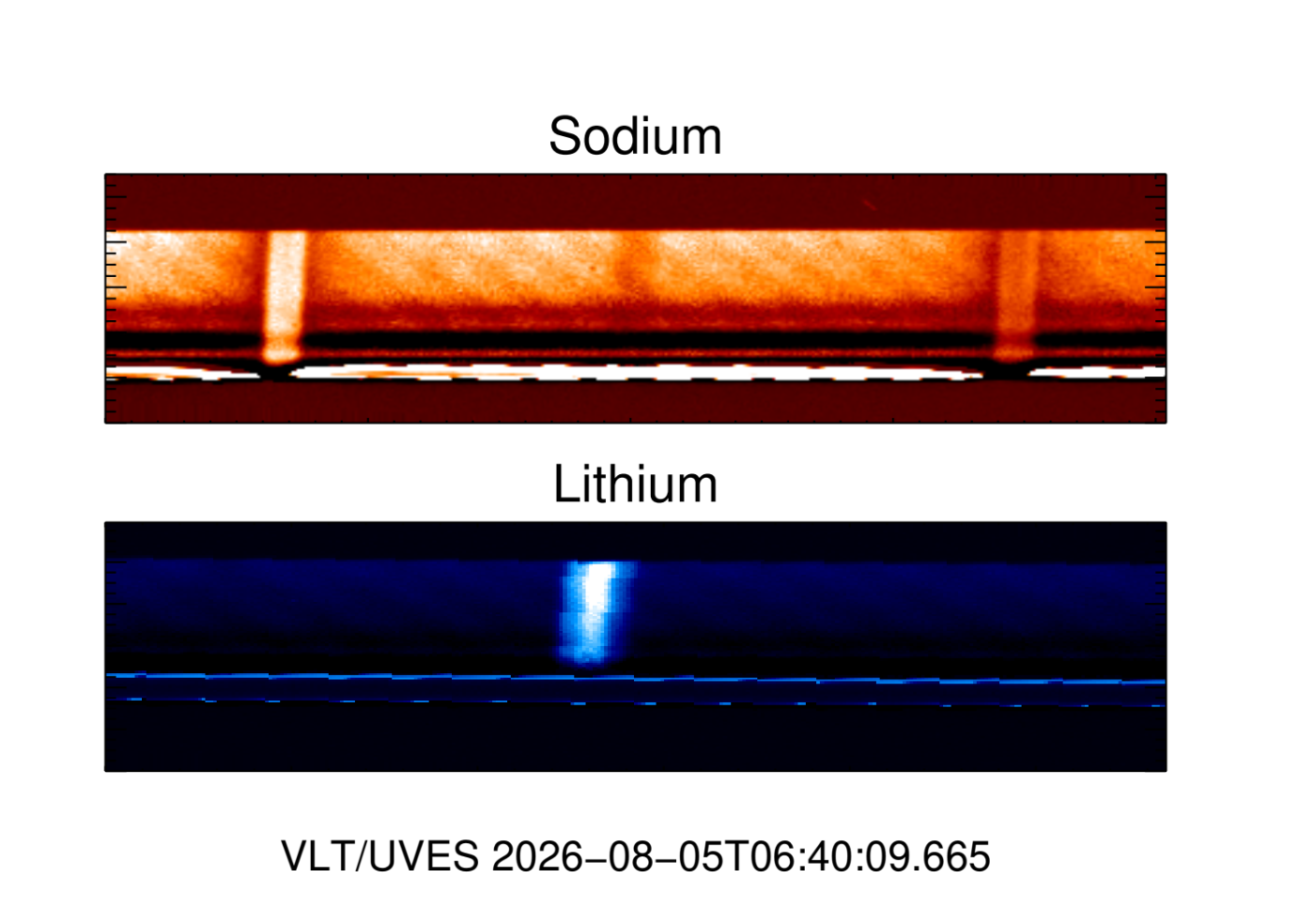
So far, observations from Earth have revealed some information. Scientists at the Lowell Observatory in Flagstaff, Arizona reported detections of a lunar plume from the impact.
"We can safely say that we measured a response from the rocket stage impact as a sodium and lithium gas plume a few 10’s of kilometers in size lasting between 5 and 10 minutes after impact," Carl Schmidt told Inside Outer Space's Leonard David.
Detections by the Lowell Observatory in Flagstaff, Arizona, show evidence of a plume on the moon caused by the impact of a SpaceX rocket on Aug. 5, 2026. (Image credit: Carl Schmidt/Lowell Observatory)
Such images of the event would provide "an opportunity to test pipelines for measuring flash properties to locate impact events seismically, and to better understand the multi-modal hazards posed to future lunar infrastructure and astronauts from space debris impacting the moon," researchers led by Benjamin Fernando of Los Alamos National Laboratory in New Mexico wrote in a recent paper discussing the then-upcoming event.
So hold tight, as researchers are now eagerly collecting and analyzing the images captured by these orbiters, and we might get images of the rocket crash, the lunar plumes and remaining aftermath soon.
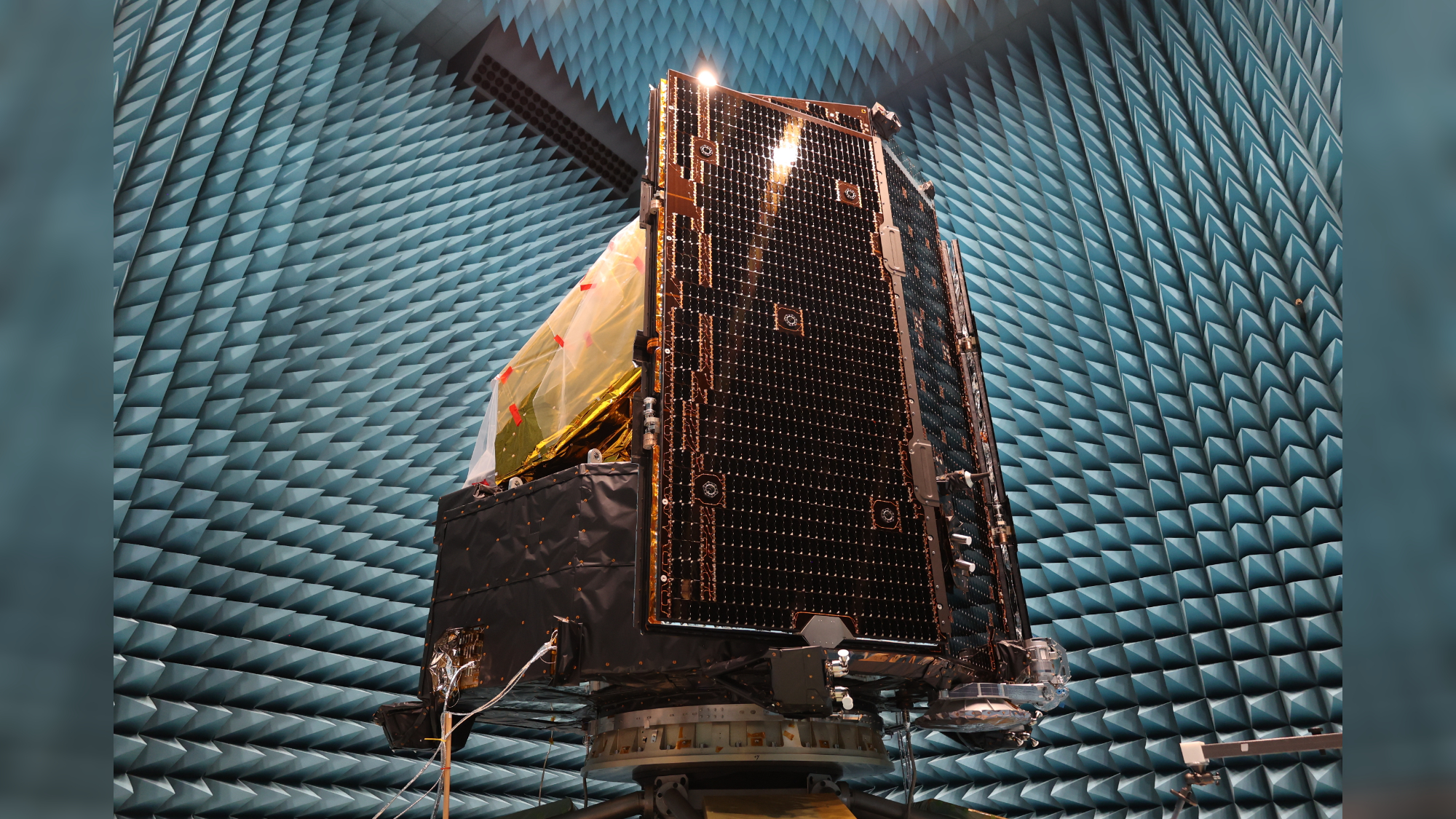
ESA's Plato spacecraft completes critical testing ahead of its spaceflight. (Image credit: ESA - R. Moorkens O'Reilly)
A planet-hunting spacecraft named Plato just passed a series of critical tests as it prepares for the challenges of outer space.
What is it?
Gleaming in the light of a laboratory, this box of electronics is actually the European Space Agency's Platospacecraft sitting inside a special test chamber where it underwent critical tests ahead of its planned spaceflight.
The Plato (PLAnetary Transits and Oscillations of stars) probe is designed to study terrestrial exoplanets, or rocky planets outside of our solar system that are Earth-sized or smaller.
This chamber, called the Maxwell Test Chamber (which is located at the European Space Research and Technology Centre in the Netherlands), is an enclosure made of conductive metal that blocks electromagnetic fields. On top of the conductive metal are foam spikes. Combined, they block out and/or absorb all electrical signals and sounds to mimic some aspects of the environment of the vacuum of space.
In this enclosure, the team turned on Plato's electronics to make sure that signals from some of the probe's instruments don't interfere with other systems or electronics on the craft. With all other signals blocked out, scientists had a clear look into how it might perform in space.
Why is it incredible?
This test is critical as Plato will need to be able to collect data and run its instruments without interference from electronics or signals from elsewhere on the spacecraft. But it's pretty impossible to ensure that things would work as planned amidst the "noise" on planet Earth.
To get any spacecraft ready to operate in the void of space, researchers conduct all sorts of tests to make absolutely sure that they're up to the challenge. In addition to tests like this, spacecraft can be placed in extremely hot or cold temperature chambers or even shaken around to make sure that they can handle the violent conditions of a rocket launch. It's amazing how we can recreate different aspects of outer space here on Earth to prepare for these missions.
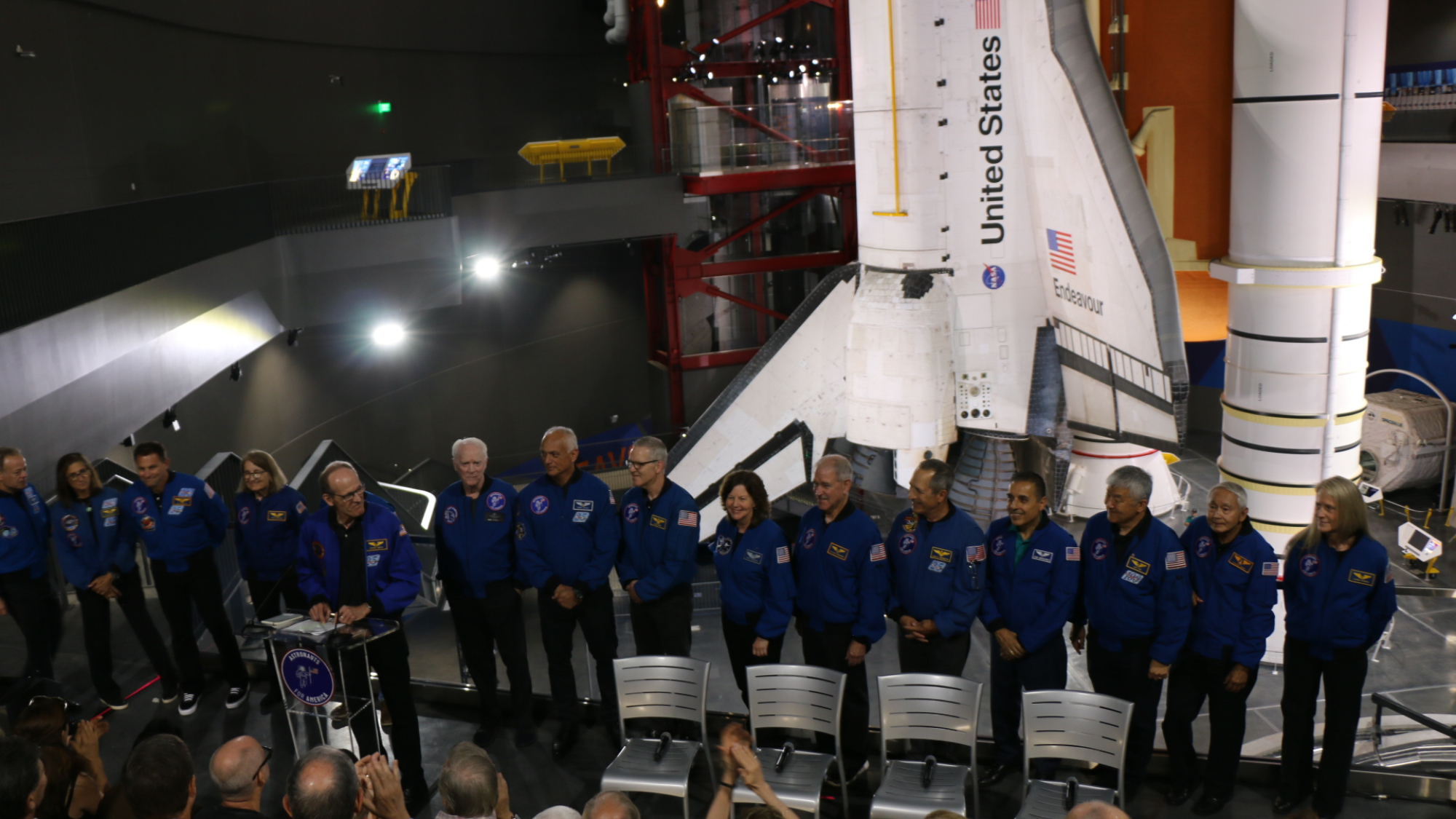
LOS ANGELES — Standing in the shadow of the space shuttle Endeavour, a group of retired NASA astronauts announced their plan to travel the country visiting colleges to try to inspire younger generations to get out and vote. This campaign comes as we lead up to the November midterm election.
This past year, a group of retired NASA astronauts teamed up for a single cause: to defend the U.S. constitution. They banded together as part of a non-profit, non-partisan activist organization called Astronauts for America. So far, they have been speaking out, using their astronaut expertise, platforms, cultural relevance and role model status to speak out in support of "science, evidence-based decision-making, public service and the rule of law," their website reads. Now, as the group announced at an event at the California Science Center's new air and space center — home to the shuttle Endeavour — they're hitting the road on a campaign tour of colleges called "Vote for Freedom."
"We have to do what we can to ensure that the country makes it through the challenges that we're dealing with here, and that is the message that we're going to be taking to colleges and universities," Apollo 9 astronaut Rusty Schweickart told Space.com. "And the agency that we have, the immediate agency, is to vote."
This tour will send astronauts from the group on a four-month jaunt across the country. Astronauts from the group's more than 100 members will visit state and community colleges, county fairs and even town halls, aiming to reach first-time voters and young people who might be new to voting.
"I'm really excited to look a bunch of younger Americans in the eye and make sure that they know that someone that they can trust said: ;Listen, you matter, because our country matters, and our country needs you,'" former NASA astronaut Cady Coleman told Space.com.
"It's with a uniquely American kind of freedom that we were able to go to the moon, and that same freedom launched the spaceship behind us 25 times into space. Now we see those freedoms under heavy threat," former NASA astronaut Steve Smith said during the event. "We're seeing chaos instead of community, violence instead of votes, lies instead of laws, and fear instead of fate. That's how democracy and freedom die."
"The mission is all that matters. Now, our country is the mission, and our message is simple: going to the polls is one small step for you, and one giant leap for our country," Smith added.
Former NASA astronaut Steve Smith speaks alongside other former astronauts in front of the space shuttle Endeavor at the California Science Center on July 20, 2026. (Image credit: Space.com/Chelsea Gohd)
This campaign leads up to the U.S. midterm elections this November. Midterm elections happen halfway through every four-year presidency. This election allows voters to decide what Congress looks like, and which political party controls Congress. This can ultimately have a major impact on what laws and decisions are passed moving forward, and whether Congress will reject or change actions by the president moving forward. And this group of astronauts is serious about the importance of getting people out to exercise their right to vote.
"I'm a child of the segregated South; I grew up in Columbia, South Carolina," former astronaut and NASA Administrator Charlie Bolden, who also serves as a steering committee member for Astronauts for America, said at the event. "I graduated in 1964. Anybody know what happened in 1964? The Voting Rights Act. So, as a person growing up in my hometown, it wasn't a guarantee that my mom and dad were going to be able to go out and vote. I look at what's going on today about people trying to restrict the ability of people to cast their ballot. That's not who we are. That's not America."
The group of astronauts recently spoke out about voting access after the U.S. Supreme Court ruled in favor of protecting the right to absentee voting, in response to attempts by the Trump administration to place restrictions on the current voting process. Especially leading up to the November midterms, each vote carries significant weight. And while this nonpartisan group isn't telling you who to vote for, they do think that everyone who can should vote.
"As astronauts, we signed an oath to our nation, and we are mission-oriented people. And our nation is now the mission," Coleman added. "We need to recognize that everyone's voice is important, and one of the voices that we don't hear very much is the young people. And we want them to understand that, even though sometimes change can seem daunting, their perspective is really important, and, you know, their voice is important."
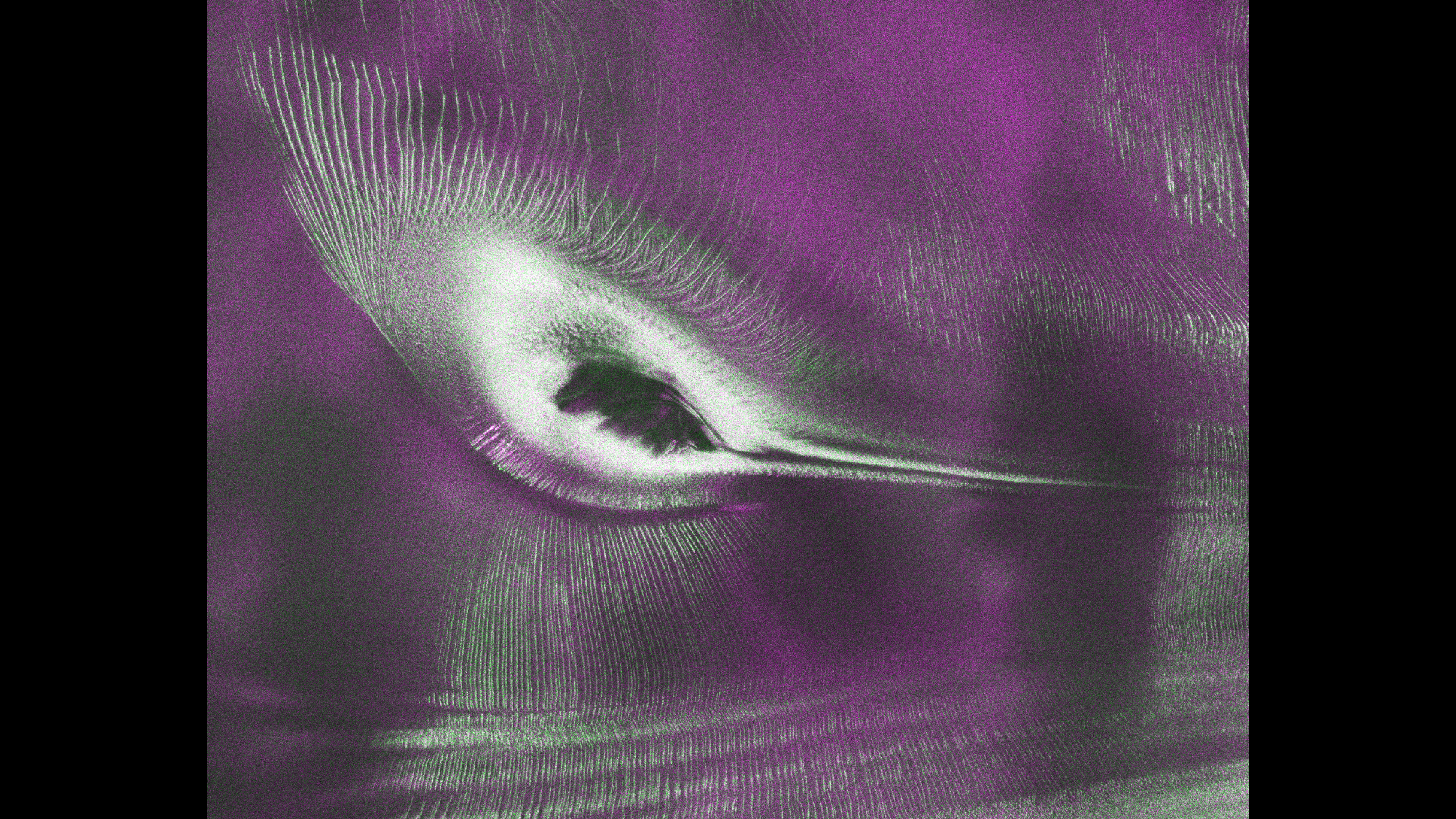
A hummingbird shape in satellite data from NISAR is actually a mountaintop spotted in Antarctica. (Image credit: NASA/JPL-Caltech)
In satellite data captured over Antarctica, what appears to be a beautiful, colorful hummingbird emerges from the crest of a mountaintop.
What is it?
While there are no hummingbirds flying around Antarctica, we can see what looks like a small, purple bird in a new satellite image of an Antarctic mountain. The dark belly of this "bird" at the center of this image is actually the top of the mountain Nunatak Zaterjavshijsja in East Antarctica.
What looks like a bird's tail is a stream of ice flowing northeast all the way out to the ocean, and what appear to be feathers splaying outward from the mountaintop are actually crevasses down the mountain. These crevasses are formed by a glacier fracturing the mountain's surface as it flows in the icy current toward the ocean.
This view was captured by radar instruments onboard the satellite NISAR (NASA-ISRO Synthetic Aperture Radar) that launched as a collaboration between NASA and ISRO (Indian Space Research Organisation). The director of NASA's Earth Science Division called NISAR "the most sophisticated radar we've ever built" in a pre-launch briefing last year.
Why is it incredible?
At first glance, this image is puzzling. What could it possibly be? Its bold colors and sharp lines evoke almost alien qualities. But the strange beauty of the shapes and colors in this satellite image reveal important information about glacier movements on the mountain.
"First, it's a beautiful image, with rich details of features that provide insights to how the glacier is moving. Then, because radar can often see through snow and deep into the ice, NISAR can observe fundamentally different properties of Antarctic ice than can be seen in optical imagery," Seongsu Jeong, the signal analysis engineer who produced the image at NASA's Jet Propulsion Laboratory, said in a statement. "With NISAR we're seeing what's hidden beneath the surface."
And now anyone can explore NISAR's data. Earlier this week, on July 20, NISAR started making the data from its radar instruments public. Moving forward, mission teams will be rolling out this data so researchers everywhere can use it to study and protect our ever-changing planet.