Moon landings could destroy evidence of life’s origins

Landing spacecraft on the moon could contaminate ancient clues about how life may have originated on Earth, a new study finds.

As NASA continues on with its plan of sending astronauts back to the moon with the Artemis program, researchers are exploring what possible unintended consequences may arise from humans visiting the lunar surface. For instance, Artemis IV will land astronauts near the moon's south pole and the agency has future plans for building a longer-term moon base on the lunar surface, which would require many more trips. And indeed, a new study has found the exhaust from spacecraft involved with these landings could expel enough methane to contaminate the moon's surface — possibly destroying molecules that could help to explain how life may have originated on Earth.

"We are trying to protect science and our investment in space," senior study author Silvio Sinibaldi, the planetary protection officer at the European Space Agency, said in a statement. "Our activity can actually hinder scientific exploration."

While experts have had concerns for some time about how rocket launches on Earth pollute our planet and atmosphere, scientists have only really considered this issue with our own planet. This is especially because we haven't been to the moon's surface in over 50 years; concerns of accidental effects of a lunar landing simply haven't been top-of-mind. That's what makes this new study so important. It points to a potential issue that could mean that future moon landings might actually be detrimental to science.
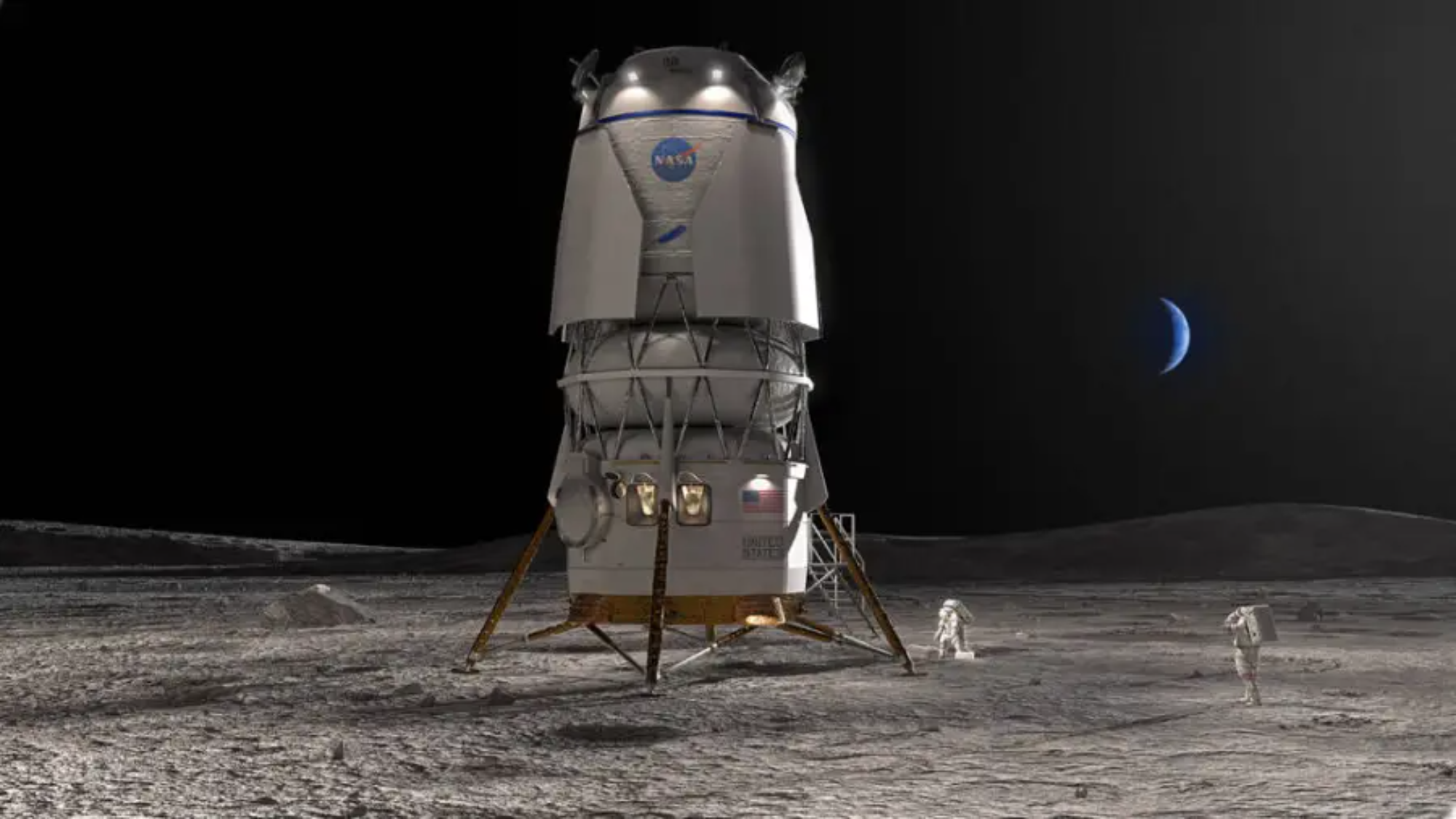
An artist's concept showing Blue Origin's lunar lander on the moon.

An artist's concept of Blue Origin's lunar lander. Lunar landings could pose a serious issue for science on the moon if methane contaminates ancient polar ices, a new study has found. (Image credit: Blue Origin)

Life's clues on the moon?

So why do we think the signs of life could be hiding on the moon? It's actually hiding in ice. Dark craters near the moon's poles, which exist in perpetual shadow, hold ancient ice. This ice is thought to contain material from asteroids and comets that smashed into the moon billions of years ago. Trapped in lunar ice to this day, these bits of ancient collisions could include what the researchers describe as "prebiotic organic molecules," or molecules that could have preceded life on Earth.

It's thought that these molecules from asteroid and comet visitors could have sparked life on Earth, and by studying those possibly trapped on the moon, researchers could be looking at the molecules that ended up combining and creating life as we know it.

The molecular history of life on Earth is pretty much nonexistent on our own planet, as it was largely destroyed by the billions of years of changes we've experienced. But the moon has remained mostly unchanged, so these wells of ice are a uniquely-preserved sampling of pre-life molecules.

"We know we have organic molecules in the solar system — in asteroids, for example," Sinibaldi said. "But how they came to perform specific functions like they do in biological matter is a gap we need to fill."

This ice exists in a somewhat fragile ecosystem, so left alone in darkness, this ice isn't going anywhere anytime soon. But with Artemis, NASA is planning on sending crewed landers to the moon's south pole. That might pose a problem. With computer models in this new study, researchers have shown that the methane exhaust from these landers could very quickly and permanently contaminate this ancient ice, destroying the molecular evidence sealed within.

Inside the simulations
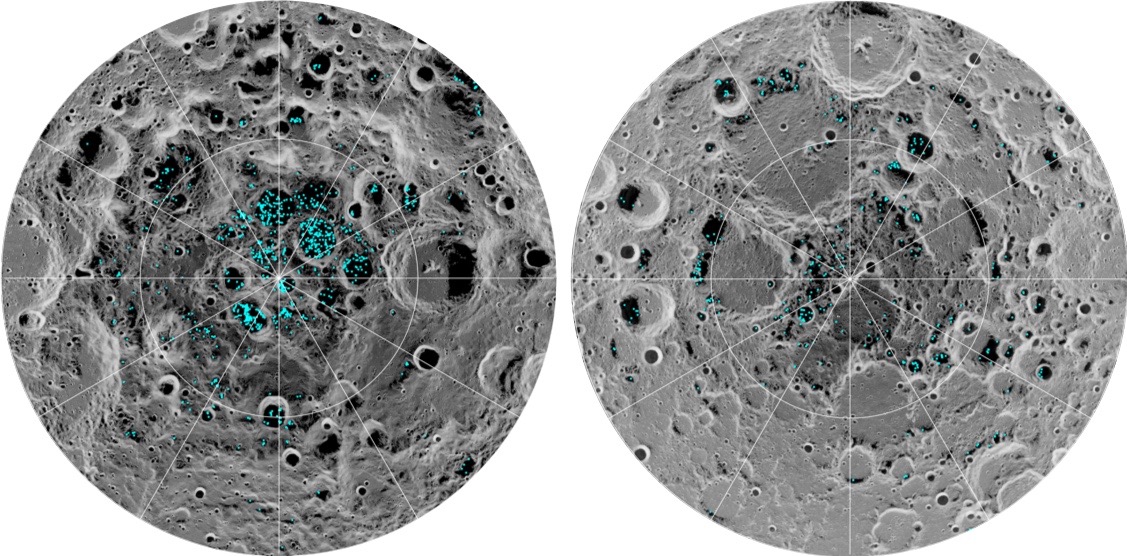
This image shows the distribution of surface ice at the moon’s south pole (left) and north pole (right). Blue represents ice locations, and the gray scale corresponds to surface temperature.

This image shows the distribution of surface ice at the moon’s south pole (left) and north pole (right). Blue represents ice locations, and the gray scale corresponds to surface temperature, with darker gray representing colder areas and lighter shades indicating warmer ones. (Image credit: NASA)

In those computer models, the researchers simulated how methane, the main organic component expelled by planned lunar landers, would spread across the moon's surface after a landing at the south pole. While the simulations included the effects of solar wind and radiation, the moon's lack of an atmosphere caused the methane to spread incredibly quickly, reaching the moon's north pole in under two lunar days.

Within one lunar week (which is roughly seven months on Earth), over half the methane was trapped at the moon's cold polar areas, with a whopping 42% of the substance trapped at the south pole compared to 12% at the north pole. This methane could collect in the same cold pockets where ice and ancient molecules have been collected for billions of years, possibly contaminating this finite, scientific evidence.

"Their trajectories are basically ballistic," lead author Francisca Paiva, a physicist at Instituto Superior Técnico in Portugal, said in the statement. "They just hop around from one point to another."

In better news, there may be a way to circumvent some of this methane disturbance. For instance, the study suggests it's possible that by choosing colder landing sites, scientists can avoid having the methane travel as quickly or as far. Additional simulations are needed to better understand how exhaust compounds travel on the moon, however, as well as the risks that this poses for scientific investigations and if there are other materials lunar trips will involve that could contaminate the environment. Above all, the new study's team emphasizes that as we push toward future lunar exploration, it is key to balance our dreams of settling the moon with preserving its priceless history.

"We have laws regulating contamination of Earth environments like Antarctica and national parks," Paiva said. "I think the moon is an environment as valuable as those."

This work was described in a study published last year in the journal the American Geophysical Union.

Extremely Large Telescope reaches a major milestone | Space photo of the day for July 13, 2026

Workers stand near the base of the Extremely Large Telescope.

ESO's Extremely Large Telescope shows off its impressive size after reaching a new milestone. (Image credit: ESO/Cimolai)

The Extremely Large Telescope just passed a serious milestone while coming together. But it's not done yet; the immense telescope is about to get even larger.

What is it?

The European Organization for Astronomical Research in the Southern Hemisphere (ESO)'s Extremely Large Telescope is under construction on a mountaintop in Chile.

In this new photo, we can really get an idea of the telescope's size. The snapshot was captured during a milestone moment for the crew working on the observatory. They rotated the telescope's structure around its vertical axis for the first time.

This wasn't just an exercise for the dedicated crew working on the ELT, but rather an important test. The team needed to ensure this rotational motion works smoothly to confirm it's possible to point the telescope at any area of the night sky.

Why is it incredible?

This rotation was no small feat with a telescope weighing about 7.7 million pounds (3,500 metric tons), and we can see some of the crew who made it happen posing with their handiwork. They had to first rotate the telescope by hand just centimeters at a time. This push led to auxiliary motors taking over to complete the full rotation.

At its current size, the ELT is enormous. But it will actually get bigger and heavier. Later on in the process, mirrors and science instruments will be installed, skyrocketing the telescope to over 10 million pounds (4,600 metric tons).

"For me, this is a beautiful reminder of what can be achieved when people push in the same direction, literally and figuratively,” Roberto Tamai, the ELT’s Program Manager at ESO, shown on the right in this image, said in a statement.

Tamai is shown standing next to Marco Sciarra, Executive President of Cimolai (a company working on the telescope's construction), in the middle and Pascal Martinez, ESO's Project Manager for the Dome and Main Structure of the ELT, on the left.

SpaceX launch creates colorful ‘jellyfish’ in the night sky | Space photo of the day for July 10, 2026

A blue and yellow jellyfish-shaped light shines in the night sky.

A "space jellyfish" cloud lit up the early morning sky following a SpaceX Falcon 9 launch. (Image credit: SpaceX)

Is it a space jellyfish? Is it an alien? No, it's the aftermath of a SpaceX rocket launch!

What is it?

Have you ever looked up and thought, "Why is there a giant glowing jellyfish cloud in the sky?" If so, chances are that you've seen the remnants of a rocket launch, and not a surprise alien visitor.

In the early hours of July 9, SpaceX launched 29 of its Starlink broadband satellites from Florida's Cape Canaveral Space Force Station to low Earth orbit. It was the rocket's 36th flight, a record.

The rocket lifted off at 5:25 a.m. EDT (0925 GMT), and the scene it painted in the dark early-morning sky looks truly out of this world. But there is a practical, Earthly explanation.

When a Falcon 9 rocket takes off, its engines expel water vapor and carbon dioxide. As it climbs higher into the sky, the temperature drops and the water vapor quickly freezes, forming ice crystals that trail behind the rocket in the spectacular plume we're seeing here. And this view is made more colorful and striking by the sunlight of early morning.

Why is it incredible?

While this photograph's beauty speaks for itself, it is also a colorful example of how real scientific moments can spark the imagination.

Do you think it looks like a jellyfish? I think it looks like a comb jelly, which isn't actually a jellyfish but rather a different type of transparent, squishy invertebrate that drifts through the ocean. It could also look like a glowing football or even a mythological monster.

Whatever you think it looks like, while we have a real scientific explanation for why this rocket launch was followed by a giant, glowing, uniquely shaped cloud, it's still fun to use our imagination.

Supreme Court ruling on mail-in ballots ensures astronauts can vote from space  — or anywhere else

A new ruling by the U.S. Supreme Court protecting voter rights could extend to astronauts living and working in space and training internationally, their families, and the multitude of NASA workers who travel to support their missions.

On Monday (June 29), the Supreme Court ruled that mail-in ballots can be counted toward a total vote even if they arrive after election day, as long as they are postmarked by election day. The ruling followed efforts by the Trump Administration to place restrictions on mail-in voting. In a new statement, the nonpartisan activist organization Astronauts for America spoke out in support of the Supreme Court's decision, which supports absentee voting.

"We don't want to see barriers put in place [that] make it more challenging for somebody to exercise their constitutional right of voting," retired NASA astronaut Wendy Lawrence told Space.com. Lawrence is a member of Astronauts for America, as well as a veteran of the U.S. Navy, where she served as a captain, engineer and helicopter pilot.

What happened?

An executive order issued by President Trump in March 2026 attempted to place a number of restrictions on voting in the country, including limitations on mail-in or absentee voting. The order directed the United States Postal Service to only transmit ballots for states that compile and submit lists of eligible mail-in voters 60 days before elections, added requirements and complications to mail-in ballots and attempted to limit who receives a ballot in the mail.

This order not only added layers to limit voting access, but it conflicted with existing procedures set by states for absentee voting. Additionally, the U.S. Constitution places the authority to change election rules and processes with Congress, not the president, though this was not the first executive order put out by Trump to attempt to change election rules, CNN has reported.

In a 5-4 ruling, the Supreme Court blocked the U.S. Postal Service from carrying out this executive order, declaring that mail-in ballots may be counted if they arrive up to five days after election day, as long as they are postmarked by election day.

"This is key to making sure we have free and fair elections, that people have the ability to cast their vote, and it's not an overwhelming burden for them to do that again," said Lawrence.

Astronauts vote (and so do the people around them)

In a statement shared on social media, Astronauts for America commented on the recent ruling.

"We at Astronauts for America are pleased to see the justices take this critical step toward safeguarding free and fair elections, and ensuring that every eligible voter has their ballot counted," the statement reads. "As astronauts, some of us cast our votes from space. As military veterans, many of us relied on voting by mail. Upholding this grace period ensures that astronauts and other Americans are able to exercise their civil rights."

"Voting is the cornerstone of our American democracy, and this is an important step forward in our battle to ensure everyone has the right to vote," the statement continued. "While the Supreme Court ruling should be celebrated, we must continue standing up for our democracy and constitutional principles."

Astronauts have used absentee voting systems for decades, and they do so regularly: Astronauts have been living in orbit on board the International Space Station continuously since November 2000. When astronauts are going to be in space during an election, NASA has a digital system that allows them to submit absentee votes. But as the statement above suggests, astronauts don't just need absentee voting during their space missions.

Astronaut training can take place all around the world, especially if there is a mission with international collaboration. Lawrence shared that, during her tenure with NASA's space shuttle program, there was a 16-month period when she had to live and train full-time in Russia. And, astronauts don't prepare for space in a vacuum. Family members like spouses might travel with them for long-term training, and there are a wide variety of mission managers and support staff for crewed missions (and their families) who might have to be on long-term travel as well.

Additionally, many astronauts like Lawrence are also military veterans who, during their service, are only able to vote through absentee voting, sometimes for years on end. While this ruling extends far past astronauts, even within the space sector, absentee voting has protected the constitutional rights of many.

Wally Funk, trailblazing pilot and astronaut, dies at 87

Wally Funk, who flew to space at 82 after a lifetime of flying and fighting for women in aviation and aerospace, has passed away at age 87.

Born in Texas in 1939, Funk was determined to take to the skies, flying as a teenager and becoming a professional aviator at the tender age of 20. Her dreams extended even beyond Earth, and in 1961 she joined the "Mercury 13" group of women who completed the testing given to NASA's male astronauts. But Funk was the only Mercury 13 alum to ever reach space. After a lifetime of flying, in July 2021, the then 82-year-old Funk launched to suborbital space aboard a Blue Origin New Shepard vehicle, a trip that she described as "incredible."

"We are deeply saddened by the passing of Wally Funk," Blue Origin shared in a statement on X on Thursday (July 9). "Wally was a pioneer in every sense of the word … On NS-16, sixty years later, Wally made history as the oldest astronaut at the time and remains the oldest woman to ever fly to space. It was a moment six decades in the making. We were humbled to be part of her journey. Her story will continue to inspire generations of future explorers. Fly Wally, Fly."

Making space history

Funk's spaceflight was historic in every sense of the word. "I've been waiting a long time to finally get up there," she said during a livestreamed postflight briefing at the time. "I've done a lot of astronaut training through the world — Russia, America … I could always beat the guys on what they were doing, because I was always stronger. I've always done everything on my own."

An undated photograph of aviator Wally Funk.

Wally Funk early in her aviation career. (Image credit: Blue Origin)

At the time of her spaceflight, Funk was the oldest person to ever go to space. But she was also the only member of the Mercury 13 to ever make it there. Funk joined the group, officially called the "Women in Space" program, as its youngest member at only 21 years old. Led by physician William Lovelace, the program put a group of young women through the same rigorous physical and mental testing as NASA's male astronauts to see how they would fare. And, across the board, the group either kept pace with or even excelled by comparison.

While the program didn't have official government sponsorship, there was hope that success could pave the way for women to be allowed into the human spaceflight program. (NASA astronauts were all male at the time; the agency didn't select a female astronaut candidate until 1978.) And in a way, it did, though it took far longer than the group likely expected.

Despite the group not leading to spaceflight access for women at the time, the participants proved their capability beyond doubt. In one particular test, participants were submerged in a sensory deprivation tank, a test meant to measure a participant's mental fortitude. While famed NASA astronaut John Glenn — who became the first American to orbit Earth — lasted three hours in the tank, Funk stayed in for a whopping 10 hours and 35 minutes.

'Married to airplanes'

Though Funk was quite young when she joined the Mercury 13, she'd already racked up years of aviation experience and an impressive array of accomplishments. In fact, Funk, who never married, famously said that she was "married to airplanes."

From her teenage experience with the "Flying Susies," Funk found her way to the skies as early as possible. And following her participation in the Mercury 13 program, Funk became the first female civilian flight instructor at a U.S. military base. Her aviation career was storied; she served as the National Transportation Safety Board's first female Air Safety Investigator, competed in air races and was even chief pilot for multiple aviation schools across the country, sharing her knowledge and expertise with countless aviation hopefuls.

But while she continued to make history and pursue her passions in aviation, her love for space never dwindled. When NASA finally began accepting women into the astronaut corps in the late 1970s, Funk was quick to apply. She applied three separate times but was denied on each occasion. Despite these setbacks, she remained close to the space world, even attending a launch with fellow former Mercury 13 members in 1995 to see NASA astronaut Eileen Collins lift off as the first woman to pilot a space shuttle.

A dream, realized

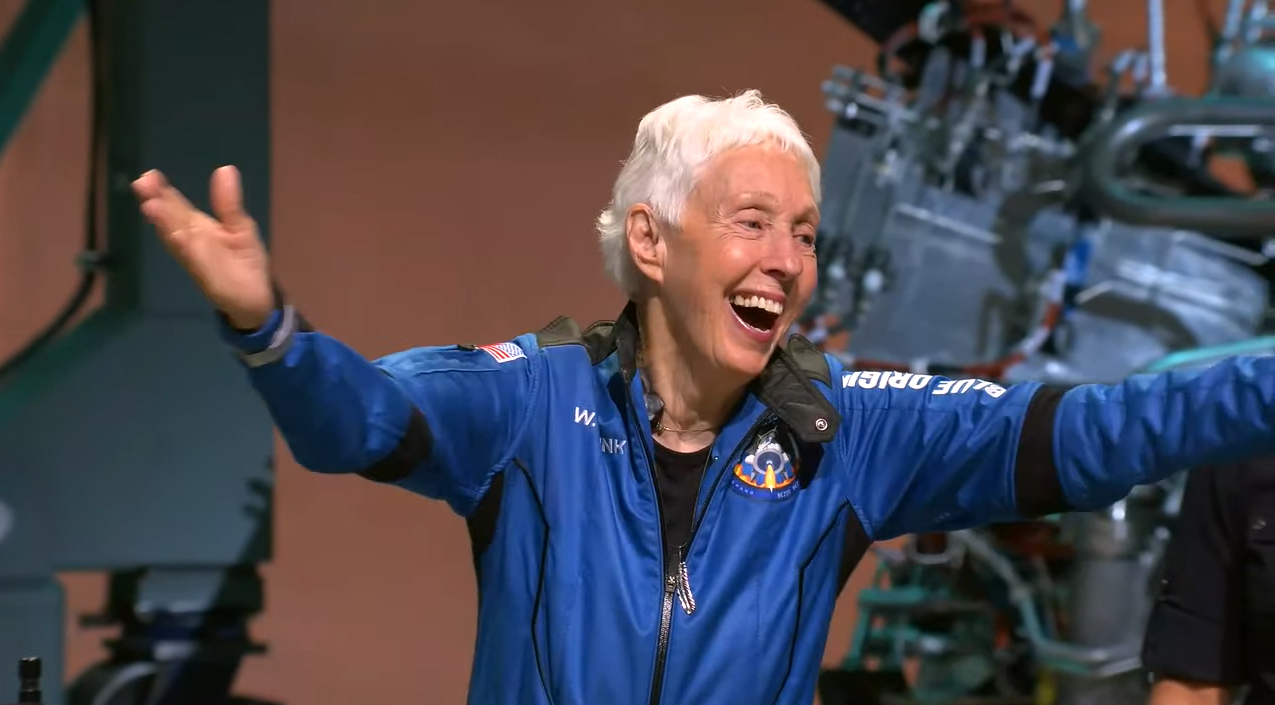
Mercury 13 aviation pioneer Wally Funk, 82, waves to a crowd after launching on Blue Origin's first crewed flight of the suborbital New Shepard rocket.

Wally Funk celebrates her spaceflight. (Image credit: Blue Origin)

With her spaceflight dream still aflame, Funk was once again quick to act when Blue Origin got New Shepard fully up on running. And on July 20, 2021, Funk finally realized this lifelong goal, on the first-ever crewed flight of the suborbital spacecraft. (Blue Origin founder Jeff Bezos was on that flight as well, along with his brother Mark, Funk and Dutch student Oliver Daemen.)

In thinking of her many aviation students, she said at the time, "I don't know if they're going to get to see this or not … but I felt so charged. I was just a normal person going up into space."

Funk will be remembered for her passion, her dedication and her many accomplishments across aviation and aerospace, which will continue to inspire aviators for generations to come.

‘Reckless’ space-based data centers lack environmental review, drawing criticism

Environmental and scientific organizations are banding together to demand federal environmental reviews of space-based data center projects, which plan to put more than a million new satellites in Earth orbit over the coming years.

Over the last few months, a number of different companies have requested licenses from the U.S. Federal Communications Commission (FCC) to launch data centers into space. SpaceX's proposal alone requests licenses for up to one million satellites in low Earth orbit (LEO). But the requested licenses don't come with any environmental review of the impacts that the satellites — especially collectively — could have on dark skies, wildlife or our atmosphere. In response, a coalition of environmental and scientific organizations represented by the environmental nonprofit Earthjustice have petitioned the FCC for this review.

"Allowing a million orbiting data centers with no environmental review isn’t just irresponsible — it’s reckless," Tim Whitehouse, executive director of Public Employees for Environmental Responsibility, said in a statement on Wednesday (July 8). "The potential for these projects to degrade the atmosphere with pollution and debris and harm wildlife needs to be carefully considered before licensing these projects."

Space is big, but a million new satellites added to LEO to support space-based data centers would be a massive increase. Currently, just Earth orbit harbors just 15,000 active satellites and 46,000 tracked objects overall. This number was already on track to grow to 58,000 active satellites, thanks in large part to SpaceX's ever-growing Starlink broadband megoconstellation, but the data-center plans could make it absolutely explode.

Experts suggest that this significant addition to the technological ecosystem in orbit could have disastrous consequences for life on Earth.

"Drastically expanding satellites in space has a direct impact on people’s everyday lives as well as the future of our planet," Jan Hasselman, senior attorney at Earthjustice, said in the statement. "Agencies that authorize companies looking to space as the next frontier still must operate within the law, and the law requires the FCC to consider all the risks and impacts of these proposals. If we have to sue so that they comply, we will."

The FCC has not yet required any environmental review for satellite companies seeking authorization to deploy in LEO. With its new petition, this coalition aims to change that, asking the FCC to stop granting licenses for orbiting data centers without an environmental review.

What possible environmental harms are they worried about? First of all, as more and more satellites are added to the orbital population, the greater chance there is of collisions, which could produce debris that not only clutters Earth orbit but also increases the risk of additional collisions.

Further the rocket launches that propel the satellites to orbit contribute greenhouse gas emissions to our atmosphere. And the spacecraft cause further pollution when they deorbit, releasing heavy metals and other materials when they burn up in Earth's air.

In addition, a massive increase in satellites will fundamentally change the night sky. Light pollution is known to impact wildlife and ecosystems, disrupting natural rhythms and influencing everything from migration patterns to daily feeding schedules. These disruptions can push animals like bats to miss windows in which insect prey are available, causing them to starve. They can also prevent mountain lions — apex predators that uphold their local ecosystems — from roaming normally at night, fragmenting populations over time, according to the National Wildlife Federation.

The effects of light pollution on wildlife would doubtless grow if suddenly a million new, blinking satellites were added to our night skies. And issues with light pollution extend to our species as well, as life would look quite different if our night skies were much more crowded by bright lights.

"These projects could permanently alter the night sky as we know it," Ruskin Hartley, executive director of DarkSky International, said in the statement. "The FCC needs to take seriously its obligation to ensure these projects do not cause unnecessary harm to naturally dark skies, or to our overall environment."

Could evidence of life on Mars be hiding in clay? Europe wants to send a rover to check

Is there life on Mars … in clay? Scientists think that the minerals in clay could be the key to finding signs of ancient life on the Red Planet.

The European Space Agency is still working toward launching its ExoMars Rosalind Franklin rover to Mars to search for signs of life. And, according to a statement from the space agency, the rover is now aiming to land at Oxia Planum, a depression on the Martian surface where it's thought that water was once plentiful. There, scientists think that they might find major clues in the hunt for life in the basin's clay, according to a new paper.

"We will use the instruments on board to ground truth the discoveries made from orbit, learn about the ancient environment in which they formed, and if they preserve any evidence of Martian life. Warmth and nutrients on an early martian seabed could have provided habitats for early life," ExoMars deputy project scientist Elliot Sefton-Nash added in the statement.

Scientists have spent years searching for signs that life once existed on Mars. It's thought that water on Mars evaporated around three billion years ago, but before then the planet likely had a more substantial atmosphere and water flowing in rivers and into lakes all across its surface. Because of the planet's history, many scientists think that it's most likely that at some point in the ancient past, the planet must have supported life. While this has yet to be confirmed, last year scientists found what is currently thought of as the strongest possible biosignature, or physical evidence of life, on Mars.

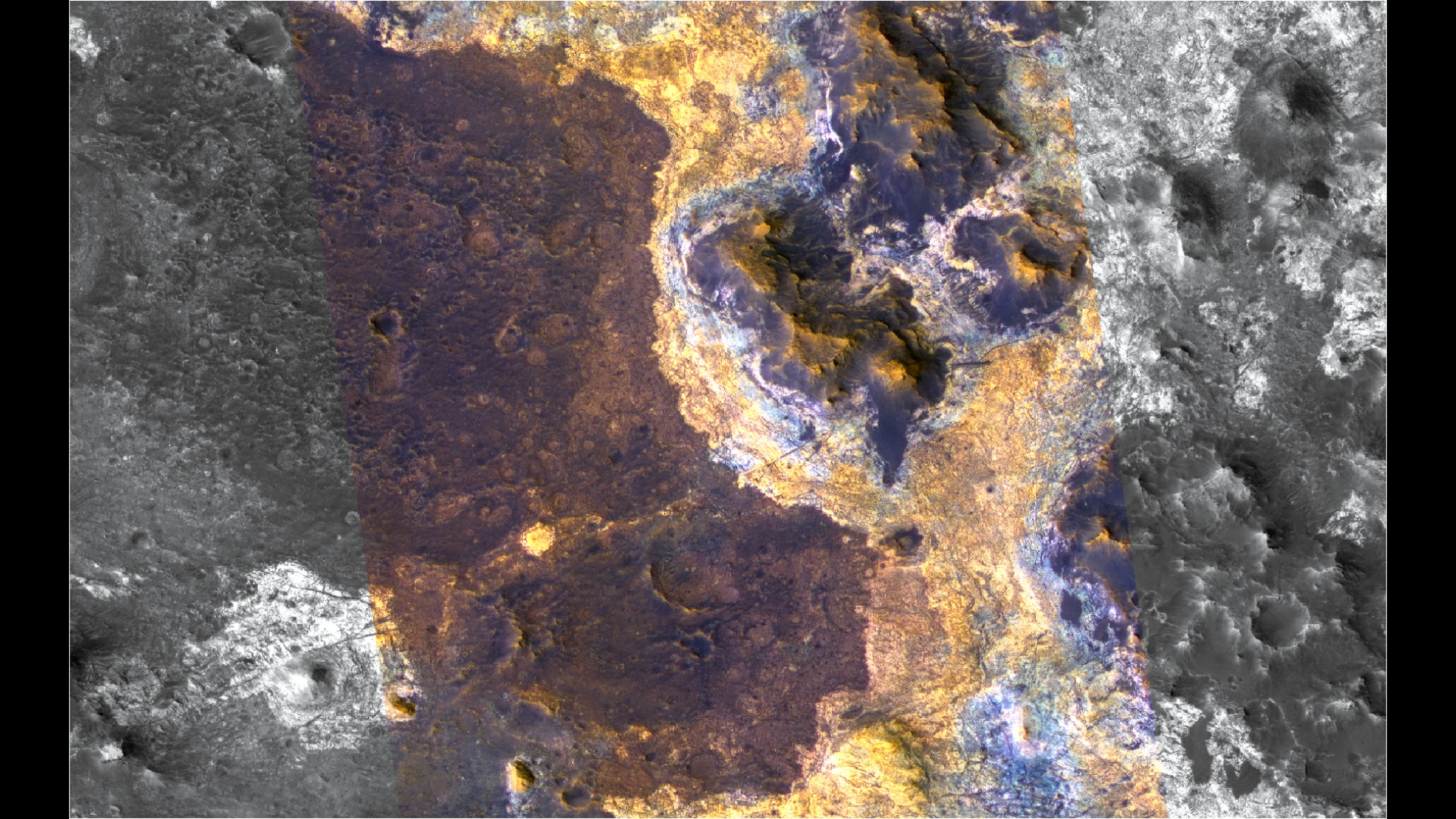
A view of the Mars surface with the left and right sides in black and white and the center in shades of yellow and purple.

This image, captured by the HiRISE camera on NASA's Mars Reconnaissance Orbiter shows the location of clay on Mars. (Image credit: NASA/JPL-Caltech)

In a new study, researchers have found extensive clay deposits at Rosalind Franklin's proposed landing site. They found this clay to reach roughly 186 miles (300 kilometers) outward from Oxia Planum, stretching as far as a Martian valley called Mawrth Vallis. To spot the clay, they first studied the planet from orbit.

Researchers used the OMEGA instrument on ESA's Mars Express orbiter and NASA's Mars Reconnaissance Orbiter to explore the minerals and rock layers on Mars between Oxia Planum and Mawrth Vallid, finding mineral layers at both sites as well as markers showing changes in water chemistry over time. These observations add to other studies pointing to water on ancient Mars.

With ESA's upcoming rover, some scientists think that the clues to life on Mars could be hiding in this clay in the Oxia Planum region.

"By landing at Oxia Planum, we’ll uncover a large-scale process that shaped ancient clays across Mars," lead author Inés Torres Auré of the University of Lyon in France said in the statement.

Scientists think that it's possible that the area of Oxia Planum could have once been home to a body of water as big as an ocean or the region could possibly have experienced incredible flooding some four billion years ago, according to the statement.

"Because the area is so large, we are not talking about a localised occurrence, but rather a regional or global process that would have required immense amounts of water. We are targeting the oldest deposits in the sequence, which makes the potential implications for the geology and early climate of Mars very relevant for the Rosalind Franklin mission in its search for life," ExoMars project scientist Jorge Vago explained in the statement.

While we have never confirmed life off-Earth and it could be different from the life we know, as far as life on Earth is concerned, water is a necessary ingredient.

ESA's Rosalind Franklin rover is projected to launch to the Red Planet in 2028. The rover will be part of ESA's ExoMars program alongside the agency's Trace Gas Orbiter which is already traveling around Mars. Rosalind Franklin will have a drill, allowing it to explore below the planet's surface as the pair work together from orbit and on the Martian surface to hunt for signs of ancient life.

This work was described in a study published in the journal Science Direct.

Take a trip to the turquoise waters of the Bahamas (from space) | Space photo of the day for July 9, 2026

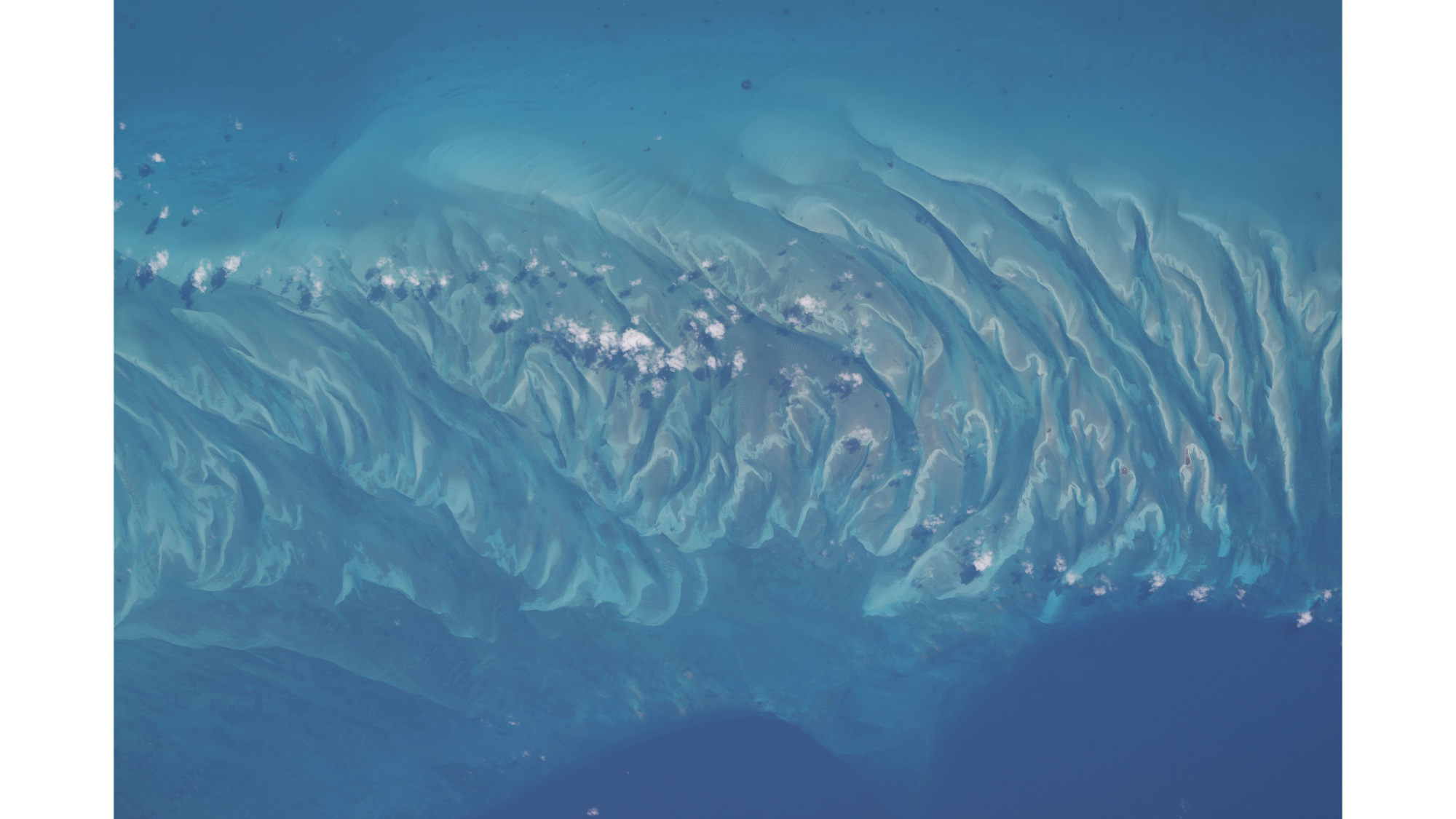
A bright blue and turquoise ocean has a center of waves and ripples of sand with white clouds overhead as seen from above.

Sandbars and waves of rippling sand dunes can be seen from space amongst the turquoise ocean in the Bahamas. (Image credit: NASA/Chris Williams)

If you look at this picture for too long, you might start to hear the waves lapping up against the shore or feel a salty breeze in the air.

You might not have a trip to the Bahamas planned, but you can always enjoy its beauty in this spectacular summertime snapshot captured by NASA astronaut Chris Williams from aboard the International Space Station.

What is it?

In a snapshot that looks straight out of a travel commercial, we can see the crests of rippling waves of sand peeking out from beneath turquoise waters off the coast of the island Eleuthera in the Bahamas.

The moment was captured 263 miles (423 kilometers) above Earth's Atlantic Ocean from aboard the space station orbiting our planet.

This isn't the first fun snapshot captured by Williams who also recently flexed his muscles for a photo mid-spacewalk.

Why is it incredible?

This photo is incredibly beautiful. That much is immediately obvious. And if you've ever swam in picturesque waters like this, then you know how calming and magical such places on Earth can be.

But this photo is more than just pretty, as it shows that we can see Earth's beauty from 263 miles away. It is a reminder that our planet is truly special. Imagine if a future mission saw beauty like this from space on a far off exoplanet, or even a planet outside of our solar system. Currently, our planet is the only one we know of with views like this, but it's possible that in the future we might find tropical shorelines and vacation vistas aren't exclusive to our home planet.

NASA’s Roman Space Telescope prepares for launch | Space photo of the day for July 8, 2026

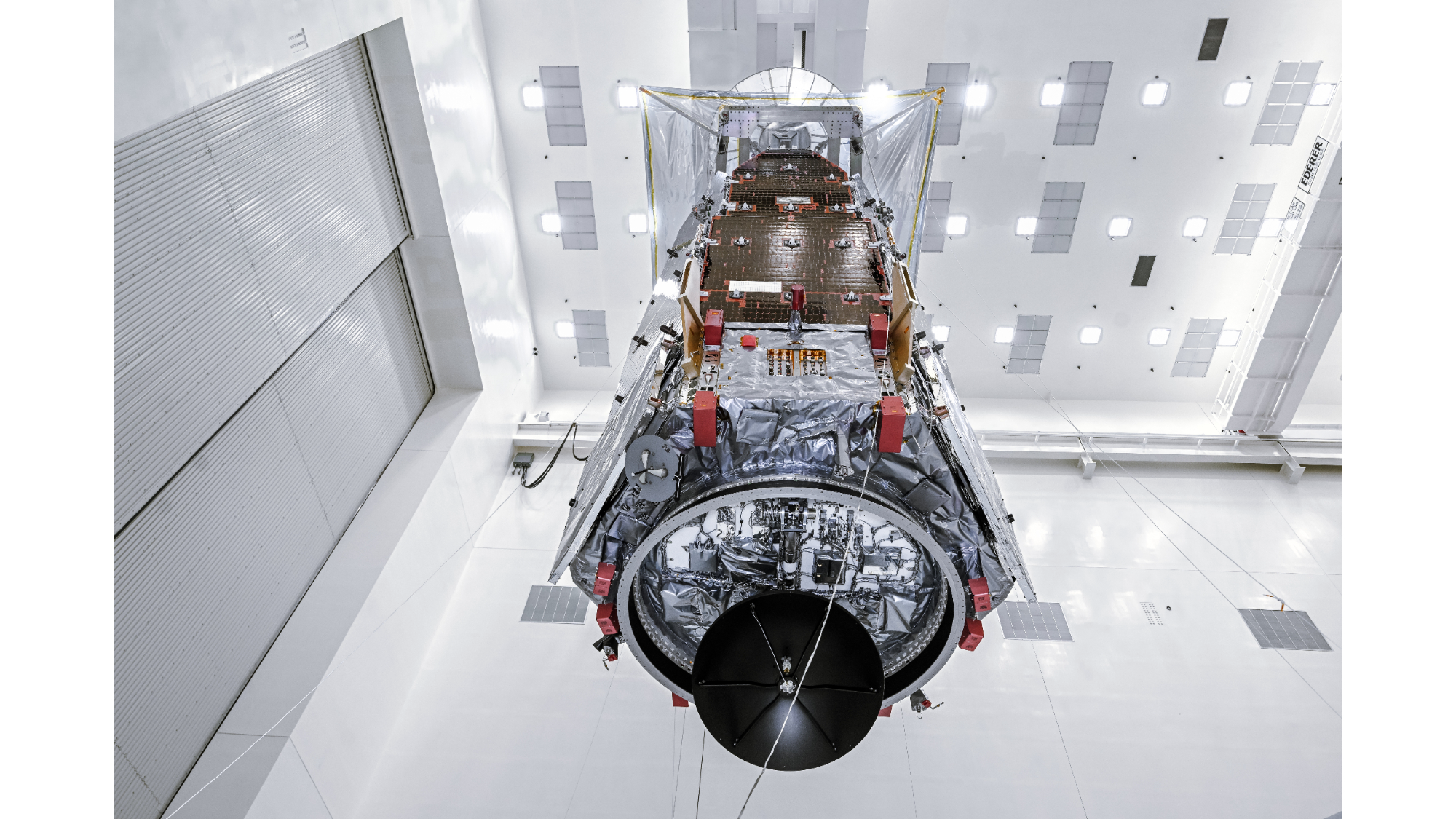
The Roman Space Telescope hangs in the clean room.

The Nancy Grace Roman Space Telescope in the clean room at NASA's Kennedy Space Center in Florida on June 26, 2026. (Image credit: NASA/Sydney Rohde (Rocz))

NASA's Nancy Grace Roman Space Telescope is hanging out in the clean room at the Kennedy Space Center (KSC) in Florida, preparing for its epic journey to space.

What is it?

Roman is NASA's next big flagship mission, designed to explore the universe like we've never seen it before. And with just over a month and a half until its expected launch on Aug. 30, it is in the home stretch to liftoff.

After recently leaving NASA's Goddard Space Flight Center in Maryland, where the telescope was assembled and tested, Roman made its way to KSC, from where it will launch. In this new photo, snapped on June 26, we can see Roman seemingly floating in mid-air, hanging inside the Payload Hazardous Servicing Facility, a secure clean room at KSC where spacecraft are fueled, tested and otherwise prepared for flight. In this moment, technicians and engineers were using a crane to lift Roman into the air into a specialized stand, where the telescope can rest while it is worked on.

Why is it incredible?

Roman — named for the pioneering astronomer Nancy Grace Roman, who served as NASA's first chief of astronomy and expanded our understanding of the universe — is a mission that scientists have been waiting for for a long time.

With a field of view at least 100 times larger than the iconic Hubble Space Telescope, Roman will be able to capture immense views across the universe. The mission will explore dark matter and dark energy, and with its tech demonstration the Roman Coronagraph Instrument, it will snap images of exoplanets, offering direct looks at worlds far from our solar system.

Our Milky Way galaxy might be larger than we thought  

Is the Milky Way even bigger than we thought? New observations have revealed that our galaxy's spiral arms could stretch farther and wider than we previously concluded.

The Milky Way's spiral structure was discovered over 175 years ago in 1850. But new information could completely change our understanding of our cosmic home. Astronomers have taken a new look at our Milky Way galaxy using data from NASA's Chandra X-ray observatory and the European Space Agency's XMM-Newton observatory and have pieced together new, precise measurements of the galaxy's spiral arms. And what they found is that its spiral arms stretch out farther than we once thought, a discovery that could change our understanding of our galaxy's structure.

"The differences are small, but any revision of these distances is important because they are so fundamental for understanding our galaxy," co-author Ilaria Fornasiero said in a statement. "For example, this could mean that astronomers have to revise estimates of the mass of the galaxy, because that affects how wide the arms stretch."

To make this new galactic measurement, researchers had to get a little creative with the data. They measured these cosmic distances by observing X-ray light scattered by the dust in the Milky Way's arms as it echoed out from around gamma-ray bursts, or the most powerful explosions across the universe that happen either when massive stars collapse or neutron stars collide and merge. These massive bursts of energy are happening far beyond our galaxy, but their X-ray light is so powerful that it can reach and bounce off of dust clouds in the Milky Way's arms.

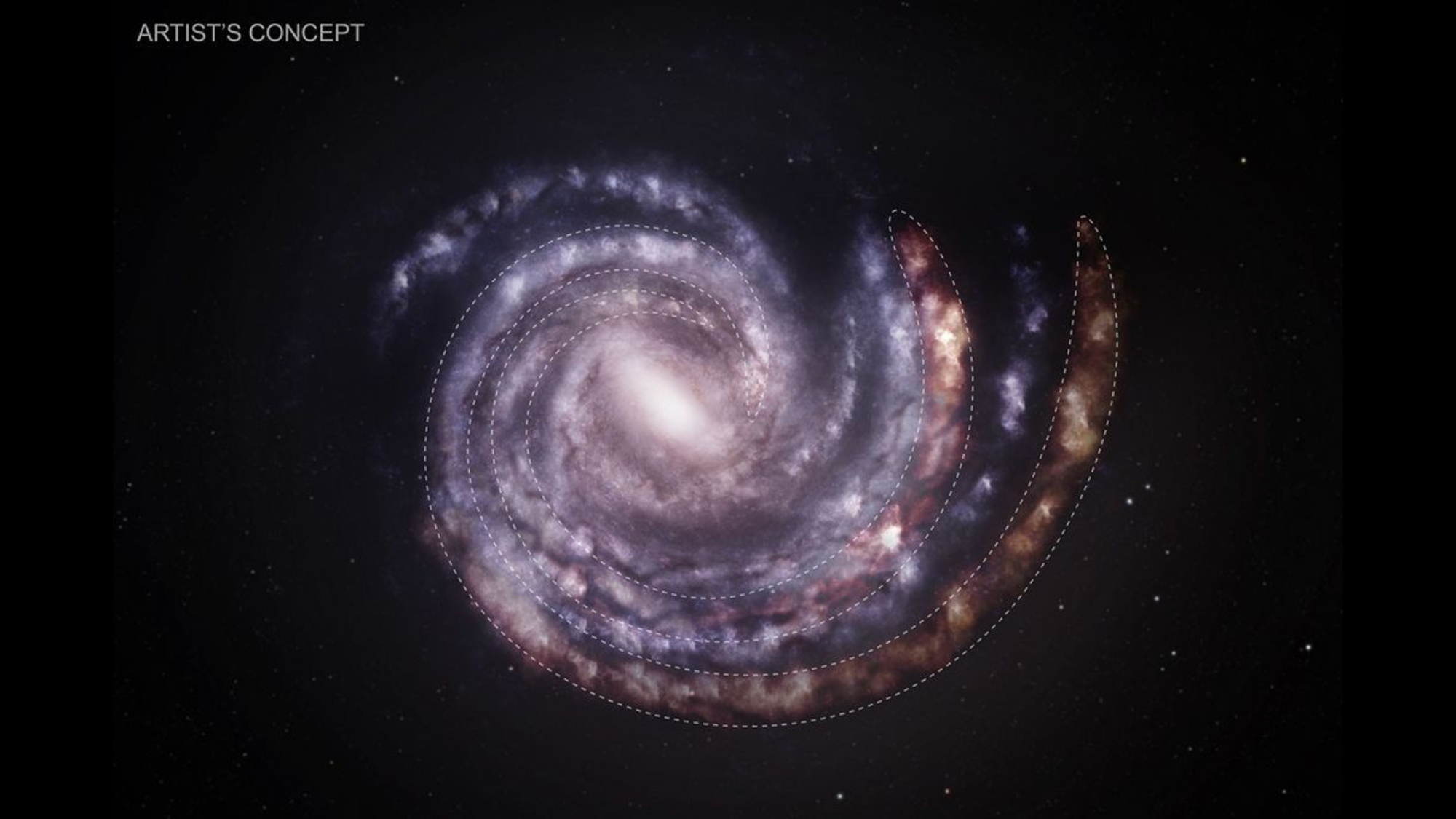
The Milky Way's spiral arms are shown where they were thought to be before and where they are now thought to extend to.

This artist's concept shows where the Milky Way's spiral arms are now thought to extend to and how that compares to previous estimations. (Image credit: NASA/CXC/SAO/M.Weiss)

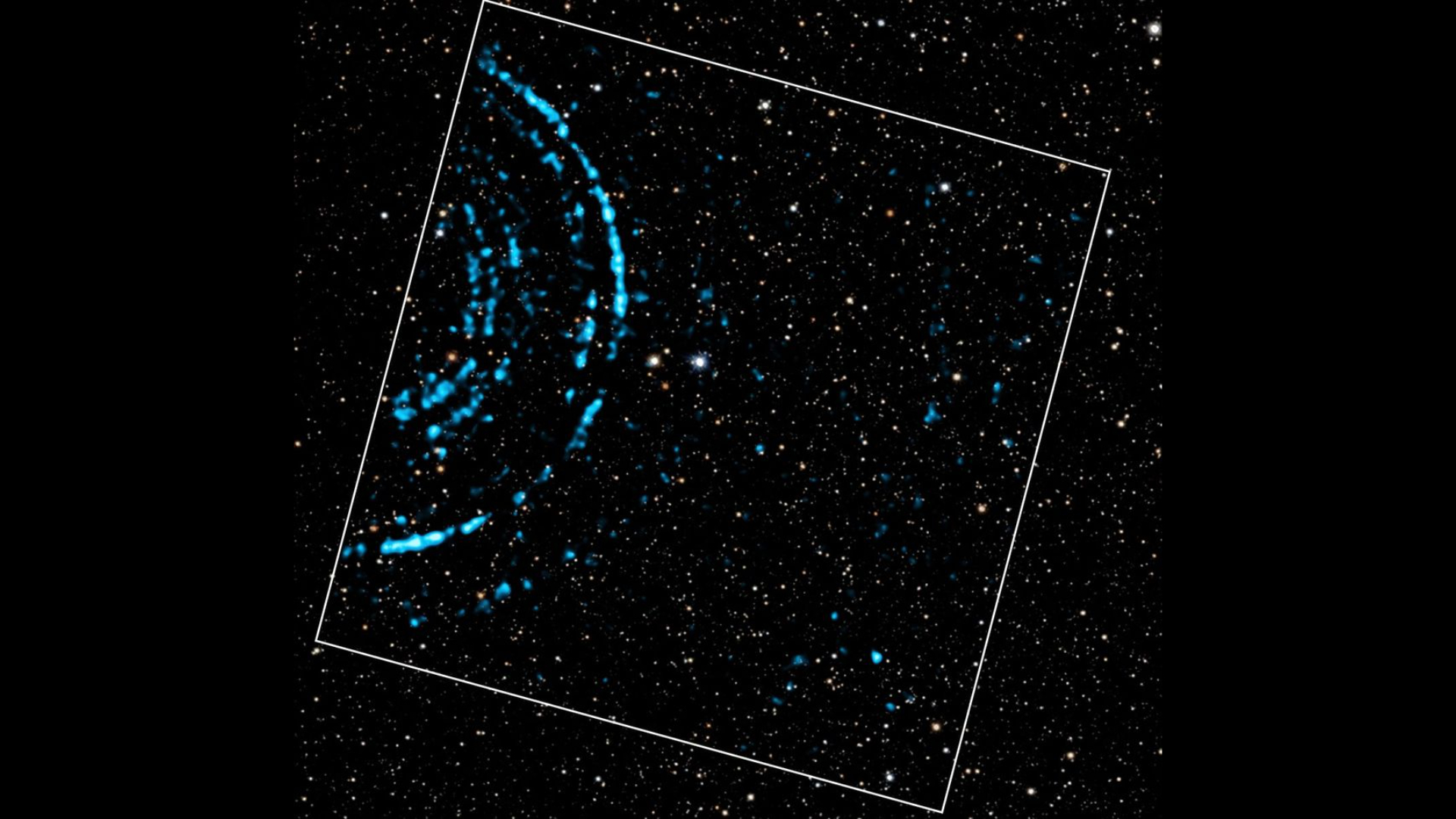
By studying the diameters of the rings of light as they expand away from these explosions and observing how and where they reflect off of the Milky Way's dust, the team was able to precisely point to where the galaxy's arms extend.

"This is a very direct way – relying only on geometry – to precisely measure distances to the Milky Way's spiral arms," lead author Beatrice Vaia, who led this research as a PhD student, said in the statement. "Most other methods rely on assumptions about how the Milky Way rotates, which become increasingly uncertain in the outer regions of our galaxy."

The team used the X-ray light from three different gamma-ray bursts to look at three of the Milky Way's spiral arms: the Perseus, the Outer, and the Outer-Scutum-Centaurus arms. According to these new measurements, both the Outer and the Outer Scutum-Centaurus arms are about ten percent more distant than was previously thought.

With this data, the team was also able to measure the thickness of the Milky Way's most distant arm, which they found to be about 3,500 light-years wide. By incorporating the arm's width, the team ensured that they were measuring the full extension of the arm and not just one particular dust cloud, further bolstering their findings.

Against a background of stars are bright blue lights that create a series of speckled rings echoing outward.

This composite image shows X-ray rings created by a gamma-ray burst bouncing off of the dust clouds in the spiral arms of the Milky Way galaxy. (Image credit: X-ray: NASA/CXC/INAF/B. Vaia et al.; Optical: Pan-STARRS; Image processing: NASA/CXC/SAO/N.Wolk & P.Edmonds)

While it's interesting that the Milky Way's arms extend out a bit farther and wider than we previously thought, these new findings could have larger implications. Based on these new measurements, astronomers may have to reinvestigate our understanding of our galaxy's mass distribution, rotation and overall structure. This evolving understanding could ripple out and impact how we view not just the structure but the evolution of our galaxy and beyond.

But this study isn't one that can be replicated too easily. That's because gamma-ray bursts don't happen all of the time. Even more rare are bursts that we can see clearly through our galaxy.

"We’re relying on the universe to provide us with these events, and so far, over 25 years, we’ve only found a handful that we can use," co-author Andrea Tiengo of Scuola Universitaria Superiore IUSS Pavia said in the same statement. "That said, we will continue to be on the lookout for more."

This work was described in a new study published June 19 in the journal Astronomy & Astrophysics.