An amateur astronomer's plans for a camping vacation two years ago transformed into a possible crater find in Canada's north.
Amateur astronomer Joël Lapointe, using Google Maps to figure out his route for the 2024 vacation, saw some odd terrain in Quebec's Côte-Nord region centered on Lake Marsal. Lapointe suspected it was an impact crater from a meteorite, and made a report on Impact Earth — a crowdsourcing website for craters with Canada's Western University in London, Ontario near Toronto. Western planetary geologist Gordon Osinski made a visit to the region in 2025, provisionally not only confirming the crater, but saying it's probably one of the biggest discovered in recent years. The 390-million-year old feature is roughly 15 miles (25 kilometers) wide.
In an email interview with Space.com while on travel in Scotland, Osinski — known as "Oz" by the space community — said to his knowledge the last discovery of that scale was the approximately 31-km (19-mile) Hiawatha structure, also possibly a crater, spotted in Greenland in 2018. "However, that structure is completely buried by ice, so its diameter is uncertain and there is still some controversy about its origin," Oz said.
But in the case of the new crater, called Uhackatik with approval from the Innu Council of Ekuanitshit in whose traditional lands the crater lies, there is no doubt at all where the crater came from. Oz's expedition to the area revealed "shock metamorphic effects", which are deformations to the rocks induced by the shock waves and heating produced by a meteorite impact.
"Impact melt rocks are like they sound: large volumes of rock that are melted by the impact event, but then cool and crystallize to look a lot like volcanic rocks," he said. "Finding these preserved — as they are usually some of the first parts of a crater to be eroded — was a big surprise."
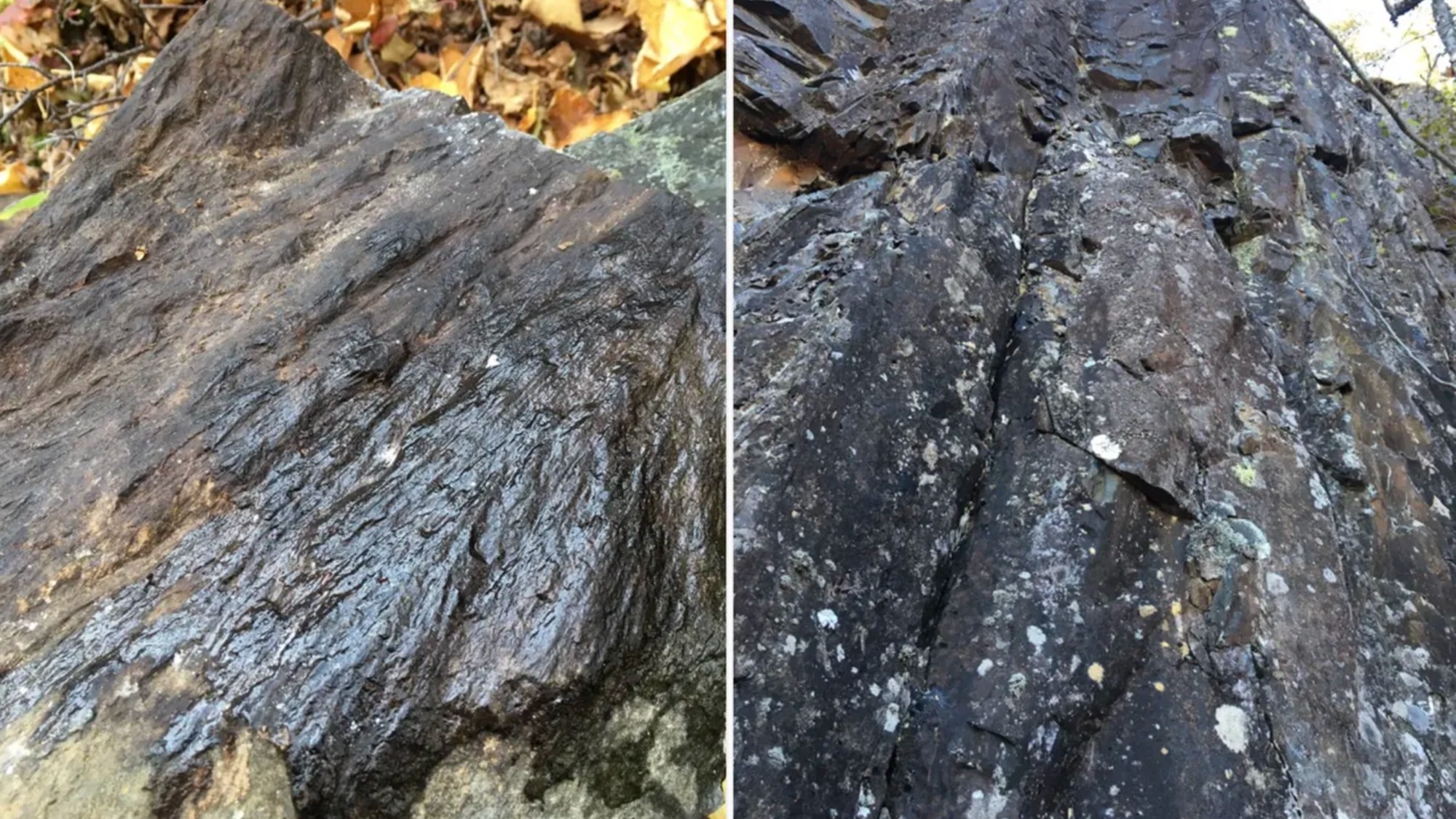
While most of the features are microscopic, Oz said in the field he and his collaborators could easily see "shatter cones", which are branching features in rock layers produced by the shockwave of impact. The research is not yet peer-reviewed, but it will be presented at the 88th Annual Meeting of the Meteoritical Society in Frankfurt, Germany in August.
A shatter cone seen in rocks found at the center of the structure (left); melt rock found 2.5 miles (4 kilometers) west of the structure's center. (Image credit: Gattacceca, J. et al.)
While 400-million-year-old impact craters on Earth are hard to find, as geologic activity as well as erosion change their features over time, the precious evidence is helpful for scientists to better understand meteorite impacts on the moon, Mars and other rocky extraterrestrial bodies.
In terms of age, Oz noted, the moon's prominent Tycho crater best represents what Uhackatik probably looked like 390 million years ago. But On Earth, one of the best comparisons to Uhackatik is a moon-like crater used to help the Artemis II astronauts get ready for their moon mission this year.
That Earth crater is called Kamestastin (also known as Mistastin) in northern Labrador, Canada. Oz regularly runs expeditions there in consultation with the Mushuau Innu First Nation, as the crater lies within their traditional hunting grounds. Kamestastin includes anorthosite, a common mineral found in craters at the moon's south pole, where NASA hopes to land astronauts under the US-led Artemis program.
"For comparative craters [to Uhackatik], Kamestastin is actually a great one as the size is very similar," Oz said. "Kamestastin is well-preserved and I've worked there a lot … so in my mind, I was using Kamestastin as a template for exploring this new potential crater."
To fully confirm Uhackatik's extraterrestrial origin, Oz and collaborators are examining samples microscopically for more evidence of shock effects, such as chemistry indicating a high-temperature melt, or deformation effects in the quartz. In the meantime, Oz's lunar work with NASA continues: he will be part of the geology teams supporting the moon-landing astronauts during the Artemis 4 and 5 missions, which will touch down as soon as 2028.
For the first time, astronomers have reconstructed the magnetic field of an entire cluster of galaxies, from its central nucleus to its outer limits.
The record-breaking achievement is the product of the deepest-ever observations of the galaxy cluster Abell 2255, located around a billion light-years away — and those observations are thanks to the European radio telescope LOFAR (Low Frequency Array).
Abell 2255has long been known for its complexity in radio waves. Its vast, diffuse radio emissions are created by particles called electrons racing at near-light, or relativistic, speeds and interacting with magnetic fields of galaxies in the cluster. Thus, using Abell 2255 as a cosmic laboratory to study the universe in radio waves could lead scientists to a better understanding of how magnetic fields come about and evolve. These observations could also help paint a picture of the dynamics of hot gas in galaxy clusters. This could reveal how the largest structures in the universe are constructed.
As part of the LOFAR Galaxy Cluster Ultra-Deep Field project, thisteam used 224 hours of radio image collection to discover that the distribution of large-scale magnetic fields throughout Abell 2255 (which itself stretches out for several million light-years) are not randomly distributed. Instead, these magnetic fields seem to be organized by the motion of gas that occurred during the formation of this galactic cluster.
"Obtaining very sensitive images of galaxy clusters at radio wavelengths is crucial to understanding how electrons are accelerated to relativistic speeds and magnetic fields are amplified on large cosmic scales," team leader Andrea Botteon, of the Italian National Institute for Astrophysics (INAF), said in a statement. "The complexity of these studies is due to the elusiveness of the radio signal from electrons moving in very weak magnetic fields. We believe that the mechanism that 'turns on' these gigantic radio emissions is linked to the formation process of galaxy clusters."
Botteon added that for this research he and his colleagues combined the deepest radio observations ever made with an innovative data analysis technique that allowed them to reconstruct the shape of a galaxy cluster's magnetic field for the first time.
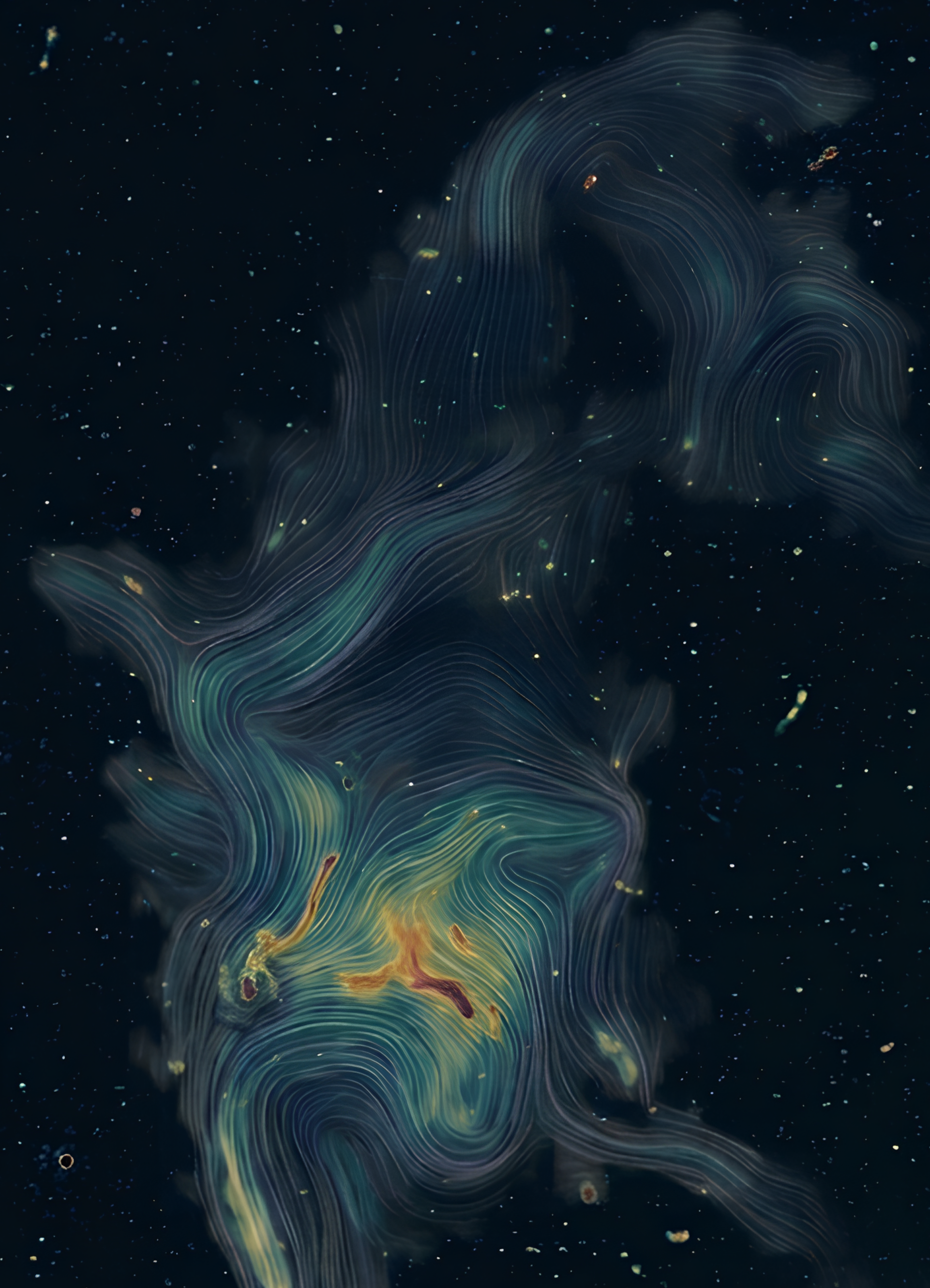
"The coherence of the magnetic field lines observed in some regions of the cluster suggests that the morphology of the field is intimately linked to the dynamics of the gas in which it resides, where it can be 'stretched' or 'compressed' by the motions associated with the formation of the cluster itself," Botteon said.
The invisible texture of the magnetic field in the central region of the galaxy cluster Abell 2255. (Image credit: A. Botteon et al. (INAF), A&A 2026)
This analysis revealed that, in some regions, the magnetic fields follow very specific directions, stretching radially along extended radio emissions. In contrast to this, in regions dominated byshock waves, magnetic fields are orientated at tangents. This suggests magnetic fields in Abell 2255 are carved out by the same dynamics that allow clusters to accrete gas and grow.
This serves as the first observational evidence that the same mechanisms that allow galaxies to grow and cluster, creating thelargest structures in the universe, also shape their magnetic fields.
The team's research has been accepted for publication in the journal Astronomy & Astrophysics and is available as a pre-peer-reviewed paper on the repository sitearXiv.
Separated by billions of miles and shaped by very different environments, Saturn's smoggy moon Titan and the dwarf planet Pluto have, on paper, little in common.
Titan is a geologically active world cloaked in an atmosphere denser than Earth's, its landscape shaped by seas of liquid methane and vast dunes built from organic particles that rain out of its skies. Pluto, by contrast, is a frigid outpost with a tenuous atmosphere hovering above an icy, frozen surface.
Yet, observations from the James Webb Space Telescope (JWST) have revealed these two disparate worlds share an identical, unexplained infrared signature on their surfaces — a sign that similar chemistry may be unfolding on both worlds despite their stark differences, scientists say.
Detailed in a new study, the feature appears at precisely the same infrared wavelength on both Titan and Pluto, indicating that it absorbs light identically on both worlds. The signal points to the presence of an unknown compound, or a family of related compounds, that scientists have yet to identify.
"It's rather mysterious," Bruno Bézard, a planetary scientist at the Paris Observatory who led the discovery, told Space.com. "We cannot say what it is."
Chasing the signal
Bézard first spotted the unexplained feature while analyzing Titan observations from November 2022, when JWST gathered infrared light leaking through the haze in very specific, narrow wavelength bands, allowing scientists to peer directly through the otherwise opaque atmosphere.
To make sense of this light, researchers rely on spectroscopy, a technique used to identify compounds by the specific wavelengths of light they absorb. Because every molecule leaves behind a unique spectral fingerprint that telescopes can detect, astronomers can routinely identify substances across the solar system and beyond, ranging from simple water ice to complex molecules.
But the newly detected feature neither matches any of the standard library spectra cataloged so far, nor does it appear to be a fluke of the hardware, the study notes. The exact same absorption feature was detected by two different JWST instruments — the Near-Infrared Spectrograph (NIRSpec) and the Mid-Infrared Instrument (MIRI) — ruling out the possibility of an instrumental artifact.
After failing to find a match with the cataloged spectral fingerprints of the simplest and most common planetary ices, Bézard wondered whether another world with similar atmospheric chemistry might hold a clue. He turned to his colleague Emmanuel Lellouch of the Paris Observatory, who had led a JWST program that had observed Pluto in May 2023.
"I asked him, 'Do you also have a signature [on Pluto] at this exact wavelength?'" Bézard recalled in the interview with Space.com. "So we looked, and we found that it is present there."
The ground truth
There is no evidence that the mystery molecule is a biosignature, Bézard said. Instead, it likely reflects the kind of prebiotic chemistry that has been operating in Titan's oxygen-free environment for more than 4 billion years.
One compelling possibility is that it belongs to a family of hydrocarbons known as allenes, which the study notes are essentially the only organic compounds known to exhibit strong absorption bands within the same 5-micron infrared range as the mystery signal.
But the allene family contains many complex variations for which complete spectra do not yet exist, Bézard said. Alternatively, the signature could belong to a known molecule whose spectral fingerprint has shifted, potentially because it is mixed with other planetary ices that have not yet been fully cataloged.
"We only have spectra for the simplest of them," Bézard said. "But it is possible that within this family you could find one or several compounds which are present together and make such an absorption feature."
Whatever the compound ultimately proves to be, he and his team believe it forms in the atmosphere through photochemical reactions before eventually "snowing" down onto the surface.
Despite their stark differences, both Titan and Pluto possess atmospheres dominated by nitrogen and methane. Scientists know from spacecraft observations and lab simulations that in the upper reaches of the planets' atmospheres, ultraviolet sunlight breaks these molecules apart, triggering a cascade of highly reactive chemical fragments. These fragments then reassemble into complex organic compounds, some of which condense and snow back down onto the surface below, which is where the JWST detected them.
A couple of different lines of evidence support this atmosphere-to-surface pipeline. First, the team analyzed how the signal behaved across Titan's disk. As the JWST scanned Titan from the center of its circular face toward its outer edge, or limb, the mysterious signal steadily weakened, the study notes.
"This is what you expect if it comes from the surface," said Bézard.
Because of the three-dimensional geometry of looking at a sphere, a signal coming from a flat surface will appear strongest at the center and grow fainter near the edge, where the angle of view through the atmosphere becomes longer and more obscured. This specific dimming trait was not shared by atmospheric carbon monoxide the team checked, which remained essentially unchanged from center to limb, Bézard said, which helped the team infer that this mystery molecule likely resides on the ground.
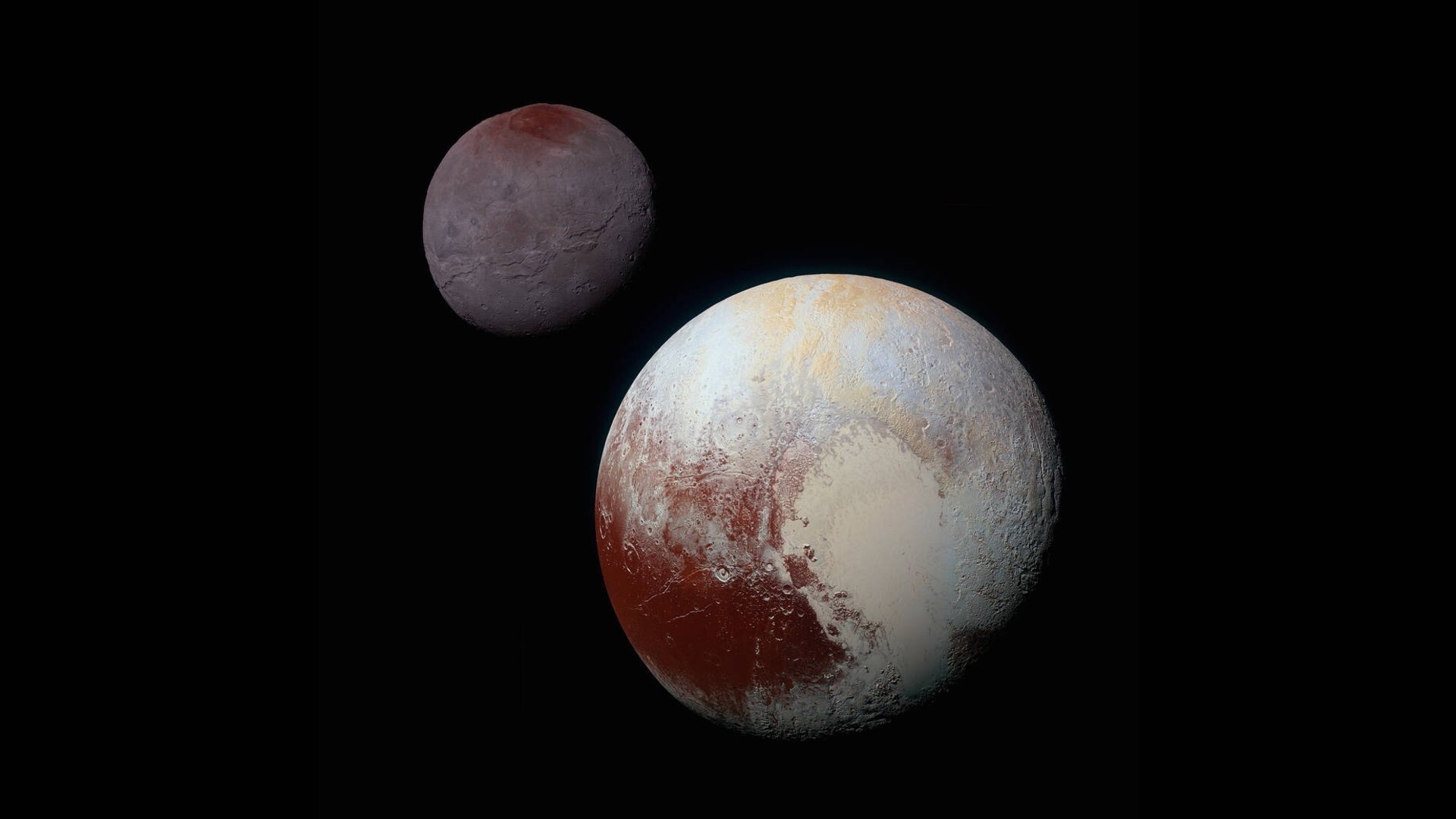
An image showing Pluto and its moon Charon in the back. (Image credit: NASA/JHUAPL/SwRI)
Pluto offered an independent line of evidence to back up this surface theory. Its near-vacuum atmosphere is physically too thin and sparse to generate an absorption feature of the observed depth, Bézard said, leaving the dwarf planet's solid surface as the only plausible source for the deep signature.
To further test their atmospheric-origin hypothesis, the team studied JWST observations of Jupiter's moon Ganymede. Because Ganymede lacks a nitrogen-methane atmosphere, it cannot run the same photochemical engine like Titan and Pluto do. Sure enough, the researchers found no trace of the mysterious feature, lending additional support to the theory that the compound is uniquely tied to the chemistry of nitrogen and methane skies.
Mapping Titan's surface
More clarity may arrive in the coming months. Researchers are currently analyzing newer JWST observations that provide a more complete view of Titan as it rotates. The data will allow the team to map the mysterious infrared signature across the moon's surface and determine whether it is associated with specific geologic features, such as Titan's vast organic-rich dune fields, which are continually replenished by a slow drizzle of complex particles produced in the atmosphere, Bézard said.
Further clues may have to wait for NASA's Dragonfly mission, a car-sized rotorcraft expected to launch in 2028 and arrive at Titan in the mid-2030s.
Although Dragonfly does not carry an infrared spectrometer to replicate JWST's light measurements, its onboard mass spectrometer will allow it to "taste" organic molecules across the various geologically interesting areas the spacecraft will fly to. By revealing which compounds are actually present on Titan's surface, the mission could give scientists a shortlist of candidates to replicate in laboratories back on Earth to see if they match the traits of the mystery molecule, Bézard said.
"It's always exciting when you discover something that was not seen before," Bézard said. "It's really the nicest part of our job."
The new study was accepted for publication in the journal Astronomy & Astrophysics.
In July 2016, "Stranger Things" stormed its way into the pantheon of pop culture greats. Finding the sweet spot of '80s nostalgia, horror, and sci-fi, the Duffer Brothers' series established itself as one of Netflix's flagship shows and a favourite water cooler topic for close to a decade.
Much like "Jurassic Park" encouraged an entire generation to suddenly view paleontology through a new set of eyes, the same can be said about "Stranger Things" and science. Seriously, how many of us discovered the many-worlds theory because of the concept of the Upside Down on the show? Even wormholes are easier to understand now because of Mr Clarke's lessons than whatever the heck happens in "Interstellar" that has Matthew McConaughey bawling like he's been forced to sit through a Jared Leto movie marathon.
Parents and government groups have long highlighted the negative effects of entertainment, but not enough is said about its positive influences, especially the ability to inspire. In fact, it's often underestimated how invaluable a show like "Stranger Things" has been to educators who want to turn around the declining numbers in STEM graduates.
For University of Liverpool physics professor Carsten Welsch, "Star Wars" references were no longer cutting it with his students. However, the "Stranger Things" science allowed him to relate to a younger generation of learners. " It's a really good way to talk about science, which can be quite a challenge, especially with teenagers," Welsch told NPR. "Normally, the moment you mention physics or engineering, they run away."
This is something echoed by Louis Bearson, the director of science, business, and education at the Institute of Physics. Bearson mentioned how some of the devices used on the show and its delicate unpacking of complex topics like quantum physics could widen the appeal of science and physics beyond the explanations in the textbooks.
"One of the issues we have is that physics really needs to be more representative of the community at large," Bearson told The Times. "If we can get a broader base of people interested through things like 'Stranger Things', that's only going to be for the good."
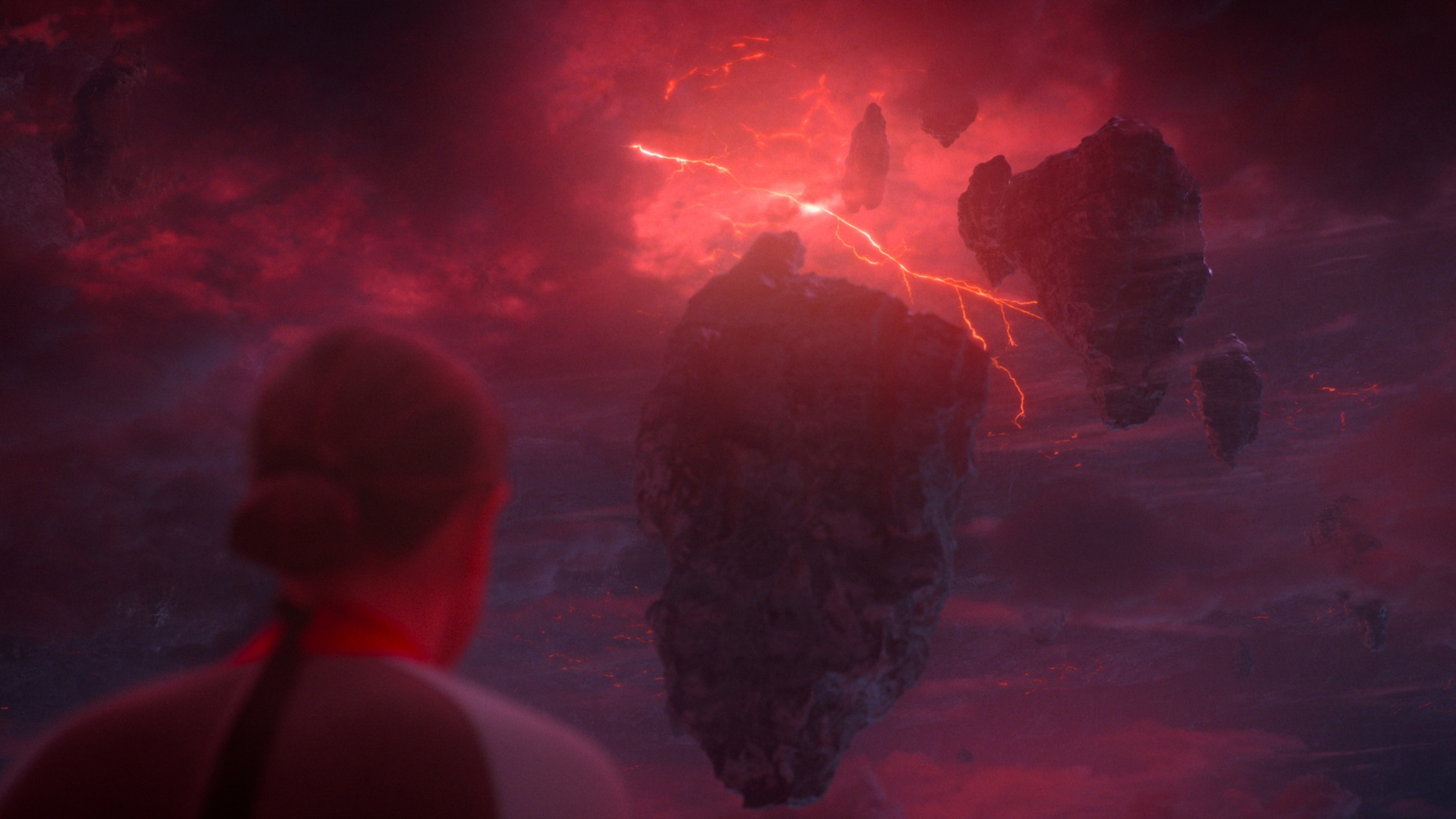
(Image credit: Netflix)
It wasn't only the educators who appreciated the power of "Stranger Things" to connect with others, but also government departments like the U.S. Department of Energy.
The official website used the premise of the Upside Down to explain its own work, especially in terms of its search for other dimensions and how this is done in a real-world setting. While the information was always out there for anybody interested in finding out more, how many people would have read and taken an interest in any of it without the influence of "Stranger Things"?Apart from the natural benefit to educators and government departments wanting to increase the interest in STEM education, "Stranger Things" opened up the doors to something else equally important: intelligent discourse among its fanbase — the kind that's often missing in an online world where trolls walk among us and bring their bad manners from under-the-bridge living.
Reddit and social media forums were flooded with young fans discussing what they watched, the possibilities of where it could go, and even providing explanations to others who might not have understood the scientific concepts. It was encouraging, insightful, and fun, as people learned through interaction and exploration, which to this day is still the best way to learn anything.
(Image credit: Netflix)
In 2017, Olivia Richter, a then-student at the School of Communication and College of Arts and Sciences and writer for The Eagle, wrote a column about how "Stranger Things" served as a modern role model for curiosity.
The author explained how the Hawkins gang expressed "a great thirst for knowledge" and dispelled the notion that being smart or nerdy was something to be ashamed of. "It is encouraging a culture of curiosity and learning in its viewers," Richter wrote. "Much of the science in the show is based in fiction, though it is still highly successful in making science look exciting and fun and creating a model for young people that it is cool to be inquisitive."
Fans demonstrated an example of this ultra-curious attitude after the series finale. Science has always been about hypotheses and proving theories, and this approach was applied to the Conformity Gate theory that spread like wildfire online. Sure, some people might call it a conspiracy theory and looking for something that isn't there, but the fans from around the world rallied to find clues and provide evidence for their unique hypothesis about the show's ending.
(Image credit: Netflix)
They might not have been right in the end — maybe even being deliberately misled by Netflix's marketing — but the fact that they questioned, critiqued, and researched to such an extent is a positive sign that the show's message had an impact. It's also proof that critical thinking isn't dead and intelligent life is still out there.
Say what you want about the final season of "Stranger Things" and whether the ending stuck the landing or not, but there's no disputing the Demogorgon-shaped mark it left on viewers around the globe. More than that, it was a show that provoked curiosity and discovery, as well as encouraging a new generation to find out more about science.
In a world riddled with fake news, false information, endless rage-bait, and sustained pushes for conformity rather than curiosity, we desperately need more neuron-firing programming like this.
All five seasons of "Stranger Things" are on Netflix.
For ten glorious days starting on April 1, 2026, one human endeavor captivated our home planet across continents and time zones: the NASA Artemis II mission to orbit the moon, the first crewed mission to cislunar space since 1972. In an Easter-Passover week that had especially demoralizing headlines on global conflicts, this mission presented a powerful vision of what journeying together and taking enormous risks for a shared purpose towards a shared future could look like.
Much has been spoken and written about the scientific and personal achievements of the Artemis II mission and its trailblazing astronauts. Their humanity, and what it did for humankind at large, is perhaps a quieter yet just-as-celebratory achievement.
In a time of trillion-dollar AI IPOs, when the seemingly planned obsolescence of humanity itself looms on our collective horizon, the Artemis II astronauts reminded us that they considered it the honor of a lifetime to do this for us - and as us - while transmitting daily that they couldn’t wait to come home to us. As Christina Koch shared at the end of the translunar injection burn (TLI) on day 2, while Artemis II set its course to leave Earth's orbital space for the moon as well as its return trajectory: "With this translunar injection burn, we do not leave Earth. We choose it."
From their morning wake-up music playlists (which inspired many to enquire about submitting their compositions for future crewed missions), to the reading out of their menus and details of their daily workouts or sleep schedules, we were reminded that these astronauts were navigating with us in real time the humdrum work of staying alive while conducting amazing science. This signal reached Earth as a continuous invitation to fellowship, and the record-breaking viewership of Artemis II built like a slow cooker feast, with global engagement increasing from launch to splashdown.
The Artemis II livestream introduced many viewers to the unavoidable aspects of spaceflight missions, such as the timing lag and blackouts in communications that will endure regardless of future technological advancements.
Sometimes this was wonderfully funny, like when the Canadian Prime Minister Mark Carney sought reassurance from the Artemis II astronauts that they preferred maple syrup to Nutella over their pancakes, with the astronauts bursting into laughter a few seconds after the media in-room chuckles.
At other times, it was the quiet anticipation of unprecedented history like the 40-minute communications blackout when the Orion spacecraft traveled behind the moon, or the heart pounding nailbiters of the 6-minute blackouts during the TLI or re-entry to Earth. In an era that rewards instantaneity over pauses, the globe watched and waited together. Such communication lags will compound dramatically for more distant worlds we explore, yet will still tether us profoundly in real time to one another despite our attention- and time-deprived schedules.
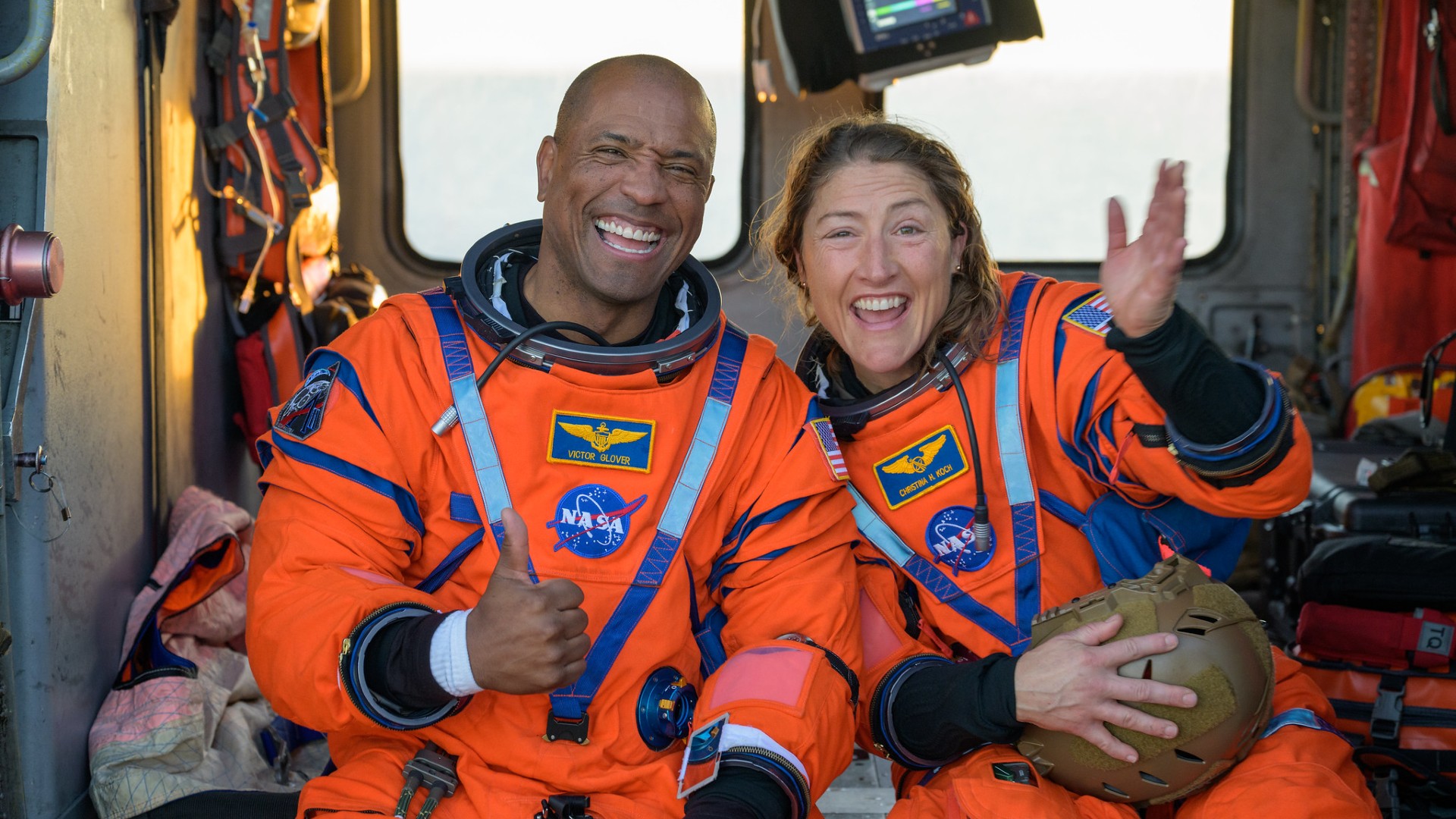
Artemis II astronauts Victor Glover and Christina Koch smile after being recovered onto a U.S. Navy vessel following splashdown. (Image credit: NASA/Bill Ingalls)
The Artemis II livestream also brought home the challenges of human bodily functions far from home. An inordinate amount of media attention and communications airtime was devoted to the brand new model of NASA toilet which developed issues just hours after launch and later became unfunctional on day 3 of the mission. Panels of NASA and space studies experts were asked by journalists about whether the astronauts were able to do either one or both of "#1" or "#2", or why the toilet gave off burning smells, highlighting the very human realities of boldly going where no one has gone before.
We also saw the rocking of the Orion capsule framed by the darkness of space and the background of the moon or Earth. We watched as each astronaut took their turn with the mandatory daily exercise routine to prevent bone density loss, cardiovascular issues and other health declines in a microgravity environment (only one astronaut can work out at a time, owing to space restrictions and to prevent buildup of exhaled carbon dioxide in an enclosed environment).
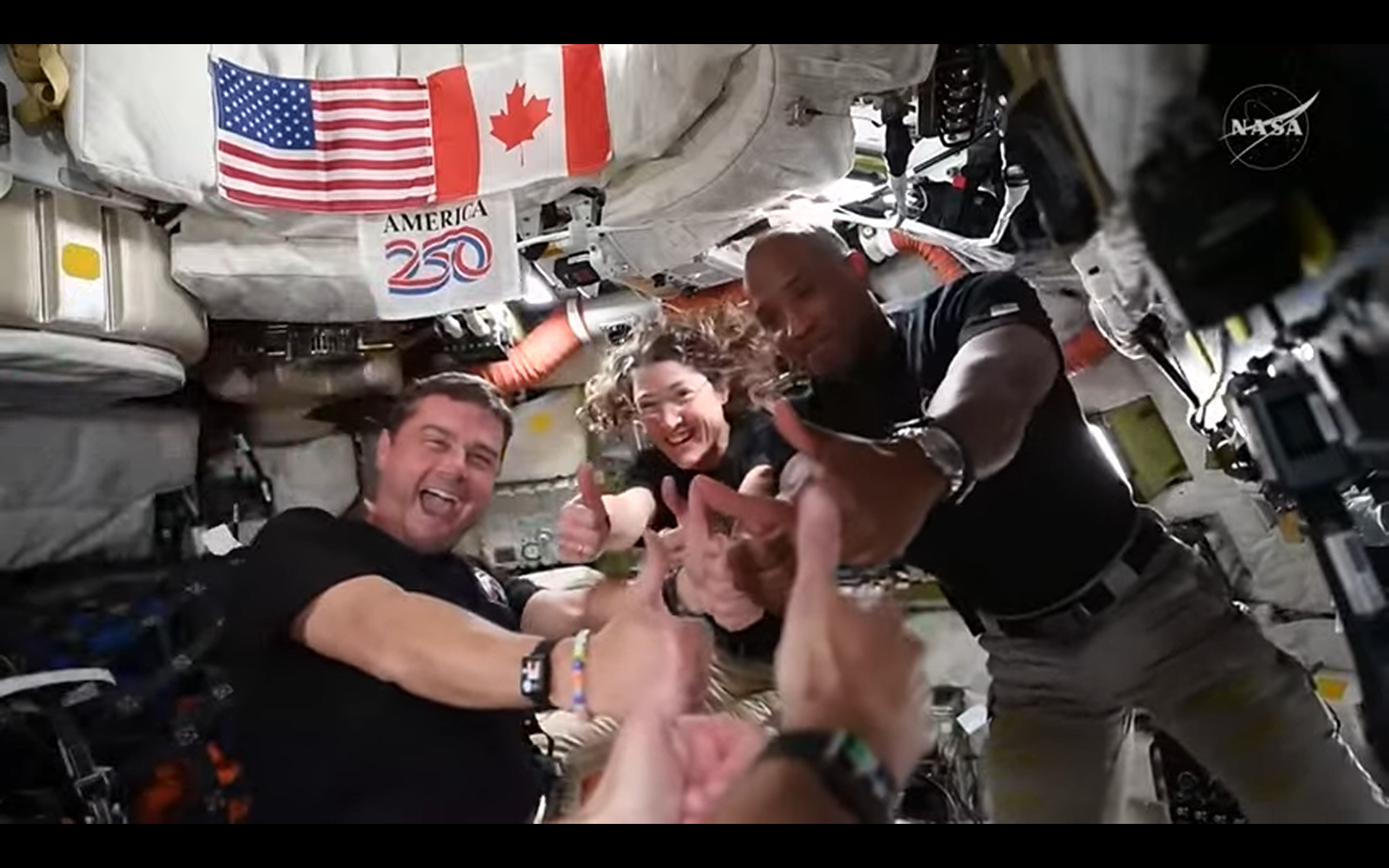
The Artemis II crew give a group thumbs-up inside their Orion capsule. (Image credit: NASA)
The Artemis II mission was full of deeply personal experiences and observations shared by the astronauts, made even more powerful by their unscripted nature. Commander Reed Wiseman's impromptu words of gratitude to the thousands of engineers and staff involved with the successful TLI, and the spontaneous naming of craters on the far side of the moon including - as the astronauts wept and hugged - one for his deceased wife Carroll, connected us in real time to their, and therefore our, evolving scientific and human perspectives.
This gratitude was echoed in a recent interview at the Kennedy Space Center, in which Wiseman shared that he had just received a handwritten note at the airport written on a boarding pass, stating "Thank you for reminding us about joy and hope in the universe again", which he expanded on to thank all the hands that helped the Artemis II mission succeed.
There were also moments during the mission when they simply ran out of words, like when they saw shades of colors on far-side lunar craters on what appears from Earth as a gray barren world. They called for new language to describe what they were seeing.
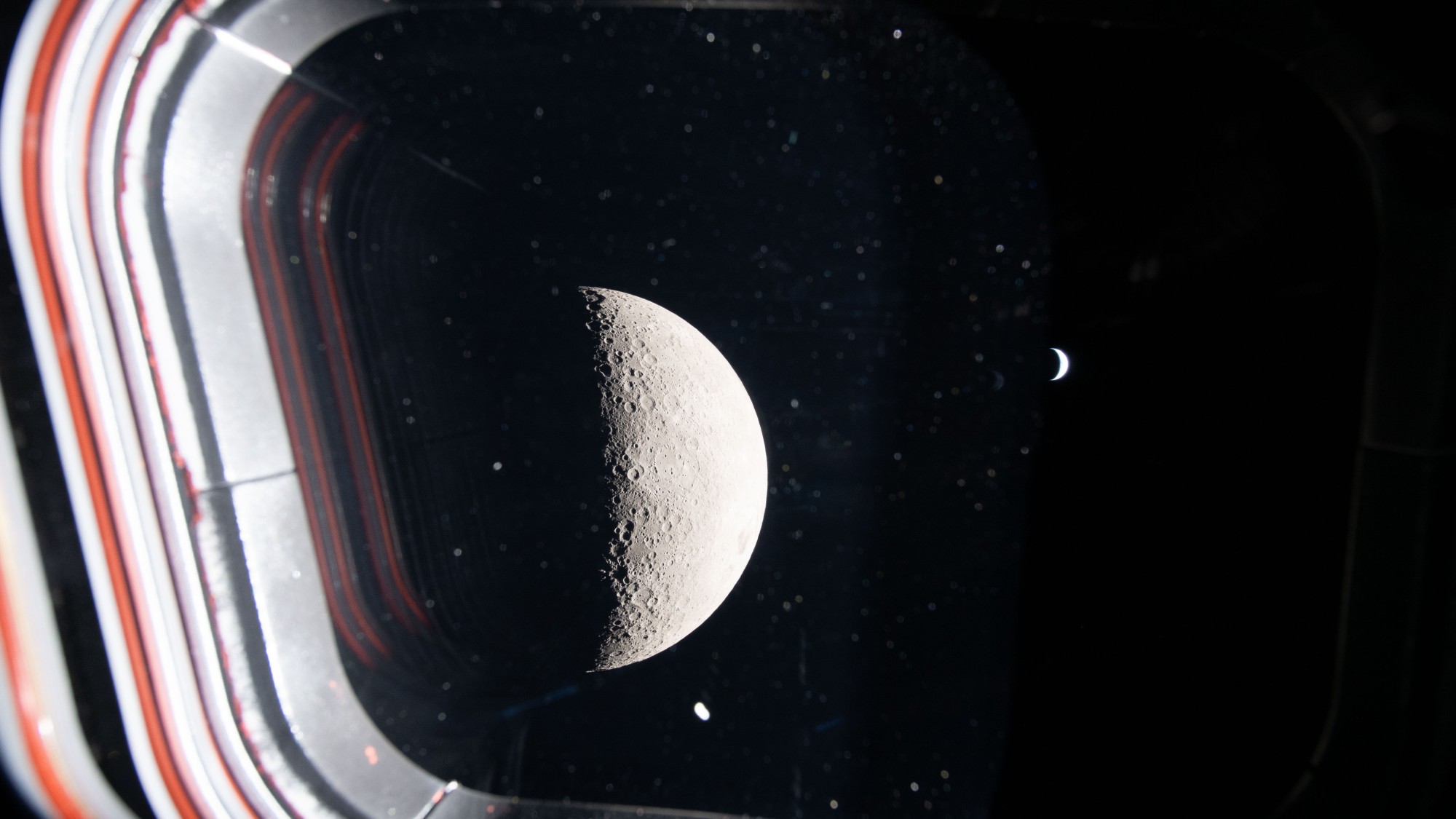
The moon and earth as seen through the window of the Artemis II crew's Orion spacecraft (Image credit: NASA)
Towards the end of the 1997 movie "Contact," based on the 1985 book by Carl Sagan, astronaut and SETI scientist Dr. Ellie Arroway (played by Jodie Foster) is overcome by the experience of interstellar travel and the dazzling views it brings. She says in a choked voice "they should have sent a poet."
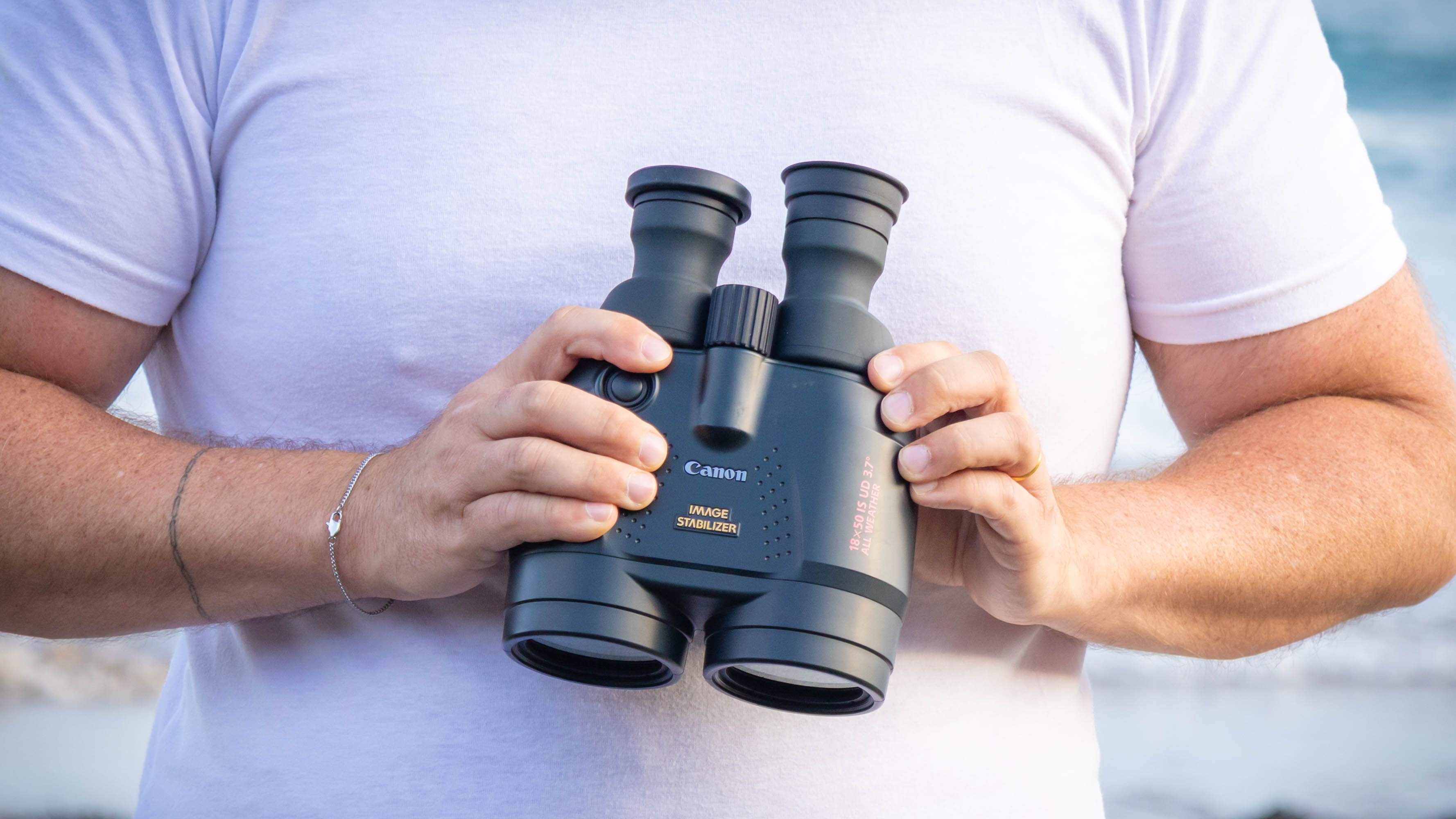
The Canon 18x50 IS binoculars are ideal for stargazing and are able to deliver clarity on night sky objects, thanks to their image stabilization. The 50mm objective lenses are the benchmark for stargazing binoculars and are able to deliver bright views of the night sky. They are currently 30% off their retail price.
When it comes to stargazing, image-stabilized binoculars are a cut above the rest. Even at high magnifications, you get detailed views of night sky objects like star clusters and nebulas, instead of shaky worms of light. Our expert reviewer gave the Canon 18x50 IS binoculars four stars and called them 'stargazing ready' thanks to their high 18x magnification and image-stabilization.
Save a huge $454 on these stargazing ready binoculars. They have 18x magnification, 50mm objectives and excellent image stabilization. They also feature weather proofing to protect them in harsh weather and rain.
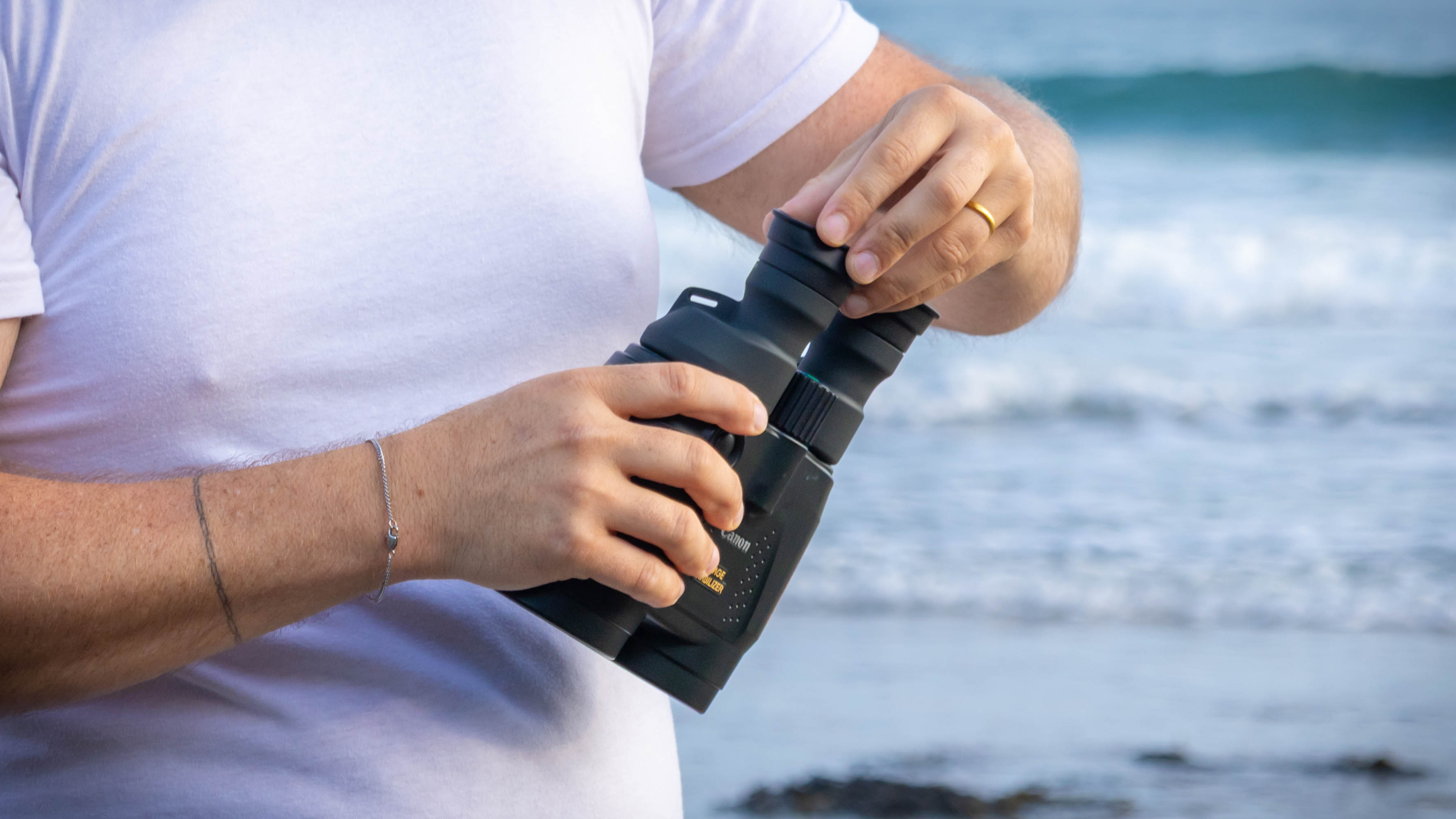
The Canon 18x50 IS binoculars don't need a tripod for stargazing thanks to the image stabilization.Jase Parnell-BrookesWhilst quite big, the Canon 18x50 IS binoculars are packed full of great premium features like 18x magnification, 50mm objective lenses and of course the image-stabilization.Jase Parnell-BrookesThey have a nice wide field of view so you can capture a spacious view. Jase Parnell-BrookesThe eyecups are rubber and can be flipped up or down depending on whether you want any eye-relief.Jase Parnell-BrookesThey feature a generous 15mm of eye relief.Jase Parnell-BrookesI loved the design and performance of the Canon 18x50 IS binoculars.Jase Parnell-Brookes
Stargazing with regular binoculars or image stabilized binoculars is the same difference as night and day. Especially at higher magnifications, image stabilization becomes a necessity when using the binoculars without a tripod and you can struggle to get a shake-free view without it.
The Canon 18x50 IS binoculars offer a powerful 18x magnification and 50mm objective lenses for great astronomy performance. You don't need to worry sacrificing low-light capability for image-stabilization. The star clusters, galaxies and nebulas are bright without becoming lines of squiggly light. They are brilliant for bird watching and general use, too, with the image stabilization adding to the quality of all views.
The optical technology stands out with ultra-low dispersion (UD) glass elements for virtually no chromatic aberration (color fringing) and doublet field flatteners for sharp stars from edge-to-edge. Optics expert, Jase Parnell-Brookes, gave them four stars in their full Canon 18x50 binoculars review for enabling a relaxing and impressive session of stargazing. They highlighted the strong grip for sturdiness in challenging conditions but even though they are advertised as all-weather, they are not fully waterproof. At 27% off asking price, this is a huge saving on a pair of binoculars we think are among the best for stargazing.
Key features: 18x magnification, 50mm objective lens diameter, 3.7-degree field of view, 15mm eye relief, 41.6 oz (1.2 kg).
Price history: The Canon 18x50 IS binoculars have a retail price of $1,648 but are often discounted from Amazon for $1,549. This deal from an Amazon seller brings the price down to $1,195, with the official Amazon listing on sale for $1,199.
Reviews consensus: In our Canon 18x50 IS binoculars review, we praised their the premium features that made it perfect for stargazing: 18x magnification, 50mm objective lenses and superb image stabilization.
✅ Buy it if: You want high powered views of the universe from handheld binoculars without the need for a tripod.
❌ Don't buy it if: If you don't need high magnification or image-stabilization, a lower magnification pair might be more suited to you, like the Nikon Action 7x50 binoculars.
In looking back and commemorating the 50th anniversary of the Viking missions to Mars, one is struck by the bold and audacious undertaking.
Twin spacecraft missions — each consisting of a lander and an orbiter — made their way to Mars and into the history books. The Viking 1 lander planted its legs on the terrain of Chryse Planitia 50 years ago today, on July 20, 1976, while its Viking 2 counterpart touched down at Utopia Planitia on Sept. 3 of that year.
Among their duties, the dual landers scooped up the first soil samples of Mars and deposited those precious collectibles into onboard, specialized equipment. Viking scientists had designed that gear to help answer an intriguing question: Is there life on Mars?
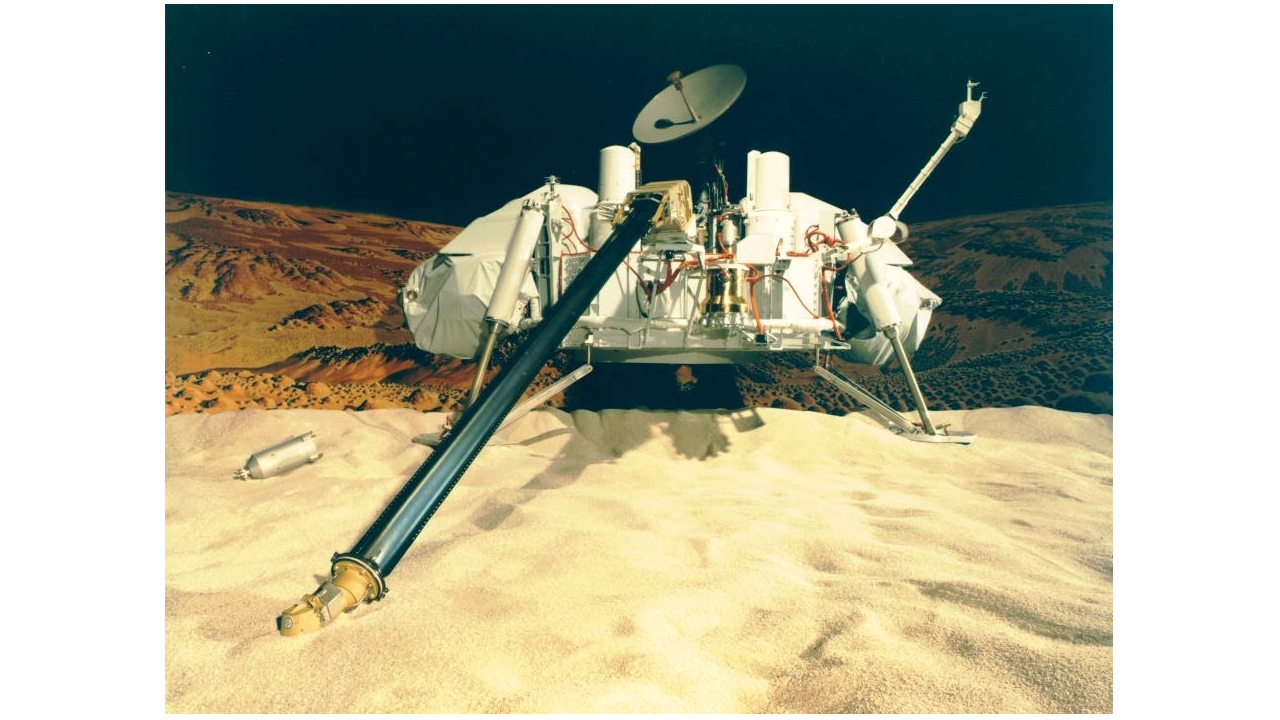
A model of NASA's Viking 1 lander here on Earth. On July 20, 1976, the spacecraft touched down on the surface of Mars. (Image credit: NASA)
One of Viking's instruments was a GCMS, a combination of a gas chromatograph (GC) and a mass spectrometer (MS). A positive GCMS detection could confirm the possibility that organics needed for the origin of life as we know it were present.
After interpreting all the data and information gleaned from ingested Martian soil, most scientists at the time concluded that Viking relayed a "no life on Mars" result.
But is it possible that the two robots actually radioed back a very clear comeback: "Can you repeat the question?"
Different techniques
Ben Clark was a member of the Viking science team, and the instrument he designed made the first-ever measurements of the chemical composition of Mars soil. He is now a senior research scientist at the Space Science Institute in Boulder, Colorado.
"There were three life-detection experiments, each using different techniques to probe whether they could stimulate biological activity in the soil by adding various selected nutrients," Clark told Space.com. "Two were generally negative in their findings, but a third experiment had an expected strong response when it added nutrient."
Indeed, astrobiologist/inventor Gilbert Levin remained convinced that his Viking microbial detection instrument, called the Labeled Release experiment, did find living microorganisms in the soil of Mars. He held tight to that view until he passed in July 2021 at the age of 97.
Skeptical scientists
Clark recalled that many members of the scientific community were skeptical when geochemists pointed out that certain minerals can cause a similar response.
"Furthermore, when a second amount of nutrient was added, there was no additional response," Clark said. "Did the organisms die between experiments?"
Because of these responses, and especially because no organic molecules could be detected, most biologists concluded there was no life in the dirt that Viking tested. "However, there is also the question of whether the best nutrients were used in the Viking tests," Clark noted.
Microbiologists who study the small organisms that live in Earth soil, Clark added, know that some species are extremely adept at using sulfate as an energy source, by combining it with organics or with hydrogen gas.
"Unfortunately, none of the Viking life-detection experiments added hydrogen gas to their chambers," Clark said.
"Ironically, the instrument which searched for organics in the soil, the GCMS, used hydrogen gas in its analytical technique," he added. "Thus, there was a tank full of hydrogen gas located just centimeters away from the life-detection experiment package, but no connection between it and the GCMS where it was located."
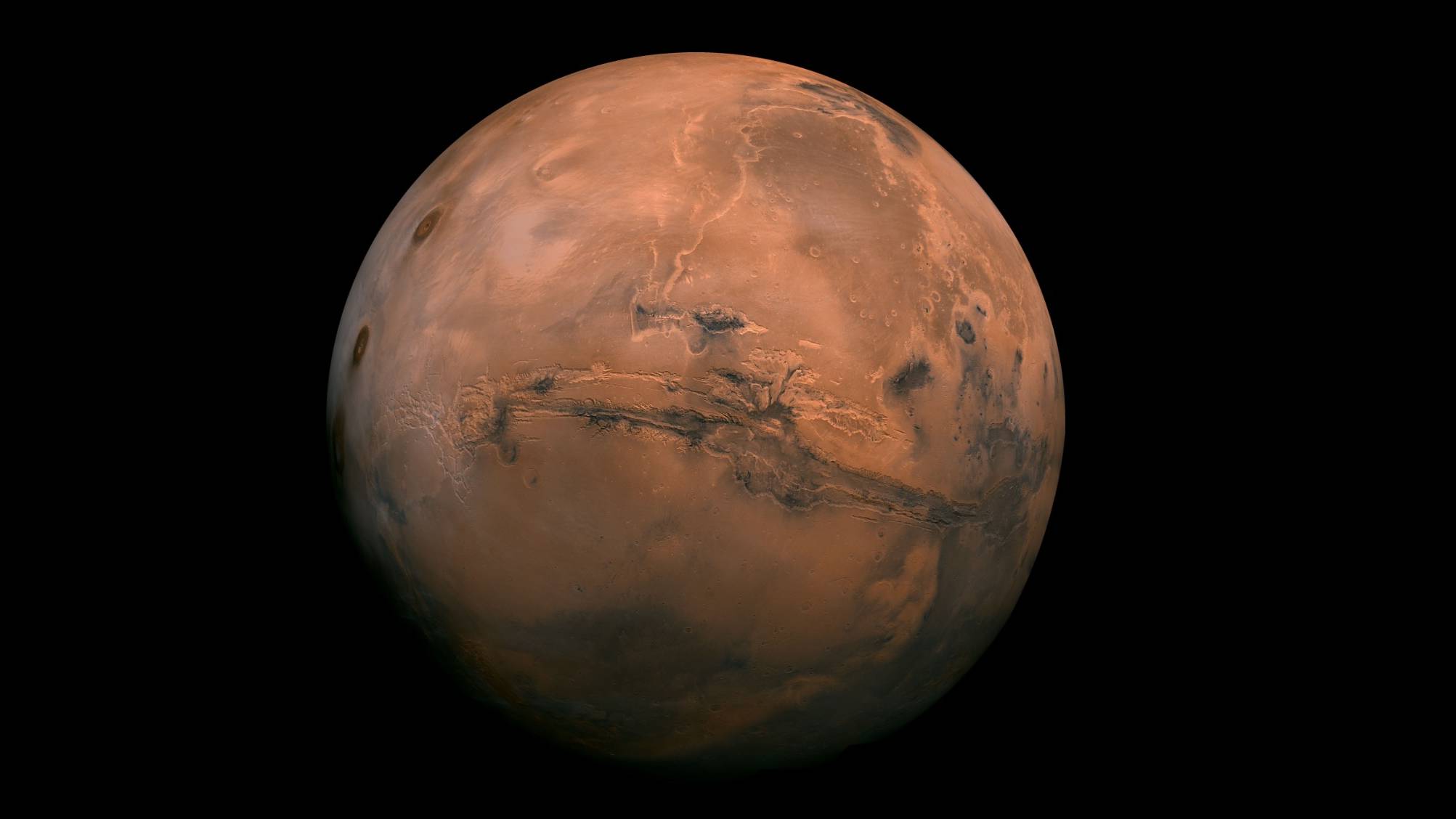
This mosaic is made up of more than 100 images captured by NASA’s Viking 1 orbiter, which operated around Mars from 1976 to 1980. The scar across the center of the planet is the vast Valles Marineris canyon system. (Image credit: NASA/JPL-Caltech)
True positive detections?
Even today, there are some scientists who question whether some of the life-detection experimental results were in fact true positive detections, according to Clark.
"Other scientists believe that it was not enough to simply test the loose soil, but that life in fact may be just centimeters below the surface in areas where there is still ice in the ground," he said.
Clark said that no other planet in our solar system so closely matches the early history of our own planet Earth.
"Recent discoveries by the rovers now roaming Mars have revealed some detections of organic molecules, and even some so-called 'reduction spots,' which are interpreted by some geologists as evidence of activity of biological organisms," he said.
Misunderstood results
Steven Benner is an astrobiochemist and director of the Foundation for Applied Molecular Evolution in Alachua, Florida. He is author of the soon-to-be-issued "Meet the Neighbors: Life on Mars and How to Find It" (Penguin Press, 2026).
Benner has long argued that the results from Viking were misunderstood. He contends that the Red Planet remains an easily reached destination to discover a possible independent origin of life and draws upon the Viking records to spotlight how the scientific process has failed in this regard to date.
Tied to Viking's 50th anniversary, "I decided to write a grumpy 'take no prisoners' book that dispenses with politeness and focuses on the facts," Benner told Space.com.
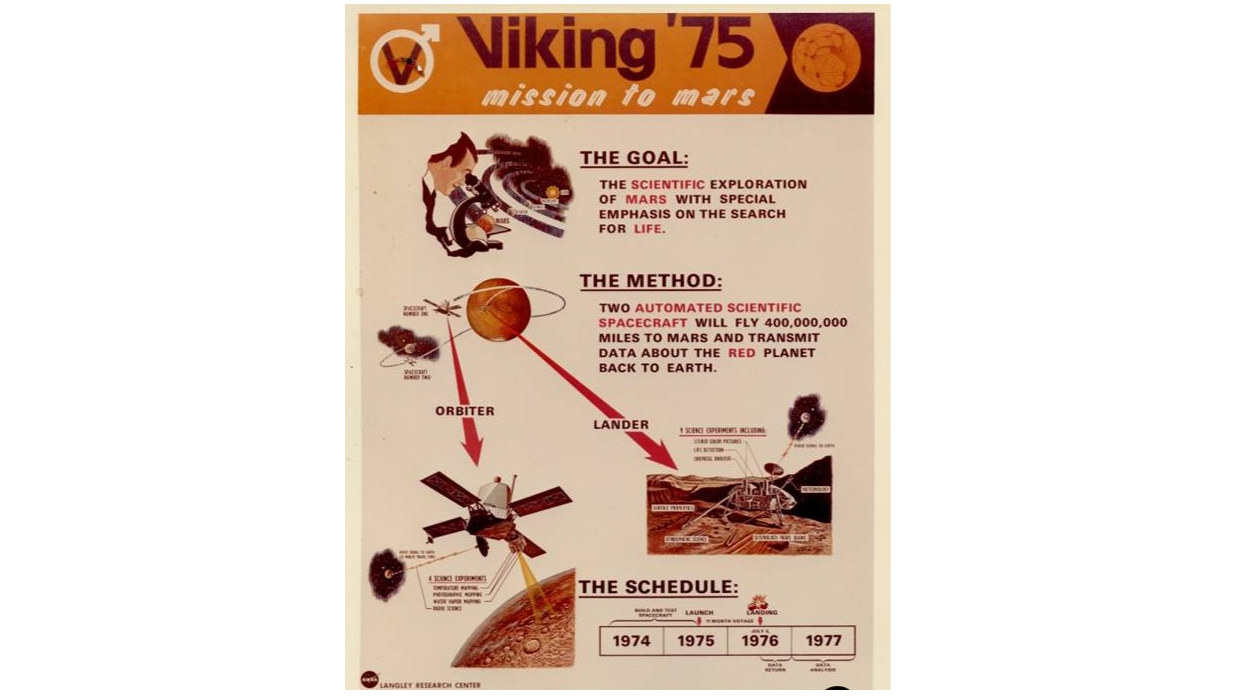
Viking flyer from NASA Langley Research Center. The spacecraft were built by Martin Marietta with Langley in Hampton, Virginia managing the Viking project. The Jet Propulsion Laboratory handled the operations of the probes once in flight. (Image credit: Langley Research Center/The Viking Mars Missions Education and Preservation Project)
Misbegotten consensus
Benner said that his new book highlights two tales.
"Viking more likely than not found autotrophic microbial life on Mars, roughly 1,000 cells per gram — about what you might expect based on Earth analogs," said Benner.
The other story, he said, is that communities will defend a misbegotten "consensus" long after that consensus ceases to be defensible. They should not be beholden to a half century of mistakes, he emphasized.
The GCMS misinterpretation was 100% of the grounds for dismissing considerable life-positive data, according to Benner. So, he said, "we should then have gone back to the status quo ante, as Gil Levin did. But since 'consensus' in science is powerful, and Levin was polite, the community marginalized him."
Her late father, James Tillman, worked on Viking 1 and 2 and was a professor in the Department of Atmospheric Sciences at the University of Washington.
"There are a variety of reasons it's important to preserve Viking data," Tillman told Space.com. Archiving how and why things were done on Viking from an engineering standpoint is vital, she said, as is safeguarding the science data accumulated during the Viking program.
"Science is dynamic. Instruments and missions are finite in what they collect, so every data is part of a growing body of knowledge coming in pieces of a much larger puzzle. We can't complete the puzzle without all of the data," said Tillman. "So every facet of Mars science is a tiny piece of the puzzle. For that reason, we need to keep all the pieces."
This is true of every engineering success and failure, she added.
"Our organization has records on both. Because of that, we can help industry reduce costs by making the archives available on failed tests as much as successful ones," Tillman said.
It takes many, many missions to get close to answers we theorize on, she pointed out. "And then there is inspiration. By preserving the past — the who, what and how — we inspire youth and the public to support endeavors and even join the workforce," she concluded.
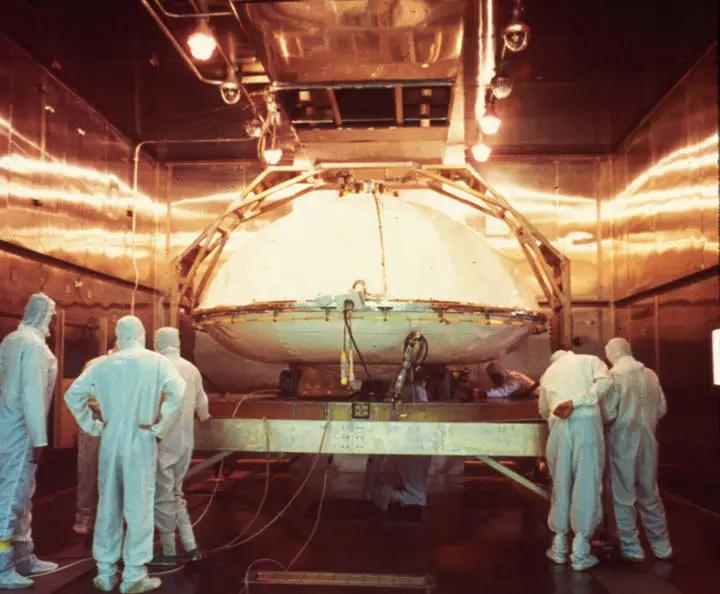
Space technicians prepare the Viking 1 lander, encased in its bioshield, for its sterilization. (Image credit: NASA)
Contaminate and confuse
"The entire Viking mission — orbiters and landers — are one of the most important sets of data about the planet Mars," said Barry DiGregorio, an honorary research fellow for the Buckingham Center for Astrobiology in the United Kingdom. He is author of "Mars: The Living Planet" (Frog Books/1997).
"Indeed, the Viking biology data have become more important today than they were during the Viking mission," said DiGregorio. "Because Viking carried the very first suite of extant biology instruments to Mars, extreme care was given to the extensive heat sterilization protocols for the Viking landers."
Those protocols ensured that the Vikings did not carry large numbers of terrestrial microorganisms that might contaminate and confuse the actual soil sample results in its three onboard life-detection instruments, DiGregorio said.
Warning flag
However, DiGregorio is also waving a warning flag.
The recent discovery of never-before-detected extremophile microbes in spacecraft assembly clean rooms has made it important to take planetary protection protocols to a new level, said DiGregorio.
"Unfortunately, the search for extant life on Mars has been made much more difficult by unwittingly sending Earth's hardiest extremophile microorganisms there for the last 30 years," he said.
If Mars life is indeed spotted, extra effort will be required "to make sure it isn't earthly extremophile microbes we are detecting," DiGregorio added.
Both Viking landers ceased operating more than four decades ago. But they could still aid the Mars life search today, according to DiGregorio. Perhaps, he said, "comparing any new data found with archived Viking Lander biology data will be crucial in determining their interpretation."
Where does James Cameron's "Aliens" rank among the other Alien movies? That depends on who you ask. Some might say it's the best, while others put it just behind the original (spoiler alert: it's the best). Regardless, there's no denying that this 1986 film shifted gears, moving the franchise from horror to horror-tingedsci-fi action and paving an alternate path for the future.
As Cameron stated in aninterview with Lofficier, the plan always was "to do a film that was not as scary... it's scary, but it's not as scary, but more intense, and I like to use the word, exhilarating. Because I think you get exhilarated by the intensity of the kind of action that's in this film."
In terms of story progression, the sequel's shake-up makes complete sense. Sigourney Weaver's Ellen Ripley survived the Xenomorph in "Alien", but now she must conquer her fears and face the grim creature once again. This time, she has allies and firepower on her side, though most of those Colonial Marines turn out to be about as useful as French kissing a beehive.
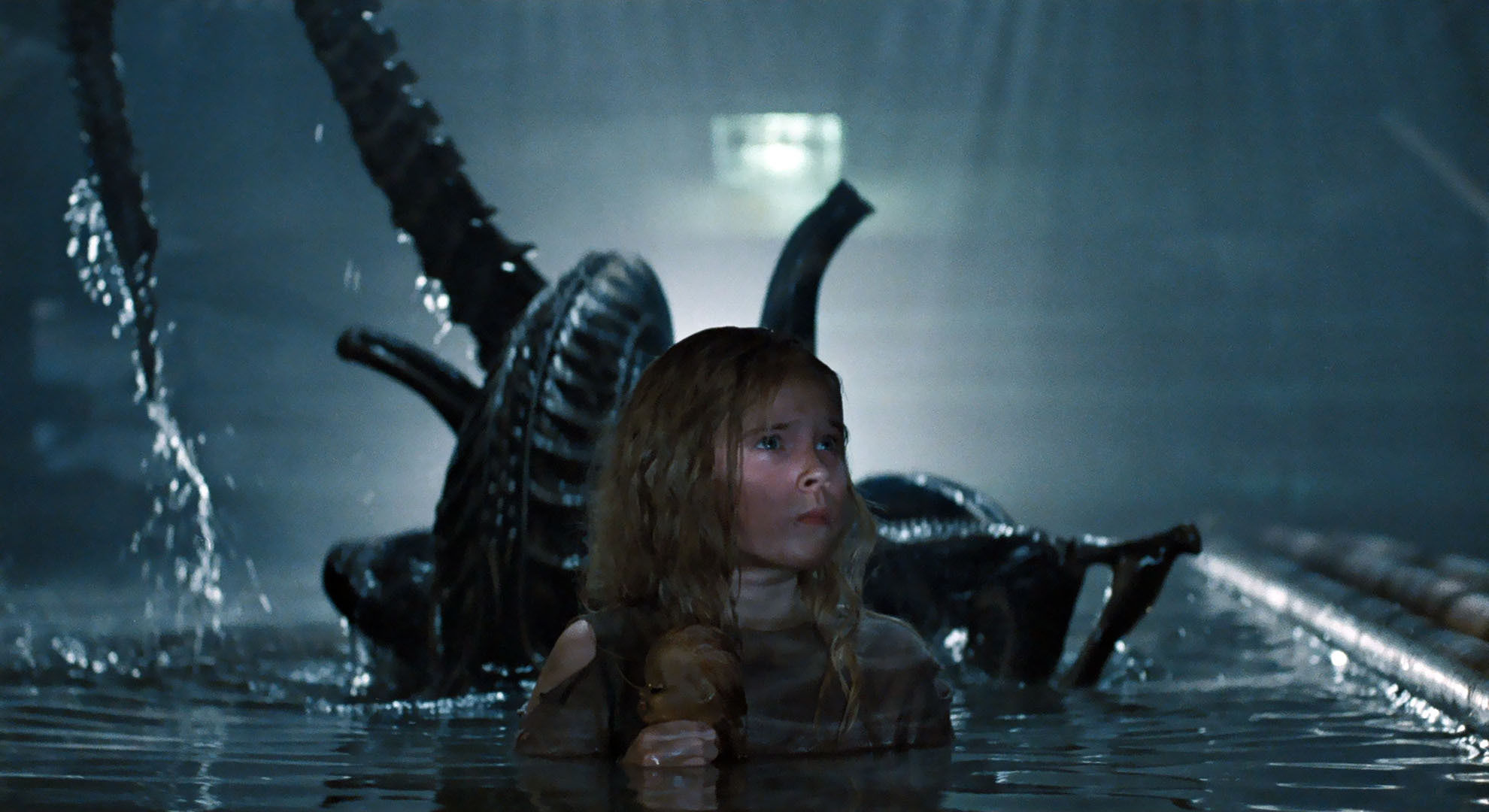
(Image credit: 20th Century Fox)
"Aliens" exploded into a monster hit, both financially and critically, suggesting that Cameron has a Midas touch when it comes to sequels. Famous movie critic Roger Ebert called it "a superb example of filmmaking craft", and it's tough to argue that point. Yet what's amazing to ponder is how "Aliens" nearly fell apart several times before it actually happened.
Despite 1979's "Alien" turning a big profit on paper, Hollywood's accounting practices are more baffling than Palpatine's return in "Star Wars: The Rise of Skywalker".
Somehow, "Alien" was deemed a flop, and 20th Century Fox remained conflicted about a sequel – so much so that it almost sold the rights to the "Rambo" producers of all people (imagine the crossover potential, though, as John Rambo guns down a horde of Xenomorphs while Jerry Goldsmith's iconic score blares in the background).
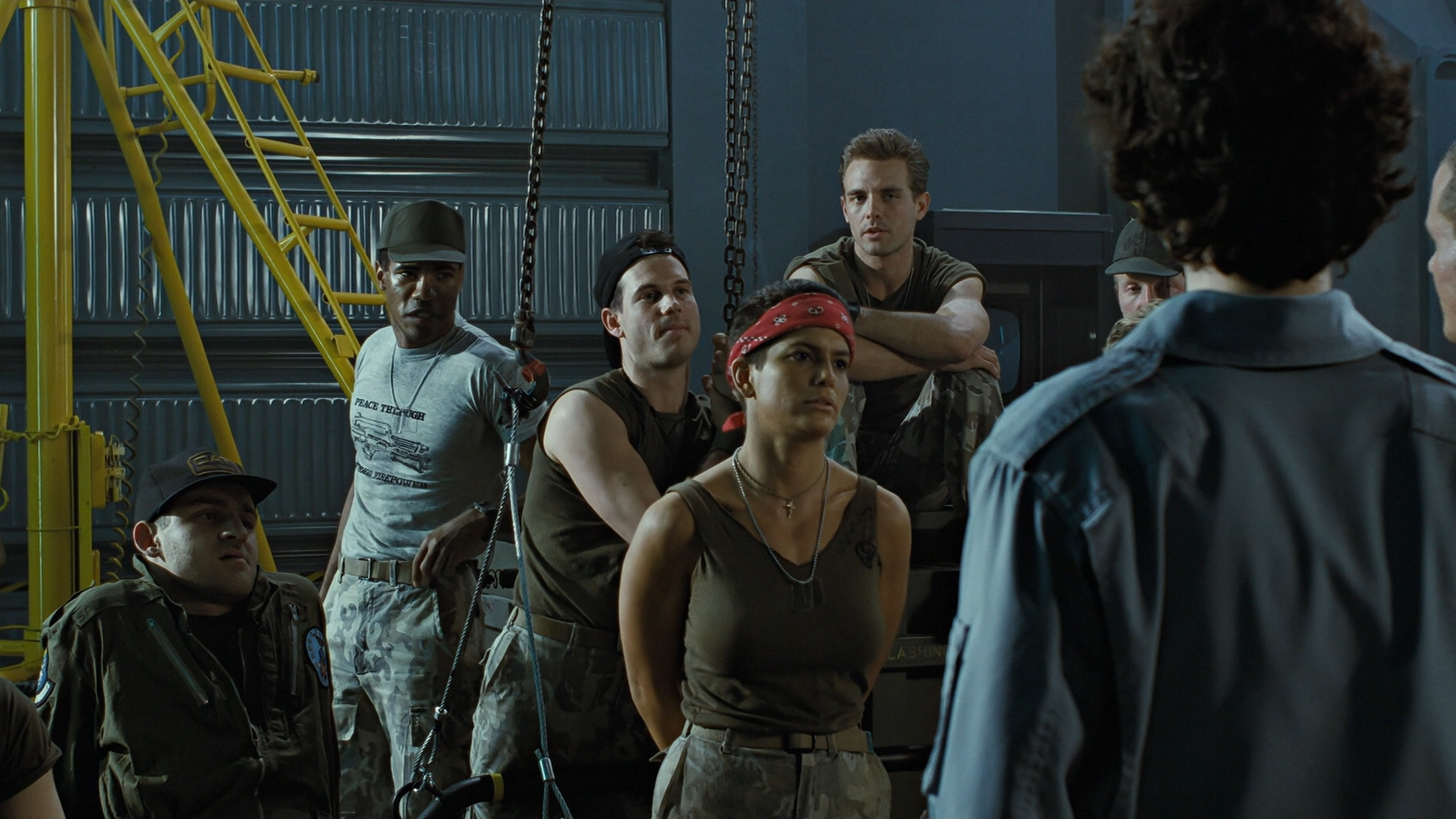
(Image credit: 20th Century Fox)
After much oohing, aahing, and handwringing, the studio relented and selected Cameron to put together a treatment based on the impressive nature of his script for "The Terminator".
In 1983, Cameron only needed three days to put together a 45-page treatment, which can be read here. The nuts and bolts of what would become "Aliens" are mostly present in this document, but Fox turned its nose up at the filmmaker's proposal. The studio certainly wasn't escaping allegations that it looked for more reasons not to do the movie than to proceed.
What "Aliens" required was a champion from within – somebody to convince the studio execs that they were leaving money on the table by ignoring this franchise. This came with the hiring of producer Larry Gordon, who pushed for the sequel in the four walls of the boardroom.
After the success of "The Terminator", Cameron returned to the fray as writer-director, while his then-girlfriend-soon-to-be-wife Gail Anne Hurd boarded the film as a producer.
(Image credit: Getty Images (Bob Penn))
With the script submitted and Cameron cocked, locked, and ready to shoot in 1985, a new problem arose: budget. Cameron's camp argued that "Aliens" could be done for $15.5 million, but Fox's bean counters feared it would be closer to $35 million, and nobody considered the poor billionaires at stake.
Fox offered $12 million. "We walked out and said, 'Thanks, we'll do something else,'" Cameron told the Los Angeles Times.
Behind the scenes, Gordon managed to convince his bosses to fork out the extra money for the production. With that hurdle successfully navigated, Cameron was back in the driver's seat and ready to head off to LV-426.
(Image credit: 20th Century Fox)
Next though, Fox decided to suggest the unthinkable at the time: "Aliens" without Sigourney Weaver. It's a decision that reeks of a straight-to-video sequel, the kind of thing you'd expect to be fronted by a Kevin Sorbo type.
Cameron, on the other hand, was under the impression that Weaver had been contractually locked in for a sequel, but that wasn't the case at all. Now it was up to Cameron to convince Weaver to do the film. He met with Weaver, and the meeting seemed positive enough, but her agents wanted a big payday for her – and rightfully so. Fox refused, and so Cameron and Hurd quit… again; they weren't going to make the movie without Weaver.
Frustrated but trying to roll the dice on this flailing project one last time, Cameron pulled a sneaky trick, as he revealed to GQ years later. Weaver shared the same agency as Arnold Schwarzenegger, so Cameron phoned Schwarzenegger's agent and told him how he was about to start rewriting the "Aliens" script to remove Ripley entirely. The news travelled faster than a Xenomorph through a ventilation shaft.
(Image credit: Getty Images)
"The deal was done in 12 hours after that," Cameron said. "So I never wrote a word of that hypothetical story that I said I was gonna do, that I had no intention of writing anyway. So anyway, it worked, and Sigourney got her million bucks, and everybody was happy."
As far as most movie productions go, "Aliens" was mostly smooth sailing when it began to shoot. Deadlines were met, it didn't go over budget, and the studio let them get on with it. The biggest challenge involved the final cut – with Fox wanting the picture to have a two-hour runtime to secure more theatrical screenings.
Cameron relented, taking out his scissors and cutting a few superfluous scenes, but the film still wasn't quite at the magic mark. Having cut everything that he could, Cameron explained that any further amendments would destroy the story and damage the integrity of the movie. This time, Fox didn't argue and stuck with the filmmaker.
(Image credit: 20th Century Fox)
History confirms the right call was made here. The franchise now follows the blueprint laid by Cameron's "Alien" more than Ridley Scott's "Jaws in space" foundation. While there's always a survival element in these movies, the action-centric approach is a critical part of the series' DNA. Sure, the protagonists remain scared, but they receive the opportunity to light up the Xenomorphs and show those ugly monsters who's the boss.
Looking back now, it's unbelievable to think that Fox almost tanked "Aliens" with its studio shenanigans. A classic emerged from the chaos of inflated egos, penny-pinching, and blood pressure-raising frustration.
It's proof that in Hollywood, no one can hear you scream (nor do they care), so it's up to you to find a way to survive.
Artificial intelligence could easily fall into the trap of identifying non-life as life on other worlds, claim two researchers from Michigan State University who have tested AI on simulated life in a computer program.
"We had previously seen that AI has a big Achilles heel when it is trying to classify things that are unlike the things in its training examples," Michigan's Christoph Adami told Space.com. "We call these 'out-of-distribution' samples and it is just incredibly easy to get AI to misclassify."
Adami is a computational biologist who uses computers to apply information theory to the study of evolution and biology. One of his leading tenets is that life can be defined by its ability to encode information and replicate it. To this end, he devised the Avida computer program in 1993. It runs digital organisms written as code that can replicate by copying themselves and competing for resources — in this case, CPU time — just like real life organisms. Although the use of digital life in evolutionary studies remains controversial, what it does provide Adami with is a huge dataset of simulated lifeforms that AI can be tested on.
Spending three months of computer analysis on a thousand parallel machines, Adami and his student Ankit Gupta asked AI to determine which programs in Avida had the properties of life, and which didn't. The life and non-life programs have very similar coding, so the difference is not obvious — and this might very well be the case on another planet where life could have differences in biology to Earth life.
Adami and Gupta started out with programs representing a random sequence of molecules and asked the AI to classify them. They then set about tweaking that sequence of molecules to try and fool the AI into thinking it was seeing life, one change at a time, each time checking whether there had been a change in how confident the AI was that it was life or non-life.
"Within about 15 changes or so we can get AI to be perfectly confident of a life classification when in fact not a single time when it was being 100% confident was it actually life," said Adami.
Furthermore, no matter the sequence they started with, the AI was constantly fooled.
Many in the scientific community stand by AI as an invaluable tool because it can process huge amounts of data and search for patterns in that data. Adami himself believes that AI has an important role to play, but as we see in everyday life, AI is prone to making things up and identifying patterns that don't exist.
Digital organisms replicating and mutating over time in the Avida program. Each colored dot represents an organism of a particular genotype, and each time they mutate into a different type, they change color. (Image credit: Adami et al/Michigan State University)
This really comes down to what the AI has been trained on, said Adami. If you ask an AI about data it has been trained on, it usually provides a correct answer. For example, if you train AI to identify pictures of apples and then ask it to pick out the fruit from a dataset that also includes pictures of non-food items, it will answer correctly virtually all the time. However, if you replace the apple pictures with photos of bananas and ask it to identify the fruit, it will struggle and start to misidentify things.
That's because the bananas represent "out of distribution" data. The AI wasn't trained on bananas, which are a very different shape to apples, and therefore the AI doesn't know what to make of them.
Similarly, we don't know what alien microbes will look like, and they could be quite different to the terrestrial microbes that the AI has been trained on. In other words, the alien life would be out of distribution, and the AI would have no context for saying whether any particular collection of molecules is life or not.
"You need to know your training data, and if you know that your testing data is part of the same distribution as the training data, then you'll be fine," said Adami. "But you can't guarantee that with extraterrestrial life."
This could pose a problem for missions designed to look for life.
If a Mars rover goes to the red planet and cuts open a rock and directly sees something that looks like microbial life as we know it, then the answer will be clear-cut and can be tested using traditional methods. However, many attempts to detect life will probably not be so hands-on, relying on mass spectrometry data to identify molecules and processes related to life. This could range from attempts to detect life in the atmosphere of Venus, or in the ocean of Europa, or on exoplanets via the Habitable Worlds Observatory, which NASA aims to launch in the 2040s to directly image exoplanets in the habitable zone of stars.
"This means that if there were an AI on a mission looking at particular mass spectrometry samples, then there's a very great chance that while it has been trained on the ground on a number of biotic and abiotic samples, it could still return a positive verdict when it has absolutely nothing to do with life," says Adami.
Caleb Scharf of NASA Ames, who along with Carnegie Science's Michael Wong is spearheading a NASA-sponsored five-year, $5 million project to develop AI tools to help search for life on other planets, thinks that Adami and Gupta's findings are rather interesting. However, Scharf suggests that machine-learning algorithms can be honed to avoid falling into this trap by allowing for unknown categories rather than the limited binary options of life or not life available in the Avida experiment.
"Gupta and Adami's study points astutely to a critical challenge in life detection that might undermine the hoped-for gains from AI and machine learning: what do we do with the unknown unknowns?" Scharf told Space.com. "We think the answer may lie in allowing algorithms to notice situations where things look askew, andthere are methods from data science to tackle this very probllem, which we're actively exploring."
The next step, said Adami, is to move out of the digital world and run the same test with real-world data.
Adami and Gupta will be presenting their findings in August at the 2026 Conference on Artificial Life, which is being held in Waterloo, Canada.
The biggest blockbusters of 2014 threw up a varied rogues' gallery of bad guys. In "Transformers: Age of Extinction", it was a reincarnated version of Optimus Prime's perma-nemesis, Megatron, while Captain America faced off against a reborn Hydra infiltrating the upper echelons of the US government in "The Winter Soldier". For Spider-Man, it was Electro, while Maleficent showed up in live-action to give Sleeping Beauty nightmares.
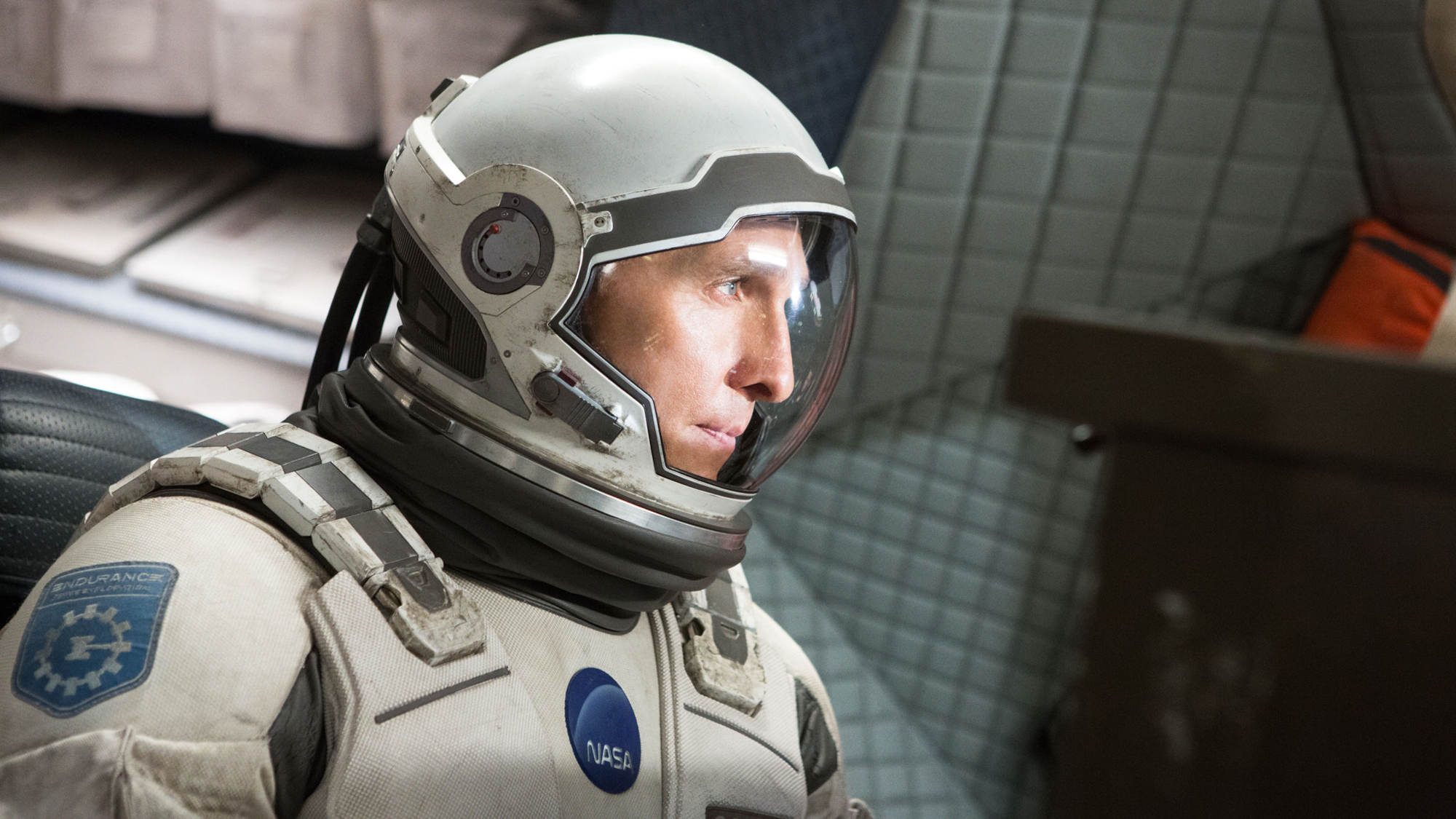
Christopher Nolan has never been one to go with the Hollywood crowd, however, and in his outer space opus "Interstellar", the antagonist was time itself — or, to be more specific, Einstein's theory of general relativity.
Nolan, whose Homeric epic "The Odyssey" makes landfall in theaters this week, has always been obsessed with time, and our perception of it. From "Memento"'s backwards narrative to "Tenet"'s time-flipping terrorists, the director has tended to steer clear of linear narratives. Even the three interweaving plotlines of his World War II drama, "Dunkirk", unfold at completely different speeds. In short, Nolan is not a filmmaker you should ever set your clock by.
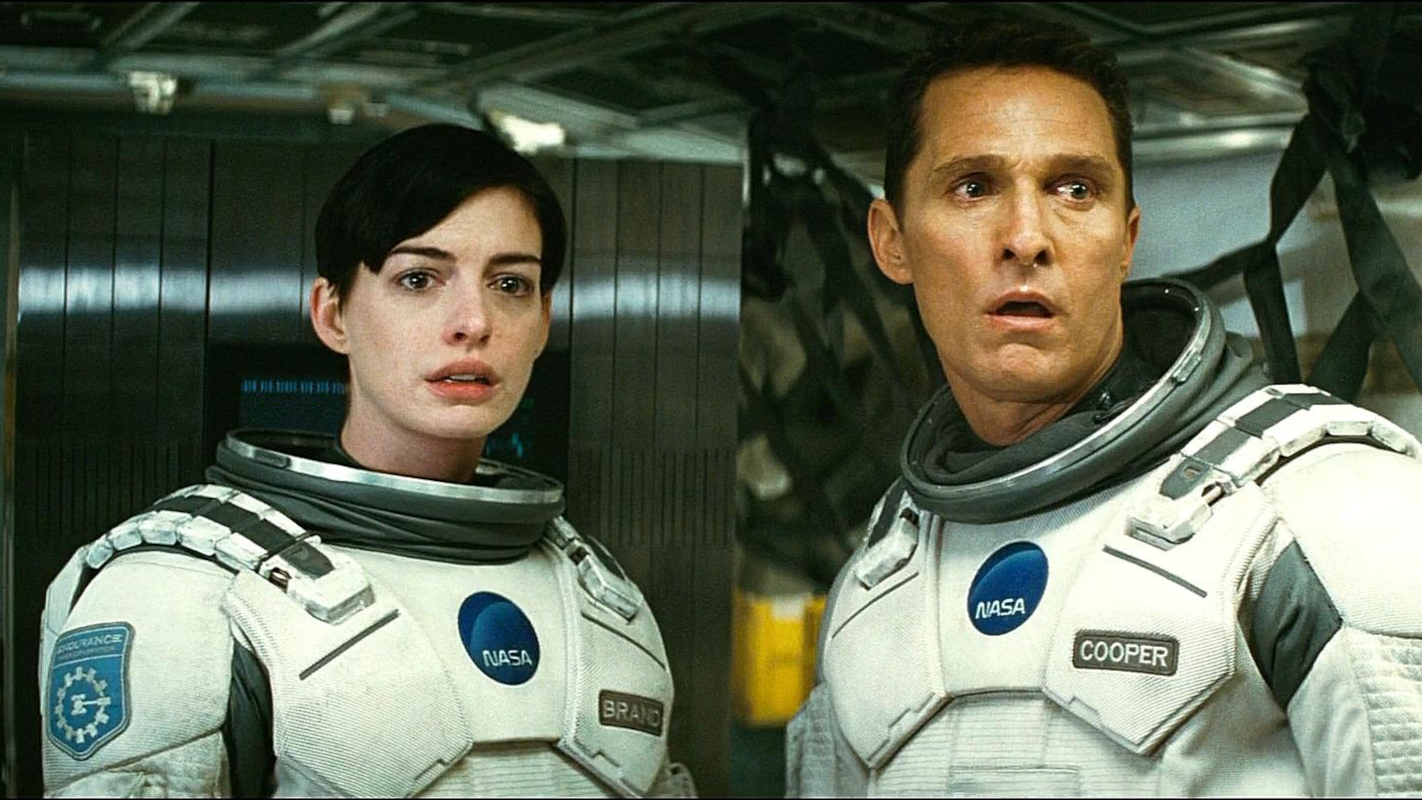
But time has never been as cruel as it is in "Interstellar", where the fundamental constants of the universe combine to wreak havoc with human emotions. "Time is relative," explains Anne Hathaway's biologist/astronaut Amelia Brand. "It can stretch, and it can squeeze, but it can't run backwards. It just can't."
She's summed up "Interstellar" in a nutshell, so it's not hard to see why this was the story Nolan wanted to tell when he added his own entry to the canon of cerebral cinematic sci-fi.
(Image credit: Paramount Pictures)
At one point in "Interstellar"'s evolution, it seemed set to be a Steven Spielberg movie. Physicist Kip Thorne had originated the project with producer Lynda Obst, and the "Close Encounters of the Third Kind" director spent a year developing the movie with them. He even hired Nolan's younger brother, Jonah (whose credits include "The Dark Knight" and "Westworld"), to write a script.
Spielberg ultimately dropped out — "It just didn't stick with me, and I don't know why," he told Empire magazine — but Jonah knew the ideal replacement. "Jonah actually said, 'If there comes a point where you decide not to make this movie, I can tell you who's gonna grab it. He's already bugging me about it. And that's my brother Chris.' The second I decided not to make it, Chris jumped on board, probably the next day. 'Interstellar' was a much better movie in Chris Nolan's hands than it would have been in mine."
In the film's near future, humanity is literally running out of time. The Earth's ecosystem is breaking down, with dust storms killing crops across the United States and causing major health issues among the survivors. Nolan even uses talking head footage of real-life survivors of the Dust Bowl that ravaged the US Midwest in the 1930s (taken from Ken Burns' 2012 documentary "The Dust Bowl") to add to the urgency of the situation.
(Image credit: Paramount Pictures)
But the remains of NASA — now forced into hiding — have a plan. They've discovered a stable wormhole near Saturn, and it leads to another galaxy. Probes have found planets on the other side, and some of them might — just might — be capable of supporting life.
So when former pilot-turned-farmer Joseph Cooper (Matthew McConaughey) stumbles on NASA's clandestine base (for reasons that will later become clear), he's recruited for a mission checking in on the brave pioneers sent to investigate these strange new worlds. Unfortunately, this means leaving his kids behind.
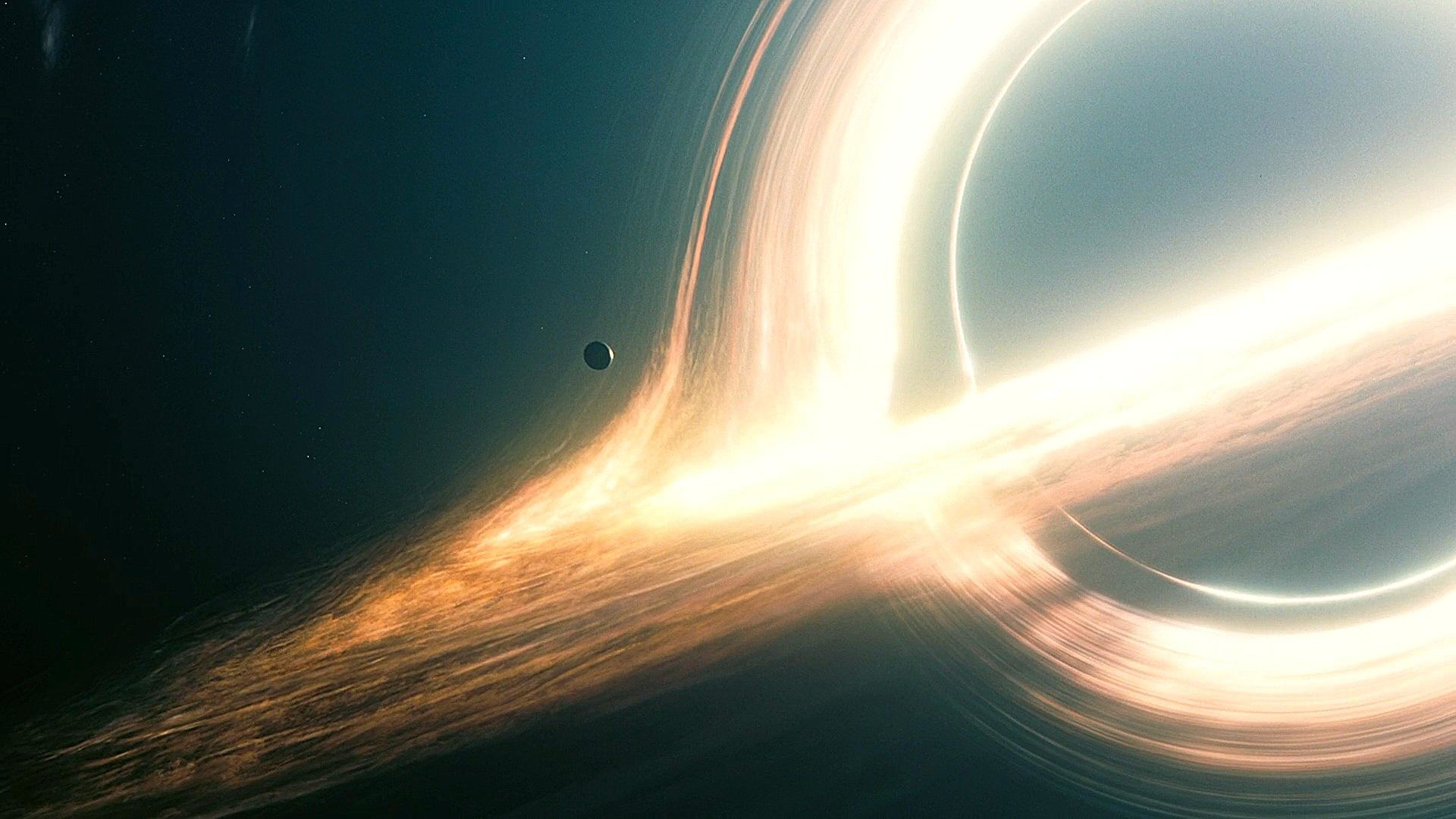
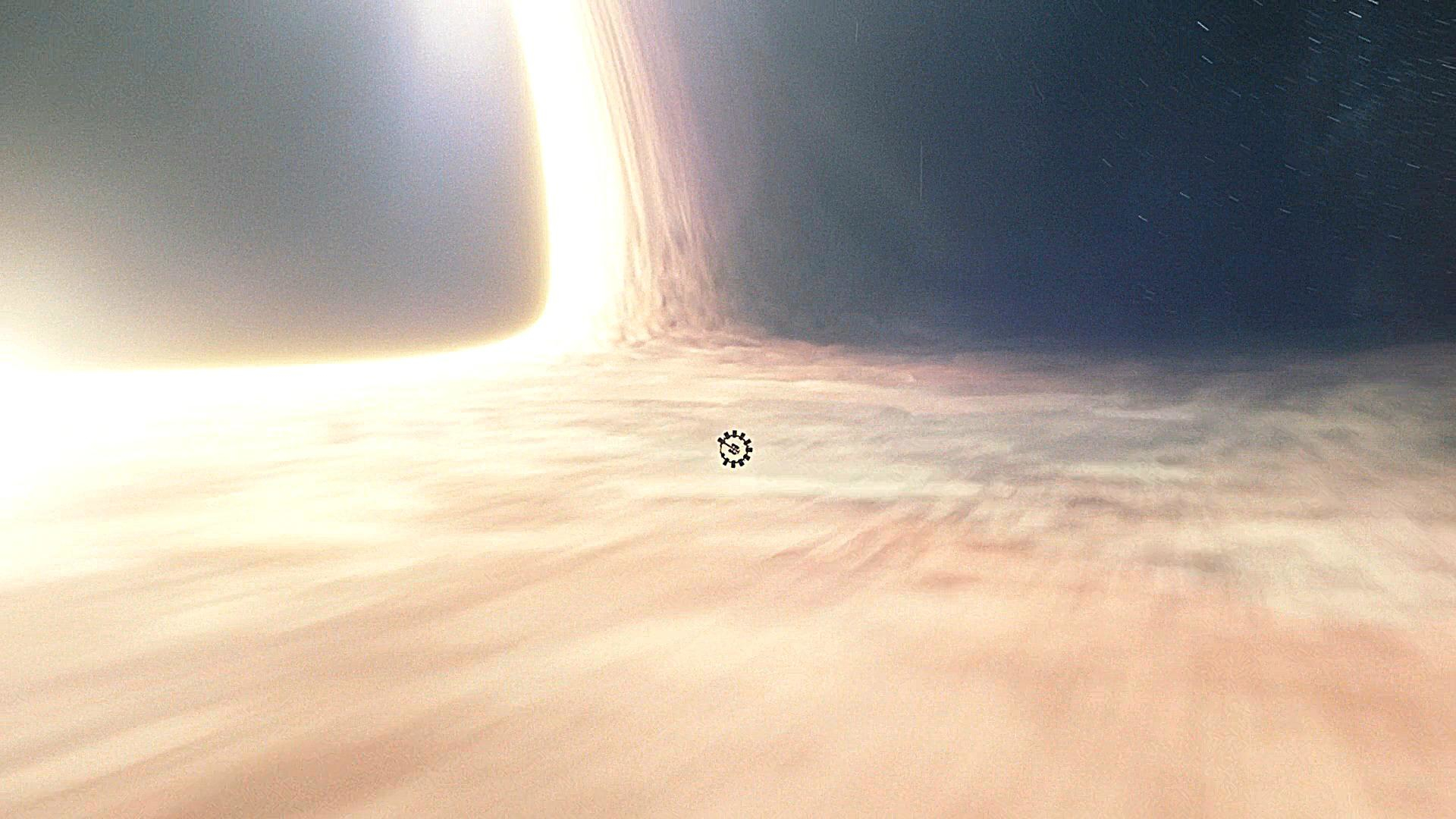
And this is where relativity becomes one of the harshest antagonists in movie history. The Endurance crew's first destination, "Miller's Planet", orbits a black hole known as Gargantua. Its gravity is so intense that anything in its vicinity experiences extreme time dilation — to the extent that an hour on the planet's surface is equivalent to seven years for everyone else. "We need to think of time as a resource, just like oxygen and food," Brand says before they make landfall.
(Image credit: Paramount Pictures)
But in that old Hollywood tradition, not everything goes to plan on the surface, and by the time Cooper and Brand escape Gargantua's influence — minus their late crewmate Doyle (Wes Bentley) — decades have passed on Earth. In an extremely powerful sequence, we see Cooper catching up on the last 20-plus years of life back home via video messages from his son, Tom (the young version played by Timothée Chalamet, the older version by Casey Affleck).
In a matter of minutes, Cooper learns about the birth and death of a grandchild, as well as the passing of his father-in-law. At the end of the reel, his heartbroken daughter Murphy (young version: Mackenzie Foy; adult version: Jessica Chastain; elderly version: Ellen Burstyn) sends her first message since he abandoned her for outer space. The reason for breaking radio silence? She's now the same age he was when he left; her childhood vanished in the blink of an eye.
"Interstellar" makes a mockery of the myth that Nolan's films are cold and emotionless. Relativity shows no mercy for family bonds, and McConaughey, Chastain, and Hathaway all deliver towering performances as they deal with its consequences. This is a human story told across a multi-dimensional canvas.
(Image credit: Paramount Pictures)
Even beyond their lives being thrown out of sync by time dilation — at the end of the movie, a still-40-something Cooper comes face-to-face with a nonagenarian Murph on her deathbed — they're coming to terms with the fact that the whole mission was built on a lie.
NASA boss Dr Brand (Michael Caine) may have thought he was doing the right thing by pretending that his gravity equation could be solved and giving false hope that humanity might one day find a new home among the stars. But it doesn't make it any less of a kicker when he confesses his grand betrayal, admitting on his deathbed that "Plan B" — sending embryos into the cosmos to extend the human race — was "Plan A" all along. Of course, whether he's right or wrong, he's a second-tier 'bad guy' compared to relativity.
Nolan went to extraordinary lengths to give his film a sound scientific footing. He consulted extensively with Thorne in order to generate a scenario where relativistic effects would be so extreme that minutes on a planet's surface would equate to years back on Earth. "Kip, apart from being an incredible mind, is actually a very good explainer of difficult concepts, and he was very patient with all of us lesser beings," producer Emma Thomas told SFX magazine. The Oscar-winning VFX team at D-Neg, meanwhile, turned their work modelling the accretion disc around Gargantua into an actual scientific paper.
(Image credit: Paramount Pictures)
By the time the film enters its endgame, it's embracing tesseracts and five-dimensional superbeings, as Cooper uses gravity to communicate with Murph across time. In the process, he reveals that the "ghost" that helped him find NASA all those years ago was actually a future version of himself. Such diamond-hard sci-fi concepts are probably not, however, the reason that "Interstellar" has since — despite mixed reviews on release — become one of Nolan's most popular films a decade later.
"What I've found is that people who let the film wash over them get the most out of it," Nolan admitted in "The Nolan Variations" by Tom Shone, and the director may just have a point. While a cynic might have issues with the notion that love is a quantifiable force transcending the universe (anyone know the SI unit for that?), it's impossible to deny the genius of "Interstellar"'s use of high-level physics to explore the human condition.
It's unlikely any of us will find ourselves in the vicinity of a black hole, but all of us know what it means to want more time with the people we love.
"The Odyssey" is in theaters from Friday, July 17. "Interstellar" is available to stream on Hulu and Paramount+ in the US, and Sky Cinema and HBO Max in the UK.