SpaceX launched another batch of its Starlink satellites from California's central coast on Wednesday night (June 24).
A Falcon 9 rocket lifted off from Vandenberg Space Force Base on Wednesday at 11:30 p.m. EDT (8:30 p.m. local time; 0330 GMT on June 25), carrying 24 of the broadband spacecraft to low Earth orbit (LEO).
The Falcon 9's first stage came back to Earth about 8.5 minutes after launch as planned, touching down in the Pacific Ocean on the SpaceX drone ship "Of Course I Still Love You."
A SpaceX Falcon 9 rocket launches 24 Starlink satellites to orbit from California's Vandenberg Space Force Base on June 24, 2026. (Image credit: SpaceX)
According to a company mission description, it was the 25th flight for this particular booster, which is known as B1081.
The rocket's upper stage, meanwhile, continued hauling the 24 satellites to LEO. The spacecraft were deployed there on schedule, just under 62 minutes into flight, according to SpaceX.
Wednesday's launch was the 74th Falcon 9 liftoff of the year, and the 59th of 2026 devoted to building out the Starlink megaconstellation. Starlink is by far the biggest satellite network ever assembled; it currently consists of nearly 10,700 active units, and the number goes up all the time.
SpaceX has launched two non-Falcon 9 missions this year as well. On April 29, a Falcon Heavy lofted the Viasat-3 F3 telecom satellite. And the company's Starship megarocket launched on its 12th-ever test flight on May 22.
Editor's note: This story was updated at 2:40 a.m. ET on June 25 with news of successful launch, rocket landing and satellite deployment.
A lot has changed since NASA last sent astronauts to the moon — including the attitudes of those space explorers.
That's the view of Victor Glover, the NASA astronaut who served as pilot on the Artemis 2 mission around the moon's far side this past April.
"When you look back on the Apollo missions, there was a lot more competition back in the office. Everybody wanted to be the first, and then everybody wanted to be the next," Glover told Angels Broadcast Television on June 12, shortly before he threw out the first pitch before a baseball game between the Los Angeles Angels and the Tampa Bay Rays.
"I think our office learned a lot from them," he added. "There are some good things about that. It makes you work really hard, but it also can create some unnecessary conflict. And so my office really wants to support everybody — wants you to be the guy that does it, and somebody just gets picked to do it, and that's OK."
Glover and his Artemis 2 crewmates — NASA's Reid Wiseman and Christina Koch and Jeremy Hansen of the Canadian Space Agency — did indeed seem to forge a very strong bond during their training and their time in space.
For example, shortly before Artemis 2's April 1 launch, Glover, Koch and Hansen came up with a plan to name a crater on the moon after Wiseman's wife Carroll, who died of cancer in 2020.
"They said the three of them had talked, and they would like to do this," Wiseman said on April 6, the day Artemis 2 looped around the moon and got farther from Earth than any crewed mission ever had. "That was an emotional moment for me. And I just thought that was just a total treasure, that they had thought through this, and they had offered this."
Wiseman, Artemis 2's commander, said he broke down when Hansen radioed mission control with the naming request. In fact, all four astronauts were overcome with emotion at that moment.
"That was, I think, where the four of us were the most forged, the most bonded, and we came out of that really focused on that day ahead," Wiseman said.
This image taken by Buzz Aldrin of the Apollo 11 landing site is the only good picture of mission commander Neil Armstrong on the lunar surface. (Image credit: NASA)
The atmosphere was a bit different during the 1960s and early 1970s, as Glover noted; undercurrents of competition and rivalry reportedly ran through the Apollo crews.
For example, multiple people, including Apollo 17 astronaut Gene Cernan, have said that Buzz Aldrin lobbied to be the first person to set foot on the moon, an honor that eventually went to Apollo 11 crewmate Neil Armstrong. (Aldrin has disputed this version of events, saying he didn't want to be the first-ever moonwalker.)
There are other big differences between Artemis and Apollo, of course. Apollo was designed to get people to the moon before the Soviet Union could do so, a goal that was regarded as a national security imperative because it would demonstrate American technological supremacy. As a result of this need for speed, Apollo did not build anything permanent on the moon, leaving behind only flags, footprints and defunct spacecraft.
Artemis, on the other hand, aims to establish a permanent and sustainable presence on Earth's nearest neighbor. If all goes to plan, NASA will build one or more moon bases near the lunar south pole, then use the skills and knowledge gained from this endeavor to get astronauts even farther afield — to Mars.
SpaceX just launched a brand-new return capsule that it has been developing in the dark.
That vehicle, called Starfall, lifted off atop a Falcon 9 rocket this morning (June 23), on a test mission designed to show that it can fly in a controlled fashion and survive the fiery trip down through Earth's atmosphere.
The demonstration flight may have caught some space fans by surprise, for SpaceX has revealed little about Starfall to date. And that air of secrecy extended through today's launch; the company cut off its webcast about 10 minutes after liftoff, a practice usually associated with national security missions.
SpaceX provided a very brief overview of Starfall today, saying via X that the new vehicle "will enable affordable, routine access to the microgravity environment for scientific research and in-space manufacturing."
Details about the vehicle are harder to come by — but we have some, thanks to an environmental assessment published by the U.S. Federal Aviation Administration (FAA) last month. That report looked at the potential environmental impact of two Starfall demonstration reentries, one or both of which was set in motion by today's launch. (It's unclear how many Starfall vehicles the Falcon 9 lofted on this initial flight.)
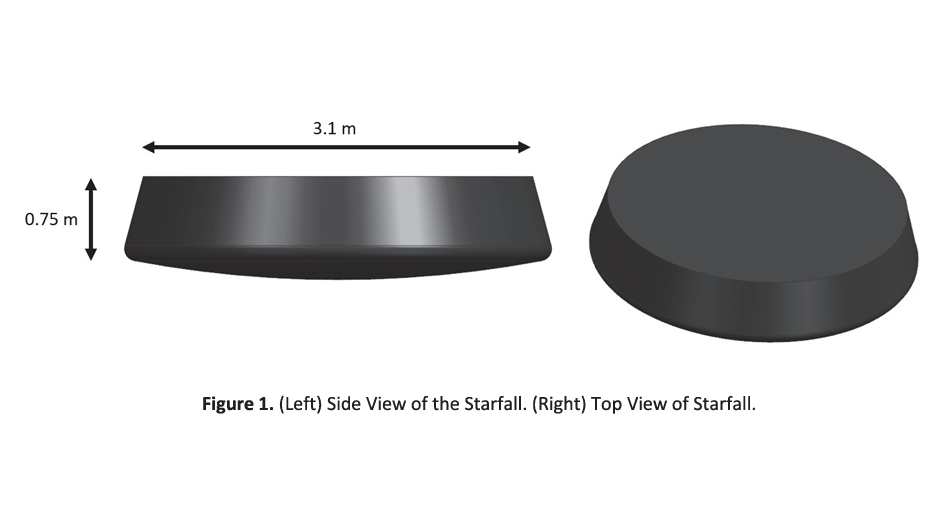
According to the FAA document, Starfall is a disk-shaped spacecraft that stands about 2.5 feet (0.75 meters) tall, with a diameter of 10.2 feet (3.1 m). It weighs roughly 4,600 pounds (2,100 kilograms) and can carry about 2,200 pounds (1,000 kg) of payload. The vehicle can launch on both the workhorse Falcon 9 and Starship, the megarocket SpaceX is developing to help humanity settle the moon and Mars, among other tasks.
Starfall consists of two parts: an aluminum "top plate" that weighs about 3,090 pounds (1,400 kg) and a detachable carbon-fiber heat shield. Cargo rides in the top plate, which features a payload bay 8.2 feet long, 4.9 feet wide and 1.6 feet tall (2.5 by 1.5 by 0.5 m).
For comparison, SpaceX's Dragon capsule, which routinely flies people and cargo to and from the International Space Station, stands about 14.7 feet (4.5 m) tall, with a diameter of 13.0 feet (4.0 m). Dragon can haul about 13,230 pounds (6,000 kg) to low Earth orbit and bring 6,600 pounds (3,000 kg) back down, according to its SpaceX specifications page.
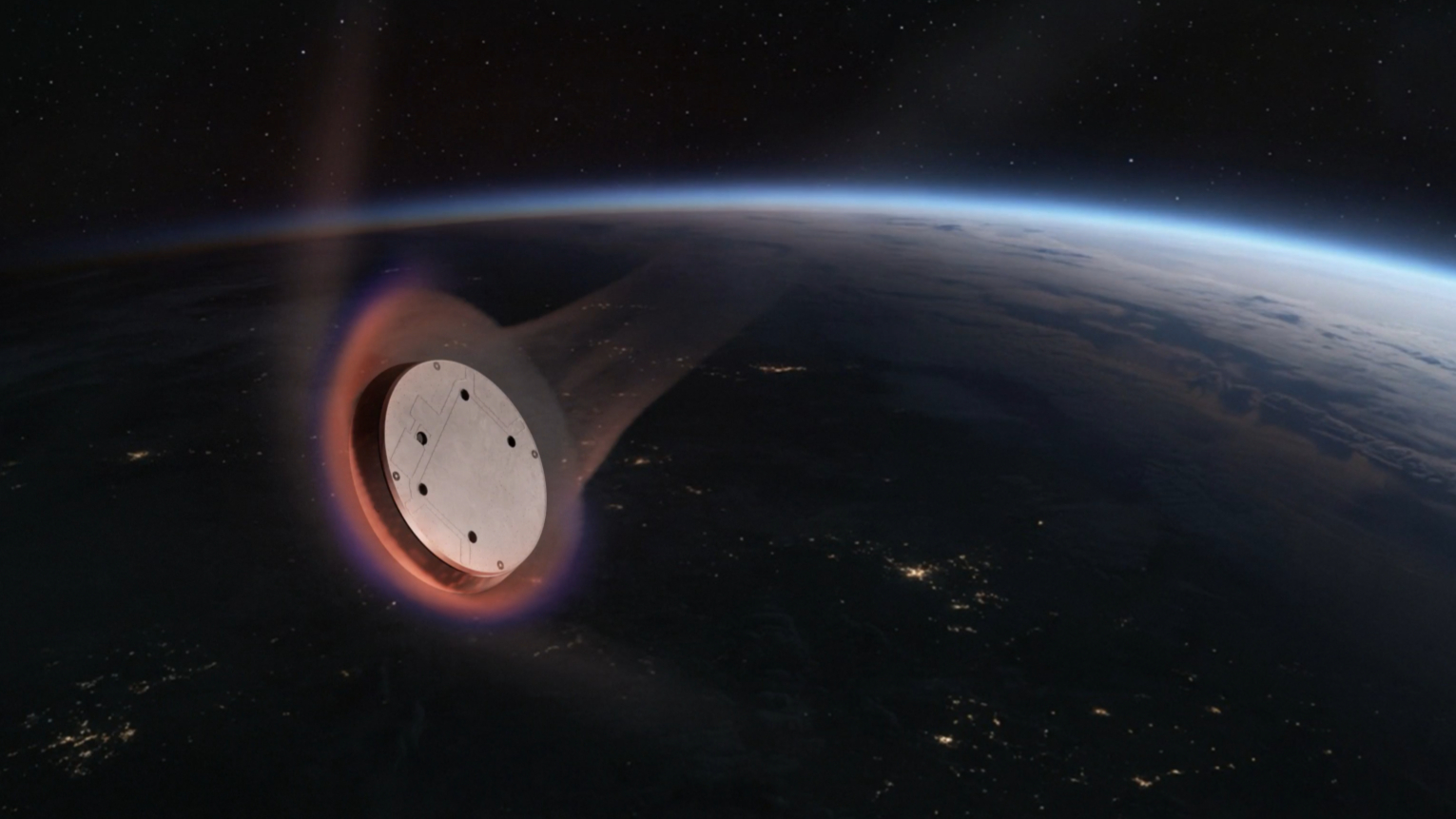
Artist's illustration of a SpaceX Starfall capsule reentering Earth's atmosphere. (Image credit: SpaceX)
Starfall is not capable of carrying astronauts. And, in another departure from Dragon, the newly debuted return vehicle does not have a traditional propulsion system.
It has only "an attitude control system which uses compressed inert gas (for example, compressed nitrogen gas) to perform small attitude control maneuvers, such as pointing the capsule's heat shield in the correct direction to safely reenter Earth's atmosphere," the FAA's assessment reads.
"Capsules do not have the ability to de-orbit themselves and can only control their attitude," it adds. "Individual capsules would reenter Earth's atmosphere on a pre-planned trajectory and splash down with the assistance of parachutes."
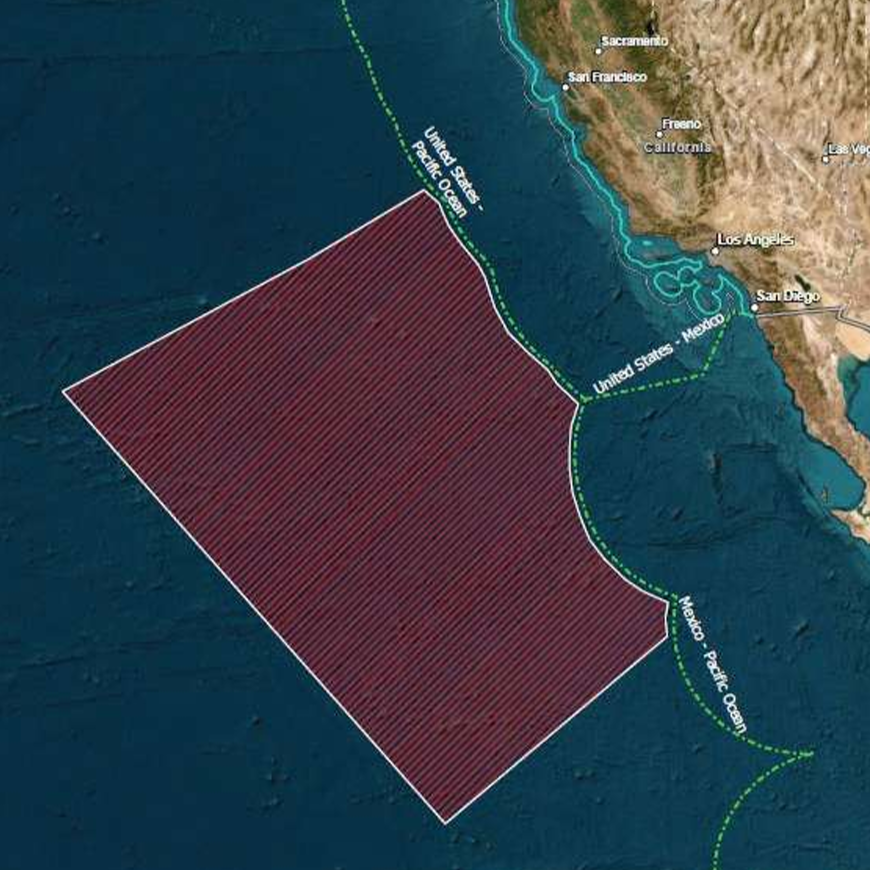
That splashdown — at least of the first two Starfall vehicles — will take place in the open Pacific Ocean, about 700 nautical miles (1,300 kilometers) off the west coast of the United States. Starfall, and its cargo, will then be collected by recovery boats.
SpaceX has two main goals for Starfall, according to the FAA document. The vehicle will "enable point-to-point delivery of critical cargo through space on rapid timelines" and also "create a self-sustaining commercial in-space manufacturing market by offering access to microgravity and vacuum, loiter on orbit, and safe return from orbit as a service at scale."
An illustration of a Starfall vehicle from an Environmental Assessment published by the Federal Aviation Administration. (Image credit: Federal Aviation Administration (FAA).)
SpaceX isn't alone in pursuing these opportunities. For example, the California-based company Varda Space has already launched and landed five of its 650-pound (300 kg) "W-series" spacecraft, which are designed to be both orbital mini-factories and return capsules.
And another California outfit, Outpost Space, is developing a line of "CarryAll" return vehicles that can get very large payloads — those weighing up to 22,000 pounds (10,000 kg) — down from space with pinpoint accuracy, within 80 feet (25 m) of a target anywhere on Earth.
The CarryAll Block 3 will be a "flagship vehicle for in-space manufacturing and warehousing, Earth return, military resilience and humanitarian aid," Outpost's website states.
SpaceX is targeting an area 700 nautical miles (1,300 km) off the United States West Coast for Starfall splashdowns. (Image credit: Federal Aviation Administration (FAA))
So SpaceX is not breaking new ground with Starfall. But the company is poised to play a leading role in the nascent Earth-return field, thanks to its launch dominance and vertical integration.
The Falcon 9 flew a whopping 165 times in 2025, after all, and SpaceX envisions launching Starship thousands of times per year when that massive rocket comes fully online. So it shouldn't be too difficult for SpaceX to send hundreds of Starfall vehicles up and then back down again, delivering space-made pharmaceuticals and other high-value goods to customers around the world.
NASA will discuss an ambitious mission to boost the orbit of its Swift space telescope during a press conference today (June 17), and you can listen to it live.
An Ariane 6 heavy-lift rocket launched a record-breaking load to orbit early Wednesday morning (June 17), carrying a batch of Amazon Leo satellites to orbit.