SpaceX launched 27 more of its Starlink internet satellites to orbit today (Sept. 6).
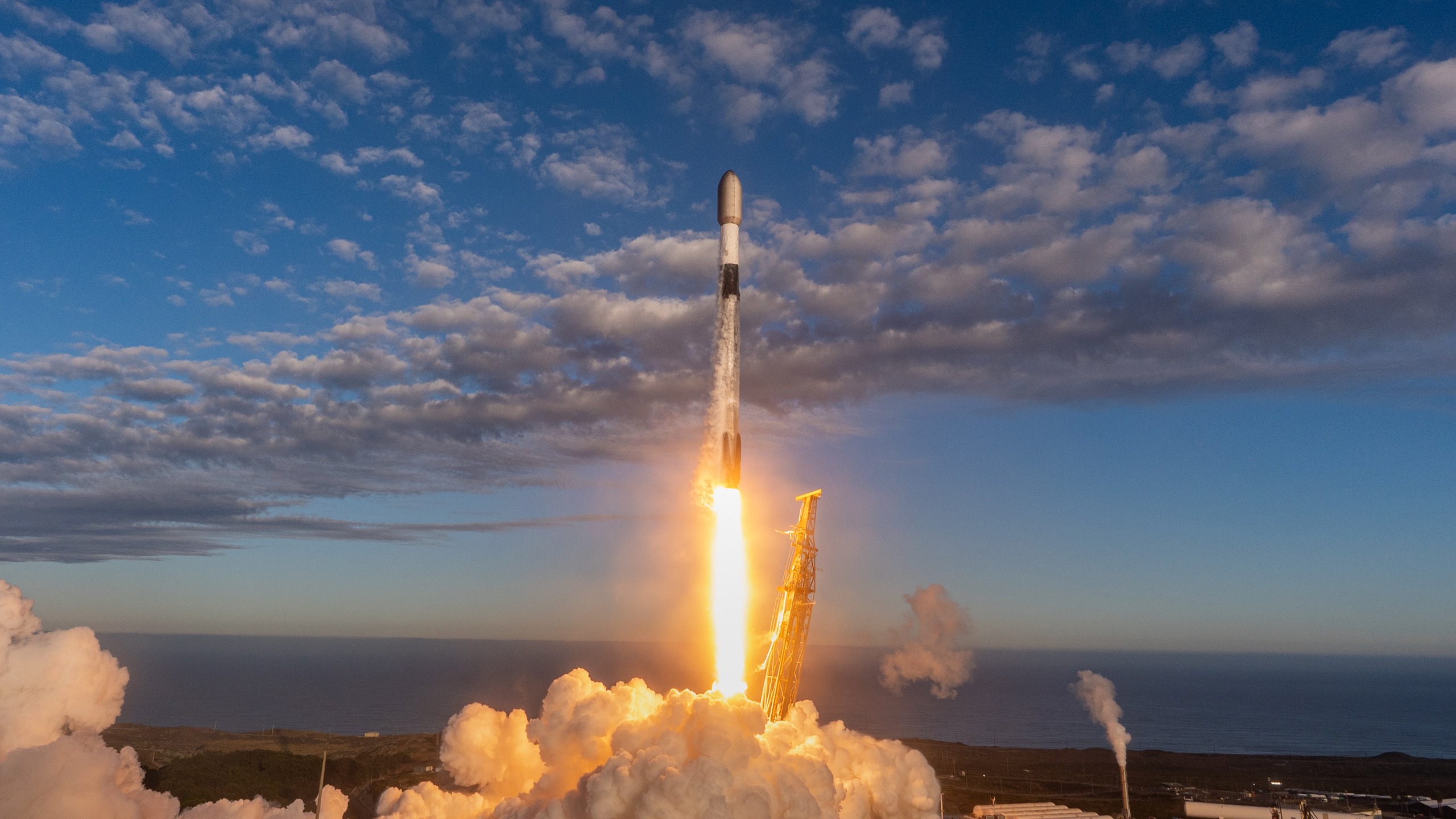
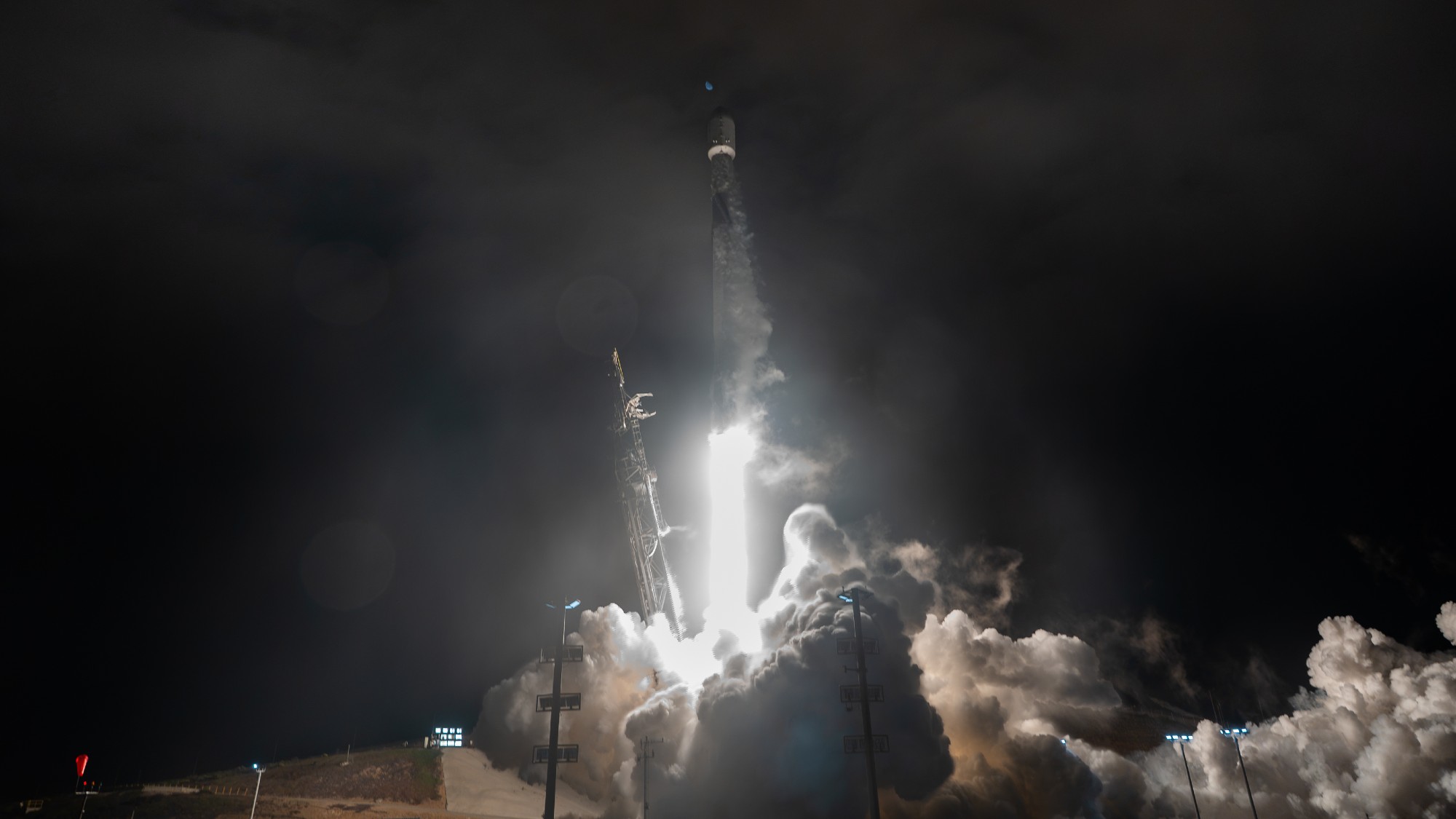
The spacecraft rode to low Earth orbit (LEO) atop a Falcon 9 rocket, which lifted off from California's Vandenberg Space Force Base at 10:26 a.m. EDT (1426 GMT; 7:26 a.m. local California time). The Falcon 9 rose into blue morning skies — something of a rarity for California's central coast, which is often cloaked in fog.
The Falcon 9's first stage came back to Earth as planned 8.5 minutes later, landing in the Pacific Ocean on the SpaceX drone ship "Of Course I Still Love You."
A SpaceX Falcon 9 rocket launches 27 Starlink satellites into orbit from Vandenberg Space Force Base in California on Sept. 6, 2026. (Image credit: SpaceX)
It was the 19th flight for this particular booster, which is designated B1088. This marks about the halfway point to the SpaceX record of 37 flights, which was set by B1067 during a Starlink launch on Aug. 25.
The Falcon 9's upper stage, meanwhile, carried the 27 Starlink satellites to LEO, deploying them on schedule 62 minutes after launch.
SpaceX's sooty Falcon 9 rocket first stage on the drone ship Of Course I Still Love You in the Pacific Ocean after a successful launch and landing on Sept. 6, 2026. (Image credit: SpaceX)
Today's launch was the 103rd Falcon 9 mission of 2026. Eighty of those flights have been dedicated to building out the Starlink megaconstellation, by far the largest satellite network ever assembled. It currently consists of more than 11,000 active spacecraft, according to astronomer and satellite tracker Jonathan McDowell.
Starlink missions fly exclusively out of Vandenberg these days. SpaceX used to launch them from Florida as well, but the company recently put those missions on hold until it gets its Starship megarocket up and running on the Space Coast.
SpaceX will rely on Starship to launch its next-gen Starlink V3 satellites, which are bigger and more capable than the current V2. The company wants to assemble a network of about 100,000 Starlink V3s in LEO, Elon Musk has said.
No rocket had ever reached orbit from Western European soil — until today.
The German company Isar Aerospace launched its Spectrum rocket from Andøya Space Center in northern Norway today (Sept. 5) at 4:12 p.m. EDT (2012 GMT; 10:12 p.m. local time in Norway). A little over seven minutes later, it etched its name into the record books, settling into an elliptical path around our planet.
"This is right now making history — making history for Spectrum, making history for Isar, making history for Europe,” Nikolaos Perakis, Spectrum chief engineer at Isar, said during today's launch webcast, which the company produced in collaboration with NASASpaceflight. "I'm incredibly proud of this massive achievement."
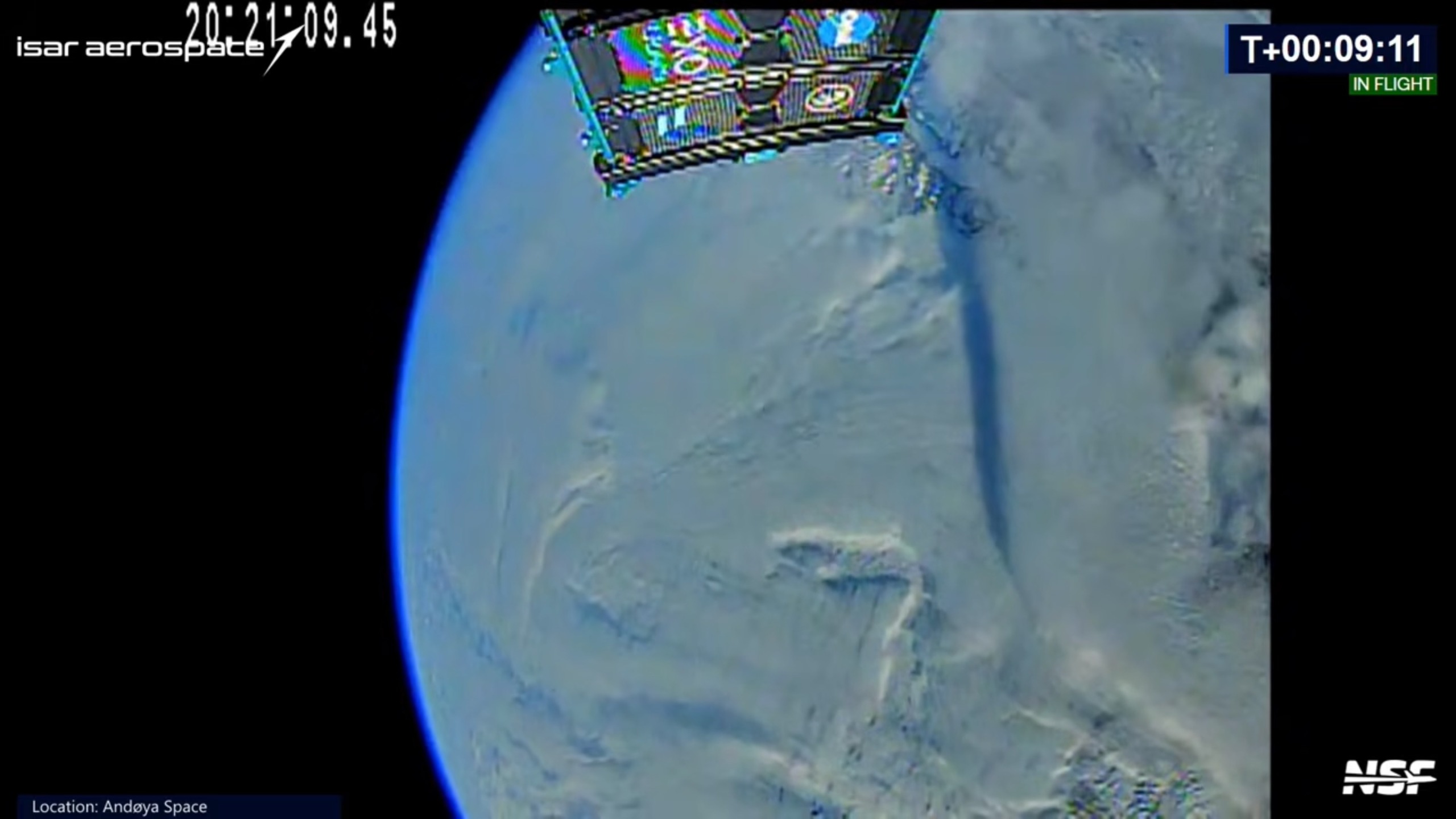
The view from the second stage of Isar Aerospace's Spectrum rocket after it reached orbit on Sept. 5, 2026. (Image credit: Isar Aerospace/NASASpaceflight)
This was Spectrum's second bite at the apple: The two-stage, 95-foot-tall (28-meter-tall) rocket first flew in March 2025, lifting off from Andøya on a flight Isar called "Going Full Spectrum." But, as often happens on debut missions, Spectrum suffered an anomaly that day; it came crashing back to Earth less than a minute after launch.
"A comprehensive investigation was completed within two months of the launch," Isar wrote in a September 2025 update. "The findings identified an unintended opening of the vent valve and a loss of attitude control at the start of the roll maneuver as the initiating events that led to the in-flight failure."
The company took the lessons learned that day and geared up for flight number two, "Onward and Upward," which was originally supposed to launch in January.
An issue with a pressurization valve nixed that plan, however, pushing the flight to March. Bad weather and an intruding boat scuttled multiple attempts that month, and an April 9 try was scrubbed due to a leak in a composite overwrapped pressure vessel.
Isar next tried to fly on June 15 but stood down after "detecting off-nominal behavior in the vehicle's fluid systems," according to a company update that day on X. But the company got that issue under control, rolling Spectrum back to the pad for today's launch.
"We had some delays, obviously," Petrakis said during the webcast. "We had some setbacks, but we came back stronger from them. And it validates this tremendous amount of engineering across all the teams, and that's what brings us into orbit."
Spectrum didn't carry viable payloads on its debut flight, but it did today: Five cubesats and one non-deployable scientific experiment went up on "Onward and Upward."
Spectrum's upper stage needed to deploy those payloads before Isar could declare full mission success. And deployment couldn't occur until after the rocket performed a circularization burn to get out of its initial elliptical orbit, which was estimated to feature a closest approach to Earth of 112 miles (180 kilometers) and a farthest-away point of 311 miles (500 km).
Spectrum was able to check those boxes, ultimately deploying the payloads as planned, Isar announced via X about two hours after launch.
So today was a very big day for Isar, which is thinking big with Spectrum. The company sees the rocket — which can haul about 2,200 pounds (1,000 kilograms) of payload to low Earth orbit — becoming a workhorse launcher of small to medium-size satellites down the road, and its infrastructure supports that vision. Isar says its manufacturing facility near Munich can churn out more than 30 of the rockets per year.
“Flight 2 is a big, big milestone, big success," Petrakis said. "But this is just the beginning. So I'm really looking forward to the next steps."
Spectrum is the first rocket to reach orbit from Western Europe, but others have long flown from a different part of the continent — the Russian part. For example, Plesetsk Cosmodrome has hosted orbital launches for about six decades now. (About 25% of Russia lies in Europe, with the rest classified as part of Asia.)
Editor's note: This story was updated at 4:45 p.m. ET with news of successful launch and orbital insertion, then again at 8:35 p.m. ET with news of payload deployment.
India notched a spaceflight milestone today (Sept. 3).
A GSLV Mark II rocket launched an Earth-imaging satellite toward geosynchronous orbit from Satish Dhawan Space Centre today at 5:25 p.m. EDT (2:55 a.m. on Sept. 4 India Standard Time).
The GSLV deployed the satellite, called EOS-05, into sub-geosynchronous transfer orbit about 18 minutes later as planned. The success marked a first for India, which had never hit that mark with an Earth-observing satellite before.
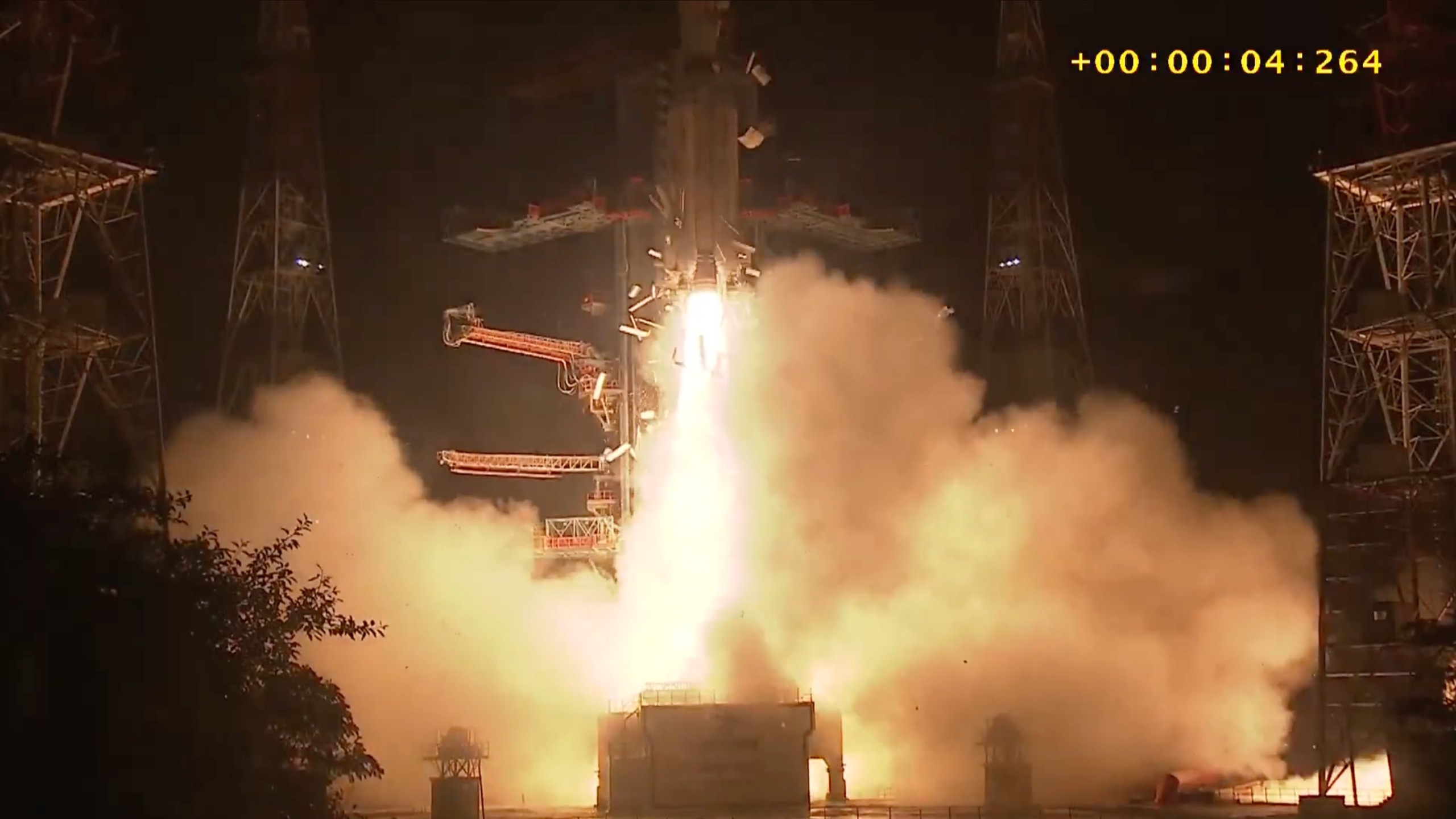
An Indian GSLV Mark II rocket launches the EOS-05 Earth-observing satellite toward geosynchronous orbit on Sept. 3, 2026. (Image credit: ISRO)
The GSLV (Geosynchronous Satellite Launch Vehicle) Mark II is a three-stage rocket that stands 170 feet (52 meters) tall. The vehicle debuted in 2010 and now has 13 flights under its belt to date, 11 of them successful. (Its predecessor, the GSLV Mark I, flew six times between 2001 and 2010, with two launch failures.)
On today's flight, the GSLV Mark II sent up EOS-05, a 5,218-pound (2367 kilograms) satellite designed to study our planet from a very high perch.
"EOS-05 is a state-of-the-art Earth observation spacecraft," Indian Space Research Organisation (ISRO) officials wrote in the press kit for today's launch. "It is India’s first-ever imaging satellite from geosynchronous orbit."
Geosynchronous orbit (GEO) lies 22,236 miles (35,786 kilometers) up, where orbital speed matches Earth's rotational speed. Spacecraft at this altitude can therefore "hover" over a particular patch of our planet, making it a popular destination for weather, communications and spy satellites.
EOS-05's "ability to maintain persistent coverage could support monitoring of the Indian subcontinent, including remote border areas, strategic assets, severe weather and environmental events," The Economic Times wrote on Wednesday (Sept. 2). "The satellite is intended for both civilian and military applications."
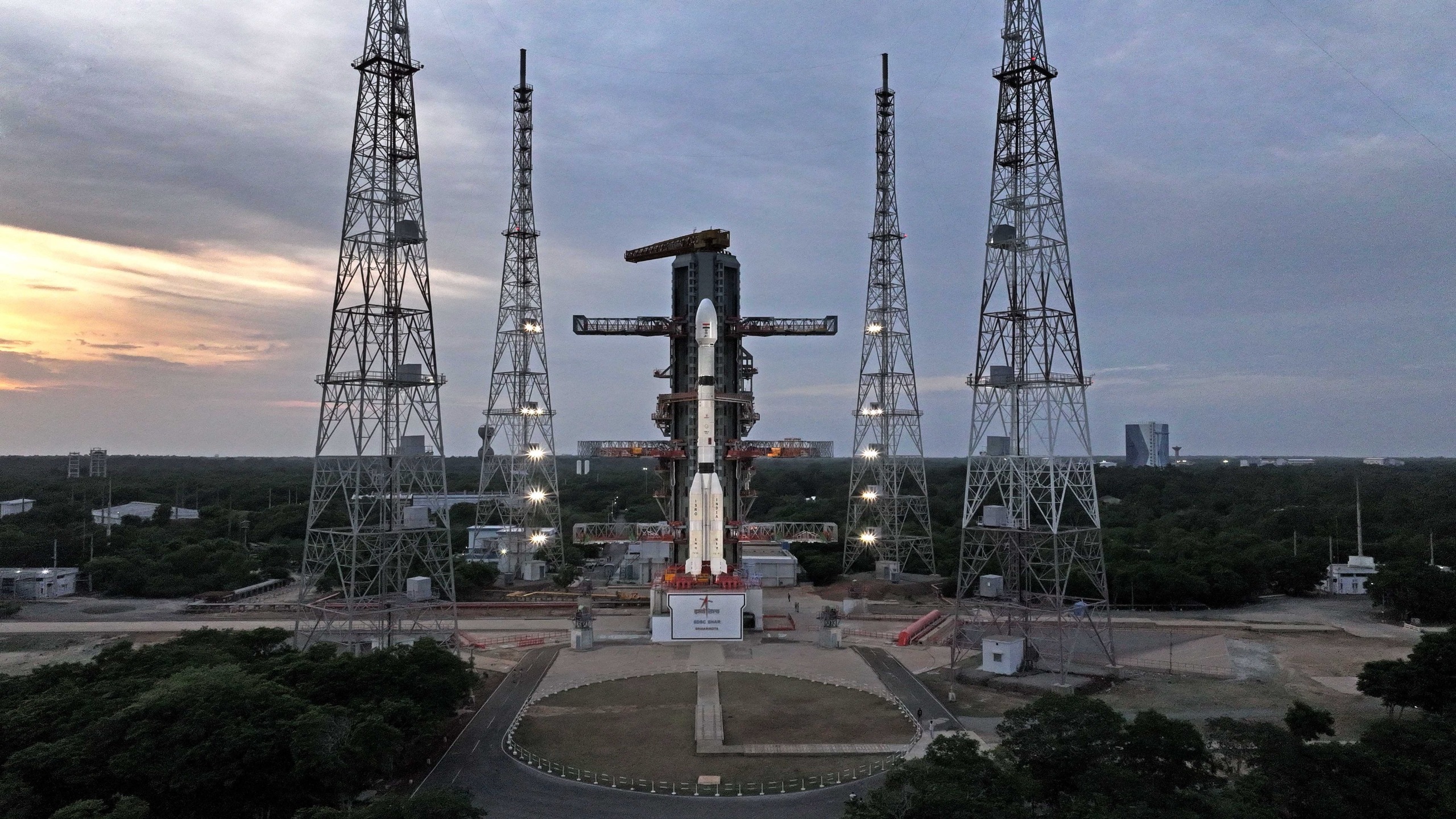
An Indian GSLV Mark II rocket topped with the EOS-05 Earth-observation satellite stands on the pad before its Sept. 3, 2026 launch. (Image credit: ISRO)
India tried to get an Earth-observing satellite to GEO once before — in August 2021, when a GSLV Mark II launched the EOS-03 spacecraft. But the rocket experienced an anomaly with its third stage, and the satellite was lost.
The rocket bounced back from that failure in May 2023 and is now riding a streak of five consecutive successful launches.
Another reusable Chinese rocket has taken to the skies.
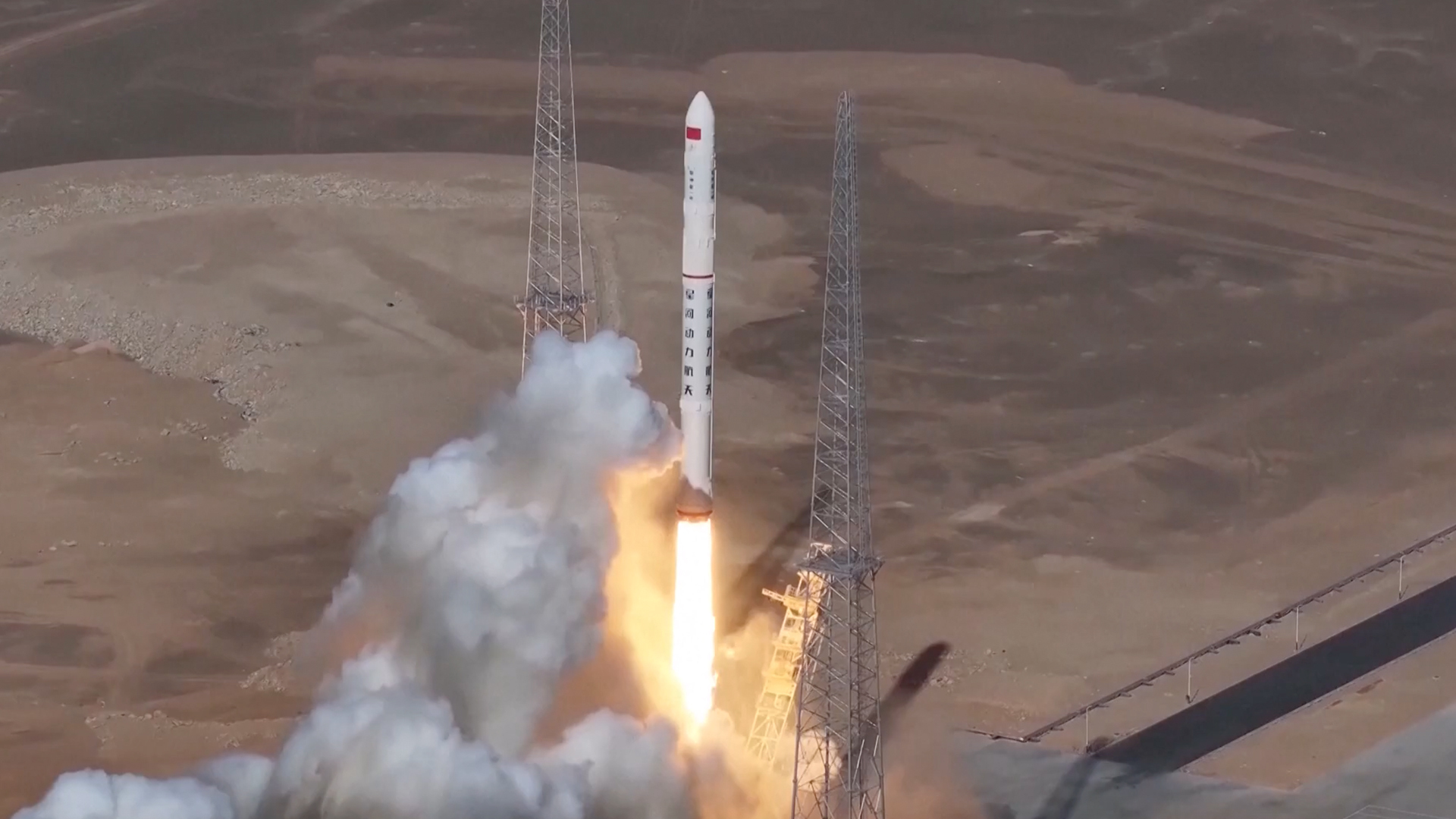
Pallas-1, a launcher developed by the Beijing-based company Galactic Energy, flew for the first time ever on Monday (Aug. 31), lifting off from the Jiuquan Satellite Launch Center in northwest China at 10 p.m. EDT (0200 GMT and 10 a.m. Beijing time on Sept. 1).
Everything went well on the mission, according to Galactic Energy.
Galactic Energy's Pallas-1 rocket launches for the first time ever, on Aug. 31, 2026. (Image credit: CCTV)
"The rocket successfully entered its predetermined orbit," the company said via social media on Monday about 30 minutes after liftoff (translation by Google). "This successful maiden flight marks Galactic Energy's official entry into a new development stage of combining solid and liquid propellants, driven by a dual-engine approach."
The company — which also operates Ceres-1, a small-satellite launcher with 23 flights under its belt to date — did not reveal what payloads, if any, Pallas-1 carried to orbit on Monday.
The two-stage Pallas-1 stands 171 feet (52 meters) tall and can haul about 15,400 pounds (7,000 kilograms) to low Earth orbit. It will be one of Galactic Energy's "core models for the large-scale satellite constellation deployment and launch market," the company wrote in Monday's update.
Reuse is key to that vision. Like SpaceX's workhorse Falcon 9, the Pallas-1 features a reusable first stage, which Galactic Energy says is designed to fly at 25 times. Also like the Falcon 9, the Pallas-1 booster will steer its way to Earth with the aid of hypersonic "grid fins" and touch down on deployable landing legs.
There was no landing attempt on Monday's debut flight, however. Galactic Energy is targeting the second half of 2027 for that milestone, according to Space News.
Pallas-1 won't be the first Chinese rocket to land during an orbital mission. Two have already done so — the Long March 10B, whose first stage settled into a net carried by a ship at sea on July 10, and Zhuque-3, which came down on landing legs on Aug. 18.
Long March rockets are built by the state-owned China Aerospace Science and Technology Corporation, but Zhuque-3 was developed by the Beijing startup LandSpace. A number of other Chinese companies are working on partially reusable rockets as well, including CAS Space, Deep Blue Aerospace, iSpace, Orienspace and Space Pioneer.
The BepiColombo mission is finally getting ready to arrive at its exotic destination.
BepiColombo launched in October 2018 and took a long, looping and highly circuitous route toward Mercury our solar system's innermost planet. That journey is now nearly over, and the mission is gearing up for arrival.
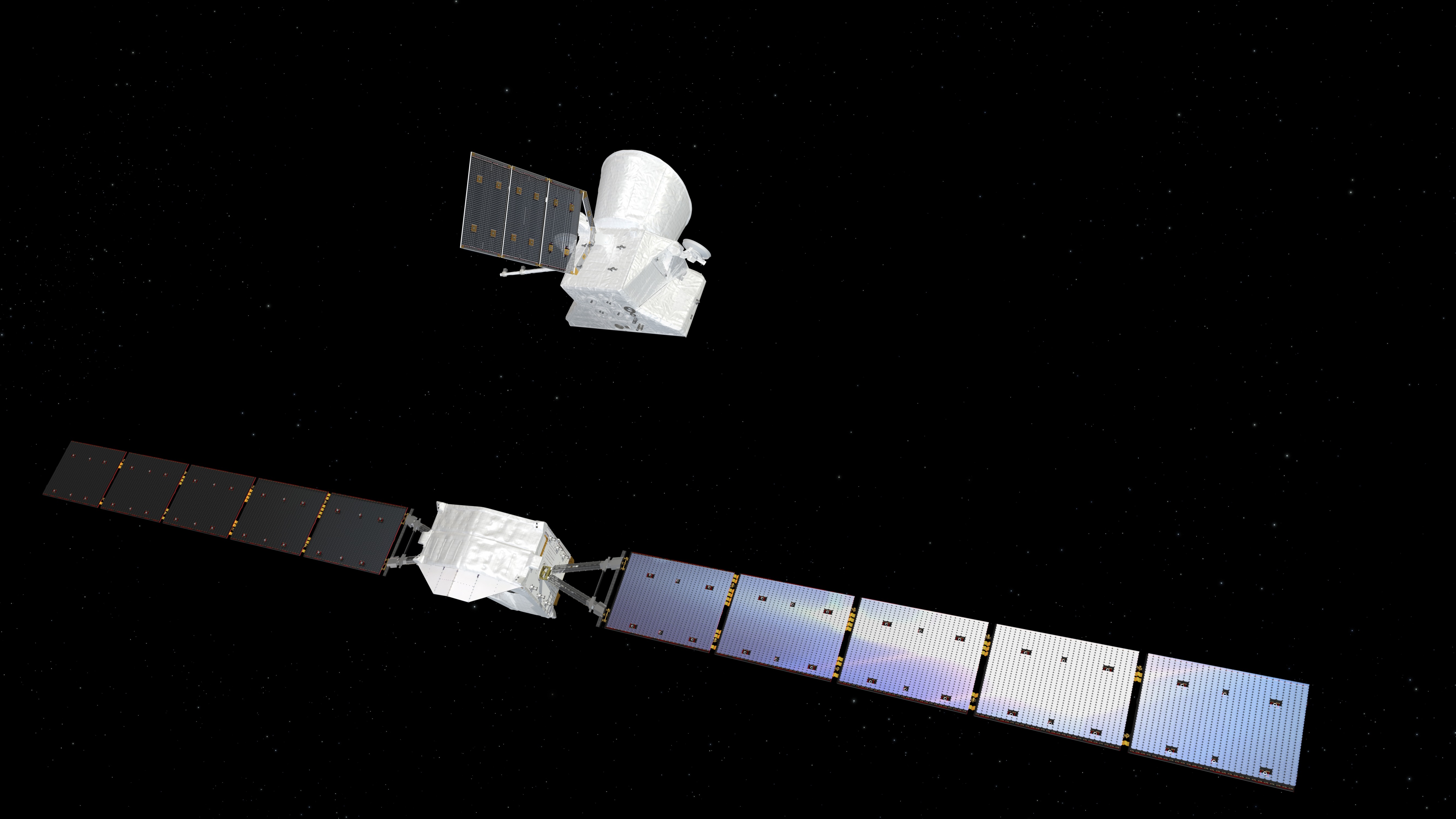
BepiColombo's two science orbiters — one run by the European Space Agency (ESA) and the other by theJapan Aerospace Exploration Agency(JAXA) — will separate from their power and propulsion module on Thursday (Sept. 3) at around 8 a.m. EDT (1200 GMT). You can watch that milestone live here at Space.com, courtesy of ESA, starting at 7:45 a.m. EDT (1145 GMT).
Artist's impression showing the Mercury Transfer Module (at bottom) separate from the BepiColombo Mercury Planetary Orbiter (MPO) and Mercury Magnetospheric Orbiter (MMO) composite spacecraft. (Image credit: ESA/ATG medialab)
ESA will pause the webcast at 8:30 a.m. EDT (1230 GMT), then resume it an hour later to cover the mission teams' acquisition of signals from the newly free-flying orbiters.
Those communications links are expected to be established no earlier than 9:53 a.m. EDT (1353 GMT), according to ESA officials. The webcast will chronicle that activity, as well as some spacecraft status checks, before ending between 10:15 and 10:45 a.m. EDT (1415 to 1445 GMT).
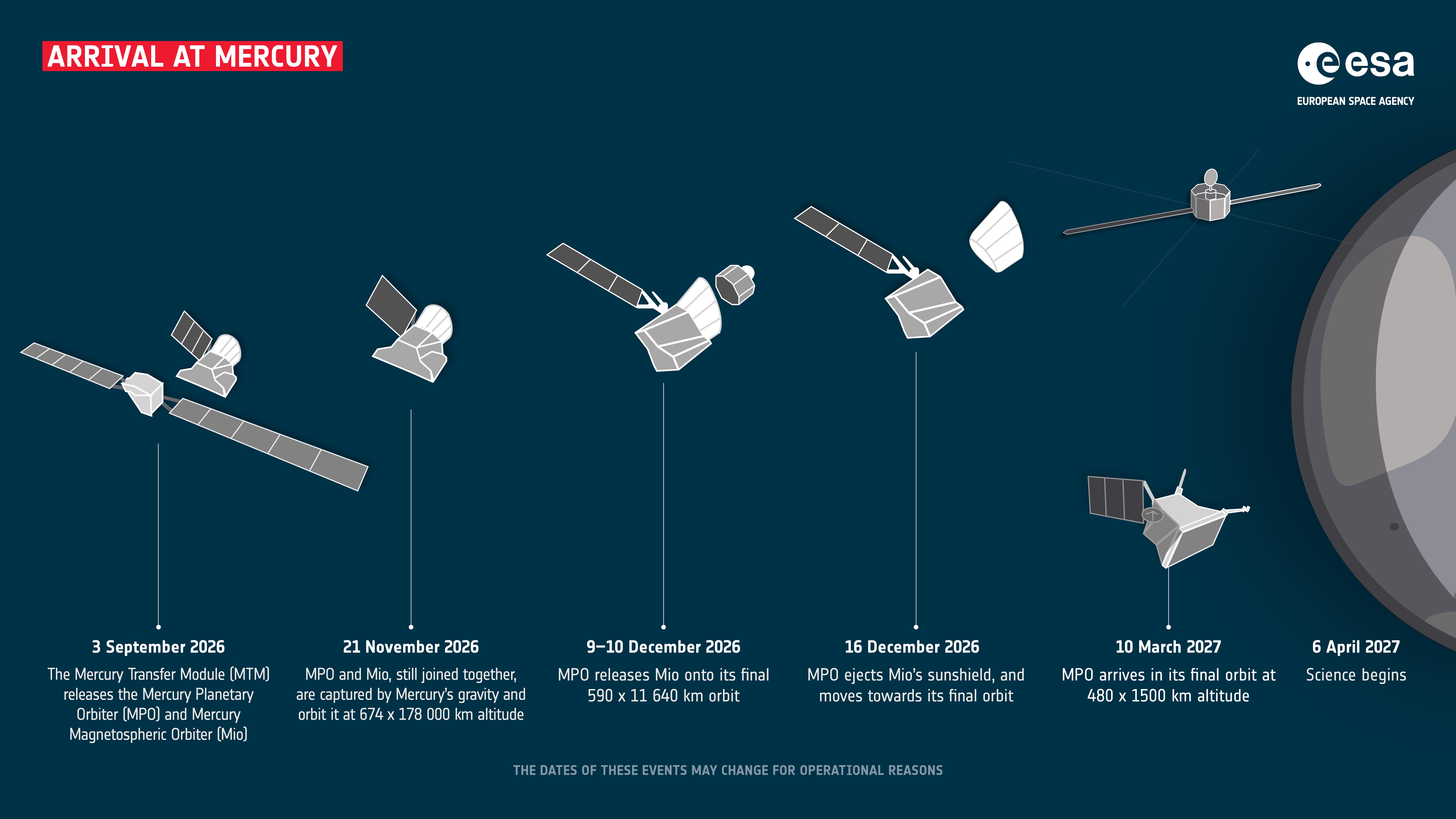
Diagram showing the key moments in the BepiColombo mission's arrival at Mercury. (Image credit: ESA)
The separation is just the beginning of BepiColombo's Mercury-arrival phase. For example, the two science orbiters — ESA's Mercury Planetary Orbiter (MPO) and JAXA's Mercury Magnetospheric Orbiter (MMO, or Mio) — won't be captured by the planet's gravity until Nov. 21.
The duo will still be linked up on that date. If all goes according to plan, MPO will release Mio into its final orbit — a highly elliptical one that gets as close as 367 miles (590 kilometers) to Mercury and as far away as 7,233 miles (11,640 km) — on Dec. 9 or Dec. 10, then start moving toward its own designated path a week later.
MPO is scheduled to reach its final orbit — an ellipse with altitude extremes of 298 miles and 932 miles (480 by 1,500 km) on March 10, 2027. The science phase of the BepiColombo mission (which is named after Italian mathematician and engineer Giuseppe "Bepi" Colombo) will begin on April 6.
That science work — performed over the course of at least one Earth year — should be intriguing and rewarding. MPO will map Mercury and Mio will study its magnetosphere, working together to shed light on "the least explored planet in the inner solar system," ESA officials wrote in a BepiColombo mission description.
"Among several investigations, BepiColombo will make a complete map of Mercury at different wavelengths," they added. "It will chart the planet's mineralogy and elemental composition, determine whether the interior of the planet is molten or not, and investigate the extent and origin of Mercury’s magnetic field."
The agency announced on Tuesday (Sept. 1) that it has selected Jeff Bezos' spaceflight company to develop the $700 million Mars Telecommunications Network (MTN), which is expected to be up and running at the Red Planet by 2030.
"The award marks a milestone in NASA's strategy to expand communications and navigation services beyond Earth and the moon, establishing the foundation for sustained exploration of Mars in the coming decades," NASA officials said in a statement on Tuesday.
As its name suggests, the MTN — previously known as the Mars Telecommunications Orbiter — will primarily serve to aid NASA science missions rather than gather data of its own.
The MTN is "a next-generation communications system that will enable reliable, high-bandwidth communications and navigation services for current and future Mars missions," NASA officials said in the statement.
The need for such a data-relay craft is expected to become acute in the coming years as NASA's fleet of current Mars orbiters ages and the agency works to prepare the Red Planet ground for crewed missions in the late 2030s or early 2040s.
At the moment, just two NASA orbiters relay data and commands between the agency's Curiosity and Perseverance Mars rovers and their handlers on Earth — Mars Odyssey and the Mars Reconnaissance Orbiter, which launched in 2001 and 2005, respectively. The European Space Agency's Mars Express and Trace Gas Orbiter spacecraft help out as well.
All four of these orbiters are gathering science data of their own, however. The MTN will not have a split focus; it will be a dedicated communications craft.
Our Mars Telecommunications Orbiter, built upon the Blue Ring platform, will strengthen the communications backbone at the Red Planet while creating new pathways for science. Capable of delivering multiple payloads to the surface and orbits of Mars, it drives discovery today and… pic.twitter.com/nCN8zMAWCkMarch 5, 2026
NASA got $700 million for a Mars telecom orbiter in July 2025, when Congress passed a budget reconciliation bill. The agency laid out requirements for the spacecraft in February of this year, then issued a request for proposals in May.
Blue Origin and Rocket Lab were viewed as the front-runners for the contract, and both pushed hard for it, touting their bona fides and expertise.
Blue Origin won out in the end, however. The company will base MTN on its Blue Ring spacecraft platform, which it describes as "an all-in-one, high-powered hybrid solar electric and chemical propelled spacecraft that provides unmatched mission maneuverability, versatility, and capacity at dramatically lower profile costs."
Blue Ring has not flown a mission yet, but a prototype version of it went to space on the first-ever launch of Blue Origin's powerful New Glenn rocket in January 2025. Though Blue Ring can fly on other rockets as well, MTN will presumably launch on a New Glenn; the newly announced NASA contract calls for Blue Origin to "design, develop, integrate, launch and operate" the Mars telecom mission.
The contract calls for Blue Origin to deliver the spacecraft to NASA no later than Dec. 31, 2028.
A SpaceX Falcon 9 rocket launched 27 of the company's internet satellites to orbit this morning (Sept. 2), lifting off from California's Vandenberg Space Force Base at 4:42 a.m. EDT (0842 GMT; 1:42 a.m. local California time).
It was the 35th flight for this Falcon 9's first stage, which is known as Booster 1063. That's just two shy of the SpaceX reuse record, which was set by B1067 last week.
A SpaceX Falcon 9 rocket launches from California's Vandenberg Space Force Base on Sept. 2, 2026. (Image credit: SpaceX)
And B1063 will almost certainly fly again: It came back to Earth successfully today, landing in the Pacific Ocean on the SpaceX drone ship "Of Course I Still Love You" about 8.5 minutes after launch.
The rocket's upper stage did its part as well, deploying the 27 Starlink satellites into low Earth orbit 62 minutes after launch. They're joining the largest satellite constellation ever assembled, which currently consists of more than 11,000 active spacecraft.
This morning's launch was the 102nd Falcon 9 flight of the year, 79 of which have been dedicated to building out the Starlink megaconstellation.
SpaceX has launched four other times in 2026 as well, conducting two missions of its Falcon Heavy rocket and two suborbital test flights of its Starship megarocket, which remains in development. The second Falcon Heavy launch of the year occurred on Sunday (Aug. 30); it sent up NASA's next flagship observatory, the Nancy Grace Roman Space Telescope.
The first dedicated mission to another star will launch before the end of the decade, if all goes according to plan.
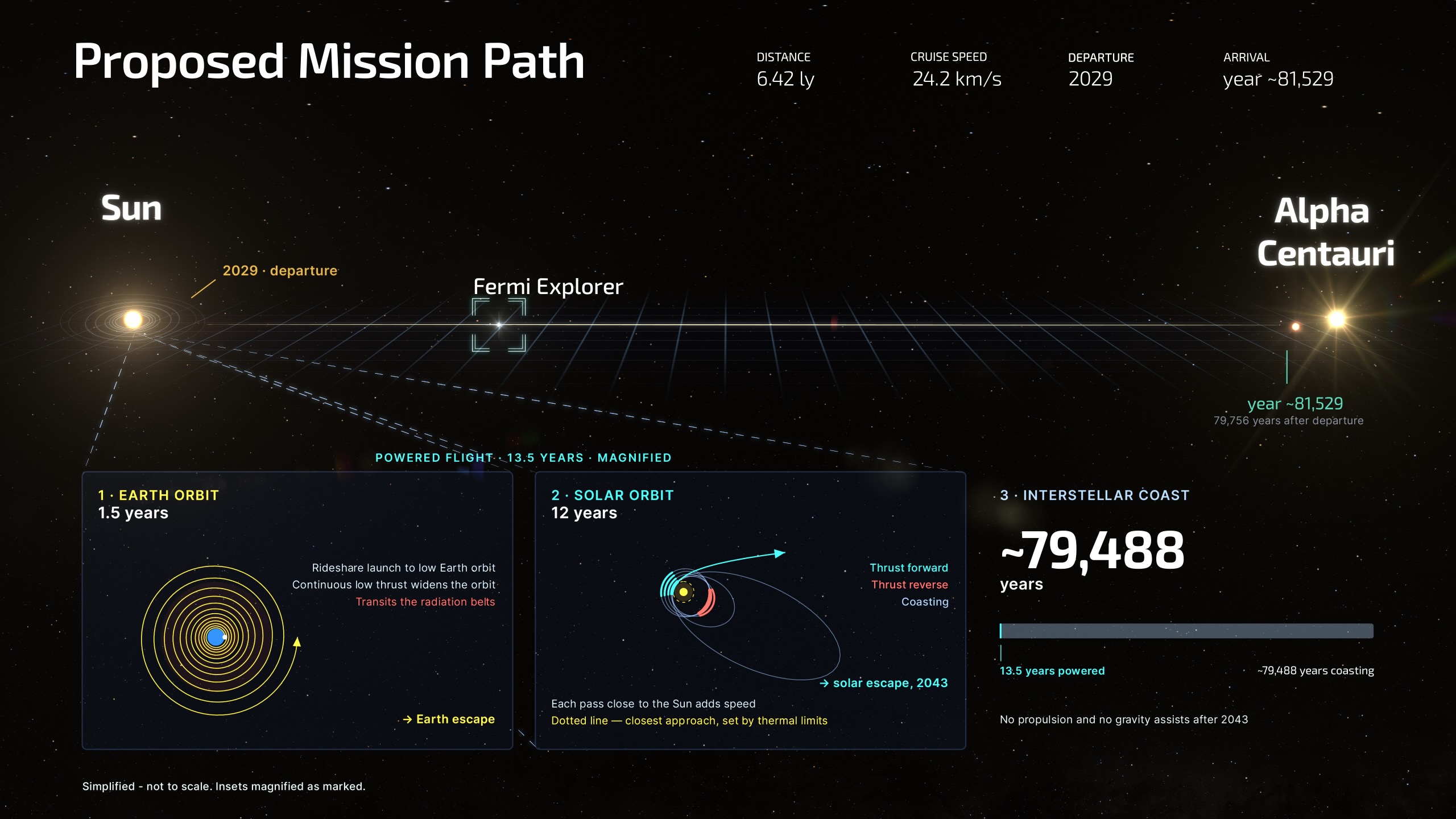
A nonprofit called the Fermi Explorer Mission announced today (Sept. 1) that it plans to send a small probe toward Alpha Centauri by 2029. But none of us will live to see the interstellar spacecraft's historic arrival; its journey is expected to take about 80,000 years.
"We hope to be both the first to leave and the last to arrive at Alpha Centauri," Philip Johnston, co-founder and president of the Fermi Explorer Mission, said in a statement today. "None of us will be here when this journey ends, and that is the point. It's about taking the first achievable step and inspiring future generations to keep pushing beyond the limits we inherited."
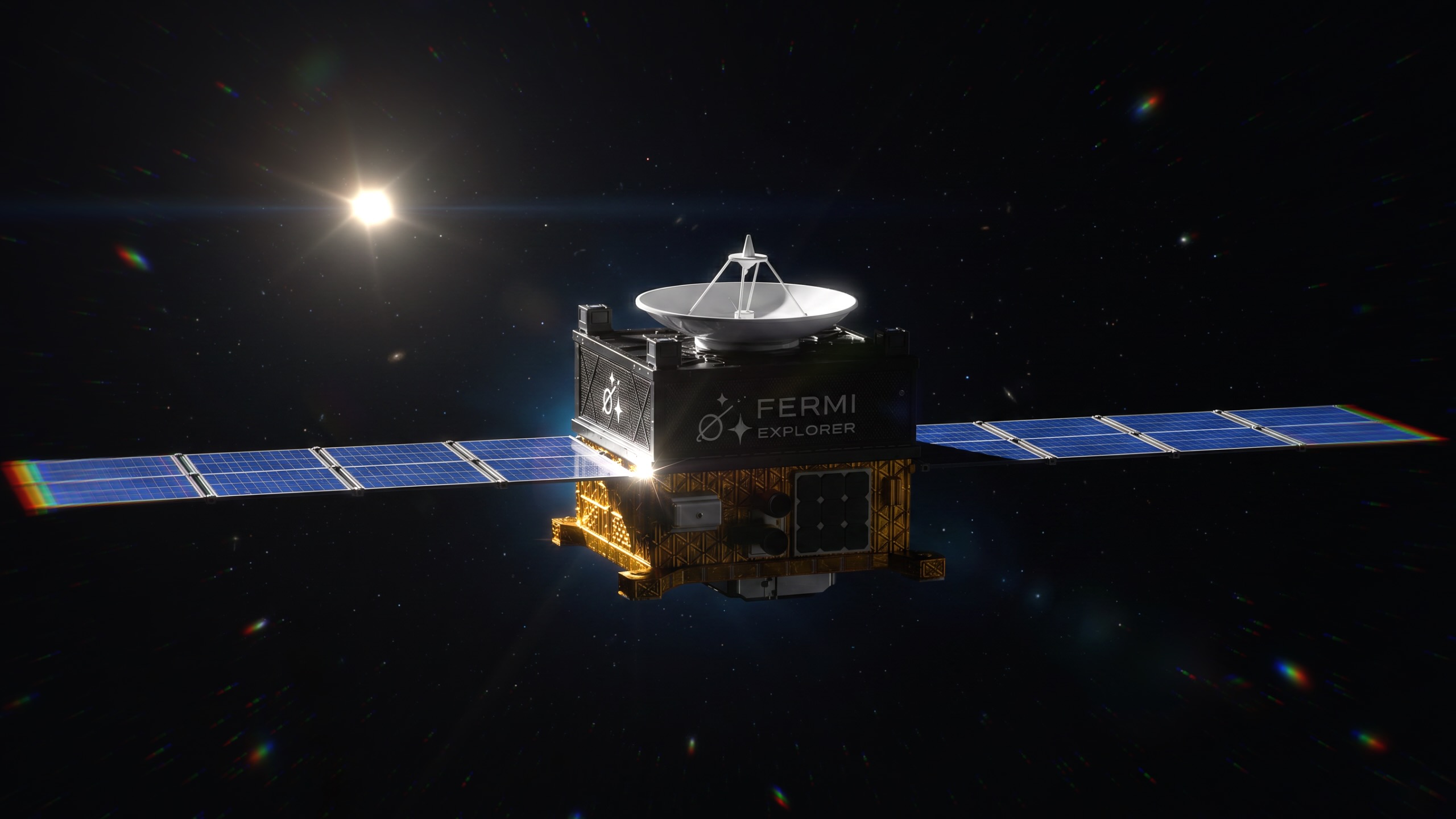
Artist's impression of the planned Fermi Explorer Mission spacecraft, which is targeted to launch toward Alpha Centauri by 2029. (Image credit: Fermi Explorer Mission)
Johnston is also co-founder and CEO of Starcloud, a company that plans to operate data centers in space. He started the Fermi Explorer Mission with fellow Starcloud co-founders Ezra Feilden and Adi Oldean. Former U.S. Air Force officer Garrett Jamison leads day-to-day execution of the project. Some big names in the spaceflight world have signed on as advisors, including former Blue Origin president Rob Meyerson and Matt Gialich, co-founder and CEO of the asteroid-mining company AstroForge.
The Fermi Explorer project is ambitious but achievable, according to Johnston and his colleagues. They want to launch a spacecraft to the three-star Alpha Centauri system — the sun's nearest stellar neighbor, at about 4.4 light-years away — by 2029.
This directed trajectory will be a first. Though NASA's Voyager 1 and Voyager 2 spacecraft are in interstellar space, they're not headed toward any particular star; rather, they're journeying outward on the path they took to complete their "grand tour" of Jupiter, Saturn, Uranus and Neptune.
The Fermi Explorer spacecraft will carry at least 2.2 pounds (1 kilogram) of payload, and its entire mission will cost less than $15 million, according to the team. If all goes to plan, the returns on that investment will be considerable.
"The mission is intended to make the idea of interstellar travel real, and to encourage more people to confront one of humanity's biggest unanswered questions when we look beyond our planet: 'Where is everybody?' (the Fermi Paradox)," the Fermi Explorer team said via X today.
The proposed path of the Fermi Explorer Mission spacecraft. (Image credit: Fermi Explorer Mission)
The Fermi Paradox takes its name from the famed physicist Enrico Fermi, who posited the "Where is everybody?" question in 1950. It has taken on greater significance in the past decade or so, as scientists have realized how common exoplanets — potential abodes for life — are throughout our Milky Way galaxy.
There are just three possible explanations for the paradox, according to the Fermi Explorer team:
Human-like intelligence is rare throughout the universe
It's not rare, but intelligent species don't survive for long
It's common and long-lasting, but intelligent aliens generally don't make themselves known to their cosmic colleagues (either by choice or by circumstance)
Launching a directed interstellar mission won't solve the paradox, but it will give us some data that we didn't have before.
"After the Fermi Explorer Mission, we will have more confidence both that is possible for intelligent species to leave for their nearest star in a way that isn't resource prohibitive, and that there are least some species that try to do it (namely us!)," team members wrote in an FAQ about the mission. "This has the effect of throwing the Fermi Paradox into even greater focus."
The Fermi Explorer Mission wants its spacecraft to be the first ever launched to Alpha Centauri, and the last to arrive. (Image credit: Fermi Explorer Mission)
The team says it envisions a small spacecraft, one that weighs just 220 to 440 pounds (100 to 200 kilograms) here on Earth. It will also likely employ electric propulsion, which is more efficient than traditional chemical thrusters.
Electric propulsion is also a proven system, meaning the Fermi Explorer team isn't relying on futuristic tech to travel to the stars. This has been a stumbling block for other interstellar projects, such as the apparently defunct Breakthrough Starshot, which wanted to blast tiny sailcraft to Proxima Centauri — part of the Alpha Centauri system — using powerful lasers. (That futuristic tech would be great if it worked, however; Breakthrough Starshot aimed to accelerate its nanoprobes to about 20% the speed of light, which equates to a roughly 20-year trip to Proxima Centauri.)
The details — who will build the spacecraft, for example, and what payloads it will carry — will be nailed down in the coming months. The project says it already has a proposal from one major satellite manufacturer that comes in under the $15 million cap.
And speaking of money: The Fermi Explorer team wants some financial help getting this mission off the ground. You can donate to the project, which is a 501(c)(3) nonprofit, here.
Two astronauts will conduct history's sixth all-female spacewalk today (Sept. 1), and you can watch it live.
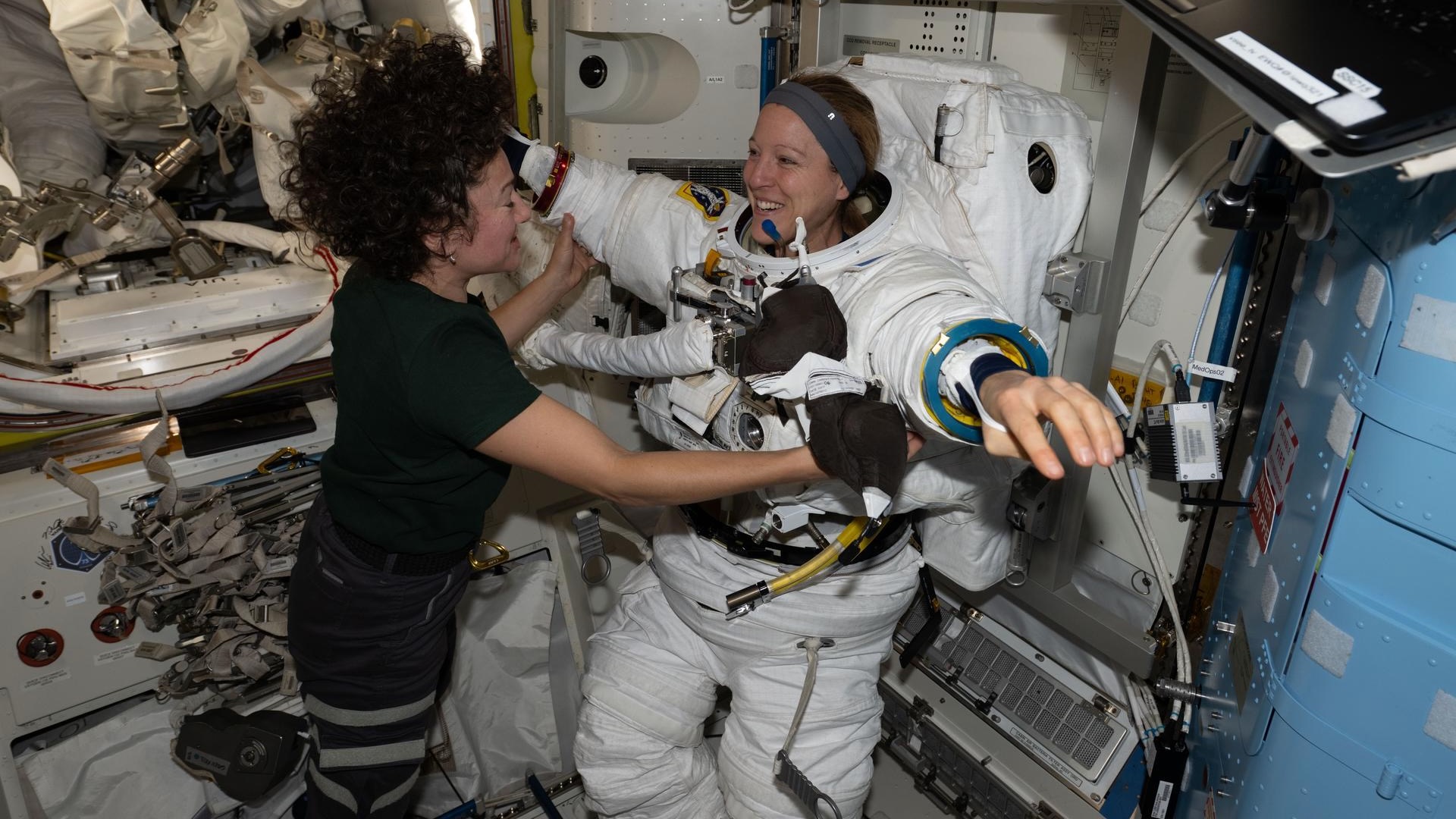
NASA's Jessica Meir and Sophie Adenot of the European Space Agency will venture outside the International Space Station (ISS) at around 8:30 a.m. EDT (1230 GMT) on an excursion expected to last about 6.5 hours.
You can watch it here at Space.com, courtesy of NASA, or directly via the agency. Coverage will start at 7:00 a.m. EDT (1100 GMT).
NASA astronaut Jessica Meir and the European Space Agency's Sophie Adenot work together inside the International Space Station’s Quest airlock during spacesuit fit and leak checks. (Image credit: NASA)
During today's spacewalk, Meir and Adenot "will replace a retroreflector on the forward port of the space station's Harmony module to support spacecraft navigation during rendezvous and docking operations," NASA officials said in a media advisory.
"After installing the reflector, the crew will work to install jumper cables for the data-relay systems, prepare the Alpha Magnetic Spectrometer's radiator for future maintenance, and replace a high-definition camera on the station's truss," they added.
Adenot will be "crew member 1" on today's spacewalk and will wear a suit with red stripes, NASA officials said. Meir will wear an unmarked suit and serve as "crew member 2."
It will be the third spacewalk for Adenot, who two weeks ago became the first French woman ever to perform an extravehicular activity (EVA). It will be the seventh for Meir, which will put her third among female NASA astronauts behind Peggy Whitson (10 EVAs) and Suni Williams (nine).
There have been just five all-female ISS spacewalks to date, and Meir has been part of three of them — the first three, in fact. She conducted those with fellow NASA astronaut (and Artemis II crewmember) Christina Koch on Oct. 18, 2019, Jan. 15, 2020 and Jan. 20, 2020.
NASA's next big space telescope has left Earth, but it's not ready to start observing the heavens just yet.
The Nancy Grace Roman Space Telescope launched yesterday (Aug. 30), riding a SpaceX Falcon Heavy rocket into the heavens. Astronomers are very excited about Roman, for it's expected to discover thousands of new exoplanets and shed light on mysterious dark energy and dark matter, among other accomplishments.
Such science work is a few months off, however. Here's a brief rundown of the next steps for the Roman team.
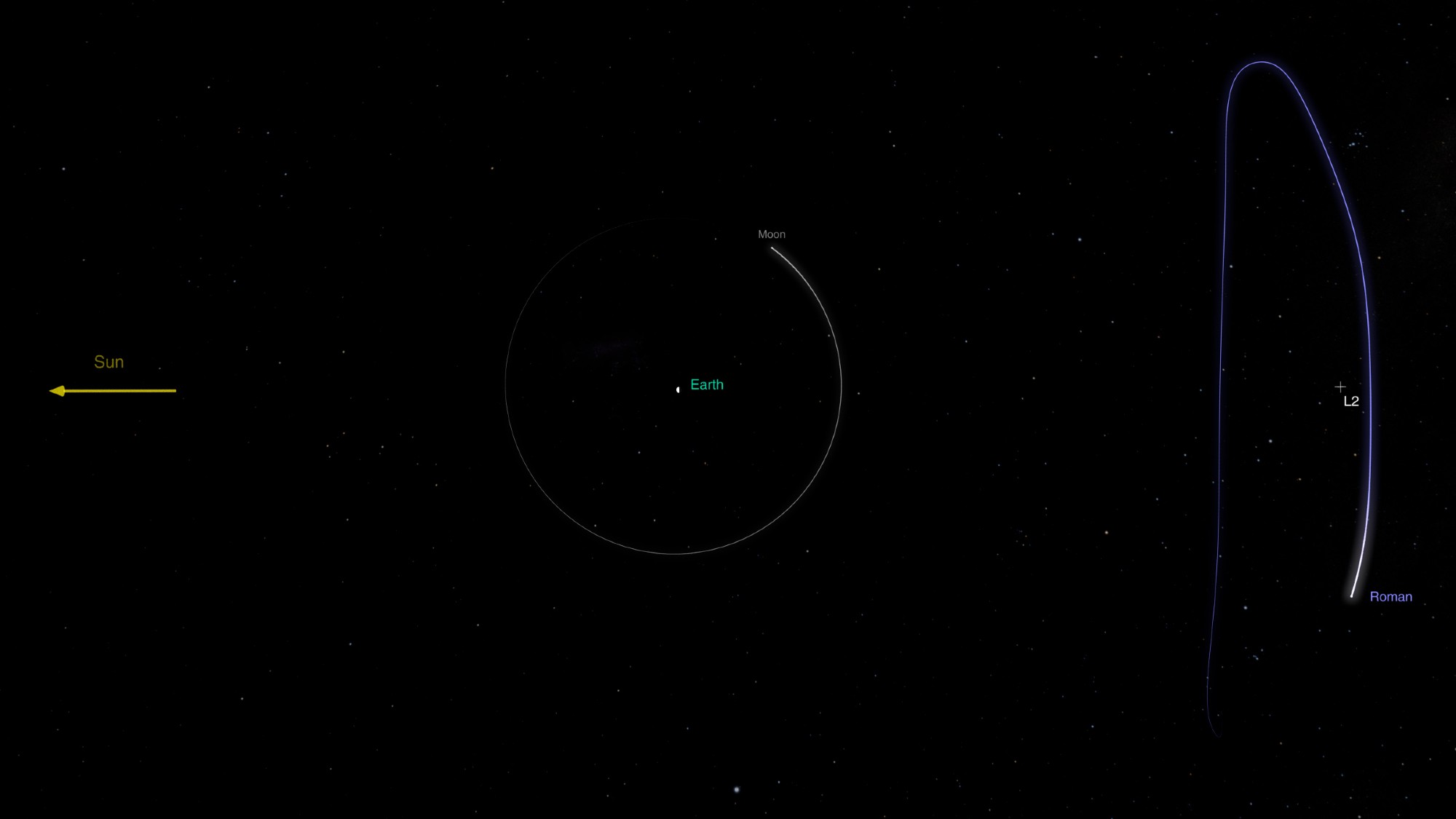
A diagram showing Roman at Lagrange point 2, between Earth and Mars. (Image credit: NASA SVS)
A long journey
The first order of business is getting Roman to its destination. The 42-foot-long (12.7 meters) scope isn't staying in Earth orbit; it's headed to the sun-Earth Lagrange Point 2 (L2), which lies about 930,000 miles (1.5 million kilometers) from our planet in the Marsward direction.
There are multiple reasons to target L2, which also hosts NASA's James Webb Space Telescope (JWST) and Europe's Euclid probe.
"At this special place in space," NASA officials wrote in a Roman explainer, "gravitational forces balance to keep objects in steady orbits with very little assistance."
"Roman's barrel-like shape will help block out unwanted light from the sun, Earth and moon, and the spacecraft’s distant location will help keep the instruments cool," they added. "The thermal stability of an observatory at L2 will provide a ten-fold improvement beyond Hubble in much of the data Roman will gather."
And don't worry about Roman and JWST bumping heads; though their cosmic addresses will be the same, they won't actually share space.
"Like Webb, Roman will trace out a large orbit around the actual L2 point — much larger than the moon's orbit around Earth — and the two will easily be kept far apart," NASA wrote in a different Roman piece.
It'll take Roman about 30 days to fly out to L2 and settle into its looping orbit there. A new round of work will then begin for the Roman team.
Checking Roman out
That work is "commissioning" — making sure that all of Roman's systems and subsystems are working properly, as is its science gear, which consists of the Wide Field Instrument (WFI) and the Coronagraph Instrument (CGI).
WFI "is a 300-megapixel infrared camera that will allow scientists to look very far back in time," NASA officials wrote in the explainer. "Seeing the universe in its early stages will help unravel how it has expanded throughout its history, which will hint at how it may continue to evolve."
CGI is a technology demonstration that will block the light of distant stars, allowing Roman to spot a wealth of previously unknown alien worlds.
"It will be far more powerful than any other coronagraph ever flown, seeing planets that are almost a billion times fainter than their host star," NASA officials wrote.
Roman should be ready to begin its science work in early 2027, according to the nonprofit Planetary Society. Its science life is slated to last five years, but astronomers are doubtless hoping for more. And there's precedent for such optimism; after all, NASA's Hubble Space Telescope is still going strong today, more than 36 years after its launch.
Hubble is a special case, given that astronauts repaired and upgraded it over the course of five servicing missions between 1993 and 2009. But other NASA space telescopes have far outlasted their warranties without such help. For example, the Chandra X-ray Observatory is operational in Earth orbit today, more than 25 years after its launch — and it has overcome budget issues along the way.