SpaceX, NASA delay next astronaut launch to ISS due to leak on Dragon spacecraft

SpaceX's next astronaut mission to the International Space Station won't launch on Sept. 12 after all.

That flight, known as Crew-13, has been delayed due to an oxidizer leak in the propulsion system of SpaceX's Dragon spacecraft, NASA announced on Saturday (Aug. 29).

"Joint NASA and SpaceX teams are performing additional tests and data review and will complete any necessary rework prior to launch," NASA officials wrote in an update on Saturday. "A new target date will be announced once available."

Crew-13 will launch atop a Falcon 9 rocket from Cape Canaveral Space Force Station.

As its name suggests, it will be the 13th operational astronaut mission SpaceX flies to the International Space Station (ISS) for NASA. (The company also conducted a crewed test flight to the orbiting lab, called Demo-2, which launched in May 2020.)

Crew-13 will send NASA astronauts Jessica Watkins and Luke Delaney of NASA, the Canadian Space Agency's Josh Kutryk, and Sergey Teteryatnikov of Russia's federal space corporation Roscosmos to the ISS for a seven-month stay.

"We expect a very busy mission with lots of station maintenance, both internal and external, with a few EVAs [extravehicular activities, or spacewalks] on the docket," Watkins said during an Aug. 3 press conference.

There will also be "visiting vehicle capture and stowage operations, lots of science — very interesting science experiments that will be flying with us as well — and plenty of outreach," she added.

SpaceX just launched a high-profile mission for NASA, sending the agency's Nancy Grace Roman Space Telescope into the final frontier on Sunday (Aug. 30) atop a Falcon Heavy rocket.

And the company is gearing up for an important test flight of Starship, the next-generation megarocket that it thinks will revolutionize spaceflight. The upcoming liftoff, the 14th to date for Starship, will see the rocket reach Earth orbit for the first time, if all goes to plan. SpaceX is thought to be targeting mid-September for Starship Flight 14.
Rocket Lab launches Japanese radar satellite to orbit on ‘Owl Around the World’ mission (video)

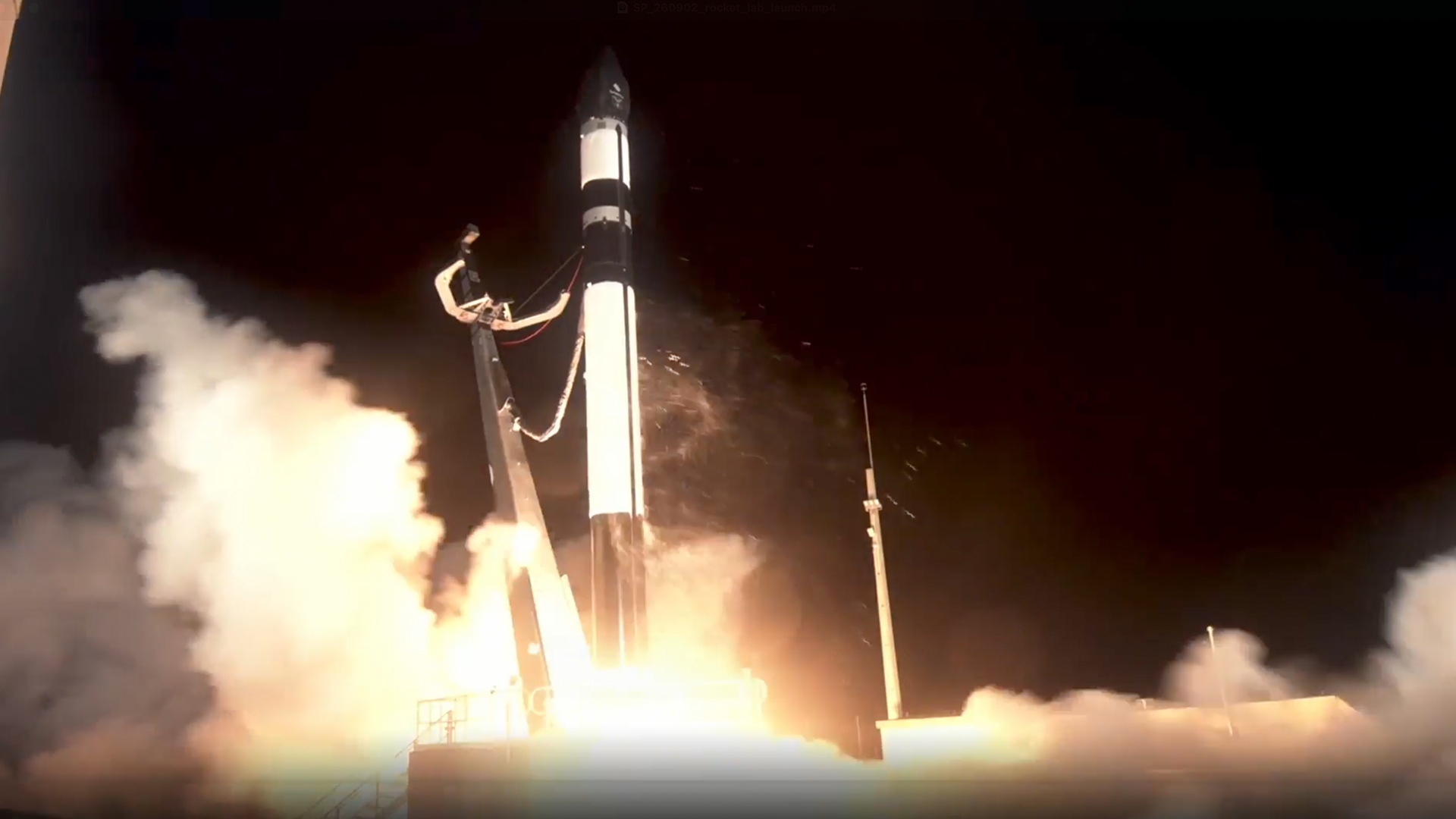
Rocket Lab successfully launched a private Japanese radar satellite to orbit early Wednesday morning (Sept. 2).

An Electron vehicle lifted off from Rocket Lab's New Zealand site on Wednesday at 8:01 a.m. EDT (1201 GMT; 12:01 a.m. local New Zealand time on Sept. 3). It carried a single Strix satellite for Synspective, a Tokyo-based Earth-imaging company.

Synspective is assembling a constellation of about 30 Strix satellites in low Earth orbit (LEO). These spacecraft — which are named after a widespread genus of owl — use synthetic aperture radar (SAR) to study our planet both day and night, and in all weather conditions.

a black and white rocket lifts off above a plume of fire and smoke

A Rocket Lab electron rocket launches the 'Owl Around the World' mission from New Zealand on Sept. 2, 2026. (Image credit: Rocket Lab)

The Strix constellation will "make it possible to quickly monitor and confirm on-the-ground changes during disasters such as earthquakes and floods at night, as well as in areas that are difficult to access," Synspective's website reads.

"In addition to disaster response, we will leverage our SAR satellite capabilities to promote efficient resource utilization," it adds. "For example, we can use our satellite data to monitor natural resources and urban development, ensuring sustainable and optimal use of land and water."

Eleven Strix satellites have now reached orbit to date, all of them atop Electron vehicles. Rocket Lab is currently the sole launch provider for Synspective and has 16 more missions for the company on its manifest after Wednesday's mission.

All went according to plan on Wednesday, according to Rocket Lab: The Electron's upper "kick stage" deployed the Strix satellite 56 minutes after liftoff, at an altitude of 357 miles (575 kilometers).

The 59-foot-tall (18 meters) Electron is designed to give small satellites dedicated rides to Earth orbit and beyond. Wednesday's mission, which Rocket Lab calls "Owl Around the World," was the rocket's 12th of 2026 and 85th overall.

Rocket Lab has also launched nine missions to date with HASTE, a suborbital version of Electron that allows customers to test sensors and instruments in a hypersonic flight environment. While Electron debuted in 2017, HASTE lifted off for the first time in June 2023.

Editor's note: This story was updated at 11:40 a.m. ET on Sept. 2 with news of successful satellite deployment.

SpaceX test-fires Starship Super Heavy booster ahead of critical Flight 14 (video)

SpaceX just took another step toward the highly anticipated next test flight of its Starship megarocket.

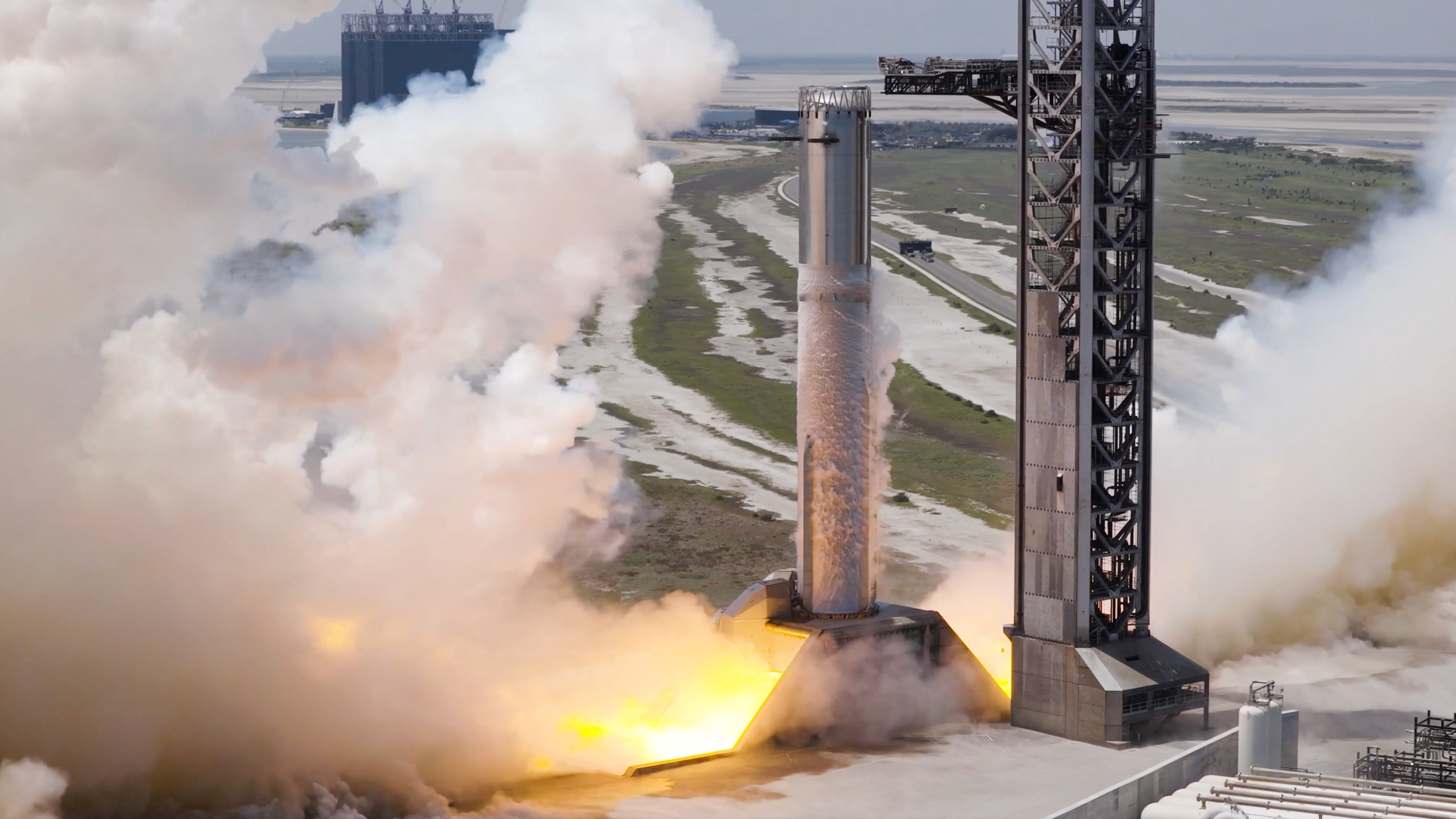
The company conducted an engine test with Starship's giant first-stage booster, known as Super Heavy, on the launch pad at its Starbase site in South Texas on Friday (Aug. 28).

"Full duration 33-engine static fire with the Super Heavy booster preparing for Flight 14," SpaceX wrote in a Friday X post that shared two videos of the test.

SpaceX conducts a static fire test with the Super Heavy booster that will conduct Starship's 14th test flight. The company released this imager on Aug. 28, 2026.

SpaceX fired up all 33 engines of its Super Heavy booster to gear up for the next Starship test flight, which will mark the first time the vehicle goes orbital. (Image credit: SpaceX)

As that post indicates, SpaceX is gearing up for the 14th test flight of Starship, a megarocket that consists of Super Heavy and a 171-foot-tall (52 meters) upper stage known as Starship, or Ship for short.

The company has already vetted the engines on Flight 14's Ship, firing up all six of them last week at Starbase.

SpaceX is believed to be targeting mid-September for Flight 14, which will be a big milestone in Starship's development — the vehicle's first-ever orbital trip. Ship will also apparently deploy operational payloads into orbit on the flight — a batch of SpaceX's next-gen "Version 3" Starlink satellites.

Ship successfully deployed 20 V3 Starlinks on Flight 13 last month, but on a suborbital trajectory, and the satellites soon crashed back to Earth.

Starship is the biggest and most powerful rocket ever built, and both Super Heavy and Ship are designed to be fully and rapidly reusable. SpaceX therefore thinks the megarocket can revolutionize spaceflight, helping humanity expand its footprint out into the solar system.

NASA is invested in the vehicle as well. The agency chose Ship as a crewed lunar lander for its Artemis program, which aims to build a base near the moon's south pole in the coming years. If all goes to plan for SpaceX, Ship will fly on NASA's Artemis III mission to Earth orbit in mid-2027 and land astronauts on the moon on Artemis IV in late 2028. (NASA picked a second crewed Artemis lander, Blue Origin's Blue Moon, which could fly on one or both of those missions as well).

‘It’s going to be beautiful’: President Trump signs order to create US Space Academy

The United States will soon have a new service academy — or something like it, anyway.

President Donald Trump today (Aug. 28) signed an executive order creating the U.S. Space Academy, an institution of higher learning that will train students for a career studying, exploring, exploiting or helping to protect the final frontier.

"It'll serve both the United States Space Force as well as NASA and the civilian spaceflight industry, and it'll attract, train and graduate the very very best of our nation," Trump said today during a ceremony at NASA's Johnson Space Center in Houston, at which he awarded the Artemis II moon astronauts the nation's highest space honor.

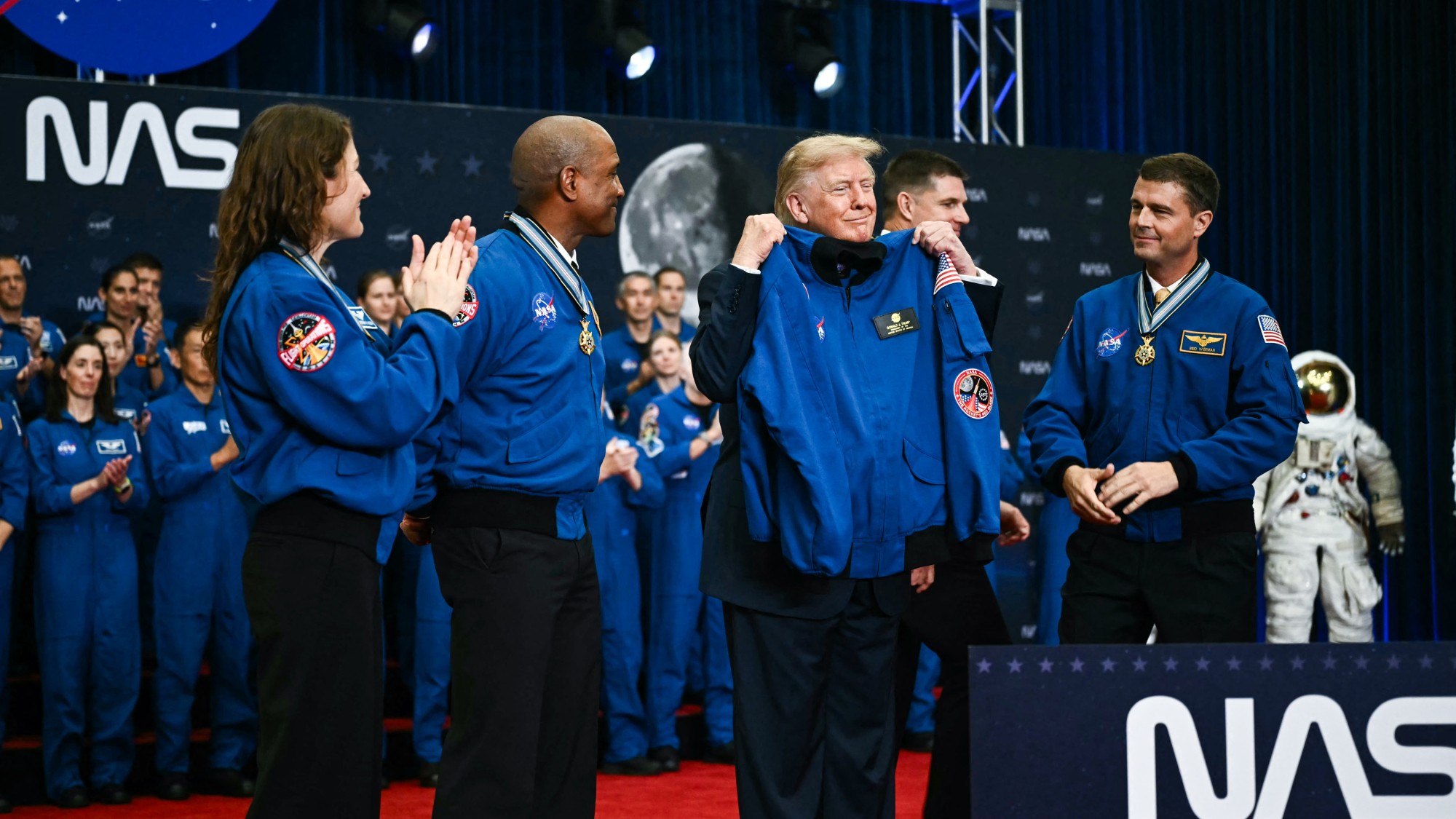
a man in a blue suit gives medals to four people in blue flight suits on a stage with a large sign that reads

President Donald Trump awarded the four astronauts of NASA's Artemis II moon mission the Congressional Space Medal of Honor at Johnson Space Center on Aug. 28, 2026. They, in turn, gave him a flight jacket. (Image credit: Kent NISHIMURA / AFP via Getty Images)

Trump compared the new school to the academies for the U.S. Army, Navy, Air Force and Coast Guard. But it appears that the U.S. Space Academy won't be so militarily focused.

"President Trump's vision for a new academy is a transformational step to educate the engineers, scientists, technicians, operators and even the astronauts who will be necessary for the inspiring future we are pursuing in space," NASA Administrator Jared Isaacman said in an agency statement today.

"In the years ahead, we will return NASA astronauts to the lunar surface, build the Moon Base, get underway on nuclear power, ignite the orbital economy and launch more missions of science and discovery," he added. "I have no doubt that so much of the future talent that will graduate and contribute to these exciting endeavors will be educated at the United States Space Academy."

Isaacman is involved in the new project. He chairs the Presidential Commission on the United States Space Academy, which will help flesh out the new school.

Within the next 120 days, the commission will submit a report "with recommendations on governance framework, service obligations for graduates, physical location of the academy, legislative requirements and more," NASA officials wrote in today's statement.

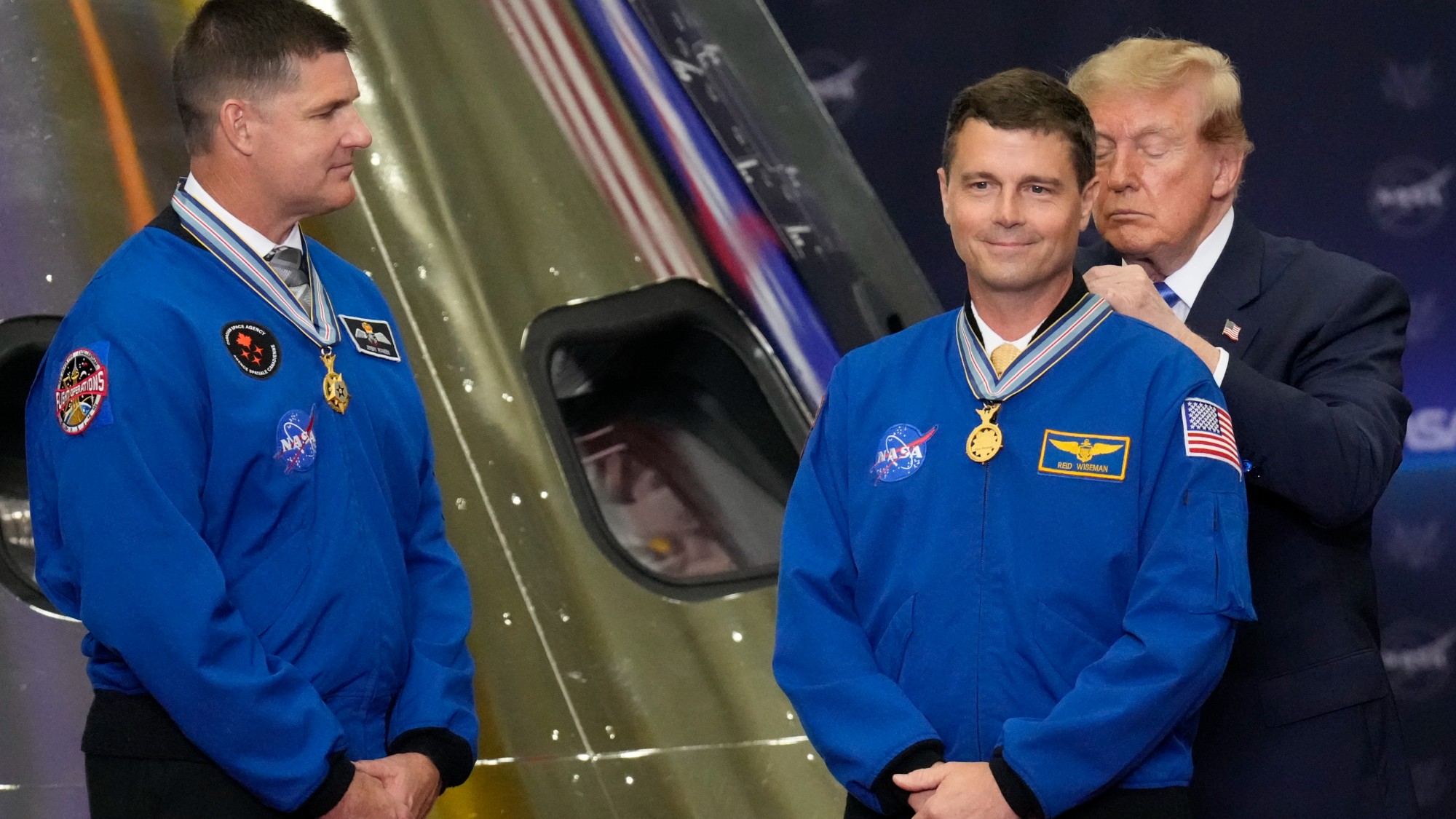
a man in a blue suit gives medals to four people in blue flight suits on a stage with a large sign that reads

Artemis II astronaut Jeremy Hansen, left, watches as President Donald Trump awards Artemis II commander Reid Wiseman with the Congressional Space Medal of Honor ceremony at NASA's Johnson Space Center in Houston Friday, Aug. 28, 2026.  (Image credit: Melissa Phillip/Houston Chronicle via Getty Images)

Trump may weigh in during the design phase. He certainly has expectations for the academy, saying that "it's got to be top line."

"Even architecturally, it's got to be — it's going to be beautiful," the president added. "It's going to be the top. It's going to be as good as it can get. You know, doing a bad building doesn't cost a lot less than doing a great building. I've always said it: Doing great architecture, doing something really great that's also practical — it doesn't cost much more than doing some of the bad stuff that you see all over the place. But we're going to make this so good and so exciting."

Relive private Chinese rocket’s explosive 1st landing attempt (video)

LandSpace's first attempt to land a rocket was quite a spectacle, as newly released video footage reminds us.

The Beijing-based company's Zhuque-3 launcher reached orbit successfully during its debut mission on Dec. 3, 2025 — quite a feat for any rocket.

But Zhuque-3 couldn't pull off the twofer. Its first stage experienced problems during the latter stages of its return to Earth, ultimately exploding in a violent fireball near its designated landing pad.

photo showing a rocket crashing into a desert landspace, creating a massive fireball

The first stage of LandSpace's first Zhuque-3 rocket crashes while trying to land on Dec. 3, 2025. (Image credit: CCTV)

We recently got some up-close looks at that failed return to Earth, thanks to CCTV. On Aug. 20, the state-run Chinese broadcaster released dramatic footage of the landing attempt, which includes video captured from a camera on the booster itself.

Those selfie shots highlight the rocket's resemblance to the paragon of reuse, SpaceX's Falcon 9. For example, we see the rapidly approaching ground through the metal mesh of two hypersonic grid fins, attitude-control devices the Falcon 9 pioneered and popularized.

The CCTV video also shows that Zhuque-3 was in trouble before it hit the ground: The booster suffered a mini-explosion during descent and was already a flaming wreck when it reintroduced itself to terra firma.

LandSpace apparently learned some important lessons that day because Zhuque-3's second mission, which occurred on Aug. 18, was a complete success. The 216-foot-tall (66 meters) rocket delivered a satellite to orbit, and its first stage stuck the landing.

It was the first-ever touchdown by a private Chinese orbital rocket, and just the second by a Chinese orbital launcher of any description. The first was pulled off on July 10 by the first stage of a Long March 10B rocket, which nestled softly into a net-like apparatus installed on a ship at sea.

SpaceX Falcon Heavy rocket launching NASA’s Roman Space Telescope on Aug. 30: How to watch it live

Update for Aug. 30, 9 a.m. ET: SpaceX successfully launched the Roman Space Telescope for NASA atop a Falcon Heavy rocket at 7:26 a.m. EDT (1126 GMT). Read our full launch wrap story with video and photos.

NASA's next great space observatory is about to lift off, and you can watch it live.

The Nancy Grace Roman Space Telescope is scheduled to launch atop a SpaceX Falcon Heavy rocket from NASA's Kennedy Space Center in Florida on Sunday (Aug. 30) at 7:26 a.m. EDT (1126 GMT).

You can watch it live here at Space.com, courtesy of NASA, beginning at 6:20 a.m. EDT (1020 GMT). You don't have to wait that long for a Roman fix, actually; there's stuff to watch on Saturday (Aug. 29) as well. Here's a rundown of this weekend's Roman action.

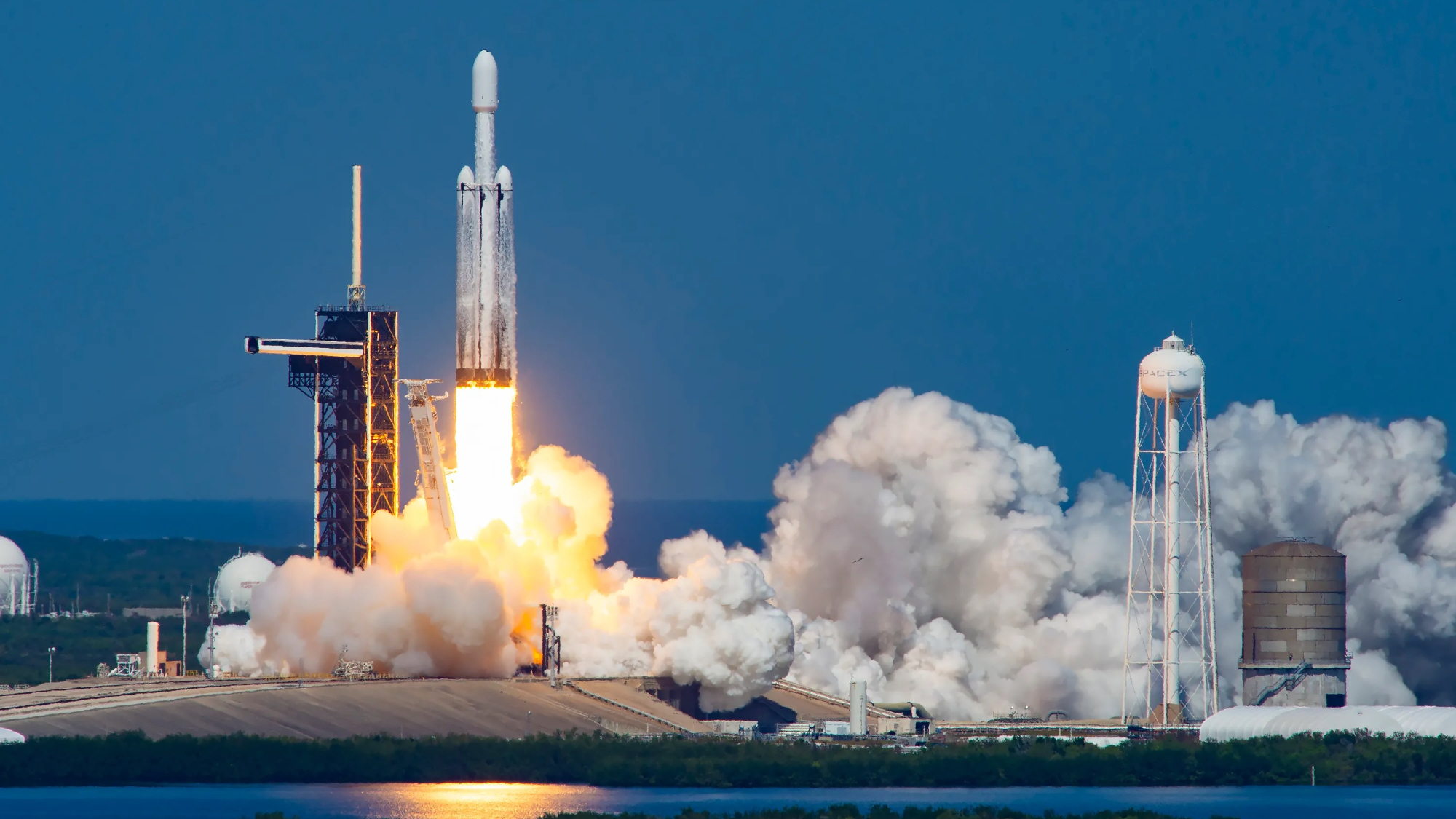
a big white rocket launches into a blue sky from a seaside pad

SpaceX's Falcon Heavy rocket launches NASA's Europa Clipper mission from Florida on Oct. 14, 2024. (Image credit: SpaceX)

Saturday: Prelaunch briefings

Things kick off at on Saturday at 9 a.m. EDT (1300 GMT) with NASA's Roman Space Telescope mission science briefing. This should be quite eventful, for Roman's science goals are ambitious; it will likely discover thousands of exoplanets, for example, and reveal intriguing new information about mysterious dark matter and dark energy.

Participants are:

  • Shawn Domagal-Goldman, director, Astrophysics Division, NASA Headquarters
  • Julie McEnery, Roman telescope senior project scientist, NASA Goddard Space Flight Center
  • Vanessa Bailey, Roman Coronagraph Instrument scientist, NASA Jet Propulsion Laboratory
  • Kristen McQuinn, Roman Science Operations Center lead, Space Telescope Science Institute
  • Lee Armus, Roman Science Support Center lead, Caltech/IPAC

Next up is the prelaunch press conference, which will discuss the mission's launch readiness. It will start at 10:30 a.m. EDT (1430 GMT) and feature the following folks:

  • Nicky Fox, associate administrator, Science Mission Directorate, NASA Headquarters
  • Lucas Paganini, Roman telescope program executive, NASA Headquarters
  • Jackie Townsend, Roman telescope project manager, NASA Goddard
  • Denton Gibson, launch director, NASA’s Launch Services Program, NASA Kennedy
  • Julianna Scheiman, director, NASA Science and Dragon Programs, SpaceX
  • Justin McReynolds, launch weather officer, 45th Weather Squadron, U.S. Space Force

Then, at 11:45 a.m. EDT (1545 GMT), NASA Administrator Jared Isaacman, an accomplished pilot and private astronaut, will put on a mini air show of sorts.

Isaacman "is expected to fly past the Nancy Grace Roman Space Telescope and Falcon Heavy rocket on the launch pad in his jet," NASA wrote in an Aug. 24 media advisory. "The flyby will be shown live on the same stream as the prelaunch news conference, with a view of the launch pad during the transition. The flyby is subject to weather and operational considerations."

Sunday: Launch day

And there's more to watch on Sunday than the launch itself. At 9:30 a.m. EDT (1330 GMT), NASA will hold a post-launch briefing featuring Isaacman, Fox, Townsend, McEnery and Gibson.

They'll likely discuss the next steps for Roman, which include a 30-day journey to its deep-space home, the sun-Earth Lagrange Point 2. This spot lies about 930,000 miles (1.5 million kilometers) from Earth in the direction of Mars. It's gravitationally stable, meaning Roman will be able to stay put without expending much fuel.

Mission team members will spend the next few months checking out the observatory's systems and science gear. It should be ready to begin its five-year science mission in early 2027.

President Trump gives Artemis II moon astronauts the Congressional Space Medal of Honor

Four astronauts just received the United States' highest space honor.

President Donald Trump gave the astronauts of NASA's Artemis II moon mission the Congressional Space Medal of Honor today (Aug. 28) during a ceremony at Johnson Space Center in Houston.

"This is a very rare thing. It's for courageous people, brilliant people, bestowed on astronauts who have distinguished themselves with exceptional service to the nation and all of mankind," Trump said during the event.

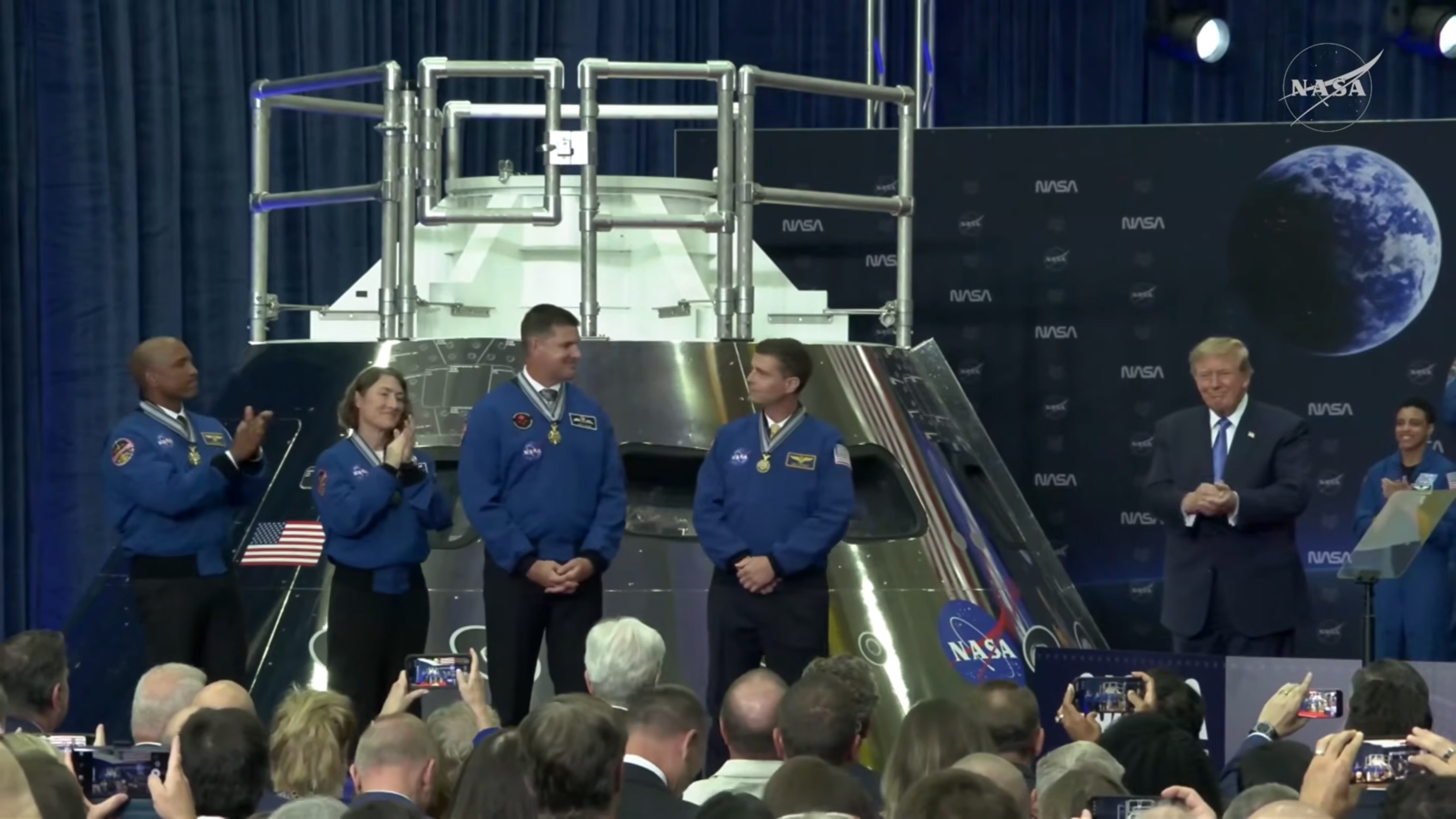
President Donald Trump awarded the four astronauts of NASA's Artemis II moon mission the Congressional Space Medal of Honor on Aug. 28, 2026.

President Donald Trump awarded the four astronauts of NASA's Artemis II moon mission the Congressional Space Medal of Honor on Aug. 28, 2026. (Image credit: NASA TV)

Artemis II launched on April 1 and came back to Earth nine days later. It was the first crewed mission of NASA's Artemis program, which aims to establish a long-term base near the moon's south pole in the coming years.

The flight sent four people — NASA's Reid Wiseman, Victor Glover and Christina Koch, as well as Canadian Space Agency astronaut Jeremy Hansen — on a looping journey around the lunar far side. It was the first crewed trip beyond low Earth orbit since Apollo 17 in 1972, and its astronauts got farther from their home planet than any people ever had before.

Artemis II engaged folks around the world thanks to its importance, its historic nature and the charisma of its astronauts. And some fortuitous orbital dynamics didn't hurt, either: The Artemis II crew were lucky enough to observe a total solar eclipse from beyond the moon, something human eyes had never seen firsthand before.

The Congressional Space Medal of Honor is awarded "to any astronaut who in the performance of his duties has distinguished himself by exceptionalIy meritorious efforts and contributions to the welfare of the Nation and of mankind," NASA wrote in a description of the award, citing Congress' stated criteria.

Though the president gives out the medal, he does so on the recommendation of the NASA administrator, the agency added. Before today, just 30 people had received the award, and most of them are pretty big names. Past honorees include Apollo 11 astronaut Neil Armstrong; Alan Shepard and John Glenn, who were the first Americans to reach space and orbit Earth, respectively; Gemini astronaut Ed White, the first American to perform a spacewalk; and Apollo 13 commander Jim Lovell.

The award was also given to each of the 14 astronauts who died in the space shuttle Challenger and Columbia disasters.

Hansen therefore wasn't the first non-American to receive the medal. Ilan Ramon, one of the seven people who perished when Columbia broke apart upon reentry to Earth's atmosphere on Feb. 1, 2003, was from Israel.

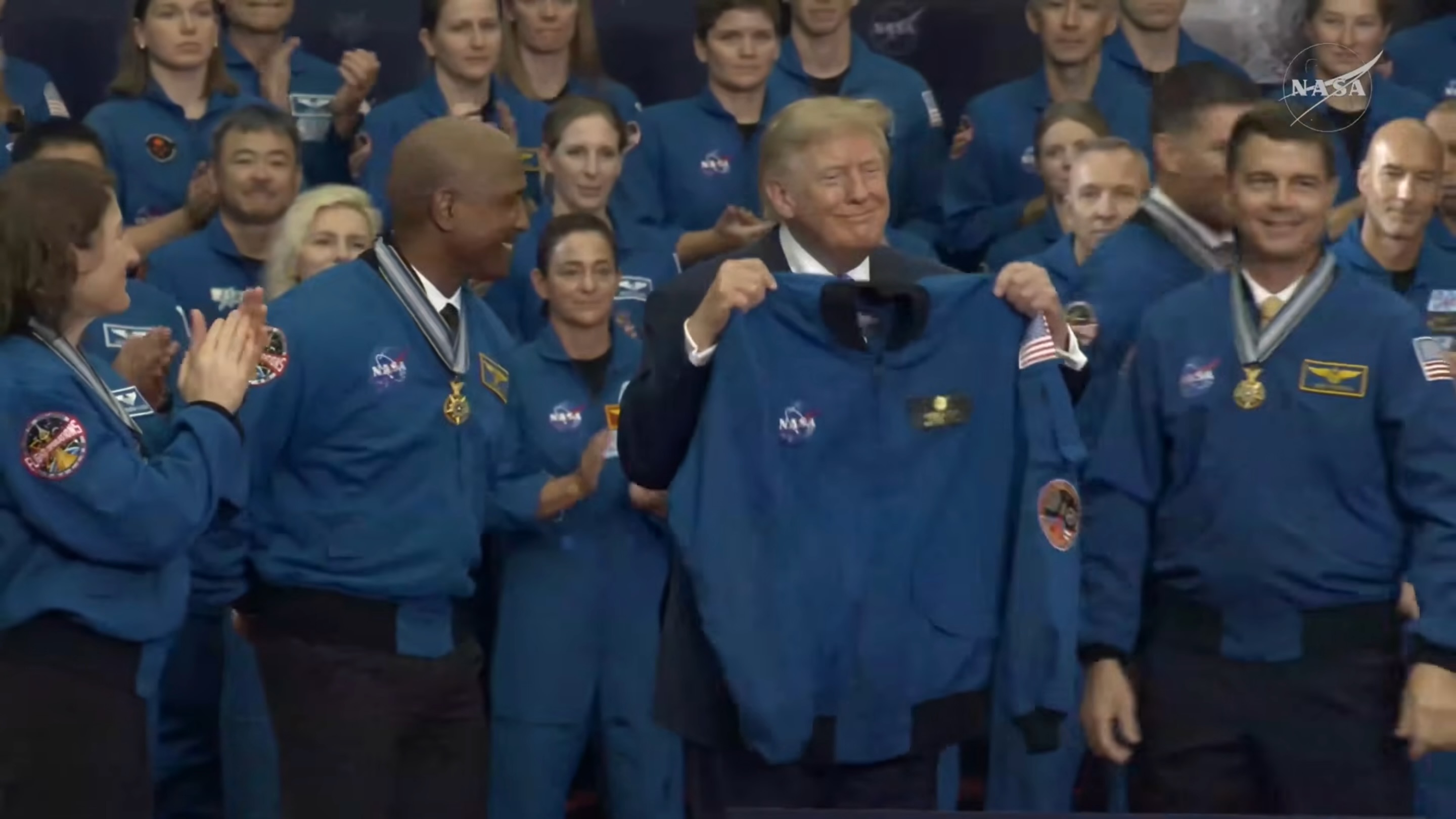
a smiling man in a dark suit holds up a blue flight jacket surrounded by a crowd of people wearing similar jackets

The Artemis II astronauts gave President Trump a special flight jacket on Aug. 28, 2026. (Image credit: NASA TV)

During his speech at today's ceremony, Trump said that the United States is entering a golden age of spaceflight and exploration. And he thanked the Artemis II astronauts for being a guiding light.

"Thanks to the crew of Artemis II, those dreams are closer than ever before," the president said. "We're on the cusp of an adventure and something that's so special, people have really not imagined anything. It's really, civilization is into the stars. The stars are up there and they're beautiful, and you're right next to them. You have the courage to be right next to them. Few people do, but you're leading the way. It's great, great bravery."

The astronauts reciprocated the warmth. For example, they gave the president a blue flight jacket commemorating the mission. And Wiseman, Artemis II's commander, thanked Trump for calling the crew during their mission.

"The one thing that really sticks out to us is, you said how proud you are and how proud our nation is of the job that we have just accomplished," Wiseman said during the ceremony. "And for us, that is what we set out to do. We wanted to inspire this nation and inspire the world, and for us, that showed us we were on the right track. So, thank you for that call."

Editor's note: This story was updated at 1:30 p.m. ET on Aug. 28 with quotes and information from the medal ceremony.

Astronaut Jonny Kim leaves NASA, will return to active military duty

Jonny Kim is leaving NASA to continue his military career.

The 42-year-old astronaut, who has one of the most jaw-dropping resumes of any person alive, is departing today (Aug. 27) after nine years with the agency. He has one mission under his belt, a long-duration flight to the International Space Station (ISS).

"Jonny has been an integral part of the agency, and his immeasurable impact will be felt for generations to come," Vanessa Wyche, director of NASA's Johnson Space Center (JSC) in Houston, said in a statement today. "From advancing groundbreaking science to inspiring the next generation, Jonny has been an incredible source of inspiration to our nation. His exceptional talent, determination, and grit will leave a lasting legacy at NASA."

NASA picked Kim as part of its 2017 astronaut class, the 22nd in the agency's history. He and his 11 fellow selectees nicknamed themselves "The Turtles."

Kim was already incredibly accomplished before he got the NASA nod. He's a physician with a medical degree from Harvard. He served in the U.S. military, as a dual-designated naval aviator and flight surgeon as well as a Navy SEAL — a commando trained to conduct special operations on sea, air and land (hence the acronymic name).

"Over the course of more than 100 combat operations, he served as a medic, sniper, navigator and point man, earning the Silver Star, Bronze Star with Combat 'V,' and numerous additional commendations," NASA officials said in the same statement.

After completing his mandatory two years of NASA astronaut training, Kim served as a CAPCOM ("capsule communicator") at JSC, relaying information between Mission Control and crewmembers on the ISS.

"Kim also contributed to Artemis program development through his work in the astronaut exploration branch, leading the astronaut crew operations branch, and serving as increment lead for Expedition 65," NASA officials said in the same statement. "His experiences as a Navy SEAL, physician and naval aviator provided unique perspectives in mission operations and crew support."

In April 2025, Kim got the chance to go to space himself. He launched to the ISS aboard a Russian Soyuz spacecraft along with Russian cosmonauts Sergey Ryzhikov and Alexey Zubritsky.

The trio lived and worked in space for 245 days, circling Earth 3,920 times and traveling a total of nearly 104 million miles (167 million kilometers), according to NASA. During that time, Kim conducted a variety of scientific experiments that could advance technological development and aid space exploration down the road.

Kim, Ryzhikov and Zubritsky returned to Earth in December, touching down in their Soyuz on the steppe of Kazakhstan .

Kim isn't walking off into the sunset now. Far from it: He's going back to active duty, "to finish out the remainder of his military career within naval aviation training," according to NASA.

"Contributing to space exploration and serving NASA has been the honor of a lifetime," Kim said in the same NASA statement.

"Throughout my career, I’ve learned that beyond the missions, the training, and the hardware, success always comes down to the people," he added. "They are our greatest asset, and leading with love and empathy is how we achieve the impossible. I look forward to carrying my commitment to service, my enduring love for space and technology, and the hard-earned lessons of this past decade into my next chapter to make a meaningful impact on humanity’s future."

Kim isn't the only astronaut to hang up his spacesuit in 2026. NASA's Mike Fincke stepped away this year, as did Canadian Jeremy Hansen, who was one of the four crewmembers on NASA's Artemis II flight around the moon.

Starship is coming home! SpaceX loads floating spacecraft onto huge ship in the Indian Ocean (photos)

More than a month after its epic spaceflight, Starship is finally headed home.

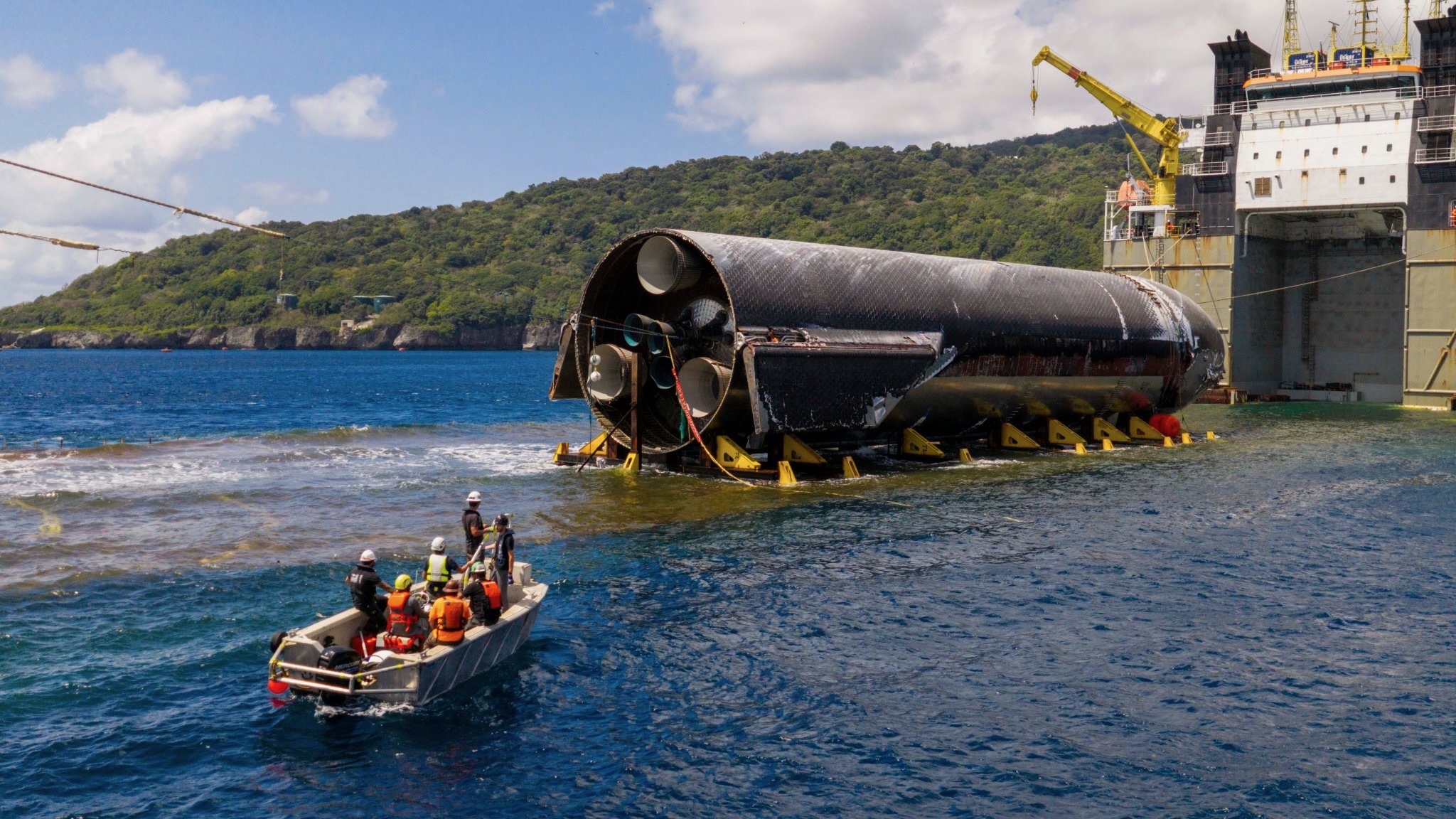
SpaceX announced today (Aug. 27) that it has loaded Starship's 171-foot-tall (52 meters) upper stage — known as Starship, or simply Ship — onto a huge "semi-submersible" ship in the Indian Ocean, off the coast of Christmas Island.

Ship had been in the water since July 24, when it splashed down to bring an end to the Starship program's 13th test flight. The vehicle will now head back to SpaceX's Starbase site in South Texas, a journey expected to take several months, according to the company.

photo of a cylindrical gray spacecraft on the deck of a ship that's moored off a verdant island

The semi-submersible's deck rises with Ship on board. (Image credit: SpaceX)

Starship Flight 13 lifted off from Starbase, sending Ship on an hour-long suborbital jaunt that went quite well. The vehicle deployed its payloads — 20 of SpaceX's big, next-gen Starlink "Version 3" satellites — into space as planned and also managed to relight one of its six Raptor engines in the final frontier as well.

Ship then splashed down softly in the Indian Ocean off the coast of Western Australia — so softly, in fact, that it survived the ordeal intact. This was unprecedented; on every previous Starship flight, the upper stage had either broken apart during reentry to Earth's atmosphere or exploded shortly after splashdown, when it toppled sideways into the waves. (Starship's first-stage booster, known as Super Heavy, attempted a soft splashdown in the Gulf of Mexico during Flight 13 but suffered engine problems and hit the water hard.)

SpaceX determined to take advantage of this unexpected development. Getting an up-close look at Ship, the company said, would shed light on how its heat shield held up during the flight — key information that could advance the development of Starship, which is designed to be fully and rapidly reusable.

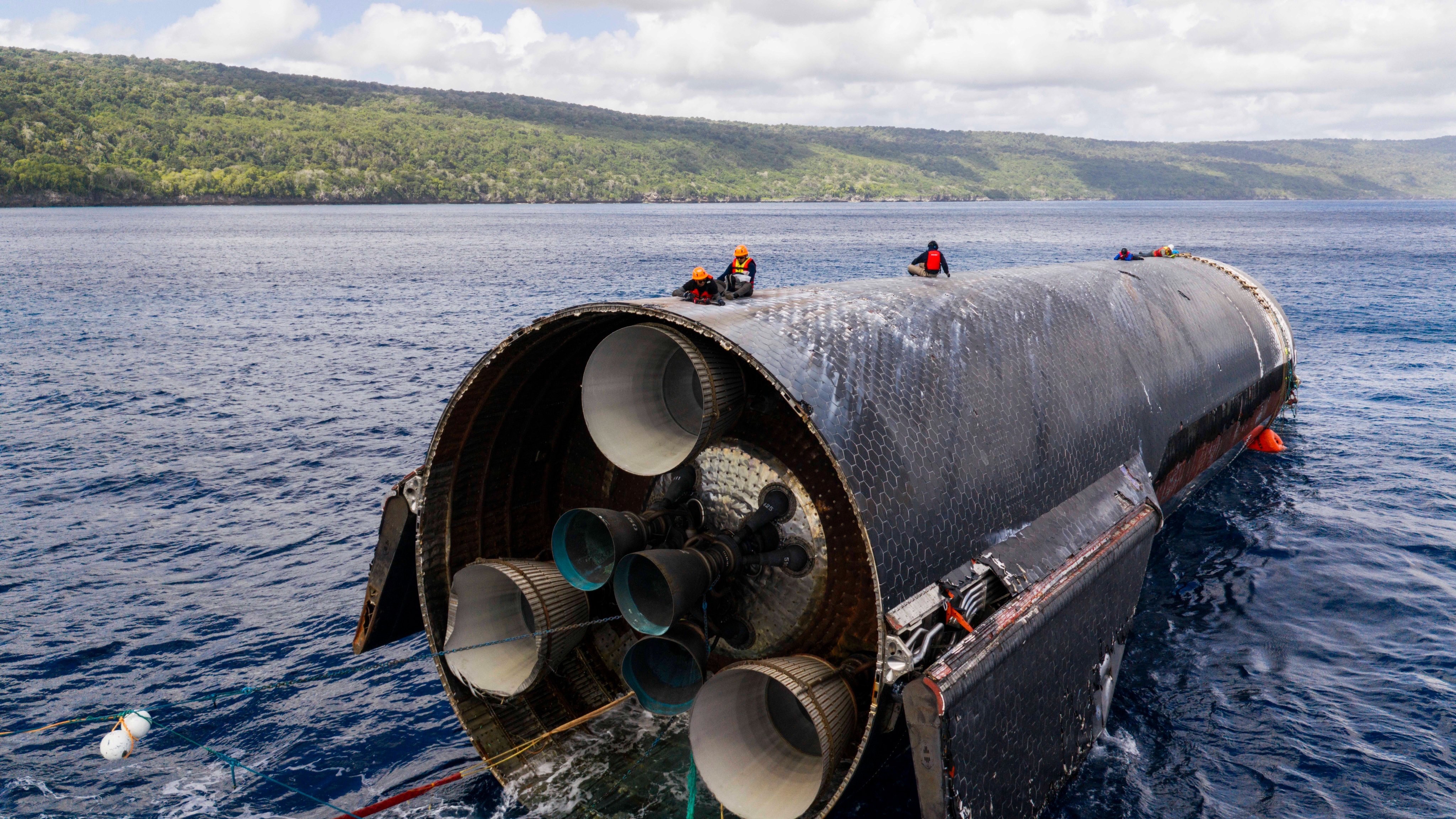
several people sit atop a large cylindrical black spacecraft floating in the ocean just off an island's coast

SpaceX engineers inspect Flight 13's Ship as it floats off the coast of Christmas Island. (Image credit: SpaceX)

So the company began towing the Flight 13 Ship to shore — an endeavor that initially seemed doomed to failure.

"Unfortunately, ship recovery is not looking good right now," SpaceX founder and CEO Elon Musk said in an Aug. 7 post on X, the social media platform he bought in 2022. He was responding to a SpaceX post that same day, which cited "challenging conditions and increasingly rough seas."

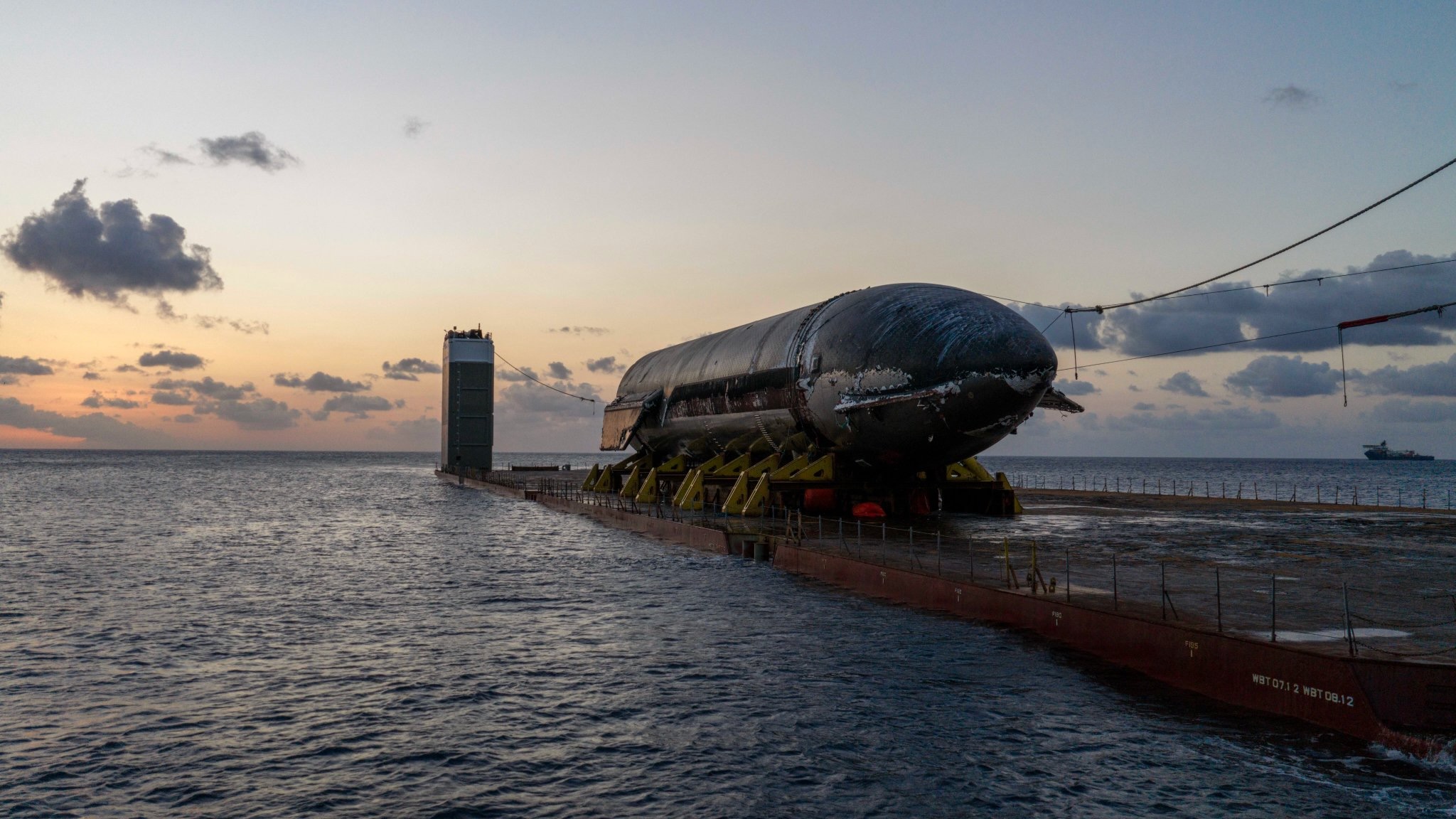
a cylindrical black spacecraft on the deck of a ship at sea at dusk

Ship is now on its its way back to Texas. (Image credit: SpaceX)

SpaceX persevered, however, and managed to tow Ship to Christmas Island, an Australian territory that lies about 1,200 miles (1,900 kilometers) northwest of the city of Broome. Once there, company engineers inspected the vehicle for several days as it bobbed in the waves, gathering valuable data, according to SpaceX.

"They collected heatshield samples and gained vital insight into how the vehicle handled reentry with improvements now planned on future vehicles," SpaceX said today in an X post that shared several photos of the operation.

Further analysis doubtless awaits, after the semi-submersible hauler vessel — so called because its deck goes underwater beneath heavy floating payloads, then rises up with them on board — arrives in Texas.

"Congratulations to the entire SpaceX Recovery team for battling through challenging conditions to give our engineers access to a wealth of data to continue rapidly developing Starship," SpaceX wrote in another X post today.