Astronomers discover the secrets of ‘string of pearls’ supernova relic and the zombie star at its heart

Scientists are still learning about a cosmic "string of pearls," a unique celestial relic left by a supernova explosion that humanity witnessed around 850 years ago.

That is thanks to the most detailed observation of the dandelion-shaped chains of gas and supernova debris that comprise Pa 30, the only supernova remnant of its type observed in the Milky Way. What makes Pa 30 even more unique is that it has a rare "zombie star" at its heart.

Supernovas like the one that created Pa 30 are called Type Ia supernovas; they happen when a dead star called a white dwarf overfeeds on a companion star like a cosmic vampire. This overfeeding triggers a runaway nuclear explosion that usually destroys the white dwarf. But on rare occasions, the supernova doesn't completely destroy the star, and a shattered stellar body remains, called a zombie star. These events are called Type Iax supernovas.

Pa 30 was first identified in 2013 by a citizen scientist in 2013, but scientists soon linked it to a cosmic explosion recorded independently in the year 1181 in Japanese, Chinese, and Arabic historical documentation. That makes this one of only five supernovas seen before the invention of the telescope.

"Reliable historical records of stellar explosions extend back only about a thousand years. For all we know, there might well be similar remnants still lurking in the dark in our own galaxy," team member Ilaria Caiazzo, assistant professor at the Institute of Science and Technology Austria (ISTA), said in a statement.

"Today, we are lucky to study an intriguing object we know was observed by astronomers who made three independent historical records of the event centuries before the invention of the telescope."

Solar system-sized pearls

Pa 30 is a good laboratory to study supernovas because, at around 7,500 light-years away, it is relatively close to Earth on cosmic scales. For instance, the heart of our galaxy is around 26,000 light-years away. "We can see this much detail because of Pa 30's proximity to Earth," said Caiazzo. "This proximity makes Pa 30 uniquely valuable for study."

It is also an important subject of study because it is the only supernova remnant in which we can see a zombie star.

Using the Gemini North telescope, Caiazzo and colleagues zoomed in on Pa 30, discovering knots along the strands of gas radiating out from the site of the cosmic explosion, like pearls on a string.

These pearls are each wide enough to encompass the orbit of Neptune, the most distant planet from the sun, ten times over.

"The planetary region of our solar system could fit in each knot about ten times with room to spare," said Caiazzo. "The knots are quite strikingly uniform. We are excited to try to model them."

The team also discovered that the zombie star sits almost perfectly at the heart of Pa 30. When these cosmic explosions happen, they should provide any debris, including zombie stars, with a kick. The fact that this "living dead" star still sits dead center of this wreckage suggests that when this explosion happened, it was roughly symmetrical and the kick was relatively light.

"Explosions conserve momentum. If the explosion itself was perfectly symmetric, the ejecta should also be symmetric, and the surviving star should not receive a substantial kick," Caiazzo said. "We were able to measure a precise upper limit of the remnant star's transverse kick speed, showing that it was surprisingly small. We practically don't see the star moving away at all."
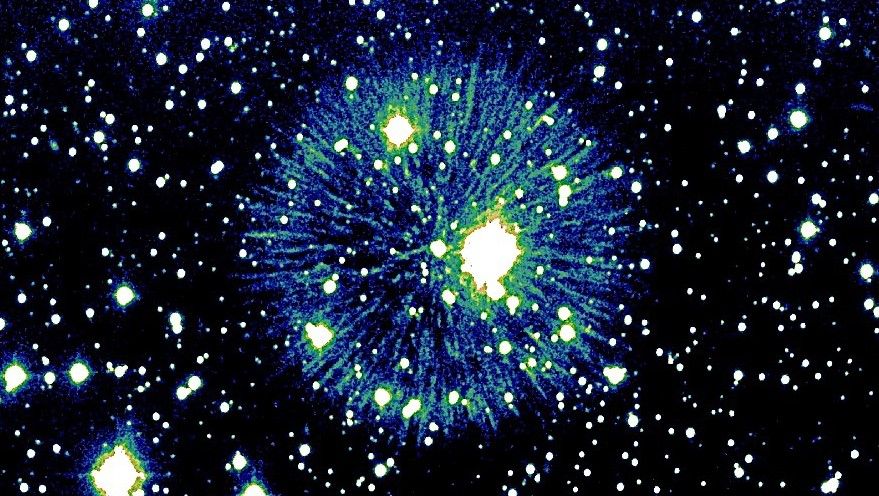
A spikey blue sphere against a starry background

An image of the nebula Pa 30. (Image credit: Robert Fesen)

While there are still many mysteries surrounding Pa 30 and its zombie occupant, one of the most exciting prospects emerging from this research is the possibility it will help identify the wreckage of other Type Iax supernovas in our galaxy.

"While we can see Type Iax supernovas in distant galaxies as point sources of light, resolving the remnants of such explosions is only possible in our own galaxy and in very few nearby ones," Caiazzo concluded. "Eventually, we plan to use Pa 30's distinctive properties to search the Milky Way and nearby galaxies for similar objects."

The team's research was published in The Astrophysical Journal.
Record breaker! Astronomers spot powerful cosmic explosion that lasted 27 days

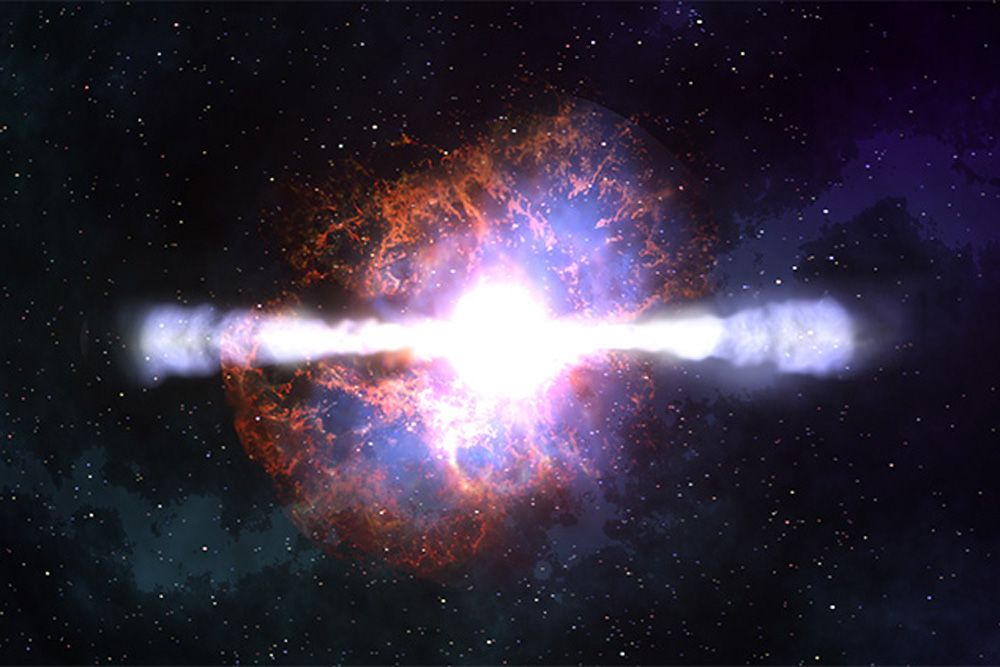
Astronomers have spotted a remarkable gamma-ray burst (GRB) that's a real Incredible Hulk compared to other cosmic explosions of the same type.

What makes this GRB so special is the fact that the central engine powering it remained active for around 27 days, flaring in X-rays following the initial blast. That's 20 days longer than the longest previous GRB on record.

This record-breaking burst — which is designated GRB 220706A and was spotted on July 6, 2022 — is even more exciting because scientists don't know what the central engine powering it actually is.

"In a nutshell, GRB 220706A is an extremely late X-ray flare. X-ray flaring is common following GRBs, but previously it has always come within the first few days after we detect the burst," study team member Benjamin Gompertz, of the University of Birmingham in England, told Space.com.

"The fact that we see flaring at around 27 days in the GRB’s rest frame tells us that there’s an ongoing active process, and that’s unprecedented in the known population," Gompertz added. "The previous record for delayed flaring was about six days after the GRB."

What created the Incredible Hulk of gamma-ray bursts?

GRBs are some of the most powerful explosions in the cosmos. They have been linked to the collapse of a massive star, which also triggers a supernova and creates a black hole. This results in a long-duration GRB, while short-duration GRBs are thought to be triggered when two stellar remnants called neutron stars collide.

GRB 220706A is an example of an ultra-long GRB, a rare cosmic blast of gamma rays in which the engine powering the GRB stays active for longer. They are incredibly rare, with their cause still unknown.

"We don’t know what the central engine driving this outburst is, and that’s what makes this such a compelling event," Gompertz said. "The fact that we see a supernova tells us that a star has collapsed, which is the standard power source for GRBs, but it doesn’t immediately account for the extremely late flaring or unusually bright supernova. We can interpret that through previous events to some degree."

Gompertz added that another ultra-long GRB detected in 2011, GRB 111209A, was associated with an unusually bright supernova (SN2011k) that had clear evidence for a central engine. The team behind that research determined that GRB 111209A is powered by a magnetar, a neutron star with a particular powerful magnetic field. In this case, the magnetic field is rotating at around 1,000 times per second.

"Our supernova looks a lot like that one, so a magnetar might be present here. That ties in nicely with super-luminous supernovas, which are also thought to be magnetar-driven," Gompertz said. "Another possibility could be that the GRB jet and the supernova are colliding with shells of dense material that were ejected towards the end of the parent star’s life, as it became unstable and began ejecting its outer layers. This sort of event is also seen in the super-luminous supernova population."

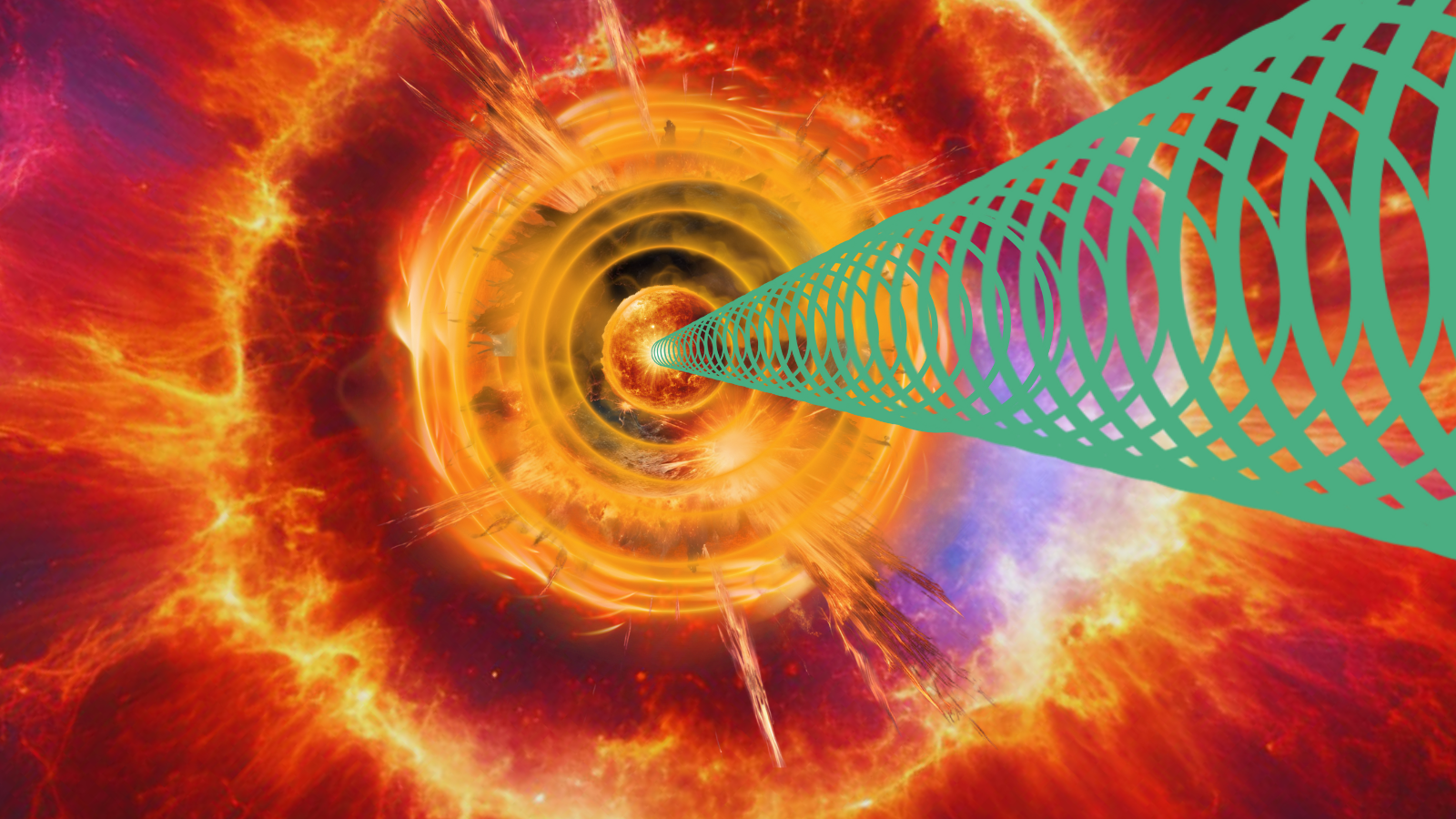
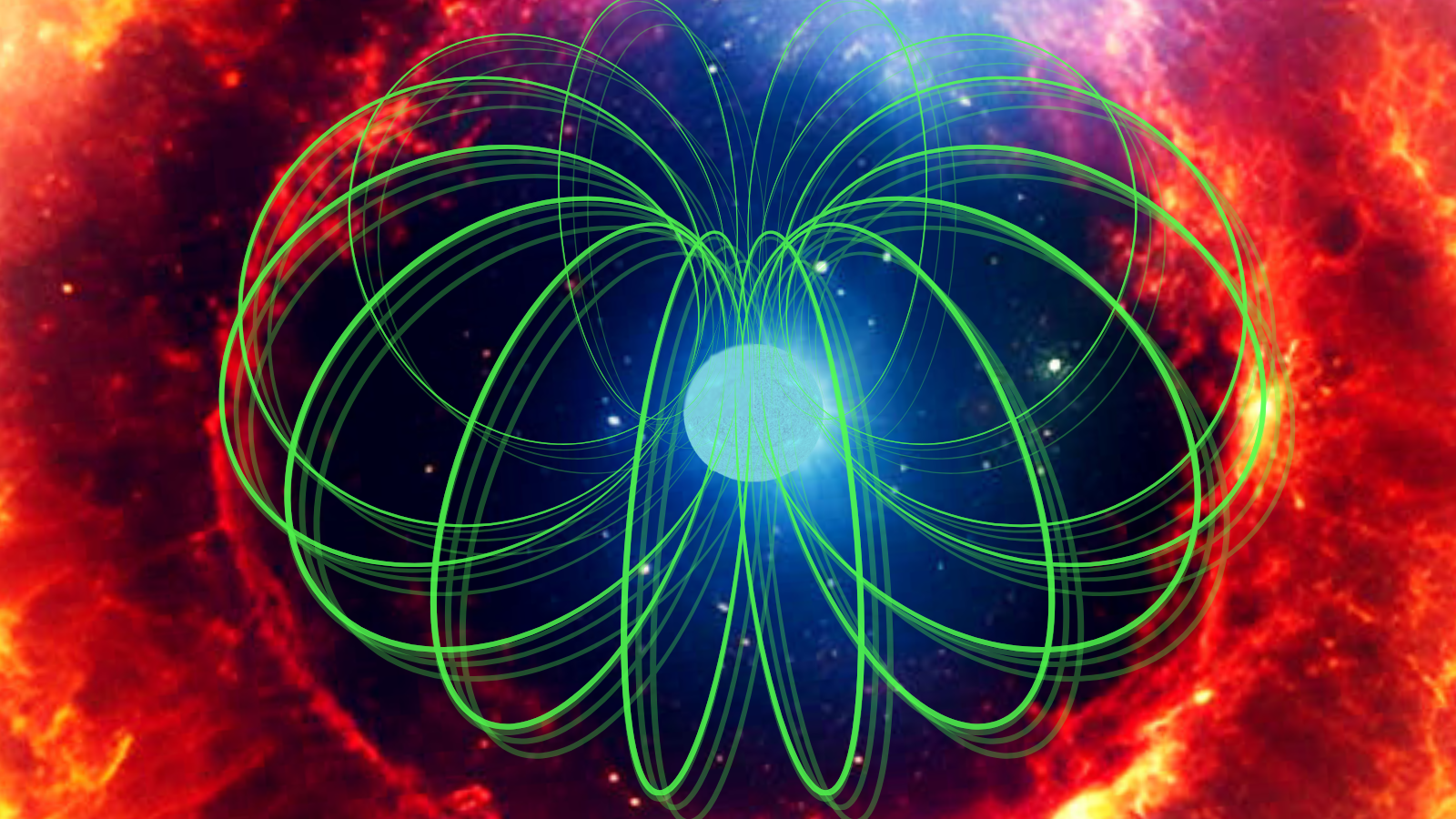
An glowing blue sphere with curved lines meeting at the sphere's poles surrounded by a ring of orange fire

An illustration showing a magnetar surrounded by green magnetic field lines at the heart of supernova wreckage (Image credit: Robert Lea (created with Canva))

The team isn't quite sure how the central engine of this ultra-long GRB differs from that of others and why that resulted in 27 days of flaring.

"One possibility is that it’s a much bigger star than we usually see producing GRBs," Gompertz said. "A bigger star would take longer to fall in on itself and so provide a longer-lived source of energy to power the jet."

GRB sources may be members of a stellar population of massive, compact stars called Wolf-Rayet stars. These are 10 times wider that the sun, with around 10 times the mass of our star. However, even the collapse of such a star can't explain GRB 220706A.

"To power GRB 220706A, we estimated we need a star more like 1,000 times the radius of the sun, which would require a population of stars known as blue supergiants," Gompertz said. "On the other hand, it may be the remnant that’s different. If this star produced a magnetar, it may be that 'normal' GRBs just collapse to black holes."

The team thinks that the big question with GRBs like this one is whether they are members of the normal GRB population or a different kind of event. Having this second event, in addition to GRB 111209A, with an unusually bright supernova potentially adds weight to the idea that these are different stars. But the problem is not yet solved.

"The incredibly late flares also strain our models for how jets are powered," Gompertz said. "It will be fascinating to see how future theoretical work can incorporate a power source from a collapsing star that can last for a month!"

A golden sphere surrounded by fiery rings

A core collapse supernova births a black hole and launches a GRB (Image credit: Robert Lea (created with Canva))

There could be even longer-lasting GRBs out in the cosmos that we have thus far failed to detect. Gompertz explained why such detections are tricky.

"GRBs this long are hard to detect because most of the satellites we use to find them are in low Earth orbit, which means the target is periodically blocked every 90 minutes or so," he explained. "That's fine for your typical 10- to 100-second-long GRB but becomes a nuisance when tracking much longer events. Long-lasting GRBs also seem to be more active in the X-rays rather than the gamma rays."

The University of Birmingham researcher added that newly launched missions like the Einstein Probe, which is more sensitive in X-rays than gamma rays, may be the perfect instruments to find more ultra-long GRBs.

"With any luck, we’ll get a few more of these to chase so that we can start trying to understand the incredible power sources that drive them," Gompertz concluded.

A pre-peer-reviewed version of the team's research is featured on the repository site arXiv.

‘They’re kind of goth’: NASA spacecraft gives mysterious brown dwarfs a close-up

Using NASA’s SPHEREx spacecraft, astronomers have studied a host of "failed stars," also known as brown dwarfs.

These strange cosmic bodies straddle the line between planets and stars, possessing a mass between 13 and 80 times that of Jupiter (0.013 to 0.08 times the mass of the sun). They get the nickname failed stars because they form like stars from collapsing clouds of gas and dust but fail to gather enough mass to trigger the fusion of hydrogen to helium in their cores, the process that powers actual stars.

This formation process also means that brown dwarfs are cosmic loners, wandering the darkness of space alone, bereft of the light of a parent star. That description might sound like lyrics from a Type O Negative song ("Black No. 1," anybody?). And that's apt, according to the leader of the new study, which reveals that, chemically speaking, the atmospheres of these dark and cloudy worlds are not unlike those of our solar system's gas giant planets.

"They’re kind of goth," Zafar Rustamkulov, of the California Institute of Technology (Caltech), said in a statement. "Unlike exoplanets, free-floating brown dwarfs are completely independent celestial objects that will fade into eternity alone. We’re still learning how complex they are."

Rustamkulov added that, from Earth orbit, SPHEREx — short for Spectro-Photometer for the History of the Universe, Epoch of Reionization, and Ices Explorer — sees wavelengths of light that are nigh-impossible to see with telescopes on the ground because water in Earth’s atmosphere absorbs them. That is important for bringing brown dwarfs into the light.

"We are picking up light from the deep, red clouds of brown dwarfs all over the sky," he said.

A forest (of brown dwarfs)

Brown dwarfs have been somewhat mysterious since their discovery in the 1990s, due to the fact that the small amount of nuclear fusion that occurs within them causes them to emit no more than a faint glow. That means that our understanding of their makeup, their storms, and their evolution really only comes from theory.

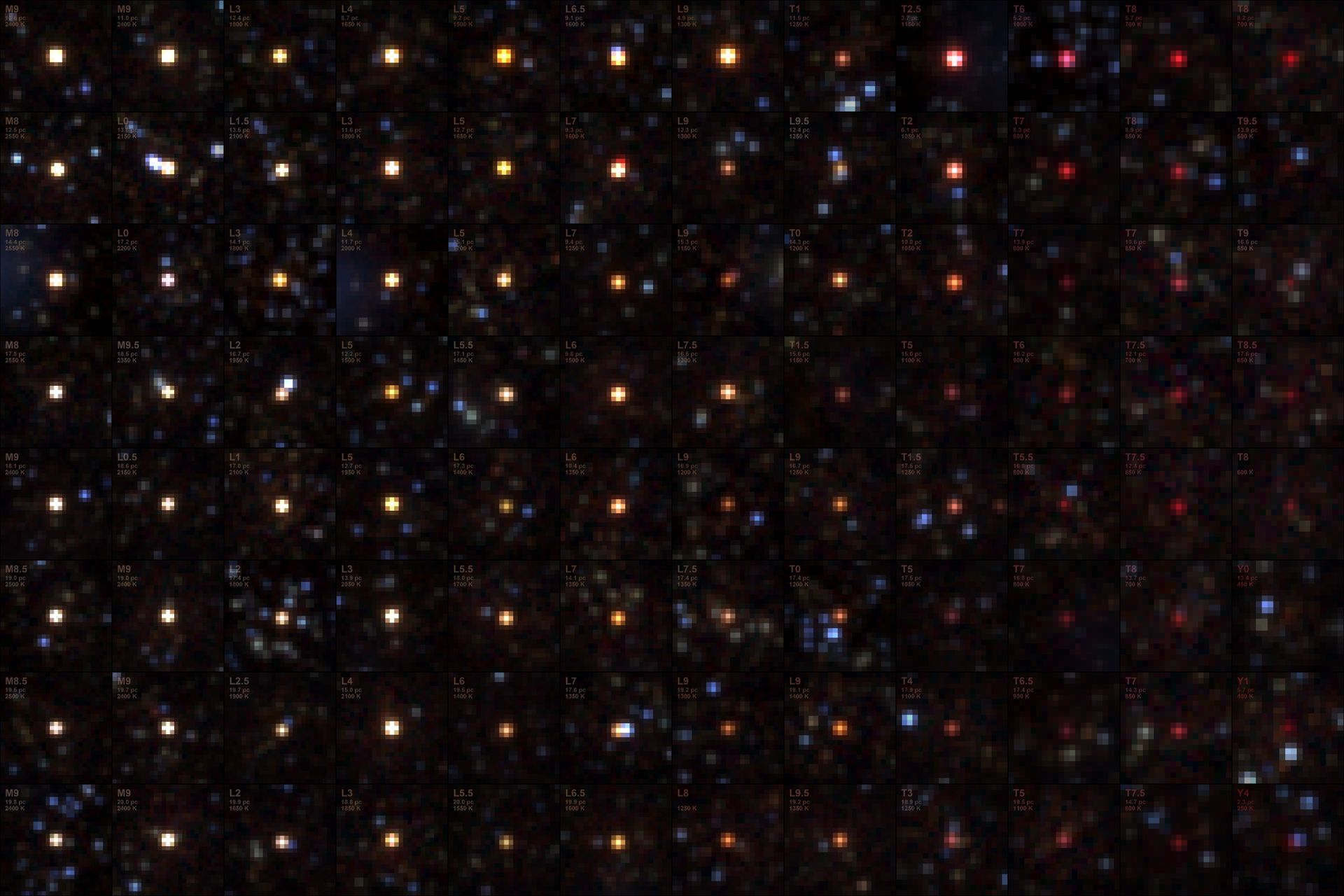
To help lift this observational darkness, the team turned to data from SPHEREx. They studied 37 nearby brown dwarfs in a spectrum of light including 102 wavelengths, from the deepest red our eyes can see to the invisible infrared light. These local failed stars spanned the full temperature range for brown dwarfs — from 4,000 degrees Fahrenheit to minus 10 degrees Fahrenheit (2,200 to minus 20 degrees Celsius).

Considering that the temperature of the sun is about 10,000 degrees Fahrenheit (5,500 degrees Celsius), you could definitely say brown dwarfs run cold.

96 boxed blobs of orange, blue, white, and yellow

Brown dwarfs observed by SPHEREx. (Image credit: Zafar Rustamkulov/NASA/JPL-Caltech)

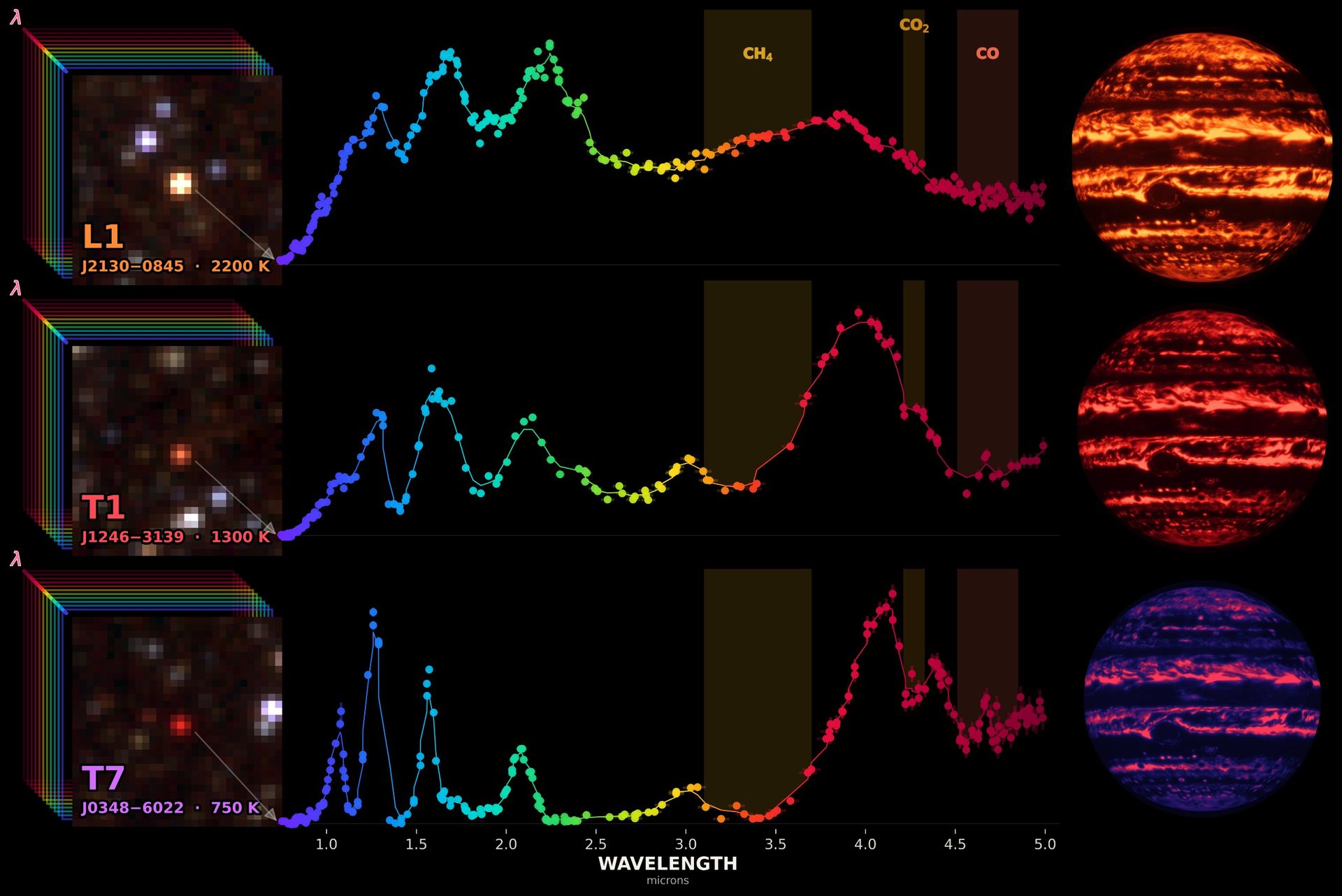
The spectra of brown dwarfs seen by SPHEREx allowed the team to determine that their atmospheres are chemically rich in water, carbon dioxide, carbon monoxide and methane.

"We’re seeing the signatures of these molecules and how they change from object to object across the entire temperature regime," said team member J. Davy Kirkpatrick, also of Caltech. "Our paper concentrated on just three dozen, but we have thousands more that we are in the process of analyzing.

"I really want to see what bounds the universe places on the variety of brown dwarfs."

All my colors

Brown dwarfs have been routinely observed by other telescopes, including NASA's James Webb Space Telescope and the agency's now-retired Spitzer Space Telescope, but the wide wavelength coverage of SPHEREx has made it particularly useful in observing these failed stars. That's good news for astronomers waiting for change in the atmospheres of brown dwarfs as they age and grow cold.

The researchers found that some brown dwarfs observed by SPHEREx are at a stage of extreme change in which their clouds are clearing, creating atmospheres rich in methane.

The team may have discovered significant new details about brown dwarfs, but they are still on the proverbial mystery street when it comes to these strange celestial objects,

"The state-of-the-art models are capturing the general chemical trend, but when it comes to these cloudy transitions, the models are struggling to match the data," said Rustamkulov. "No two brown dwarfs are alike. Even at the same temperature, their spectra look quite distinct."

NASA’s SPHEREx reveals molecules like methane (CH4), carbon dioxide (CO2), and carbon monoxide (CO) in brown dwarf atmospheres. The telescope’s view of three different brown dwarfs appears on the left

NASA’s SPHEREx reveals molecules like methane (CH4), carbon dioxide (CO2), and carbon monoxide (CO) in brown dwarf atmospheres. The telescope’s view of three different brown dwarfs appears on the left. (Image credit: Zafar Rustamkulov/International Gemini Observatory/NOIRLab/NSF/AURA, M.H. Wong (UC Berkeley) et al. Acknowledgments: M. Zamani)

"This journey has turned many of us into accidental meteorologists. We know how hard it is to predict weather on our own planet, and we realize it's going to be just as challenging to explain the phenomena we see in these bizarre, cold objects," Kirkpatrick said. "The findings are a call to action to explore even more of these dark worlds."

As astronomers resond to that call to action, I will ponder how I could have worked Bauhaus' Goth classic "Bela Lugosi is Dead" into this article.

The team's research was published on Sept. 28 in The Astrophysical Journal.
Scientists find ‘gemstones’ in atmosphere of bizarre, scorching-hot ‘marshmallow’ exoplanet

Using data from the James Webb Space Telescope (JWST), astronomers have unraveled some of the atmospheric secrets of a bizarre, blisteringly hot world that has the consistency of marshmallow.

The extrasolar planet, or exoplanet, under the watchful infrared eye of the JWST, is WASP-17b, located around 1,300 light-years away. The exoplanet has a mass around 0.8 times that of Jupiter, but it is around twice as wide as the solar system's largest planet, giving it a "super-puff" consistency comparable to the Earth-based treat. WASP-17 b is so close to its parent star that it completes an orbit in under four Earth days, with this proximity also making the temperature of this "hot Jupiter" skyrocket.

Given the extreme conditions of this exoplanet, it is little wonder that its atmosphere is pretty unusual too. Using a new technique called transmission strings, a team of scientists mapped the contours of the atmosphere of WASP-17b. They found that the atmosphere is shaped like a ring with prominent "gems" rising from it.

"Planets are temperamental, their atmospheres complex and chaotic," team member Hannah Wakeford of the University of Bristol said in a statement. "The fact that all of these numbers came together and showed us this very structured, dynamical picture of this giant world over 1,000 light-years away was just really exciting."

Astronomers like WASP-17b so much they put a ring on it

WASP-17b is so close to its parent star that it is tidally locked, meaning one side permanently faces the star; its dayside is constantly bombarded with stellar radiation. In contrast, the planet also has a cooler nightside, which faces out into space in perpetuity.

By creating incredibly comprehensive 3D views of this exoplanet's atmosphere, researchers found that WASP-17b's atmosphere has a chemical composition and temperature that shift between dayside and nightside according to theory and modelling.

This was possible because the transmission strings technique tracked WASP-17b as it crossed or transited in front of its star, capturing the composition of light around the edge of the planet's atmosphere, or limb, from different angles. This method trumps standard approaches because traditional modelling only maps light as an average across the entire limb.

"Rather than assuming your atmosphere is a circle with the same radius all the way around, our technique allows you to pull out different distances from the center to the edge of the planet," Lili Alderson, of Cornell University, said. "We're able to go around the edge.

"So, we've gone from a ring to understanding where on the ring the gemstones are, so to speak."

The modelling showed just such a "gem," that occurs where hot winds from the planet reach the equator and the nightside of WASP-17b, the atmosphere of the cooler side inflates.

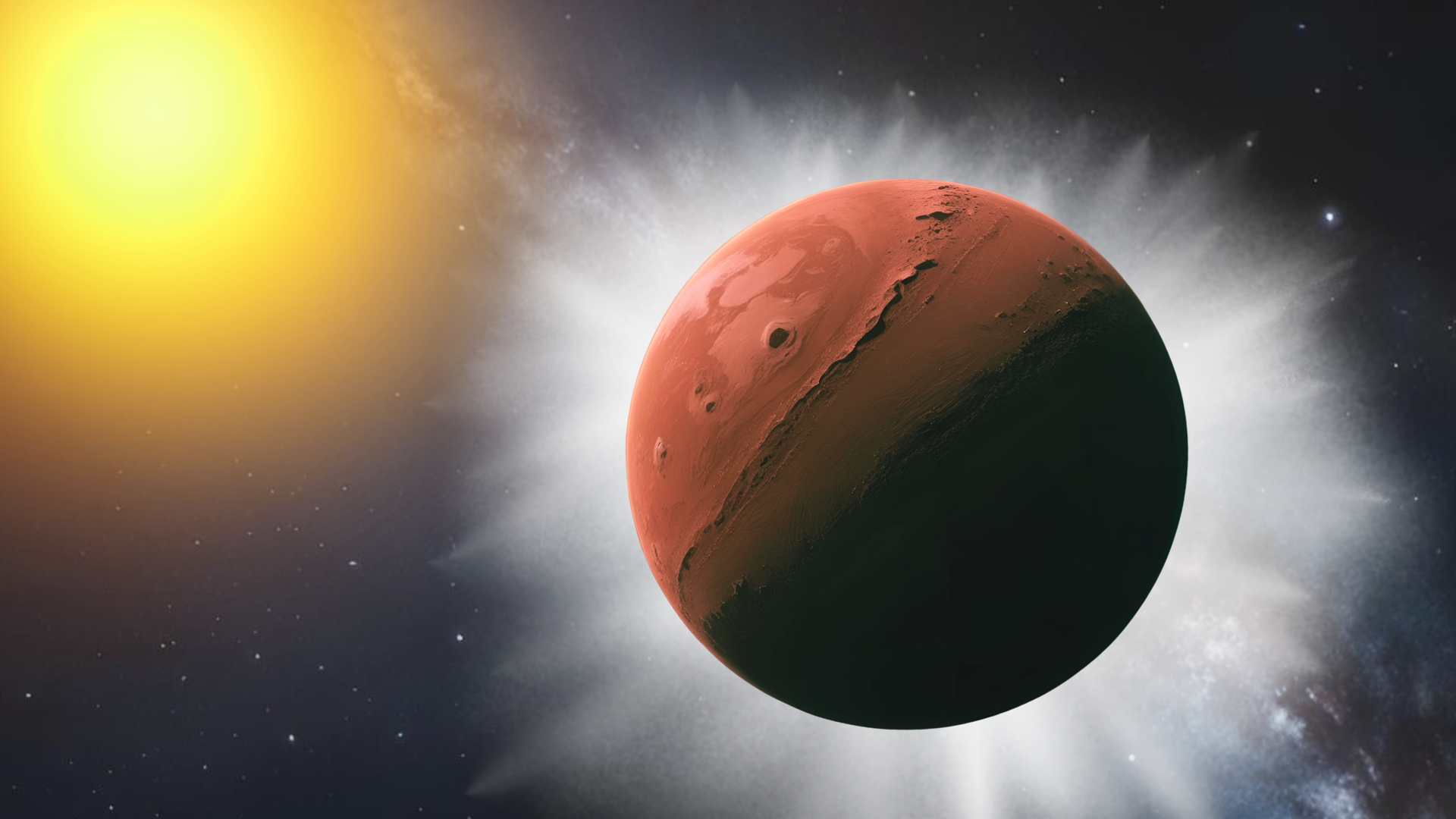
A rusty red shape surrounded by a spiky cloud of white smoke

An illustration of the atmosphere of WASP-17b with "gems" rising from it. (Image credit: Robert Lea)

"Theory predicts that the morning and the evening sides should have a strong temperature difference, and WASP-17b fits really nicely in that trend – pretty much bang-on what we thought it would be," Alderson said.

The successful application of the transmission strings method is an exciting step forward in the modelling of the atmospheres of the over 6,000 worlds in NASA's exoplanet catalog.

"This is proof of concept that planets are, in fact, 3D objects, and that, consistently, as they go around their star, what we predict should be happening is happening," Alderson concluded. "To move beyond computational exercises and see it for real is a different matter."

The team's research was published on Wednesday (Oct.14) in the journal Nature Astronomy.

Astronomers discover the 1st ever green star, a cosmic zombie just in time for Halloween

How awesome would it be if the sun could take on a spooky green glow for Halloween? It turns out that scientists have discovered that our star may indeed go green, but only billions of years from now after its death  — and only if it then starts eating planets like a cosmic zombie.

That's possible because scientists have discovered that white dwarfs, the type of stellar remnants sun-sized stars leave behind when they die, can actually take on a range of colors including green if they snack on their rocky planets like cosmic cannibals.

For stellar scientists, the colors of stars have always been indicative of their temperatures. Cool stars look orange, while stars like the sun look white, and the hottest stars glow pale blue. This is akin to a blacksmith's iron glowing red, then orange, then white-hot as it heats up. Researchers have always assumed that white dwarfs follow the same rule. However, new research suggests that these stellar corpses could glow in a range of colors including green, pink, cyan, yellow, and purple. That means the universe is far more colorful than we suspected.

"Most stars, including most white dwarfs, behave like 'perfect radiators,' so their color is set almost entirely by temperature. But nobody had really looked into what else might be possible for white dwarfs," team leader Mark Hollands of the University of Warwick said in a statement sent to Space.com.

"It turns out these incredibly dense stars caaaaan produce colors nobody expected, and some of them genuinely surprised me."

How white dwarfs break stellar color rules

White dwarfs get their name because when they were discovered, they appeared surprisingly hot and glowed white or pale blue. However, this new research suggests that this slightly bland and uniform appearance is because no white dwarf is close enough for Earthbound astronomers to see their true colors.

The key to the rainbow-like array of colors this team suggests white dwarfs could possess is their density. White dwarfs form when stars with a mass roughly that of the sun run out of fuel and can no longer support themselves against their own gravity, causing their cores to collapse. As a result, the matter that makes up white dwarfs is around the density of water, millions of times denser than the sun's surface, the photosphere.

In these conditions, elements like carbon, calcium, and sodium can interact with the surrounding dense helium plasma and absorb light across a wider range of colors than they would at lower densities. That shifts the colors of white dwarfs away from the white/light blue seen for a perfect radiator of heat.

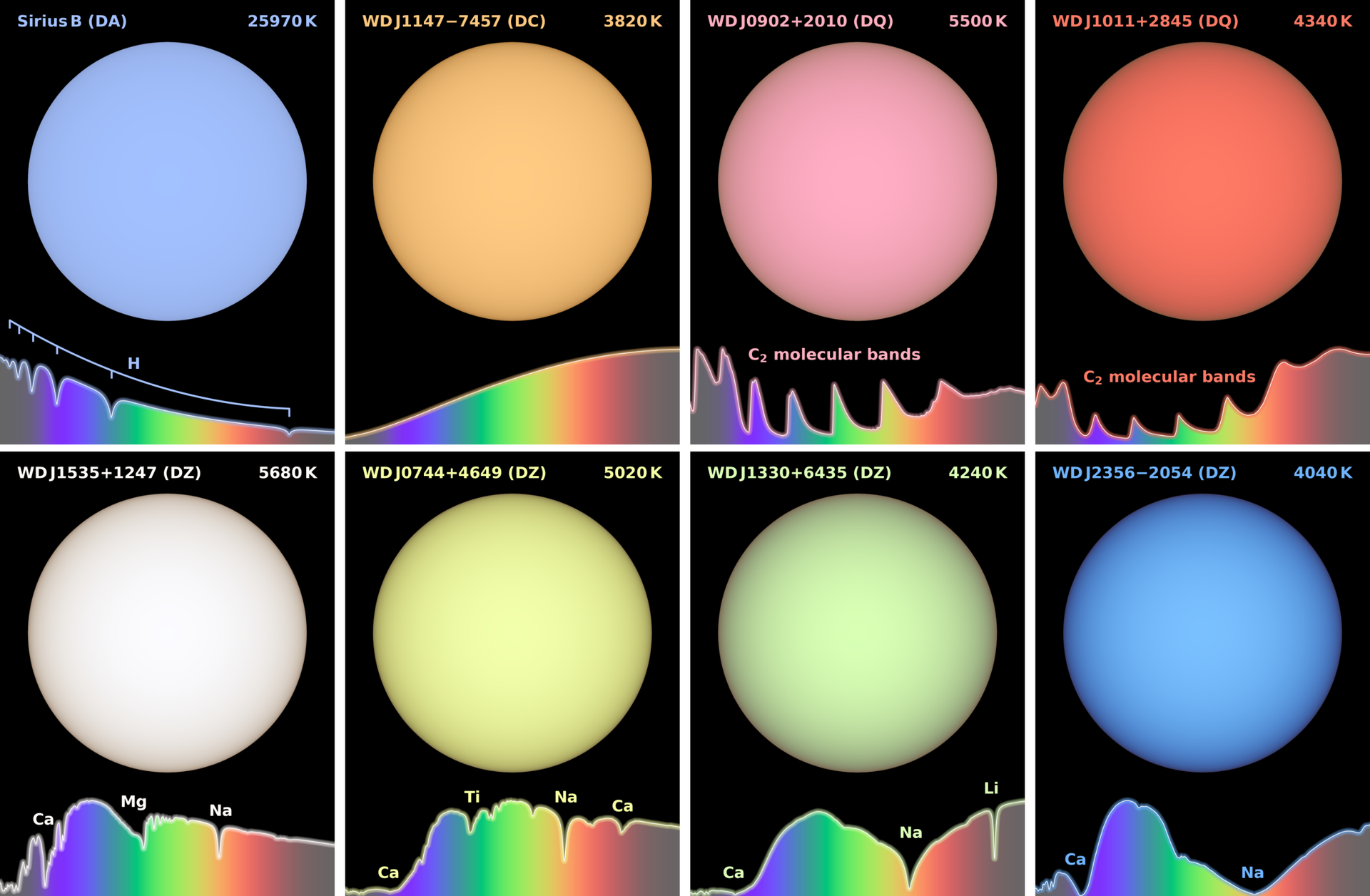
Eight spheres of different colors

Colour-accurate simulated images of white dwarfs.  (Image credit: Mark Hollands/University of Warwick)

The researchers found that the colors of white dwarfs would fit into distinct groups tied to the individual chemical makeup of the stellar remnant's atmosphere.

White dwarfs abundant in carbon should be pink or purple, while those that have been enriched with debris from consumed asteroids and comets, and the remains of old planetary systems, would take a more yellow hue. Cooler white dwarfs with mixed hydrogen and helium atmospheres often would glow cyan or pale blue, caused as hydrogen molecules collide with helium atoms in their dense atmospheres.

One of the most striking examples of white dwarf coloration, however, would arise when one of these living dead stars starts feeding on the planets around it like a horror movie zombie.

Zombie white dwarfs go green

The researchers found that some dead star white dwarfs can go a little green around the gills after snacking on orbiting planets.

An example of this is WD J1330+6435, a cool white dwarf located around 326 light-years away, which has been accreting rocky material from a planetary companion. This has enriched its atmosphere with calcium, lithium, and sodium, and the team's model suggests this would have led WD J1330+6435 to adopt a green hue.

But unlike the green-tinged zombies of George Romero's classic Dawn of the Dead, there are no hordes of these green-faced cosmic zombies ... yet.

The researchers think that no other star, living or dead, has ever been credibly reported as green. That makes WD J1330+6435 the first known genuinely green star.

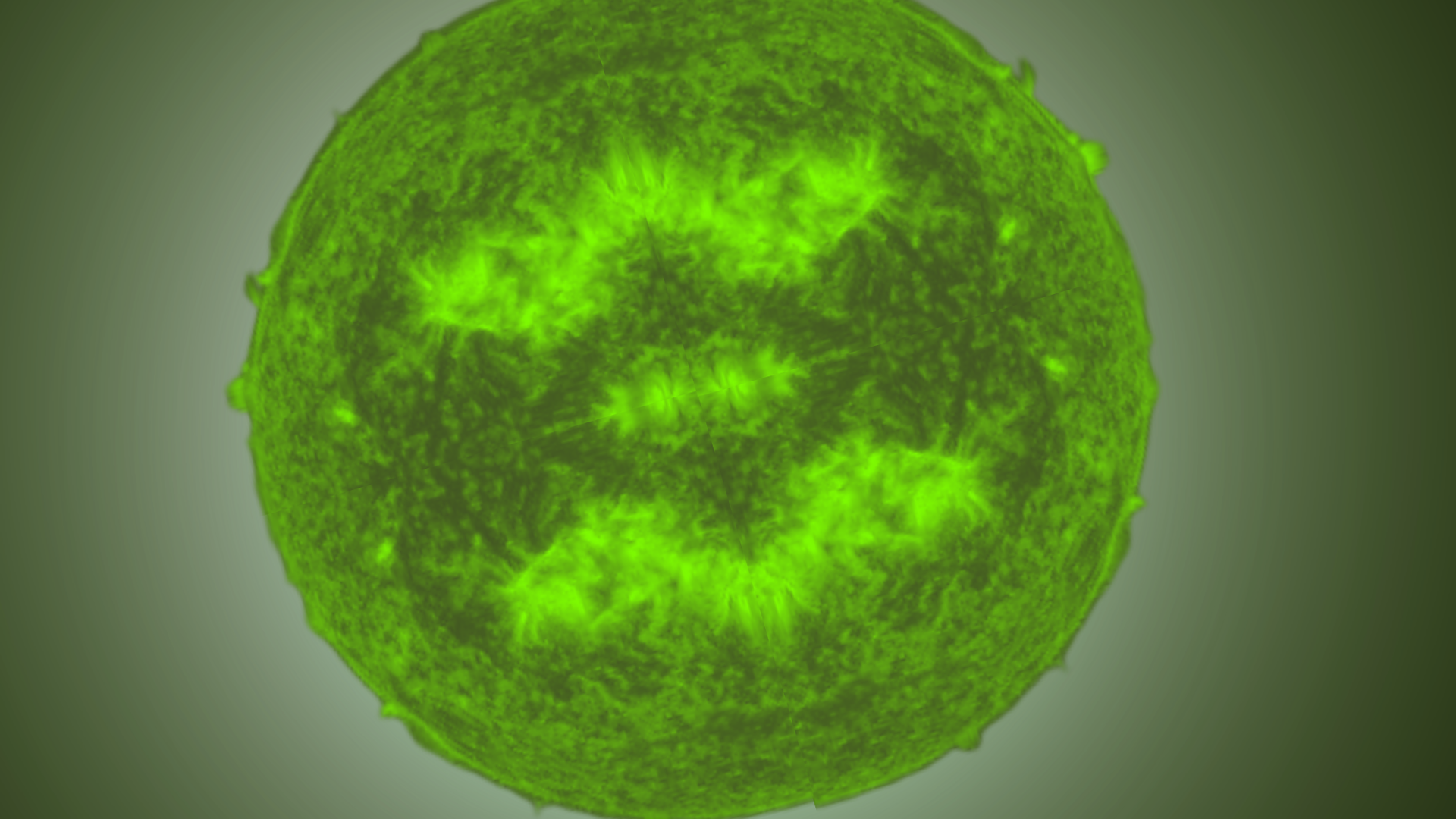
A green sphere with dark patches

An illustration of a green star (Image credit: Robert Lea (created with Canva))

"The traces of sodium in the atmosphere of this white dwarf absorb the orange part of the spectrum, leaving behind a ghostly green glow," Hollands said. "Imagine standing on a planet and looking up at a green star. It feels like something out of science fiction."

Scientists see red

The team didn't just discover that a known white dwarf is the first-ever green star; they also discovered what could be the reddest star ever in the form of the white dwarf WD J1011+2845.

Located just 48 light-years from Earth, this white dwarf has a deep convection zone that carries carbon from its core to its surface. These carbon molecules distort light from the white dwarf, causing a deep salmon-pink glow unlike anything seen in any other star.

A pink sphere with a cross section standing out

Enriched from below: The cool white dwarf WDJ0902+2010 has a deep convection zone within its helium dominated outer envelope. (Image credit: Mark A. Garlick/University of Warwick)

Despite this rainbow of white dwarfs, the team theorizes that white is still the most common color for these stellar corpses. Only five of the 151 white dwarfs within around 65 light-years of Earth have extraordinary coloring. Extrapolating this to the total population of white dwarfs, the team estimates that only one in 30 of these dead stars has an unusual color.

"One in thirty might not sound like a huge fraction, but across the entire population of white dwarfs in the universe, that is still a lot of oddly colored stars out there," Boris Gänsicke, Department of Physics, University of Warwick, said. "Yet if we take the median across a representative population of white dwarfs, we found that the average white dwarf really is white."

The team's research was published on Thursday (Oct. 14) in the journal RAS Techniques and Instruments.

Planetary genealogy: Milky Way worlds belong to 1 of 2 ‘families,’ scientists find

You can tell a lot about how a child will age by looking at their parents, and it turns out that this could be true for planetary systems, too. Scientists have performed cosmic genealogy on planetary systems in the Milky Way, finding two distinct families that influence the evolution and fate of these systems.

The study team, led by researchers at the Italian National Institute for Astrophysics (INAF), studied 300 of the best-understood multiplanet systems of the over 1,000 that astronomers have discovered in the Milky Way.

The team's research clarifies how the environments around infant stars directly affect planetary fates and, in turn, the survival of extrasolar planets, or exoplanets, that are potentially capable of hosting life. That could be crucial as astronomers search for life beyond the solar system, pointing them to systems with potentially habitable planets like Earth.

"The fundamental question we started from was: What determines the characteristics of planetary systems as we see them today? Are they established at birth or sculpted by evolution over time? The truth, in the end, turned out to lie somewhere in the middle," team member and INAF researcher Diego Turrini said in a statement sent to Space.com.

"Our results show that there is a genetic link between planetary systems and their stars, and that, depending on the star around which they are born, this link also determines their fate," Turrini added.

What is the genetic code of a planetary system?

The first "family" the scientists identified consists of wide, massive systems, often with total masses between two and 10 times that of our own solar system. The planets in these systems orbit stars more massive than the sun with lower concentrations of elements heavier than hydrogen and helium (which astronomers somewhat confusingly call metals) than seen in our star.

The second family is more compact and lower-mass systems. The members of this family are composed of planets with comparable masses and sizes, a so-called "peas-in-a-pod" configuration. They orbit stars with mass and metallicity equal to or lower than those of the sun, with orbits that are usually much tighter than those of Mercury, the closest planet to the sun.

One of the "genes" Turrini and colleagues selected to sort planetary systems into families was the deviations that planets make from orbiting their star in the same circular plane. That, in turn, reveals a family history of violent gravitational instability caused by events like giant collisions and planetary ejections.

Violent events were common for the first family, but much less so for the second group of planetary systems, the researchers found. They determined that the number of these turbulent events a planetary system experiences can be linked to even modest variations in the environment in which planets form. These variations arise due to different properties of the parent star of those systems.

Thus, the nature of the star in these systems doesn't just fundamentally change the formation of planets in their systems; it influences the system's future evolution, determining whether it will be characterized by phases of marked instability and giant impacts.

A light brown sphere collides with a small dark blue sphere surrounded by irregularly shaped rubble

An illustration shows two planets colliding. Such collisions may be more common around certain types of stars (Image credit: Robert Lea (created with Canva))

"The main difficulty during the data analysis was determining whether the two families of planetary systems were real or just an illusion created by the technological limits of current observational techniques," said team member Camilla Danielski, of the University of Valencia in Spain.

"At the end of the path, it became clear that selection effects acted as the tip of the iceberg, revealing the existence of much deeper structural diversities between these systems," Danielski said.

The scientists tested their conclusions by running simulations of planetary system evolution, all of which began with different conditions.

"The scenarios that best reproduce the dynamical properties of the family of wide and massive systems are those in which the systems are unstable from birth," said research supervisor and INAF researcher Danae Polychroni. "The greater abundance of material from which planets form around their host stars causes them to be born too large, preventing the system from remaining stable."

The team's research was published on Tuesday (Oct. 13) in the journal Nature Astronomy.

Scientists discover that some of the universe’s biggest explosions may have never happened at all

Now you see them, now you don't. Scientists have discovered that some of the universe's most powerful explosions, hypernovas, may not happen at all.

These explosions, known as hypernovas, were first proposed to explain unusual stars in the halo of our galaxy, the Milky Way, and in a neighboring dwarf galaxy. It was suggested that these stars could only form from the debris of an explosion 10 times more powerful than the 'average' supernovas.

The team behind these new findings suggests that ordinary supernovas could actually account for these stars when the uneven or non-spherical way they fling out matter is considered.

"If we look at a supernova today, the star's materials are not spread evenly. Oxygen might predominantly fly in one direction, sulphur in another. New stars might form from a mix of pieces of the supernova, not its overall mix of elements," team leader Anmol Aggarwal of University College London (UCL) said in a statement. "We developed mathematical models that took account of this and found in all cases that stars with a very unusual mix of ingredients were most likely formed from ordinary supernovas.

"All the evidence we see for hypernovae is suddenly gone."

Hypernova vs. supernova: What's the difference?

Supernovas occur when massive stars run out of fuel for nuclear fusion, effectively ending their lives. This results in the star's core collapsing, sending shockwaves rippling through its outer layers, causing explosions we call supernovas.

Hypernovas are proposed to occur in a similar way, but for an even more massive and rapidly spinning star. This results in a vastly more energetic explosion.

When supernovas or hypernovas happen, they fling elements that the dying star has forged throughout its lifetime into their surrounding cosmic environments. These elements eventually become the building blocks of the next generation of stars.

That means analyzing the chemical signatures of stars can tell stellar scientists about their family histories.

Plumes of white smoke emerge from a spherical cloud

Artist's impression of a hypernova, generating 2 gamma-ray jets. (Image credit: NASA/JPL-CALTECH)

"Just before a star goes supernova, it has layers like an onion, with heavier elements at the center and lighter ones further out. Our model looks at how much material from each layer or each region would be needed to fit the observed star," Ralph Schoenrich of Mullard Space Science Laboratory at UCL said. "We still don’t know how well the supernova material gets mixed before it forms new stars. That is despite decades of work in this area. Our research suggests some mixing goes on, but incomplete mixing.

"We need to take this into account in our models of how chemicals evolve in galaxies and of how the interstellar medium works."

The team began their investigation by observing four stars that are suspected to have been forged from material ejected in a hypernova explosion. Three of those stars were more likely to have been created after supernovas, the team concluded.

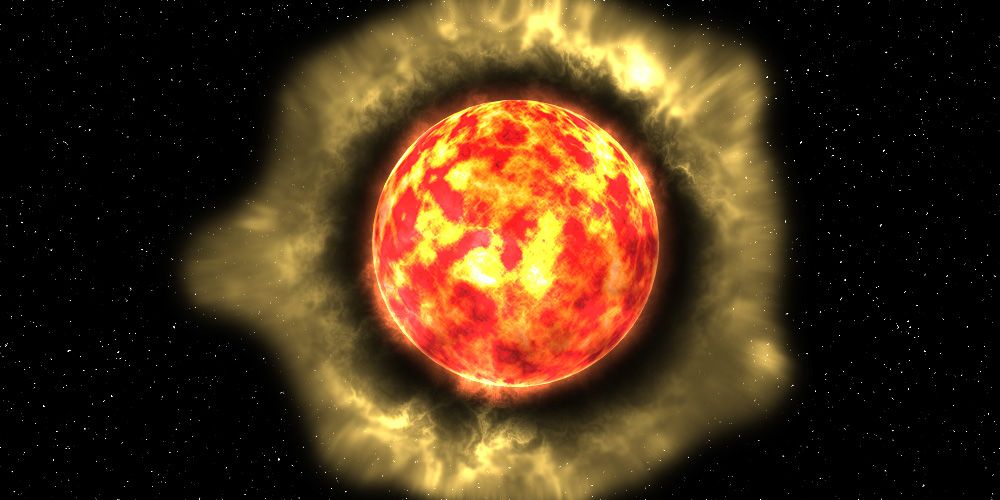
A red sphere surrounded by a halo of yellow smoke

An artist's impression of the dust surrounding a red giant star. (Image credit: Anna Mayall )

The scientists then studied a single red giant star in the halo of the Milky Way with an odd chemical composition, including an overabundance of heavy elements like silver and uranium. These are too heavy to be forged in the cores of all but the most massive stars, the kind of stars that go hypernova.

Such elements could also be created when two massive and dense stellar remnants called neutron stars collide and merge. However, this star doesn't have certain other heavy elements that would be present after a neutron star collision.

This team considered the origins of this star using a model of the Milky Way that has been rapidly enriched with elements heavier than hydrogen and helium, which astronomers call metals, via the death of the first generation of stars.

The rapid speed at which the star spins and the fact it exists at the outskirts of the Milky Way led the team to conclude that this star escaped a metal-poor dwarf galaxy and was eventually dragged into our galaxy. The event that created it, they concluded, was the combination of a neutron star merger and an ordinary supernova.

No hypernova required. An asymmetrical supernova would be enough, the scientists found.

The team's research was published as two papers in the journal Monthly Notices of the Royal Astronomical Society.

A faint glow from the early universe could help solve the mystery of dark energy

Hydrogen may be the most common element in the cosmos, but scientists could use it to do something unique: uncover the nature of dark energy, the mysterious force driving the accelerating expansion of the universe.

This new line of dark energy investigation comes from the fact that researchers have determined that the CHIME (Canadian Hydrogen Intensity Mapping Experiment) project can detect the faint radio glow of hydrogen from the universe's distant past.

Not only does this represent a faster and much less expensive way to investigate dark energy, but it is a major milestone for CHIME. The instrument was specifically devised to investigate dark energy and its pervasive influence.

"This is a completely new technique for probing the cosmos, delivered by an instrument that was conceived and built by Canadians," CHIME principal investigator Mark Halpern of the University of British Columbia said in a statement. "It's a bold new step in the global cosmology program and a Canadian success story."

Why is dark energy so problematic?

Dark energy is the mysterious force that is accelerating the expansion of the universe. It is so problematic for scientists because it started acting on the fabric of space only after the expansion triggered by the Big Bang had halted.

That's akin to pushing a child on a swing, watching it stop, and then seeing the swing start up again without a push. And, not only that, but the swing starts oscillating faster and faster. Consider scientists akin to very worried parents, who would really like to know where this ghostly push came from and how it is going to proceed.

Just as, if the push on the swing continues, the child could end up in the bushes, or in orbit, the strengthening of dark energy could result in the cold death of the cosmos, or even a "Big Rip" scenario that sees space shredded. Alternatively, if it weakens and allows gravity to reassert dominance, then the universe could collapse back in on itself, resulting in a "Big Crunch" ending that sees the cosmos compressed back into a singularity, as it was at the beginning of time.

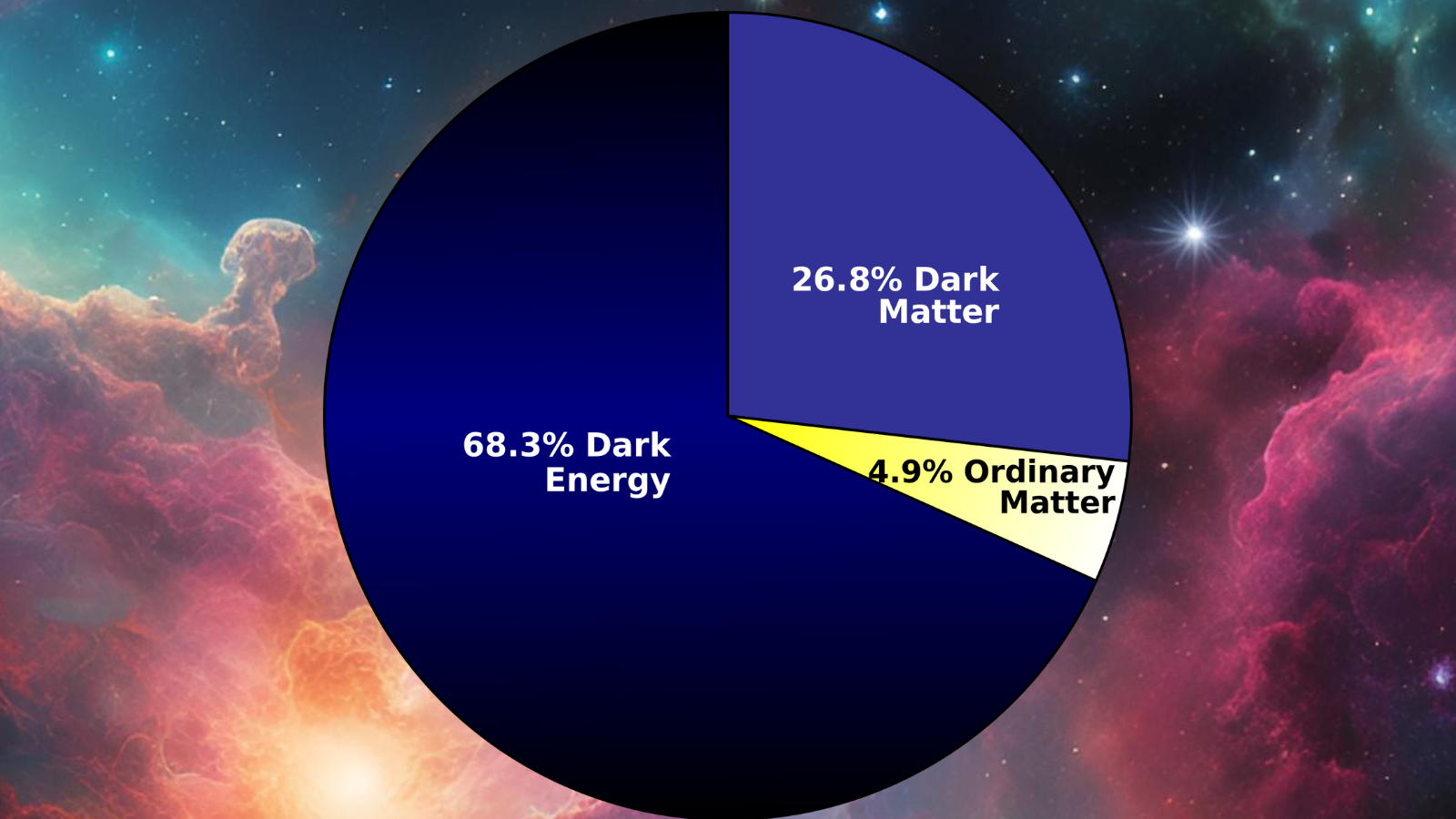
Dark energy is now the dominant element of the universe, accounting for 68% of the universe's matter-energy budget. It's little wonder that scientists are very keen to know what this mysterious force is.

A pie chart showing the universe's matter-energy budget

The universe's matter-energy budget showing the dominance of dark energy (Image credit: Robert Lea (created with Canva))

So how can hydrogen help the investigation of dark energy?

"Hydrogen is the most common element in the universe and the raw material from which stars form," team member Arnab Chakraborty of the University of Toronto said. "Its faint radio emission acts like a cosmic tracer, revealing how matter is distributed across space."

Previously, CHIME could map the distribution of hydrogen in the early universe but only by cross-correlating its observations with galaxy survey data from other telescopes, operations that cost millions of dollars and can only focus on regions of the universe dense enough to form stars. CHIME has now shown it can map the radio glow of hydrogen all on its own.

Indeed, the team has already begun making steps in this direction using just a tiny fraction of existing CHIME data. Using 94 nights of observations from 2019, they detected a hydrogen signal from when the universe was just 5 billion years old.

"Our data indicate that roughly 2% of the hydrogen in the universe was in neutral atomic form at this time, broadly consistent with other measurements," team member Shabbir Shaikh of Arizona State University said. "By measuring how that hydrogen is distributed and clustered, CHIME gives us a new way to test our understanding of how galaxies form and evolve."

CHIME has now collected seven years of data, and using this, the team is hoping to probe the distribution of hydrogen back to 3 billion years after the Big Bang.

The team's research was published across two papers in The Astrophysical Journal.
Astronomers witness supermassive black hole gorge on a cosmic meal before ‘burping’ radio jets 300 days later

Using the NASA X-ray spacecraft Swift combined with radio observations, astronomers have observed a supermassive black hole burping radio jets 300 days after a heavy cosmic meal. The team was also able to roughly estimate the mass of this feeding cosmic titan, which sits at the heart of the Perseus Cluster, a massive collection of thousands of galaxies.

The black hole sits at the center of the galaxy NGC 1275, located around 225 light-years away, and is the brightest galaxy of the Perseus Cluster. The supermassive black hole first flared in X-rays, which indicated an increase in the rate at which it was accreting matter. Actively feeding supermassive black holes sit in regions called active galactic nuclei (AGNs), with their immense gravity heating surrounding matter, causing them to glow brightly. These emissions are boosted by material channeled to the poles of the central black hole, from where it is blasted out as powerful twin jets that shine across the electromagnetic spectrum, particularly in radio waves.

The observation of the following radio jet from the AGN at the heart of NGC 1275 via flaring in radio waves is crucial for understanding the relationship between the disk of matter that surrounds and feeds the black hole, called an accretion disk, and the jets it launches. This so-called disk-jet coupling is key to developing a better picture of how black holes influence star formation in the galaxies in which they sit, and thus the growth of those galaxies.

Making these observations is no mean feat. The ideal spacecraft for observing X-ray emissions is Chandra, but it doesn't observe NGC 1275 frequently enough to observe its long-term behaviour. NASA's Neil Gehrels Swift Observatory may lack the power of Chandra, but having launched in 2004, it has collected a vast amount of data regarding NGC 1275 and its central supermassive black hole.

"It is fairly difficult to see the inner region of this AGN because NGC 1275 is at the center of the massive Perseus cluster of galaxies, which adds additional light to our observations," team leader Sarah Ketchum of the University of Michigan told Space.com. "We developed a model that allowed us to remove the cluster emission from archival Swift data, and in doing so, we were able to see the changes in the X-ray flux from gas accreting onto the black hole in NGC 1275, from 2007 to 2025."

Ketchum added that the capabilities of Swift were key to this investigation of NGC 1275, which is the ideal laboratory for the study of disk-jet coupling.

"There have been studies on other galaxies with AGN that show evidence of coupling between gas accretion traced in X-ray light and gas ejection in jets, traced in radio light. But NGC 1275 reveals the impact of black hole jets on large spatial scales better than any other system," the University of Michigan researcher continued.

This black hole didn't eat a star

Ketchum and colleagues saw the strongest ever X-ray flare from NGC 1275 in Feb. 2023. Lasting less than 60 days and consisting of two 5-day blasts, this episode saw a doubling of the X-ray brightness of the AGN at the heart of NGC 1275.

The flaring was so extreme that the team had to rule out a tidal disruption event (TDE) as the cause. These occur when an unfortunate star's orbit brings it too close to the immense gravitational influence of a supermassive black hole. This influence generates intense tidal forces that simultaneously squash and squeeze the star, "speghettifying" it and allowing the black hole to snack on some plasma pasta.

"We were able to rule out TDEs as a cause," Ketchum said. "Thus, the flaring was likely caused by a spike in the rate at which matter accreted onto the black hole."

Using Swift data, the team was able to infer the radius over which the AGN emits radiation. Because the size of a black hole is directly correlated with its mass, this meant that the researchers were able to constrain the mass of the black hole at the heart of NGC 1275. They determined that this supermassive black hole has a mass somewhere between 100 million times the mass of the sun and 1 billion solar masses.

The team then compared their data to known radio data to better understand the relationship between the X-ray emission and the radio jets that disrupt gas in NGC 1275.

A large purple spiral against a black background

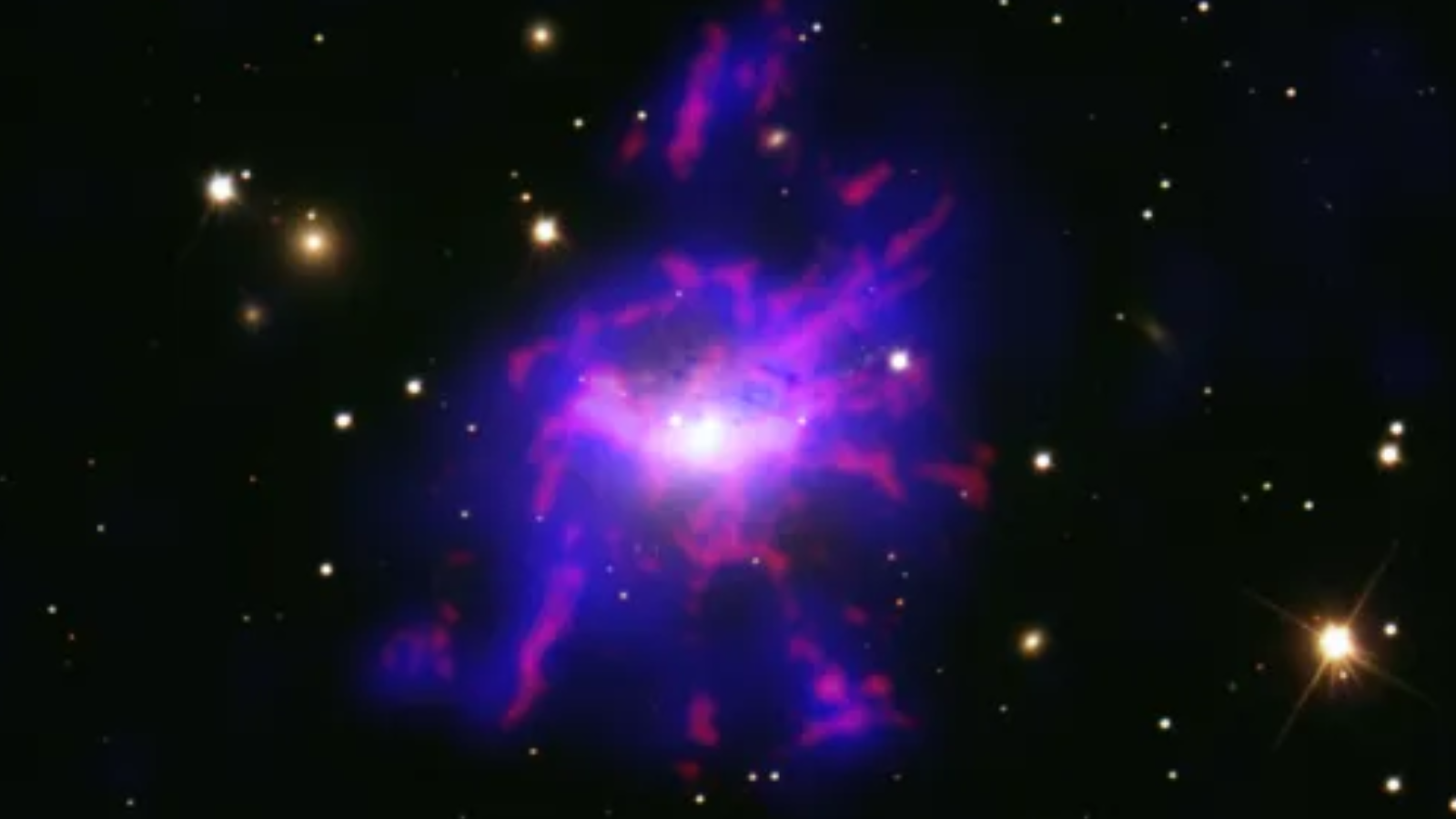
The Perseus Cluster and its central supermassive black hole in white as seen by the Chandra telescope and the VLT. (Image credit:  X-ray: NASA/CXC/SAO/V. Olivares et al.; Optical/IR: DSS; H-alpha: CFHT/SITELLE; Centaurus Cluster: X-ray: NASA/CXC/SAO/V. Olivaresi et al.)

Ketchum added that she and her colleagues found tentative evidence of around a 300-day delay between the X-ray flaring and the radio wave emission. This indicates the time it takes plasma to travel from the base of the jet to a knot or shock created when it hits surrounding gas or dust.

"This should be tested further in the future. Our X-ray data only sparsely sample the changes in NGC 1275," Ketchum said. "This makes it difficult to determine an exact relationship between the X-ray and radio radiation for large portions of our light curve, so we would need more X-ray data to further study this connection."

The researcher added that if the X-ray flares are produced close to the black hole, an echo of these flares should be seen coming from the accretion disk.

"An emission line from neutral iron is seen in data from NGC 1275, and this may be the echo. However, we likely need many observations with XMM-Newton and XRISM ( X-Ray Imaging and Spectroscopy Mission) to really establish that connection," Ketchum concluded.

The team's research has been accepted for publication in the Astrophysical Journal Letters, with a pre-peer-review version available on the repository site arXiv.

Mysterious 10-minute X-ray burst from a distant galaxy may have come from 2 dead stars colliding

Astronomers investigating mysterious flashes of X-rays believe that these blasts could stem from collisions between neutron stars, the events that forge elements like gold, silver, and platinum.

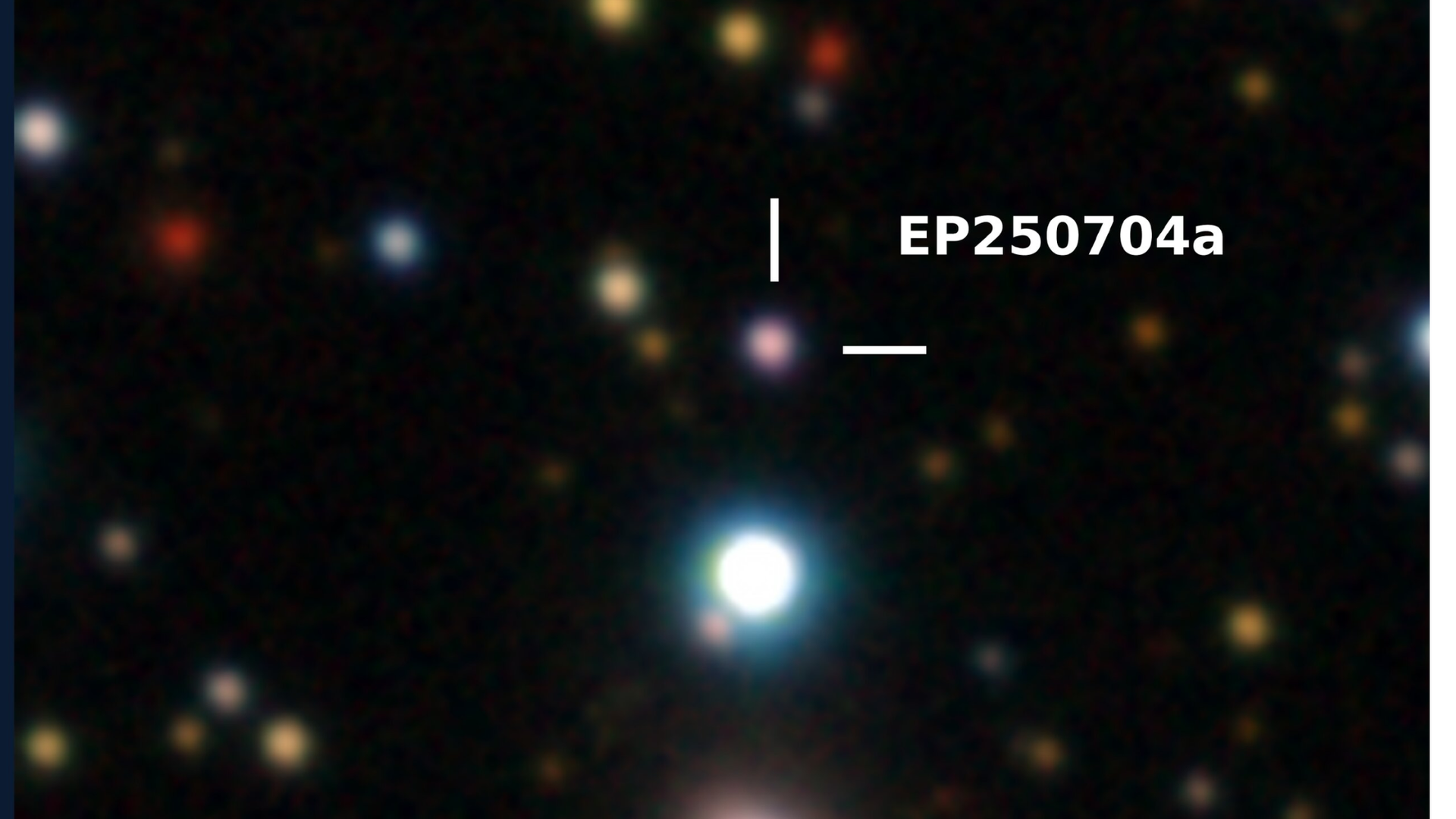
The event designated EP250704a, was first seen on July 4, 2025, as a blast of gamma rays lasting half a second followed by a bright X-ray emission lasting 10 minutes. After receiving an alert from the joint European-Chinese Einstein probe that witnessed the blast, a team of astronomers started to hunt for its cause by studying the aftermath of the explosion using the European Southern Observatory's Very Large Telescope (VLT), the Very Large Array (VLA), and other telescopes.

According to astronomer Niccolò Passaleva who led the observations of the X-ray flash with the VLT, this cosmic outburst was unlike any scientists had seen before. "This is the longest-lasting prompt X-ray flash ever observed from a neutron star merger," Passaleva said in a statement. "It is an opportunity to have a front-row seat to the most extreme forces of the universe and discover more of its secrets."

Neutron stars are created when massive stars die in supernova explosions, cramming one or two the mass of the sun into a width akin to a city on Earth and creating material so dense that a single teaspoon of neutron star matter brought to Earth would weigh 10 million tons. When these extreme dead stars slam together, they create environments so turbulent and violent they are capable of forging elements so heavy that even the hearts of stars can't do it. Elements like the gold on your finger.

These collision and merger events, marked by flashes of light called kilonovas, have long been associated with flashes of high-energy gamma-rays that disappear within two seconds, but new research suggests some neutron star mergers could reveal themselves via blasts of X-rays lasting minutes.

In particular, scientists have wondered if neutron star mergers could be the cause of hundreds of X-ray flashes in distant galaxies discovered by the Einstein probe since its launch in 2024. While some of these have been linked to the supernova-explosive death of massive stars that can create a neutron star or a black hole, others have defied explanation. EP250704a is one such X-ray flash.

"When I saw the X-ray data from this new event, I realized something was up," team member Eleonora Troja, part of the Einstein Probe European collaboration, said in the statement.

The team believes that there is something special in the neutron star merger mix that results in these X-ray bursts.

A glowing purple sphere in white crosshairs

EP250704a, an X-ray event suspected to be neutron merger. (Image credit: Niccolò Passaleva, Eleonora Troja (ERC BHianca), ESO/VLT)

Merging with a magnetar

All neutron stars are created the same way from the collapsing core of a massive star, but not all neutron stars are equal.

Just as an ice skater pulls in their arms to increase the speed of a spin, the rapid reduction in radius of a collapsing stellar core can "spin up" the rotation of a neutron star to 'over 700 times per second. This collapse can have another consequence too.

It turns out that magnetic fields get stronger when magnetic field lines are pushed closer together. That means the collapse of a stellar core with an already powerful magnetic field can create a neutron star with the strongest magnetic field in the universe. Those neutron stars have a special name: magnetars.

A blue sphere surrounded by green field lines and a ring of orange fire

An illustration shows a magnetar surrounded by green magnetic field lines (Image credit: Robert Lea (created with Canva))

The team behind this research thinks that the neutron star merger in question involved at least one magnetar.

"If the remnant of the collision is a magnetar, it could keep bursting for longer," Troja said. "Magnetars are rapidly spinning neutron stars with huge magnetic fields. When they dump their magnetic power into the surroundings, they can make any explosion brighter and longer-lasting."

The progression of colliding neutron stars as seen by a gold and blue spacecraft

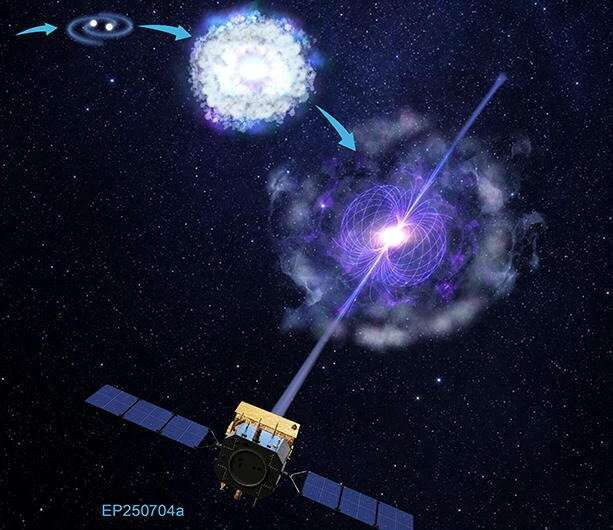
An illustration of the Einstein probe detecting a cosmic explosion caused by two colliding neutron stars (Image credit: Science Bulletin (2026))

The researchers ruled out a supernova as the cause of the X-ray burst and were also able to determine that the light from this collision has been travelling to Earth for 6 billion years.

Discovering more of these extreme X-ray flashes could help astronomers determine how often magnetars are formed through these neutron star mergers, Passaleva said in the statement.

The team's research was published in the journal Science Bulletin.