
‘Let’s not fool the public’: Why moon art should be more realistic in the Artemis age

GOLDEN, Colorado — The moon is in need of good and accurate artists!

As NASA's Artemis program hits its stride, and in a few years "reboots" our moon with a human presence, there's an urgent need to guard against artistic misrepresentations of the lunar landscape, experts say.

We've all seen those alluring lunar renderings of vehicles and astronauts bounding about while setting up equipment and putting in place a moon base.

illustration of four astronauts in white spacesuits working on the moon

What's wrong with this picture? Missing in this artwork are small craters, dust, dirty equipment and dirty astronauts. (Image credit: NASA)

Reality versus depictions

"We are telling the public the moon is easy — it is not!"

That's the matter-of-fact warning from Daniel Britt, the Pegasus Professor of Astronomy and Planetary Sciences in the Department of Physics at the University of Central Florida. He's also the director of the Center for Lunar and Asteroid Surface Science.

Britt spoke about and showcased artists' misconceptions during a "reality versus depictions of the lunar surface" talk here at a Space Resources Roundtable, held from June 2 to June 5 on the campus of the Colorado School of Mines.

"I wish I could say that engineers and managers know better, but they don't. We are training a generation of engineers to not worry about terrain. If the artists are getting it wrong, it is our fault. Let's stop fooling ourselves," Britt said.

Well versed in what the lunar surface truly offers, Britt scolded a number of arty accounts of lunar territory promulgated by both NASA and commercial space ventures. He spotlighted what's wrong with those pictures — for starters, small craters and ever-present lunar dust, along with dirty astronauts, dirty equipment and dirty habitats.

two photos of a dusty astronaut in a white spacesuits. in the right-hand picture he has his helmet off and is inside his spacecraft

Dusting off past moonwalker experiences reveals a dusty future on the moon. (Image credit: NASA/Daniel Britt)

Facts of life

A flat, dustless moon is not the one we are sending Artemis astronauts to, said Britt. Crews will experience coarse terrain, pervasive dust, and a surface unlike anything here on Earth. These are the facts of life on the moon, he said.

The Apollo moon-landing missions learned this first hand. But those astronauts explored equatorial areas. The Artemis program is targeting the lunar south polar region, which will be tough to deal with thanks to the low angle of the sun.

"When you look into the sun, it will be blasting into your face. But at least you'll see the shadow of that crater you are about to trip into," said Britt. "But looking down-sun, you won't see diddly squat."

"There's need to stop deluding ourselves," Britt told Space.com, advocating the creation of a 1-to-10 scoring system for lunar art, with prizes for the worst and best visualizations

"What I want to do is land on the moon way safer and easier," he added, "so you need to ask yourself what's missing from these depictions. We are training the public to think this is easy."
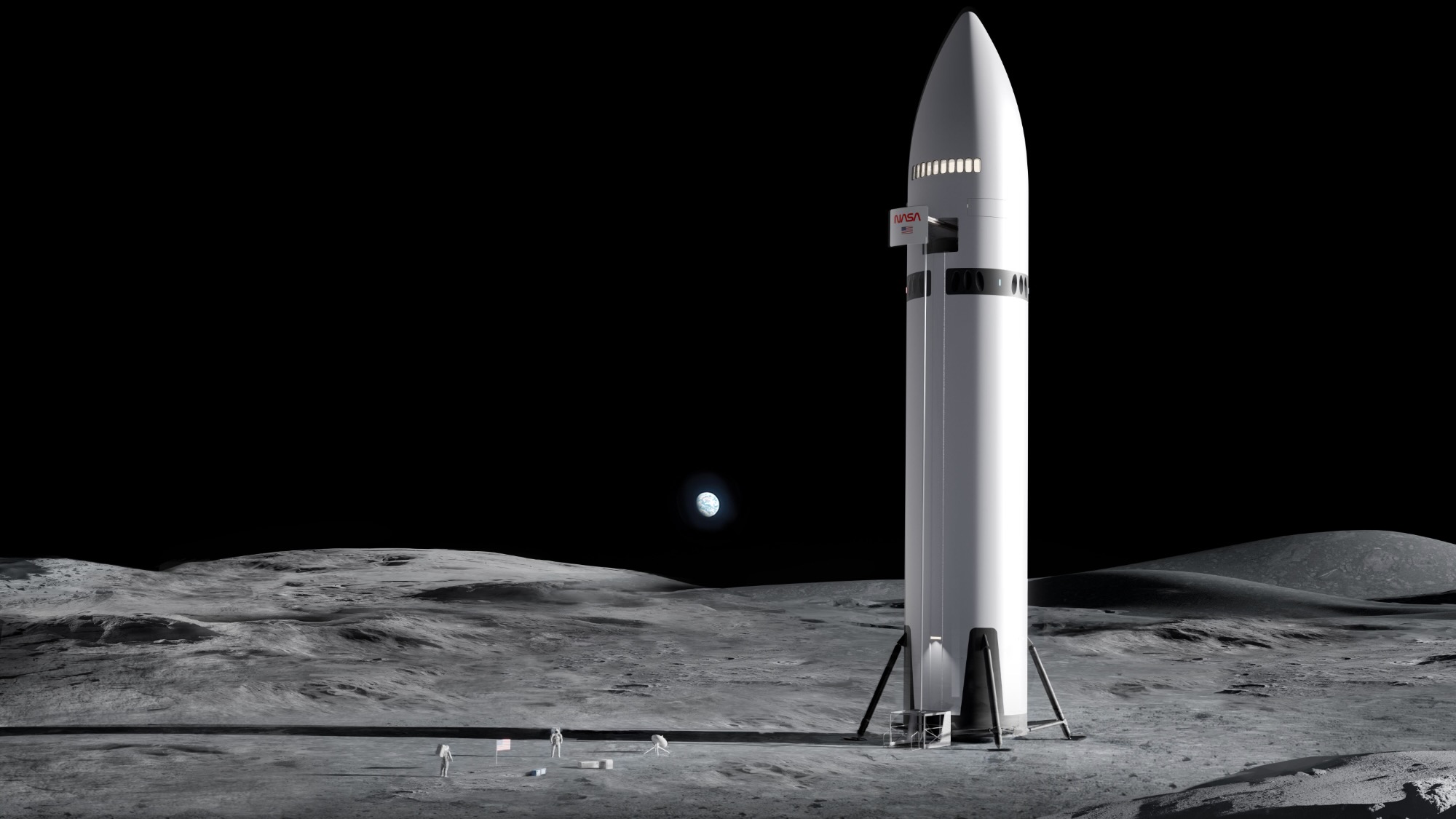
illustration of a very tall white spacecraft on the moon, with earth in the background

No dust, almost no small craters, no tipping problems. (Image credit: SpaceX)

False impression

To support his concern, Britt spotlighted both Apollo moonwalker-taken imagery and the scenery as projected by artists, be it using paint brush or artificial intelligence-guided computer work.

"The sun angle washes out the rough terrain. Almost all the pictures taken from the surface give the very false impression of a flat, gentle terrain," Britt said. "The reality is that the lunar surface is heavily cratered, rough, very dusty and covered in regolith."

Most Apollo surface images were taken "down-sun" because looking "up-sun" was hard. "This leaves a very false impression of a flat moon with gentle terrain," Britt said.

illustration of a large white spacecraft on the moon with two astronauts in white spacesuits on the ground nearby

Why should we care about artist's misconceptions? Because they create false impressions that lunar landings are easier than they actually are. (Image credit: Blue Origin)

Tilt problems

Apollo was pretty lucky, Britt said, observing that several of the six human moon landings experienced tilt problems. For instance, Apollo 14 experienced a 7-degree tilt on landing, and Apollo 15 had an 11-degree tilt on touchdown.

Apollo 11 had to dodge a boulder field. Apollo 12 and Apollo 16 landed on the edge of big craters. "Even small craters can be meters deep," said Britt, recalling problems encountered by astronauts on their descent to the moon.

"The dust went as far as I could see in any direction and completely obliterated craters and anything else … I couldn't tell what was underneath me," astronaut Pete Conrad said during an Apollo 12 debriefing. "I knew I was in a generally good area, and I was just going to have to bite the bullet and land, because I couldn't tell whether there was a crater down there or not."

Similarly, Apollo 16 commander John Young said: "I couldn't judge slope out the window worth a hoot, and that's the truth. Even down low. The ground looks flat, but I'm sure it would look flat if it had been a 6-8 degree slope, too. I don't see any way around that."

photo of a white and gold spacecraft tilting on the edge of a small crater on the moon

Landing on "flat" places on the moon is a dicey situation. This Apollo 15 image shows the 11-degree tilt experienced by that mission during touchdown. (Image credit: NASA)

Getting it wrong

A flat, crater-free, dustless moon is a staple of imagery issued by NASA, the European Space Agency, other space agencies, and even private space firms, said Britt.

"Yes, these are artists' impressions," Britt said, "but somebody is telling the artists what to draw. I love the idea of landing and operating on a moon without dust, small craters, and rough terrain. However, we see the misconception of a flat, gentle moon everywhere."

"Commercial providers are just as bad. No dust, almost no small craters, no tipping problems. Yes, these are artists' impressions, and they are getting it wrong," said Britt. "NASA knows better. All these people should know better, but don't. Let's not fool the public. We owe them better data."
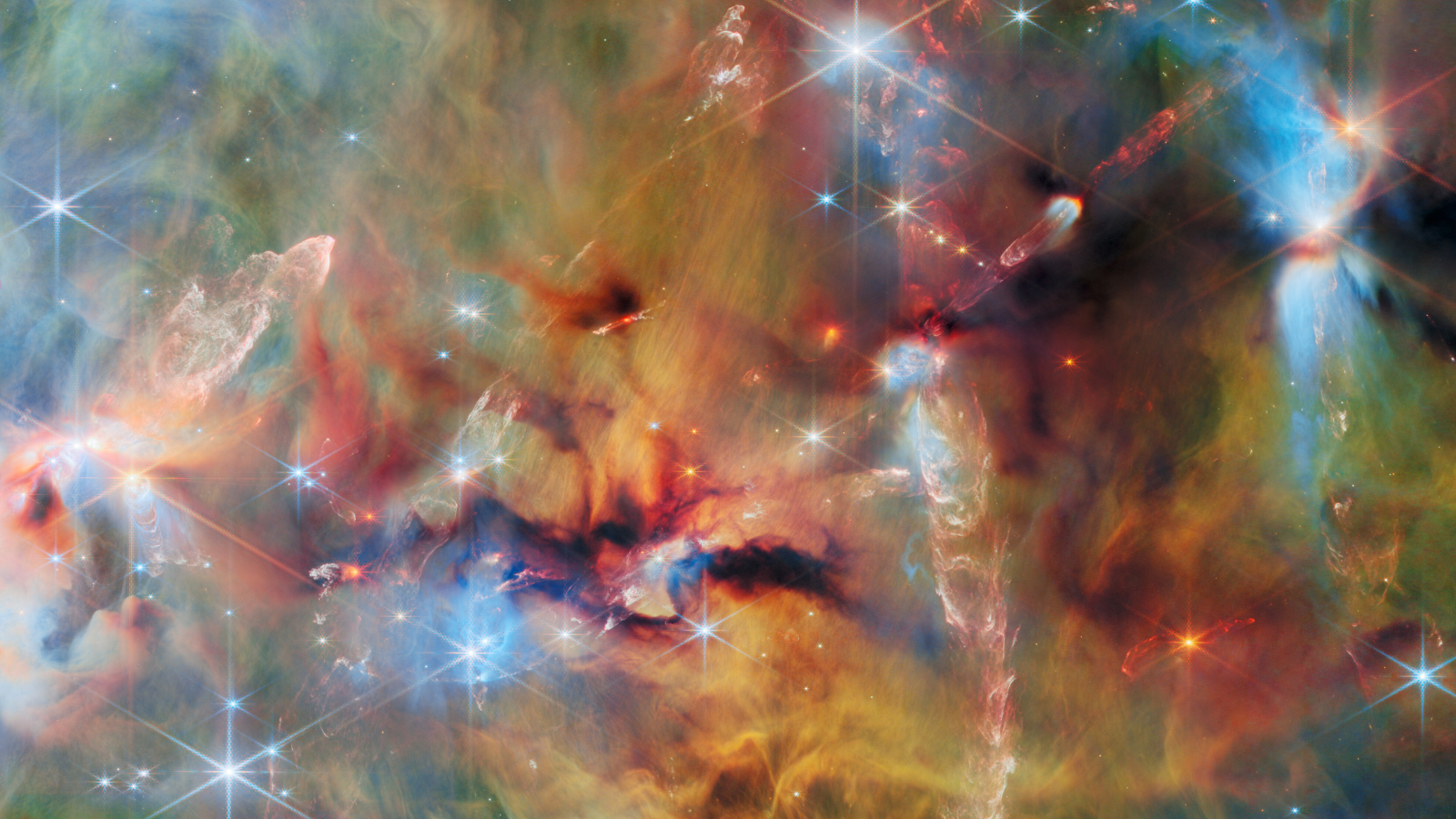
James Webb Space Telescope captures the star-forming clouds of Orion A in stunning detail | Space photo of the day for June 22, 2026

The James Webb Space Telescope Picture of the Month shows the giant molecular cloud Orion A, an area of the sky replete with star-forming clouds. (Image credit: ESA/Webb, NASA & CSA, T. Megeath, M. Zamani (ESA/Webb) Acknowledgement: M. H. Özsaraç)

The image of the day for Monday (June 22) shows the star-forming clouds of Orion A in stunning detail.

Released as the James Webb Space Telescope (JWST) Picture of the Month, the image further demonstrates the impact the $10 billion space telescope has had on our view of the cosmos since it began operations in July 2022.

What is Orion A?

Located around 1,300 light-years from Earth and situated to the south of Orion's Belt in the night sky, Orion A is one of the largest and closest molecular clouds to our planet. Shaped like a filament, this structure of gas and dust is around 290 light-years long.

Part of the Orion molecular cloud complex, Orion A is a packed stellar nursery. Over the last few million years alone, it is estimated that Orion A has given birth to around 3,000 stellar objects.

The molecular cloud is also host to many young protostars surrounded by platters of gas and dust called protoplanetary disks, which, as the name suggests, will form planets. Thus, studying regions like Orion A could be key to understanding how the solar system came to be around 4.6 billion years ago.

Our sun is destined to ‘kick and spit’ its way across the solar system when it dies

Scientists have discovered that dying stars don't go down without a fight. New research suggests that when stars like the sun enter their red giant phase, they spit out blobs of plasma and receive a corresponding "kick" in the opposite direction.

Stars become red giants when the hydrogen in their cores is exhausted, and that core collapses. This results in the outer layers of the star where nuclear fusion is still occurring, puffing out and expanding the star's radius to as much as 100 times its original size. Those outer layers are eventually lost altogether, leaving behind a dense stellar remnant known as a white dwarf. The sun itself will undergo this transformation in around 5 billion years, swelling out to around the orbit of Mars and engulfing the inner rocky planets, including Earth.

California Institute of Technology researcher Jim Fuller calculated that before a star becomes a white dwarf, it will receive around 10,000 little kicks over the course of hundreds of thousands of years. The cause of these kicks is the ejection of blobs of plasma from the red giant stars.

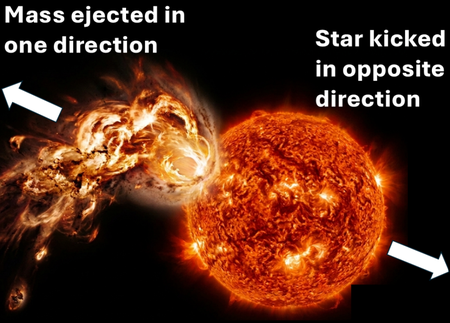
"In this model, blobs of matter are chaotically being ejected from the surface of the bloated stars in an asymmetric fashion," Fuller said in a statement. "And every time that happens, the star gets a little kick in the opposite direction. Like Newton said, for every action there is an equal and opposite reaction."

The blobs of plasma will be chaotically ejected in random directions, but this will still result in an overall net push on the red giant, a phenomenon mathematicians call a "random walk." This is akin to randomly flipping a coin to decide whether to move north or south and still eventually finding yourself moved from your starting position.

Fuller determined that for a red giant, this random walk would see a movement in a random direction at a speed of around 2,200 mph (3,540 km/h). This may seem like a lot, but it pales in comparison to the kicks received by massive stars that explode as supernovas.

An illustration shows a red giant ejecting plasma and receiving a kick in the opposite direction

An illustration shows a red giant ejecting plasma and receiving a kick in the opposite direction (Image credit: Jim Fuller/Caltech)

The lack of an explosion in the transformation of an average-sized star into a white dwarf makes these events less dramatic, but we have still seen evidence of this happening.

Caltech researcher Kareem El-Badry has previously discovered that widely separated binaries are less common in cases when one star has undergone the transformation into a white dwarf. One possible explanation is that repeated kicks during the red giant phase eventually break apart these loosely bound stellar pairs.

"If the orbital speed of the binaries is less than the kick speed, the wide binaries will become gravitationally unbound," Fuller said. Fuller's model also suggests something that astronomers are yet to see. He predicts that in some cases the kicks received by a red giant could send it pinballing toward a stellar companion, causing a massive explosion when the two collide.

Astronomers could now search the cosmos for such events, the discovery of which would help verify Fuller's model.

Fuller's results were presented at the 248th meeting of the American Astronomical Society in Pasadena. The study has been submitted to the Proceedings of the Astronomical Society of the Pacific.