The solstice can even be seen from space in this new image from the Meteosat Third Generation (MTG) mission. (Image credit: ESA/Eumetsat)
Twice each year, we celebrate what we call a solstice when Earth is at its maximum tilt toward or away from the sun. And during this June's summer solstice, a European weather satellite managed to capture a striking image of the celestial moment from space.
What is it?
This image of the solstice was captured on June 21 by the European Space Agency's (ESA) Meteosat Third Generation (MTG) mission. This is a fleet of Earth-monitoring satellites that capture images of our home planet to support weather monitoring over Europe, Africa and regions of the Atlantic and Indian Oceans. The first Meteosat satellite launched in 1977 as ESA's first Earth-observing mission, and to date, there have been 11 satellites launched as part of this series.
In this image, the first of the third generation of Meteosat satellites, MTG-I1, captured an image of Earth just six minutes after we passed the moment of summer solstice, according to ESA. This image shows clearly Earth's "terminator line," or the fuzzy "line" that divides nighttime and daytime on a planet.
Why is it incredible?
On the day of a solstice when Earth is at its maximum tilt, there is almost exactly the same amount of daytime as there is nighttime. In the northern hemisphere, the June solstice marks the longest day of the year, or the day with the most sunlight. And, in the southern hemisphere, the June solstice marks the shortest day of the year.
In June, those in the northern hemisphere celebrate their extra hours of sunlight before the days start getting shorter again. Historically, solstices have been celebrated around the world, folded into cultural traditions and practices. As humans invented agriculture, and our food systems rely on things like available sunlight, it makes sense that throughout time, the changing duration of sunlight would be tightly intertwined with all aspects of our day-to-day lives.
If you stand outside the old Corn Exchange in Bristol, you'll see a clock with two minute hands above the entrance. One hand is set to London time, the other to Bristol's — ten minutes behind. The lag is because the sun reaches its peak over the second city a little bit after the first.
Of course, when it comes to scheduling anything with bounds beyond one city, having two poses an issue. This is why, in 1840, the British company Great Western Railway imposed what it called "Railway Time" across its whole network of trains, establishing Greenwich Mean Time as the first standardized time. And it's still the time zone used in the U.K. today. However, when several towns refused to adopt the time established by the Royal Observatory in Greenwich, the solution was to use two minute hands instead of one. And so the three-handed clock came to be.
That compromise could soon repeat itself in a less likely location: the moon.
The U.S. and China, the two largest space powers, disagree on what time it is on the moon. That's a problem because experts say satellites from one country will be unable to coordinate with spacecraft from the other during future space missions — which could risk accidents.
The White House has tasked NASA with establishing Coordinated Lunar Time (LTC) as a universal time on the moon, which would set the standard for NASA's LunaNet satellite system. But China has other ideas.
China's Chang'e Program, named after the Goddess who flew from the Earth to the moon in Chinese folklore, is the only space program with active lunar relay satellites, Queqiao-1 and Queqiao-2. These relay satellites are the first basis of a moon-wide GPS system meant for future space missions could rely on, meaning they compete with NASA's LunaNet — and because of the way GPS works, these satellites will need a standardized time situation. China is also the only space power to have landed spacecraft on the far side of the moon, where radio signals from Earth are blocked, proving it can coordinate landings without relying on commands from home.
In other words, while the U.S. surpasses China in terms of total space missions, the relay satellites could give China the edge when it comes to establishing the first lunar GPS system for future moon landings. China also hasn't agreed to use LTC for this system, raising the prospect that timekeeping standards could diverge.
Moon Race 2.0
Last year, experts warned U.S. Senators that China is set to win the moon race — the 21st century race to secure lunar resources establish a human presence on the moon — unless space operations receive more funding. Scientists further pointed out funding issues that could impact U.S. leadership in the lunar arena and wavering political commitment to Gateway, the space station intended to serve the Artemis moon program.
Private space-faring companies are also looking to governments to set international standards before spending money on expensive equipment. If China sets the standards before the US, private companies might gear with investments for Chinese customers, giving the country the edge over competitors.
"If everybody has their own standards, the complication increases for the user and manufacturers," says Bijunath Patla, a theoretical physicist at the National Institute of Standards and Technology (NIST). "So there is a chance of making some mistakes, errors, and interchanging, and then having a mishap."
GPS works by having satellites broadcast time signals. If the clocks on the satellites disagree, even by a microsecond, the GPS positioning can shift by hundreds of meters. In an emergency landing, that difference could prove expensive, or even fatal in the case of a human spaceflight mission.
A visualization showing some of the main tenets of NASA's Artemis moon program. (Image credit: NASA)
If you take out the cellphone in your pocket, or look at the right-hand corner of your laptop to check the time, the precise time has been coordinated by hundreds of atomic clocks.
Atomic clocks created by NIST measure the oscillation of microwaves, the upwards and downwards swings of energy. Cesium atoms in the clocks absorb microwave energy only when oscillations reach 9,192,631,770 cycles per second.
Because all cesium atoms are the same, every atomic clock measures the exact same second as every other atomic clock. Their invention led to the universal standard of time we use today, superseding the time set by the Royal Greenwich Observatory in the 1800s.
International Atomic Time developed from the atomic clock, set by NIST’s optical "lattice clocks" and "cesium fountain clocks”, with the recently invented “nuclear clock” set to make the standard even more precise by ticking according to the fluctuations of thorium-229 nuclei.
The time on our screens comes from over 80 countries working with their own atomic clocks to work out the time. The U.S. Naval Observatory is one of these, submitting the time of its atomic clocks in Washington D.C. and Colorado to an international timekeeping organization in France.
Based in a suburb of Paris, the International Bureau of Weights and Measures (BIPM) collects the time from dozens of scientific labs across the world and uses the input from their atomic clocks to produce the weighted average time, what we call Coordinated Universal Time (UTC).
BIPM sends back corrections to each country, which recalibrate their own clocks to UTC. Countries beam these corrections to their satellites, which then transmit the standardised time to cell towers. The result appears on our phones.
But while our timekeeping methods are universal, time itself is not.
The Long March-8 Y3 carrier rocket carrying the relay satellite Queqiao-2 blasts off from the Wenchang Spacecraft Launch Site on March 20, 2024 in Wenchang, Hainan Province of China. (Image credit: Luo Yunfei/China News Service/VCG via Getty Images)
Spacetime
If the international atomic standard had been running since the Big Bang, NIST claims, it would not have gained or lost a single second since the universe began.
The way we experience time depends on gravity. The gravity we feel on Earth is determined by the mass and radius of our planet. Away from the Earth's gravity, spacetime behaves differently.
If one identical twin stayed on Earth, but the other travelled to a black hole, where matter is compressed, then both would experience time differently. Should the twin in the black hole take an atomic clock, and somehow survive, they would return to Earth to find that their twin had died, along with everyone they knew. Hundreds of millions of years would have passed by, according to the clock that remained on Earth, whereas their atomic clock would have ticked away only a short time.
"That person's time is being slowed down by gravity, their time is ticking slower," says Patla. "It's the same thing with the Earth and the moon. The clocks really tick faster."
A view of how spacetime is warped around massive bodies. This has implications for how time is experienced. (Image credit: NASA)
Because of the physics of spacetime, coordinating missions with satellites away from the Earth's gravity gets increasingly difficult.
On the moon, clocks run around 56 microseconds faster than clocks on Earth. While everyone agrees on the math, not everyone agrees on who should wind the clock.
Because of the difference, space powers need to agree to convert the discrepancy into UTC, or an equivalent that works on satellites coordinating space missions. Without agreement, engineering equipment that relies on GPS could diverge, and missions could prove dangerous in the years ahead, particularly with the projected increase in space landings.
Aiming to land a crew on the moon by 2030, the Chinese space agency plans to establish a moon base by 2035, from which asteroid mining operations or future missions to Mars could be prepared. Atomic clocks on Mars tick about 477 microseconds faster per day, leading to suggestions of a Mars time zone. But Patla says a separate time zone for Mars may prove too complicated.
About time
Almost all space powers are targeting the south pole of the moon, where loads of frozen water presumably found there can be converted to hydrogen to use as rocket fuel for future space missions. Exiting the moon is less fuel-consuming than exiting the Earth's atmosphere, though assembling rockets on the moon has never been attempted.
But the south pole of the moon is scarred by impact craters and jagged mountains, which could make landing there more risky. In a historic moment, India was the first nation to land a spacecraft there in 2023 — and hundreds of launches from various countries are scheduled over the coming decades to achieve the same feat. As these launch attempts start to happen, converting between differing satellite times in an emergency could prove dangerous.
Luckily, there's more collaboration between the agencies than some might suspect. NIST has check-ins with China's Purple Mountain Observatory, which according to Patla are purely advisory, so the two countries can better coordinate their activities in space.
China has announced its own mathematical framework for timekeeping, the Lunar Time Ephemeris (or LTE440), which could complement NASA’s Lunar Time, building towards a more robust conversion between the two countries. The math and physics are not in dispute, Patla adds, a fact that should give policymakers some comfort.
"Most of the world uses UTC, and so there is an incentive for everybody to take the best route to get there," says Patla. "If we want to have a lunar economy and if we want to have a sustained presence on the moon, then the standards would be helpful to link moon time to Earth time."
The oldest known asteroid impact site on Earth was created 3.02 billion years ago in what's now Western Australia — not far from where we've seen the oldest traces of life on our planet.
A rock formation in Western Australia's Pilbara region seems to offer evidence of an asteroid slamming into Earth's newly-formed rocky crust around 3.02 billion years ago. That makes the formation, called the North Pole Dome, the oldest evidence of an asteroid impact on Earth, according to a recent study, which dated crystals in the rocks shocked and reshaped by the impact's tremendous heat and pressure.
It's the latest salvo in an ongoing debate about the age of the crater (or what's left of it after billions of years of erosion), and there's more at stake than bragging rights: a crater dating back this deep in Earth's distant past could shed light on the rise of the continents and the origin of life.
A rare glimpse
Inside most rocks in Earth's crust, tiny grains of mineral called zircon quietly record the passage of eons. Zircon contains tiny amounts of uranium, which slowly but steadily breaks down into lead; that steadiness is key, because the ratios of those two elements reveal how long it's been since a grain of zircon crystallized from hot, molten rock. In this case, zircon grains told Kirkland and his colleagues that it had been about 3.02 billion years since the tremendous heat and pressure of an asteroid impact melted zircon crystals in the rocks around North Pole Dome.
"Some zircons at the North Pole Dome have unusual branching, skeletal shapes," Kirkland said in an emailed press release. "We interpret these as impact-modified crystals, formed when older zircon was disrupted, partly recrystallized, and in places, regrown during the intense heating caused by the impact."
If Kirkland and his colleagues are right, the area, also called the Miralga Impact Structure, is the oldest trace of an asteroid colliding with our planet. The newly published date makes Miralga a relic of a tumultuous period in our solar system's history, called the Late Heavy Bombardment, when the giant planets were still jockeying for position in their orbits around the sun, flinging asteroids and comets toward the inner solar system in the process (or so cosmologists theorize). Amid this rain of space rocks, Earth was midway through the Archaean Eon, with the planet's surface finally cooling to form a thin crust of solid rock. Earth's surface lay beneath an orangish haze of methane, a little like a warmer version of Saturn's moon Titan.
And somewhere in there, the first life took shape.
The oldest traces of that early life are just a few kilometers from North Pole Dome: limestone stromatolites, made of layers of tiny sediment grains trapped in, and eventually left behind by, sheets of early bacteria. The ones in Pilbara are about 3.5 billion years old, another date courtesy of zircon grains. If the Miralga impact happened 3.02 billion years ago, it struck a world already teeming with overlapping mats of bacteria.
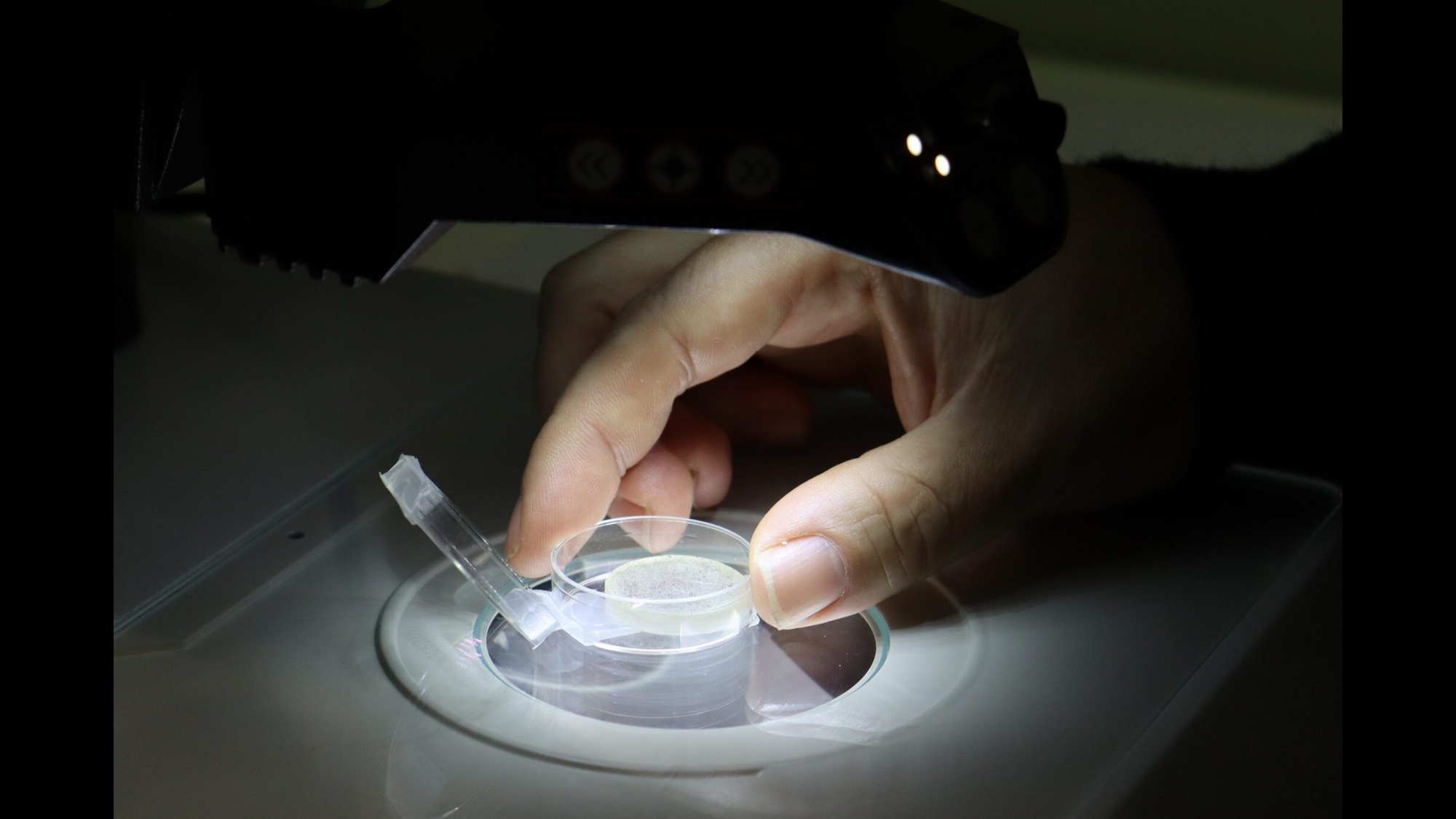
Dr. Chris Kirkland studying tiny zircon crystals in the lab. (Image credit: Chris Kirkland/Curtain University)
The oldest known Earth rock, a 4.35-billion-year-old sandstone formation (also dated using zircon), lies just a few hundred kilometers south of Pilbara, in the Jack Hills. Why is all of this — the oldest rocks, the oldest asteroid crater, and the oldest traces of life — in Western Australia? It's reasonably likely that crust formed, life emerged, and meteors smashed into the ground millions of years earlier, in places all over the world, but the evidence just happened to be preserved in this area of Australia. Most of Earth's very oldest rocks have long since been reworked by plate tectonics or erosion, basically erasing the first chapters of our geological record.
A heated debate about heated rock
"While the site had previously been identified as an ancient impact crater, its exact age remained uncertain," said Kirkland.
Last year, Kirkland and his colleagues proposed that the impact dated back to 3.47 billion years ago, almost the same age as the nearby stromatolites. In that same paper, the team suggested that the original crater – whose outline has long since eroded away, leaving behind only impact-shocked rocks and tantalizing hints – might have been up to 62 miles (100 km) wide. The 22-mile-wide (35-kilometer-wide) North Pole Dome itself seemed to mark the crater's center; rock in the middle of large craters often rebounds upward after the impact, leaving a peak or dome behind (picture the way the middle of a trampoline flexes upward, captured in a freeze frame).
But another group of geoscientists published a paper a few months later, arguing that Miralga (a name they gave the crater, based on the local Aboriginal peoples' name for the area) couldn't be any more than 2.7 billion years old, and only 10 miles (16 km) wide. That's still substantial, and old enough to be interesting, but too young and too small to have played much of a role in shaping the region's life, or its continental crust.
"By the time of the impact, the Pilbara was already quite old," wrote the study’s authors in an essay at the time (of the paper, not the impact).
The teams agreed on, basically, one thing: the area around North Pole Dome was definitely an impact site, and dating very old rocks is not easy. Both 2025 papers looked at the placement of rocks called shatter cones, which form when the shockwaves of an impact (or, sometimes, an underground nuclear bomb test) pass through rock, leaving behind ripples, striations, or cracks. But based on where the shatter cones appeared in relation to other rock layers, the two teams of scientists drew very different conclusions.
"Ancient craters are incredibly difficult to date, because over billions of years, rocks are altered by heat, pressure, and fluids, which can obscure or reset the original impact signatures," said Kirkland, whose team now argues that the zircon crystal dates are much more precise than either team's previous efforts. "What we've been able to do here is separate the moment of impact from its long geological history."
Curtin University geoscientist Chris Kirkland and his colleagues published their work in the journal Geology.
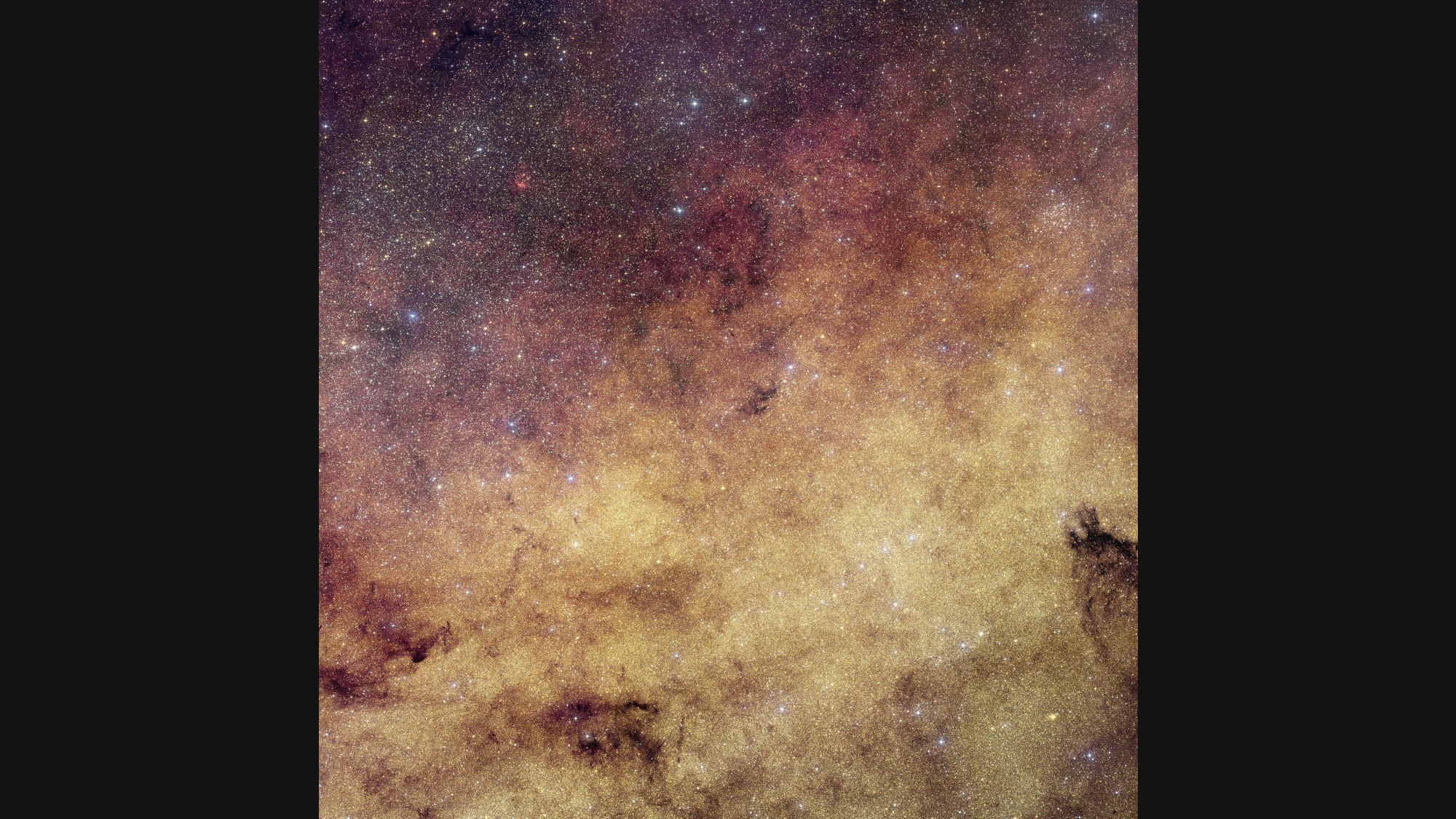
In 2025, the European Space Agency dark universe detective spacecraft Euclid turned its attention to the heart of the Milky Way for just 26 hours. In just over one day, Euclid was able to create the largest and most detailed photo of this region of our galaxy ever made.
The image, packed with 60 million stars, could help scientists hunt for extrasolar planets, exoplanets, in this region known as the galactic bulge.
Euclidis designed to study dark energy, the mysterious force that drives the accelerating expansion of the universe, by studying distant galaxies. That means the space telescope is powerful enough to distinguish individual stars in the central bulge of the Milky Way. Other telescopes fail to do this because they are too blinded by the densely packed stars in this region.
The largest high-resolution photo ever made of our Milky Way galaxy's center in visible light. It was taken on March 23, 2025 by the European Space Agency's Euclid space telescope. (Image credit: ESA/Euclid/Euclid Consortium/NASA, CFHT, image processing by J.-C. Cuillandre and E. Bertin (CEA Paris-Saclay))
Euclid was requested to monitor the central bulge of the Milky Way to assist astronomers in the hunt for exoplanets because this is the perfect region for so-called "microlensing" events to occur.
"To catch microlensing, you need to observe parts of the sky that are crowded with stars, such as close to the center of our galaxy," team leader Jean-Philippe Beaulieu of the Institut d'Astrophysique de Paris in France said in a statement.
Microlensing is a weak form of gravitational lensing that occurs when objects with mass cause the very fabric of space to warp. When light from a background source passes through this warping of space, its path is curved. This can be used to study the background source; for example, scientists have used it to great effect with theJames Webb Space Telescope (JWST) to study some of the most distant and early galaxies. However, the curvature of light from background sources can also be used to detect faint objects like planets.
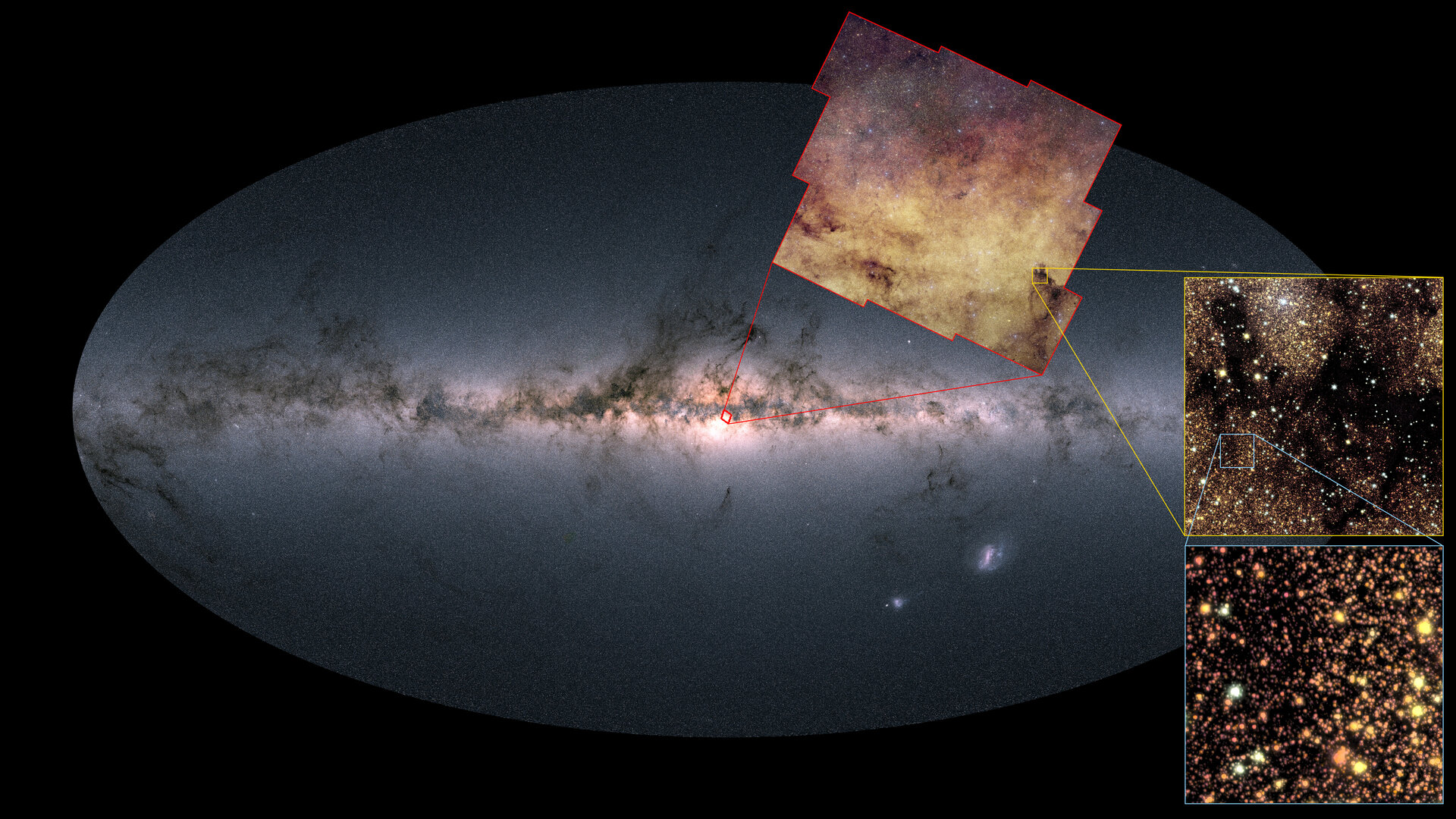
The location of Euclid’s new image of the galactic bulge is visible on Gaia’s map of the entire sky. (Image credit: ESA/Euclid/Euclid Consortium/NASA, CFHT, ESA/Gaia/DPAC,image processing by J.-C. Cuillandre and E. Bertin (CEA Paris-Saclay))
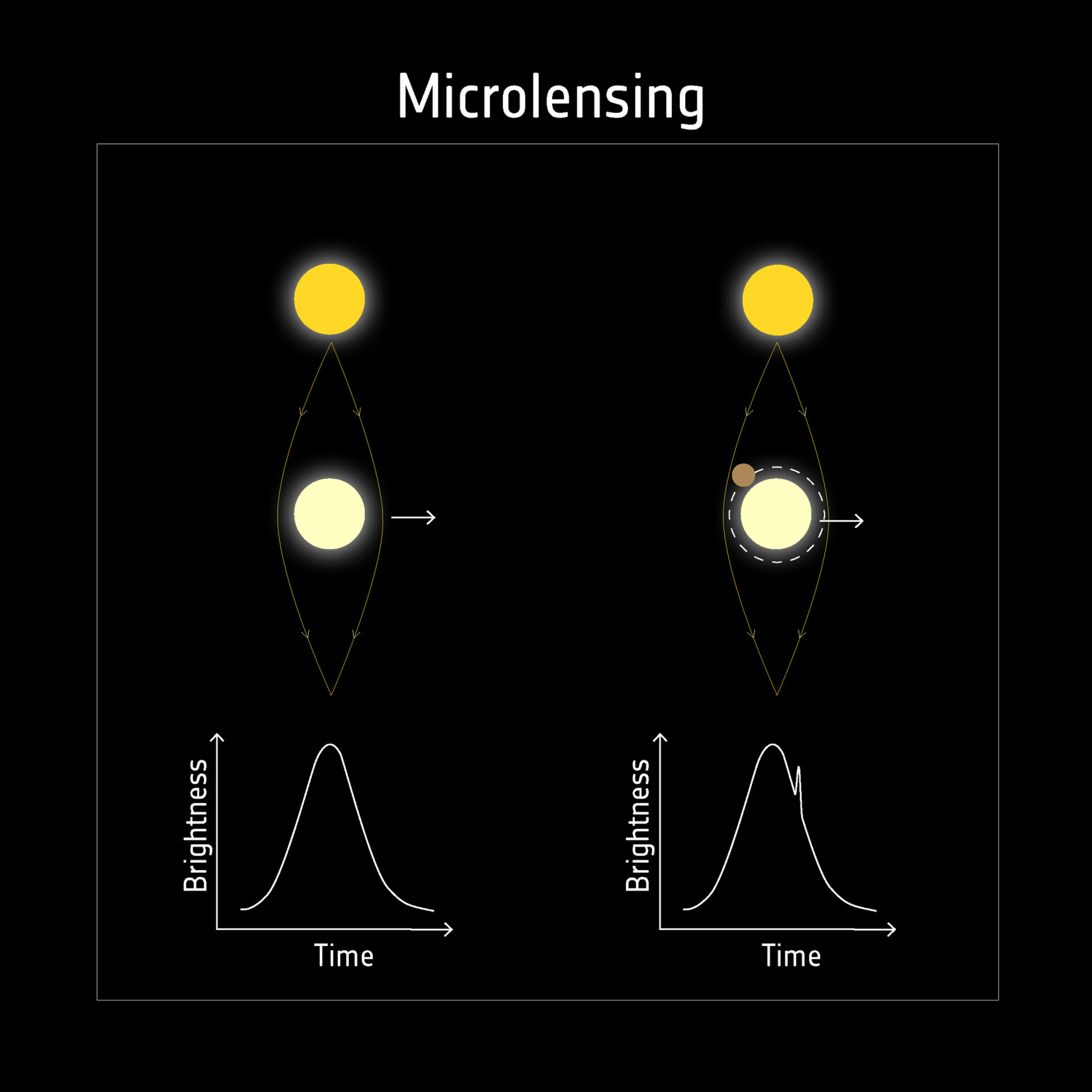
Spotting planets using microlensing requires one star to pass in front of another and act as a gravitational lens. The presence of a planet causes a tiny perturbation in the lensing of light from the background star. It's a small effect, but one that has been used very effectively in the detection of exoplanets.
"During the last twenty years, almost 300 exoplanets have been discovered using this technique, all with ground-based telescopes and all towards the center of our galaxy," Beaulieu said. "This image from Euclid includes 51 known planetary systems – and it will assist in studying many more that will be found."
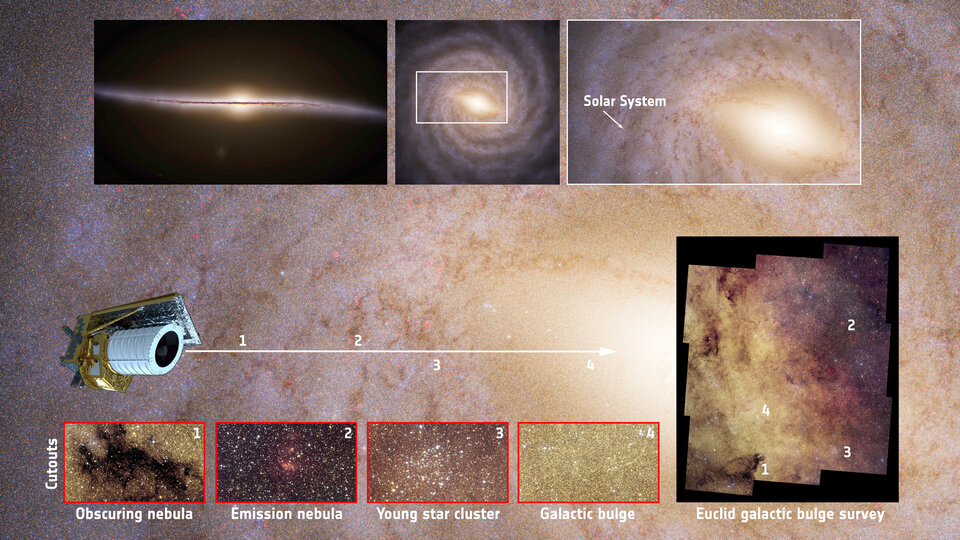
This infographic places Euclid’s galactic bulge survey in the broader context of the Milky Way’s structure, using data from ESA’s Gaia mission. (Image credit: Euclid images: ESA/Euclid/Euclid Consortium/NASA, CFHT, image processing by J.-C. Cuillandre and E. Bertin (CEA Paris-Saclay); Milky Way artist impressions: ESA/Gaia/DPAC, Stefan Payne-Wardenaar))
Despite Euclid's study of the central bulge pointing the way forward in observing new microlensing events, there are no such events in the data from the ESA spacecraft. That is because detecting such events takes around 20 days.
Instead, it will be up to telescopes like the forthcoming Nancy Grace Roman Space Telescope to observe this region for longer periods and compare with this day's worth of Euclid data to find microlensing events.
"In 24 hours, Euclid has already captured the stars involved in all the future microlensing events that the Roman space telescope will detect, but before the stars and planets involved have aligned," team member Natalia Rektsini of the Institut d'Astrophysique de Paris said.
"This means that anyone who detects a microlensing event in the same region, for example, with Roman, will be able from now on to use Euclid data as a time reference in the past and see how the stars looked before they overlapped. Since Euclid can clearly separate individual stars, one can then measure how fast they move over time and use that information to confirm the existence of a planet and determine its mass. This would not be possible with data from one point in time."
A diagram shows how microlensing can be used to detect planets (Image credit: ESA)
One reason this is so exciting to exoplanet hunters is that other techniques used to spot these distant worlds tend to excel at detecting hot and massive planets close to their host stars.
Microlensing, however, can be used to detect more diminutive planets much farther from their host stars and with chillier temperatures. That means it could be used to detect ice giants like Uranus and Neptune in wide orbits around central bulge stars.
"This result shows what a relatively small, dedicated team can achieve within a large international mission," says Valeria Pettorino, Euclid Project Scientist at ESA.
"That's why this Euclid data will be a time reference for past and future missions and enable studies of exoplanets and their masses. This data can also be used for other scientific applications, from brown dwarfs and binary stars to stellar motions and dust across our galaxy."
Could Martian mudstones be holding evidence of ancient microbes? New findings strengthen the case that the Red Planet once held life.
New data from NASA's Perseverance rover has revealed complex carbon in two Martian mudstones found in Mars' Jezero crater, the same location where previous evidence of possible ancient life has been found. Scientists think this macromolecular (meaning large) complex carbon, could hold evidence that ancient microbial life once existed in the same sedimentary material, according to one new paper describing these observations. "Measurements of two mudstones show hundreds of organic detections, making this the most robust organic detection in Jezero crater," the paper reads.
This comes soon after the news last year that Perseverance found what has been dubbed the strongest evidence of potential biosignatures, or hints of life, on Mars.
"Carbon is the primary building block for life on Earth, and all living things are made up of complex organic macromolecules," co-lead author Ashley Murphy, a researcher at the Planetary Science Institute, told Space.com. "On Earth, [macromolecular carbon] is often found in extremely old rocks and in some cases it is the only organic evidence of past microbial life.
"Since early Mars may have been more similar to Earth," Murphy added, "we may anticipate finding [macromolecular carbon] in old Martian rocks too, so we are searching for these organic macromolecules on Mars and other planetary bodies to determine whether the necessary chemical ingredients and environmental conditions to support life have ever existed there."
Perseverance landed on Mars in 2021 in Jezero Crater, an expansive crater thought to once be a lake that could have possibly harbored life. This landing site was in fact chosen because scientists thought it could have some of the best evidence for possible ancient life on the planet. And so far, in Perseverance's extensive explorations — which have now officially taken the rover the distance of a marathon on Mars — that prediction seems like it's turning out to be true.
In this new research, a team of scientists co-led by Murphy used Perseverance's spectrometer SHERLOC (the Scanning Habitable Environments with Raman and Luminescence for Organics and Chemicals), which uses lasers to identify an area or object's chemical and mineral makeup, to map the distribution of organic matter in the individual mudstones. The crew found organic carbon inside two mudstones.
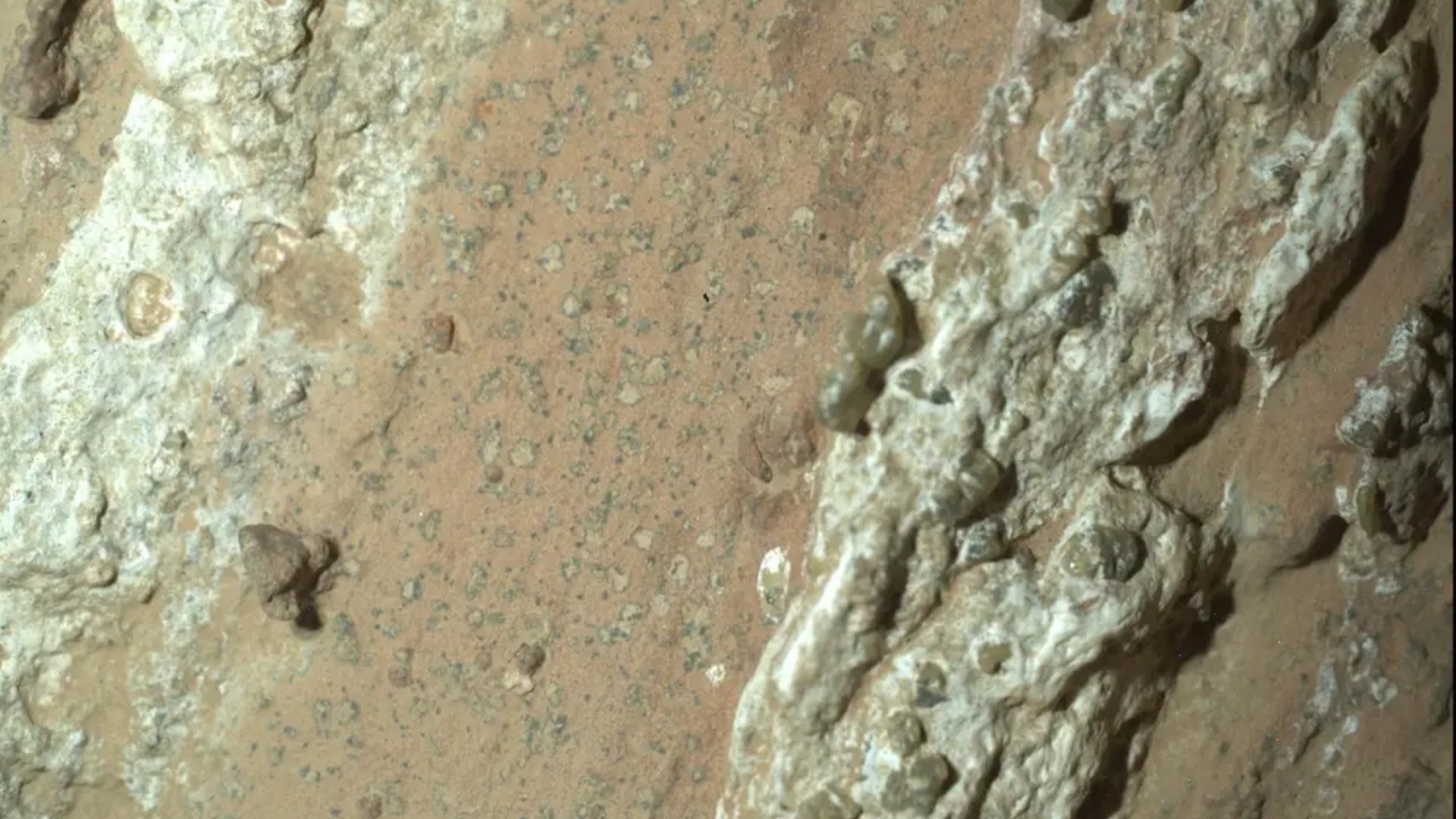
Furthermore, these carbon-filled mudstones were found in the same location as the last year's discovery of a potential biosignature found in a sedimentary rock on the Red Planet, which scientists say is still the strongest evidence that life could have once existed on early Mars. In this discovery, Perseverance found a rock now-named "Cheyava Falls" with distinctive "leopard spots."
These types of rock marking can be created in high heat or extremely acidic temperatures, but neither of these conditions are thought to have existed in the area. However, the markings can also be formed by the presence of life. So, while this rock wasn't conclusive evidence of past life on Mars, it certainly provided significant evidence that is now supported by this new data.
With these observations, the rover has made two main findings.
First, Perseverance has found organic, large, complex carbon in mudstones in Bright Angel, a rocky area on the northern and southern edges of Neretva Vallis, which is an ancient river valley in the Jezero area. And not only did Perseverance make hundreds of detections of organic carbon in these rocks, but the researchers also state that this is "the only detection of macromolecular carbon on a natural rock surface on Mars."
"This is also the first detection of MMC in a mudstone on Mars outside of Gale Crater, suggesting that the availability of organics may have been widespread across the planet billions of years ago," co-lead author Kyle Uckert, the SHERLOC deputy principal investigator at NASA's Jet Propulsion Laboratory, told Space.com.
A closeup of "leopard spots" on Mars seen by the Perseverance rover on the rock Cheyava Falls, which may show signs of a biosignature, but could also be from geologic processes. (Image credit: NASA/JPL-Caltech/MSSS)
While both studied mudstones have organic carbon in their interiors, according to these observations from Perseverance, there were some differences between the two rocks. The carbon in one mudstone was found mixed with primarily silicate minerals, while the other was filled with carbon mixed with secondary carbonate and sulfate minerals. The team also found that the carbon in both rocks was relatively intact, meaning the specimens might be resistant to radiation and oxidation or that it may have been recently exposed to the Martian surface.
Secondly, the team found that, in this identified carbon, Perseverance has detected evidence of potential biochemical interactions. These interactions left behind features in the two mudstones that look just like features created by microscopic life in sediments on Earth. This begs the question: Did ancient microbes on Mars really live in the sediments in this once-flowing river?
Maybe, maybe not. While that would certainly be one explanation, it's also possible that the carbon could have been created without life.
"There are multiple potential pathways to form abiotic organics on Mars," the authors state in this paper, clarifying that this, even compounded with other existing data, cannot conclusively say whether or not life created what Perseverance has observed.
"The science payload of the Perseverance rover was not designed to distinguish between abiotic and biotic processes, but was instead selected to identify compelling rocks to be collected for possible return to Earth for more rigorous testing," Uckert told Space.com. Uckert added that there could be many non-life reasons behind the presence of this complex carbon, "for example, it may have been delivered to the surface via meteoritic infall, or formed through hydrothermal geologic processes," he said.
For now, we can only wait until the next juicy bit of evidence about ancient life on Mars reveals itself.
This work was described in a paper published June 24 in the journal Science Advances.
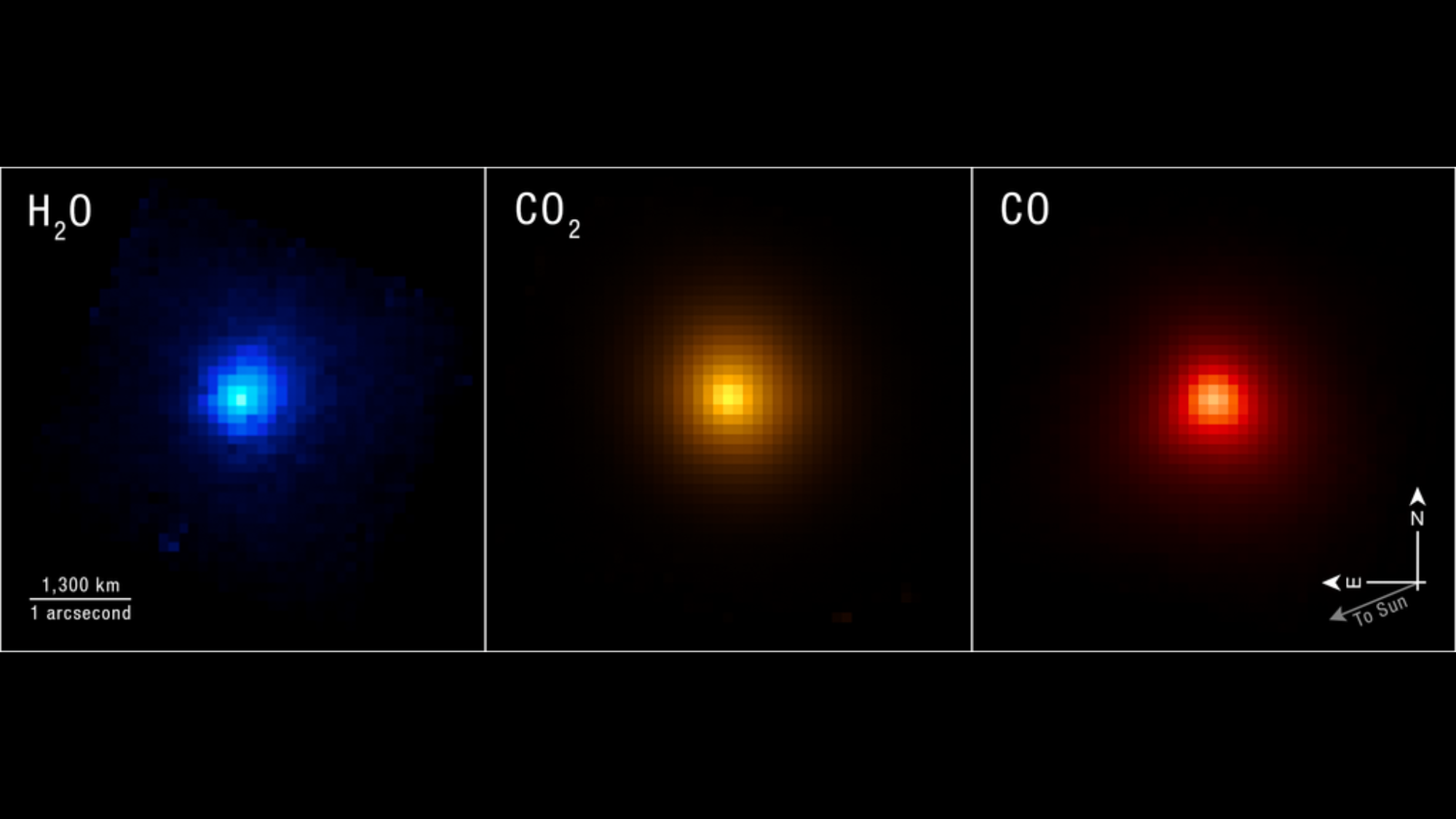
Researchers using JWST are finding clues about comet 3I/ATLAS' origins. (Image credit: NASA, ESA, CSA, STScI, Martin Cordiner (CUA, NASA-GSFC); Image Processing: Alyssa Pagan (STScI))
NASA's James Webb Space Telescope is finding clues that are leading scientists closer to understanding the origins of the interstellar comet 3I/ATLAS.
What is it?
Comet 3I/ATLAS captured the world's attention when it was discovered nearly a year ago on July 1, 2025. The comet was first spotted by the Asteroid Terrestrial-impact Last Alert System (ATLAS), and is only the third interstellar object every discovered.
The comet swooped through our solar system, passing by Earth at a far (and safe) distance on its tour of our cosmic neighborhood. It is on a long trajectory that will take it out of our solar system, never to return.
In observations from the James Webb Space Telescope, scientists were able to look in the direction the comet as it began moving away from the sun in December of last year. While in close proximity to our star, the sun's heat warmed the comet, making it extra bright and easy to observe.
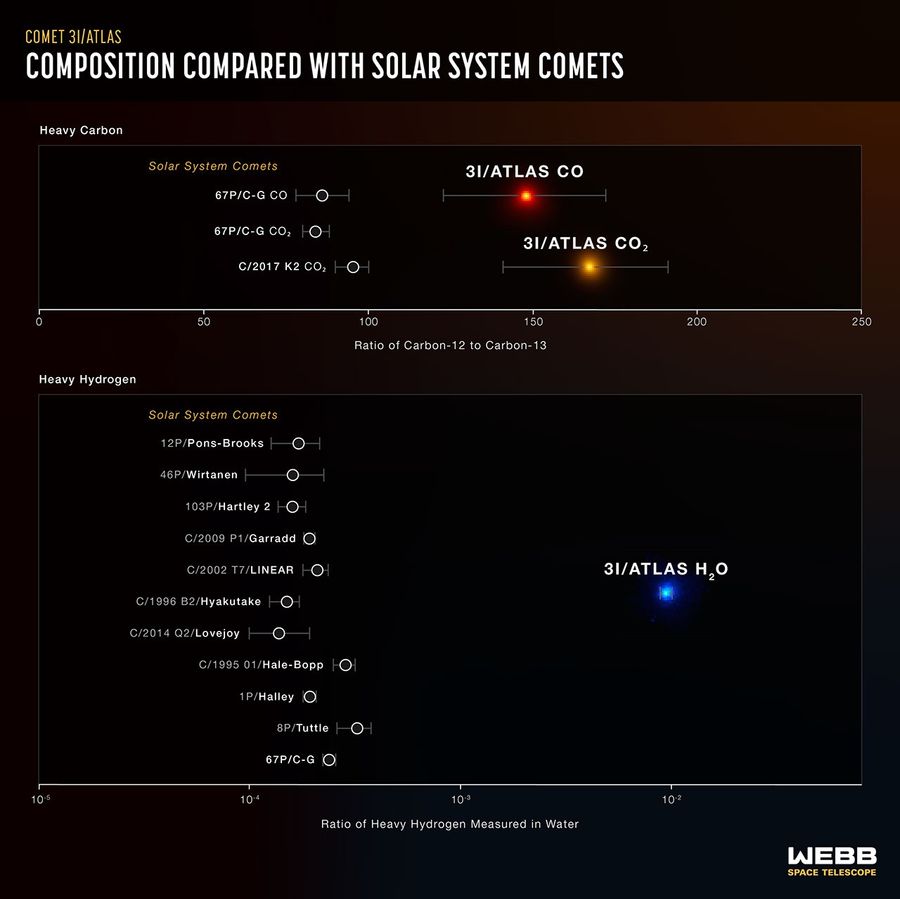
With this view, astronomers were able to calculate some of the ratios of the chemicals present in the comet. This further highlighted that the object is from out of our solar system, as they found ratios of carbon and heavy hydrogen not found in comets in our solar system.
Researchers described their results in a new paper published June 22 in the journal Nature.
This graph shows some of the differences between 3I/ATLAS and comets found in our own solar system. (Image credit: NASA, ESA, CSA, Martin Cordiner (CUA, NASA-GSFC), Leah Hustak (STScI))
Why is it incredible?
Being only the third interstellar object ever found, people were excited about 3I/ATLAS. They were so excited, in fact, that conspiracies about the object sprouted up quickly. Due to it being from outside of our solar system, some claimed that the comet could be some sort of alien spaceship, similar to the initial suspicions about the interstellar object 'Oumuamua found years earlier.
But with new information coming in from space telescopes, and astronomers eager to understand this object better, these clues are leading us closer and closer to the true origins of this strange comet.
A bright, dense cluster of hot, massive stars in a galaxy that existed 1.4 billion years after the big bang has been found helping to end the early universe's foggy days during which neutral hydrogen gas was draped across the cosmos, obscuring ultraviolet light from luminous objects.
The cluster was found emitting ultraviolet light in a small but quickly growing galaxy by the Hubble Space Telescope. The presence of this ultraviolet light, and the star-forming history of the cluster producing it, suggests that bursts of star formation contributed to waves of ionizing radiation that gradually cleared out the opaque neutral hydrogen.
In the aftermath of the big bang, the universe was filled with neutral hydrogen gas that is opaque at short wavelengths of light, such as ultraviolet. However, this ultraviolet light was the neutral hydrogen's worst enemy, gradually ionizing the gas across the universe. Once ionized, hydrogen gas cannot absorb ultraviolet light — and so, the cosmos became transparent at those wavelengths.
Because of this, the first billion or so years are called the Epoch of Reionization. It is referred to as "reionization" rather than ionization because, technically, the gas had already been ionized once before during the first 379,000 years after the Big Bang.
While investigating what brought about this epoch, astronomers had identified two chief suspects that could have produced sufficient amounts of ultraviolet light to ionize the neutral hydrogen. One is active supermassive black holes and the other is the first generations of hot, massive stars. The problem is, given that neutral hydrogen is adept at absorbing the ultraviolet light, astronomers have had difficulty tracing that ultraviolet back to its source and identifying which of the two suspects are the main culprit.
In 2023 the James Webb Space Telescope (JWST) made a major breakthrough, finding a galaxy that existed just 900 million years after the Big Bang that was producing enough energy to ionize the neutral gas surrounding it.
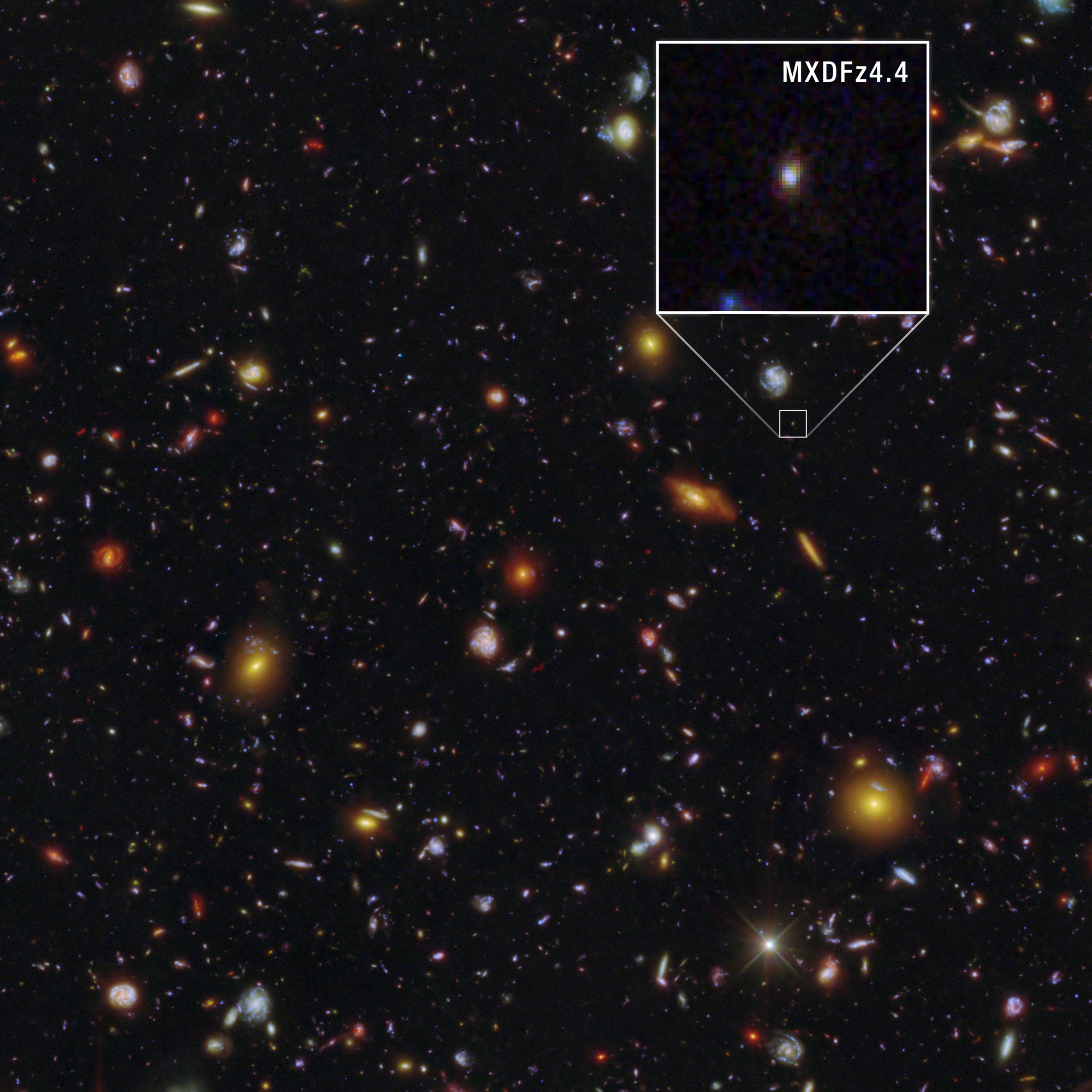
Now the Hubble Space Telescope has gone further, detecting ultraviolet light from a galaxy called MXDFz4.4. This ultraviolet light should only be visible if the surrounding gas had already been ionized.
"Observing a galaxy like this was thought to be impossible," said Ilias Goovaerts of the Space Telescope Science Institute (STScI) in Baltimore, who led the discovery, in a statement. "Researchers expected the 'fog' of neutral hydrogen that filled the early universe would be too thick and obscure our view of its ionizing light. Hubble not only spotted that light, but it also helped reveal incredible details about the galaxy's characteristics."
The full Hubble Space Telescope's view of MXDFz4.4 and its surroundings from our vantage point. (Image credit: NASA/ESA/CSA/STScI/Ilias Goovaerts and Anton Koekemoer (STScI)/Marc Rafelski (STScI, JHU)/ Image Processing: Alyssa Pagan (STScI))
MXDFz4.4 was first identified in the MUSE eXtremely Deep Field (MXDF), with MUSE being the Multi Unit Spectroscopic Explorer on the European Southern Observatory's Very Large Telescope in Chile. The "z4.4" part of its name tells us that the galaxy exists at a redshift of 4.4, meaning that it existed 12.37 billion years ago. As the universe has expanded in the time since then, the ultraviolet light has been redshifted into visible wavelengths that were detected by Hubble.
"Astronomers have found many galaxies that existed at this point in the history of the universe, but we haven't detected ionizing photons from any of them, making MXDFz4.4 one of a kind," said Marc Rafelski, who is the Hubble Deputy Mission Head at STScI.
MXDFz4.4 is 100 times smaller than our Milky Way galaxy but is forming stars ten times faster than our galaxy is. Many of those stars are being born in the tight, luminous cluster producing the ionizing ultraviolet.
An artist's impression of the young, distant galaxy MXDFz4.4 and its dense cluster of luminous stars. (Image credit: NASA/ESA/Leah Hustak (STScI))
The cluster contains "A lot of young, hot, massive stars in a small space [that] do a better job of blasting through opaque gas," said Goovaerts.
Furthermore, by comparing Hubble's observations of MXDFz.4.4 with those of the JWST, which probed for cooler, older stars in the galaxy, Goovaerts and Rafelski's team discovered that the stars in the cluster had formed in bursts, each burst producing fresh quantities of ionizing ultraviolet radiation that helped to clear out more and more of the neutral gas over time. We now see the galaxy about 250 million years after it finished reionizing the surrounding gas. These hot, massive stars in the cluster end their lives after a few million years as supernova explosions, the blast waves and radiation from which can create bubbles in the gas light years across, creating further pathways for ultraviolet light to escape and be detected by Hubble.
The observations seem to nail down the theory that clusters of hot, massive, luminous stars in young galaxies in the early universe played a dominant role in ionizing the universe's neutral gas.
"Hubble's observations of MXDFz4.4 let us test our hypotheses much closer to the Era of Reionization than ever before," said Rafelski. "Finding more galaxies, especially at slightly later cosmic times where larger samples are within reach, would let us refine these measurements and figure out what cleared our view as that era was ending."
Using NASA's exoplanet-hunting spacecraft TESS (Transiting Exoplanet Survey Satellite), scientists have discovered a planetary system that scientists are calling "improbable." It could change how we think about the mechanisms behind planet formation.
The reason for the unusual arrangement of this planetary system is a failed star or brown dwarf designated TOI-201 c. Objects like this get the slightly unfair nickname of "failed stars" because, despite forming from a collapsing cloud of gas and dust like other stars, they fail to gather enough mass to trigger nuclear fusion of hydrogen to helium in their cores. Brown dwarfs have masses between 13 and 80 times that of Jupiter, or 0.013 to 0.08 the mass of the sun. That puts them right between the most massive planets and the smallest stars.
TOI-201 c is on a highly elliptical orbit, taking 2,881 days to orbit its star, which has resulted in planets including a super-Earth named TOI-201 d and a warm Jupiter named TOI-201 b, forming in a narrow zone within its orbit, something that isn't just new to astronomers; it is completely unexpected based on planetary formation models.
The 5.8-day orbit of TOI-201 d and the 53-day orbit of TOI-201 b are both perfectly aligned with the orbit of the brown dwarf. The brown dwarf creates gravitational instability at distances equivalent to the distance between Mars and the sun, but this didn't prevent planets from forming in the system.
"This discovery provides a crucial insight into how planets form even around massive, eccentric objects," team member and INAF researcher Aldo Bonomo said in an emailed statement.
The system challenges the idea that gas giant planets form at distances equivalent to 2 to 3 times the distance between Earth and the sun in the disks of gas and dust that surround stars during their infancy.
"The presence of the brown dwarf on such an elliptical orbit forced the planets to form and survive by occupying the innermost and hottest edges of the primordial disk," team member Luca Naponiello of the National Institute for Astrophysics (INAF) said in the statement. "Furthermore, the data show that during the close approach of the brown dwarf, the warm Jupiter undergoes strong and sudden variations in its transit timing, bearing witness to an intense and vigorous dynamic interaction currently underway between the two giants."
The system was discovered by TESS using a rare mono-transit event, which describes a planetary body making one crossing of the face of its star, causing a dip in starlight. This was followed by an observing campaign conducted from the ground.
It is extremely rare to discover objects like TOI-201 c with such long and eccentric orbital periods using transits they make of their parent star. This brown dwarf is the first one of these objects to have its mass confirmed, making it an important step forward in astronomy.
"It [TOI-201c] is the transiting object with the longest orbital period for which the mass is known," Naponiello said.
The team's results were published on Wednesday (June 17) in the journal Nature.
A huge, shining bauble of stars called Terzan 5 could be a clump of our galaxy's central bulge that hasn't been smoothed out into the mix, and has instead survived as a fossil relic leftover from the birth of the Milky Way galaxy.
"Terzan 5 may provide direct evidence that can help explain how bulges formed in galaxies throughout the universe," said Barbara Lanzoni of the University of Bologna in a statement. Lanzoni is a member of a team of astronomers, led by Bologna colleagues Giorgia Zullo and Francesco Ferraro, who tackled Terzan 5 with the James Webb Space Telescope (JWST).
Terzan 5 is a globular cluster — a huge sphere of stars with a total mass two million times greater than our sun's and a total luminosity 800,000 times greater. The problem is, Terzan 5 lies about 18,800 light-years away in the bulge of the Milky Way galaxy. This means dense lanes of intervening galactic dust block our view, significantly dimming Terzan 5's apparent brightness. That's why it wasn't discovered until 1968 by the Turkish–French–Armenian astronomer Agop Terzan.
Globular clusters tend to be ancient. They also tend to have formed all their stars in one giant burst. As such, all their stars should be the same age, 12 to 13 billion years old. Yet, a select few globular clusters show evidence of having more than one generation of stars. These include Omega Centauri, NGC 2808 and NGC 1783 in the Milky Way galaxy, as well as NGC 411 in the Small Magellanic Cloud and NGC 1696 in the Large Magellanic Cloud. Several explanations have been put forward, including the possibility that they are the core remnants of dwarf galaxies that have been stripped of most of their stars by gravitational tidal forces emanating from the Milky Way. Or perhaps these clusters were simply massive enough to retain some molecular gas for future stellar generations.
When the Hubble Space Telescope took a look at Terzan 5 in 2009 and then again in 2016, it found that it too was among the ranks of weird globular clusters with two generations of stars, dating back 12.5 and 4.7 billion years. However, because it is behind so much galactic dust, not even Hubble has the clearest of views.
The JWST, however, does. Its near-infrared vision can see through the dust.
"Webb's new near-infrared observations, cross-referenced with Hubble's archival observations, have given us a much clearer picture of the history of Terzan 5," said study leader Giorgia Zullo, who is a Ph.D. student at Bologna.
The JWST detected two further generations of stars, one generation born 3.8 billion years ago and another 2.5 billion years ago. Four generations of stars is hard to explain for any globular cluster, which is why the team think that Terzan 5 could be something more primordial: a leftover building block of the Milky Way's bulge that was never quite assimilated by our galaxy.
"For some reason, this peculiar clump of stars formed separately from the bulge and was not destroyed as the bulge itself formed," said Ferraro. "Terzan 5 is what we now call a bulge fossil fragment because it resembles the primordial clumps that contributed to the formation of the bulge."
Disk galaxies sport two main components: a relatively narrow disk formed from spiral arms, and a bulbous core called the bulge. Galactic bulges tend to be the oldest parts of galaxies, forming billions of years before the disks, at least in the Milky Way's case. The JWST is seeing this process occurring in the early universe, revealing clumpy, young galaxies, but given the great expanse of space and time that JWST is looking across, the observations of the building blocks that go into making these galaxies are still not totally clear. With Terzan 5, we could be looking at one of the building blocks of the Milky Way's bulge relatively close-up, and it could provide new insights into the birth of our galaxy.
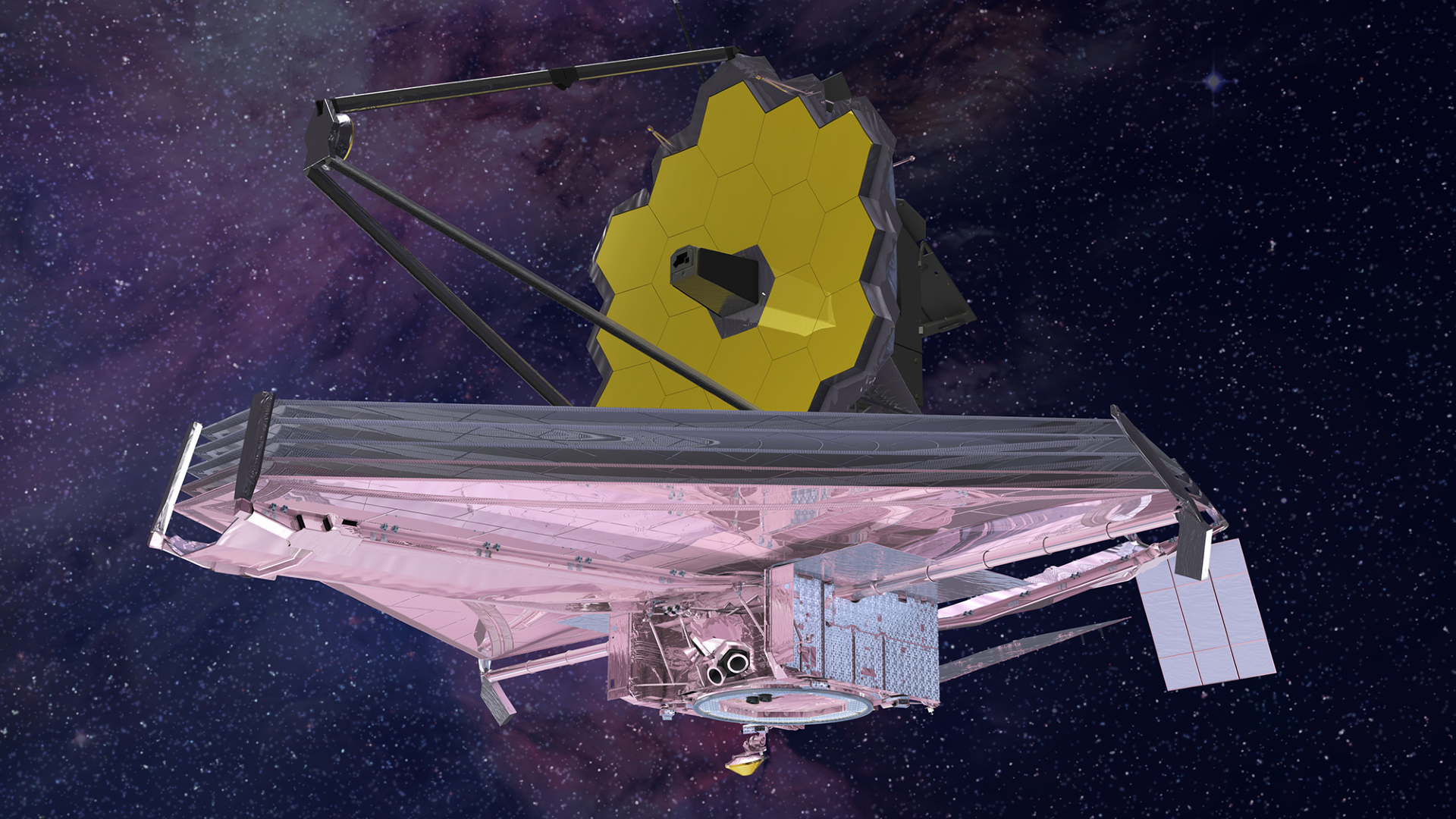
An artist's impression of the James Webb Space Telescope. (Image credit: NASA, ESA, CSA, Northrop Grumman)
Terzan 5 is probably not the only bulge fossil fragment either. As well as those other aforementioned globular clusters, some of which might be fossil fragments and others might be the cores of dwarf galaxies, the globular cluster Liller 1 close to the center of our galaxy shares many of Terzan 5's properties, including its high abundance of heavy elements produced by multiple generations of stars that have died either in supernova explosions.
The team are now looking to chase up another 40 or 50 globular clusters in the bulge to see if they could also be bulge fossil fragments, or whether they are just regular globular clusters.
The findings were presented at the 248th meeting of the American Astronomical Society in Pasadena, California which took place between June 14 and June 18. A paper describing the JWST observations has also been published in the journal Astronomy & Astrophysics.
The expansion of the universe is still accelerating under the influence of dark energy, despite recent claims to the contrary, according to new research. This means that dark energy, the mysterious force that dominates the universe, is not weakening but continues to get stronger, considered something of a "cosmological crisis" as it was so against expectations.
In 1998, via the study of cosmic explosions called Type Ia supernovas, astronomers discovered that not only is the universe expanding, but that the speed of that expansion is increasing. "Dark energy" was the name given to the mysterious force driving this accelerating expansion. Since then, scientists have discovered that dark energy accounts for around 70% of the universe's matter and energy.
In November 2025, research was published that suggested the expansion of the universe was slowing, meaning dark energy would be weakening. But this new research suggests that these findings from last year might not be a cosmic hand grenade thrown into the cosmological apple cart, but instead may have actually emerged from a scientific misunderstanding.
"Thankfully, we have averted this crisis, but the mystery about why the rate of expansion of the universe is still accelerating remains," lead author of the new refuting research, Phil Wiseman, from the University of Southampton in the UK, said in a statement. "The previous and well-accepted measurements were, in fact, fine, and our current understanding of the fate of the universe remains robust. By proving our measurements are correct, we can get back to trying to understand what this dark energy actually is, rather than wondering if it exists at all."
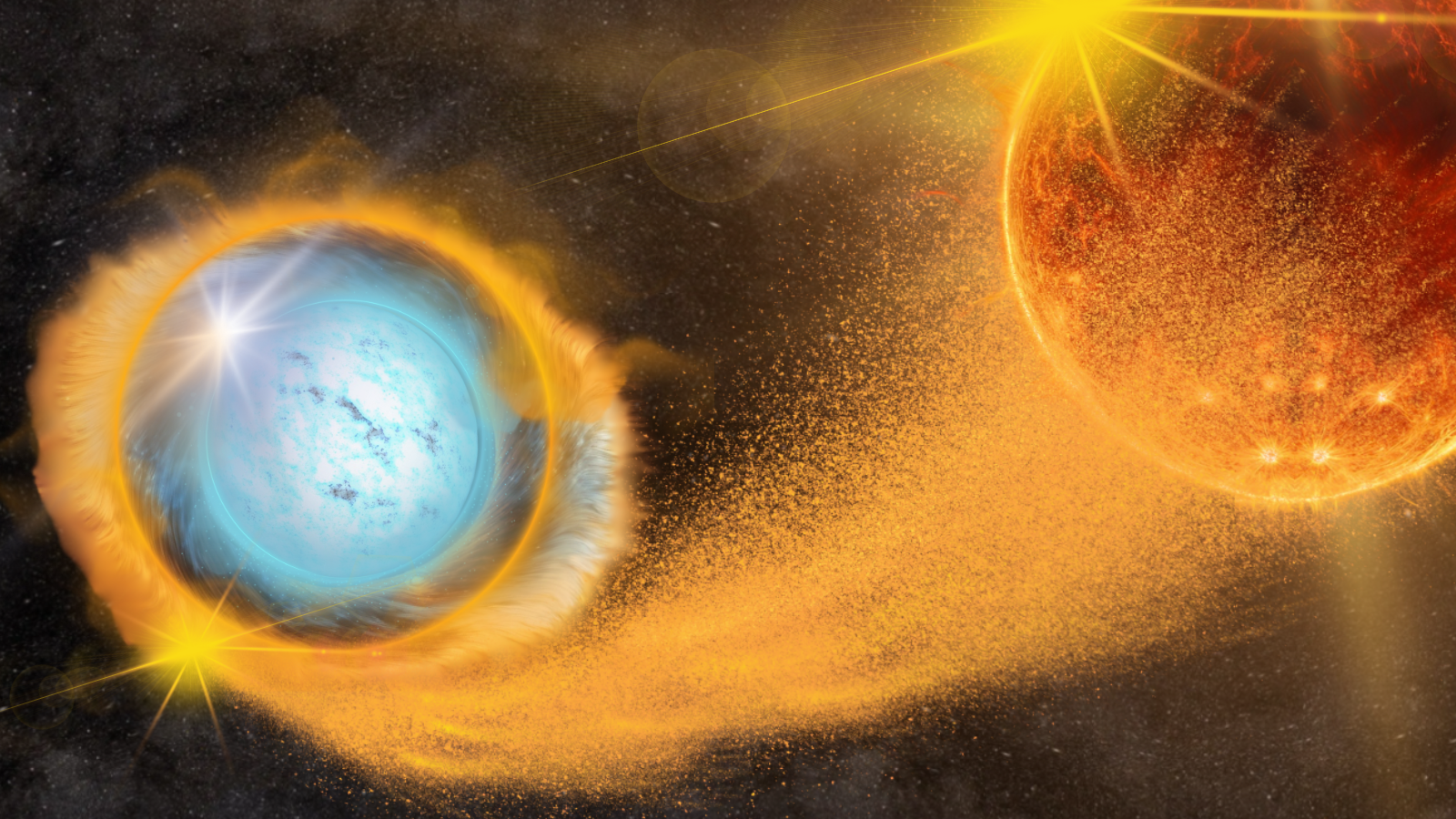
The research from 2025 that suggested dark energy was weakening was based upon a reassessment of the brightness of Type Ia supernovas, which occur when a dead star called a white dwarf overfeeds on a companion star. This causes a runaway nuclear explosion of such uniform brightness that it can be used to measure cosmic distances. In fact, these explosions are so uniform that astronomers refer to them as "standard candles."
This prior research determined, incorrectly it now seems, that as the universe has aged, the brightness of Type Ia supernovas had changed, leading to incorrect measurements of distances based on them as well as incorrect estimates of the speed of the universe's expansion. Both of these led to the suggestion that dark energy is weakening.
An illustration of a white dwarf star feeding on a stellar companion prior to a type Ia supernova (Image credit: Robert Lea (created with Canva))
But Wiseman and colleagues found this previous team had made an error in how they calculated the ages of exploding white dwarfs, finding they had assumed the ages of these stars would be the same as the ages of the galaxies in which they exploded.
They also found the 2025 research hadn't accounted for a common correction used in cosmology that factors in the masses of galaxies in which Type Ia supernovas occur.
"Extraordinary claims require especially careful testing," team member Adam Riess, who in 2011 shared the Nobel Prize for the discovery of dark energy, said. "What we find is that when we calibrate these supernovae, accounting for different host environments and populations, the evidence for cosmic acceleration remains remarkably consistent."
While the challenge to dark energy's growing dominance over the universe seems now to have been refuted, the back and forth on this topic shows how ideas in science aren't dogma and remain open for revision.
"This is how progress is made," team member Mark Sullivan, also from the University of Southampton, said. "Although this idea did not turn out to be correct, it has opened up new ways of thinking about how supernovae explode and how we can measure dark energy more accurately."