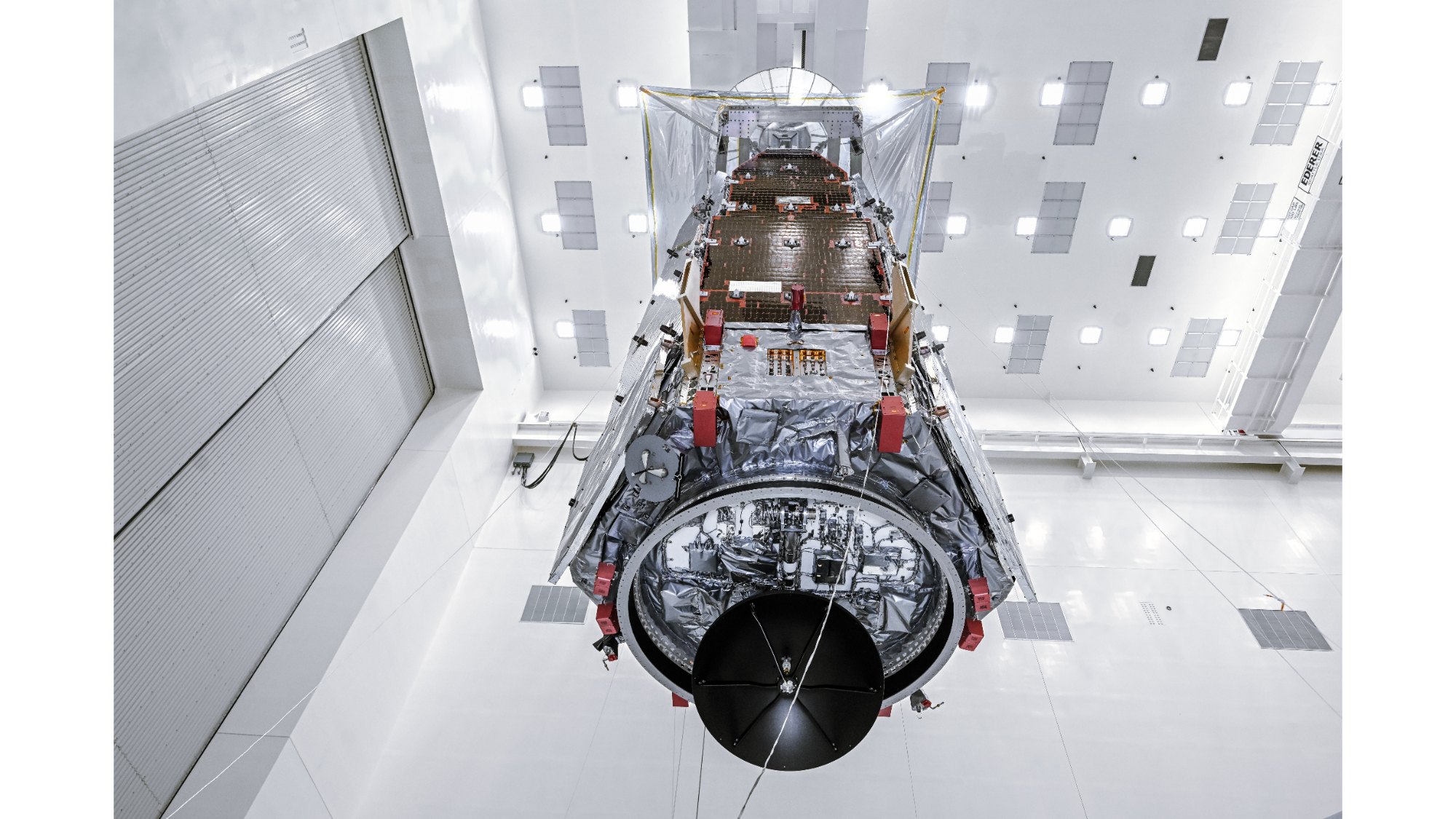
The Nancy Grace Roman Space Telescope is NASA's next great observatory poised to lead humanity's next generation of astronomical discoveries. The Roman Space Telescope will research the mysteries of dark energy, search for exoplanets and investigate the physics of distant stars.
SpaceX will launch Roman on a Falcon Heavy rocket from NASA's Kennedy Space Center (KSC) in Florida. Liftoff is scheduled for no earlier than 7:26 a.m. EDT (1126 GMT) on Sunday, Aug. 30. from Launch Complex-39A (LC-39A). Follow this blog for live updates as Roman is prepped for launch and delievered to space for a brand new mission of discovery.
Roman was recently encapsulated inside Falcon Heavy's payload fairing, and underwent a full launch-day dress rehearsal on Aug. 20. NASA, SpaceX and Roman mission managers then completed the mission's Flight Readiness Review on Aug. 21, formally clearing the observatory to begin its final launch preparations.
Next, the telescope, encapsulated in its payload fairings, will be transported to SpaceX's hangar at LC-39A, where it will be attached to Falcon Heavy rocket before the it rolls out to the pad for launch later this week.
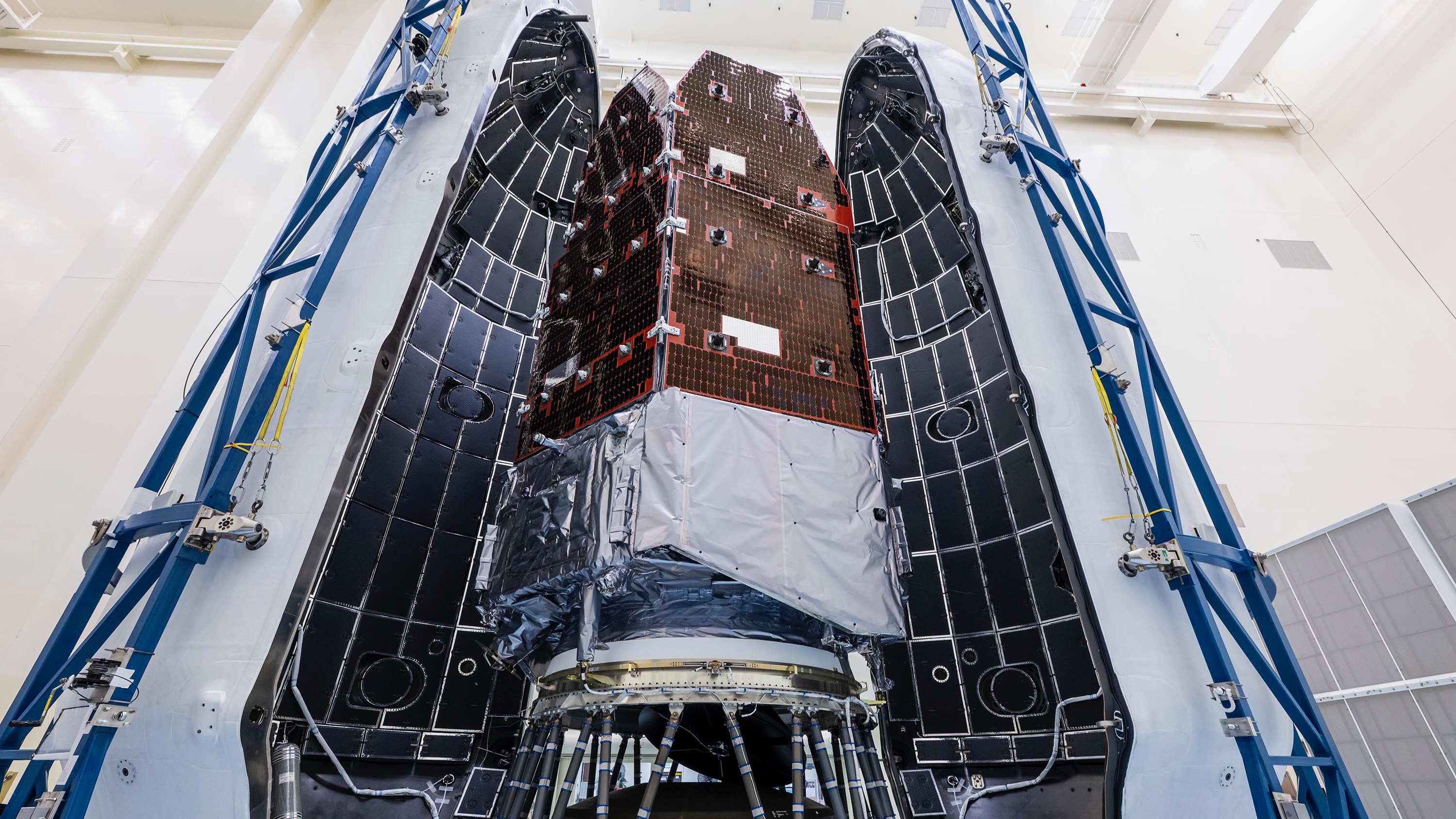
SpaceX seals Roman inside Falcon Heavy fairing ahead of Aug. 30 launch
(Image credit: SpaceX)
NASA's Nancy Grace Roman Space Telescope is one step closer to launch. SpaceX has sealed the bus-sized observatory inside the payload fairing of its Falcon Heavy rocket, the company announced today (Aug. 24). Everything remains on course for Roman to lift off from NASA's Kennedy Space Center in Florida early on Sunday morning (Aug. 30).
After launch, it'll take Roman about 30 days to reach its distant destination — the sun-Earth Lagrange Point 2, which lies about 930,000 miles (1.5 million kilometers) from Earth in the direction of Mars. After a roughly three-month checkout period, the scope will start observing the heavens — hunting for exoplanets and shedding light on dark matter and dark energy, among other tasks.
Roman arrives at SpaceX hangar before launch
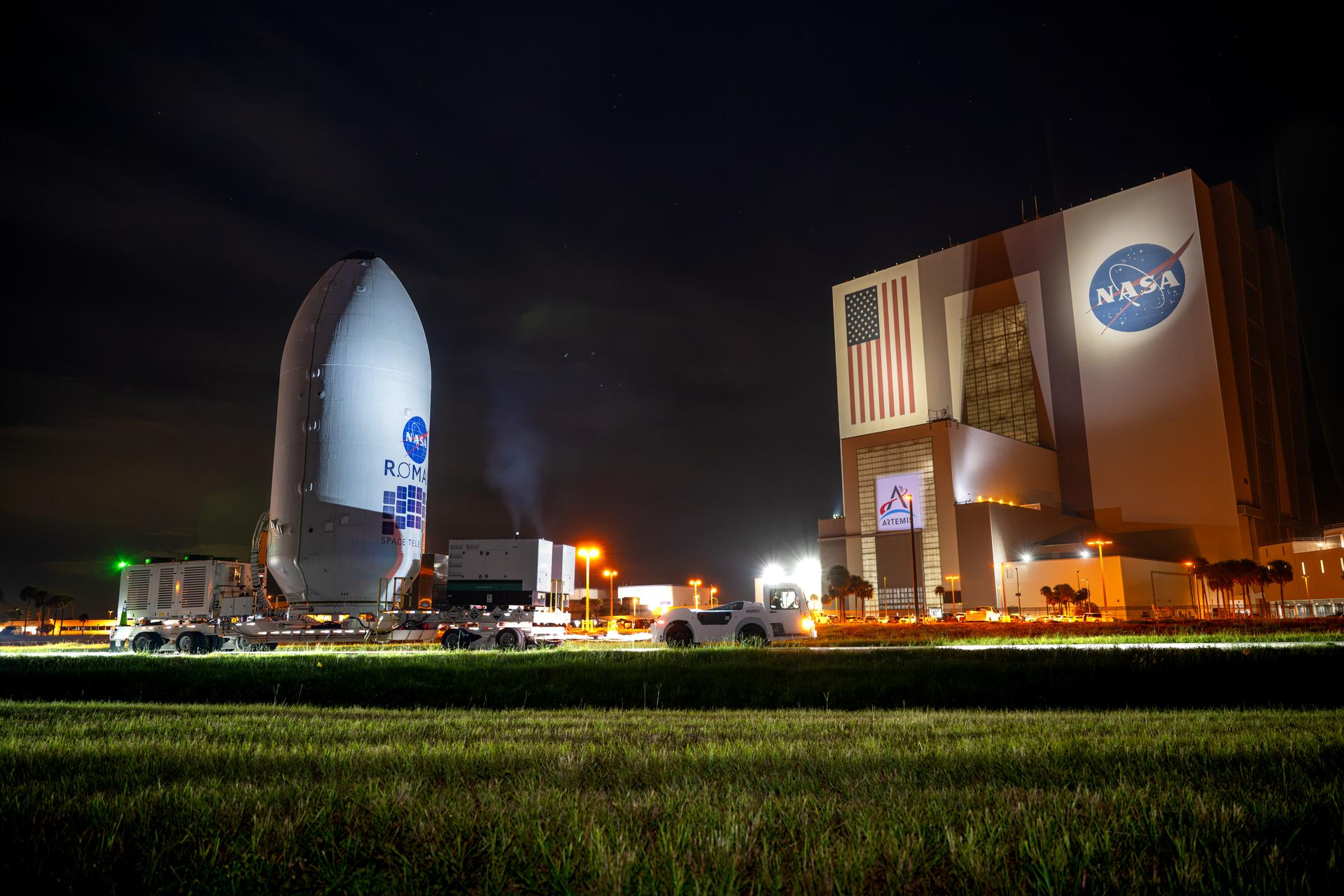
NASA’s Nancy Grace Roman Space Telescope, encapsulated in its payload fairing, travels from the Payload Hazardous Servicing Facility to the SpaceX hangar at Launch Complex 39A at NASA’s Kennedy Space Center on Tuesday, Aug. 25, 2026, ahead of mating to a SpaceX Falcon Heavy rocket. (Image credit: Sydney Rohde (Rocz))
Roman is one step closer to space! NASA transported the new space telescope inside its rocket fairing from the Kennedy Space Center's Payload Hazardous Servicing Facility to SpaceX's hanger at Launch Complex-39A (LC-39A).
The trip occurred overnight on Aug. 25, traveling in a caravan of vehicles to one its last Earthly destinations. Next, Roman and its protective fairings will be mated to SpaceX's Falcon Heavy rocket and undergo final fit checks and tests before rolling out to the launch pad.
A Launch Readiness Review panel will be held by NASA and SpaceX on Friday (Aug. 28), to make a final determination for launch readiness. If everything goes according to plan, liftoff will proceed toward the scheduled 7:26 a.m. EDT (1126 GMT) target on Sunday (Aug. 30).
SpaceX shows off Roman's Falcon Heavy rocket ride
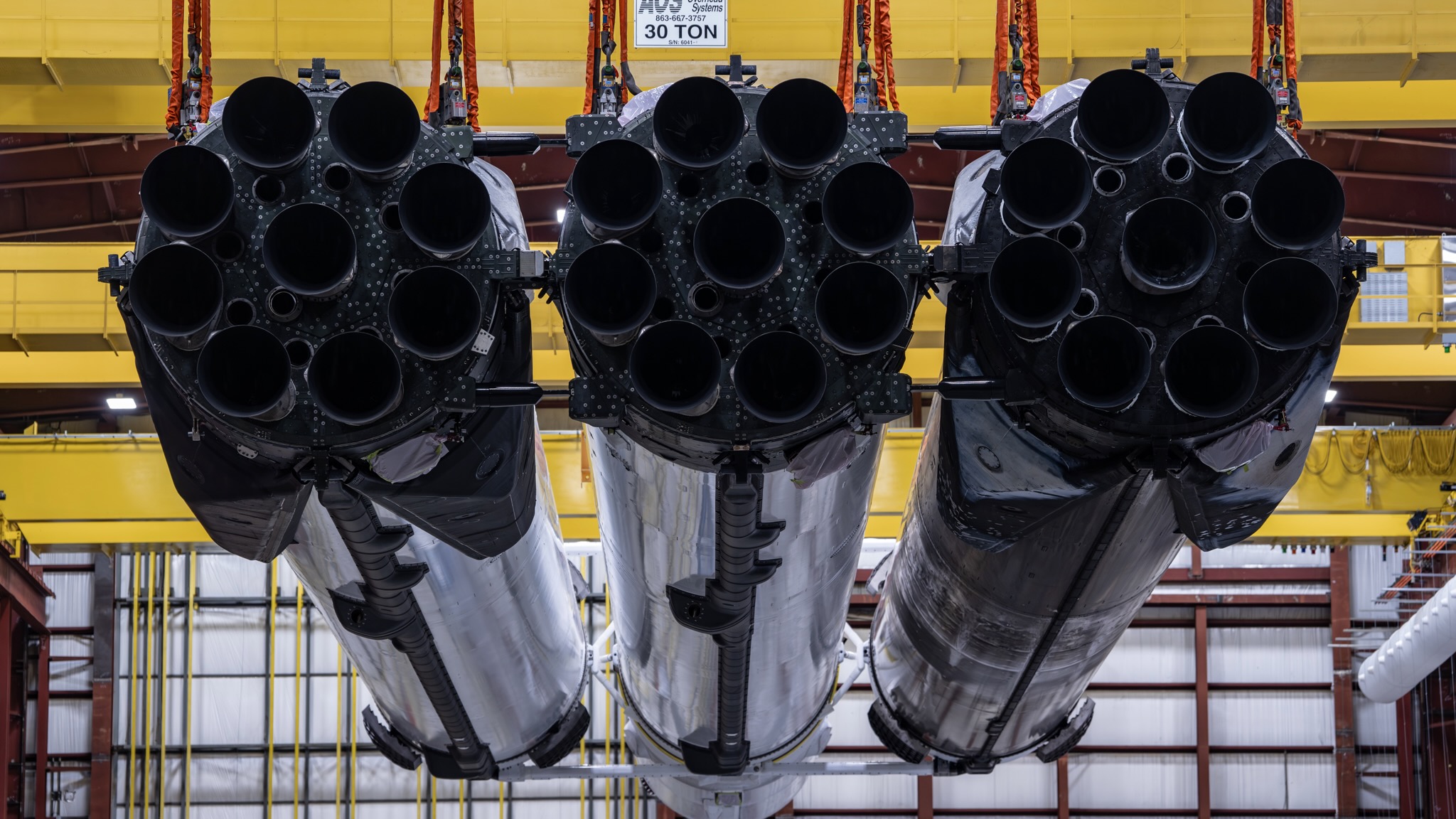
The three first-stage boosters of the Falcon Heavy rocket that will launch NASA's Nancy Grace Roman Space Telescope on Aug. 30, 2026. SpaceX shared this photo via X on Aug. 26. (Image credit: SpaceX)
That launcher is a Falcon Heavy, whose first stage consists of three modified, strapped-together Falcon 9 boosters. In an X post today (Aug. 26), SpaceX showed off that trio, which are currently in the hangar at Launch Pad 39A at NASA's Kennedy Space Center in Florida. The Falcon Heavy is scheduled to launch Roman — which will hunt for exoplanets and shed light on mysterious dark matter and dark energy — from Pad 39A on Sunday (Aug. 30) at 7:26 a.m. EDT (1126 GMT). You can watch the highly anticipated liftoff here at Space.com.
HOUSTON — What does NASA's astronaut training hub look like these days, as the agency aims to bring more commercial space stations into the fold?
It's an interesting mix of government and private companies, of space agency personnel and of contractors, all working together to keep U.S. and international astronauts flying through the end of the ISS — currently expected around 2030 — and the new breed of commercial space stations expected to take its place.
Canadian reporters like myself were invited on a tour of Johnson Space Center (JSC) on Aug. 4 ahead of the launch of SpaceX Crew-13, which launches no earlier than Sept. 12. Canadian Space Agency astronaut Josh Kutryk is a mission specialist on the Crew Dragon spacecraft, which also includes NASA commander Jessica Watkins, NASA pilot Luke Delaney and Roscosmos mission specialist Teteryatnikov.
The ISS remains an active program for at least a few years; NASA managers reiterated in a press conference here on Aug. 3 that they are still targeting an end-of-operations in about 2030 — but they are prepared to extend the lifetime of the station if directed by Congress (which wants to keep going at least another two years).
The space station has had a leak on the Russian side for several years, and astronauts recently and briefly sheltered in a Crew Dragon during discussions of a fix. At the press conference, NASA added the situation is under control as Roscosmos agreed to essentially seal off that area. Major station systems, they added, are otherwise in good health.
But as spaceflight takes planning, teams are already thinking about "lessons learned" when the ISS retires for a new generation of mission planners, which would include an even greater focus on companies. NASA's Commercial LEO (Low Earth Orbit) Destinations or CLD program aims to have private space stations for astronauts by the time the ISS retires, and handed out early-stage contracts valued at about $415 million in 2021 to three teams led by Nanoracks, Blue Origin and Northrop Grumman. After NASA briefly considered changing the program's scope, after input from industry a new request for proposals advancing CLD should be out soon.
Meanwhile, companies like Vast Space have their own self-funded modules almost ready to fly, while Bigelow Aerospace has an inflatable module on ISS that is being tested, long-duration wise, to make sure the concept holds up for a future free-flying destination. No matter who hosts astronauts, however, NASA officials on the tour said they are prepared to offer expertise and help — and there is no other visible demonstration of that expertise to the public than the ISS Mission Control, which is often shown live on NASA+ during a selection of space station operations.
Mission Control: 'We have all of those disciplines'
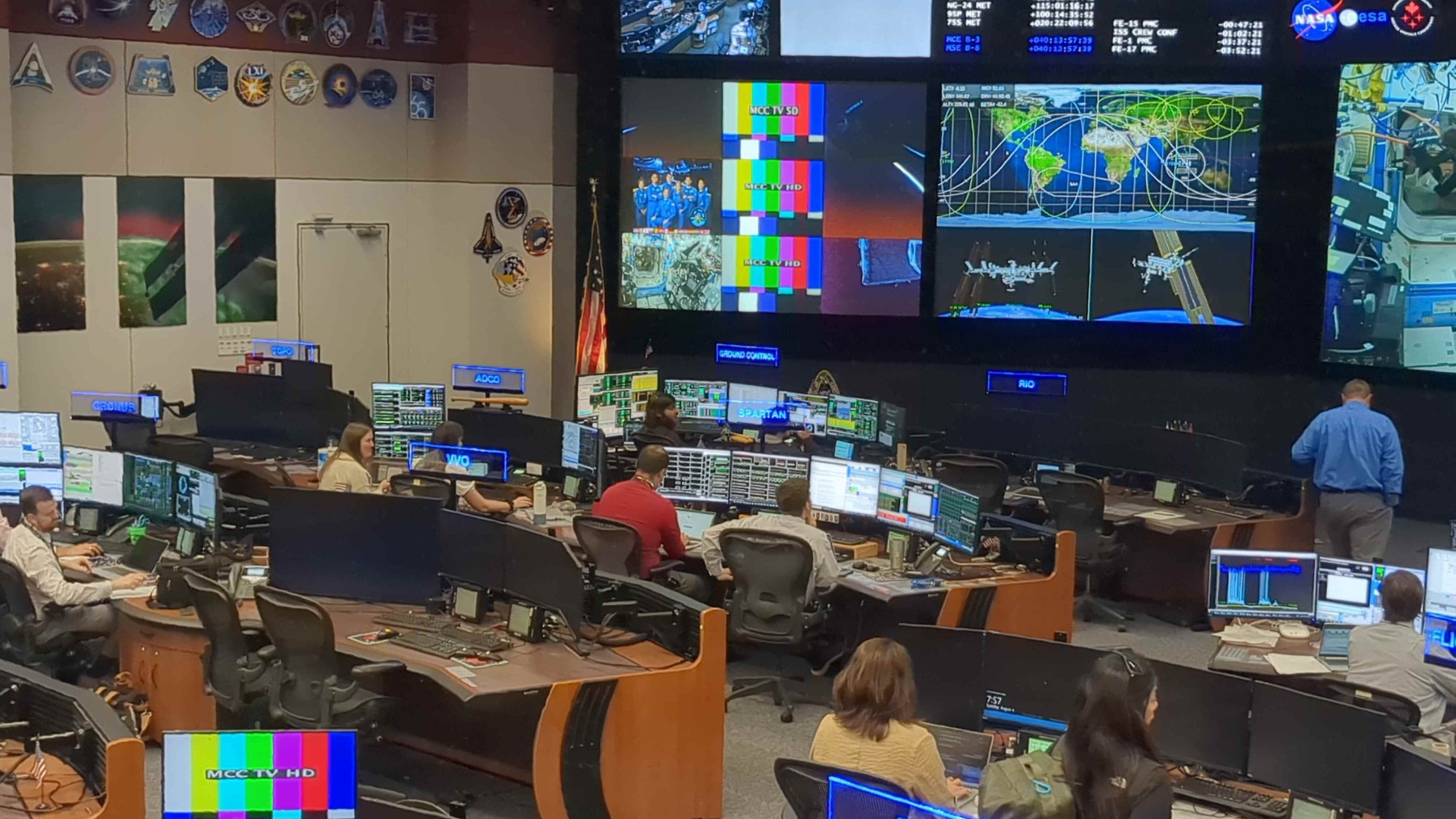
The mission control room at Johnson Space Center in Houston. (Image credit: Elizabeth Howell/Future)
The Mission Control building holds several dedicated control rooms for different mission purposes, including an historic Apollo control center and another room alternately used for Boeing Starliner and Artemis missions. I've been lucky enough to visit all of these in the past. Our only stop in the building Aug. 4, however, was the iconic ISS mission control.
On screen at the front of the room, the Expedition 75 astronauts were awake and active, occasionally zooming by a camera mounted inside the Destiny U.S. lab sandwiched between two station "nodes" leading to other modules. Flight director Diane Dailey told us the controllers are watching for things like if the astronauts are loaded down with equipment, which indicates that would not be a good time to call unless urgent. "We usually have that live camera view just up for awareness. It just helps us understand," she said.
Speaking of calls, an open laptop screen, deliberately positioned within view of the camera, showed all "green" on the comms channels—which helps ground controllers figure out if the crew can hear them, as the station flies in and out of satellite and ground station views all the time. (A flight map, also at the front of the room, also allows for tracking the station and its communications capabilities as it flies around the world.)
While it was hard not to keep gazing at these screens, what was almost as mesmerizing was watching the quiet group of ISS controllers positioned in front of their own laptops and occasionally holding side conversations about their systems. SpaceX now has its own Mission Control in California for its spacecraft, while Boeing chose to integrate theirs with NASA's. Whatever pathway companies choose, however, Mission Control will remain an important example of "division of labor" for future space stations.
"You're going to see different consoles that specialize in different aspects of spacecraft operations," Dailey said. "I like to kind of think of it in terms of, 'What are all the capabilities you'd need on any given spacecraft', right? You'd need propulsion. You'd need communications. You'd need computers. All of those things. So, we have all of those disciplines and all those areas in the spacecraft represented here."
Building 9: What to do 'when you no longer have gravity assisting you'
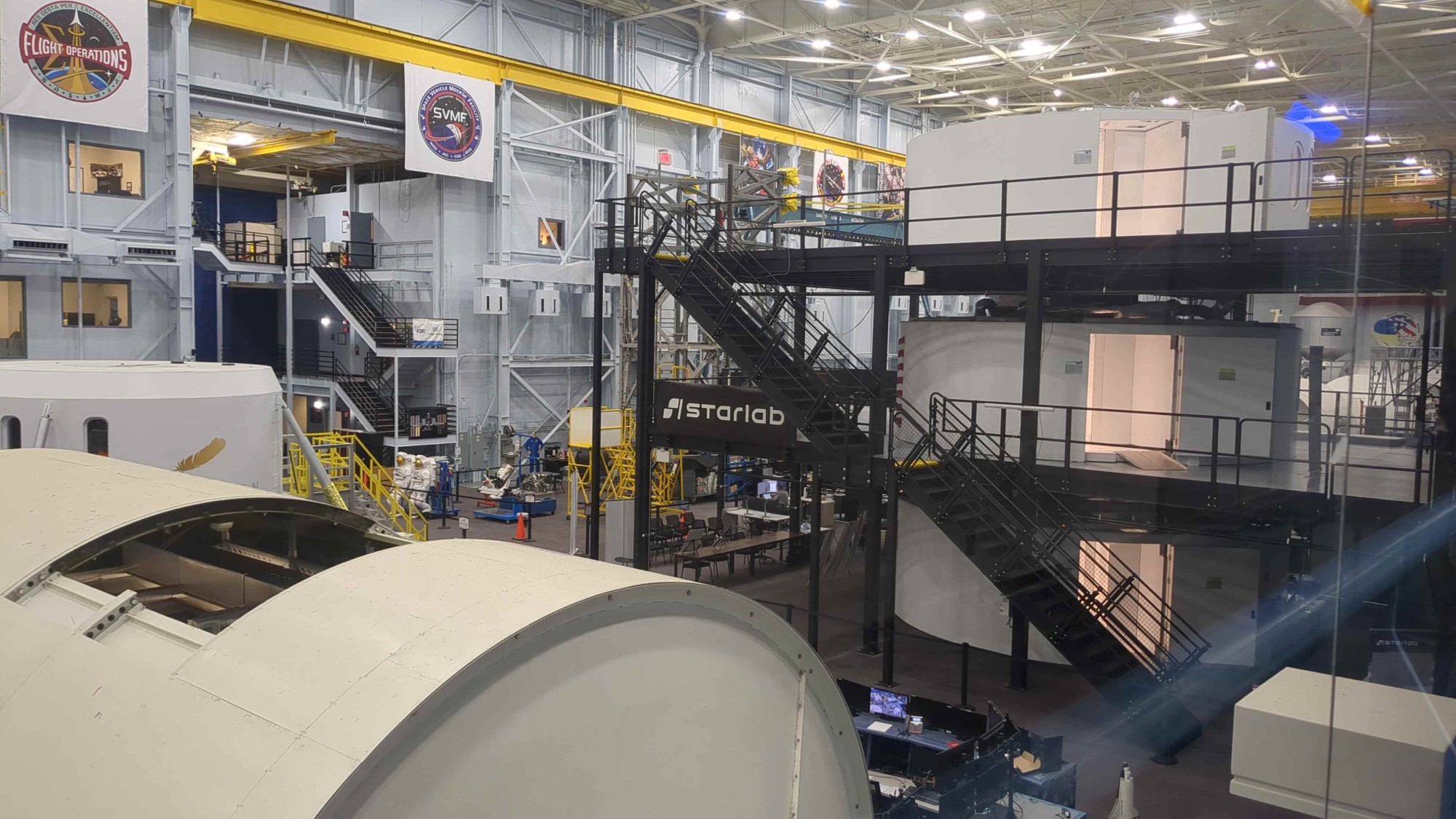
The Space Vehicle Mockup Facility — known to JSC workers as Building 9 — is constantly in flux, because modules constantly shift in and out of the facility for different missions. The facility's goal these days is not only to support NASA missions, but also private industry, by providing the physical space and hardware to simulate problems in space if they arise.
When it comes to astronaut training, one example is learning how to do CPR: "CPR is hard enough when you have gravity. When you no longer have gravity assisting you, they [astronauts] have to learn to 'strap in'," said Mathieu Caron, the CSA's director of astronauts, life sciences and space medicine, who accompanied reporters on the tour of Building 9.
That's only one example of an emergency, of course. Another one is fire alarms—in which the astronauts learn how to quickly gather their team in a "safe haven" with communications and computers available to talk with Earth, then to make sure everyone is there before assessing the situation and figuring out how to deal with it (which could mean fighting the fire, or heading to an escape vehicle.)
When astronauts are training for fire alarms in Building 9, Caron said, there's an extra step involved: letting nearby personnel know that the simulated fire alarm in the ISS area is not the actual fire alarm for the building. "Like, if you hear this specific bell, it's because they're just practicing that training," he explained.
The emphasis of our visit was on ISS operations, given that we were visiting in association with Crew-13, but the facility's website also mentions "commercial space flight companies and exploration programs" among the customers.
While walking the perimeter of the building alongside NASA and CSA, we could see some distant glimpses of other companies' hardware — from SpaceX and Blue Origin, for example, as well as the Starlab Space consortium's multi-floor space station mockup. As NASA very much intends to be the customer on future CLD destinations, surely more of these companies will be occupying the floor of Building 9 after the ISS retires.
A view inside Building 9 at NASA's Johnson Space Center in Houston. (Image credit: Elizabeth Howell/Future)
Neutral Buoyancy Laboratory: 'The better they get, the more we treat it like the real world'
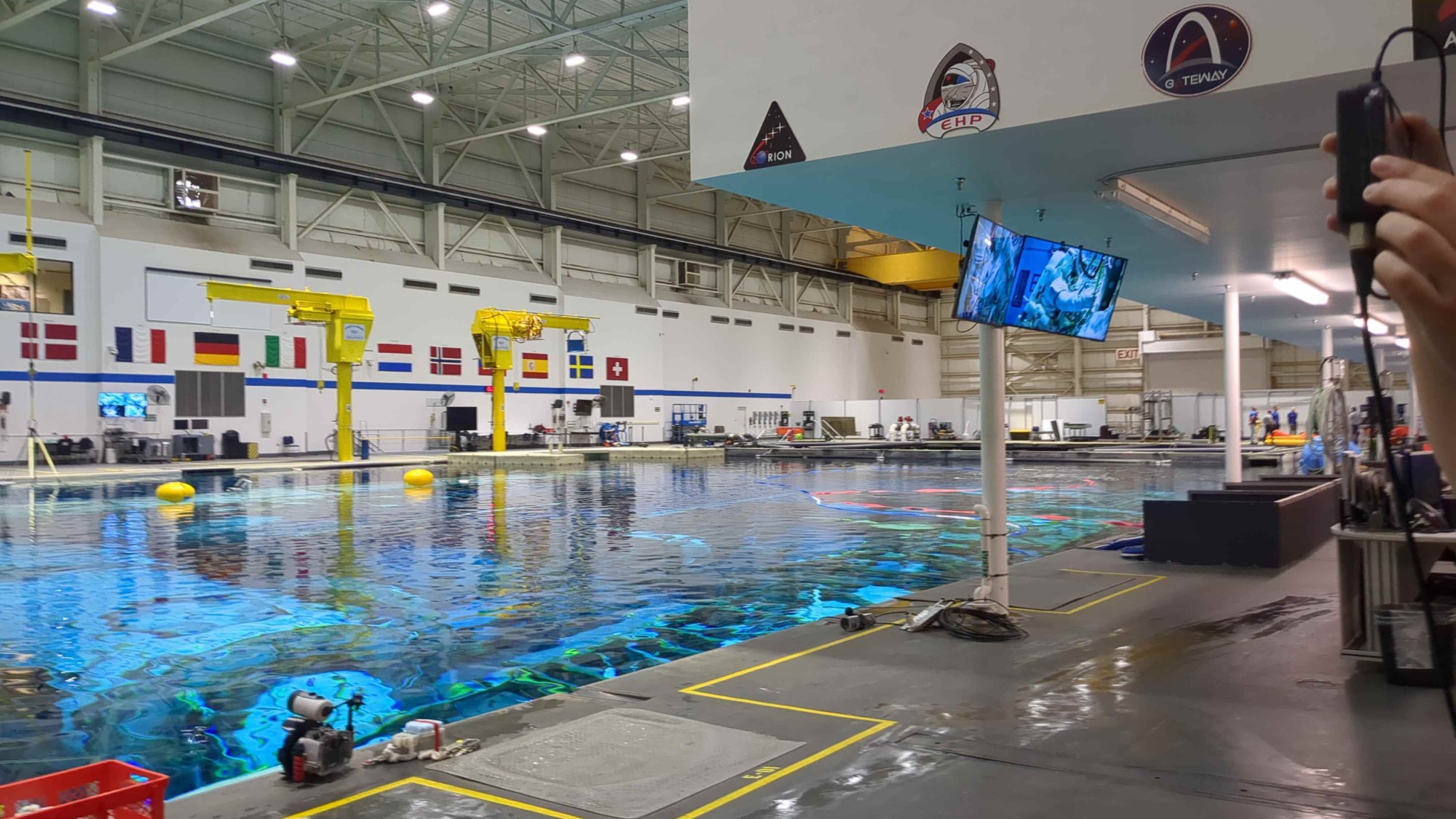
Our last stop on the Gilligan-like three-hour tour was the Neutral Buoyancy Laboratory, which is part of JSC's Sonny Carter Training Facility and about a 15-minute drive from the heart of the NASA campus. Most space people would easily recognize this place as the spot where astronauts rehearse spacewalks, clad in adapted spacesuits simulating what they'll feel for real the moment they step out the hatch.
I spent much of my childhood in community center pools, learning how to swim, and when I walked beside the football-field-sized pool for the first time the humidity — and the echoes on the ceiling and walls from noises — felt somewhat like old times. The scale, however, was strange. The echoes were happening much further away from me, while the humidity was less intense given the expanse of the huge facility. It was hard for my mind to settle, as the setting felt both familiar and unfamiliar.
We only spent a few moments poolside, however, as getting up on the catwalks allowed a much better view of the scene. In one zone were the ISS module mockups inside the pool, through which a couple of astronauts were training while surrounded by divers. (You could track the team's progress by watching the bubbles and hoses on the surface.)
"When they [astronaut candidates] first start, we help them a lot," the NBL's Tim Hall told our media group. "The more mature they get in their training, and the better they get, the more we treat it like the real world — and let them execute on their own."
NASA's Neutral Buoyancy Laboratory at Johnson Space Center in Houston. (Image credit: Elizabeth Howell/Future)
In another was an area where the Orion spacecraft for the Artemis 2 moon mission was put through its paces during training: Could the arriving divers handle waves? What if the spacecraft landed upside-down? All of these things were simulated repeatedly to ease recovery operations.
"Have you ever watched 'Apollo 13'?" Hall asked us. (It's the movie that sparked my interest in space when I saw it on VHS in 1996, so yes.) "If you're a fan, at the end of the movie, you'll see them at 'Stable 1'," he continued — that means the spacecraft is upright in the water.
"We have Stable 1, 2, 3, 4. Those are all the positions of the vehicle when it's laying in the water. So, this thing is actually training for the crew. … we can rotate [the spacecraft], so they train the crew how to get in and out of it in the different stable conditions."
The deep-ocean capabilities are not only useful for spacecraft, but for applications like the oil industry: the pool has been used in past years to simulate offshore work and fire training for the engineers on distant rigs, for example. Private space companies also have had their own time in the pool for spacesuit applications, such as what Axiom Space advertised in 2025 to test the Axiom Extravehicular Mobility Unit (AxEMU) spacesuit that NASA astronauts are expected to use on the lunar surface.
Could more companies come in as the ISS program winds down? Hall says right now a lot of the spare capacity is taken up by the U.S. Navy, but the NBL does expect to offer more of these commercial services in future — as it's already advertised on their website.
"We're open to that for sure," Hall said. "We haven't had anybody out here yet for, like, a recovery or anything on training like that from a private space [company], but that's definitely something we'll address."
NASA's Artemis II moon astronauts will join a very exclusive club next week.
President Donald Trump will award those spaceflyers the Congressional Space Medal of Honor next Friday (Aug. 28) at Johnson Space Center in Houston to recognize their historic journey around the moon this past April.
The ceremony will begin at 11 a.m. EDT (1500 GMT) and will feature NASA Administrator Jared Isaacman, President Trump and the Artemis II astronauts. You'll be able to watch it live when the time comes.
Artemis II sent NASA astronauts Reid Wiseman, Victor Glover and Christina Koch, as well as the Canadian Space Agency's Jeremy Hansen, on a 10-day trip around Earth's nearest neighbor. It was the first crewed voyage beyond low Earth orbit since 1972, when the Apollo 17 astronauts returned home from the moon.
The Congressional Space Medal of Honor is the highest award that the U.S. government can bestow upon an astronaut. It's possible that only Wiseman, Glover and Koch will receive it next week; NASA's media advisory about the event states that Trump will give the medal to "each of NASA's Artemis II crew members," suggesting that Hansen might not be included. (The award is not limited to American citizens.)
Thirty people have received the Congressional Space Medal of Honor to date. They are:
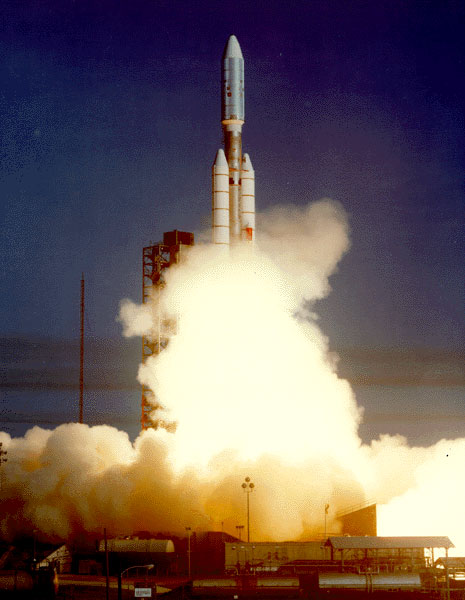
On Aug. 20, 1977, NASA launched the Voyager 2 spacecraft on a mission to explore the outer planets. Despite its name, this was the first of the two Voyager missions NASA launched that year.
Thanks to a rare alignment of the planets, NASA had the opportunity to send a spacecraft on an unprecedented journey to Jupiter, Saturn, Uranus and Neptune.While Voyager 1 ended its planetary mission after Saturn, Voyager 2 completed a 12-year journey to Neptune. But they didn't stop there!
Voyager 1 left the solar system and entered interstellar space in 2012, and Voyager 2 followed suit in 2018. As it approaches 50 years of operation, the probe continues to return data from three functioning science instruments.
NASA's Voyager 2 launched on Aug. 20, 1977. (Image credit: NASA)
Why it mattered
Nearly half a century later, it remains the only spacecraft to visit all four has giants in our solar system, and the only spacecraft humanity has ever sent past Uranus and Neptune. Some of Voyager 2’s biggest surprises came from the moons orbiting those planets. Its images of Neptune’s largest moon, Triton, revealed active geyser-like plumes blasting nitrogen miles above the surface — making it one of only three geologically active moons in the solar system (maybe four, depending on what Europa Clipper finds).
Decades beyond its original mission, Voyager 2 has begun studying the Kuiper Belt environment beyond the Sun’s protective heliosphere, giving scientists measurements from a region no spacecraft had been designed to reach. Voyager 2's plutonium power supply drops in efficiency about four watts per year, and NASA engineers were recently able to reduce how much power Voyager 2 needs by switching off a number of non-science components to adapt a less demanding method of warming the spacecraft while it continues traveling ever farther away from the sun.
NASA is calling off the effort to save its Neil Gehrels Swift Observatory after a private rescue spacecraft couldn't overcome its own problems in orbit.
LINK, the specialized probe from Katalyst Space that NASA contracted for the Swift Boost mission, was delivered to space on an air-launched Northrop Grumman Pegasus XL rocket on July 3. The vehicle was designed to rendezvous with the Swift Observatory in order to grapple and raise it to a more stable orbit, but LINK ran into trouble when it began to spin uncontrollably about three weeks after launch.
Today (Aug. 19), NASA announced an official end to LINK's efforts to boost Swift's orbit, citing ongoing attitude control issues with the private spacecraft, but the agency hasn't canceled the mission outright. LINK will still attempt a rendezvous with Swift in order to practice proximity operations and demonstrate its capabilities other than spacecraft capture, which could aid future missions down the road.
From its inception, the Swift Boost mission was always viewed as a long shot. Increased solar activity had already begun decaying the observatory's orbit faster than anticipated when NASA awarded the $30 million Swift Boost contract to Katalyst in 2025, giving the Arizona-based company less than a year to complete LINK's design, manufacture and testing before time to save Swift would run out.
"NASA should be willing to move quickly and take smart risks when the potential return is worth it, and that is exactly what we did with this mission," NASA Administrator Jared Isaacman said in a statement today. "This is not the outcome we were working toward, but it does not change why this mission was worth attempting. The team moved with extraordinary speed to give Swift a chance to carry out more science while advancing capabilities America will need for satellite servicing in the future."
Swift is a one-of-its kind orbital observatory designed to study high-energy phenomena across the universe. It can detect sudden events like gamma-ray bursts and quickly direct its instruments to study them in X-ray, ultraviolet and visible light. The spacecraft is also routinely redirected for rapid response research to study things like newly discovered supernovae, black-hole ejections, fast radio bursts and other short-lived astronomical events.
With LINK now incapable of boosting Swift's orbit, NASA estimates the observatory will dip catastrophically low into Earth's atmosphere before the end of the year. After Swift dies, the agency says it will "continue to prioritize finding new options to react rapidly to cosmic events, using current missions to help fill the gap in the meantime."
Katalyst is working closely with NASA as the Swift Boost mission enters its next phase. Together, the company and space agency are evaluating logistics for LINK's rendezvous and maneuvering demonstration within Swift's vicinity, which will provide data for potential future servicing missions to other satellites, NASA's statement says.
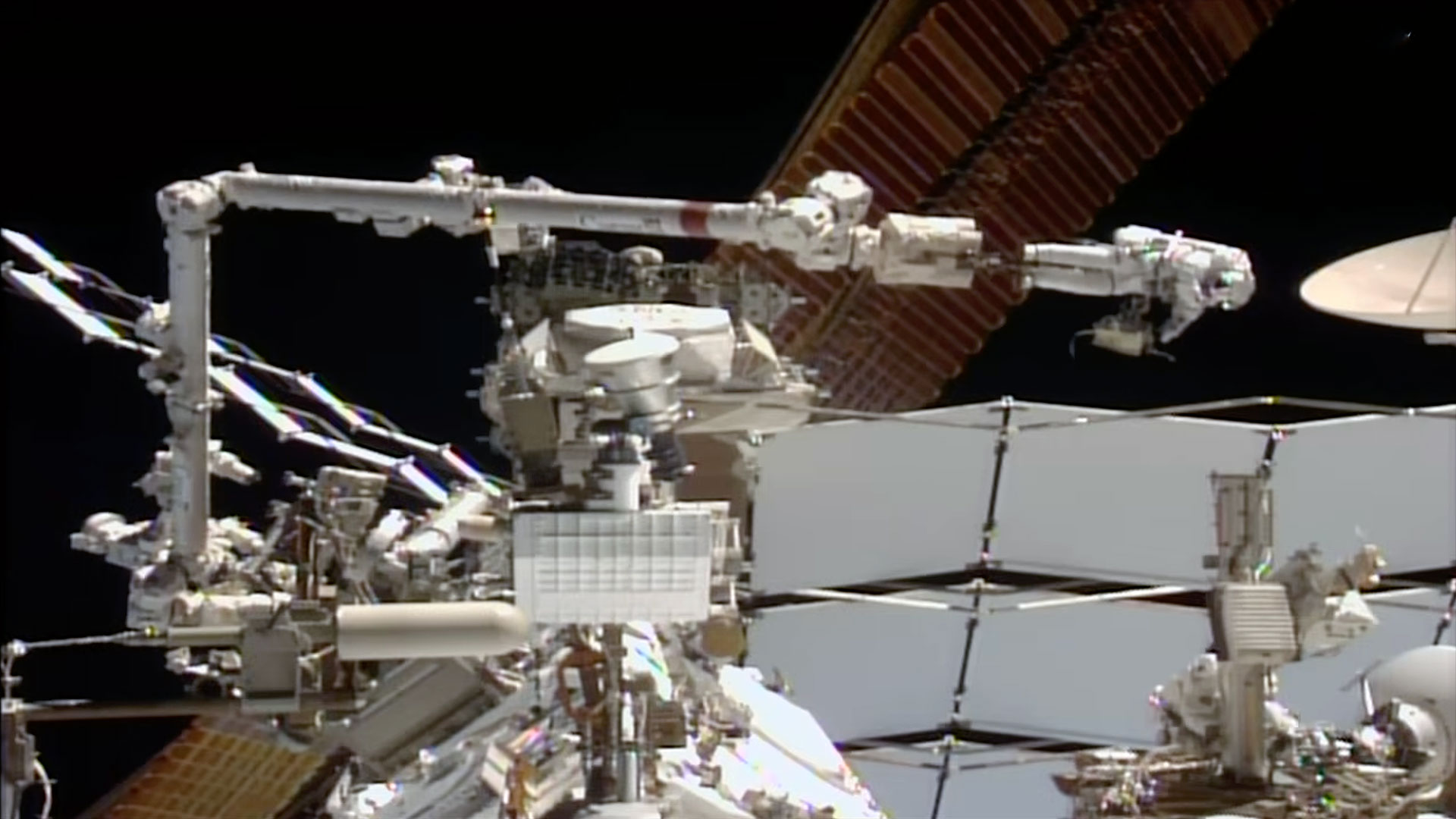
Two astronauts — including the first French woman in history to perform a spacewalk — worked outside of the International Space Station (ISS) on Tuesday (Aug 18), becoming temporary TV repairpersons. Just like what frequently happens on Earth, the work required more time than the "appointment" allowed, requiring a second visit to be scheduled.
NASA astronaut Anil Menon and ESA (European Space Agency) astronaut Sophie Adenot were tasked with the removal and replacement of a Space-to-Ground antenna that since November had ceased being able to track NASA's data relay satellites, rendering it unusable. A second antenna has been in use since, continuing the transmission of critical data and enabling high-speed communications with Mission Control Houston.
Spacewalk planners had allocated about six and a half hours for the work to be completed. The two Expedition 75 crewmates were successful in removing the failed Space-to-Ground antenna from its mount on the station's truss but ran into delays disconnecting its electrical connections and and locking down gimbal bolts, or pins, to secure the large dish assembly during its transport to its temporary stowage location.
"We got into this with the mindset that we wanted everything to go perfectly," said Menon as the spacewalk came to an end. "Things were a lot different than expected, but what I would say that I am really impressed with is that all of those contingencies were well thought out."
As such, flight controllers had the astronauts tether the failed antenna to the truss and waived them off installing the replacement antenna, leaving it for a future extravehicular activity (EVA) still to be scheduled. Mission managers will decide whether to add that task to a spacewalk already planned for next Tuesday (Aug. 25) or to leave it for a later outing.
"We are looking at times," radioed Mission Control to the spacewalkers. "We are going to go directly to the long-duration tie-down of this SGANT on the Z-1 truss."
NASA astronaut Anil Menon is maneuvered outside of the International Space Station by the Candarm 2 robotic arm, Tuesday, Aug. 18, 2026. (Image credit: NASA)
Menon and Adenot began the spacewalk at 8:29 a.m. EDT (1229 GMT) when they switched their spacesuits to battery power. Their EVA ended once they were back inside the U.S. Quest airlock and re-pressurization began at 2:52 p.m. EDT (1852 GMT).
Their total time logged on this spacewalk was 6 hours and 23 minutes.
Tuesday's spacewalk was the 282nd in support of ISS assembly, maintenance and upgrades. It was Menon's second EVA since making his first outing with fellow NASA astronaut Jessica Meir on Aug. 6, increasing his total spacewalking time to 12 hours and 50 minutes.
It was the first time that Sophie Adenot ventured into the vacuum of space, making her the first female and fifth citizen of France to perform a spacewalk after Jean-Loup Chrétien, Jean-Pierre Haigneré, Philippe Perrin, and Thomas Pesquet.
"What a day!" said Adenot. "My deepest gratitude to everyone who made this possible — the pioneers who came before us, but also the incredible teams working behind the scenes today."
This was the fifth spacewalk conducted out of the International Space Station this year, the second for Expedition 75 and the 97th using U.S. extravehicular mobility unit (EMU) spacesuits at the space station.
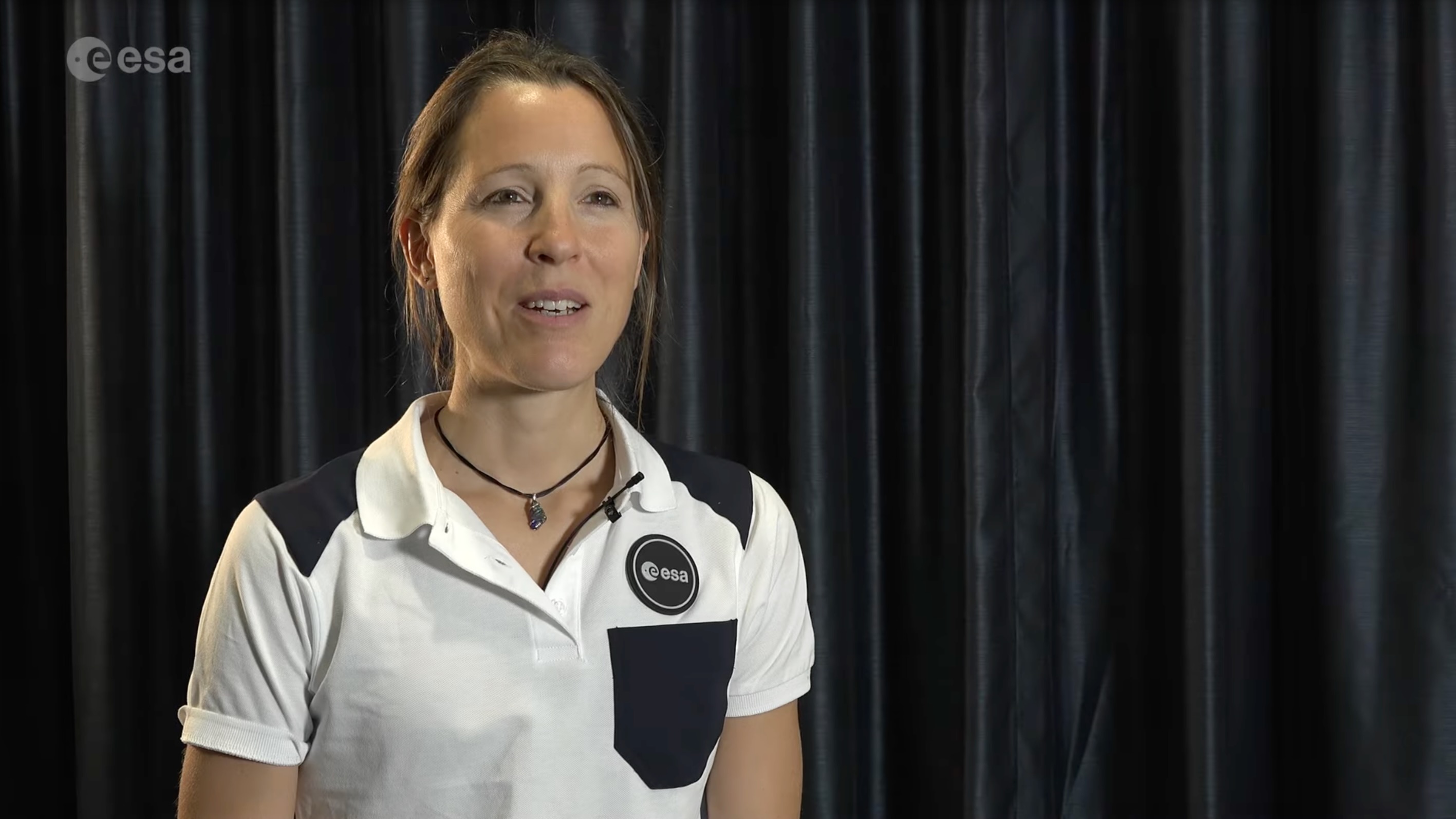
Sophie Adenot will make spaceflight history today (Aug. 18).
The European Space Agency (ESA) astronaut will become the first French woman ever to conduct a spacewalk, an activity she'll undertake with NASA astronaut Anil Menon.
The duo are scheduled to step outside the International Space Station (ISS) for a 6.5-hour excursion today at around 8:35 a.m. EDT (1235 GMT). You can watch it live here at Space.com, courtesy of NASA. Coverage starts at 7 a.m. EDT (1100 GMT).
Sophie Adenot is part of the European Space Agency's 2022 astronaut class. (Image credit: ESA)
Adenot and Menon will "replace a space-to-ground antenna on the orbital complex," NASA officials wrote in a spacewalk preview.
"The antenna is a critical communications link NASA uses to transmit data, enabling high-speed communications between the Mission Control Center in Houston and the space station," they added.
This will be the second spacewalk for Menon; his first one, conducted with fellow NASA astronaut Jessica Meir, occurred on Aug. 6. During that extravehicular activity (EVA), a carbon dioxide sensor on Menon's spacesuit gave "an unexpected data reading," NASA officials wrote in an Aug. 7 update.
The sensor returned to normal after Menon doffed the suit, but NASA took some extra time to make sure there was no serious issue. As a result, the agency pushed his second spacewalk back a few days — from the originally planned Aug. 13 to today.
Today's spacewalk will be the 282nd overall in the long history of the ISS. Menon, who reached orbit on a Russian Soyuz spacecraft on July 14, will be "crewmember 1" on the EVA. Adenot — a member of SpaceX's Crew-12 mission, which reached the orbiting lab in February — will be "crewmember 2."
Adenot won't be the first French person overall to conduct an EVA. That distinction goes to Jean-Loup Chrétien, who performed a spacewalk outside the then-Soviet Union's Mir space station in 1988.
Other male French astronauts, including Philippe Perrin and Thomas Pesquet, later spacewalked outside the ISS. Pesquet also became the first French person to command an ISS mission, taking the reins in October 2021.
MORRISON, Colorado - The Artemis II crew that circuited the moon earlier this year came full circle, dropping by a distinctive spot on Earth that's visually reminiscent of both the moon and Mars.
On Aug. 3, the vast and stunning Red Rocks Amphitheatre served as both an inoculation of near-term nostalgia and heart-felt congratulations to the crew for the impressive journey of Artemis II. The 10-day mission began on April 1 of this year, flew around the moon and back, and splashed down in the Pacific Ocean on April 10. It was the first crewed flight to saunter spaceward beyond low Earth orbit in 53 years.
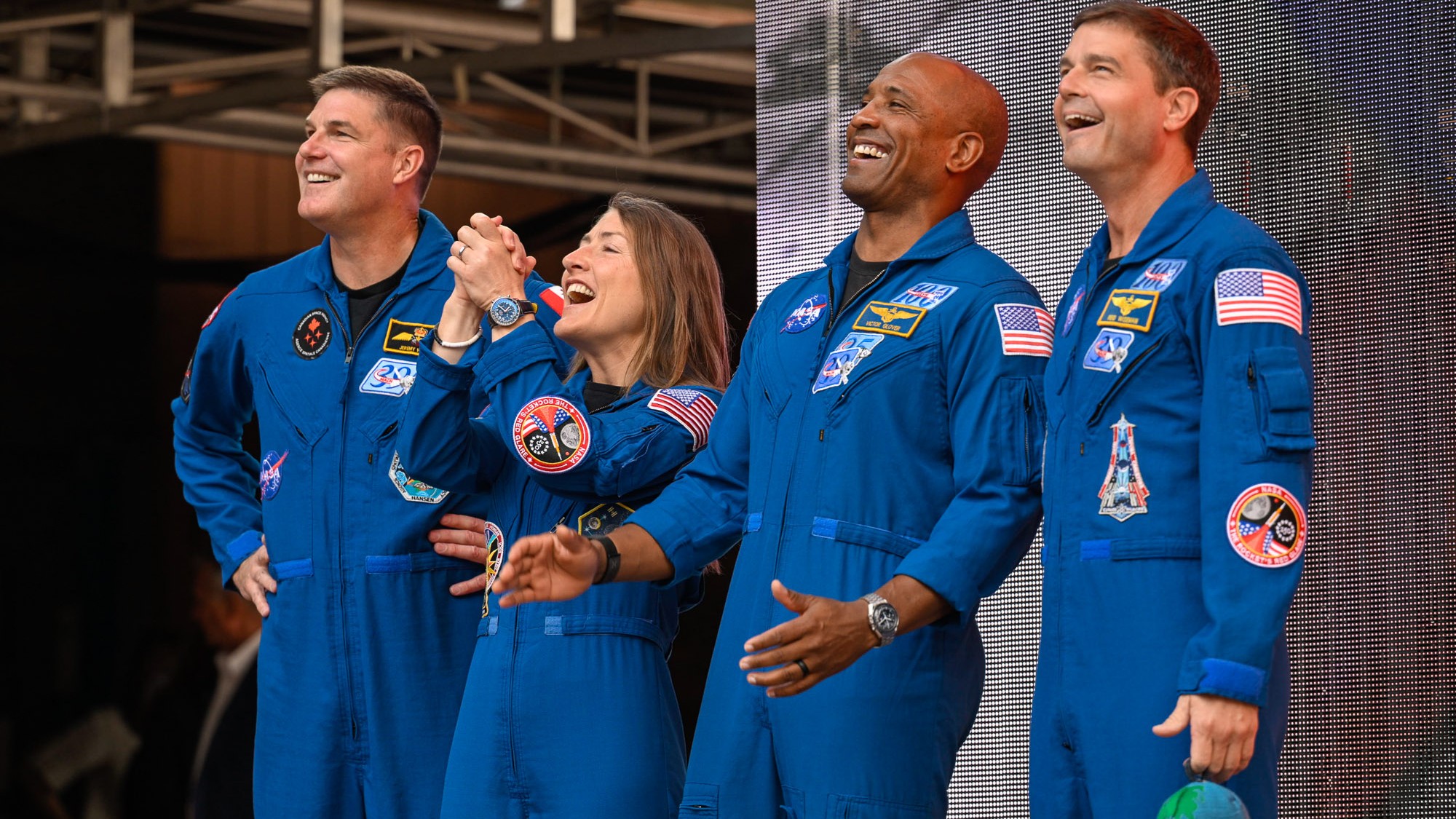
Some 8,500 people packed the open-air venue at Red Rocks to make eye-contact with space travelers Reid Wiseman, commander, Victor Glover, pilot, Christina Koch and Jeremy Hansen as mission specialists – all of them clearly awestruck by the crowd reaction. The event was a broader post-flight campaign for the foursome, also spotlighting the region's contributions to the sojourn of Artemis II. A science, technology, engineering, and mathematics (STEM) fest was also part of the early morning affair.
The Artemis II crew speaks at Red Rocks Amphitheatre in Morrison, Colorado on Aug. 3, 2026. (Image credit: Lockheed Martin)
Iconic location
"I can't imagine a more iconic location on Earth to hear about the trip to the moon," said Robert Lightfoot, president of Lockheed Martin Space and a major aerospace contractor for the Artemis program. There were hundreds of suppliers across the rocky mountain region, over 10,000 employees, that supported the Artemis II mission, he told the gathered throng.
Leadership from industry prime contractors including Lockheed Martin, Amentum, Boeing, L3 Harris and Northrop Grumman took part in the salute to the Artemis II voyage.
Colorado Governor Jared Polis pointed out that "here in Colorado, we're a mile closer to space." As the best and biggest homecoming for the Artemis II crew, he added, "keep reaching for the stars."
Lori Glaze, NASA associate administrator for the Human Spaceflight Mission Directorate, said today "is a truly revolutionary and exciting time for NASA and America's space program. We are going to reach farther. We're going to dream bigger. And we're going to secure America's leadership in deep space exploration and discovery."
The Artemis II crew speaks to a crowd of 8,500 at Red Rocks Amphitheatre in Morrison, Colorado on Aug. 3, 2026. (Image credit: Lockheed Martin)
What next?
In a pre-event press gaggle, Space.com asked the Artemis II crew members how their Orion spacecraft named Integrity performed and would help the upcoming Artemis III crewed flight in Earth orbit.
"It handled incredibly well," said Reid Wiseman, Artemis II commander. "Just from habitability, I think that is where we learned the most, putting four humans in the spacecraft. We knew that the machine was technically competent and capable of getting to the moon … Artemis I taught us that," he told Space.com.
"We had some heat shield things we needed to sort out on Artemis II. But putting the four of us in there, seeing how the life support system worked and how is it for habitability, to eat, live, work, and sleep in there, we definitely learned a lot that we've handed on to Artemis III," said Wiseman.
Sense of gratitude
The Red Rock Artemis II stage event had the four Artemis II crew members facing a huge gathering of supportive spectators. In excess of 1,300 questions were submitted by the attendees.
The Artemis II crew entrance was marked by roaring footage of the Artemis I launch scored by music from thunderous Metallica's "Fuel."
"The biggest thing that this mission has given us is an overwhelming sense of gratitude. I think we've got to figure out how to keep this going," Glover said.
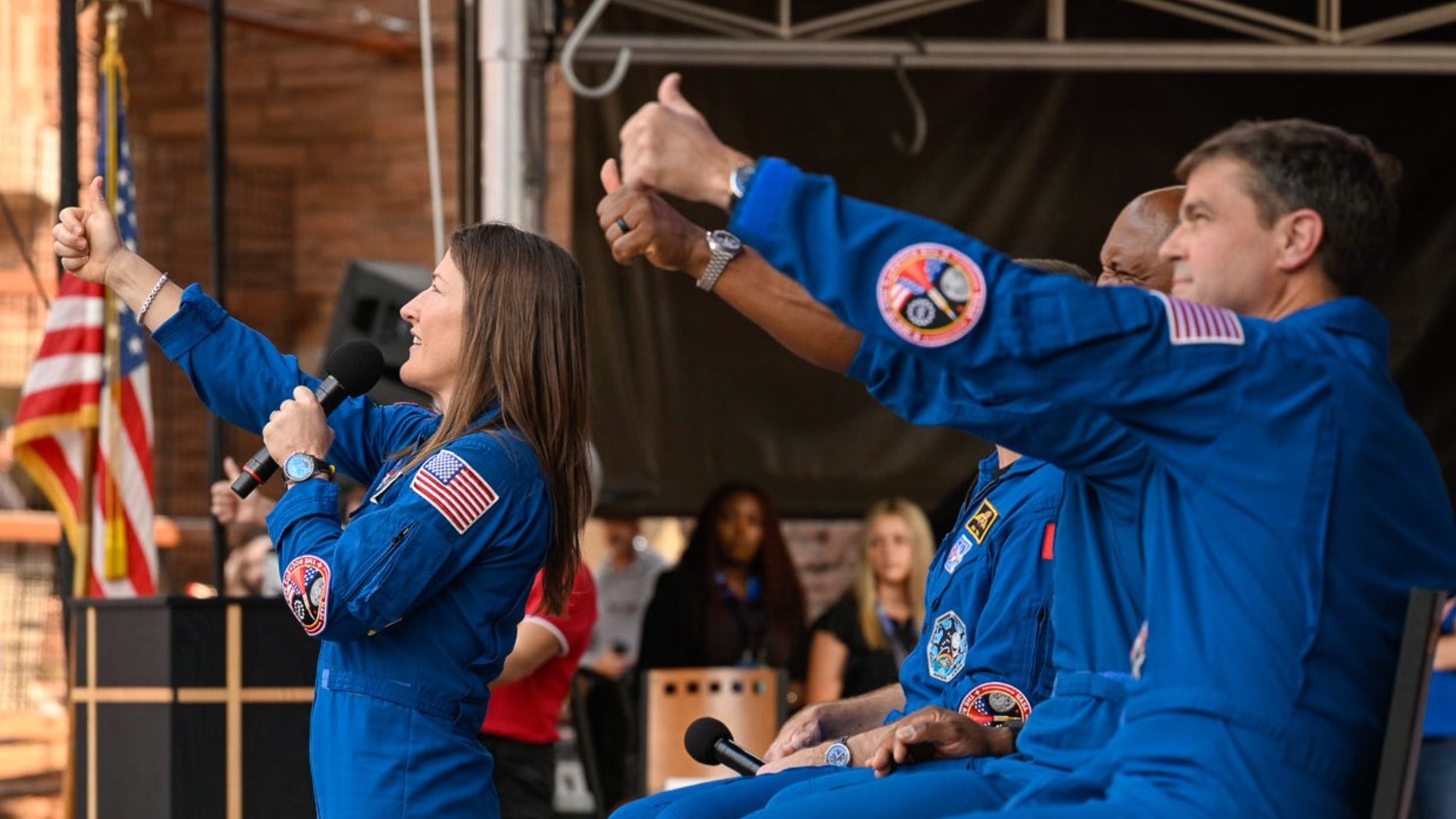
For Christina Koch, the Red Rocks gathering spurred a call and response audience participation. "I say moon, you say joy," to which the throng promptly called back three times. She also asked the audience to put their thumb out in the air. From a distance, "you can cover the entire Earth with your thumb. That's how small it was to us," she said, "but what you knew was that was home."
Proximity operations
Victor Glover, the pilot of Artemis II, focused on a proximity operations demonstration during the flight. That entailed the crew guiding the spacecraft through a series of controlled approach and retreat maneuvers using the detached upper stage, the interim cryogenic propulsion stage, as a reference target.
"That is when we had a chance to fly the spacecraft by hand, not just using the computers," Glover told Space.com. "We actually got to fly. One of the most amazing aspects of that is looking out the window or through the cameras on the [cockpit] displays to determine how far we were from the upper stage," he explained.
That task made use of all four sets of eyes onboard Orion, Glover said. "We did not have radar, or some other type of digital ranging system between us and that vehicle. But the Artemis II team trusted us to fly like that. I'm still blown away by that trust," he said, "and it flew marvelously."
The Artemis II crew gives a thumbs-up to the crowd at Red Rocks Amphitheatre in Morrison, Colorado on Aug. 3, 2026. (Image credit: Lockheed Martin)
"We are going to demonstrate docking with one or both of our two landers, the Blue Origin and the SpaceX lander. They've got some demonstration versions that they are preparing right now. We're working on that mission to prove out, not just going back and forth at a target, but actually docking and doing that hard job," Glaze told Space.com.
Space.com pressed Glaze on the term "demonstration versions" of the Blue Origin and SpaceX lunar landers.
Would the fidelity of those demos be good enough to green-light an actual human moon landing on the Artemis IV mission?
"I do," Glaze responded. "We're working really hard with both of our lander providers on development of the demo pathfinder versions of their landers that we will dock with […] to assure that the docking systems are the same docking system we're going to work with when we are going for the landing mission," she said.
Glaze said that "this is one of the key risks. This allows us to buy down that risk and at least work through that part of the mission. So when we do the landed mission we've got that part out of the way.
"We've got our lessons learned from those docking demonstrations. And then we are really focused on all the risks associated with the landing on the moon … we can really focus our efforts there."
According to Space.com sources, however, there is active discussion of whether the lunar south pole is an advisable location for the first human landing of the Artemis Program. Indeed, Artemis II pilot Glover recently stated that he thinks there's a need to be realistic and progressively work our way to the south pole locale rather than land there first.
"We've had a lot of conversations with both of our lander vendors. The designs they have are for the south pole," responded Glaze. "We're working really closely with them on those designs. And we are very focused on landing at the south pole."
Over the moon
Canada's Artemis II mission specialist, Jeremy Hansen, told the audience that their space trek was a very human experience for the four crew members, "but we came to see and feel you. You shared the moon joy," he said.
Hansen underscored the international character of Artemis II. "It was one of those deliberate contributions to the planet," he said, because billions of us on Earth have to join forces. "We have to work together. We can no longer believe that our end-state is not working together. Not acceptable. We have to collaborate," he said.
Asked by a young audience member about items taken on their excursion around the moon, mission specialist Koch replied: "I took handwritten letters that I hadn't read before from my family, and also a very tall cow figurine. My dad had the idea of having a cow jump over the moon."
Not every canceled NASA program earns a halo after its demise, but one scrapped project is finding new life by contributing its parts to help the space agency achieve its moon base goals faster.
Northrop Grumman is repurposing hardware and technology from the Habitation and Logistics Outpost (HALO) space station module for use on a new series of Lunar Infrastructure Demo (LID) missions. HALO was originally designed as the habitation module for NASA's since-cancelled moon-orbiting Gateway space station but found itself on the chopping block when the agency restructured the Artemis program architecture earlier this year.
Rather than scrap the unfinished module outright, Northrop Grumman will adapt HALO's electrical and mechanical components to support the development of technologies for a moon base that can survive the cold, weeks-long night at the lunar south pole while sustaining the long-term habitation of astronauts inside.
Part of NASA's reasoning for canceling Gateway was the need for expedience. As the agency's vision for Artemis and the return of astronauts to the lunar surface has evolved, China's plans to land the first taikonauts on the moon have steadily taken shape. Those ambitions, and the continued progression of China's lunar program, have kicked off a new space race in which the U.S. and NASA are intent on maintaining their first-place position.
In March, NASA Administrator Jared Isaacman announced a shakeup to the Artemis program designed to enable a more step-by-step approach toward developing the technologies needed for a next-generation crewed lunar landing, and to achieve that landing on the shortest timeline possible.
That timeline currently puts the first Artemis lunar landing with astronauts on the Artemis IV mission, scheduled for late 2028. Before then, however, NASA is planning nearly two dozen uncrewed missions to the moon to lay the groundwork for the infrastructure needed to precede astronauts' return. And, rather than let HALO rust in a warehouse, Northrop is doubling down on its commitment to the cause.
"To help NASA move faster … HALO’s power, data and mechanical interfaces will enable NASA to move with speed and begin gathering real lunar surface performance data sooner," the company said in a press release on Aug. 4.
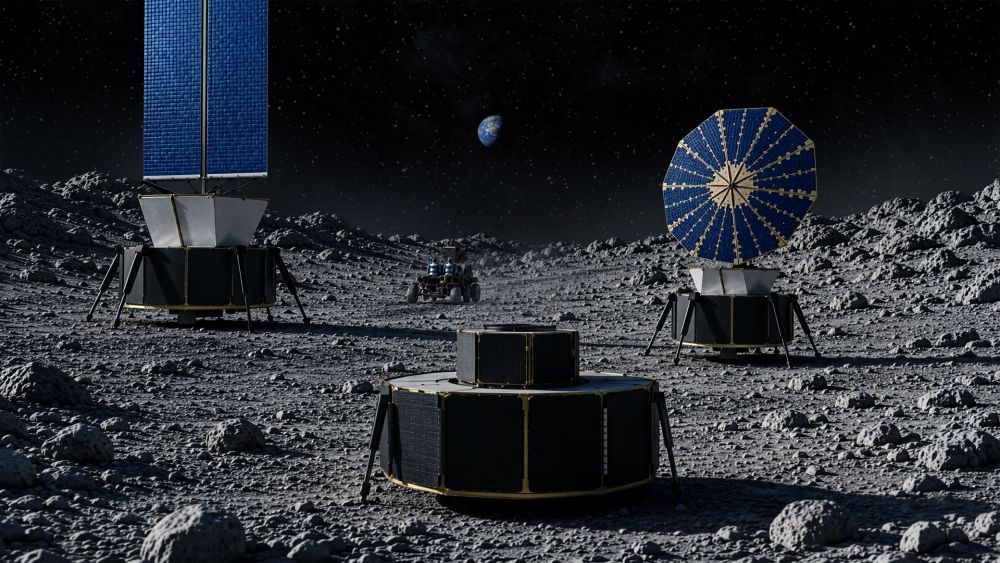
Northrop Grumman’s Lunar Infrastructure Demos (LID-1, LID-2 and LID-3) will reuse HALO derived technologies to rapidly mature lunar surface power, thermal, autonomy, communications and hosted payload services that can survive the lunar night and scale into persistent infrastructure near the moon’s south pole. (Image credit: Northrop Grumman)
Northrop announced 3 LID missions to "reuse HALO-derived technologies to rapidly mature lunar surface power, thermal, autonomy, communications and hosted payload services," which will help NASA gather data to better protect robotics and crews during long-duration stints near the moon's south pole, where the agency plans to establish its Artemis moon base. Neither the company nor NASA gave a target timeline for these missions.
NASA is targeting the south pole specifically because of the abundance of water ice that scientists have detected in that region on the moon. When harnessed appropriately, such ice concentrations can be used for a variety of applications to enable sustainable habitation on the lunar surface — the ultimate goal of the Artemis program — including potable water, radiation shielding and rocket fuel.
NASA believes that overcoming the technological hurdle of "in-situ resource utilization" (ISRU), or the ability to rely on materials locally available to you in order to sustain your survival, is the gold standard of spaceflight that will open the door to humanity's long-term exploration of the cosmos. Manufacturing propellants off Earth, for example, would mean a substantial increase in the distance any particular mission to space can fly, because nearly 95% of a rocket's mass at launch is fuel. So, the ability to refuel in space, circumventing the burden of launching to orbit fully fueled, would give satellites and crewed spacecraft the ability to fly much farther into the solar system than current launch systems allow.
As much as Artemis is, in itself, a program to establish a permanent human presence on the moon, NASA also sees it as the proving ground for technologies that could one day sustain astronaut missions to Mars. There is worry, however, over the national security and economic consequences that could accompany China beating the U.S. to the moon, so speed is top of mind for those tasked with the country's lunar return.
"As America embarks on the next chapter in human space exploration, our Lunar Infrastructure Demos will help turn the moon into a place where astronauts can stay, work and make discoveries that benefit humanity,” said David Schiller, Northrop Grumman's vice president of civil space and sciences, in a statement. “Our ready‑to‑fly, reliable HALO technologies allow NASA to move faster, putting in place robust infrastructure that can endure the lunar night and establish a strong blueprint for a future moon base.”
A radiation-shielding vest might one day protect astronauts from dangerous, random outbursts from the sun, a new study finds.
More than 50 years after the final Apollo mission, NASA's Artemis program aims to return humans to the moon. To succeed, this project must protect astronauts from solar radiation, especially the intense and unpredictable radiation from solar storms. Coating an entire spacecraft with a meaningfully thick layer of radiation shielding remains impractical due to weight constraints, but wrapping astronauts in protective garments may potentially be helpful.
In the new study, researchers experimented with the AstroRad vest, which was designed by the Israeli startup StemRad with support from the Israel Space Agency and aerospace giant Lockheed Martin. The garment was created to protect astronauts from explosions from the sun known as solar particle events.
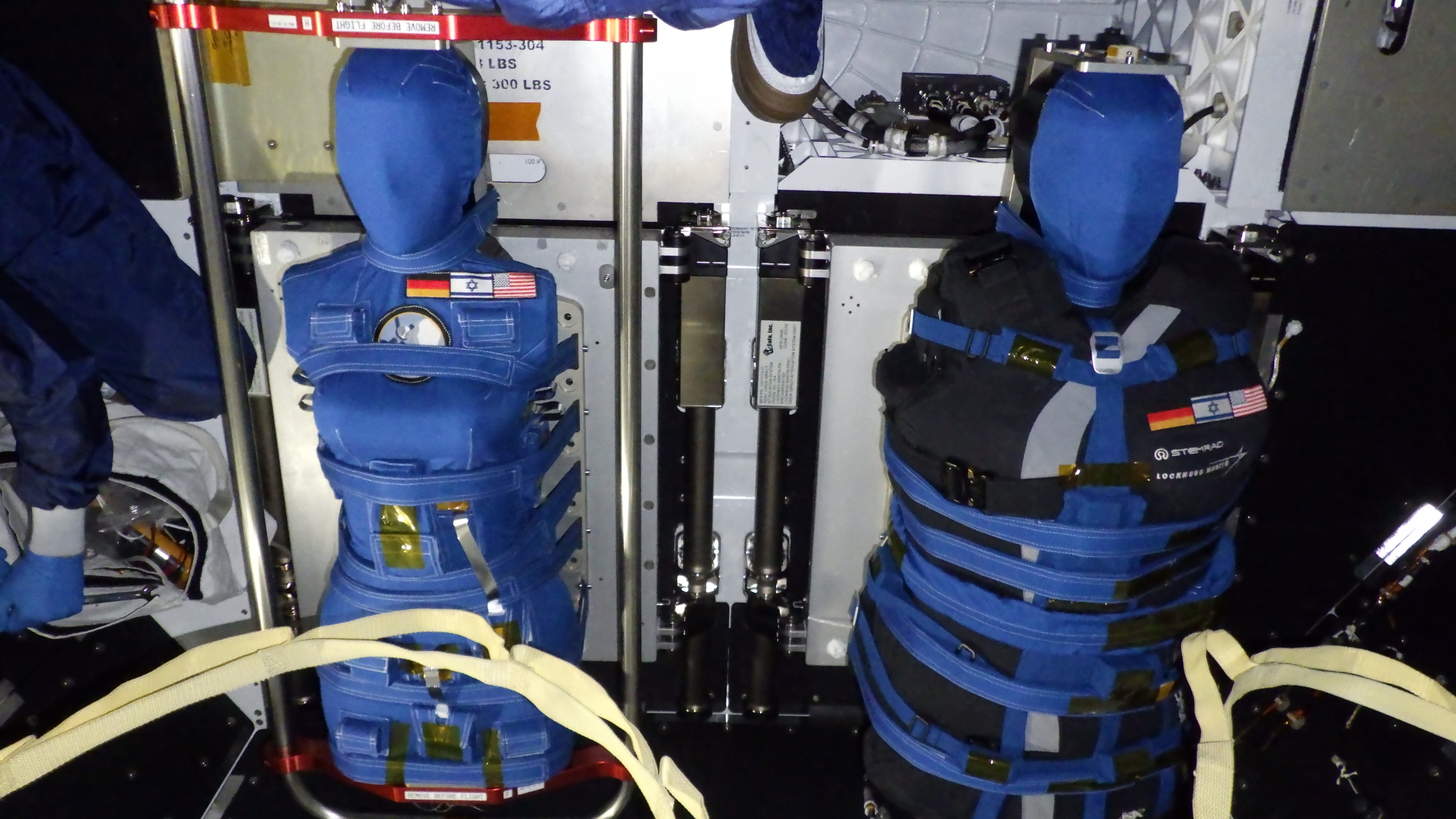
The "phantoms" Helga and Zohar inside the Orion spacecraft at NASA's Vehicle Assembly Building prior to the launch of Artemis I. Zohar, right, wore the AstroRad vest while Helga did not. (Image credit: NASA/Lockheed Martin/DLR)
"Radiation in space is unavoidable, and a single major solar particle event can make a substantial contribution to an astronaut's lifetime risk of radiation-induced cancer," study co-author Oren Milstein, CEO and co-founder of StemRad, told Space.com. "By significantly reducing that contribution, personal shielding could be particularly important for future lunar and Mars missions."
When it comes to protection against radiation, lead is excellent at blocking hazardous forms of light, such as X-rays and gamma rays. However, lead is much less effective at defending against the kinds of dangerous particles that can hurtle through space. For instance, when fast high-energy electrons known as beta particles strike dense lead atoms, they can trigger a shower of X-rays that are more harmful than the beta particles themselves. And if neutrons strike lead atoms, they can knock loose a spray of neutrons from the atoms' nuclei, worsening the impact from the radiation.
Instead, AstroRad relies on a high-density plastic rich in hydrogen. Among the elements, hydrogen possesses the highest density of electrons per atom, which can help create a dense shield to protect against incoming particles. At the same time, hydrogen atoms normally do not have neutrons, so if neutrons hit them, they cannot generate the kind of dangerous neutron sprays that can happen with lead atoms.
Moreover, the plastic in AstroRad is much lighter than lead. This makes it easier to move around in garments incorporating the plastic, and more practical for space missions in which weight is a major limitation.
The scientists combined thousands of hexagonal rods of the rigid plastic together like scales to create a flexible garment. All in all, each vest weighed about 57 pounds (26 kilograms).
The scientists developed a vest rather than a full-body suit or a helmet because "different organs and tissues have very different sensitivities to radiation, so shielding every part of the body equally is not the most effective approach," study co-author Jordan Houri, lead scientist for space exploration at StemRad, told Space.com. "At the same time, a full-body suit would be much harder to put on and move around in."
The shielding thickness of the AstroRad vest was based on how sensitive to radiation the underlying organs were. This strategy provides about a 30% greater reduction in the dose of radiation a person receives compared with distributing the same amount of shielding uniformly across the body, Houri said.
The researchers tested their vest during NASA's uncrewed Artemis I moon mission in late 2022 using a pair of extraordinarily complex dummies called phantoms. These artificial torsos were constructed of plastics that mimicked the density of human tissue, bone and organs, and each was equipped with more than 5,600 radiation sensors on and in them.
The two phantoms were designed to be adult females, since previous research found that breasts and ovaries are especially susceptible to radiation damage.
"Women are predicted to face a higher risk of radiation-induced cancer," Milstein said. "Targeted shielding could help narrow that difference in risk between male and female astronauts."
Since the phantoms mimicked women, they were given women's names, Zohar and Helga. "Helga was contributed to the experiment by the German Aerospace Center, and Helga is a traditional German name," Milstein said. "Zohar was contributed by the Israel Space Agency, which selected the name through a public outreach campaign. Zohar is a traditional Hebrew name meaning 'radiance,' which we thought was particularly fitting."
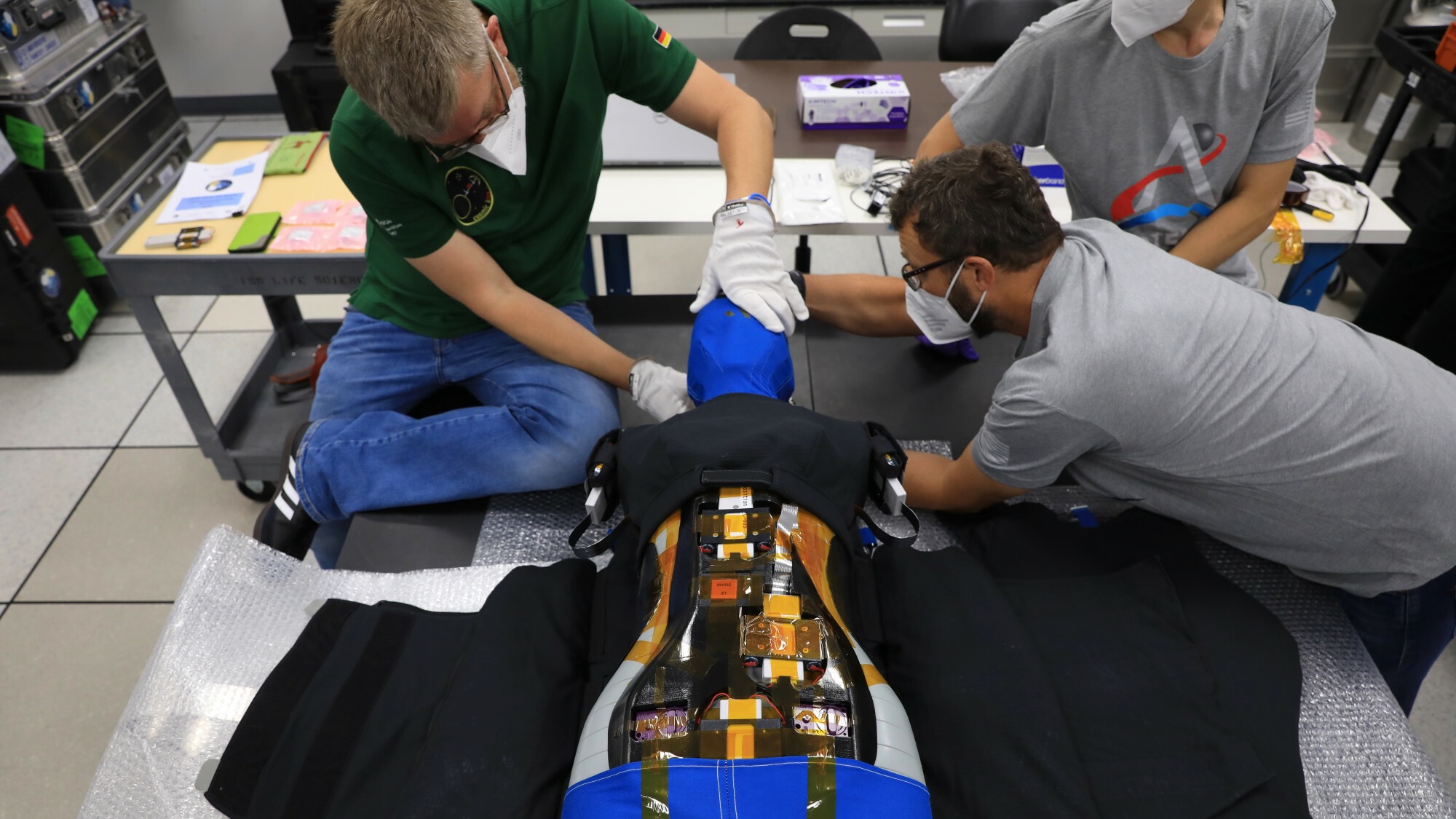
Assembling the Zohar phantom with the AstroRad vest at Kennedy Space Center prior to launch of Artemis I. (Image credit: NASA/DLR)
Zohar and Helga flew seated in NASA's Orion spacecraft; Zohar was equipped with an AstroRad vest, while Helga was not. Although Orion did not encounter a significant solar outburst during its 26-day mission to lunar orbit and back, the researchers were able to extrapolate how much solar radiation astronauts might experience based on what the phantoms encountered passing through the inner Van Allen belt of radiation surrounding Earth.
When the scientists analyzed past solar particle events, they found the AstroRad vest would have significantly reduced the dose of radiation a person during those outbursts — for instance, by nearly 60% for a solar particle event that happened in August 1972.
"We had originally anticipated something closer to 45%, so when we first saw the result, we thought we needed to go back and find an error," Houri said. "Instead, the detailed analysis showed that AstroRad's approach of providing targeted shielding to the most radiation-sensitive organs and tissues was even more effective than we had projected."
Such a reduction could spare astronauts the equivalent of up to 193 days of deep-space radiation exposure. "The most important implication is that AstroRad could help overcome one of the major health challenges limiting long-duration human exploration beyond Earth," Milstein said.
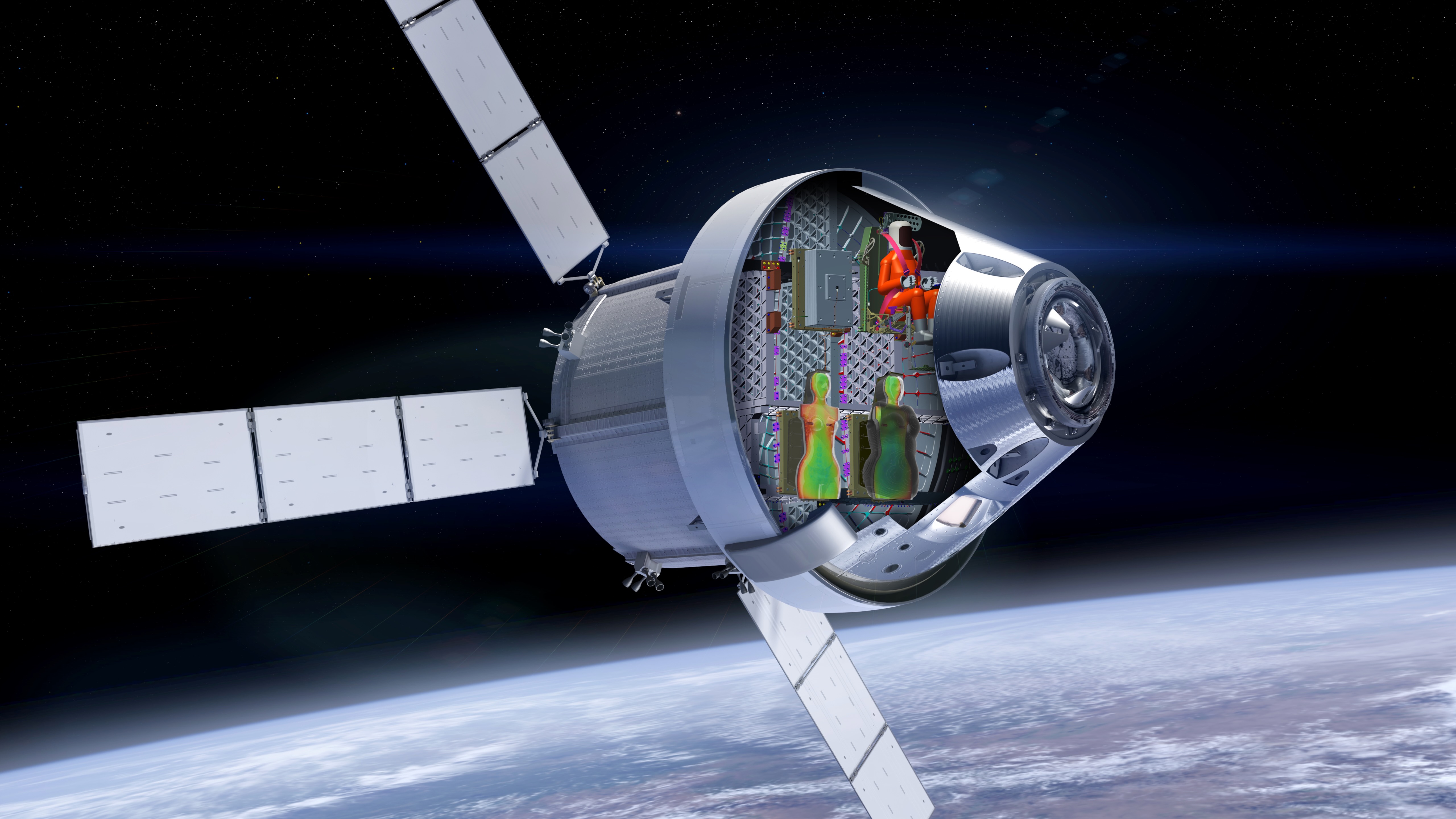
3D rendering of the Matroshka AstroRad Radiation Experiment (MARE) during NASA’s Artemis I mission, showing the two radiation dosimetry phantoms, Helga and Zohar inside the Orion spacecraft. (Image credit: NASA/Lockheed Martin/DLR/StemRad)
AstroRad is not something astronauts would wear continuously throughout an entire mission, Houri said. "AstroRad was developed as an emergency countermeasure for solar particle events, so astronauts would only wear it when radiation levels are elevated, typically for periods of hours or days," he explained.
Still, "although it is not something astronauts would need to wear throughout an entire mission, we designed the vest to remain usable for many hours at a time," Milstein said. During tests with the vests on the International Space Station, "several crew members even slept with it on."
The level of radiation protection the AstroRad vest provided was similar to that supplied by the Orion spacecraft's onboard storm shelter, "while allowing the astronaut wearing it to leave the shelter and continue mission-critical tasks," Houri said. "AstroRad can be used on its own or together with a shelter, but one of its main advantages is that an astronaut can remain protected while moving around the cabin and carrying out essential mission operations rather than remaining inside the shelter."
The scientists are now investigating whether it is possible to manufacture radiation shielding in space using onboard materials. For instance, in collaboration with Florida aerospace company Redwire, "we have already demonstrated that it is possible to 3D-print AstroRad components from recycled polyethylene aboard the International Space Station," Milstein said.
The scientists detailed their findings online today (Aug. 12) in the journal Science Advances.