The success of NASA's future moon base depends in large part on mission design, which should allow astronauts to work together well in a way independent from psychological training, a new study asserts.
The goal of the study was to identify "specific conditions" for mission success and to look for any "red flags" that may stand in the way, lead investigator Anamaria Berea, a computational social scientist at George Mason University (GMU), told Space.com via email. (The first author of the PLOS ONE study, which was published in May, was GMU's Raymond Vera.)
The team conducted the research using agent-based models, which are tools for computational simulations in fields ranging from the study of bird flocks to the spread of disease, Berea said. While a lot of modern-day AI "trains" or "learns" to extrapolate from information provided in a data set, agent-based modeling instead uses a data set to "understand emergent phenomena that don't have one single cause or direct cause," she said.
The study team considered scenarios for how many astronauts would be on the moon base and how often resupply missions would occur. In an "initial case," for example, the assumed mission duration was three months, with a single resupply run at Month 2 with food, water, air and a fresh group of astronauts.
Using a complex probability analysis known as a Monte Carlo simulation, the model astronauts in this scenario showed a productivity rate of about 20% against their expected tasks, "which is acceptable for a typical manufacturing process," the authors noted.
This productivity rate doesn't take into account anything unexpected that may crop up during the mission, the authors added. "The low task completion rate suggests that, on average, teams are having challenges to overcoming psychological stressors and environmental disruptions," they wrote.
Lessons from the International Space Station
NASA tracks productivity a little differently on the International Space Station (ISS). The agency uses a metric called "utilization," which largely refers to the amount of crew time and number of scientific investigations that are performed on the space station during an increment or expedition. As of 2014, the ISS program suggested that ideal utilization should be 35 hours per crew per week when there are three people working on the U.S. part of the space station, and 68.5 hours if there are four or more. (The Russian side of the ISS works largely independently in this respect.)
"NASA has generally met or exceeded this goal and set a high of 120 average hours per week devoted to research from October 2019 to April 2020," NASA's Office of the Inspector General (OIG), which has been tracking all of these productivity figures, stated in a report published in September 2024.
"Starting March 2022 through March 2023, the latest published data, we have seen utilization near 90 hours per week," the OIG noted. "In addition to the hours spent per week on research, the number of scientific investigations performed on-orbit has increased."
Figure 1 of the OIG report also shows both crew time and scientific investigations increasing, as a trend, between 2000 and 2023, suggesting that utilization of the space station is continuing to grow. And this is despite periodic and documented disruptions that required astronauts to take a step back from being productive, such as emergency ammonia leaks requiring spacewalks, the 9/11 disaster, or sheltering in place during brief contingencies such as space debris passing within a few miles of the station.
Not all crew time can be used for utilization even if all goes well, however, as the station requires normal maintenance like cleaning, and astronauts also need daily time for sleep, meals and a little relaxation. Additionally, utilization tends to increase with larger crews on the space station compared with smaller ones, as maintenance becomes less of a burden with more hands to take on these tasks.
But "lack of redundancy" in key supply items to the space station does pose a risk to utilization, the OIG has noted. As just one example, SpaceX Crew Dragon capsules and Roscosmos Soyuz spacecraft are the only two vehicles that bring astronauts to the station right now. "The lack of redundancy and limited capabilities of both cargo and crew transportation increase the risk to NASA's current and future ability to bring critical supplies, science, and crew to and from the station to maintain safe operations and full utilization of the ISS," the OIG wrote in the report.
Isolated environments
Those of us who have been on long car rides in a group, or who remember being in tight quarters with roommates or family during the pandemic, have some idea of what an isolated, confined environment (ICE) feels like: crowded, with limited resources, and possessing few connections with the outside world. Space serves as just one example of a true ICE; isolated research bases (like in Antarctica) or submarines have also been studied in the literature, according to a separate 2021 study in the journal Neuroscience & Biobehavioral Reviews.
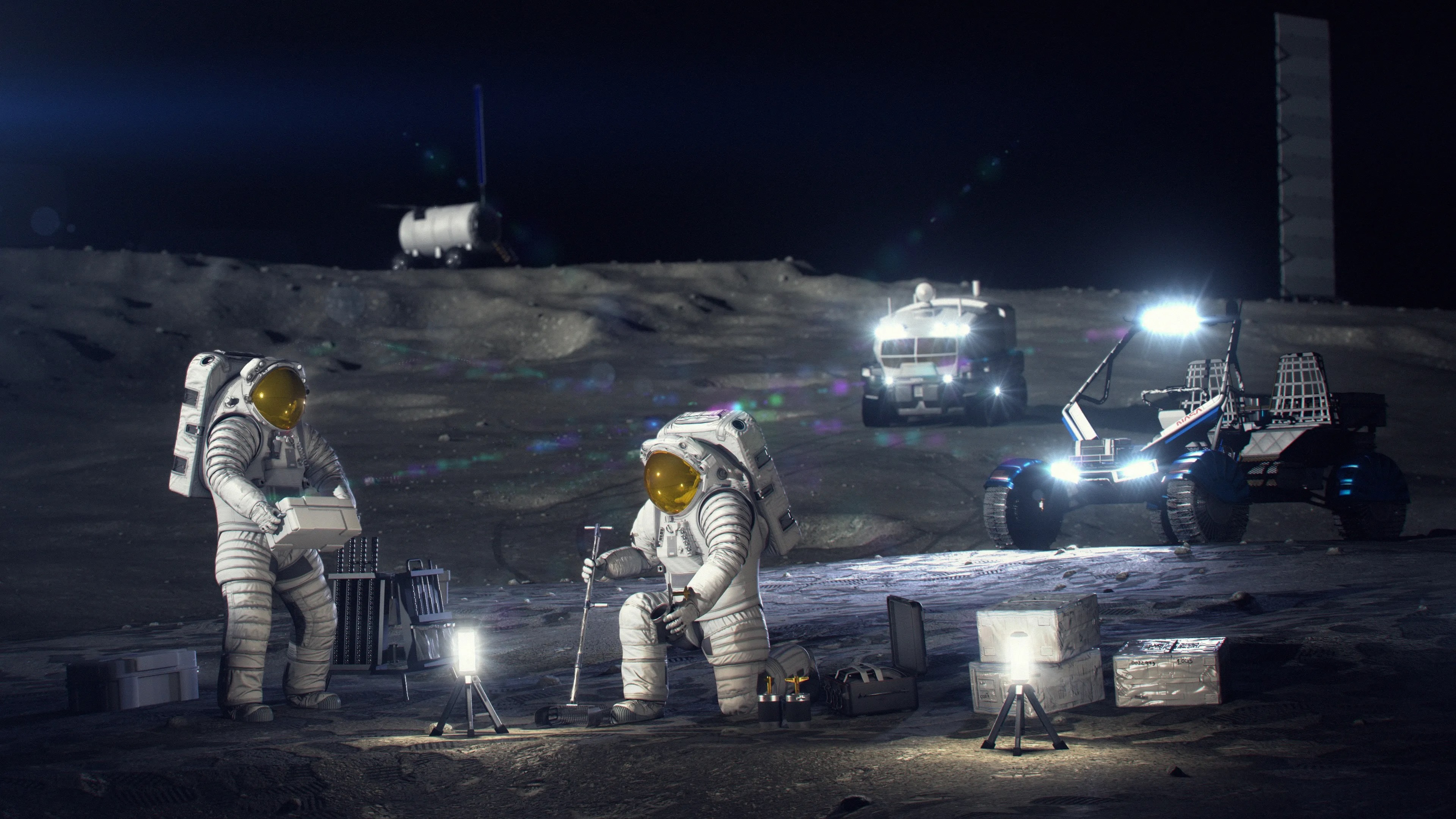
Put simply, ICE refers to a location where humans must work to a high standard in isolated and often dangerous circumstances, with only long-distance support (if possible) from a mission control or its equivalent. And, as the new study points out, a moon base would be a complex example of an isolated environment — one featuring not only resident astronauts but also rovers, other robots and occasional visiting crews.
"The premise for our modeling approach came from trying to understand better the human factors involved in crewed space missions, particularly the deep-space ones, for which we don't have a lot of historical data," Berea said.
That's because only a handful of people have traveled beyond low Earth orbit — the two dozen who flew to lunar realms on Apollo missions in the late 1960s and early 1970s, and the four astronauts of NASA's Artemis 2 flight around the moon this past April.
"We ran various scenarios of space mission durations, number of astronauts, potentially unforeseen circumstances that can happen on the lunar surface or the habitat," she said. The model suggested the missions with the highest probability of success would include six astronauts working on the moon at a time, with fresh supplies coming from Earth every two weeks, and no extreme fluctuations in the environment from things like radiation or a micrometeorite impact.
"In contrast, the worst-case scenario consists of four astronauts on the moon at one time, only one month resupply window between Earth and moon, and moderate to high adverse environmental probabilities," Berea said. And, when asked if training is a factor in mitigating adverse effects, she did not necessarily agree that the years of work NASA and other agency astronauts put in would be more effective than shorter-duration training used for moon base analogs.
"People can be very, very well trained, but for long-duration or deep-space missions, there will always be a human factor involved," she said. "We looked at combinations of skills and personalities in a team of astronauts, and there is a fine line between having a team that is too small and a team that is too large, and there are synergies and emergent behaviors that come from people interacting with each other and with their environment.
"The team is more than the sum of its people," she continued. "The best ways to overcome these is not by more training, but by fine-tuning other aspects of the missions: the duration of the mission, the frequency of resupply missions, and the contingency plans for accidents and unforeseen conditions in extreme environments."
NASA, however, puts its ISS crews through many years of remote environment training long before they float through the space station hatch — and Artemis 2 commander Reid Wiseman told The New Yorker that extensive psychosocial training led to the obvious closeness seen live among his own four lunar crewmates despite tight quarters (and vent line issues that led to occasional toilet trouble).
That psychological intervention during training was by design. "Preparation starts by recruiting mentally healthy people and then providing training to help them deal with potential situations and issues," wrote the Canadian Space Agency of this training, citing NASA protocols. "Astronauts repeat this training often enough that they can anticipate their own reactions and those of their teammates. They also receive constant support from teams on the ground and have access to a variety of tools to help them deal with potentially difficult situations."
Berea noted, however, that psychology forms a part (but is not the focus) of her teams' simulation, including considering NASA TLX (task load index) scores and data, which measures coping and stress for astronauts. The researchers also considered case studies from analogs including Antarctic research missions and time aboard submarines or oil rigs, as some examples.
"We need to pay attention not only to the astronauts, but the team as a whole, and each team and space mission are unique. We will not be able to model these with statistics or AI," she said. "But what we can do is to make sure that before we send any human to live and work on the moon, that we understand well the complexity of interactions and scenarios they will face during the mission, and we can help with that."