‘Silo’ season 3 showrunner Graham Yost explains the time jumps and turning half of the show into a political thriller (interview)

Apple TV’s riveting sci-fi series, "Silo," is stretching its narrative legs for its third and penultimate season. Juliette (Rebecca Ferguson) deals with amnesia after her fiery return to Silo 18, satisfying secrets are revealed, and we strap in for temporal jumps 352 years back to the "Before Times" to figure out how the apocalypse arrived.

"We rolled the dice a bit and hoped it would work and weren’t entirely sure, but felt it would," Executive Producer and Showrunner Graham Yost tells Space regarding the new season's time shifts. "After the fact, I heard some of the quibbles about too much time in 17, but we made our best guess on that one as well. What we did feel was that cutting back and forth was not a real problem. Even though it's 350 years separating the two stories, it's not like we're going back to Elizabethan times. It’s Silo world, which is its own crazy time. It's a place out of time.

"So when I saw the first episodes, I felt like this is okay. Part of the good thing about being outside, being people in modern clothing and cars, is you know immediately when you are and where you are. That really helped orient the story."

After Juliette’s harrowing ordeal in Silo 17 last season, audiences were left hungering for answers heading into this new batch of ten episodes. Fortunately, they shine the light of truth on matters — both in the doomsday bunker and back when Earth was still recognizable.

These time shifts allowed the production crew and cinematographers to tinker with the show’s visual style, including using different equipment to film each time period.

Ashley Zukerman in "Silo," premiering July 3, 2026 on Apple TV. (Image credit: Apple TV)

"I think they went to a different lens," Yost adds. "The choice was made to go from an anamorphic lens to something else, so there is a slight change and a slightly different framing. We've got the same production designer for both units, so there can be little flavors that Nicole [Northridge] would come up with that we don’t even realize are hints of what’s coming in the future. "

"But the origin story is a political thriller basically. We’re harkening back to 'Three Days of the Condor,' 'The Parallax View' and things like that of the '70s," explains Yost. "That sort of paranoid cinema. There are bits in there that let us feel way more cinematic because we equate that with cinema rather than television."

Alexandria Riley as Camille Sims in "Silo" season 3 (Image credit: Apple TV)

It's not all about the time jumps back to the past, though; Yost and his team have also been looking to up their game in the Silo's themselves, too.

"Then, in 18 with Juliette, the only expansion there was to spend as much time as we did within the algorithm room with Camille talking to the voice and making that interesting," reveals Yost.

"The answer to that was you cast Alex [Alexandria Riley]. She does such a compelling job that you’re just going to watch her talk to a wall. We knew how good she was from the scene she did in season one, and that's why this whole storyline developed, because we love her."

Apple TV's "Silo" season 3 premieres on July 3, 2026.

Watch Silo on Apple TV+:
Apple TV+: $12.99/month (7-day free trial)
Apple TV & Peacock Premium: $14.99/month

He-Man and beyond: 20 sci-fi cartoons (some iconic, some weird) that transported ’80s and ’90s kids to strange new worlds

Kids who grew up in the '80s and '90s couldn't enjoy the massive selection of live-action sci-fi TV available right now.

With the biggest out-of-this-world adventures likely to be found in theaters, many of the most memorable — and undoubtedly the weirdest — concepts tended to be found in Saturday morning cartoons.

This is a realm of exposition-heavy opening credits, relentlessly earwormy theme tunes, and heroes who, for no obvious reason, choose to hang out with cute/annoying [delete as appropriate] comedy sidekicks like Orko and Snarf.

The massive success of "He-Man and the Masters of the Universe" also established a symbiotic link between television screens and playrooms, as toy giants Mattel, Hasbro, and Kenner realised that a successful animated series could be the ultimate advertising opportunity for their latest product lines.

Below, we've picked out 20 sci-fi cartoons that brought outer space, time travel, must-own vehicles, and genre-defining villains into millions of living rooms every week. Just don't blame us if you get sucked into YouTube and Wikipedia rabbit holes, as you look back on classic (and not so classic) shows that helped shape a generation…

1. Battle of the Planets

Dates: 1978-1980 | Toy line? Yes | Cute/annoying sidekick: 7-Zark-7 (a robot)

Japanese anime series "Science Ninja Team Gatchaman" gets a US makeover, with most of the original show's more violent excesses toned down.

7-Zark-7, a robot whose design owes absolutely nothing (ahem) to R2-D2, was added to supply exposition and kid-friendly comedy, but the basic premise remains — five teens in bird-like superhero outfits (and a very cool spaceship) come together as G-Force, protecting Earth from the evil Zoltar.

2. The Fonz and the Happy Days Gang

Dates: 1980-1981 | Toy Line? No | Cute/annoying sidekick: Mr Cool (a dog)

A spin-off from nostalgia-heavy '50s-set sitcom "Happy Days" might seem an unlikely addition to this list, but — even more than live-action stablemate "Mork & Mindy" — this series is unashamedly sci-fi.

The Fonz, Richie Cunningham, and Ralph Malph end up travelling through time with a 25th-century woman named Cupcake, finding themselves in all sorts of 'hilarious' scrapes as they try to get back to 1957 Milwaukee. Iconic DJ Wolfman Jack (who also appeared in "American Graffiti") supplies the opening narration.

3. Ulysses 31

Dates: 1981-1982 | Toy line? Yes | Cute/annoying sidekick: Nono (a small, nail-eating robot)

Looking to take a crash course in Greek mythology? French/Japanese co-production "Ulysses 31" transfers Homer's Odyssey to the 31st century, as the titular starship captain kills a robot Cyclops, angers the gods of Olympus, and is sentenced to wander unknown stars until he finds the Kingdom of Hades.

While Ulysses looks like a Bee Gees tribute act and his laser sword is a "Star Wars"-shaped lawsuit waiting to happen, this show is bold, ambitious and — at times — surprisingly bleak.

4. SuperTed

Dates: 1982-1986 | Toy line? Yes (plush toys) | Cute/annoying sidekick: N/A

Undoubtedly the only show on this list to have debuted in Welsh, Brit cartoon SuperTed is the story of an ordinary teddy bear who's brought to life, and subsequently gains superpowers courtesy of some "cosmic dust". Former "Doctor Who" star Jon Pertwee voices the hero's jetpack-wearing alien bestie Spotty, who stays remarkably calm considering SuperTed effectively rips off his skin every time he activates his powers.

The character returned in a US co-production, "The Further Adventures of SuperTed", in 1989.

5. He-Man and the Masters of the Universe

Dates: 1983-1984 | Toy line? Yes | Cute/annoying sidekick: Orko (a floating Trollan magician)

As much of a colossus as its musclebound hero, "Masters of the Universe" is the ultimate '80s cartoon. Commissioned by Mattel as a blatant weekly half-hour commercial for its popular toy line, the show pits He-Man and his heroic chums against the evil (but strangely inept) Skeletor in a battle for control of Castle Grayskull. Eternia's residents are potential plastic playthings first, characters second, though they never forget to deliver a corny moral at the end of each episode.

The second live-action "Masters of the Universe" movie is in theaters now.

6. Bananaman

Dates: 1983-1988 | Toy line: No | Cute/annoying sidekick: Crow (a talking, er, crow)

Whenever youthful Acacia Road resident Eric Twinge eats a banana, an amazing transformation occurs… A superhero cartoon and a healthy eating campaign in one, this comic-book-inspired series is an unashamedly tongue-in-cheek British pastiche of Superman and other caped crusaders.

Legendary '70s comedy troupe the Goodies supply the voices, as Eric's fruity alter-ego, Bananaman, battles the villainous likes of General Blight, Doctor Gloom, and, of course, Appleman.

7. Challenge of the GoBots

Dates: 1984-1985 | Toy line? Yes | Cute/annoying sidekick: No

The Transformers weren't the only robots in disguise vying for kids' eyeballs in the mid-'80s. In fact, these robots — an amalgamation of Tonka's GoBots and Bandai's Robo Machine toys — made it to TV first, though the show's mythology (in which the heroic Guardians battle the villainous Renegades) never caught fire like its more successful mechanical cousin (see below).

That said, Peter "Optimus Prime" Cullen and Frank "Megatron" Welker have voice credits on both shows.

8. Transformers

Dates: 1984-1987 | Toy line? Yes | Cute/annoying sidekick: No

The only cartoon on this list that's even more toyetic than "Masters of the Universe", the original "Transformers" cartoon was the result of Hasbro's efforts to create a backstory for shapeshifting toys it had imported (and subsequently rebranded) from Japan.

It's that classic tale of good robots (Optimus Prime's Autobots) fighting evil robots (Megatron's Decepticons), using an unsuspecting planet Earth as their battleground, while transforming into planes, trains, and automobiles — not to mention tape players and dinosaurs.

The 1986 theatrical movie boldly killed off many of the franchise's most iconic characters in a bid to flog more toys.

9. ThunderCats

Dates: 1985-1989 | Toy line? Yes | Cute/annoying sidekick: Snarf (a cat-like child-minder)

"Masters of the Universe" and "Transformers" were the biggest beasts to emerge from the 1980s cartoon playground, but "ThunderCats" was never far behind. Indeed, it's had a couple of animated reboots, and is arguably crying (or should that be roaring?) out for a live-action movie.

On paper, its warrior cat people premise sounds like a disaster, but thanks to its timeless iconography — the Sword of Omens, ever-living bad guy Mumm-Ra, the catchiest theme tune in an era of catchy theme tunes — "ThunderCats" is a bona fide classic of the era.

10. Star Wars: Droids

Dates: 1985-1986 | Toyline: Yes | Cute/annoying sidekick: No

Lucasfilm attempted to keep the "Star Wars" flame burning with a short-lived animated double-bill of "Ewoks" and this more overtly sci-fi offering.

Subtitled "The Adventures of R2-D2 and C-3PO", it follows some (now non-canon) adventures of the droid duo before they meet Luke Skywalker on Tatooine. Anthony Daniels (inevitably) voices 3PO, R2-D2 stars "as himself", while The Police drummer Stewart Copeland provides the theme tune.

11. She-Ra: Princess of Power

Dates: 1985-1987 | Toy line? Yes | Cute/annoying sidekick: Kowl (a flying koala/owl hybrid)

1985 movie "The Secret of the Sword" revealed that, much like Luke Skywalker, He-Man's alter-ego, Prince Adam, has a long-lost twin sister of his own. And, even though she's been working for Skeletor's old boss Hordak on Eternia's sister planet, Etheria, Princess Adora is just as heroic as her brother – especially when she waves around a magic sword of her own to transform herself into She-Ra.

It's essentially "Masters of the Universe" with an all-new line-up of toy opportunities, though the story was rebooted as the acclaimed "She-Ra and the Princesses of Power" in 2018.

12. Jayce and the Wheeled Warriors

Dates: 1985 | Toy line? Yes | Cute/annoying sidekick: Oon (a tiny lance-wielding knight)

Future "Babylon 5" creator J Michael Straczynski was hired to create a "MOTU"-esque mythology for Mattel's existing Wheeled Warriors toys. The result was this short-lived cartoon, in which an evil race of sentient plants known as the Monster Minds tries to take over the universe.

For some reason, the aggressive flora have the ability to transform into a fleet of multi-purpose vehicles — it's a good job, then, that eponymous hero Jayce and his buddies have fancy wheels of their own.

13. M.A.S.K.

Dates: 1985-1986 | Toy line? Yes | Cute/annoying sidekick: T-Bob (an egg-shaped robot who transforms into a scooter)

With the popularity of "Star Wars" action figures on the wane, manufacturer Kenner made a bid for some of that lucrative two-toys-in-one "Transformers" action.

In this particular cartoon/toy commercial, the altruistic members of M.A.S.K. (Mobile Armored Strike Kommand (sic)) thwart the evil schemes of V.E.N.O.M. (Vicious Evil Network Of Mayhem) with their transforming vehicles —such as a motorbike that turns into a helicopter. The protagonists also wear helmets (or masks — geddit?) that give them unique abilities.

14. Centurions

Dates: 1986 | Toy line? Yes | Cute/annoying sidekick: Shadow (a dog), Lucy (an orangutan)

The impossible search for the next "Transformers" continued with this blatantly toyetic actioner.

Three implausibly named soldiers (ocean specialist Max Ray, land guy Jake Rockwell, and fly boy Ace McCloud) are the titular Centurions, who use their impressive arsenal of exosuits to save the world from Doc Terror, an evil cyborg whose name is an absolute PR disaster. The show is possibly most notable for having comic-book legends Jack Kirby and Gil Kane on its creative team.

15. Defenders of the Earth

Dates: 1986 | Toy line? Yes | Cute/annoying sidekick: Kisa (a telepathic black panther)

When Ming the Merciless relocates from Mongo to our very own North Pole, Flash Gordon joins forces with three other less famous characters from the King Features comic-book back catalogue to, well, defend the Earth.

Flash, the animal-whispering Phantom, Mandrake the Magician, and super-strong Lothar bring their unique skills to the table, along with their respective kids. The catchy-as-hell theme song features lyrics from a certain Stan Lee.

16. BraveStarr

Dates: 1987-1988 | Toy line? Yes | Cute/annoying sidekick: Deputy Fuzz (BraveStarr's Prairie Person deputy)

Years before "Firefly" and "Serenity" got in on the act, the "Masters of the Universe" dream team of Mattel and animators Filmation took the notion of a space Western very literally indeed.

Superpowered Marshal BraveStarr protects the planet of New Texas from various frontier bad guys, assisted by the eyes of the hawk, the ears of the wolf, the speed of the puma, and the strength of the bear. His 'Equestroid' steed, Thirty/Thirty, can also transform into a bipedal, gun-wielding form.

17. Visionaries

Dates: 1987 | Toy line? Yes | Cute/annoying sidekick: No

Like "Masters of the Universe" and "Star Wars", "Visionaries" straddles the line between sci-fi and fantasy.

When all technology stops working on the futuristic planet of Prysmos, magic becomes the dominant force. A wizard named Merklynn subsequently gifts two factions of "Knights of the Magical Light" (aka the Spectral Knights and the Darkling Lords) with the ability to transform into the animal totem they wear on the chestplates of their armor.

The good guys get to run around as lions, foxes, and bears. The villains? Well, they have to make do with beetles, lizards, and molluscs.

18. Fantastic Max

Dates: 1988-1990 | Toy line? No | Cute/annoying sidekick: Zoe (Max's five-year-old sister)

Effectively "my first sci-fi", this cartoon from the "SuperTed" stable makes the irresponsible move of sending a baby into space (without his parents) on a regular basis.

Max is accompanied on his adventures by anxious robot C-3PO AB Sitter, and FX, a magical alien masquerading as a toy who can turn the kid's implausibly impressive sand sculptures into fully functioning robots.

Max also has a tendency to yell "dirty diapers" at times of (very mild) peril.

19. The Pirates of Dark Water

Dates: 1991-1993 | Toy line? Yes | Cute/annoying sidekick: Niddler (a monkey-bird)

Just as BraveStarr plundered Westerns for inspiration, this show puts a sci-fi/fantasy spin on another classic Hollywood staple.

On the alien world of Mer (think "Waterworld", but with less Costner), an estranged prince named Ren leads a ragtag bunch of heroes on a quest to find the 13 "Treasures of Rule" — all the while hoping to save their planet from a sentient oil slick known as Dark Water.

20. Bucky O'Hare and the Toad Wars!

Dates: 1991 | Toy line? Yes | Cute/annoying sidekick: Does the human kid count?

It's basically "Star Wars" with animals, set in a parallel "aniverse" where the eponymous space captain Bucky O'Hare (a green hare) leads a furry rebellion against the evil Toad Empire.

The show only ran for 13 episodes, but it made a big impact, particularly in the UK, where it became a popular part of the after-school CBBC schedule. The theme tune is one of the most memorable out there — "Let's croak us some toads!" — and the Righteous Indignation is surely one of the best names for a spaceship, ever.

This Week In Space podcast: Episode 217 — America in Space

On Episode 217 of This Week In Space, Rod Pyle and Tariq Malik discuss the progression of American space efforts.

Since 1958, the United States has been part of the spaceflight adventure, and since the mid-1960s has led in just about any category that counts. In this episode, we review which flights launched or landed on July 4, and relive some of our very favorite US space missions of all time!

Download or subscribe to this show at: https://twit.tv/shows/this-week-in-space.

Get episodes ad-free with Club TWiT at https://twit.tv/clubtwit

Space news of the week

Model Falcon 9!

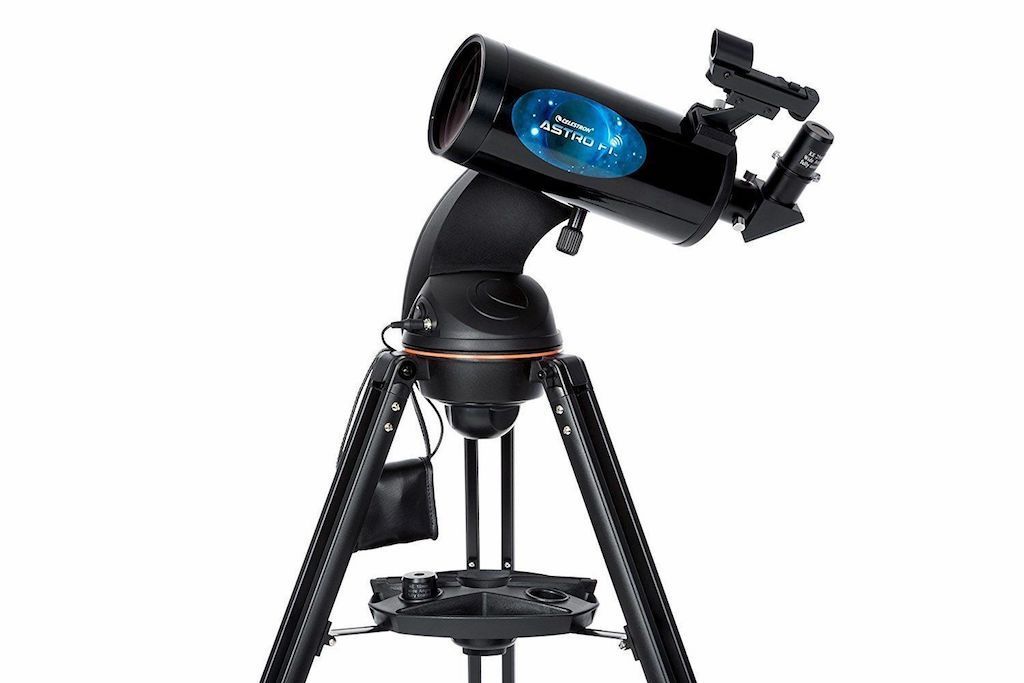
TOP TELESCOPE PICK:

A Celestron telescope on a white background

(Image credit: Celestron)

Looking for a telescope to see planets and comets? We recommend the Celestron Astro Fi 102 as the top pick in our best beginner's telescope guide.

Finally, did you know you can launch your own SpaceX rocket? Model rocket maker Estes' stunning scale model of a Falcon 9 rocket that you can pick up now. The launchable model is a detailed recreation of the Falcon 9 and retails for $149.99. You can save 10% by using the code IN-COLLECTSPACE at checkout, courtesy of our partners collectSPACE.com.

About This Week In Space

This Week in Space covers the new space age. Every Friday we take a deep dive into a fascinating topic. What's happening with the new race to the moon and other planets? When will SpaceX really send people to Mars?

Join Rod Pyle and Tariq Malik from Space.com as they tackle those questions and more each week on Friday afternoons. You can subscribe today on your favorite podcatcher.

30 years on, “Independence Day” still proves the versatility of the original “The War of the Worlds”

"Independence Day" definitely isn't "The War of the Worlds". The characters are all new, the alien invaders don't come from Mars, and HG Wells sure as hell didn't write about spaceships engaging in "Star Wars"-esque dogfights over Victorian England.

But here's the contradiction. "Independence Day" totally is "The War of the Worlds". It's about Earth being hopelessly outgunned by aliens from outer space and a human resistance fighting back against impossible odds. It also has, more or less, the same ending — the extra-terrestrials' demise by computer virus is a cunning update of the original book's microbial final twist.

Director Roland Emmerich's genius, however, was reinventing Wells' sci-fi classic for the blockbuster age. His aliens had Hollywood in their blood, their entire plan built around delivering the perfect money shot. Let's be honest, there has to be a more practical way of flattening entire cities than blasting famous landmarks with a Death Star-scale super-lasers, but it wouldn't have been quite so popcorn- — or movie poster- — friendly.

(Image credit: 20th Century Studios)

Besides, nobody was going to believe that humanity's nemesis hailed from Mars after the Viking landers had sent back photos of a barren, dead world. Reinventing the aliens' origin story — as nomadic, resource-hungry scavengers — just made sense in the cynical '90s.

"The War of the Worlds" is cut from the same cloth as fellow genre pioneers "Frankenstein" and "Dracula" (the latter was, coincidentally, originally published the same year as Wells' alien invasion classic). Each story is so versatile that it can be reimagined again and again to reflect the hopes and fears of any time period. You can change a few names here and there — as "Nosferatu" famously did with Bram Stoker's vampire page-turner — but these plotlines have become archetypes within our collective consciousness.

(Image credit: 20th Century Studios)

More than a century later, we still can't get enough. They're also — to use that hoary old sci-fi/fantasy cliché — a brilliant way of pointing a mirror back at the time they were made.

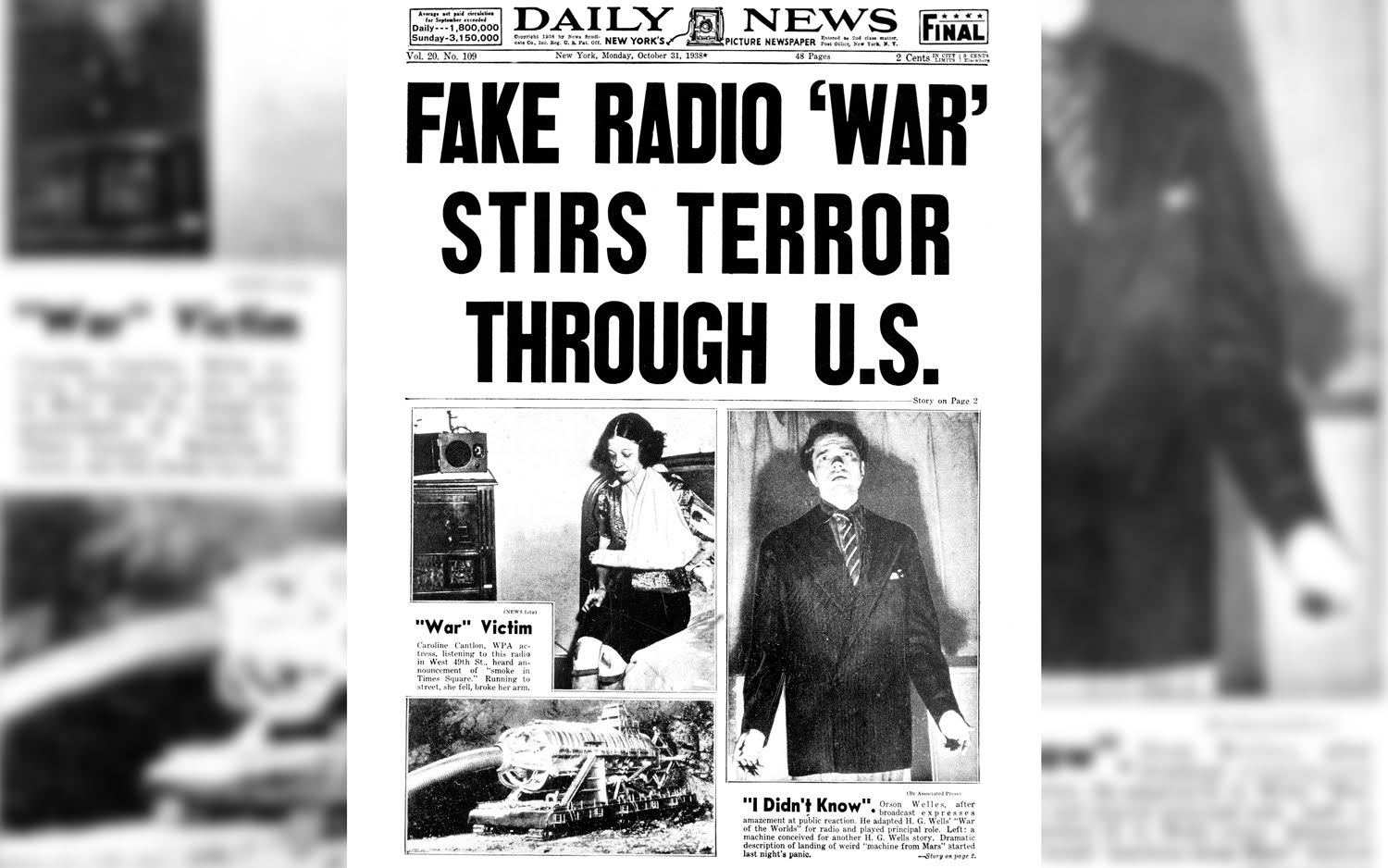
"The War of the Worlds" was less than 40 years old (and still in copyright) when a 20-something Orson Welles turned it into a radio drama in 1938. The cinematic immortality of "Citizen Kane" was still three years away when the Hollywood wunderkind went looking for a story to adapt as a fake newscast for Halloween.

Writer Howard Koch shifted the action from 19th-century London to contemporary New Jersey (coincidentally, also the location of Steven Spielberg's 2005 "War of the Worlds"), and the resulting broadcast became one of the most famous — and definitely most infamous — radio dramas in history. Indeed, it was so far ahead of its time that "Ghostwatch", the BBC's spooky primetime mockumentary, got itself into trouble for a similar, knowingly 'fake news' stunt over half a century later.

(Image credit: New York Daily News Archive/Getty)

Welles and co designed the adaptation to sound like a news bulletin — complete with weather reports and 'expert' analysis — as the aliens made their move on New York. And even though subsequent reports about the mass panic the broadcast generated in the real world were almost definitely exaggerated, some listeners who came to the show late really did believe that it was time to start welcoming their Martian overlords.

Welles' "War of the Worlds" was perfectly timed to capitalize on fears about the escalating threat of war in Europe. But the first blockbuster movie adaptation arrived in a very different political climate, when the Cold War was driving fears about the rise of communism and the threat of nuclear war.

When the Martians attack in George Pal's 1953 movie, the US army — unsurprisingly — drop an atomic bomb on their invasion fleet, but they're left unscathed thanks to their powerful forcefields. A powerful statement about the pointlessness of nuclear war, or simply an excuse to keep the story's common cold conclusion intact?

(Image credit: Paramount Pictures)

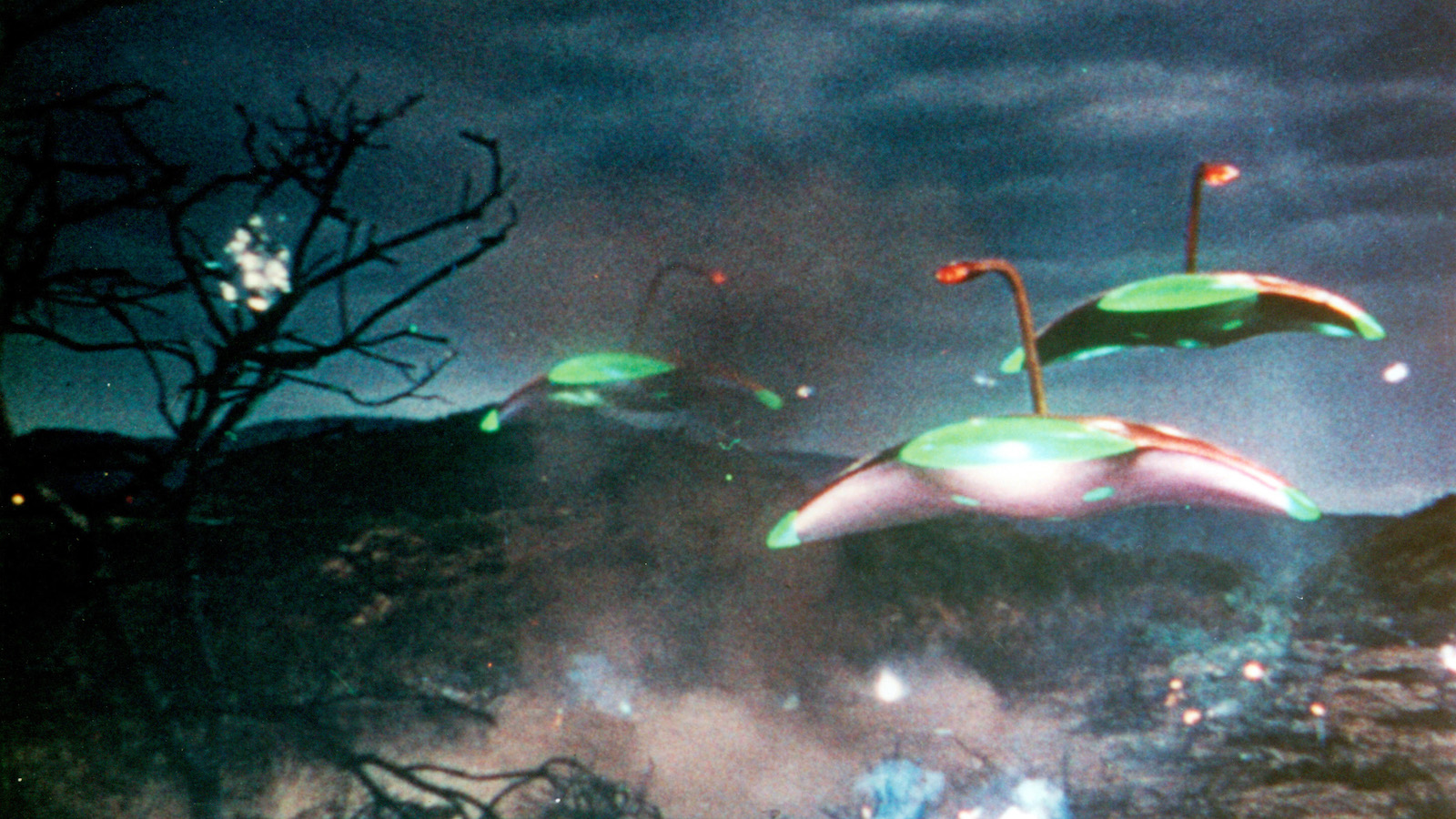
The movie is probably more important, however, as a precursor of the sci-fi blockbusters that would follow. Filmed in Technicolor, its visual effects were truly groundbreaking, as the movie imagined alien terrors that, before then, had only been possible on the page or on radio.

Anyone who's read the original book will note that Pal's floating Martian war machines don't quite match Wells' tripods, though the movie does subtly point out that — despite appearances — they're actually walking on invisible forcefield legs. Yes, really…

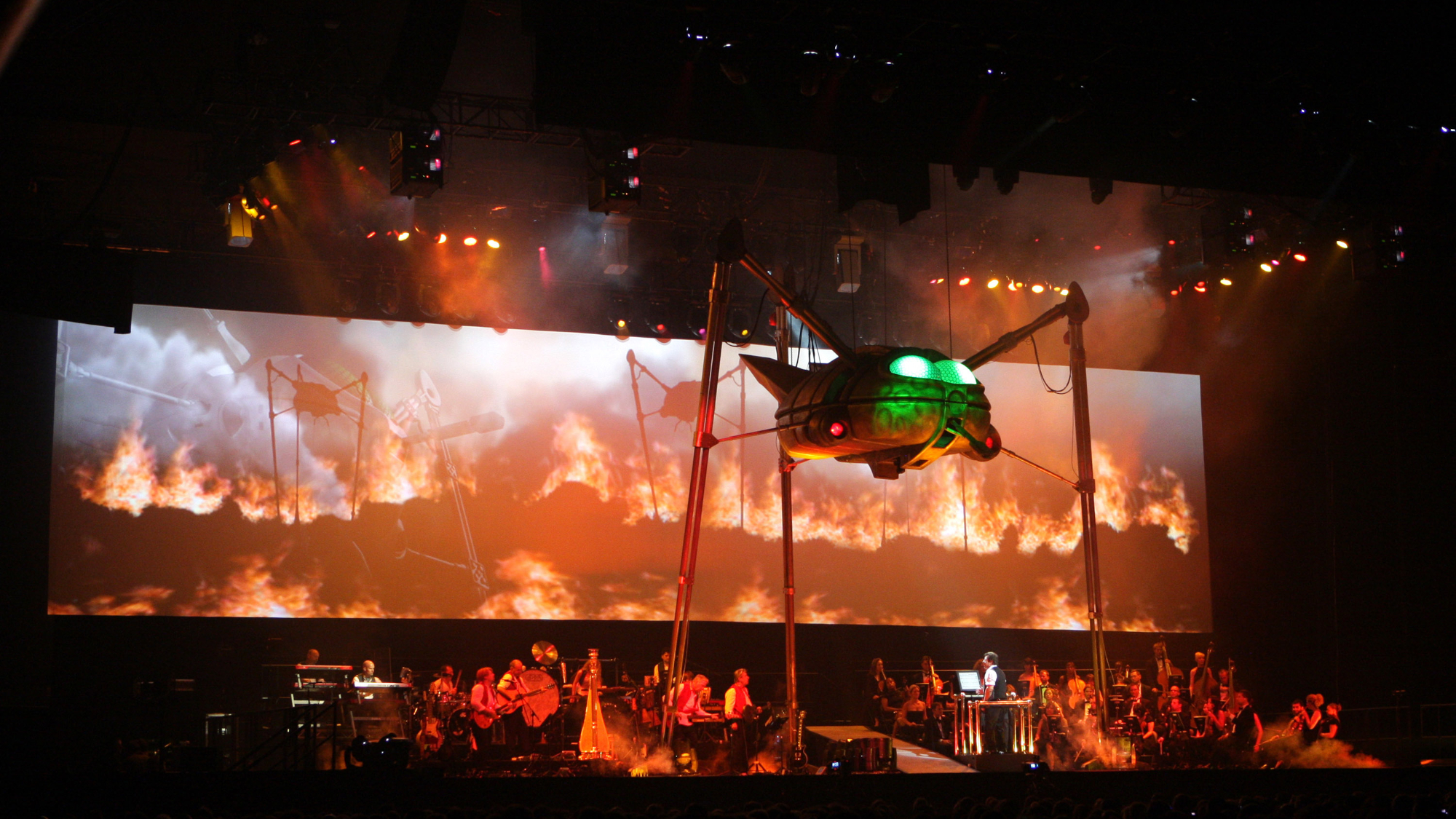
Wells' story got an unlikely new lease of life in the late 1970s when an American composer made a concept album that found its way into millions of record collections in the UK.

The snappily titled "Jeff Wayne's Musical Version of the War of the Worlds" reimagined the alien invasion as a prog rock opus, with Richard Burton as the journalist recounting the story, and '70s music stars Justin Hayward, David Essex, Phil Lynott (Thin Lizzy) and Julie Covington (who'd had a number one with "Don't Cry for Me Argentina") popping up on the soundtrack. Nearly 50 years later, Wayne is still touring his masterwork, finding new stage effects and guest stars (Liam Neeson has replaced Burton in later versions) to bring the invasion to life.

(Image credit: Getty Images (Mark Venema))

But even though the names were changed, "Independence Day" may just be the "War of the Worlds" that's had the biggest cultural impact of all. It was everywhere in 1996, with its superlative marketing campaign propelling it to the top of that year's box office chart. It was 1996's "Jurassic Park", the sci-fi epic that everybody went to see.

It arguably changed the rules of engagement for subsequent adaptations of Wells' novel, as any set-pieces featuring flying saucers flattening cities would now be judged against Emmerich's highly lucrative carnage. Spielberg's "War of the Worlds", released nearly a decade later, wisely took a very different route, keeping Wells' tripods and noxious red weed, and loading the invasion with powerful post-9/11 subtext.

In 2019, the BBC went down a path it had with many classic novels and adapted "The War of the Worlds" as a three-part period piece. The same year, another, longer-running TV version focused on the story of survivors after an alien apocalypse that had wiped out most of the Earth's population.

(Image credit: Paramount Pictures)

And then, in 2025, Wells' text finally met its match in the universally panned version that pitted a desk-bound Ice Cube against invaders who want us for our data. This was a "War of the Worlds" for the digital age, built on sledgehammer-subtle allegories for privacy and surveillance.

It wasn't the sci-fi classic's finest hour, but it did at least continue to prove the remarkable malleability of a 129-year-old novel. Like "Independence Day," it wasn't Wells' "War of the Worlds", but it also was, all at the same time.

"Independence Day" is on Disney+ in the US and UK.

Watch Independence Day on Disney+:
Disney+ (With Ads): $11.99/month
Disney+ Premium (No Ads): $18.99/month or $189.99/year

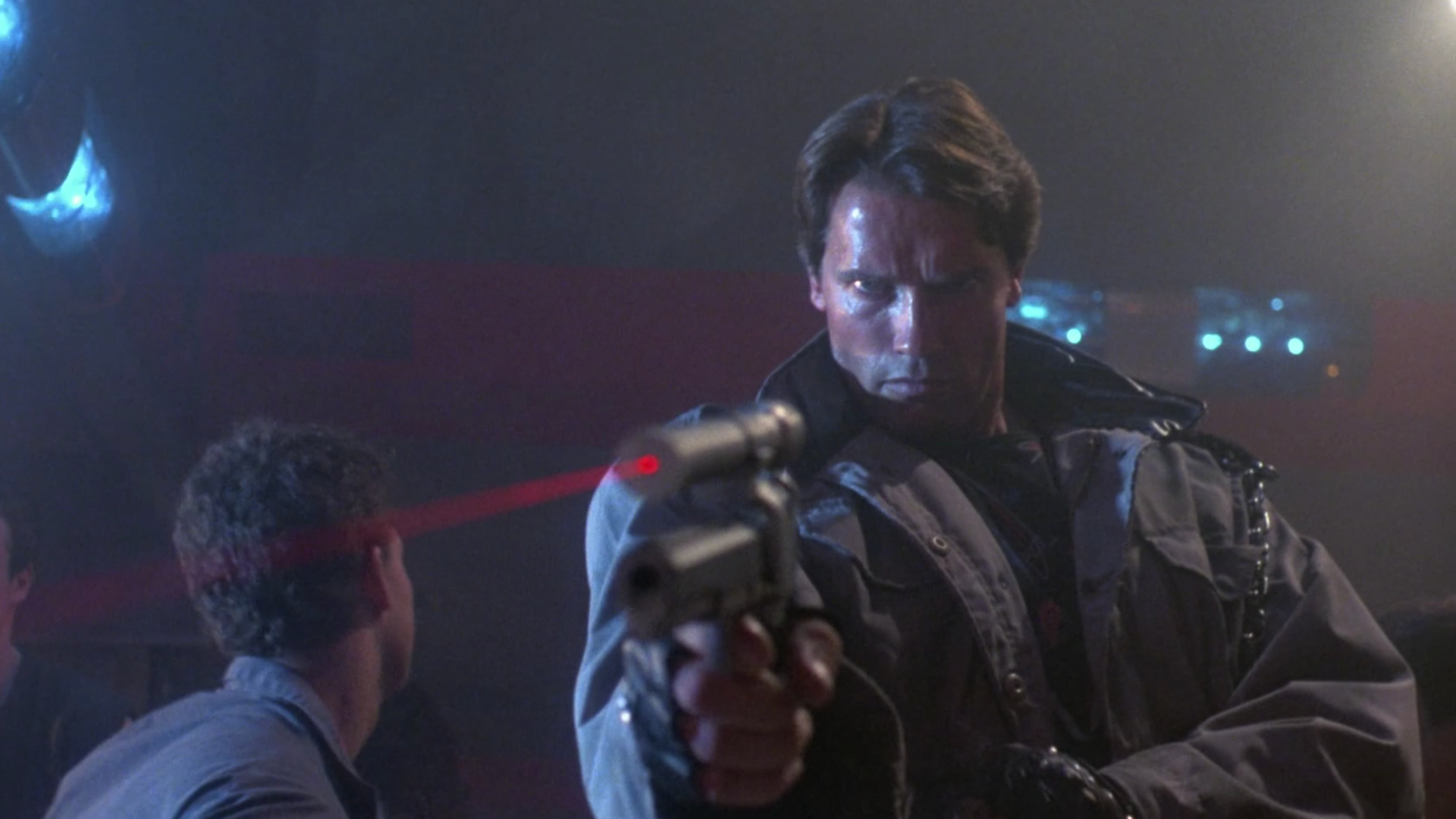
As ‘Terminator 2: Judgment Day’ turns 35, it’s time to accept the truth: Terminator shouldn’t be back

For a franchise where the main hook is time travel, "Terminator" probably wishes it could take us back in time… or just borrow the neuralyzer from "Men in Black" to wipe everybody's mind after everything post-1991. Now, as "Terminator 2: Judgment Day" turns 35 this month, we think it's time to call it: Terminator shouldn't be back.

The decline of the "Terminator" franchise might be one of the greatest falls from grace ever seen in cinema. The first two movies established themselves as genre classics, combining heart-stopping action with futuristic sci-fi that explored the threat of AI bringing about an apocalypse.

No one could get enough of the concept, with several clones such as Jean-Claude Van Damme's "Universal Soldier" and Mario Van Peebles' "Solo" copying James Cameron's homework and trying to ride its coattails. In the end, none of them were fit to lick the boots of Arnold Schwarzenegger's T-800. And as it turns out, neither were any of the subsequent Terminator sequels that followed.

1991's "Terminator 2: Judgment Day" is one of the best sequels of all time, but it also wraps up the story perfectly in retrospect. It nearly ended there, too, as the franchise sat in limbo for the next decade, buried in legal battles and rights disputes.

Cameron had plans for a third film, but he moved on to create "Avatar", leaving "Terminator 3: Rise of the Machines" to blast into theatres in 2003 without him. Is it an awful film? No, but it fails to do or say anything new. It's "a rusted robot compared to the first two films", as a fan referred to it in a Rotten Tomatoes review.

(Image credit: Carolco Pictures)

A TV series titled "Terminator: The Sarah Connor Chronicles" debuted in 2008. It ignores the events of the last movie, as Sarah Connor (Lena Headey) and her son, John (Thomas Dekker), continue to do everything in their power to stop the creation of Skynet. An interesting and alternate continuation of the story, but no one really watched the show, resulting in a quick pull of the plug after two seasons.

From there, the franchise shot forward into the future in 2009's "Terminator Salvation". Despite Christian Bale's spirited performance as John Connor, including an infamous leaked behind-the-scenes rant, there's no salvation to be found here – only the damnation of a soulless story and deliberate nostalgia-bait. And the less said about 2015's reboot-but-not-a-reboot "Terminator Genisys", the better.

(Image credit: Cinema '84)

Then, 2019's "Terminator: Dark Fate" arrived. Out of all the sequels, this is likely the best of the lot, as it attempts to inject fresh blood into the franchise, but it's still hamstrung by hanging onto the narrative threads of the past. The decision to kill John Connor is daft to the nth degree, effectively nullifying the entire point of the series. But the worst part about "Terminator: Dark Fate" wasn't the middling reviews or online hullabaloo about John; it was how it tanked at the box office. It's the lowest-performing "Terminator" sequel – all but killing the chances of more movies for at least the immediate future.

So, what did the franchise do? It pivoted. The murder bots headed back to the comics and video game arena, while an anime show, "Terminator Zero" arrived on streaming in 2024. Maybe the audience changed, so the franchise needed to change along with it? Well, about that…

In February 2026, news broke that Netflix had cancelled "Terminator Zero". It's a cruel move, especially since the Mattson Tomlin-created show attempted to do something different by telling a Terminator story that isn't about John Connor.

It's set in Japan and follows Malcolm Lee (voiced by André Holland), who attempts to stop the rise of Skynet by creating his own AI named Kokoro. The series isn't afraid of having tough discussions about humanity and if we're fated to destroy ourselves, no matter how many times someone tries to prevent it by changing the course of history. Should we even be saved from ourselves?

"Terminator Zero" proves to be a breath of fresh air, keeping the John Connor chronicles out of the picture and introducing new characters to propel the action forward. It's the shot in the arm that the franchise desperately needed; the core themes of Cameron's two movies are still in check, but the additional layers help to evolve and widen the landscape of the story. This is something the fandom had been calling out for many times before in the years prior. Yet, when originality finally arrived in the form of "Terminator Zero", the amount of eyeballs on the series didn't justify Netflix's continued investment in it.

If it wasn't clear before, it is now. The return of both Schwarzenegger and Linda Hamilton didn't make an iota of a difference in "Terminator: Dark Fate", while the decision to go in a bold new direction with the anime series hardly made a splash. The general public has lost interest in "Terminator" – and there's no coming back from it. No amount of time-traveling expeditions to reboot or create alternate timelines can save it now, because it's been done to the point of overkill.

(Image credit: Twentieth Century Fox)

It's not just that the movies failed to change with the times, though… we've changed. The "Terminator" movies are a warning about the dangers of technology and AI. The problem with watching it now is that it doesn't feel like fiction anymore. As the irresponsible use of AI escalates and an OpenAI smart model has already refused to follow instructions, Cameron's nightmare is turning into reality. Will ChatGPT be building humanoid robots to hunt us down in 50 years time? Probably not. Reality tends to offer less stylish and cinematic ends for its protagonists.

In August 2025, Cameron admitted that he's struggling to write a new "Terminator" film for this very reason. "I'm tasked with writing a new 'Terminator' story," he said. "I've been unable to get started on that very far because I don't know what to say that won't be overtaken by real events. We are living in a science fiction age right now.”

Despite this, Cameron confirmed that he's working on a new Terminator script — this time sans Schwarzenegger — in a December 2025 interview with The Hollywood Reporter. "It's time for a new generation of characters," said Cameron. "There needs to be a broader interpretation of Terminator and the idea of a time war and super intelligence. I want to do new stuff that people aren't imagining".

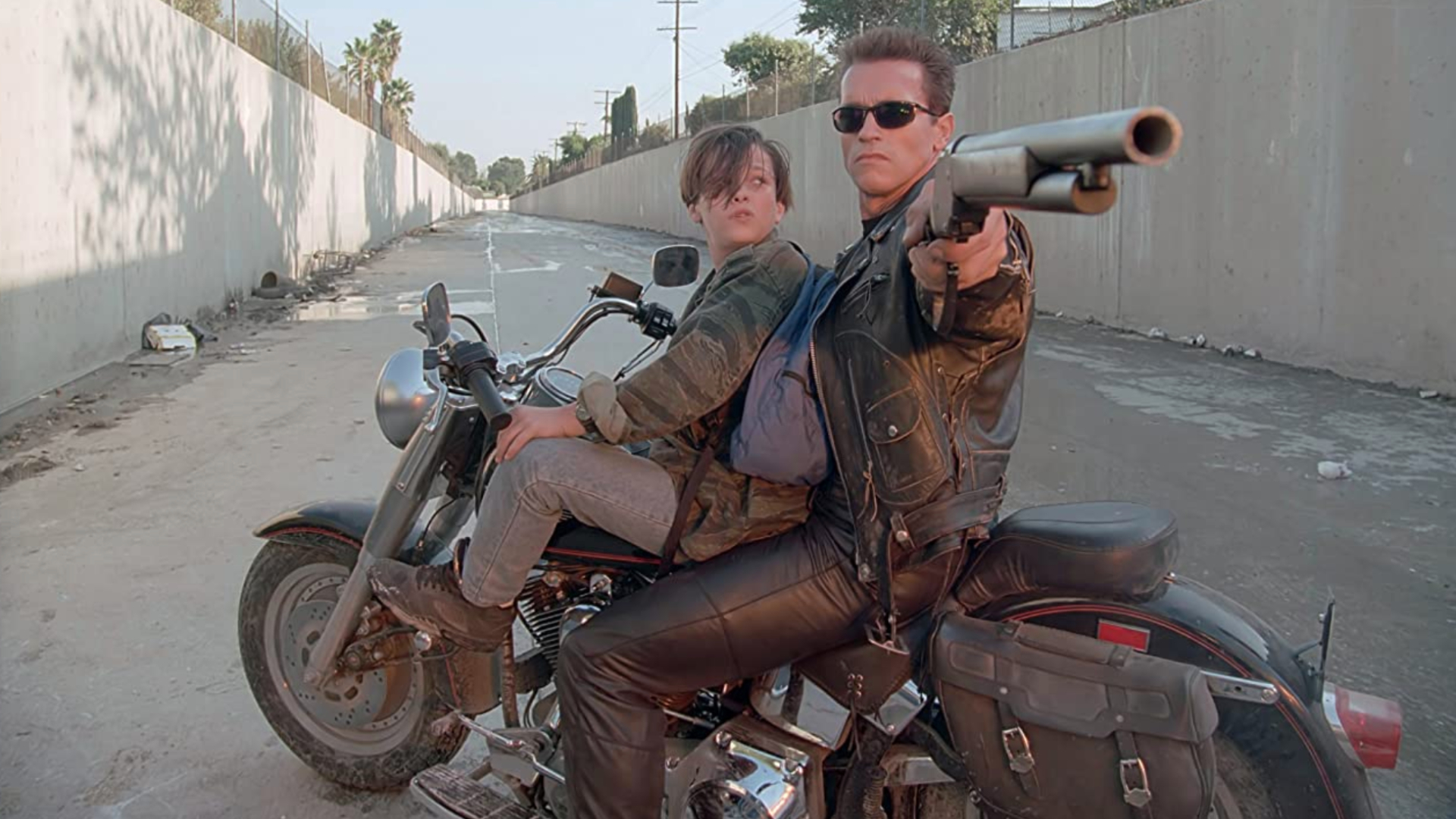
Terminator 2 Judgment Day_thumbs up_Carolco Pictures

(Image credit: Carolco Pictures)

And so we're destined to do this dance once more. Kyle Reese warned us as much in the original. "It absolutely will not stop... ever, until you are dead!" We thought he was talking about the T-800, but maybe what he was really warning us about was the dark fate of this iconic movie franchise.

The harsh truth is that every good story needs to know when to end. The obsession with turning everything into a franchise and extending it until it's limping along and slack-jawed needs to be curbed. Not everything needs to go on for all eternity. Look at "Back to the Future" as a prime example; despite repeated calls for "Back to the Future Part IV", Robert Zemeckis and Bob Gale have rejected it. Consequently, the legacy of "Back to the Future" seems far more secure than "Terminator's" in the modern era, because they know the story's done.

Schwarzenegger's T-800 famously said, "I'll be back," and he kept his promise for over three decades. This time, though, it's time for him to stay gone.

‘Independence Day’ at 30: Roland Emmerich & Dean Devlin talk blowing up the White House and crafting a true sci-fi classic (interview)

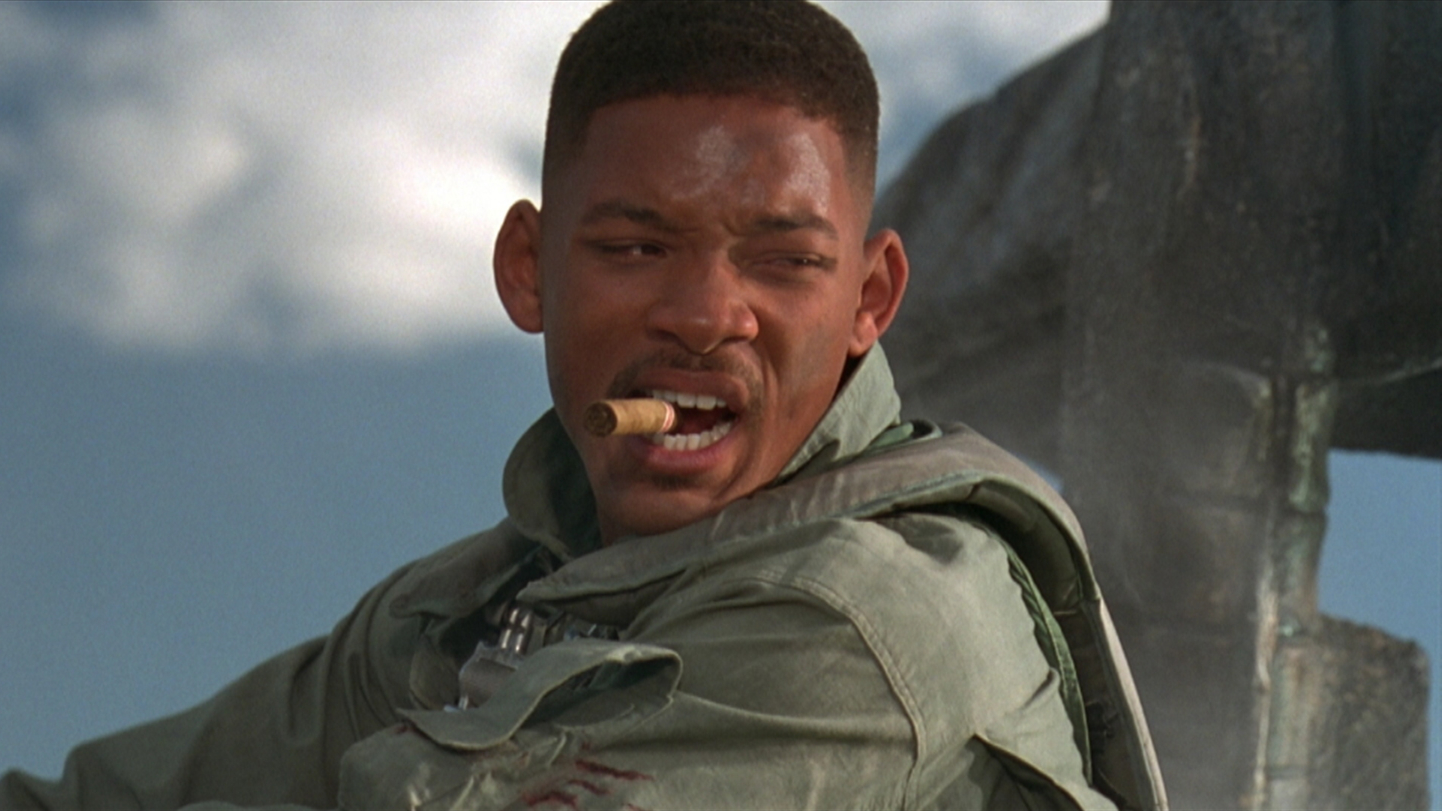
Happy 30th birthday to "Independence Day," the sci-fi mega blockbuster that made Will Smith an instant Hollywood star, crushed the box office by becoming the fastest film to reach $100 million, and obliterated Washington, D.C, all in one fell swoop of pure popcorn movie entertainment.

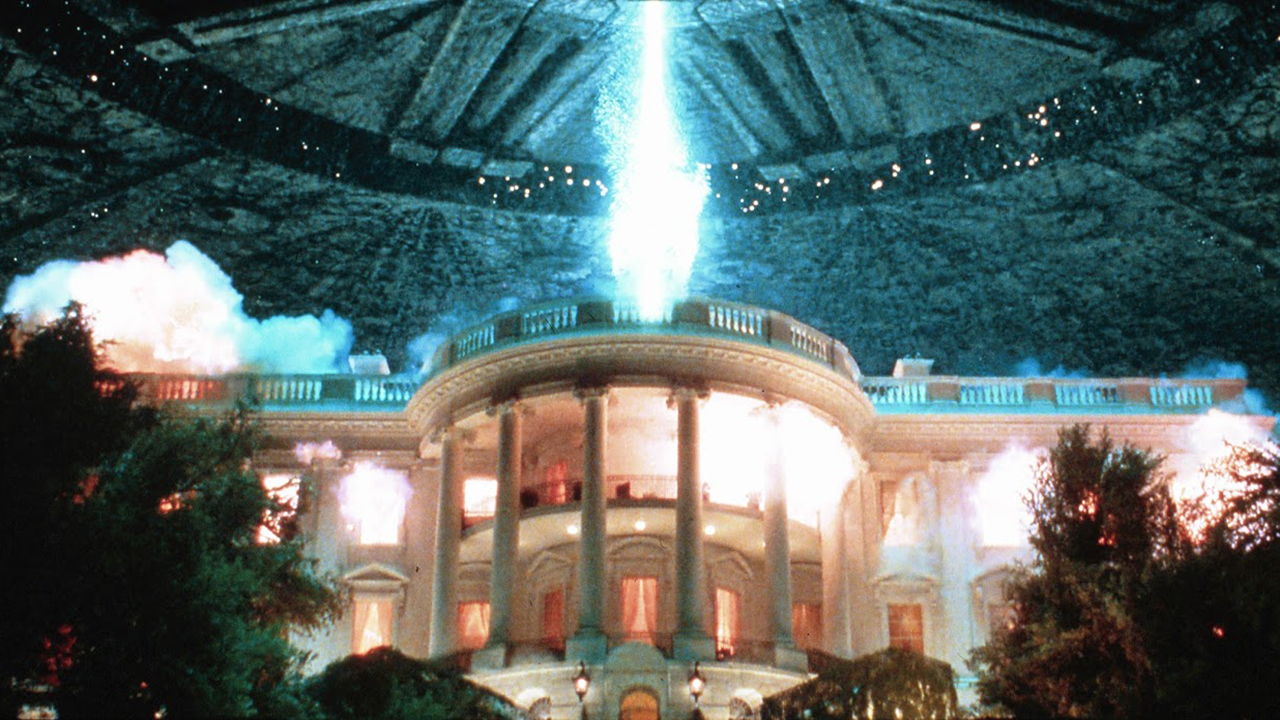
We often talk about certain works of art ushering in or being ushered in by, but "Independence Day" ("ID4") truly broke the mold for how huge tentpole pictures were marketed three decades ago, something that still reverberates today. Is there any bigger money shot than a city-sized flying saucer poised over the White House delivering a lethal laser blast of searing coherent light?

So, to celebrate "Independence Day" on its 30th anniversary, we connected with the dynamic creative duo of director Roland Emmerich and screenwriter Dean Devlin ("Universal Soldier," "Stargate," "Godzilla") for a jog down memory lane to remember one of the greatest sci-fi movies in history.

"We’d just done 'Stargate', and it was this bizarre situation where MGM had no movies to release in the month of October, so they decided to release our film," Devlin tells Space. "Roland and I had a lot of frustrations in the process of the film marketing. So we were in a fortunate position when 'Independence Day's' script came out, we had nine studios bidding on it. We had a lot of leverage, and one of the things we said was that we want to have real control over the marketing. Roland had this idea of a trailer where in it you see the White House blow up."

Its first teaser on Super Bowl Sunday in January of 1996 was a potent 30-second shot across Hollywood’s bow to announce itself to the world. Rarely had marketing campaigns started six months early, something that’s become commonplace in the digital age. But back in 1996, when Bill Clinton was president, Michael Jordan's Chicago Bulls were flying high, and the Summer Olympic Games were about to ignite in Atlanta, it was a bold move that paid off.

"I'll never forget, after we made the deal, we had this big meeting with the studio, and we got in a room, and they said to Roland and I, 'Well, you know we can't really show the White House blowing up in a trailer with what happened recently with this terrorist attack on the Federal Building. It could cause a problem.' I said, 'Yeah, but this is aliens, it's not terrorists.' Then Roland goes, 'So wait, you're telling me that if we do this, it will cause an enormous amount of controversy and everybody will talk about our movie. And that’s wrong why?'"

The "ID4" marketing campaign was one for the ages! (Image credit: 20th Century Studios)

Released by 20th Century Fox on July 3, 1996, "ID4" and its old-fashioned, flag-waving patriotic flair exploded into theaters with an epic alien invasion tale that was irresistible.

Yes, kids, audiences really did wait in long lines snaking around the block to see their favorite films when they opened. This sci-fi extravaganza was the perfect summertime escape that was appropriately launched over the festive Fourth of July week. The advertising sizzle paid off, and the film became the top-grossing of the year, raking in a whopping $817.4 million worldwide.

Emmerich recalls that the studio secretly tested "ID4" with and without the White House explosion, and there was no more discussion, leaving it as one of the highest-testing teaser trailers ever.

Will Smith and Jeff Goldblum star in "Independence Day" (Image credit: 20th Century Studios)

Starring Bill Pullman, Will Smith, Jeff Goldblum, Viveca Fox, Judd Hirsch, Margaret Colin, Brent Spiner, and Randy Quaid, it showcased terrifying extraterrestrial designs by Patrick Tatopoulos, a stirring score from David Arnold, enveloping soundscapes, and some of the best miniatures and model work ever captured on screen.

It's a spirited throwback to ‘50s-era science fiction thrillers like "The War of the Worlds" or "Earth vs. the Flying Saucers" and even won a well-deserved Academy Award for Volker Engel and his ace VFX team.

"The art of film has been lost," Emmerich notes. "When you look at 'Project Hail Mary' for example. It's meandering, and you don’t really know why this was $250 million. Because it's one actor and a stone puppet."So this is what got lost. That films got made for a price with great visual effects, and we had great visual effects and won an Oscar."

ID4's cast seems star-studded in hindsight, but Emmerich and his team took some big risks that earned them the ire of the studio.

"At that point, Will Smith was nobody, and we had to really fight for him," explains Emmerich. "The same thing with Jeff Goldblum. Nobody wanted to see him. At the very beginning, there was this idea of using up-and-coming stars and revisiting older stars, and they [the studio] didn’t like that. We had to fight for them. And it inspired a different marketing campaign. Like with helicopters flying around with 'The world ends July 4th.'"

When "Independence Day" opened wide in 2,977 venues, fans furiously flocked to theaters and multiplexes around the country, creating a once-in-a-decade demand for available seats. That week, Roland Emmerich was vacationing in sunny Puerto Vallarta, as far away from the rollout as possible.

"So I'm in a car with a bunch of people while he's in Puerto Vallarta," Devlin recalls. "And we’re videotaping for Roland to see the crowds at the theaters. We’re in Westwood, and the line goes for three blocks. We get to the front of the line, and the number three person in line was director Jon Turteltaub, whose movie ["Phenomenon"] was opening on the same day. I jumped out of the car and said, 'Jon, your movie is opening across the street. Why are you in the line for this one?' And he said, 'This is the one I want to see.' I thought at that moment that yeah, this is a cultural event."

Behind the scenes on "Independence Day" ©1996 20th Century Studios, Inc.  Now streaming on Hulu and Disney+ (Image credit: 20th Century Studios)

Emmerich and Devlin admit to feeling a hint of this intense response a bit earlier during the final ID4 test screening in Las Vegas.

"Remember, this was before digital prints and digital projectors," says Devlin. "So the audience recruited for the test was not told what movie they get to watch. All they know is it's science fiction. The place was packed, and Roland and I were in the back. The little opening thing comes on and [...] it says 'Independence Day' and the place went insane. They were cheering and freaking out. Roland and I were looking at each other like, 'Oh my god, this is great.'

"In those days, you could still have a head of a studio roll the dice on a project he believes in," reminisces Devlin. "Tom Jacobson was the head of the studio at the time, and he had two lieutenants underneath him. One loved the script, and the other hated the script and didn't want to do it. He read it himself and said, 'No, we're going to make this film.'

"That can’t happen today," laments Devlin. "Now you've got these greenlight committees and algorithms that decide what gets made. And I think that's part of what pollutes the ability to do something that’s original and out of the box."

Dean Devlin and Roland Emmerich conjuring up cinematic alchemy on "Independence Day" (Image credit: 20th Century Studios)

Few Hollywood partnerships in the ‘90s were as formidable as this prolific pair, and "ID4" might have been the zenith of their long collaboration and friendship.

"This was a really true partnership," Emmerich notes. "Everything that the success brought is 50-50. We wrote a script together, which was f***ing fantastic. Not much got changed. Only a little bit on the Randy Quaid character."

"We were under pressure because I learned that Warner Bros. was already in production of a Tim Burton movie called 'Mars Attacks.' I realized we have to do this very fast and we have to go write somewhere where we’re not disturbed," recalls Emmerich.

The White House wasn't the only casualty caught in ID4's wake, though, as another renowned filmmaker's sci-fi flick took a beating at the box office.

"After three or four weeks, we gave the script to our agent, and he said, 'Oh my god, this is the most commercial thing I've seen in years.' And that's how the auction came along. He sent it out on Wednesday, and they all had to cancel their lunches. We called this thing 'Independence Day' because that's where we wanted to have it, six weeks before 'Mars Attacks' was to come out."

A scene from "Independence Day" ©1996 20th Century Studios, Inc.  Now streaming on Hulu and Disney+” (Image credit: 20th Century Studios)

"Larry Franco was producing 'Mars Attacks', and he said, 'You should have seen Tim's face.' He was just destroyed because he had such high hopes with this film because it was so quirky and cool. And it's actually a really good film, but it was destroyed by 'Independence Day.'"

As America salutes its 250th anniversary, relive the counterattack once more and see for yourselves just how well "Independence Day" holds up after 30 years!

Watch Independence Day on Hulu:
Hulu with Ads: $11.99/month or $119.99/year
Premium (No Ads): $18.99/month

‘Silo’ season 3: Release date & how to watch Apple TV’s sensational post-apocalyptic saga

"Silo" season 3 is almost upon us, offering another round of riveting episodes of Apple TV's undeniably intriguing sci-fi series. We're about to learn how the end of the world began with the new season's split-timeline between Silo 18 and the Before Times, when the madness all started.

Adapted from Hugh Howey's trilogy of dystopian sci-fi novels, "Wool," "Shift," and "Dust," "Silo" was created by and executive produced by Emmy-winning producer Graham Yost ("Speed," "Band of Brothers," "Justified") and initially debuted on Apple TV back in 2023. This third season promises to be the best yet, and we guarantee that it's going to be an eye-opening descent into the core of the overarching tale of humanity’s last band of hearty heroes and nefarious villains trying to stay sane.

Dump out your memory-suppressing H2O and let's dig into "Silo" season 3!

WHEN DOES "SILO" SEASON 3 ARRIVE?

Rebecca Ferguson as Juliette Nichols in "Silo" Season 3 (Image credit: Apple TV)

The third and penultimate season of "Silo" premieres on July 3, 2026, at 12:00 a.m. Eastern Time (ET) for the first episode of what’s going to be a wildly eventful 10-episode outing.

Fresh weekly episodes will arrive each Friday until the season finale is broadcast on Sept. 4, 2026.

HOW TO WATCH "SILO" SEASON 3

(Image credit: Apple TV)

"Silo" season 3 will stream exclusively on Apple TV.

"Silo" is an Apple original that explores the last vestiges of humankind, surviving in 144-level doomsday bunkers, and the various factions of post-apocalyptic society struggling to exist and understand why the outside environment is a death sentence.

The first two seasons of "Silo" are also now available to watch in their entirety on Apple TV, so you can catch up on all the dark drama.

Watch Silo on Apple TV+:
Apple TV+: $12.99/month (7-day free trial)
Apple TV & Peacock Premium: $14.99/month

If you're going to be out of the country when the show debuts, you can still watch it on your streaming service of choice using a VPN.

You'll be able to connect to your streaming services, no matter where you are on Earth (though you might not have wifi if you're hiding in one of the Silos).

Editors Choice

Get 75% off Nord VPN risk-free for 30 days

Travelling abroad and still want access to Apple TV? Good news, NordVPN can help you get around those pesky geoblocking restrictions so you can watch the streaming service you've paid for anywhere in the world.VIEW DEAL ON

WHAT IS THE PLOT OF "SILO" SEASON 3?

Common in "Silo," premiering July 3, 2026 on Apple TV. (Image credit: Apple TV)

Warning: Spoilery "Silo" Season 2 Territory Ahead!

The prime timeline of "Silo" takes place in the far future, some 352 years from now, but nobody in Silo 18 is really counting, or even owns accurate calendars, now that we think about it.

Fans who've followed the show religiously know that Juliette trudged back from Silo 17 just before a mass Silo 18 exodus in last year’s finale episode after learning about a lethal safeguard installed in each bunker by the Founders to prevent rebellion.

She's met in the airlock by an unhinged and disillusioned Bernard (Tim Robbins) armed with a gun, and before you can say "Burnt Toast," the automatic fire system activates, and they’re both engulfed in raging flames.

That same episode ends with a flashback three centuries earlier to a restaurant in Washington, D.C., after a dirty bomb has been detonated in the city, where we're introduced to Helen and Daniel, two pivotal new characters that we’ll be following heavily in this upcoming outing.

"Season three of 'Silo' continues the saga of a dystopian society of 10,000 people living underground under mysterious circumstances, while revealing an origin story set centuries earlier," explains the official synopsis.

"In the present, Juliette Nichols (Rebecca Ferguson) survives her forced 'cleaning' but returns with memory loss as the silo recovers from rebellion and faces a dangerous new threat. Meanwhile, in the 'Before Times,' journalist Helen Drew (Jessica Henwick) and Congressman Daniel Keene (Ashley Zukerman) uncover a conspiracy that pulls them into a chain of events with catastrophic, irreversible consequences."

"SILO" SEASON 3 TEASERS AND TRAILERS

Sneak peeks at "Silo's" third season have been sparse, and with an abundance of startling reveals about to be discovered, fans should be grateful that the PR folks at Apple TV haven’t exposed too much as our survivors try to make sense of their depressing upside-down world.

The first reverse-edited teaser landed back on Apr. 21, 2026, which got us pumped for the pandemonium!

The main trailer debuted on June 2, 2026, and we were immediately brought up to speed about Juliette being inside the fire box for three minutes, but she's now experiencing amnesia and can’t remember her friends or what secret she uncovered while inside Silo 17.

We also gain more info on the silo Founders and the monumental 21st-century engineering project that created them to rescue humanity from extinction.

"The end of the world cannot be stopped, it can only be survived," states Colin Hanks' chilling billionaire industrialist character.

WHO ARE THE "SILO" SEASON 3 CAST AND CREATORS?

(Image credit: Apple TV)

"Silo" season 3's outstanding ensemble cast includes:

  • Rebecca Ferguson – Juliette Nichols
  • Jessica Henwick – Helen
  • Ashley Zukerman – Daniel
  • Common – Robert Sims
  • Harriet Walter – Martha Walker
  • Chinaza Uche – Paul Billings
  • Avi Nash – Lukas Kyle
  • Alexandria Riley – Camille Sims
  • Shane McRae – Knox
  • Remmie Milner – Shirley Campbell
  • Rick Gomez – Patrick Kennedy
  • Billy Postlethwaite – Hank
  • Clare Perkins – Carla McLain
  • Steve Zahn – Jimmy Conroy

The following newcomers will also be joining the series in unknown roles:

  • Colin Hanks
  • Laura Innes
  • Jessica Brown Findlay
  • Morven Christie
  • Reed Birney
  • Matt Craven

Produced by Apple Studios and AMC Studios, "Silo"'s upcoming 10-chapter nightmare is executive produced by showrunner Graham Yost, Michael Dinner, Rebecca Ferguson, Nina Jack, Joanna Thapa, Morten Tyldum, Howey, Amber Templemore, Fred Golan, and Rémi Aubuchon.

WILL THERE BE A "SILO" SEASON 4?

Alexandria Riley in "Silo," premiering July 3, 2026 on Apple TV. (Image credit: Apple TV)

Yes, we’re not out of the hole quite yet!

Apple TV gave a green light for both "Silo's" third and fourth seasons back in December of 2024 after overwhelming acclaim and impressive viewership numbers, guaranteeing a proper end to the "Silo" saga. Season 4 will be the final season, though.

"It has been a richly rewarding experience to adapt Hugh's epic novels with our partners at Apple, and we are thrilled to have the opportunity to bring this complete story to the screen over the course of four seasons," Yost shared after Apple TV’s renewal.

"With the final two chapters of 'Silo,' we can't wait to give fans of the show an incredibly satisfying conclusion to the many mysteries and unanswered questions contained within the walls of these silos."

Watch Silo on Apple TV+:
Apple TV+: $12.99/month (7-day free trial)
Apple TV & Peacock Premium: $14.99/month

How to invade planet Earth: A sci-fi movie alien’s guide to bringing the human race to its knees

It looks there for the taking, doesn't it? The third rock from the sun just sitting there, all defenceless, run by squabbling politicians ruling over a human race who'd rather be sharing "get ready with me" videos than vigilantly watching the skies as they should be.

But next time you set your sights on invading planet Earth, remember that it's easier said than done. Some of the mightiest alien attack forces in existence have met their match in this particular corner of the Milky Way, as the residents of this nondescript ball of rock have repeatedly found ways to repel extraterrestrial attackers — even when they're massively outgunned.

So don't embarrass yourself in front of your attack fleet. Having painstakingly researched numerous previous assaults on Earth, we've assembled a guide to all the things you should — and indeed shouldn't — do the next time you try to bring those snivelling humans to their knees. Follow these tips, and the Earth can be yours to do with as you please.

DO… target major landmarks

Independence Day (1996)

(Image credit: 20th Century Studios)

Case study: "Independence Day"

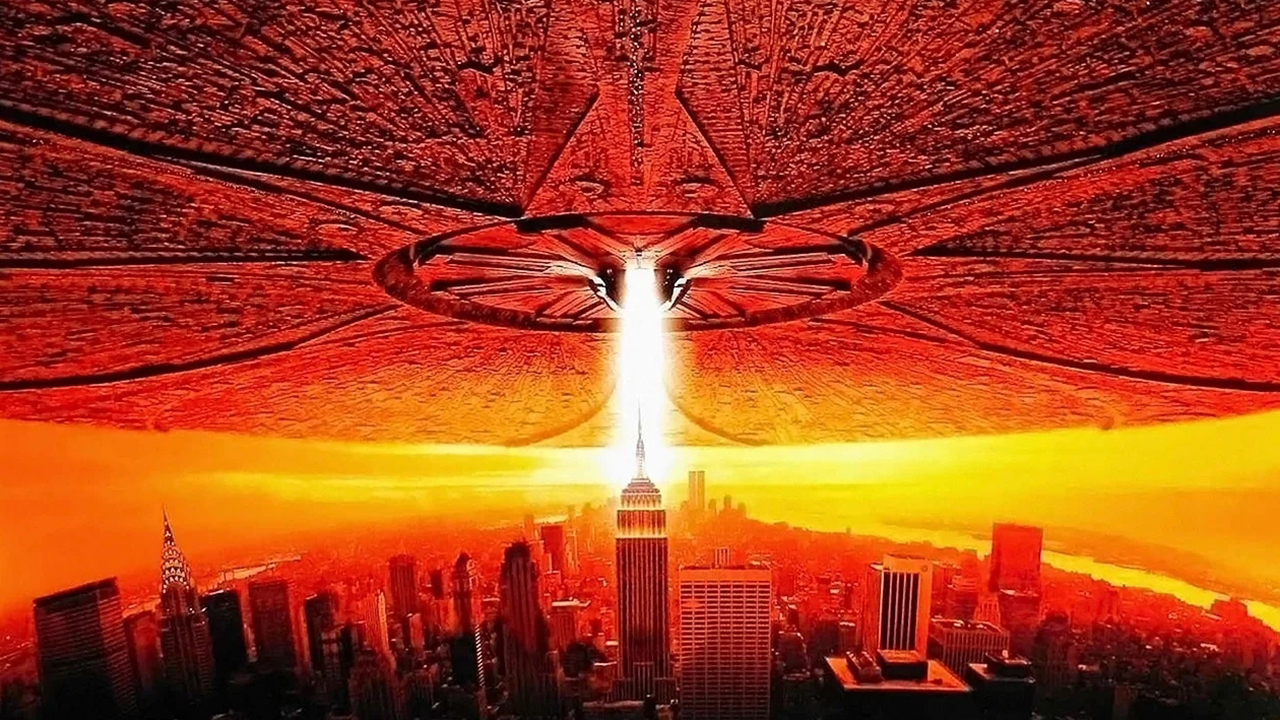
If you really want to show your prospective underlings who's boss, you'll need to make a big entrance. Hovering over major landmarks (eg: The White House, The Empire State Building, the Capitol) is a great place to start, as the eyes of the world's media will be upon you.

Some bystanders will think you came in peace, of course, but by the time the masses have realized what you're up to, it'll be way too late for those puny humans.

DON'T… invade if you have a severe allergic reaction to water

Crop circles from the movie Signs (2002)

(Image credit: Buena Vista Pictures)

Case study: "Signs"

Don't be like these crop-circle-obsessed idiots. If water's not for you, you really shouldn't set your sights on a planet whose surface is over 70% water. There are other, less soggy worlds to conquer.

DO… dress up as the personification of evil

The Overlords choose a humble farmer to be their ambassador to Earth, in the Syfy miniseries Childhood's End.

(Image credit: Syfy)

Case study: "Childhood's End"

A bit of a cheat code, this, but if you really want humans to fear (or, at the very least, respect) you, you could do worse than model yourself on Satan/Beelzebub/Mephistopheles/Old Nick/the Devil/whatever you want to call him. They're sure to hang on your every word, though do be prepared for them to assume the worst of you, even if your intentions are good.

DON'T… get cocky

Scene from the movie Superman II (1980). Clark Kent (aka Superman) is battered and bleeding. Lois Lane is holding on to him.

(Image credit: Dovemead Films)

Case study: "Superman II"

Earth's famously yellow sun works such wonders on Kryptonian physiology that it can be tempting to get everyone you know kneeling at your feet. Alas, hubris is a one-way ticket to the Phantom Zone.

DO… plan ahead

Still from the sci-fi movie

(Image credit: Paramount Pictures)

Case study: "War of the Worlds"

Transporting invading forces down to a planet's surface can be such a time-consuming process that unnecessary delays could give locals an opportunity to mount a resistance — inconvenient, to say the least.

By playing the long game, however, you can bury your vehicles of mass destruction underground centuries before they're needed. A few carefully deployed bolts of lightning later, and you'll be frying humans for fun.

DON'T… get drawn into crazy conspiracy theories

The X Files_20th Century Fox Television_HERO IMAGE

(Image credit: 20th Century Fox Television)

Case study: "The X-Files"

Infiltrating the upper echelons of existing Earth governments may seem like an oven-ready route to taking control. But unless you have a clear, easy-to-define plan, your followers will get bored long before your Machiavellian schemes come to fruition.

DO… turn Earth into a pre-industrial society

The Masters, an alien race shown in the BBC sci-fi series

(Image credit: BBC)

Case study: "The Tripods"

Applying mind-controlling "Caps" to 14-year-old Earthers is a smart move that can ensure they'll spend their lives worshipping you as gods.

But arguably the Master's smartest move was rendering all Earth technology obsolete, making all the advances of the Industrial Revolution null and void – nobody's going to fight off your giant three-legged war machines with pitchforks and rotten cabbages.

DON'T… telegraph your arrival

a woman floats in the air in front of a star and two moons

(Image credit: Netflix)

Case study: "3 Body Problem"

There's a lot to be said for surprise attacks.

So if you're confined to sub-light speed travel (damn you, Einstein!), it's probably best not to give humanity a few centuries' head start — even if you're not confident their tech won't surpass yours in the meantime.

DO… go back to an earlier point in history

The Borg Queen and Locutus/Captain Picard in Star Trek: First Contact

(Image credit: Paramount Pictures)

Case study: "Star Trek: First Contact"

It's said that the definition of madness is doing the same thing again and again and expecting a different result. Cybernetic terrors, the Borg were quick to realize this, and — after one too many defeats at the hands of the technologically inferior Federation – changed the rules of engagement by travelling back in time to assimilate humanity before they had the wherewithal to fight back.

Employ this method, and resistance really will be futile.

DON'T… limit your aspirations to a small town

The World’s End (2013)

(Image credit: Universal Pictures)

Case study: "The World's End"

We get it. You find a small suburban town you like – with more than its fair share of charming bars – and putting down roots seems the only logical thing to do. Being top dog on the local council, however, is not the same as world domination.

DO… develop the ability to loop time

Screenshot showing Tom Cruise in the sci-fi movie Edge of Tomorrow (2014)

(Image credit: Warner Bros. Pictures)

Case study: "Edge of Tomorrow"

We all make mistakes, but that really doesn't matter if you can channel your inner Punxsutawney Phil and turn back time. By trapping everyone else in your own personal Groundhog Day, you can learn from your battlefield errors, fix the things that once went wrong, and ensure you come out on top. Every. Single. Time.

DON'T… skimp on your disguises

A handshake, with one person's pinky finger extended

(Image credit: QM Productions)

Case study: "The Invaders"

It's the small details that count. If your tech is sufficiently advanced to craft convincing human facsimiles, why not push the boat out a little further and give them a pulse and a pinky finger that doesn't stick out at a telltale weird angle?

DO… have humans raise your offspring

(Image credit: MGM)

Case study: "Village of the Damned"

Even if their offspring are evil little ****s, humans tend to love their kids. Take advantage of this evolutionary flaw (sorry, trait) by impregnating Earth women and having them raise your progeny for you.

It's unlikely your children will be able to hide their inherited desire for world domination for long, but they'll do what they can to pave the way for your arrival.

DON'T… forget your jabs

(Image credit: Paramount Pictures)

Case study: "War of the Worlds"

Even humans know that it's often a good idea to get vaccinated when they visit a new country. So heading to Earth without boosting your immunity to local diseases means risking colossal embarrassment. And lots of excess phlegm.

DO… spread your spores

(Image credit: United Artists)

Case study: "Invasion of the Body Snatchers"

Spaceships are hard to do. Not only do you need to build them and develop a form of propulsion capable of traversing the immense distances between stars, but you also have to keep the creatures inside them alive in the vacuum of space. In other words, too much effort.

If, however, you spread your spores via stellar winds, all the painful work is done for you. Once your seeds have made Earthfall, it's just a small matter of infecting unwitting Earth folk and replacing them with pliant pod people. Job done.

DON'T… forget to update your anti-virus software

(Image credit: 20th Century Fox)

Case study: "Independence Day"

Maybe you forgot to renew your anti-virus subscription. Maybe you think your operating system won't be susceptible to malware designed for 'inferior' Earth computers. But come on, losing your fleet to a virus sent by a mid-90s Mac is a system error you'll never live down.

DO… hide in plain sight

(Image credit: Focus Features)

Case study: "Bugonia"

Most humans choose not to believe that there are aliens among them. So if you sent a spy to Earth, made sure they looked entirely human and they got themselves, say, a respectable job as the CEO of a major company, nobody would ever suspect they came from another planet.

In fact, anyone who suggested they were born on a different world would be so thoroughly discredited that keeping their identity secret would be a doddle.

DON'T… rely on a hive mind

(Image credit: Disney / Marvel)

Case study: "The Avengers"

Sure, there are certain efficiencies that come from networking your computers, but you'll have egg on your face the next time Earth's Mightiest Heroes (their words, not ours) join forces and take out your command ship.

DO… absorb everything in your path

(Image credit: Universal Pictures)

Case study: "The Thing"

If you're the sort of alien species who can absorb and replicate any species you come into contact with, then Earth really is yours for the taking. The only thing you need to avoid is crash-landing in an uninhabited area.

Find your way into more populated parts of the world, however, and projections suggest the entire planet could be yours in just three years.

DON'T… be dandruff

(Image credit: Columbia Pictures)

Case study: "Evolution"

Arsenic is poisonous to carbon-based lifeforms, so — the logic goes — selenium must be toxic to anyone whose DNA runs on nitrogen.

The science may be questionable, but would you want to take the risk? Especially when you know Earth has vast supplies of selenium-filled Head & Shoulders waiting to take you out.

DO… have fun

(Image credit: Warner Bros.)

Case study: "Mars Attacks!"

Taking over your nearest neighbor in the Solar System is a serious business, but that doesn't mean you can't have a good laugh while you're doing it.

Want to know what would happen if you attached the head of a "Sex and the City" star to a dog's body? You'll never know unless you try. Playing skittles with ancient landmarks? Why not give it a go? And surely it would be rude not to reimagine Mount Rushmore with your own visage.

DON'T… bother

(Image credit: BBC)

Case study: "Doctor Who"

For a small blue dot described as "Mostly Harmless" by "The Hitchhiker's Guide to the Galaxy" (other reference works are available), Earth has a lot of supporters across the cosmos. Indeed, so many previous invasions have been thwarted by Time Lords, superheroes, and other unlikely protectors that it may be best to stay at home.

Steven Spielberg sci-fi movies ranked, worst to best

Steven Spielberg's latest sci-fi movie, Disclosure Day, has finally hit cinemas worldwide. It's been eight years since the iconic director released a movie in this genre, re-entering his UFO era with a twisted alien thriller. To mark his momentous return to sci-fi cinema, we've taken time to gaze across his entire sci-fi slate, ranking them from worst to best.

We use the term 'worst' lightly, though. Spielberg is a movie legend after all. To date, he's directed over 30 films during his illustrious career, crafting spectacular titles with a deep understanding of what it takes to truly tell a story. Frankly, if you don't recognize the nine movies listed here, well, where the devil have you been?

So, hold onto your butts and please enjoy our ranking of Steven Spielberg's sci-fi movies, worst to best.

Honorable mention: Firelight

A short film called Firelight is arguably his inaugural entry into sci-fi cinema, with only a few minutes ever having been publicly released. While we can't place it in the rankings, it must be mentioned as Spielberg was only a teenager at the time, demonstrating his early genius and determination to bring his ideas to life.

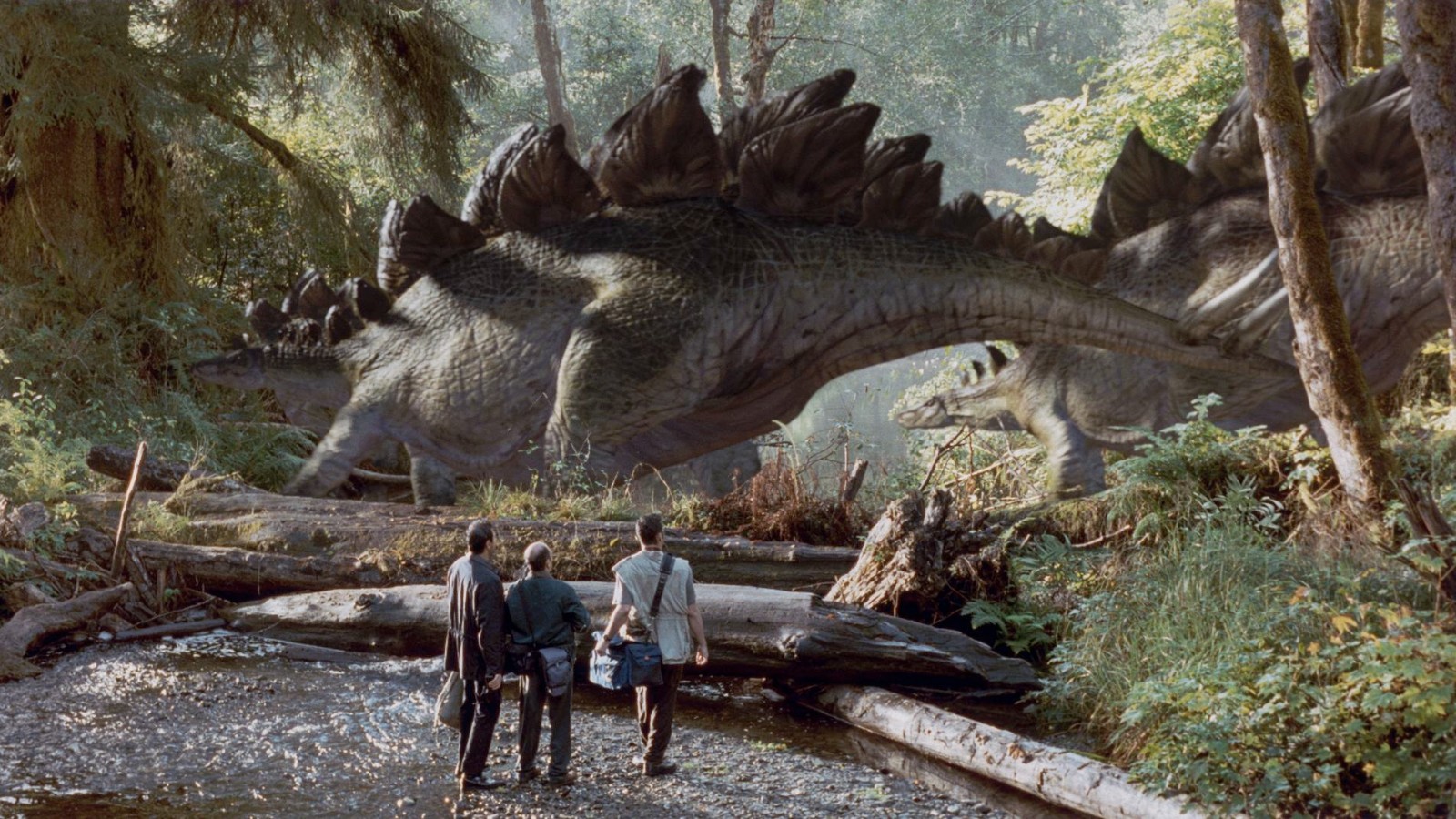
9. The Lost World: Jurassic Park

(Image credit: Universal Pictures)

Release date: May 23, 1997 | Cast: Jeff Goldblum, Julianne Moore, Vince Vaughn | Rotten Tomatoes score: 57% critics, 52% audience

Spielberg was riding a real high from the first critically-acclaimed Jurassic Park, so of course there had to be a sequel. Unfortunately, those were some mighty big dinosaur-shaped boots to fill, and The Lost World didn't quite live up to the overwhelming success of its predecessor. Somewhat understandable given how iconic the first movie was. That being said, it's still one of the best Jurassic Park movies ever made. Just not the best.

With Dr. Ian Malcolm (Jeff Goldblum) leading the sequel, he leads a team to a second island where dinosaurs roam freely, though a threat jeopardizes their peace. Trying to carve out its own path in the wake of Jurassic Park was a tall order.

It leans more into the horror genre this time around, which gives it a fresh feeling, but The Lost World doesn't quite have the same glimmer and spectacle of the first movie's cast (although Goldblum was certainly a standout character).

8. Disclosure Day

(Image credit: Universal Pictures)

Release date: June 12, 2026 | Cast: Emily Blunt, Josh O'Connor, Colin Firth | Rotten Tomatoes score: 79% critics, 70% audience

After an 8-year hiatus away from the genre, Spielberg finally returned to sci-fi with 2026's Disclosure Day. Was it worth the wait? Eh.

Disclosure Day centers on a conspiracy to cover up the existence of aliens, and it gets a lot of things right. The cast plays their roles to perfection, the dialogue is snappy and witty, and it hits all the right marks aesthetically, but something about it just feels… off.

The central story — following an unlikely duo (Blunt & Connor) on a journey to uncover and reveal the truth to the world — asks you to think, but often falls apart when you do, as you start to notice the string of McGuffins, contrivances, and vapid action scenes stringing it together.

It's an entertaining watch, but nothing more, which is a real shame from a filmmaker of Spielberg's caliber.

7. War of the Worlds

(Image credit: Paramount Pictures)

Release date: June 29, 2005 | Cast: Tom Cruise, Dakota Fanning, Tim Robbins | Rotten Tomatoes score: 76% critics, 42% audience

H.G. Wells' novel The War of the Worlds practically begged for a movie director with abundant talent to tackle it. Fortunately, Spielberg stepped up to the plate, transforming the short novel into a big-screen masterpiece.

War of the Worlds follows Ray Ferrier (Tom Cruise), a divorced crane operator, who must protect his children from an alien invasion – not your usual setup for a weekend of parental custody! It's epic in proportion and relentless in action, with the narrative underscore of Morgan Freeman's liquid caramel voice setting the tone.

This movie was another return to aliens for Spielberg, although here he opts for their arrival to be even more devastating and unpredictable than in his previous visitations. He finds a great balance between big action and moments of reflection, weaving an ever-building tension throughout the movie that has captivated audiences for over 20 years.

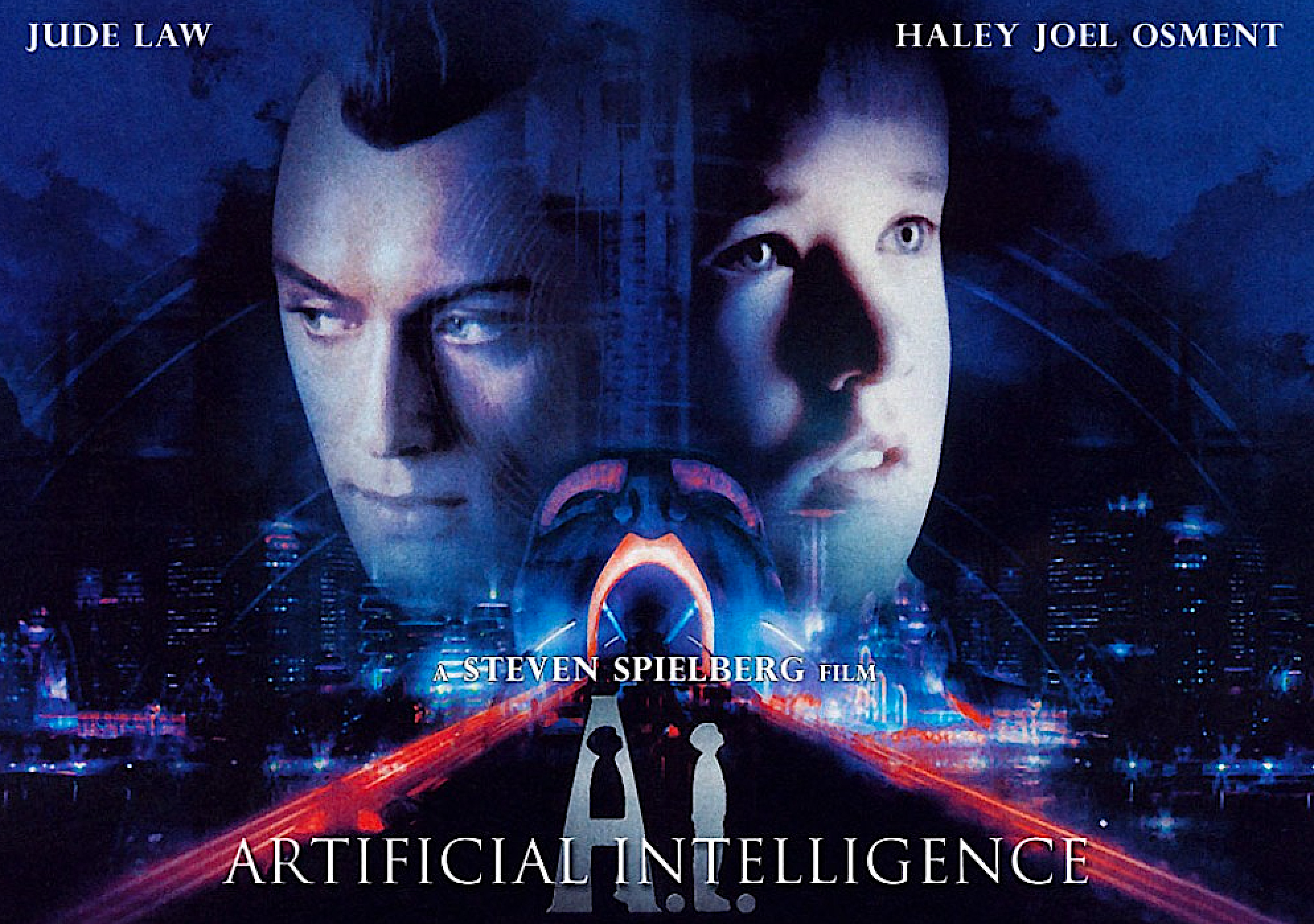
6. A.I. Artificial Intelligence

(Image credit: Warner Bros.)

Release date: June 29, 2001 | Cast: Haley Joel Osment, Jude Law, Brendan Gleeson | Rotten Tomatoes score: 76% critics, 64% audience

Before ChatGPT and Grok, there was David (Haley Joel Osment), an A.I. android child programmed to love.

Initially, Stanley Kubrick was spearheading the movie, but let it go as he felt CGI wouldn't do David's role justice, nor could any child actor. Instead, he handed it over to Spielberg, who believed that a child could.

Taking place in a futuristic world, "A.I. Artificial Intelligence" is a loosely based adaptation of Brian Aldiss' sci-fi short story "Supertoys Last All Summer Long." Young David is adopted into a family who are going through their own parental torture, but he never quite feels at home.

To understand who he truly is, David embarks on a journey that's unbelievably lonely and incredibly daring. It's equal parts moving as it is disturbing, and you'll be left questioning what's morally right and wrong.

5. Ready Player One

(Image credit: Warner Bros.)

Release date: March 29, 2018 | Cast: Tye Sheridan, Olivia Cooke, Simon Pegg | Rotten Tomatoes score: 71% critics, 77% audience

Ready Player One is another book adaptation for Spielberg, this time of Ernest Cline's novel of the same name. Welcome to the 2040s, where the virtual reality world OASIS is the place to be… especially if you're someone like orphan Wade Watts, desperately searching for a better life outside of the dystopian hellscape that Earth has become.

When OASIS creator and billionaire James Halliday passes away, his OASIS avatar announces a competition for the ultimate prize – ownership of the digital society itself (and a staggering amount of money, of course). This sends the world into a frenzy, with players, including Wade, determined to win. Including some rather nasty, big corpo bullies who enlist specialist teams to hunt down clues, and other players, too.

With nostalgic odes to musical history and memories of video games woven within, Spielberg works hard to bring Cline's love letter to the 80s to life in a visually captivating and action-packed way. Cline's sequel, Ready Player Two, is reportedly in development, though this time Spielberg is only attached as a producer.

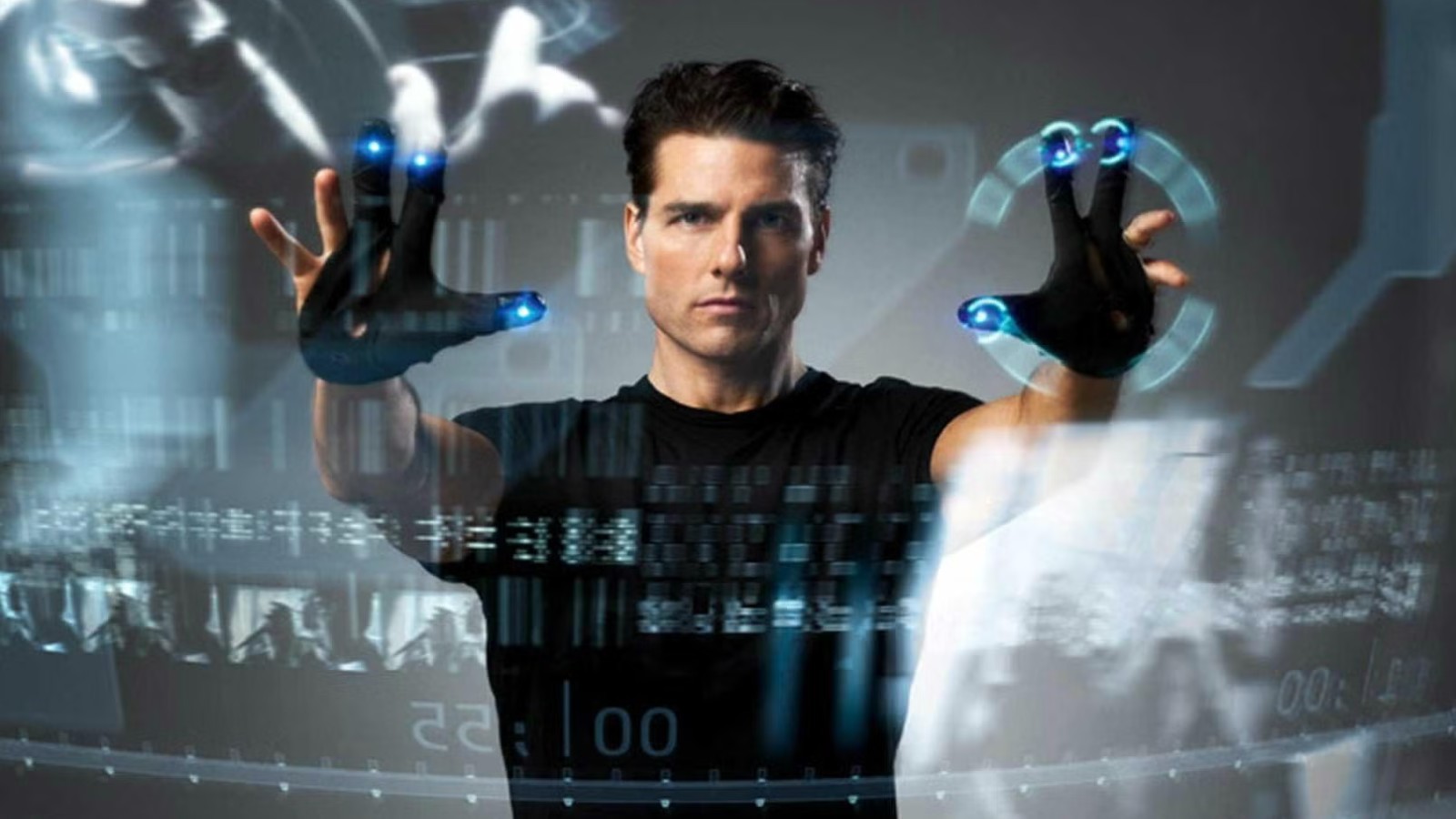
4. Minority Report

(Image credit: 20th Century Fox)

Release date: June 21, 2002 | Cast: Tom Cruise, Colin Farrell, Samantha Morton | Rotten Tomatoes score: 89% critics, 80% audience

Though Cruise and Spielberg later worked on War of the Worlds, Minority Report came first and is arguably the better of their collaborations. A crime department in not-so-far-away 2054 predicts crimes before they happen. John Anderton (Tom Cruise) heads up the PreCrime unit and is helped largely by three psychics called Precognitives (Precogs) that they have hooked up in strange spa-like tubs.

It quickly twists into a nightmare for John as his name comes up as a soon-to-be criminal, which prompts him to go on the run to prove his innocence before it's too late. Minority Report is a crime thriller with all kinds of twisted, sci-fi futurism tech from sick sticks to eye-digging robots.

Spielberg adds heart-pounding, sensational chases to craft this true epic, and ironically, it made several predictions about future life that ring eerily true today.

3. Jurassic Park

(Image credit: Jun Maegawa, CC BY-SA 3.0)

Release date: June 11, 1993 | Cast: Sam Neill, Laura Dern, Jeff Goldblum | Rotten Tomatoes score: 91% critics, 91% audience

When Spielberg took on the movie adaptation of Michael Crichton's novel "Jurassic Park," he transformed the way we see dinosaurs forever.

With a mix of CGI and animatronics, it found an impressive balance that leapt the genre forward, and it's certainly far more captivating than the Jurassic movie sequels that have come since.

Experts are invited to experience an amusement park built around cloned dinosaurs. What could go wrong? Well, plenty. The stage is set for unbelievable tension and suspense-building, and it's executed perfectly through Spielberg's directorial prowess with memorable scenes from raptors in the kitchen to a T-Rex in the toilet.

It's not only these iconic dinosaur moments that make the movie captivating, but in true Spielberg fashion, it's the conversations and intricate web of personalities, too. And John Williams' legendary film score, too, of course. With dinosaurs, you can fall prey to doing a bit too much. Jurassic Park does just enough.

2. Close Encounters of the Third Kind

(Image credit: Colombia Pictures)

Release date: November 16, 1977 | Cast: Richard Dreyfuss, Teri Garr, Melinda Dillon | Rotten Tomatoes score: 91% critics, 85% audience

As we mentioned in the intro, Firelight was a movie that Spielberg made in his teens, shown only within the walls of the Phoenix Little Theatre. Then, in 1977, he took his initial Firelight ideas so much further by crafting Close Encounters of the Third Kind. It's Spielberg's first proper foray into UFOs and what many have dreamed would eventually lead to a spiritual successor in Disclosure Day.

Here we have Roy Neary (Richard Dreyfuss), who has a close encounter of the Third Kind, finding a UFO when working as an electrical lineman. Weirdly, the government won't admit that 'they' exist. Unlike his later work with Disclosure Day, this prompts a journey of discovery rather than one of fear. With budget and belief, Spielberg turned his small-town dreams into a huge production that had a significant impact on the sci-fi cinema landscape.

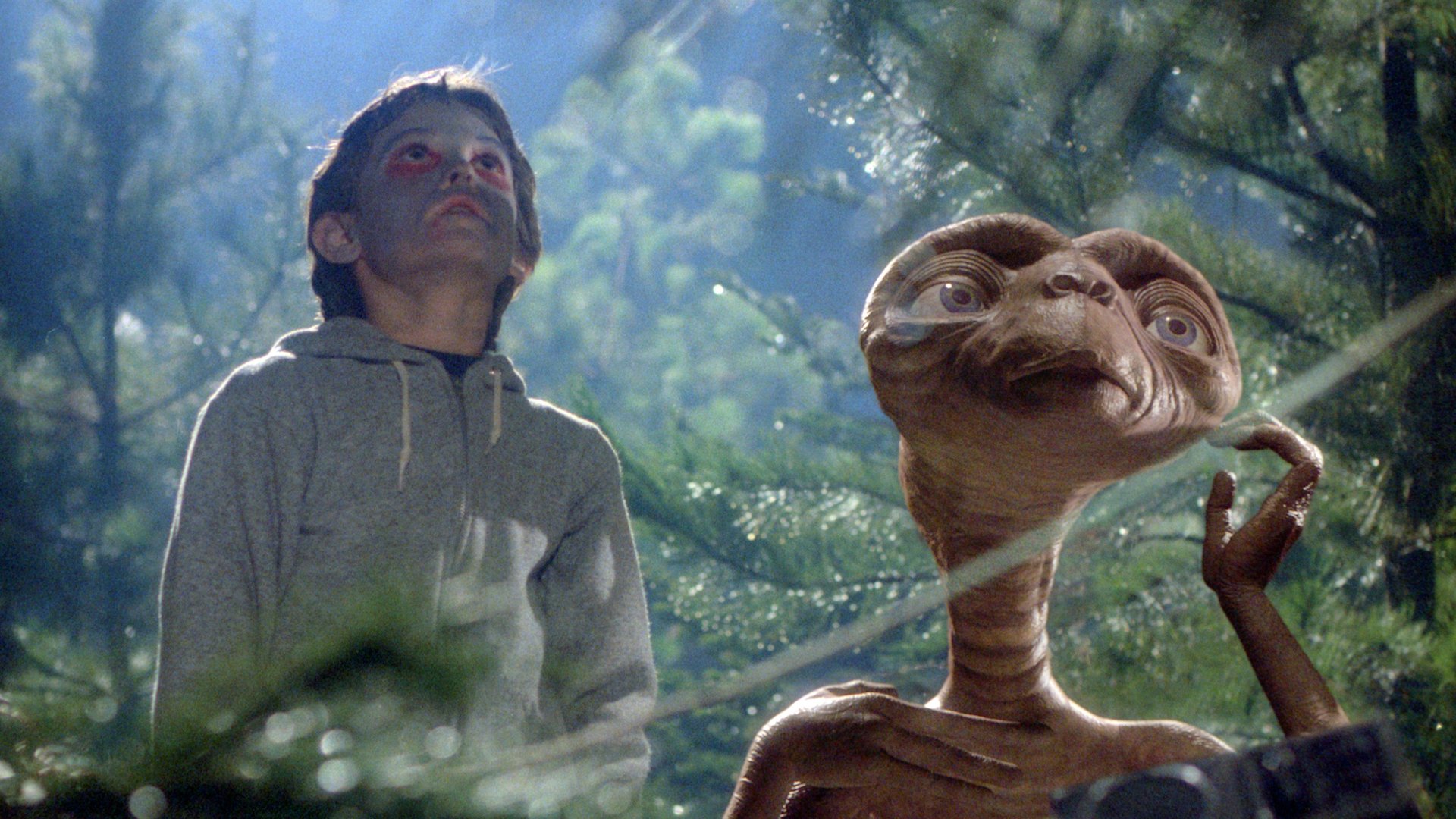
1. E.T. the Extra-Terrestrial

(Image credit: Universal Pictures)

Release date: June 11, 1982 | Cast: Henry Thomas, Drew Barrymore, Peter Coyote | Rotten Tomatoes score: 99% critics, 72% audience

There's just something so utterly delightful about a child's naivety to dress up an alien they've encountered in a closet in a bid to hide its true identity. And that's not the only whimsy of Spielberg's E.T. the Extra-Terrestrial, as it's a beautiful adventure, unravelling the innocence of childhood alongside the curiosity about what's really 'out there.'

Aliens, for the most part, have been portrayed as devastating lifeforms that are a threat to Earth. Even Spielberg is guilty of using this narrative. However, E.T. is the antithesis of this with his Grogu-level of cuteness and gentle nature. Elliott (Henry Thomas) forms an unbreakable bond with E.T that'll make you wonder whether your ingrained fear of aliens is really worth all the worry.

E.T. is one of the best examples of Spielberg's ability to combine emotion with adventure, readjusting our thoughts about life as we know it. Plus, it's got a fantastic musical score to boot. It is, after all, one of the best sci-fi movies of all time.

It’s been 25 years since ‘A.I. Artificial Intelligence’, and we think this was peak Spielberg sci-fi

On the occasion of its 25th anniversary today, it’s worth noting a certain sense of irony that Steven Spielberg's "A.I. Artificial Intelligence" seems oddly prescient into today’s AI-obsessed environment, especially when compared to the master director’s recently released "Disclosure Day," which sadly feels three decades late to the whole governmental cover-up UFO/UAP party.

"A.I. Artificial Intelligence's" path to the silver screen is a strange odyssey, one that includes two of the world's greatest filmmakers, a '60s short story about global warming and advanced robots, a child star hot off a horror hit, multiple production starts and stops, and even a crazy sudden death conspiracy theory.

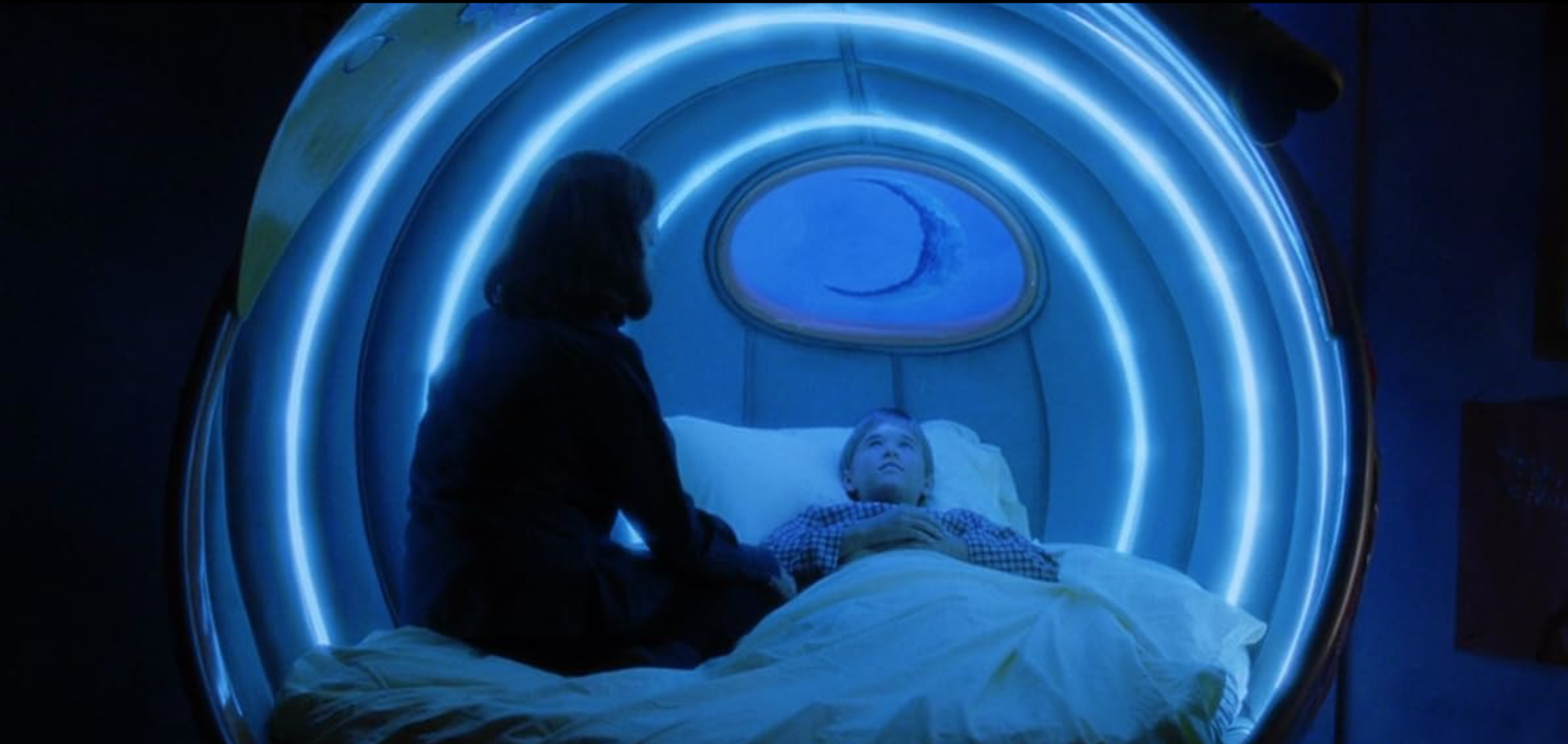
This $75 million futuristic fairy tale was filmed in a dreamy, desaturated preternatural haze that draws audiences into its emotional depths, making "A.I." one of Spielberg’s finest films made during what can be considered his darker, more serious period of moviemaking.

Released by Warner Brothers on June 29, 2001, the mature sci-fi film attracted a diverse audience that was mesmerized by the depiction of a climate-changed world and the advancement of artificial humans called mechas. It tells the story of a couple whose child is stricken with a fatal disease, causing them to purchase David, a new model of android child programmed to love.

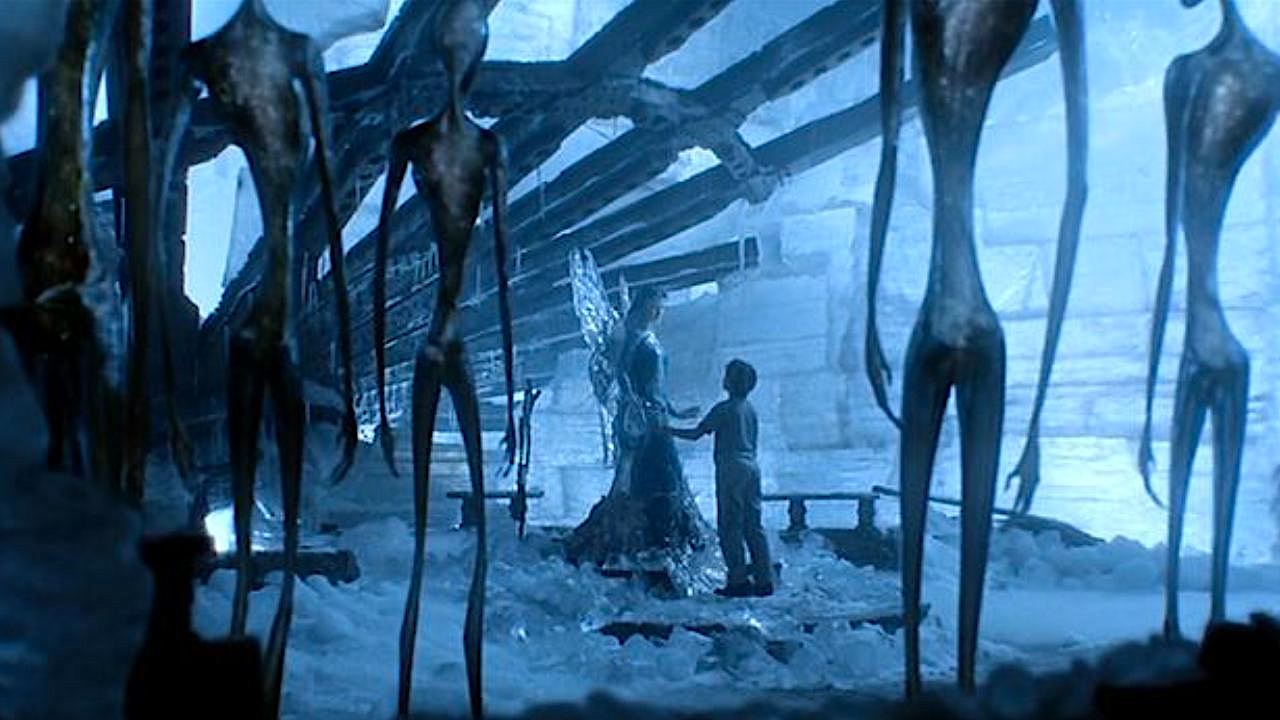
When their son recovers, conflict between the human and mecha becomes hazardous, and David is disposed of, where he meets up with a band of stray robots. Attuned to the fairy tale of "Pinocchio" and yearning to become a real boy, David and his A.I. toy bear Teddy embark on a strange road trip to a flooded Manhattan to find the Blue Fairy, who might grant him his wish.

25 years later, "A.I. Artificial Intelligence" feels even more timely (Image credit: Warner Bros.)

Spielberg naturally brought along his faithful A-list team of Oscar-winning collaborators that included cinematographer Janusz Kaminski, editor Michael Kahn, and composer John Williams for this PG-13 sci-fi adventure whose eventual global box office take was a respectable $236 million.

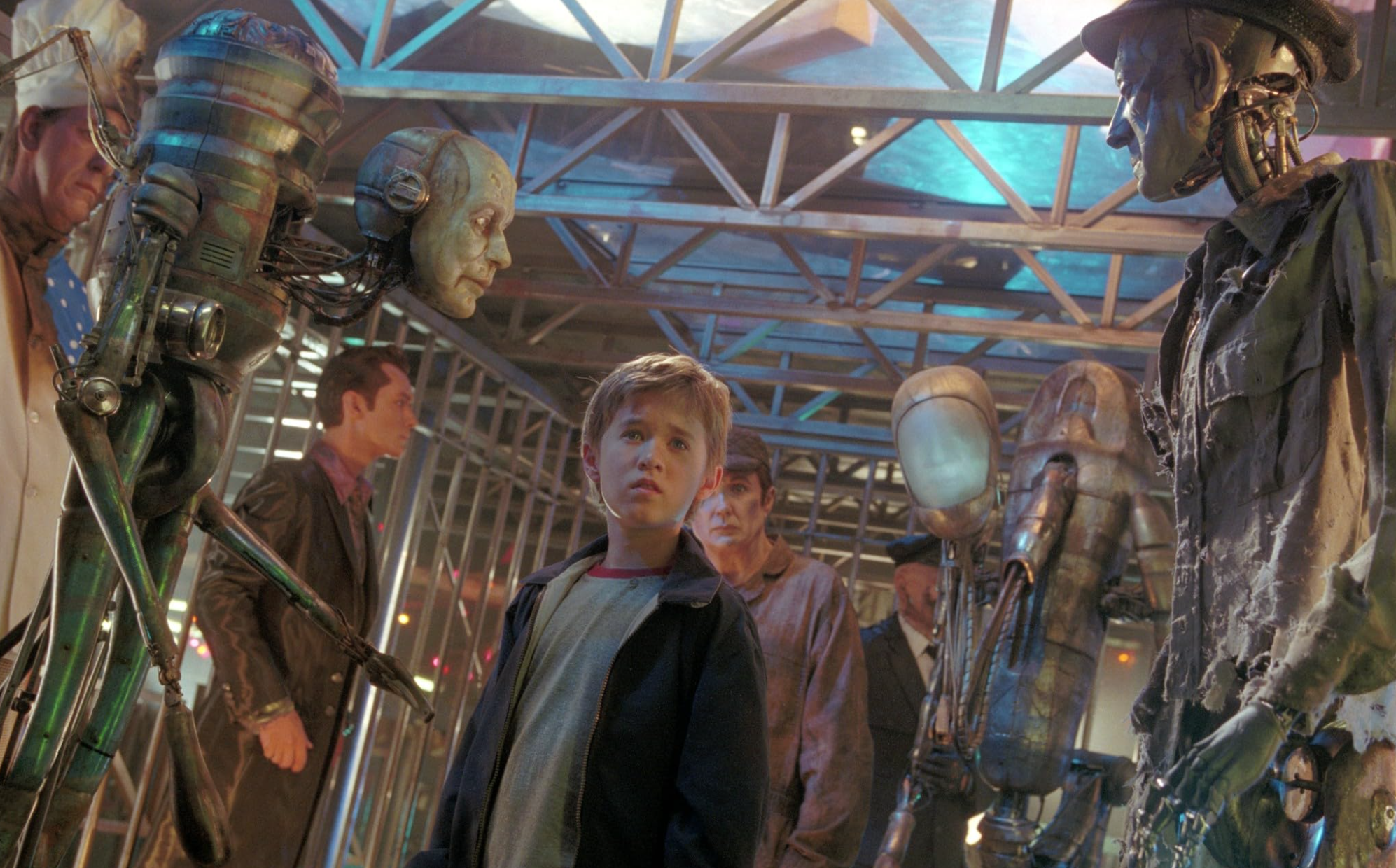
Starring Haley Joel Osment, Frances O’Connor, Jude Law, Sam Robards, Brendan Gleeson, and William Hurt, "A.I." was a brilliant storm of spectacular visual effects, especially observed in the Flesh Fair set pieces where robots were forced into gladiatorial battles to entertain post-apocalyptic crowds.

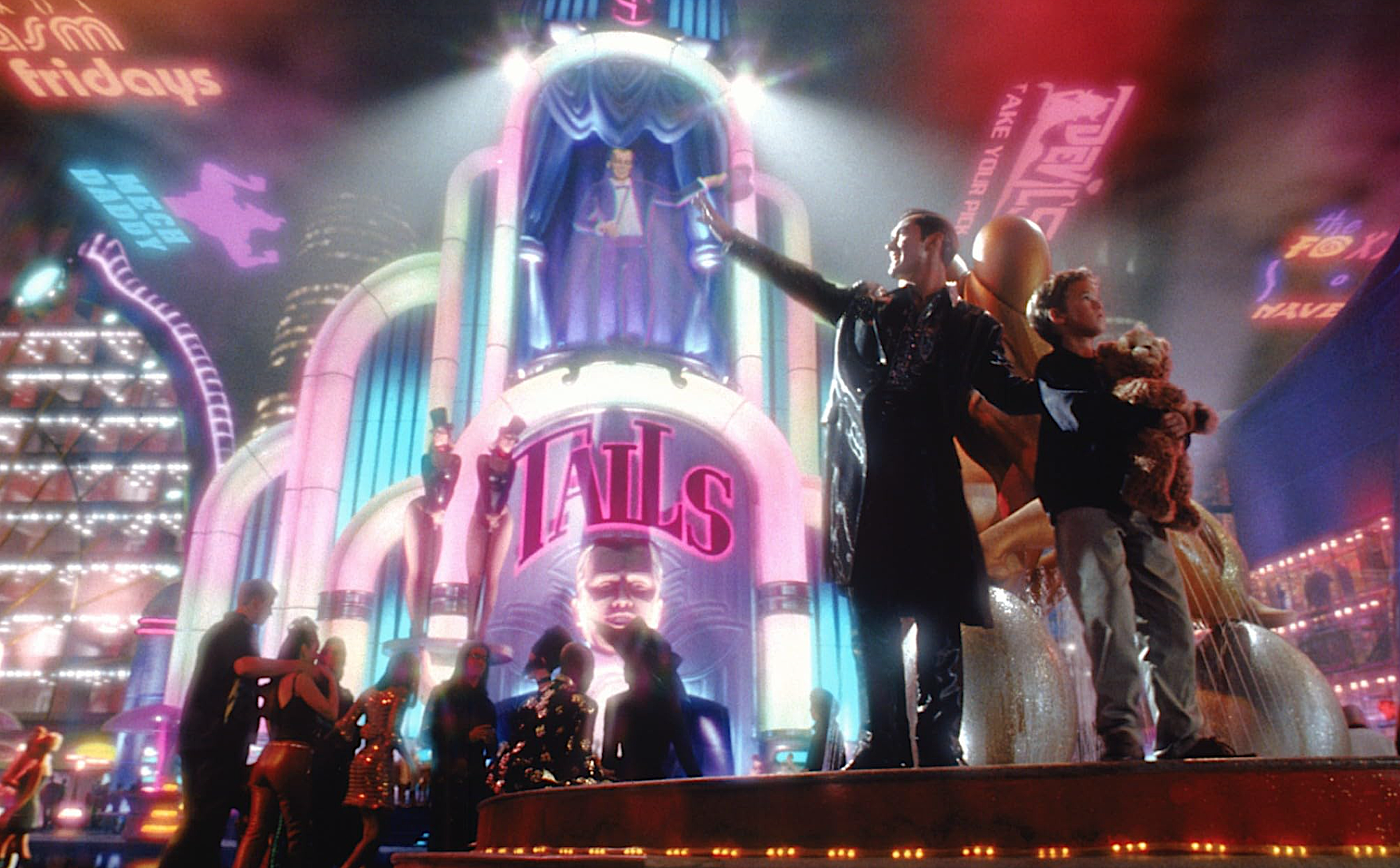
Jude Law and Haley Joel Osment in the decadent Rogue City from "A.I. Artificial Intelligence" (Image credit: Warner Bros.)

Law has a lot of ribald fun with his pleasure model android called Gigolo Joe, who rescues David and brings him into his fold as they travel to meet their 'maker' in a sort of twisted "Wizard of Oz"-like journey. Robin Williams also voices an amusing interactive search engine conceived in the likeness of Albert Einstein and aptly called Dr. Know.

Fresh from his role as Cole Sear, aka the "I see dead people" kid in M. Night Shyamalan’s "The Sixth Sense," Osment gives a shattering performance here as an innocent machine hoping to fulfill its programming and be loved as a real boy. It's been noted that Osment doesn't blink once in the film, and he displays an incredible depth of feeling on screen for such a young actor.

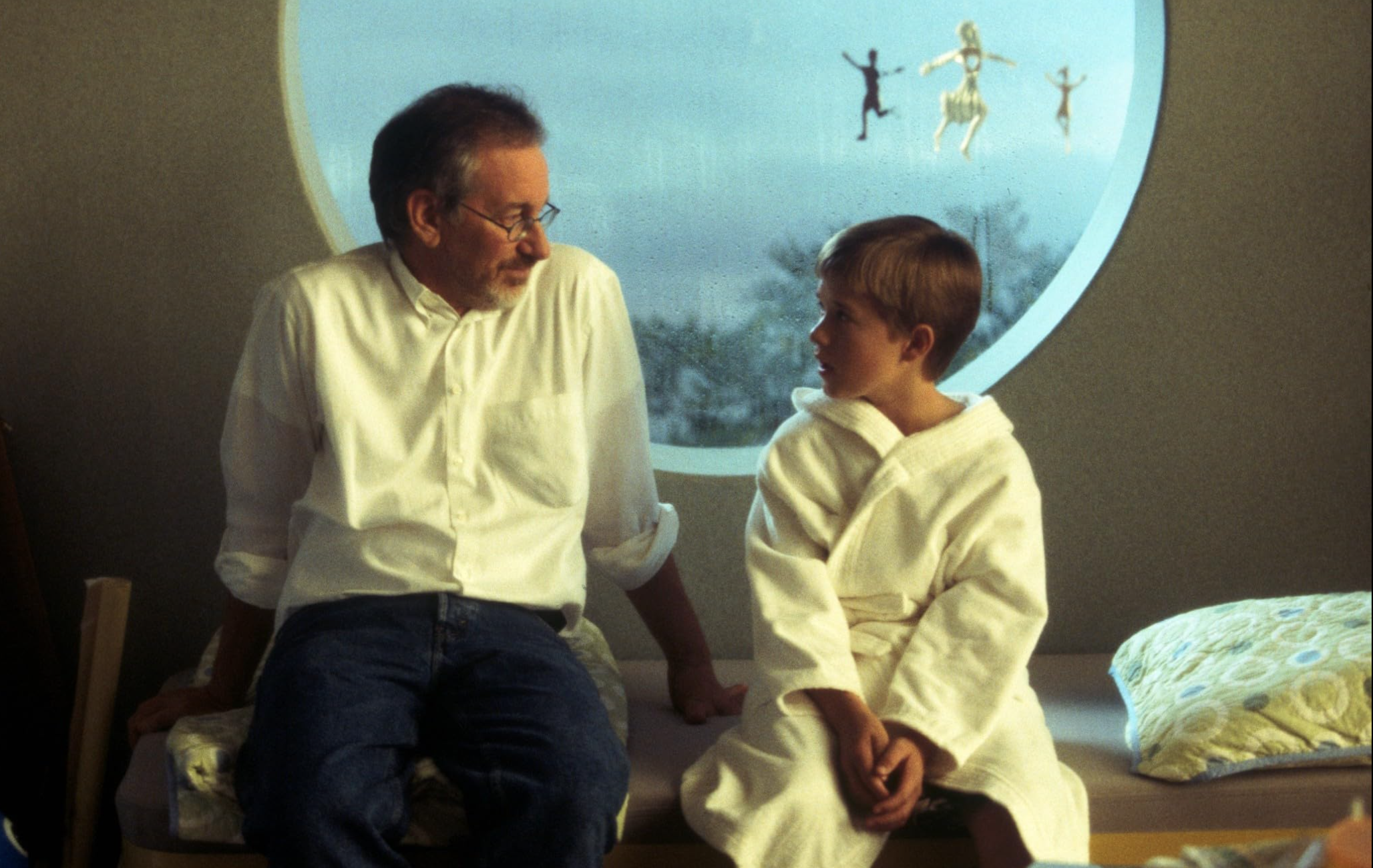
Steven Spielberg working with Haley Joel Osment on the set of "A.I. Artificial Intelligence" (Image credit: Warner Bros.)

"A.I.'s" narrative also returns to one of the major themes seen in Spielberg’s catalog, that of the dissolving family unit. It’s been well documented and discussed over the years that his parents’ divorce when he was 19 had a devastating effect on Spielberg.

That trauma of fractured families has been well played out in numerous Spielberg movies, including "Close Encounters of the Third Kind," "E.T. the Extra-Terrestrial," "Empire of the Sun," "War of the Worlds," and is even revealed in detail in "The Fabelmans."

Here in "A.I.", the broken home that Haley Joel Osment’s android character, David, experiences feels even more raw. His adoring mother, Monica, sensing David's emotional instability and fearing for her family’s life, drives her robo-child out to the woods and abandons him as he desperately begs her to stop. It’s a tearful, heart-wrenching moment few viewers forget.

"A.I. Artificial Intelligence" began life as a 1969 short story by author Brian Aldiss titled "Super-Toys Last All Summer Long." It’s a brief read with a twist ending that we won’t spoil here.

Adapting the futuristic tale of a flooded New York City, a Cybertronics engineer, his family, a next-generation synthetic child, and a robotic teddy bear was a passion project of the great Stanley Kubrick. The meticulous filmmaker made several attempts to crack the plot with numerous writers, including Sara Maitland, Ian Watson, and Brian Aldiss himself, but it never quite coalesced into a finished script.

Spielberg was then brought in as a potential director in 1995, and the two cinematic geniuses collaborated for years to map out the story. Upon Kubrick's surprising death in 1999 (some believing foul play for revealing industry secrets), four days following the release of "Eyes Wide Shut," Spielberg agreed to complete the project for his friend and mentor and eventually drafted the finished screenplay.

It's naturally a bit of a cobbled-together effort with so many ideas cooked in, but it all works as a type of existential exploration of the role of artificial beings in future society, our responsibility to our intelligent creations, and their emotional potential.

A dreamy scene from Steven Spielberg's "A.I. Artificial Intelligence" (Image credit: Warner Bros.)

Trying to stay true to Kubrick’s ideals, Spielberg was intimately involved in the writing, producing, and directing of "A.I.," which represents one of only two films in his entire career where that creative trifecta occurred, the other film project being 2022’s "The Fabelmans."

Coming off of 1998's triumphant "Saving Private Ryan," 2001's "A.I." continued the pattern of Spielberg’s serious segment of his career in a run that included four science fiction movies dropped over a seven-year period. Besides "A.I.," those additional releases were 2002’s "Minority Report," 2005’s "War of the Worlds," and 2008’s "Indiana Jones and the Kingdom of the Crystal Skull." The master wouldn’t revisit the genre again for ten years until 2018’s "Ready Player One."

Advancements in digital visual effects in the decade of the 2000s benefited from the millions of dollars poured into franchises like "Star Wars," "Harry Potter," "Pirates of the Caribbean," and "Transformers." "A.I." was one of the first to benefit from that infusion of innovation that kicked off with the first "Star Wars" prequel, 1999's "The Phantom Menace."

Technology not being up to depicting a life-like robot was one of the sticking points for Kubrick, but a combo of practical effects from Stan Winston Studio and CGI did the trick.

Haley Joel Osment and Jude Law in "A.I. Artificial Intelligence" (Image credit: Warner Bros.)

Another creative synthesis between Kubrick and Spielberg regarding "A.I.'s" story involves their shared love of Carlo Collodi’s classic children’s story, "The Adventures of Pinocchio," with Kubrick's vision of the film as a sort of Pinocchio with robots. Spielberg's "Close Encounters of the Third Kind" contains several references to the Disney animated "Pinocchio" as well.

The fusion of Kubrick's bleak, unflattering view of human nature paired with Spielberg's wondrous warmth and sentimentality makes for a unique cinematic cocktail that keeps "A.I." fresh and relevant.

One controversial element of "A.I." is the ending with the humanoid aliens using the guise of the Blue Fairy to grant David’s wish of one last day with his mother and the recurring motif of his wanting to become a real boy and simply be loved.

Advanced mechas thousand of years in the future watch David and the Blue Fairy interact in "A.I. Artificial Intelligence." (Image credit: Warner Bros.)

It’s a bittersweet finale that’s not without its detractors, but the simple fact that it's still fertile territory for spirited debate points to the movie's lasting importance in Spielberg’s oeuvre, and one that remains even more topical and timely today on "A.I.'s" milestone 25th birthday.

Watch A.I. Artificial Intelligence on Hulu:
Hulu with Ads: $11.99/month or $119.99/year
Premium (No Ads): $18.99/month