‘Superman Returns’ at 20: Is it a sequel? Is it a reboot? Two decades on, we’re still not sure

It's a contested field, but John Williams' majestic "Superman" theme is up there with the best the composer's ever written. Almost five decades on, that stirring orchestral march remains synonymous with Krypton's most famous son, still more than capable of making grown men want to run out of telephone boxes (remember those?) while ripping their shirts open.

It's perhaps not surprising, then, that Bryan Singer couldn't imagine using any other music when signed up to direct "Superman Returns", which celebrates its 20th anniversary this weekend.

"From day one, Bryan said he wouldn't even greenlight the movie if he couldn't use the John Williams music," composer John Ottman told IGN at the time of release. "That's how important it was to Bryan. I had moments of wanting to evolve the theme a little bit and alter it slightly, but Bryan was against any modifications at all, even down to the last flute flourish."

But the filmmaker's devotion to Richard Donner's classic 1978 "Superman: The Movie" (still undoubtedly the best "Superman" movie) stretched way beyond replicating that famous score — a homage James Gunn repeated in his own Man of Steel reboot last year. Because, for better and worse, "Superman Returns" is an unashamed love letter to the film that made us believe a man could fly all those years ago.

"Smallville" may have been flying high on TV, but the early '00s had hardly soared for DC on the big screen. The success of "Blade", "X-Men" (also directed by Singer), and "Spider-Man" had turned Marvel into Hollywood's pre-eminent source of comic-book blockbusters, and the Distinguished Competition was playing catch-up.

They were also licking their wounds following infamous stinkers "Batman & Robin" (1997) and "Catwoman" (2004), and the DC renaissance wouldn't truly begin until Christopher Nolan's critically acclaimed "Batman Begins" in 2005.

(Image credit: Warner Bros)

There had been attempts to bring Supes back to theaters for the first time since 1987's disastrous "Superman IV: The Quest for Peace". Tim Burton, who'd directed the ridiculously successful 1989 "Batman" reboot, was attached to "Superman Lives" in the '90s, while "Das Boot"/"Air Force One" helmer Wolfgang Petersen spent several years developing a standalone "Batman v Superman" movie, working from a screenplay by "Seven" writer Andrew Kevin Walker.

Then Brett Ratner was all set to direct "Superman: Flyby", scripted by a certain JJ Abrams, until he left the project in March 2003, citing difficulties casting the lead role — not to mention his desire to make "Rush Hour 3" — as reasons for his departure. "Charlie's Angels" director McG briefly picked up the cape, but by July 2024, Warner Bros had handed the Fortress of Solitude keys to Singer. Singer subsequently departed the X-Men threequel, which was ultimately directed — after a bizarre game of Hollywood musical chairs — by Ratner, before he made "Rush Hour 3".

Working with "X2" writers Michael Dougherty and Dan Harris, Singer jettisoned those previous treatments to craft an all-new — albeit nostalgic — take on Superman. Conveniently, the trio pretended that the disappointing "Superman III" and "Superman IV" never happened, instead picking up the story five years after the events of "Superman II" — aka the one where Clark and Lois Lane fall in love, Superman renounces his powers, inexplicably gets them back, and makes Lois forget the whole affair.

(Image credit: Warner Bros)

It turns out that Superman (and, naturally, Clark Kent) has been away ever since, exploring the remains of Krypton in the hope of finding survivors of his race. In the meantime, Lois has moved in with the nephew of "Daily Planet" editor Perry White, had a kid called Jason, and written a Pulitzer Prize-winning article entitled "Why the world doesn't need Superman". She, and planet Earth, have apparently moved on.

The world's greatest criminal mastermind has not, however, so Lex Luthor comes out of retirement to defeat the Man of Steel once and for all. His dastardly scheme involves using Kryptonian tech to build an all-new continent off the coast of Metropolis — even after all these years, he's still obsessed with real estate.

"Superman Returns" is a movie of contradictions. While it's technically a continuation of the Christopher Reeve series, it's also a reboot. So even though, in Superman and Lois's timeline, only five years have passed, the film is set in 2006 rather than 1985. There's also an entirely new cast.

(Image credit: Warner Bros)

Although established names like Nicolas Cage, Brendan Fraser, Josh Hartnett, and Jude Law had been linked with previous incarnations of Superman, Singer opted to cast an unknown, just as Donner had done with the peerless Reeve. Brandon Routh actually makes a decent Superman — heroic, yet understated and touchingly melancholic — but never gets a chance to do much as Clark Kent.

As Lois, meanwhile, Kate Bosworth certainly didn't deserve the excessive criticism she received at the time, yet is miscast in an underwritten role that lacks the screwball energy of Margot Kidder's performance. But it's Kevin Spacey (who'd won an Oscar for his performance in Singer's "The Usual Suspects) who feels most out of place as an overly vicious Lex Luthor, no match for the timeless, ridiculously charming Gene Hackman version.

Even in the pre-social media world of 2006, "Superman Returns" was attracting negative hype long before it flew into theaters. The darker red of Superman's cape and reduced size of the House of El logo proved particularly controversial, as Singer eschewed the primary colored hues of the Reeve outfit for something more muted and more in keeping with the "realistic" superhero uniforms of the era.

(Image credit: Warner Bros)

And when it landed, it turned out to be very different from what many fans had wanted. Indeed, anyone expecting all-out action — or the giant robot spiders that would, infamously, have featured in Burton's "Superman Lives" project — was left massively disappointed by this reflective character piece. "Superman Returns" was less a film for kids and teens than adults who'd grown up on the Donner movie. As such, saving the day often takes a backseat to themes of lost love and paths not taken.

"I think that 'Superman Returns' was a bit nostalgic and romantic, and I don't think that was what people were expecting, especially in the summer," Singer told Empire in 2016. "What I had noticed is that there weren't a lot of women lining up to see a comic book movie, but they were lining up to see 'The Devil Wears Prada', which may have been something I wanted to address."

In the film's big reveal, Jason (Tristan Lake Leabu) is revealed to be Clark's son, and he throws a piano at a bad guy to prove it. But the more interesting storyline is actually the love triangle between Superman, Lois, and Richard White ("X-Men"'s James Marsden). It would have been so easy to make Richard a bad guy, but here he's thoroughly decent and — while he needs a seaplane to fly — just as heroic as his Spandex-clad love rival. By the end of the film, it's clear that he — not Clark/Superman — is the right man for Lois.

(Image credit: Warner Bros)

Continuing a long tradition of "Superman" movies with ropey endings, it isn't plain sailing getting to that point. Because Lex had the evil foresight to lace his island with kryptonite, Superman finds himself on the verge of death (requiring a human rescue), yet still finds the strength to fly the entire landmass into orbit — another exertion he recovers from remarkably quickly. It's also worth mentioning that, at one point, Lois and Jason are saved by a fax — how very 2006.

"Superman Returns"' $391 million box office take made it the ninth highest grossing film of the year, coming in behind "The Da Vinci Code", "Casino Royale", "Cars" and — in an intriguing twist of fate — "X-Men: The Last Stand". It was a respectable return, yet not enough for Warner Bros, who opted not to make a sequel.

It remains, however, a memorable experiment in nostalgia, making some brave creative decisions without ever standing on its own two feet. Besides, whatever else anyone says about it, it's still bookended by the greatest superhero theme tune ever written.

"Superman Returns" is available to stream on HBO Max in the US, and Netflix and Prime Video in the UK.

Watch Superman Returns on HBO Max:

Basic (Ads): $10.99/month or $109.99/year
Standard (No Ads): $18.49/month or $184.99/year
Premium (4K): $22.99/month or $229.99/year

‘Logan’s Run’ at 50: Remembering this disco-age sci-fi classic on its golden anniversary

The 1970s were truly when science fiction cinema made astronomical leaps into the public's consciousness and catapulted out of the B-movie bin to become a respected entertainment genre.

Aside from a few serious science fiction standouts like "The Andromeda Strain," "Silent Running," "Soylent Green," "Westworld," and "Rollerball," the pre-"Star Wars" era of Hollywood sci-fi was mostly forgettable fare.

But before we all travelled to a galaxy far, far away, experienced close encounters of the third kind, or set down on LV-426, MGM Studios gifted us with "Logan's Run," a lavish futuristic spectacle that offered a colorful peek into a dystopian future. It delivered with provocative themes about the suppression of truth, the inevitability of aging and death, violence as sport, and the complicated nature of freedom.

First released on June 23, 1976 — right before the United States was about to celebrate its big 200th birthday — "Logan's Run" featured an exceptional cast led by Michael York, Richard Jordan, Peter Ustinov, Roscoe Lee Brown, and British sensation Jenny Agutter, who would later go on to co-star in director John Landis' "An American Werewolf in London." It even placed a spotlight on popular supermodel Farrah Fawcett-Majors as the sexy New You Shop worker, Holly 13.

On the occasion of "Logan's Run's" 50th anniversary this week, let's look back at this forgotten gem that inspired filmmakers and artists to leap into the genre, absorbed in its sanitized vision of the future and the unsettling truth behind the sunny facade of paradise's perfection.

Those of a certain age might recall the first spectacular trailers opening with images of a 23rd-century domed city sparkling with water features and bright white buildings connected by transparent transportation tubes filled with bullet-like people pods.

This beautiful exterior disguises a fragile utopian society with a dark secret that humanity is only too happy to ignore, operating in fake hedonistic tranquility as state-sponsored death events are delivered in amphitheaters to cheering crowds.

York stars as Logan 5, a young buck employed as a Sandman, a sort of futuristic cop whose job is to uphold the law and terminate anyone who attempts to escape from the mandated Carousel ceremony, where citizens reaching the age of 30 are supposedly reincarnated. He and his elite Sandman partner, Francis 7 (Jordan), enjoy blasting away at daring fugitives who reject the forced expiration bit and attempt to flee when their palm-implanted life-clocks turn red.

"Logan's Run" was first released by MGM on June 23, 1976 (Image credit: MGM)

When the city’s AI overlord forces Logan to infiltrate a secret runner’s sect to find a mythical place called Sanctuary outside of civilization’s domed clusters, he joins forces with Jessica 6 (Agutter) to find the truth behind a symbolic ankh, pursued by a relentless Francis 7.

Adapted from distinguished sci-fi author William F. Nolan’s 1967 novel and directed by British filmmaker Michael Anderson, this big budget treat is a beautiful film to watch, with its vibrant Metrocolor palette shot by legendary cinematographer Ernest Laszlo, Jerry Goldsmith’s penetrating orchestral score accented with synthesizer tones, and thrilling set pieces filmed in actual locations like Houston’s Hyatt Regency Hotel and the Fort Worth Water Gardens in Texas.

Carrousel is not a gateway to everlasting life! (Image credit: MGM)

"Logan's Run" was a solid summer hit for MGM, pulling in a domestic total of $25 million off a $9 million budget. When the 1977 Academy Awards arrived, the sci-fi blockbuster was nominated for Best Cinematography and Best Art Direction and won an Oscar for Special Achievement in Visual Effects.

It also holds the distinction of being the first movie presented in Dolby Stereo when matched with 70mm prints. And who can forget the frightening ice cave robot named Box, perfectly portrayed by Roscoe Lee Brown inside a shiny android suit?

Get ready for the deep freeze treatment if you meet Box! (Image credit: MGM)

For three decades, it’s been rumored that "Logan's Run" would be getting a remake, bouncing around in a series of stalled projects, one that supposedly attracted Ryan Gosling, but at this point, no progress has been made.

A short-lived "Logan's Run" TV series aired in '77, but a "Star Wars" tsunami swept in that year and washed it away.

So, if you're looking for a nostalgic trip back to '70s sci-fi, then why not check out the original "Logan's Run" this weekend to help celebrate its landmark 50th anniversary and revel in all its disco-era dystopian pleasures?

Rent or buy Logan's Run on Amazon Prime Video:

Rent: $3.99
Buy: $9.99 $9.99
Blu-ray: $7.99

This Week In Space podcast: Episode 216 — Dark Matter Intelligence

On Episode 216 of This Week In Space, Rod Pyle and Tariq Malik talk with physicist Dr. Daniel Whiteson about other intelligences is beyond our scope.

Whiteson, particle physicist at CERN's Large Hadron Collider and professor at UC Irvine, joins us to explore less conventional thoughts on first contact. We look at the challenges of communicating with extraterrestrial intelligences, potential difficulties of communicating via non-terrestrial mathematics and physics, and the possibility that extraterrestrials might actually be terrestrial... but existing as denizens of the dark energy universe. One might be sitting in your lap right now! Join us for the far-ranging discussion.

Download or subscribe to this show at: https://twit.tv/shows/this-week-in-space.

Get episodes ad-free with Club TWiT at https://twit.tv/clubtwit

Space news of the week

Model Falcon 9!

TOP TELESCOPE PICK:

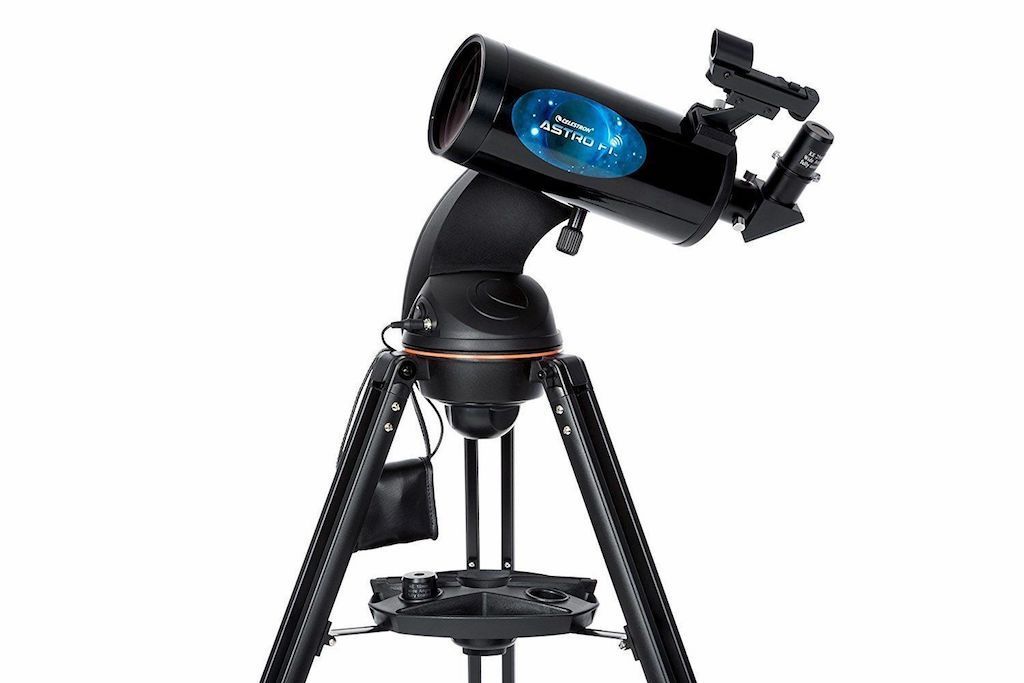
A Celestron telescope on a white background

(Image credit: Celestron)

Looking for a telescope to see planets and comets? We recommend the Celestron Astro Fi 102 as the top pick in our best beginner's telescope guide.

Finally, did you know you can launch your own SpaceX rocket? Model rocket maker Estes' stunning scale model of a Falcon 9 rocket that you can pick up now. The launchable model is a detailed recreation of the Falcon 9 and retails for $149.99. You can save 10% by using the code IN-COLLECTSPACE at checkout, courtesy of our partners collectSPACE.com.

About This Week In Space

This Week in Space covers the new space age. Every Friday we take a deep dive into a fascinating topic. What's happening with the new race to the moon and other planets? When will SpaceX really send people to Mars?

Join Rod Pyle and Tariq Malik from Space.com as they tackle those questions and more each week on Friday afternoons. You can subscribe today on your favorite podcatcher.

SpaceCamp at 40: A wish-fulfillment fantasy brought down to earth by NASA’s real-life disaster

When "SpaceCamp" landed in theaters in June 1986, it should have been the ultimate wish-fulfillment movie, as if "The Goonies" had cashed in their hard-earned pirate treasure in return for a spin in an actual Space Shuttle.

It boasted a bigger budget than "Top Gun", a cast of up-and-coming young stars — including a future Oscar-winner — and a score by Hollywood's most famous composer. Twentieth Century Fox had bet big on a blockbuster hit, but a real-life tragedy four months earlier ensured the film was doomed to be an also-ran at the box office.

The real-life Space Camp at the US Space & Rocket Center in Huntsville, Alabama, was a dream destination for any kid with an interest in science, math, and space exploration — the ultimate trip for tweens and teens with a passion for science and technology.

Screenshot from the 1986 space movie SpaceCamp.

(Image credit: 20th Century Fox)

The brainchild of original Space & Rocket Center director Edward O Buckbee and Apollo rocket engineer Wernher von Braun, the facility opened in 1982. It has since welcomed over a million wannabes through its doors, including Elon Musk, Chelsea Clinton, and several attendees who went on to become actual astronauts.

Patrick Bailey, who wrote the original "SpaceCamp" story, got the idea from his wife, who'd spotted a news story about the camp while working as a researcher on American variety show "That's Incredible!"

He developed the idea alongside Buckbee, and the duo successfully pitched the project to producer Leonard Goldberg, who'd had a major hit with "WarGames" a few years earlier. (It's easy to see why Goldberg saw the potential in SpaceCamp, seeing as WarGames was based on a similar scenario of ordinary kids being thrown into a dangerous and improbable situation.)

Screenshot from the 1986 space movie SpaceCamp.

(Image credit: 20th Century Fox)

NASA also approved the script, and — rather surprisingly — wasn’t put off by the fact that the whole plot revolved around a colossal screw-up on the launchpad.

The film focuses on a quintet of bickering camp attendees as they try out various training simulators, and learn — repeatedly and exhaustingly — the value of teamwork. It's all set to be a standard, barely postcard-worthy week away from home, until a totally implausible sequence of events sees them blasting off into orbit (with a single instructor to look after them) on the Space Shuttle Atlantis.

First, 12-year-old Max persuades management that he should be allowed into Big Kid camp, even though he's too young. Then he befriends a sentient, but worryingly glitchy, robot janitor named Jinx, who wants to make "Star Wars"-obsessed Max's dream of going into space a reality.

Screenshot from the 1986 space movie SpaceCamp.

(Image credit: 20th Century Fox)

Jinx's scheme gets a convenient helping hand when NASA — for the benefit of the plot — allows the kids to sit in an actual shuttle during an actual engine test. That questionable decision gives Jinx all the window he needs to initiate a "thermal curtain failure" in one of the solid rocket boosters, leaving mission control no choice but to blast the kids into space.

Once the initial excitement of weightlessness has worn off, the kids realize the true extent of their predicament. While instructor Andie is a qualified astronaut who'd been patiently waiting for her first mission, it turns out that the unprepared Shuttle wasn't rigged for long-range radio communications. And — shock horror! — there isn't enough oxygen to get them to their re-entry window for landing at Edwards Air Force Base.

Suddenly, these rookie kids are forced into roles real-life astronauts spend years training for, going on spacewalks and landing state-of-the-art spacecraft as if it's as straightforward as playing a video game.

Screenshot from the 1986 space movie SpaceCamp.

(Image credit: 20th Century Fox)

But as ridiculous as the premise is, it's kept grounded by an extremely likable ensemble, one of Hollywood's most impressive examples of pre-fame casting. While Lea Thompson (Kathryn) and Larry B Scott (Rudy) were familiar from "Back to the Future" and "Revenge of the Nerds", respectively, Tate Donovan (Kevin), Kelly Preston (Tish), and — perhaps, most notably — future Oscar-winner Joaquin Phoenix (then known as Leaf) were all playing their first major movie roles.

And even though they broadly correspond to the jock/brain/princess archetypes you'd find in a John Hughes movie, the movie makes an effort to defy expectations of the era. Tish, for example, is — despite her valley girl persona — super-smart and has an eidetic memory.

More experienced heads were provided by Kate Capshaw (fresh off "Indiana Jones and the Temple of Doom") as astronaut Andie Bergstrom, and Tom Skerritt ("Alien", "Top Gun") as her moonwalking husband, Zach. "Lost" fans should also look out for a young Terry O'Quinn (John Locke) in mission control.

Screenshot from the 1986 space movie SpaceCamp.

(Image credit: 20th Century Fox)

Both the cast and director Harry Winer have spoken of the camaraderie on set, which was probably a good thing given the unexpected length of the production.

"After the first day of filming, we were already 10 days behind schedule," Thompson recalled in a 2012 interview with AV Club. "And it kind of kept on that way. It was supposed to be a three-month shoot, and it ended up taking six. We had t-shirts printed up that said, '"SpaceCamp": It’s Not Just a Movie, It’s a Career'. Oh, actually, instead of 'SpaceCamp', it actually said 'SpaceCramp!'"

The biggest name in the production, however, went unseen, as the legendary John Williams (who's always had a soft spot for kids' films; see also "Home Alone" and "Harry Potter") composed the soundtrack. While he resisted the temptation to add in a few bars from a galaxy far, far away during "SpaceCamp"'s many nods to "Star Wars", the score is unmistakably one of his.

Screenshot from the 1986 space movie SpaceCamp.

(Image credit: 20th Century Fox)

"There's a reason why anyone who's a legend is a legend," Winer said in an interview with AL.com back in 2022.

"John Williams is the most gratifying and rewarding creative collaboration I've had in my entire career. He would analyze a story and consider when there was a need for silence. He understood your creative intentions and found a way in a very poetic medium of music to interpret and enhance your vision. It was literally remarkable."

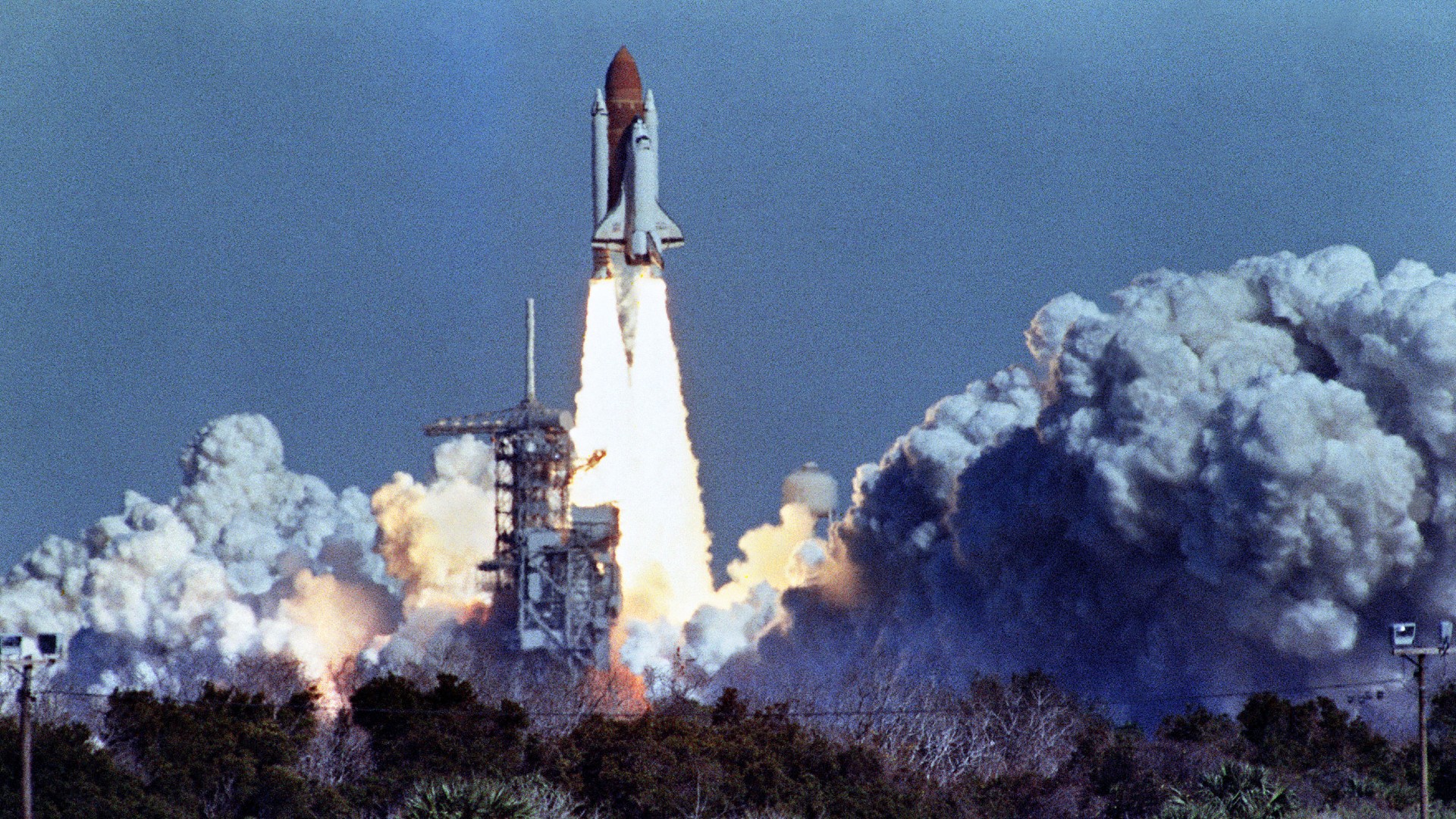
"SpaceCamp" was all set for a prime summer release slot when disaster struck in January 1986. After the Space Shuttle Challenger exploded during take off, killing all seven crewmembers on board, a lighthearted movie about five kids accidentally heading into orbit suddenly seemed rather less appealing.

a white aircraft attached to a large orange rocket lifts off above a plume of fire and smoke

The space shuttle Challenger launched from Kennedy Space Center on Jan. 28, 1986 with a crew of seven astronauts aboard. An accident 73 seconds after liftoff claimed the lives of all seven and destroyed the vehicle. (Image credit: BOB PEARSON/AFP via Getty Images)

Many questioned whether it should have been released at all, but Fox decided to press ahead. Winer even wondered if the public might even find the film cathartic, "because after such a tragedy, people would need to cling to the hope the film represented. And needless to say, I was totally wrong," he said later. "They saw it as a source of jeopardy, of disappointment, of tragedy, rather than hope. No one went to see 'SpaceCamp', so then I felt like I had failed miserably."

Not helped by scathing reviews — "Would anyone like this movie?" asked legendary critic Roger Ebert. "Juvenile space nuts, maybe. But they'd be too sophisticated."

Forty years on, it remains a decent, if unspectacular, family movie, but "SpaceCamp" barely made back half of its production budget in theaters. It was the very definition of a Hollywood flop, but it still left its mark.

Screenshot from the 1986 space movie SpaceCamp.

(Image credit: 20th Century Fox)

Interest in the film reportedly doubled attendance at the real-life Space Camp, and there’s anecdotal evidence that the movie encouraged kids to pursue careers in science. In more recent years, there's even been talk of a remake, though its current status is unknown.

"I've had a lot of people come up to me and say that they became physicists or inventors, because of how much they loved [Space Camp] and how much it inspired them," said Thompson. "That was really sweet and something I never really expected."

"SpaceCamp" is currently unavailable to stream and download from any major service (though there is a disappointingly low-res version on YouTube). There is also a Blu-ray release, but it's hard to find and expensive.

Supergirl’s brilliant poster is a reminder that they don’t make sci-fi movie posters like they used to

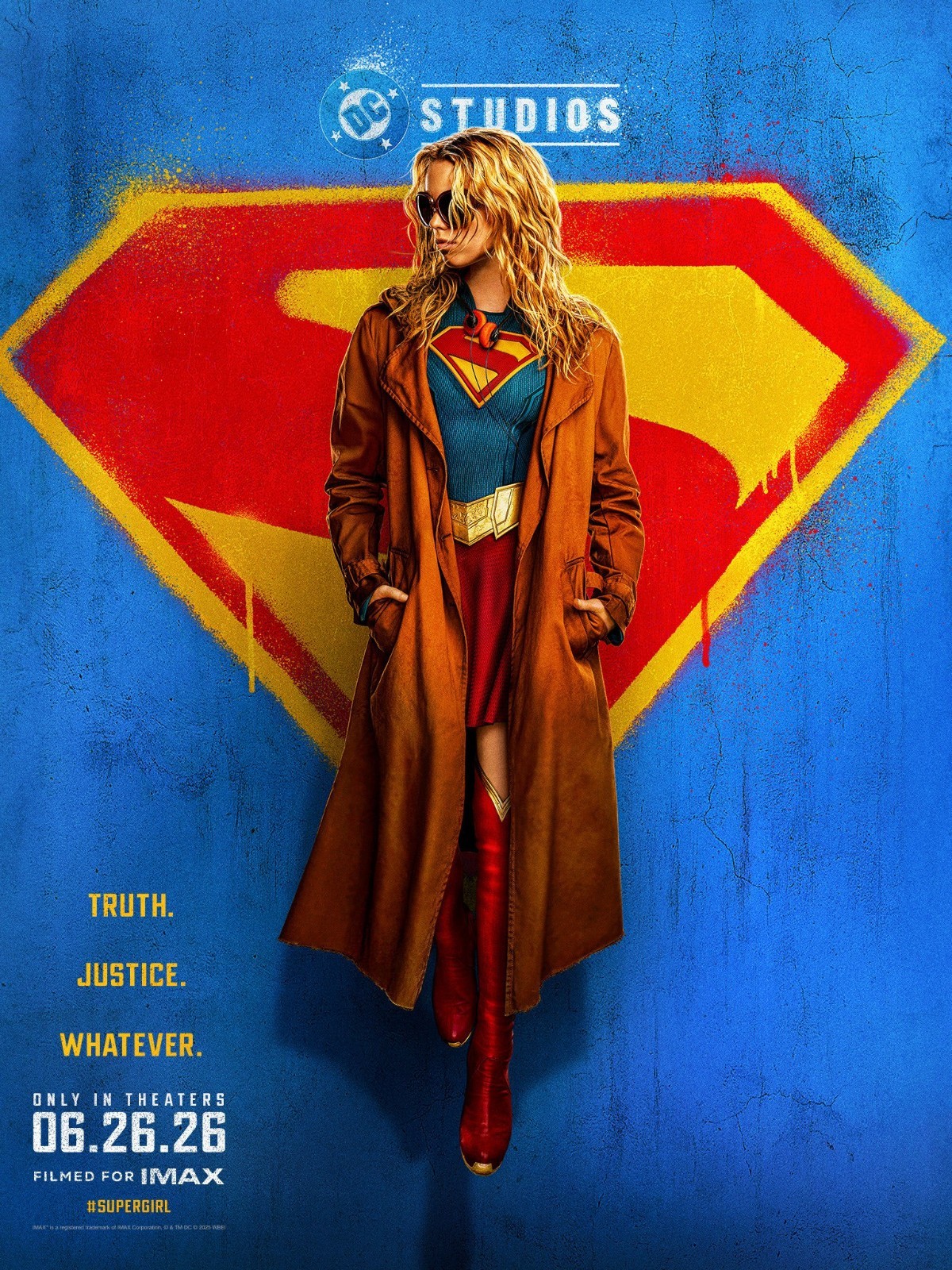
DC's new "Supergirl" may or may not turn out to be a classic of the comic-book genre. It may or may not be a smash hit in theaters. But whatever else happens when Kara Zor-El flies into the unpredictable headwinds of the worldwide box office, one thing the new movie has got 100% right is its promo poster.

Let's take a look at its components. The bright, primary-colored House of El logo in the background is so bold and unmistakable that there's no need to spell out that this is a Super movie. At the same time, having that famous shield spray-painted on a wall is elegant shorthand for "Looking for overgrown boy scout Clark Kent? Then move along".

Meanwhile, lead actor Milly Alcock's "don't care" pose — not to mention the overcoat, sunglasses, and retro headphones — screams attitude. And by the time you get to that "Truth. Justice. Whatever" tagline… well, you know pretty much everything you need to know about our latest trip to James Gunn's new-look DC Universe. The only thing it's missing is super-pooch Krypto.

(Image credit: Warner Bros)

This "Supergirl" promo stands out in multiplex foyers as every good poster should, yet feels like a rarity in modern Hollywood. Time and time again, one-sheet designs revert to a tried, tested, and tedious formula of Photoshopped (other design software is available) montage of famous faces from a movie. Many of them are presented in the same muddy monochrome — it's almost as if they've stepped out of a Zack Snyder movie — and you need a microscope to make out many of the details. Catching a theater-goer's eye seems a long way down anyone's list of priorities.

It hasn't always been this way, because the science fiction genre has been responsible for many of the best film posters ever made. In the 1950s, B-movies and even the occasional studio tentpole used their promos as unashamed generators of hype, commissioning artists to paint giant arachnids, giant monsters, and — in one notable 50-foot example — giant women. Embiggening the baddies was clearly one of the first things these artists were taught at poster school.

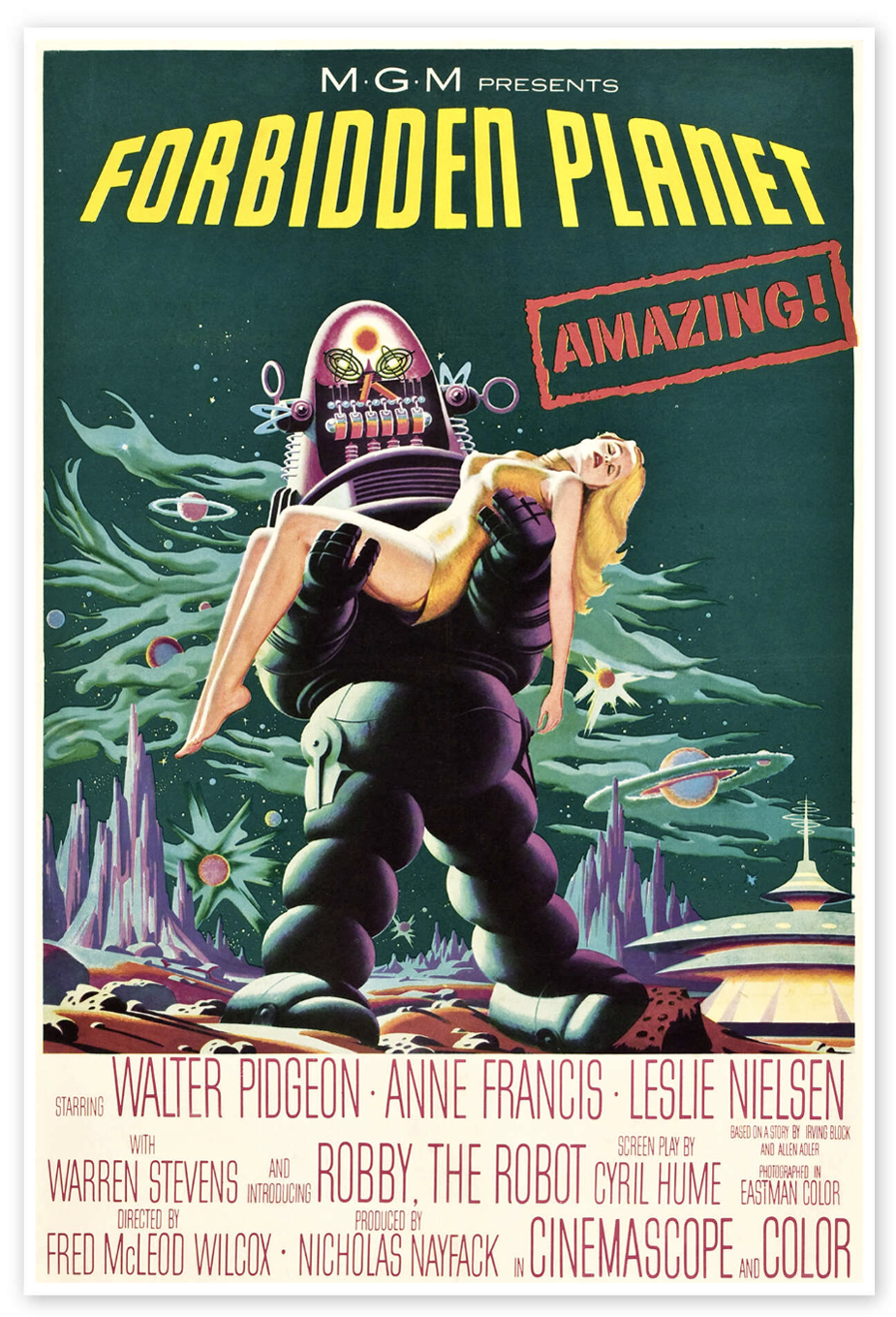
Movie poster for Forbidden Planet
Metro-Goldwyn-Mayer
Movie poster for 2001 A Space Odyssey
Metro-Goldwyn-Mayer

They also refused to be constrained by minor inconveniences like plot details. Posters for both "The Day the Earth Stood Still" (1951) and "Forbidden Planet" (1956) are built around angry robots carrying scantily clad women, even though neither film features any such scenes.

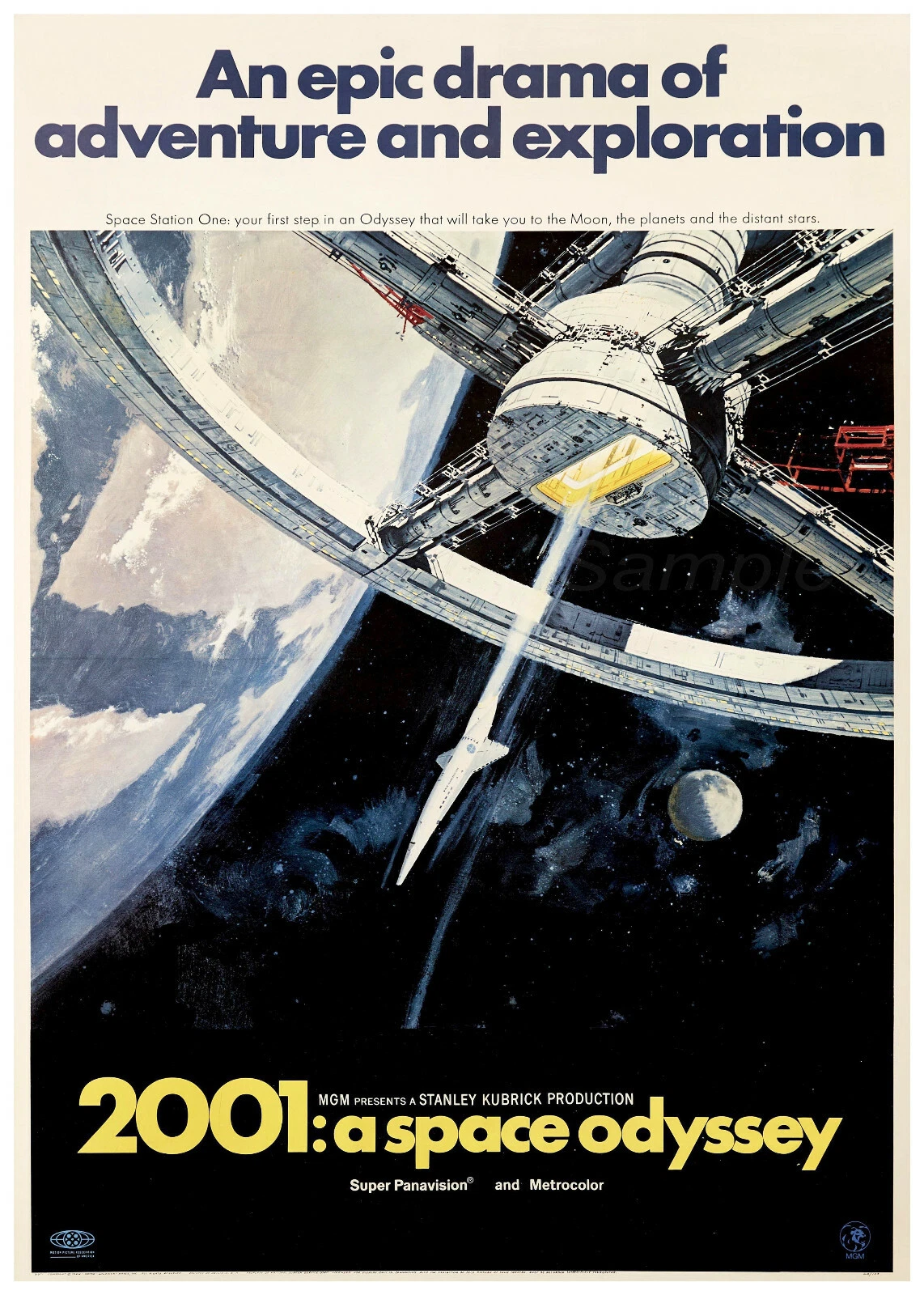
A decade or so later, space-set sci-fi movies like "2001: A Space Odyssey" (1968) and "Silent Running" (1972) were opting for a rather more subdued approach. Indeed, their hardware-heavy one-sheets looked more like the covers of hard SF novels than movie posters. "2001"'s more famous conceptual "The Ultimate Trip" star child promos weren't created until Stanley Kubrick's epic was given a 1970 re-release, as movie execs tried to capitalize on its growing, though unintended, reputation as a psychedelic counter-culture classic.

But it's arguably two insanely influential movies released within two years in the late-'70s that laid down the blueprint for what a sci-fi movie poster could and should do — "Star Wars" and "Alien".

Movie poster for Star Wars: A New Hope
Disney
Movie poster for Star Wars: A New Hope
Disney

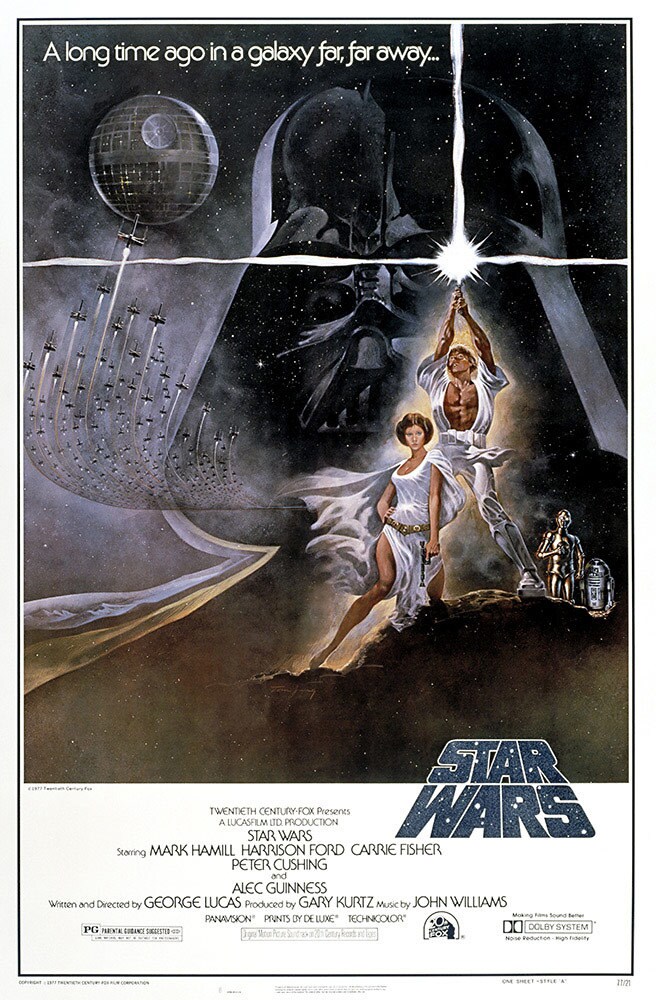
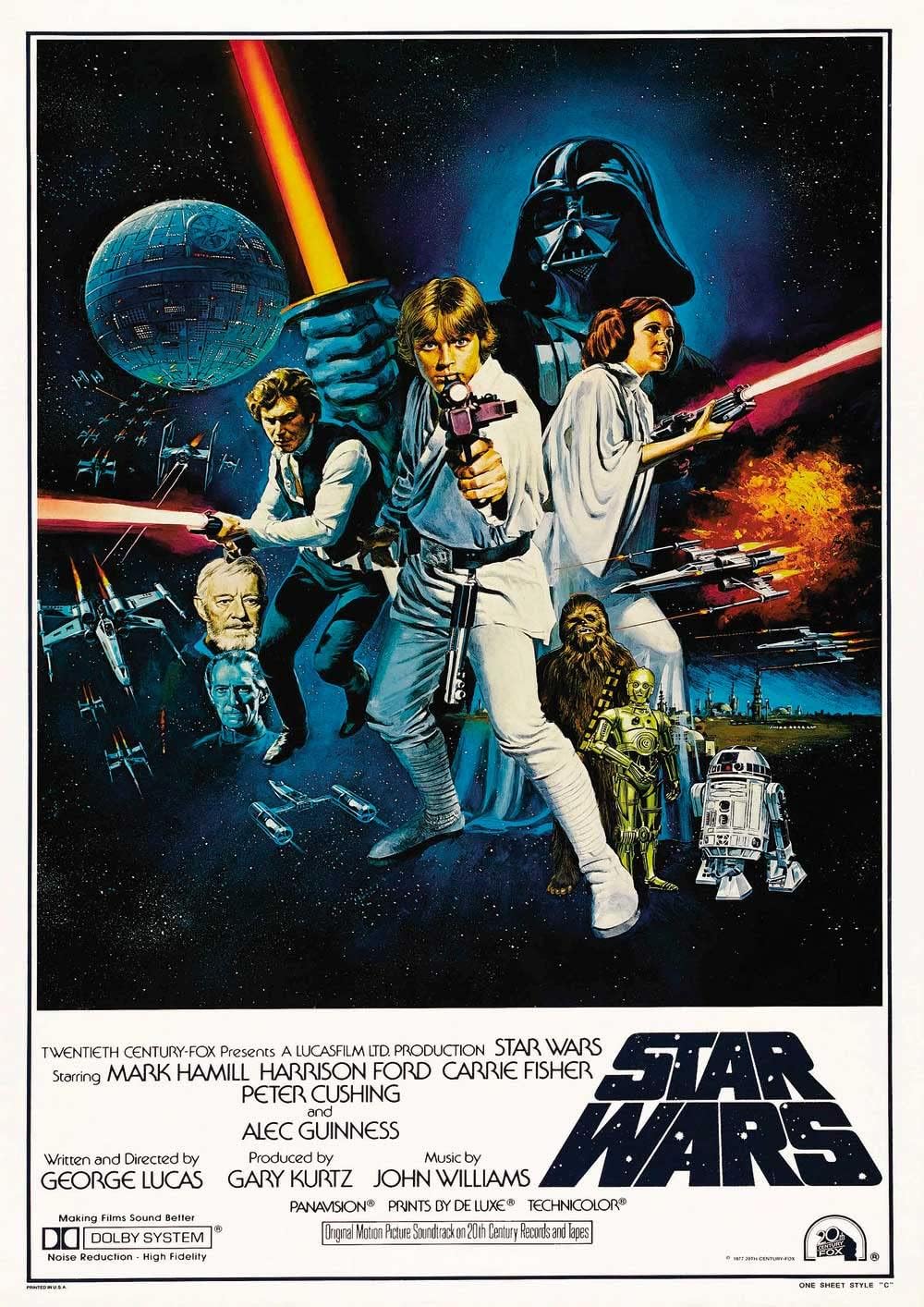
At first glance, the early posters for "A New Hope" look like the character montages that have gone on to become the Hollywood norm. Look closer, however, and there's genuine artistry to their composition.

Although Tom Jung's famous "Style A" poster is a galaxy far, far away from screen accurate — what's going on with Luke's lightsaber and six-pack? — it effortlessly captures the all-action essence of the movie. Tom Chantrell's (arguably) even-more-iconic "Style C" design unites all the key players in a wonderfully kinetic collage of laser fire, lightsabers, and X-wings.

It's a sub-genre of poster art that the late Drew Struzan (who passed away in 2025) would subsequently go on to master. His legendary, hand-painted designs for the likes of "Indiana Jones and the Last Crusade", the "Star Wars" Special Editions, the "Star Wars" prequels, "Blade Runner" and (yes, really) "The Muppet Movie" have laid down a marker for every draughtsperson who's followed. "I want the poster to look like an adventure," Struzan told SlashFilm in 2021.

Movie poster for Alien
20th Century Fox
Movie poster for The Thing
Universal Pictures

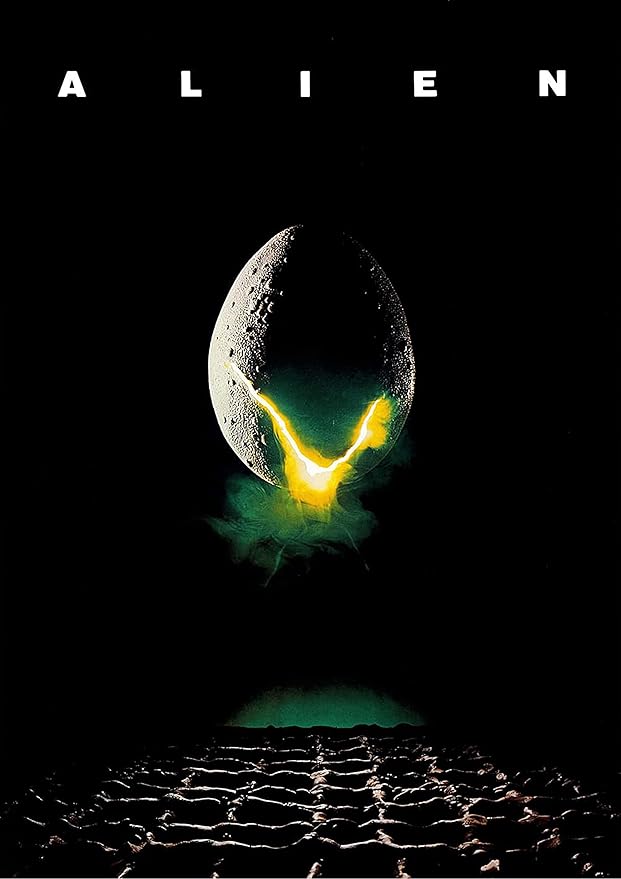
In 1979, "Alien"'s famous "In space no one can hear you scream" design helped to popularize the conceptual one-sheet, as a single extraterrestrial egg hinted at the horrors Ridley Scott had in store.

Many of the most memorable posters of the '80s, '90s, and '00s opted for a single abstract image, whether it was ET and Elliott silhouetted against the Moon, an alien spacecraft hovering over New York for "Independence Day", or the minimalist, Happy Meal-friendly logos of "Ghostbusters" and "Jurassic Park".

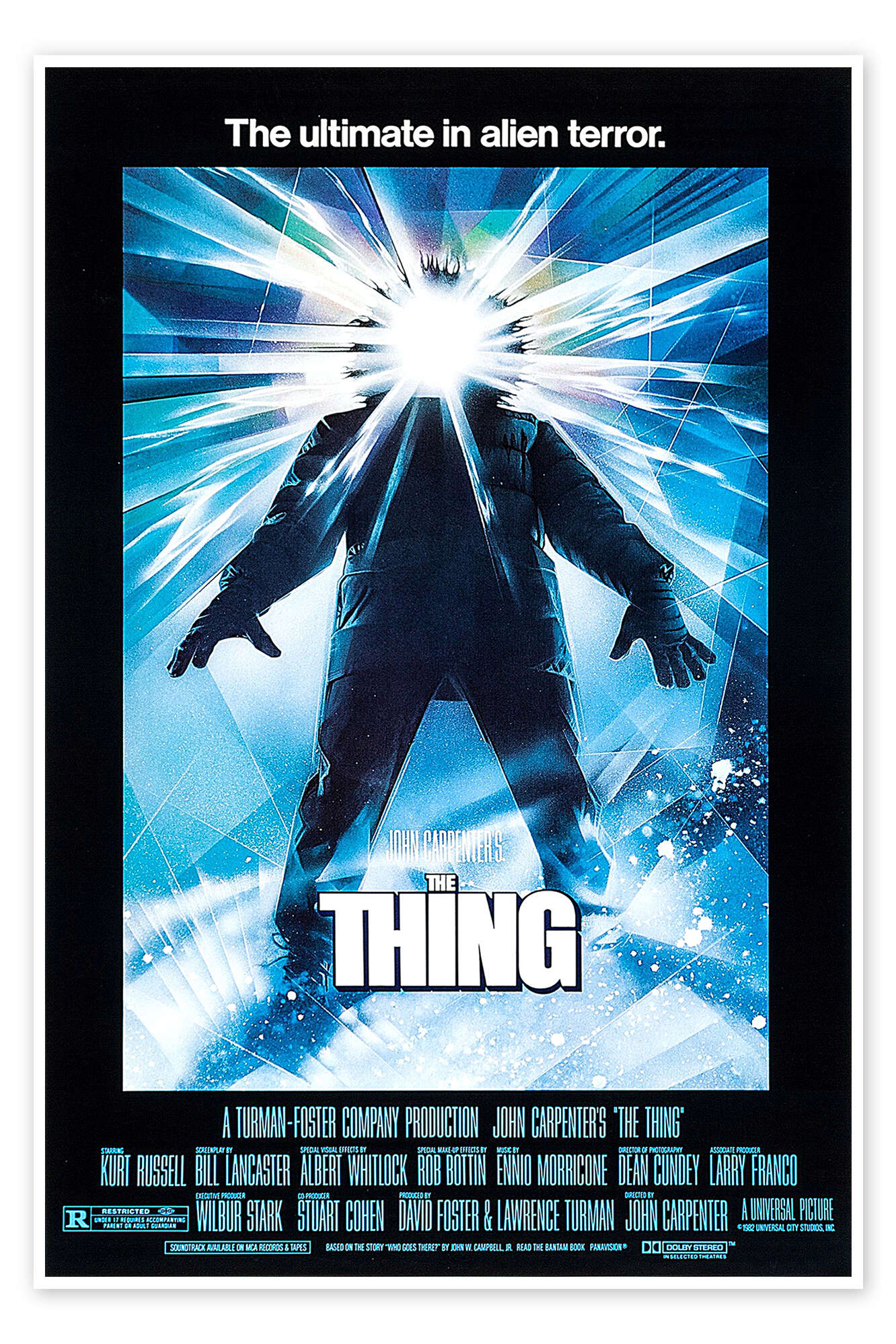
Struzan's famous poster for John Carpenter's "The Thing" (the one with a faceless guy in a parka) was born out of necessity, the artist having been given little information beyond the fact that it was a loose remake of 1951's "The Thing from Another World". "[I had to] find a way of making nothing into something," Struzan later said of a design he reportedly created over a single night. It's fair to say he succeeded.

Movie poster for Alien Romulus
20th Century Fox
Movie poster for Arrival
Paramount Pictures

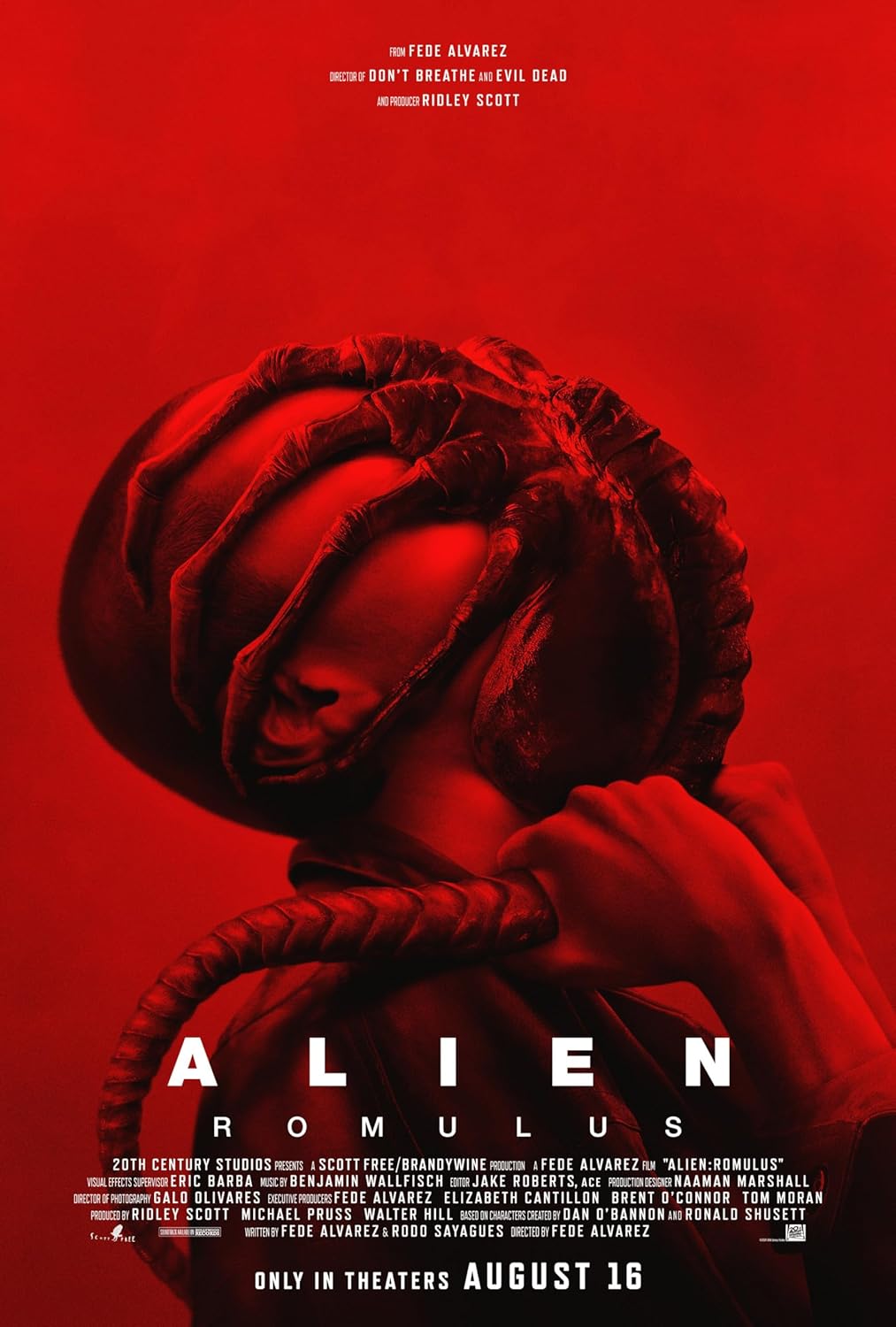
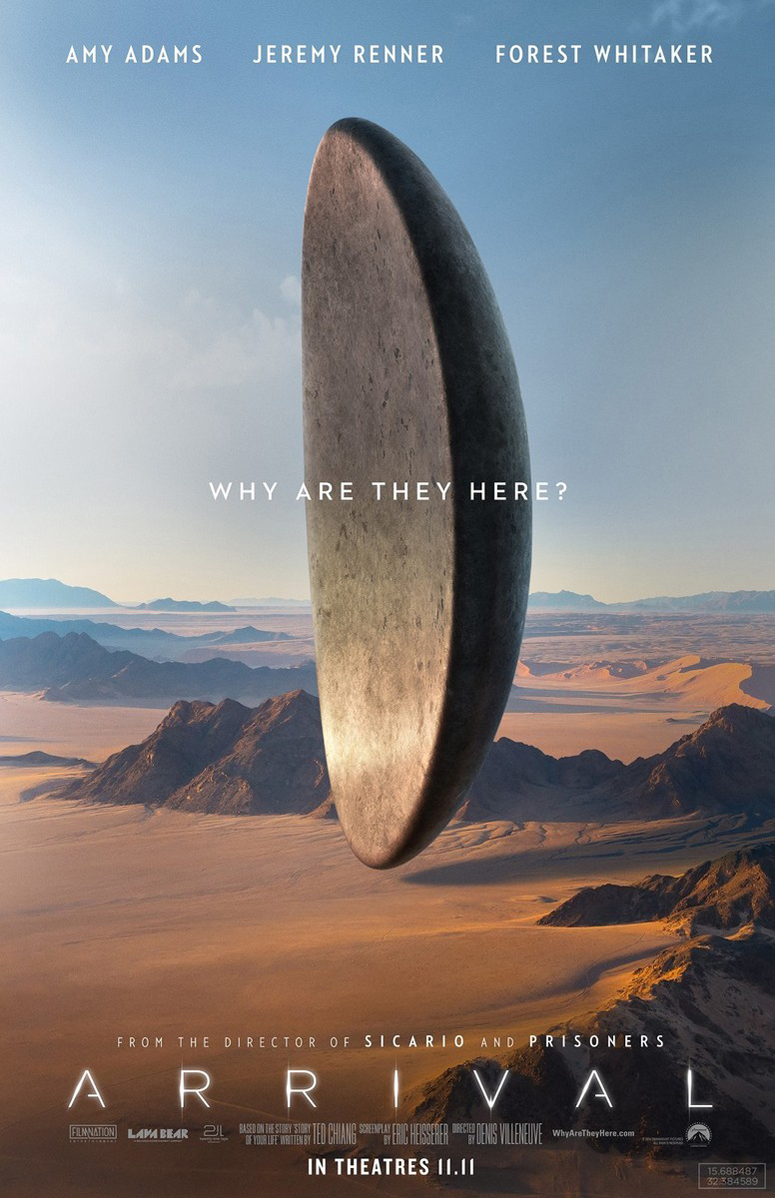
One thing all these designs have in common is that — as well as being great adverts for their respective movies — they're bona fide works of art. It's a tradition modern creators like the brilliant Matt Ferguson (and notable exceptions like "Alien Romulus" and "Arrival") are doing their best to keep alive — even though the lobby of a contemporary multiplex is less likely to be confused for an art gallery than it might once have been.

Even with the caveat that we tend to remember the great stuff and forget the duds, modern movie posters are rarely as good as they used to be. With montages often based around the contractual importance of respective stars, too many look like they've been created by committee rather than a single visionary artist — the design most executives, agents, and lawyers disliked least, rather than the one a few loved.

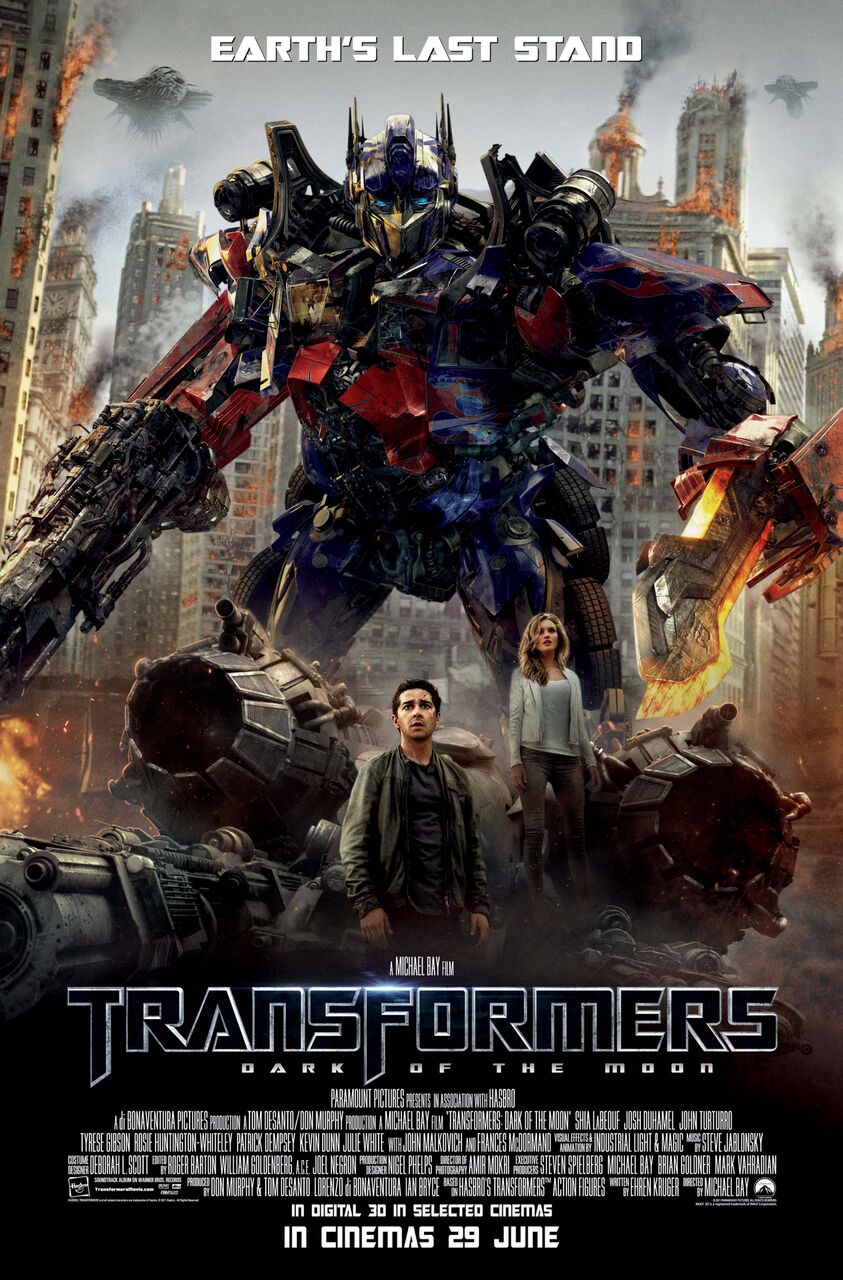
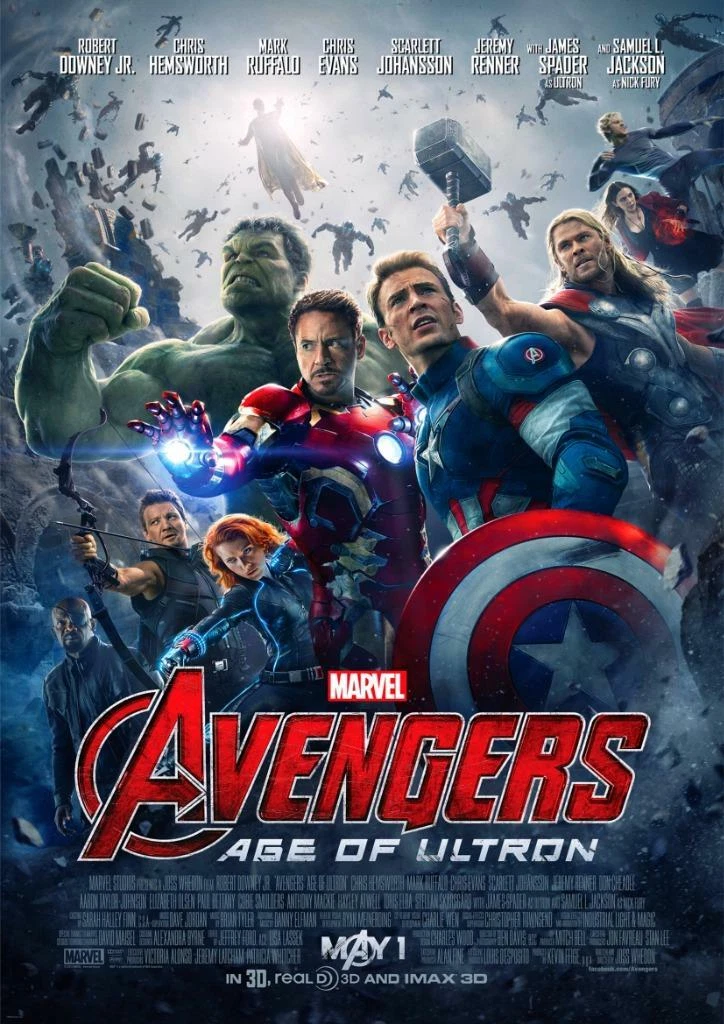
Can there be any other explanation for "Transformers" one-sheets that look like they've been passed through a filter of sludge, or an "Avengers: Age of Ultron" design so crowded that it looks like Marvel's answer to "Where's Waldo?".

Movie poster for Transformers Dark of the Moon
Paramount Pictures
Movie poster for Avengers: Age of Ultron
Marvel Studios / Disney

Maybe Hollywood doesn't care anymore. Maybe their market research tells them that identikit montages get the best results at the box office, or that traditional one-sheets are small fry next to social media and trailers when it comes to getting bums on theater seats.

But if the measure of a good movie poster is something that you'd want to put in a frame and hang on your wall, the current generation is (mostly) lacking.

So, whether or not "Supergirl" flies, let's celebrate the film's stylish, memorable poster art as a wonderful break from the status quo.

‘F9’ took a car into space, but 5 years on, just how ridiculous was the scene? We asked the experts

Five years ago, an internet meme turned into a reality in "F9" when the Fast & Furious crew launched a car into space. Depending on your sense of humor and ability to suspend disbelief, it's either peak cinema or extreme tomfoolery, but it's clear that the only way this franchise will ever top this moment is by drag racing a velociraptor in a "Jurassic World" crossover.

The "F9" scene sees Tej Parker (played by Ludacris) and Roman Pearce (Tyrese Gibson) sit inside a rocket-strapped Pontiac Fiero that's launched from a plane and sent into orbit to destroy a satellite. They succeed in their mission, then find themselves hanging about in space and waving at the International Space Station crew, who wonder if they're Minions. No, they aren't, but they're (say this part in Dom Toretto's deep voice) family.

Now, the Fast & Furious franchise has never played by the rules of physics, or reality for that matter. It values entertainment above all, but it's still fun to explore where it gets certain parts right and wrong at times. So we asked three experts about this car-launched-into-space scene and how ridiculous it is. Surprisingly, it isn't as dumb as everybody might think it is.

The filmmakers flub the carrier plane, though. Remember the aircraft that takes the Fiero up into the sky? It's something of a Frankenstein's monster. "The cockpit that they show is crossed between a Boeing 767 and 777," David Cohen, the current dean of aeronautics at Lynn University and former colonel of the U.S. Air Force, tells Space. "However, the aircraft from the external shot looks a little like a military C-17 – except that it has four engines. The C-17 was actually used as the basis for the transport aircraft in the 'Avengers' movies."

According to Cohen, another major issue in this sequence is how the Fiero sits on top of the carrier aircraft before it's dispatched. "Even in a military aircraft that's carrying weapons and missiles, there's a tremendous amount of time that is spent on both the carriage and the release of that weapon from the aircraft, including multiple cameras and a lot of testing," he says.

"So there's never something as simple as, 'Oh, we're just going to strap this on and see how it goes.'" When the Fiero is released, it's far too close to hitting the tail of the plane. In other words, it would have needed to be launched in another manner.

Now, there is a precedent of air-launch-to-orbit (ALTO) in the real world, such as the Northrop Grumman Pegasus. However, Bryan Schmidt, assistant professor of mechanical and aerospace engineering at Case Western Reserve University, thinks the "F9" filmmakers took direct influence from the first spaceflight of Virgin Galactic's SpaceShipTwo, which would coincide with the film's production timeline.

"Burt Rutan and Richard Branson formed a company called Virgin Galactic, and if you remember, they built a space plane for essentially space tourism," Schmidt says.

"The SpaceShipTwo could fly six people in this little rocketship that would get airdropped from a plane. Their first flight into space was in 2018, and this movie came out in 2021, so my guess is that the filmmakers were actually drawing a lot of inspiration from that system where the space plane would get carried up by an airplane, then the airplane would drop it around 40,000 feet, and the rockets would ignite and take it up to space."

(Image credit: Universal Pictures)

As Schmidt explains, the SpaceShipTwo dropped at around 40,000 feet while the vehicle in "F9" is at 50,000 feet, but it's still a similar-enough concept. "The densest part of the atmosphere is the bottom," Schmidt says.

"By using an airplane to get you up, you're dramatically reducing the amount of work that the rockets on the spacecraft have to do. So you can make your engine and your spacecraft a lot smaller and still be able to attain a pretty high altitude. If you look at SpaceShipTwo, its rocket engine is pretty small – the engine itself is about the size of a person. The other interesting thing is that if you look in the movie, there's a tank of nitrous oxide in the car. In the SpaceShipTwo, the oxidizer that they used for their rocket fuel was nitrous oxide."

(Image credit: Universal Pictures)

Ashmeet Singh, assistant professor of physics at the Indian Institute of Technology Delhi, sees the same logic in the ALTO but thinks the Fiero would struggle to reach its ultimate destination. "To stay in orbit you have to be moving sideways at about 7.8 kilometres per second, and thanks to Newton's Third Law of action equals minus reaction, rockets burn and eject fuel to get an opposite directed thrust," he says. "To get to those fantastic speeds, real rockets are almost entirely propellant by weight. A couple of boosters bolted to a car can't carry anything close to that."

There's also the question of the Fiero itself, and if it would last the entire journey. According to Earl (Jason Tobin) in "F9", the modified car has a ceramic polymer coating. While spacecraft use ceramic coating for heat protection, one wonders how thorough the testing for Tej and Roman's expedition really was. A regular Fiero simply wouldn't cut it, as Singh explains. "On the way up, the car wouldn't survive the heat from air resistance and the compression of the air, as the car rams into air molecules faster than it can move out of the way, which makes it heat past 1000°C. And a fibreglass body with ordinary glass has no heat shield and no structure for the violent shaking."

Cohen, Schmidt, and Singh all agree on how ridiculous it is that Roman uses the Fiero's steering wheel at all. "The steering wheel is pure theatrics: in a vacuum, there's no air over a wing and no road under a tyre, nothing to push against, so turning it does exactly nothing," Singh says. "Real spacecraft pivot by firing little thrusters, not by steering." Schmidt jokes that maybe it's something for Roman to hold onto while on the way up."*

*The car is shown to have tiny thrusters, so maybe they're hooked up to the wheel? We'll give them the benefit of the doubt.

(Image credit: Universal Pictures)

All three experts also highlight that the scuba-like gear that Tej and Roman wear is grounded in some real-world logic. "The very first time human beings went above Earth into an area where there wasn't enough breathable air, Wiley Post was one of the first pioneers doing this in the 1930s," Cohen says.

"Post had effectively what was a scuba suit at the time to handle the pressure and keep the air in the suit, and allowed him to breathe. So, the concept is not foreign to aviation." What is funny to Cohen is how Tej uses duct tape to keep his suit together.

As Schmidt and Singh add, though, these suits might not suffice depending on the length of the journey and the pressure in space, differing from underwater situations. Apart from the actual suits protecting the characters, you also need to consider the effect of G-force on Tej and Roman. Both look relatively fit and in good shape, but are they astronaut-fit for this undertaking?

(Image credit: Universal Pictures)

"As a pilot and astronaut, there's physiology you have to know about and ways you can clench muscles and attempt to fight some of the forces you experience," Cohen says.

"G-loss of consciousness is possible, and it happens with pilots in high-performance aircraft occasionally. They'll pull so many Gs that the force will take the blood out of their head down to their feet, and they lose consciousness. Ultimately, you do come back, but the goal is not to have that happen. It does not appear that there's any accountability for G-forces in 'F9', at least in the scene where the car is departing the aircraft."

(Image credit: Universal Pictures)

Unquestionably, "F9" is pure entertainment, so liberties are taken to sell an outrageous story where everybody behaves and acts like an invincible superhero. Having said that, it's good to see that the filmmakers and screenwriters actually attempted to bring an iota of realism to the film.

"Another powerful moment the scene gets right isn't the hardware or the science, it's possibly the awe on Tej and Roman's faces when they see Earth reflected in their visors," Singh explains. "Chris Hadfield, the Canadian astronaut who actually commanded the Space Station, even admitted that feeling to be true to the real thing."

To infinity and beyond... for family.

"F9" is available to stream on Prime Video.

Watch F9 on Amazon Prime Video:

Amazon Prime: $14.99/month or $139/year
Amazon Prime Video: $8.99/month

Ad-free add-on: $2.99/month

‘50% superhero and 50% noir, but 100% totally new’: ‘Spider-Noir’ composers on injecting retro style into the superhero multiverse (interview)

Sony Pictures Television and Amazon MGM Studios' brash experimental superhero series, "Spider-Noir," is a refreshing treat that revitalizes the fading genre with a cool film noir twist.

Showcasing the "Spider-Man Noir" comics character seen in "Spider-Man: Into the Spider-Verse", it stars Nicholas Cage as a 1930s New York City private detective named Ben Reilly who moonlights as the nocturnal avenger The Spider.

Juilliard-educated composers Kris Bowers ("The Wild Robot," "Secret Invasion") and Michael Dean Parsons ("Light & Magic," "Bridgerton") have created a magnificent sweeping score with roots in old-school crime thrillers, Hollywood Golden Age jazz, and a variety of intriguing electronic instruments not traditionally used in a classical score of this nature. We caught up with the musical pair to hear more about their influences for this mesmerizing Spider-Noir soundtrack.

"The first thing we talked about when we were watching the picture-locked season was how it was important that this score was rooted both in the noir and superhero space but also be wholly unique in its own thing," Bowers tells Space.

"We created a playlist of all our favorite noir scores from 'Chinatown' to 'Double Indemnity' to 'Vertigo' and remind ourselves about all the things we love about that music, then pretty quickly try to forget it so we didn't lean too much in that," explains Bowers.

"Superhero music, I feel like, has been in our DNA for the last 20 years or so. For us, it was looking at how in the noir space, you had these iconic, memorable melodies and themes and these things that are tracking characters across the arcs of their stories. Then with the superhero side of things, it was about making it feel modern and edgy and have a lot of sounds you wouldn’t expect in your typical noir score."

From the beginning, Bowers and Parsons instinctively knew "Spider-Noir's" atmospheric music would be thematically driven, but they also didn’t want it to be an homage washing over the whole series.

"We wanted it to feel customized and coming out of these individual characters and the unique story that was being told," Parsons adds. "One of the first things we asked Oren was, since the show takes place in New York, what does New York mean to you?"

"We were expecting a noir-inspired answer, like about using trumpets and saxophones," says Parsons. "Instead, he said New York is 'Nineties electric punk guitar.' As we talked to him more, there was something that really fit naturally about bringing in a modern guitar sound into this palette that made us realize this is 50% superhero and 50% noir, but 100% totally new."

One enchanting component of this score’s distinctiveness, beyond the sweeping symphonic interludes, is the inclusion of some unconventional instruments to layer into the moody tracks.

"The theremin was one of our early discoveries that was kind of a marriage between the electronic contemporary and also this noir world," notes Parsons. "We were researching the early electronic instruments that could have plausibly been around or starting to be popularized in that era, so we gravitated towards the theremin not only for that reason, but because Ben's theme begins with this big soaring octave leap.

"So we thought, what if we take the theremin and have it play the octave leap as a signature for Ben. Anytime he's doing a day in the life detective work, or anytime we need to point out him doing something heroic, we're able to use that theremin, which has been run through distortion pedals and other things, to call it out."

Giving the composers enough confidence to be daring provided the ideal creative environment to conjure up what we believe is an instant classic that gets even better each time it's heard.

"It's really just a credit to how generous our collaborators were in Oren, the showrunner, and the rest of the team," says Bowers. "It was the thing where every time we shared something, oftentimes the only notes we got back would be to make it even weirder or more different or add some other sound. That's important, especially when you're on a project, and you don't have much time, and you're dealing with one of the most important pieces of IP in the world with Spider-Man.

"Often, you can get a lot of stress and anxiety and tightness in terms of not wanting to try things out. I feel like we were encouraged to fail in the best way possible, where we never felt any idea was too crazy for this team. It was an amazing collaborative process with them."

The show hails from executive producer Oren Uziel ('Mortal Kombat,' 'The Lost City'), and fans are applauding its stylish take on the multiverse, which can be enjoyed in either True-Hue Full Color or Authentic Black & White.

"Spider-Noir" is now streaming all 8 episodes on Prime Video.

Watch Spider-Noir on Amazon Prime Video:

Amazon Prime: $14.99/month or $139/year
Amazon Prime Video: $8.99/month

Ad-free add-on: $2.99/month

As ‘Avatar: Fire & Ash’ hits Disney+, we look at 3 of the weirdest alien creatures in the ‘Avatar’ movies

Avatar: Fire and Ash was a box office smash hit when it dropped in December 2025, and it's easy to see why. Compelling characters, breathtaking action, beautiful environments, and an array of wondrous alien creatures.

We've explored the strange creatures of the Avatar universe before, but now that the third movie has finally hit Disney+, we're taking another look at three more awe-inspiring alien creatures from these movies, including some new stunners introduced in Fire & Ash.

If you’re more of an RDA fan (or at least admire the humans’ technology), we also took a good look at Avatar’s most iconic spaceships and vehicles. James Cameron rarely misses when it comes to gorgeous sci-fi designs — man-made or natural — and eagle-eyed veterans might even spot an explicit reference (which we won’t spoil here) to Aliens in Fire and Ash.

Watch Avatar: Fire & Ash on Disney+:
Disney+ (With Ads): $11.99/month
Disney+ Premium (No Ads): $18.99/month or $189.99/year

It might be a while before we get more updates on Avatar 4 and 5’s status, so if you're itching to explore Pandora more after watching Fire and Ash on Disney+, then you should also check out the video game, Avatar: Frontiers of Pandora. Ubisoft’s open-world game is a memorable – and surprisingly brutal at times – experience, but it also lets fans explore the world, see the creatures, and dive deeper into the lore.

Now, let's mask up and prepare to drop into the wilderness of Pandora as we look at three of the Avatar series’ coolest (and weirdest) alien creatures.

Akula

The Akula, an alien sea creature from the movie Avatar: The Way of Water

(Image credit: 20th Century Studios)

First seen in Avatar: The Way of Water, the akula is a carnivorous fish that essentially acts as the great white shark of Pandora’s oceans, though it’ll remind paleofanatics of Earth’s armored Dunkleosteus. Its most shocking feature — and one perfectly showcased when it tries to eat Lo’ak in the second movie — is a three-part jaw that opens up in a big triangular shape.

Like most creatures in the Pandoran seas, the akula is important to the Metkayina’s culture. Those Na’vi choose to model their traditional knives after the teeth of the fearsome creature, and some members of the tribe even wear the akula’s actual teeth with necklaces. It’s terrifying to them, too, and thus deserves respect.

The lead creature designer on the Avatar sequels, Zachary Berger, revealed the process behind the akula’s creation, stating the basis for the final design was born from a sketch Wētā Workshop had done a long time ago. Unsurprisingly, it seems the mouth “reveal” was the final touch the otherwise familiar design needed to fully come together.

Nightwraith (ska’avum)

The Nightwraith, an alien flying creature from the movie Avatar: Fire & Ash

(Image credit: 20th Century Studios)

Another scary aerial predator introduced in the sequels is the nightwraith, which the Na’vi call ska’avum.

First seen in Fire and Ash as the ride of choice of villain Varang, it’s a four-winged monster with folding vanes that give it a distinct shape against the sky. It’s also slightly larger in size than the more common ikran, as seen during Varang and Neytiri’s ferocious clashes. Moreover, its “bony crests” give it an additional edge when it comes to attack and defense.

As far as we know, Varang is the only Na’vi to ride a nightwraith. This is a good fit considering the character’s fiery nature, but it wasn’t always the plan, as her aerial partner wasn’t defined in the script and was developed into an all-new creature after shooting had wrapped. Word is that Varang was originally meant to ride an armored ikran instead.

Southern squidray (tsyong)

The Southern squidray, an alien squid-like creature from the movie Avatar: Fire & Ash

(Image credit: 20th Century Studios)

Fire and Ash also added Pandora’s own giant squids to the already crowded bestiary, and those things are gnarly... even outside the water. When Eywa goes to war (again) during that third act, things get scary very fast if you’re on the human invaders’ side. Enter the four-eyed southern squidray, called tsyong by the Na’vi.

With razor-toothed tentacles and an oversized beak that opens up horizontally and can bite through most natural materials, these deep-sea hunters can feed on almost any other animal in the sea due to their impressive speed and strength in numbers.

Even the agile ilu have a hard time escaping them, so you can quickly understand why the Na’vi treat them as “dark spirits” sent by Eywa to judge. By the end of the third Avatar movie, the RDA is the one being judged (harshly) by the nightmare-inducing cephalopods.

Watch Avatar: Fire & Ash on Disney+:
Disney+ (With Ads): $11.99/month
Disney+ Premium (No Ads): $18.99/month or $189.99/year

‘Rick and Morty’ cast talk vocal health, hot viscous liquids, and their favorite season 9 moments (interview)

Adult Swim's smash animated series "Rick and Morty" recently unleashed its ninth season, and it's already shaping up to be one of the best seasons so far, with plenty of interdimensional shenanigans, existential excursions, evolutionary entanglements, hostile living room furniture, a potential trip to Boob World, and Pool Time!

We chatted to the creators Dan Harmon and Scott Marder earlier this month, but now we're catching up with the main cast to hear from Ian Cardoni (Rick), Sarah Chalke (Beth), Harry Belden (Morty), and Spencer Grammer (Summer) on the rigors of voice acting, playing in the multiverse, and watching all your plosives.

"We've got what we would consider classic adventures, balanced by a lot of fresh and new directions for these characters and for these stories," Cardoni tells Space.

Rick Sanchez from Rick and Morty, pictured alongside his voice actor Ian Cardoni (Image credit: Getty Images / Adult Swim)

"I can honestly say that some of my favorite moments of episodes of the whole series run are coming in season 9, and I'm excited for fans to see that. Sci-fi in its best form is human stories. It may be our future, and I think we get glimpses of that by tapping into the human elements. With all the wacky hijinks that take place, we're in for a really amazing season and some real good science fiction."

Those hijinks call for some suitably animated vocal performances from the vast though. "These are voices that take a toll, even when it’s not a session, when it requires the intense gravel or yelling of Rick," explains Cardoni.

"It requires your full instrument. I like to prep with a full cardio workout because oxygen support is what you need. Then I go on vocal rest before and after sessions. I have all kinds of warm, hot, viscous liquids to soothe. I use a vocal steamer. Harry [Belden] is really religious about his regimen, but I’ve got my own way to get myself into the voice, but not burn out. Voice acting is acting. And the show doesn’t pull any punches emotionally."

Beth and Space Beth from Rick and Morty, pictured alongside their voice actor Sarah Chalke (Image credit: Getty Images / Adult Swim)

Chalke relishes her time playing Beth and Space Beth and adamantly declares season 9 as her favorite season they’ve ever done.

"There's a couple of specific episodes, 'Salute Your Morts' and 'Jer Bud' where you really get to go deeper into the relationships," she notes. "The fun part of 'Rick and Morty' as an actor is all the unique challenges because there's no limits and because it's a multiverse and because the show can go anywhere, you’re always doing things with your voice you've never done before.

"None of us have to do the voice intensity Ian does with Rick. You're working those vocal chords so hard with the burping and all of that," Chalke remarks to Cardoni. "For me, Space Beth is more in that direction than Beth. So I always record all of that first and Space Beth second because she has more of a gravelly, raspy quality to it. It's whatever you need to do to make it grounded and as real as you can."

Morty from Rick and Morty, pictured alongside his voice actor Harry Belden (Image credit: Getty Images / Adult Swim)

For Belden, it was gratifying for Morty to experience a great deal of personal growth this season.

"There are a lot of intense situations that he finds himself in, and I’m excited for fans to see him go through that and come out the other side," he adds. "For me, my favorite episode is going to be the finale ["Field of Dreams"] for sure, and the journey that Morty goes on. There's so much good stuff in there."

Regarding his own regimen of keeping his vocal health tip-top, Belden explains:

"I like to run a couple of miles before I start, stretch out the entire body, do the actual vocal warmups. Morty being such a particular voice, I need a lot of breath support, so I have a wide stance and create a powerful base. I’m expanding my ribcage to support myself. And that’s not without even getting into tongue placement, spreading your lips wide to get the sound out, watching your plosives on the letter 'p.' It's all this stuff you would never ever think about."

Grammer is thrilled to see some fan favorite characters make return cameos in season 9, as we get to watch Summer and Morty just being terrible teenagers, and loves the fact that the Smith family gets a swimming pool.

Summer from Rick and Morty, pictured alongside her voice actor Spencer Grammer (Image credit: Getty Images / Adult Swim)

"I kind of learned on the job about 14 years ago," she reveals. "I was trained as an actor though, so I have a pretty good vocal ability. But it's very demanding, especially as you get older. There’s these tiny muscles and tiny folds. The last few years, I’ve really devoted to vocal health and got to a place where I can comfortably do the Summer role really well."

Grammer has really embraced the role of Summer, but it's also led to some major lifestyle changes for her. "You have to choose where you want to live. I don’t see a lot of people now. I just work a lot", explains Grammer.

"I can’t go to a party that’s going to be loud and talk to people. And that's fine. Alcohol is really bad for hydration, so I don’t really drink anymore. I’m constantly drinking water or something really slimy all the time. I have a whole kit of just things for your voice that I always take with me."

Executive produced by Dan Harmon and showrunner Scott Marder, "Rick and Morty season 9" airs Sundays at 11 p.m. on Cartoon Network's Adult Swim, and will also begin streaming weekly on Hulu and HBO Max starting June 15, 2026.

Watch Rick & Morty Seasons 1-8 on HBO Max:

Basic (Ads): $10.99/month or $109.99/year
Standard (No Ads): $18.49/month or $184.99/year
Premium (4K): $22.99/month or $229.99/year

‘Project Hail Mary’ is streaming now on MGM+, and you can watch for just $0.99 for a limited time

'Project Hail Mary' has finally landed on a streaming service, though maybe not the one you were expecting.

Amazon MGM Studios' "Project Hail Mary" recently launched (June 18) first on the MGM+ streaming platform, which is a sister site to Prime Video, after its 90-day theatrical window was up. As a bonus, there is a summer deal that lets you snag the Amazon Prime Video MGM+ channel for $0.99/month for 2 months. Be quick, though; this offer ends June 26.

Watch Project Hail Mary on MGM+ (via Amazon Prime Video): $0.99/mo for 2 months ($7.99/month thereafter)

This is a limited-time offer that ends on June 26, 2026.

"Project Hail Mary" sees reluctant astronaut Ryland Grace embarking on a cosmic rescue mission to save Earth, aided by a stone-skinned alien named Rocky. Fans looking for the Ryan Gosling space epic to show up on Prime Video out of the gate might be a little surprised, but as they say, That’s Hollywood, Baby.

Why MGM+ and not Amazon Prime Video?

Since Amazon MGM Studios is both a theatrical and streaming studio, deals are often shifted depending on the different monetization models involved.

In "Project Hail Mary's" case, MGM+ becomes the initial outlet for streaming and PVOD, with Prime Video as the secondary streaming destination. Movies making their first streaming stop on Prime Video, like "Red One," are handled differently within the corporation, especially if their costs were paid by Prime Video.

Directed by Phil Lord and Chris Miller, "Project Hail Mary" was a certified crowd-pleaser after a juggernaut marketing campaign that saw waves of teasers, trailers, clips, and interview videos anywhere and everywhere, which helped to catapult the popular sci-fi film adapted from Andy Weir's bestselling novel to a decent $678 million global haul.
Amazon, the behemoth parent company of both Prime Video and MGM+, possibly also made a decision to deliver the spring blockbuster initially to MGM+ as an enticement to lure prospective customers to the much smaller platform as a way to drive up subscription numbers. Prime Video's sweet MGM+ deal is further evidence of this plan's logic.

For now, "Project Hail Mary"'s interstellar odyssey is available exclusively on MGM+, but we’ll keep you updated when its official Prime Video date arrives.