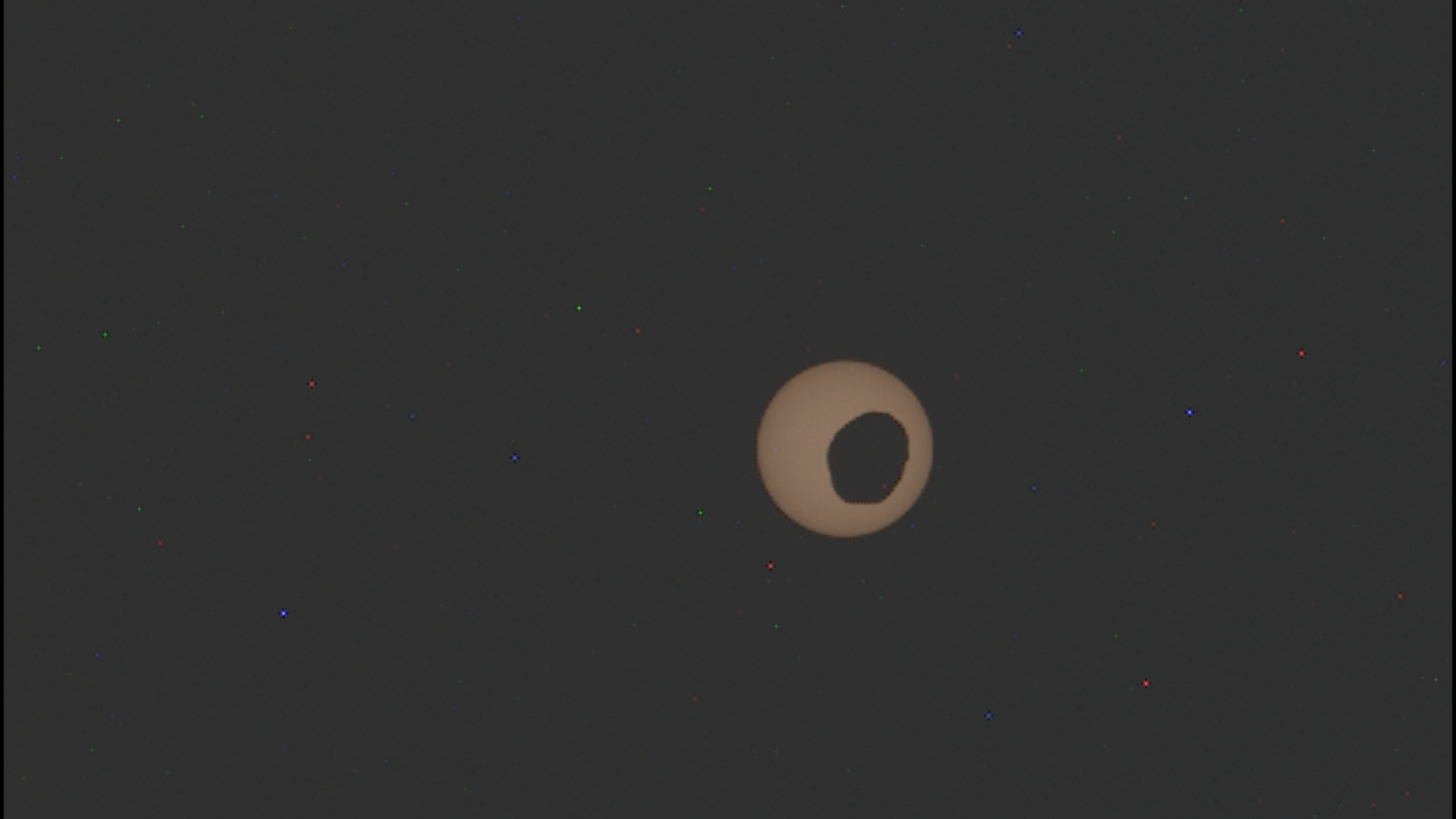
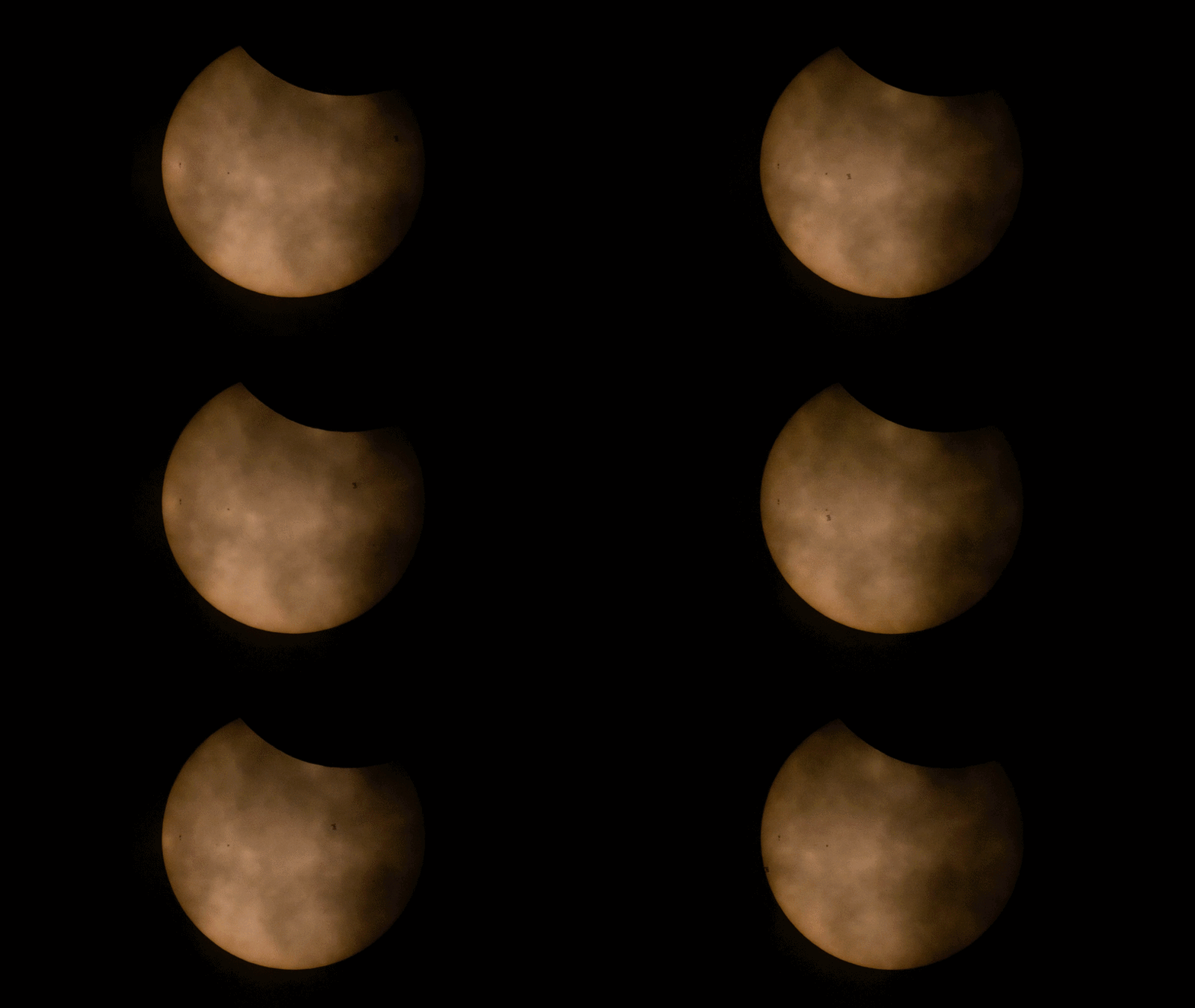
NASA's Perseverance Mars rover saw a solar eclipse from the Martian surface. (Image credit: NASA/JPL-Caltech/ASU)
People around the world enjoyed stellar views with last week's total solar eclipse.
And the day after we looked up to see the moon obscuring out sun, NASA's PerseveranceMars rover looked up to see its own Martian solar eclipse.
What is it?
Solar eclipses aren't unique to Earth. In theory, any planet with at least one orbiting moon would have times where that moon might eclipse some part of its sun to anyone looking up from the planet's surface.
Looking up with its left Mastcam-Z camera, Perseverance snapped this image of one of Mars' two moons, Phobos and Deimos, partially eclipsing the sun. This appears to be Phobos — the larger of the pair — eclipsing the sun.
Why is it incredible?
So far, we humans have only directly had vantage points on Earth, in Earth orbit and on the moon. We have not yet landed humans on Mars, and it remains unclear how long it might be before that happens.
But robotic explorers like Perseverance allow us to travel where we can't go ourselves. Such travelers have taken us into interstellar space and all throughout our solar system. From Saturn's rings to Neptune's distant, icy neighborhood, robotic probes have allowed humanity's reach to stretch far through the cosmos.
And thanks to Perseverance and its two "eyes," the two Mastcam-Z cameras located high on its mast, we can travel right to the surface of Mars, look up and see an alien solar eclipse. What an amazing thing that is.
Is it a rocket car? Tearing across the Utah desert at over 400 mph (644 kph), a hydrogen-powered car has set a new land speed record.
Wing Commander Andy Green, a retired British Royal Air Force fighter pilot, just set a new world land speed record at the Bonneville Salt Flats in the JCB Hydromax vehicle. On two different runs on Aug. 11, the car went 400.623 mph (644.740 kph) and then 412.135 mph (663.267 kph), which averages out to 406.320 mph (653.909 kph).
That's the fastest that any car with a hydrogen internal combustion engine has traveled. "It was an amazing experience," Green told Space.com on Aug. 12 about his record-breaking drives.
"Anything above about 350 miles an hour [563 kph], we'd have gone away really pleased," he added. "It is performing better. It was more reliable than we expected, and it has blown away the hydrogen record. It's in every way a real thrill for all of us yesterday to see that happen."
Green is no stranger to breaking records. In 1997, he drove a jet-powered car 763.035 mph (1,227.985 kph, or Mach 1.02), setting a new land speed record while also becoming the first person to break the sound barrier on land.
About 20 years ago, Green also set the land speed record for a diesel-powered vehicle, going over 350 mph (563 kph). Until now, the fastest hydrogen-powered vehicle didn't come close to that, topping out at 303 mph (488 kph). But this new record shows the promising capability of hydrogen-powered engines on land.
The hydrogen engine doesn't produce carbon dioxide like a traditional gasoline or diesel engine does. And while it's not the most traditional car engine on Earth, hydrogen has powered some rocket engines for decades. For example, NASA's Space Launch System (SLS) launcher, which has two successful Artemis moon mission liftoffs under its belt, burns liquid hydrogen and liquid oxygen. (The SLS core stage employs RS-25 engines, which also powered NASA's now-retired space shuttle.)
The JCB Hydromax isn't exactly a rocket on wheels, but it does demonstrate an incredible technological feat. And the "rocket car" probably has more in common with an actual rocket than we might think. For example, while it's not as fast as a rocket, pushing a vehicle to its limits requires many of the same preparations.
"There is a countdown and a checklist," Green told Space.com. "And several times we've had to stop the countdown, reheat something, adjust something, restart the countdown and launch it off the start line."
However, despite its speed, hydrogen-powered engine and countdown clock, this "rocket car" isn't going to space anytime soon.
"These are built for the construction industry," Green said about the engines. "They normally kick out 74 horsepower," he added, so they put "two of them in a race car to show how tough, how adaptable [and] how capable they are."
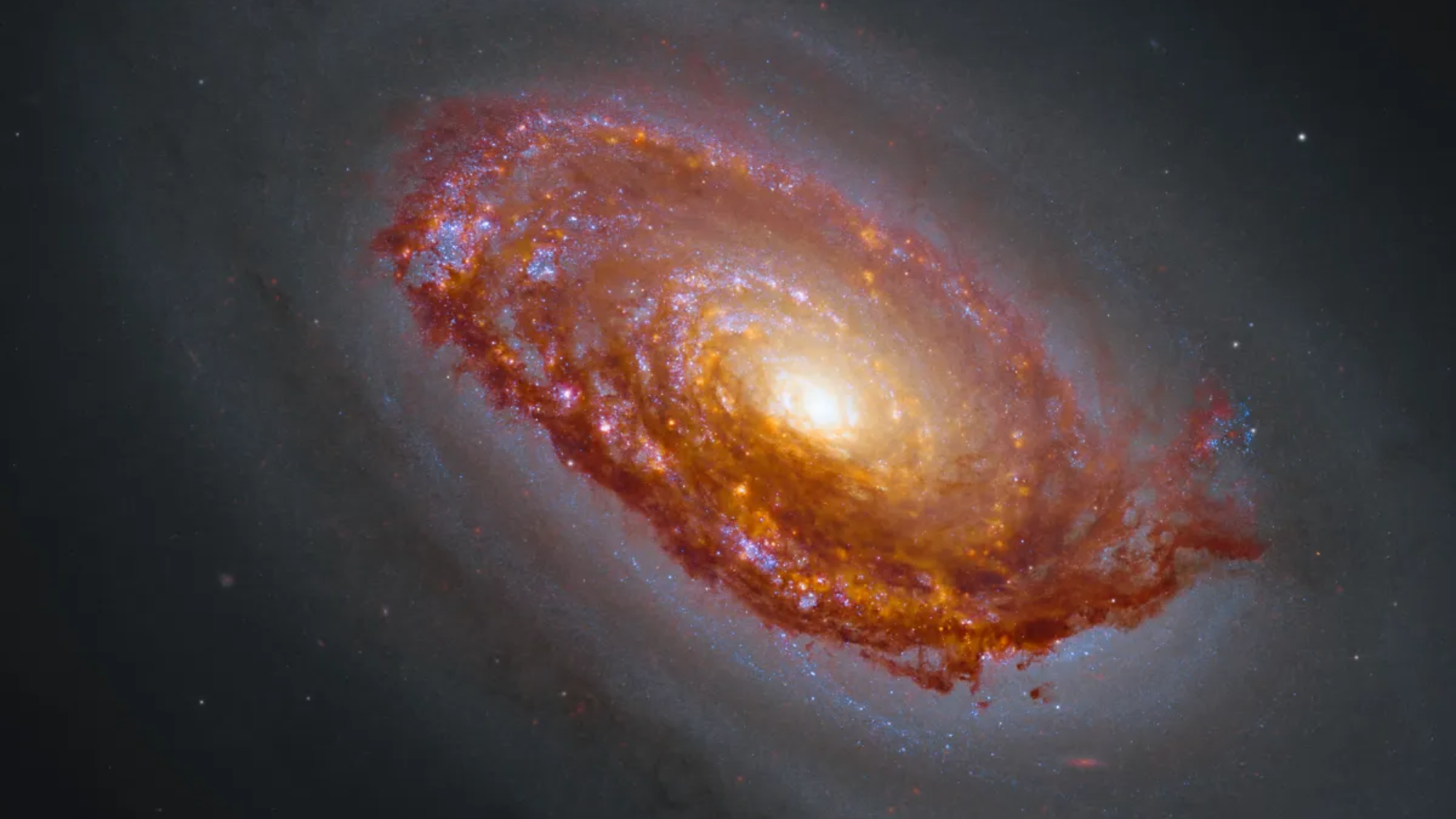
The "Black Eye Galaxy" is captured in this new composite image from the Hubble Space Telescope and JWST. (Image credit: NASA, CSA, ESA, F. Belfiore (European Southern Observatory – Germany), J. Lee (Space Telescope Science Institute), A. Leroy (The Ohio State University), and D. Thilker (The Johns Hopkins University); Processing: Gladys Kober (NASA/Catholic University of America))
Sometimes, incredibly powerful space telescopes work together to accomplish amazing things. Recently, observations made by both the James Webb Space Telescope and Hubble were combined in a composite image that shows the incredible nature of the "Black Eye Galaxy," more formally known as Messier 64.
What is it?
The Black Eye Galaxy is a strange spiral galaxy located 17 million light-years from Earth, in the constellation Coma Berenices, a name that means "Berenice's Hair" in Latin.
Discovered in 1779, the Black Eye Galaxy is fairly isolated from other galaxies and is known for its hypnotizing "stare." This look is created by the galaxy's internal, swirling motion. However, unlike many other spiral galaxies, the gas in the outer reaches of this one rotates in the opposite direction to the gas and stars closer to its center, creating an especially unusual motion.
To capture this incredible composite view of the galaxy, astronomers combined near and mid-infrared wavelength observations made by JWST and ultraviolet, visible and near-infrared observations made by Hubble.
Why is it incredible?
As we look forward to observations from NASA's upcoming flagship space observer, the Nancy Grace Roman Space Telescope, this collaborative effort shows how such powerful instruments don't replace one another; rather, they bring different capabilities to the table and can complement each other.
And, while this new image is the result of a team effort of cutting edge-technology, the Black Eye Galaxy is also a favorite target for backyard astronomers because it can often be spotted in small telescopes.
Imagine orbiting hundreds of miles above Earth and seeing your home planet below — up in smoke.
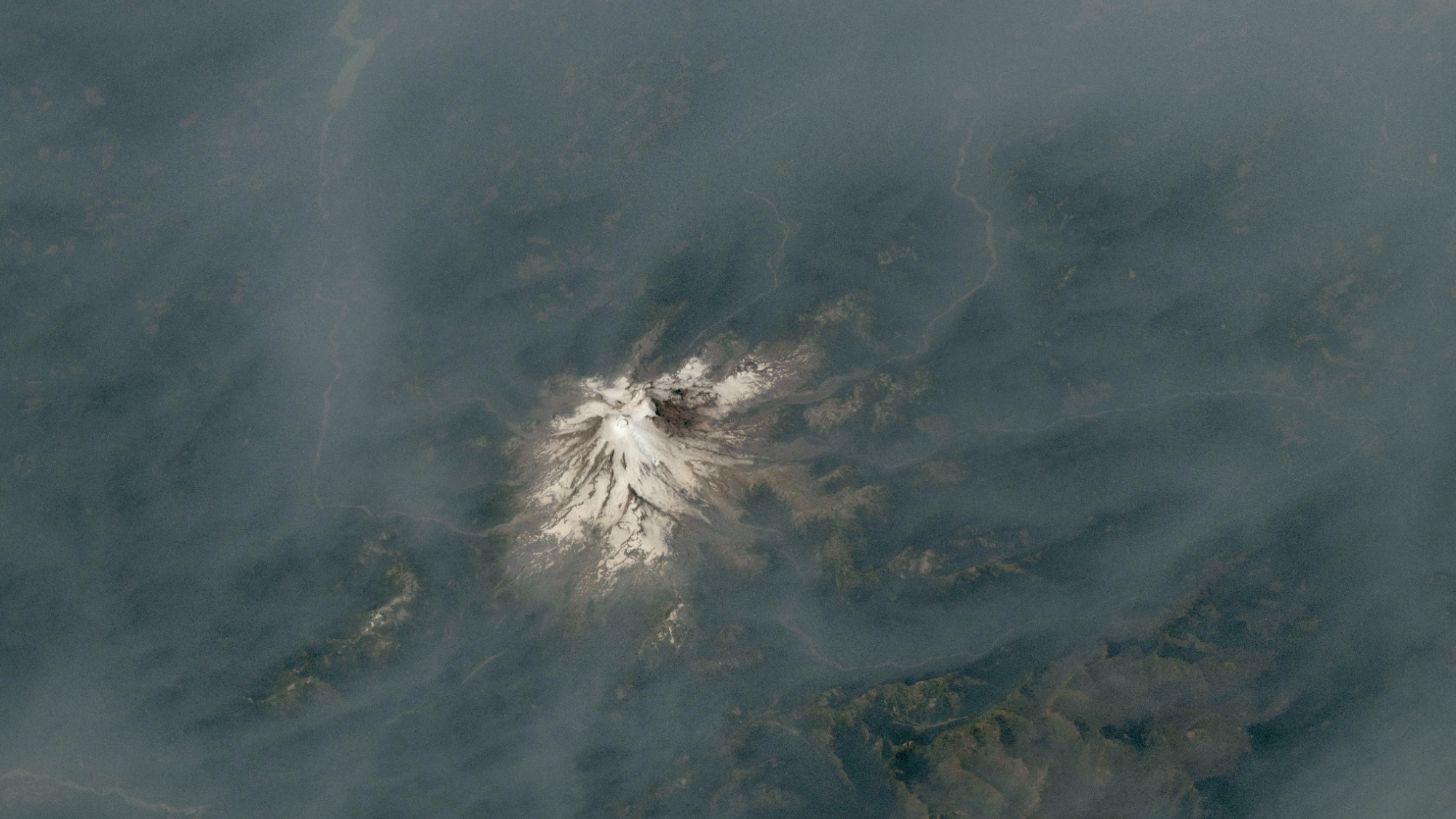
That was the reality recently for astronauts aboard the International Space Station (ISS) who captured this image of the volcano Mount Rainier covered in smoke from nearby wildfires.
What is it?
This past July, hundreds of wildfires devastated a number of regions across Canada. But unfortunately, this was not the end of wildfires decimating North America this summer.
Recently, wildfires have spread across Washington and Oregon, burning over 84,000 acres (34,000 hectares) as of Aug. 12, according to NASA.
This image, captured by astronauts aboard the ISS, shows smoke blowing from wildfires in central and eastern Washington to the volcano Mount Rainier. The astronauts also captured imagery of Mt. Hood about 100 miles (160 kilometers) south. With Mt. Hood, you can also see thick plumes of smoke coming from the Grasshopper fire, which was ignited by a lightning strike.
Why is it incredible?
This is the worst fire season the Pacific Northwest has seen in over 30 years, CNN has reported. The wildfires have forced many to evacuate their homes, shut down major roads and more. In addition to the immediate dangers presented by the wildfires themselves, as we can see from these images, the smoke from the fires extends far and wide and has created unhealthy air quality levels.
As of Wednesday (Aug. 12), over 2.7 million acres (1.1 million hectares) had already burned, and by Friday (Aug. 14), the region still had dozens of uncontained wildfires, CNN reported.
While tackling the problem of wildfires — which is increasing as climate change worsens — takes place on Earth, we can learn a lot from seeing things from above. The vantage point of outer space allows for views like this, which can give a larger perspective. And satellite views can provide even more in-depth information to support wildfire fighting activities back on Earth.
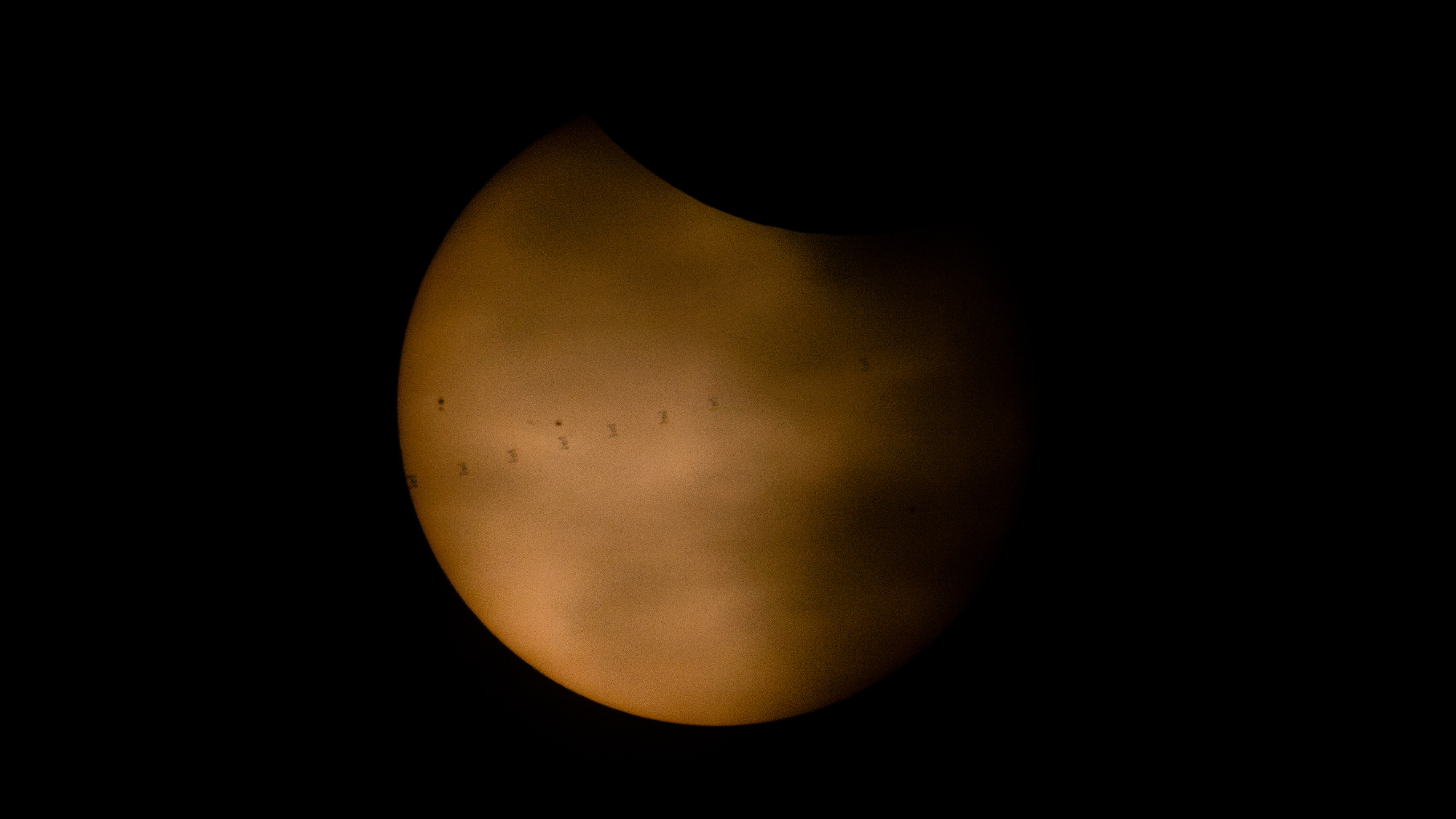
The silhouette of the ISS transiting across the sun's face during the Aug. 12, 2026 total solar eclipse. (Image credit: NASA/Joel Kowsky)
This week's total solar eclipse captured the world's attention, and millions of skywatchers looked up (with the correct protective eyewear, hopefully) to experience the moon blocking out our star's light. And, as you can see in this image, even the International Space Station (ISS) itself got in on the fun.
What is it?
On Aug. 12, 2026, the moon completely blocked out the sun's light for millions of lucky skywatchers witnessing a total solar eclipse.
But the moon isn't the only thing orbiting Earth. Tons of satellites and probes do too, and that includes the ISS. This created a truly remarkable moment for some skywatchers. With the right equipment, it was possible to see the silhouette of the ISS in front of the sun.
This composite image shows eight different frames of the ISS silhouetted on the sun's face as the moon takes a "bite" out of our star to create a partial eclipse.
This gif shows the ISS' silhouette moving across the sun's face during a partial solar eclipse on Aug. 12, 2026. (Image credit: NASA/Joel Kowsky)
Why is it incredible?
Solar eclipses like this week's total solar eclipse really bring people together. It creates opportunities for humans to come together and gather for a common goal.
And while the ISS is featured in this image, we may also want to consider the astronauts aboard. In other words, people on Earth weren't the only ones who got to participate in the marvel.
The Expedition 75 astronauts on the ISS (NASA astronauts Jessica Meir, Anil Menon, and Jack Hathaway; ESA (European Space Agency) astronaut Sophie Adenot; and Roscosmos cosmonauts Pyotr Dubrov, Andrey Fedyaev and Anna Kikina) caught the show too as they orbited our planet. There they were, in between Earth and the moon, as our planet's neighbor blocked out our star.
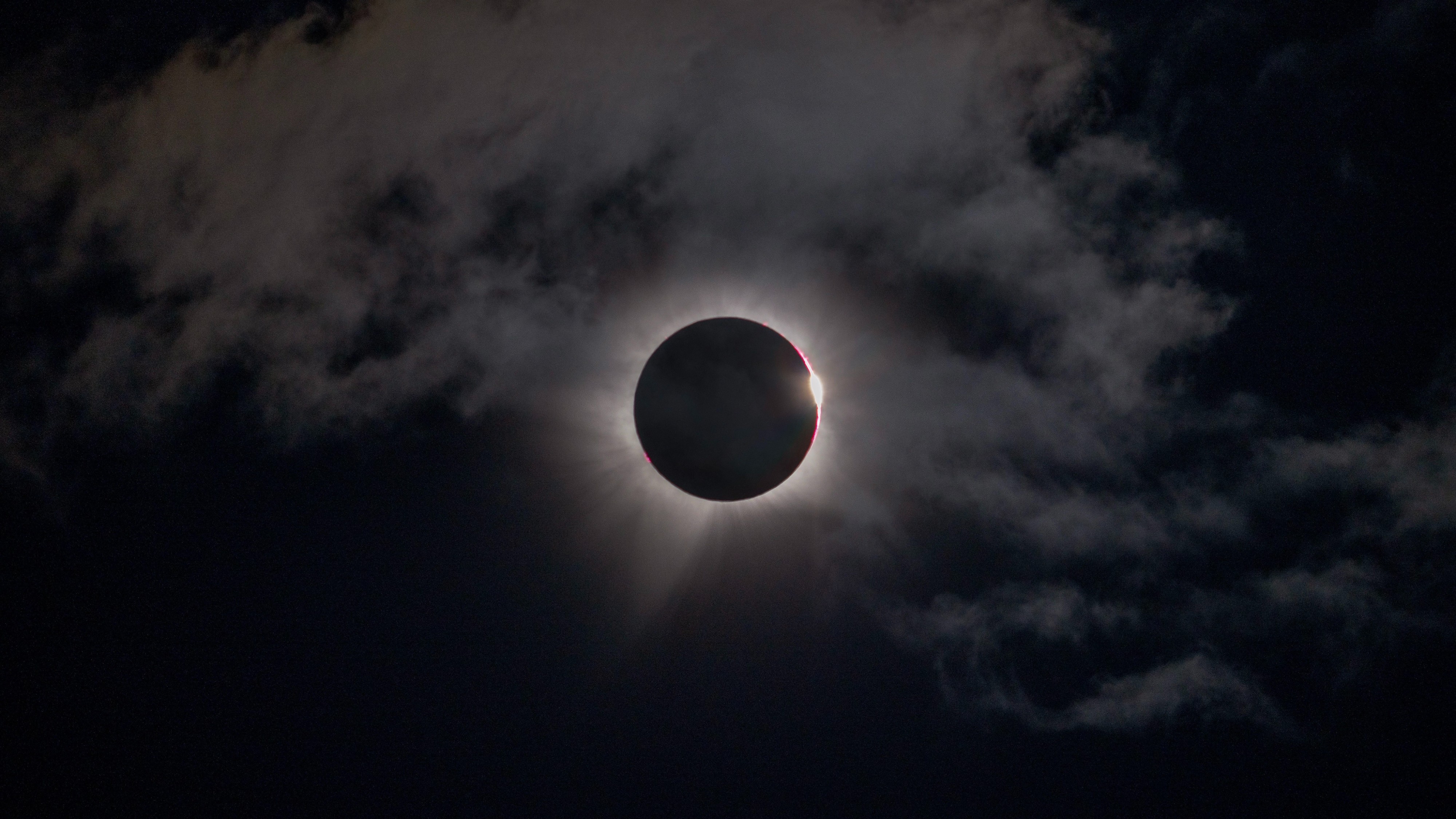
The moment just before totality during the Aug. 12, 2026 total solar eclipse, captured from the deck of the MS Spitsbergen on the HX Expeditions eclipse voyage. (Image credit: Daisy Dobrijevic/Future)
The total solar eclipse of Aug. 12, 2026 was one for the books. And this photo, snapped just as the eclipse was about to enter totality, really captures the drama of the moment.
What is it?
On Aug. 12, 2026, millions of people around the world witnessed a total solar eclipse. This happens when the moon passes in front of the sun, completely blocking it from our perspective here on Earth. (During a partial solar eclipse, only part of the sun's face is blocked by the moon.)
Observers lucky enough to be in the narrow "path of totality" that day got an experience they'll never forget.
Why is it incredible?
The chance to observe a total solar eclipse doesn't come along very often and is truly surreal and magical. While you might logically know that it's a predictable result of orbital dynamics, it's still incredibly strange in the moment to watch the sun disappear behind a black disk.
During totality, you experience a sort of false nighttime in the middle of the day. This can trigger strange responses from wildlife, with animals that are typically nocturnal coming out to see what's going on, confused about why night arrived at what feels like the wrong time.
Space.com skywatching editor Daisy Dobrijevic traveled to the Scoresby Sund off the coast of Greenland to experience the total solar eclipse from the deck of the MS Spitsbergen on the HX Expeditions eclipse voyage, and she's been taking us all along on her journey.
"I couldn't believe my eyes. I knew exactly what to expect — I’ve written about total solar eclipses countless times and given talks about them — but nothing prepared me for the feeling of actually seeing it," Dobrijevic said about her experience watching the eclipse. "I was completely in awe. As thin clouds drifted in towards the end of totality, they only added to the drama and emotion of an already extraordinary sight."
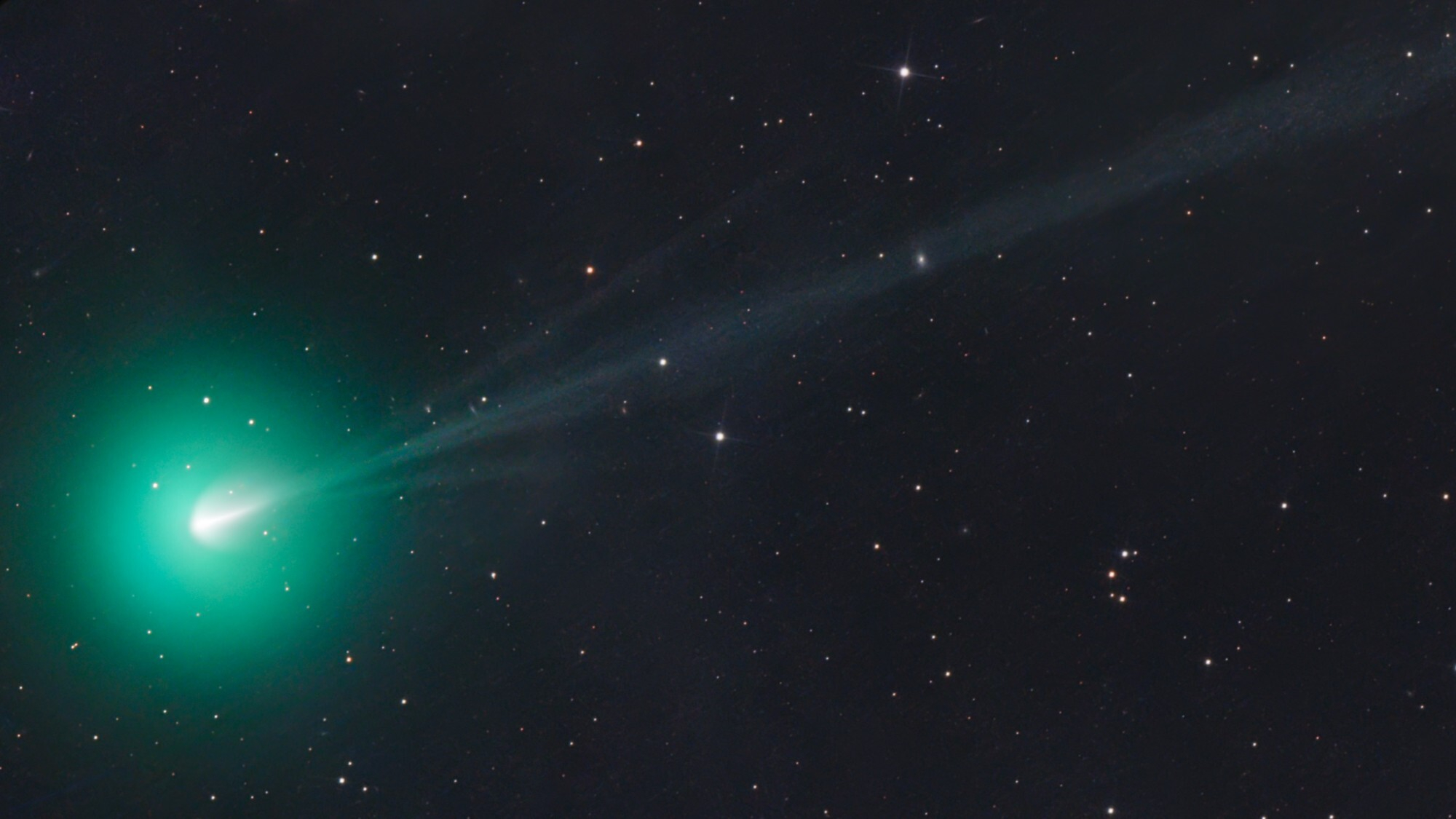
Discovered by Australian astronomer Robert H. McNaught, the comet orbits our sun once every 5.5 years. Back in June, the comet reached perihelion, or the closest point in its orbit around the sun. Around that time, the comet experienced a large outburst, which brightened it about 8,000 times.
The comet brightened back up this August to about 600 times its normal brightness — and it was during this period when astrophotographers Gerald Rhemann and Michael Jäger captured it streaking across the night sky over Namibia.
To capture the moment, the pair used a 12-inch Astrograph telescope with a ZWO ASI 6200 MM Pro camera.
Why is it incredible?
It's not every day you see a comet in the night sky. Even if one is overhead, often they're too tricky or too far away to spot without a telescope, and even then it can be a challenge.
It's also incredible that the moment captured in the new image showcases the comet 220P/McNaught with such spectacular clarity and detail. It must have been something truly special to witness.
While spotting a comet like this might not happen every day, we can sometimes see the debris trailing behind a comet as its tail burns up in our atmosphere. These burnt comet bits are actually the "shooting stars" we see in the night sky during a meteor shower.
Right now, the Perseids meteor shower is on its annual parade across the night sky. This meteor shower is made up of debris shed by the comet Swift-Tuttle as it swoops by on its annual trip across the solar system. Under dark skies, skywatchers can see up to 100 shooting stars thanks to Swift-Tuttle.
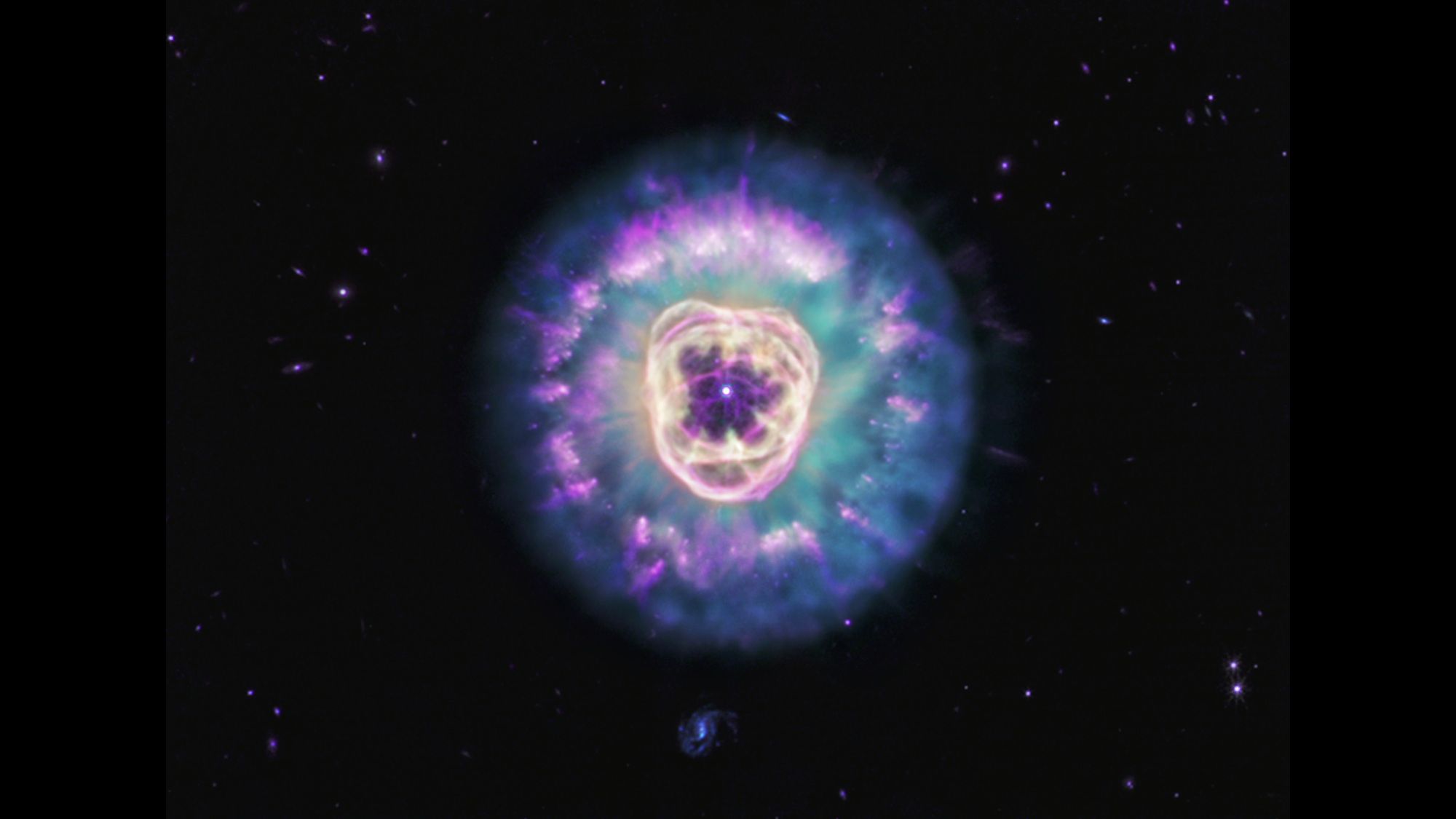
The Lion Nebula glows gloriously in this new snapshot from the James Webb Space Telescope, made using data from the NIRCam and MIRI instruments. Image: NASA, ESA, CSA, STScI; Image Processing: Alyssa Pagan (STScI)The Lion Nebula glows gloriously in this new snapshot by the James Webb Space Telescope using data from JWST's MIRI instrument. Image: NASA, ESA, CSA, STScI; Image Processing: Alyssa Pagan (STScI)
With a glorious mane of glowing purple gas and dust, the Lion Nebula sparkles on the cosmic savanna in this new image captured by the James Webb Space Telescope.
What is it?
This new image highlights the stunning beauty of the Lion Nebula (formally named NGC 2392), which earned its nickname thanks to its vaguely lion-head-shaped "face" and surrounding, fuzzy "mane".
At the center of this lion's face lies its nose, a bright purple spot. This spot is actually the remnant of a dying star that's radiating energy outward and powering the cosmic structure. This oxygen-rich remnant is a white dwarf, or the hot core of a dying star. As a star like this dies, it becomes unstable and sheds its outer layers, blasting gas and dust outward to create a planetary nebula.
The white dwarf got left behind after the nose in the center of the "lion's" face expelled energy and created a big bubble of ionized gas around itself. Over time, the lion's face will continue to expand. Astronomers estimate that in about 10,000 years, the lion might dissipate entirely.
Why is it incredible?
This isn't the first time we've seen the Lion Nebula. Back in 2000, for instance, the Hubble Space Telescope took a close look at the nebula.
However, the JWST snapped this image of the nebula using two of its state-of-the-art instruments: the NIRCam (Near Infrared Camera) and MIRI (Mid Infrared Instrument). And the new view gives us a very detailed look at the nebula.
With these new instruments, we can see details we never saw in the Hubble's view of the Lion Nebula — like certain dust and gas features. Overall, this view gives us a much more accurate view of what the nebula actually looks like, and what cosmic structures hold it up.
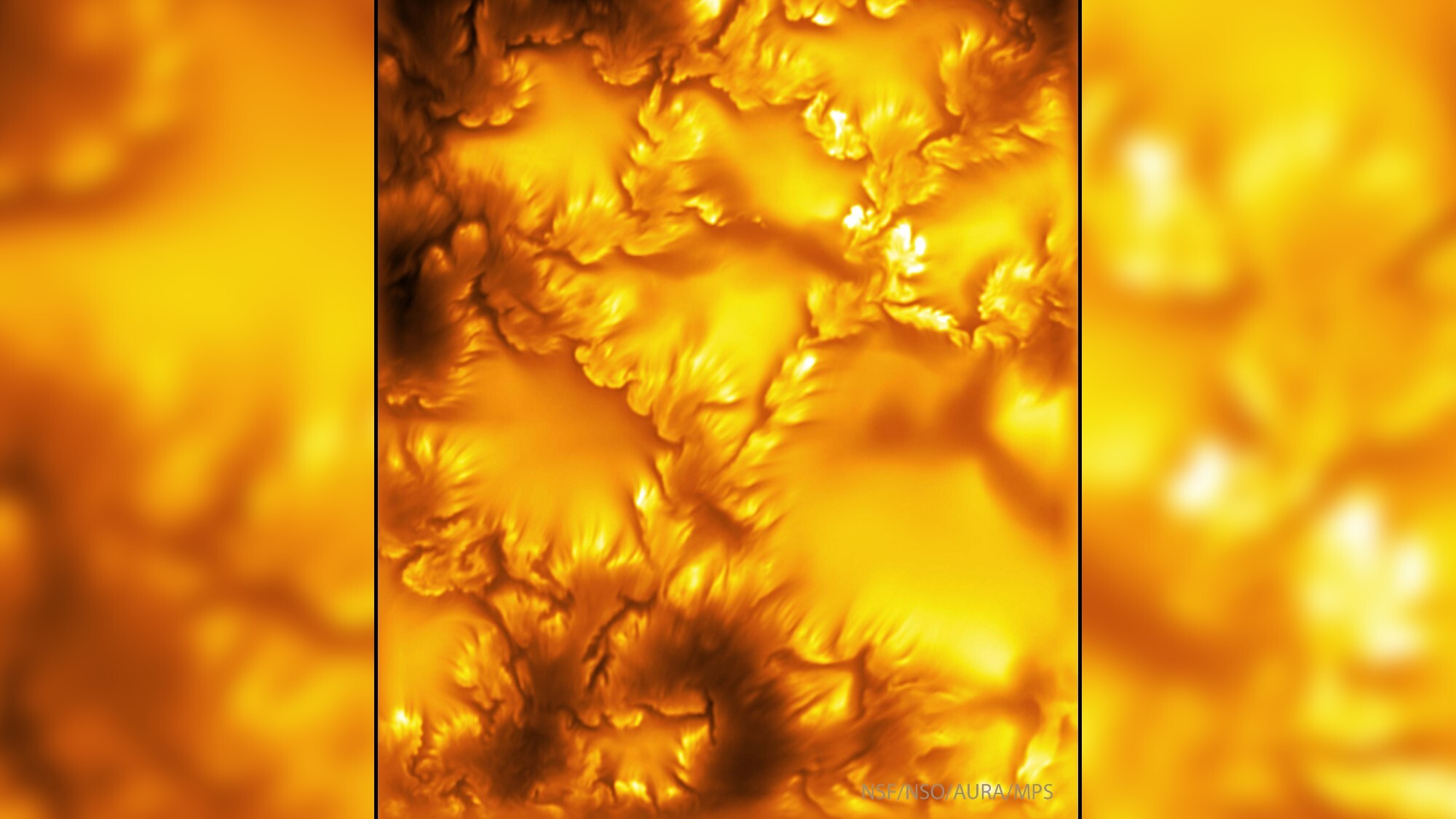
This image of the sun — the sharpest ever snapped — was captured by the NSF Inouye solar telescope. (Image credit: NSF, NSO, AURA, MPS, Inouye Tel)
Scientists have captured the sharpest image ever of our sun's surface. This view has revealed incredible new details about the inner mechanisms driving stellar activity.
What is it?
An international team of researchers using the U.S. National Science Foundation's Inouye Solar Telescope has captured the highest-resolution view of the sun's surface.
In analyzing observations from this telescope, the team, made up of researchers from the National Solar Observatory, the NSF NCR High Altitude Observatory and the German Max Planck Institut für Sonnensystemforschung, discovered strange patterns on the sun's surface. The whirling patterns, they found, are actually evidence of what's called Kelvin-Helmholtz instability (KHI), or instability that happens when there is a change in velocity of fluids.
Why is it incredible?
This image is groundbreaking. Capturing the highest-resolution view of the sun's surface is a massive accomplishment, and in the time-lapse video above, you can even see the fluid dynamics on the surface of the sun in motion.
But this view is much more than a beautiful, high-resolution image. These observations have revealed swirls on the sun's surface at the edges of the magnetic areas, allowing the team to identify KHI on the sun's surface. This fluid instability has long been suspected on the sun, but these observations are the first time they have ever been directly seen like this.
“We believe that the discovery of Kelvin-Helmholtz Instability in the solar photosphere, backed up by analysis of numerical simulations, is a major step forward in our understanding of the dynamics and evolution of solar and stellar plasma, and will serve as a basis for future discoveries," David Boboltz, the deputy director at the National Solar Observatory, said in a statement.
A paper describing these findings was published recently in the journal Nature.
Picture it: A swarm of tiny robot helicopters descends through a reddish-brown sky, landing gracefully on the Martian surface. What are they wearing? Tiny capes.
NASA's SkyFall mission will send a trio of mini rotorcraft to Mars equipped with ground penetrating radar technology which happens to look like little capes. These uniquely designed swaths of fabric look decidedly strange or even accidental in new videos from NASA's Jet Propulsion Laboratory (JPL) that show the little drones practice landing. But these capes are actually flexible antennae that will allow the craft to peer beneath the Red Planet's surface in search of water ice.
"The only way to detect shallow subsurface ice remotely is to fly close to the ground," Adrian Tang, SkyFall’s ground-penetrating radar lead instrument scientist at JPL, said in a statement on Thursday (Aug. 6). "By flying low and slow, a SkyFall helicopter could capture radar images that resolve the fine layering where dry soil gives way to ice, detecting its presence and mapping its extent."
Orbiting spacecraft have studied Mars for decades, imaging the planet and mapping it with radar. But from orbit, their radar is unable to see the first few feet of material just below the planet's surface — a zone where scientists expect to find shallow ice deposits mixed in with the rocks and dust. This work could be important for future astronauts who need to better understand the ground below their feet for safety reasons, and for future travelers searching for accessible ice to process for drinking water, oxygen and fuel.
Skyfall will follow in the footsteps of Ingenuity, the first rotorcraft on another world, which hitched a ride to Mars aboard NASA's Perseverance rover. The new choppers are based heavily on Ingenuity, which weighed just 4 pounds (1.8 kilograms) here on Earth. But Skyfall will be more capable than Ingenuity, whose main job was to show that choppers can explore the thin skies of Mars.
SkyFall's tiny cape ground-penetrating radar, which uses a type of flexible antenna called Vivaldi that was invented back in 1978, is designed to survey up to 16 feet (5 meters) below the Martian surface. The radar will be able to reach anywhere from several yards below the planet's surface to the uppermost layers of surface material.
And the antenna's unique design ensures that the SkyFall drones will be able to make these subsurface observations without damaging the equipment during landing.. The antenna is extremely lightweight, and the team miniaturized it to be both the right size and shape to fit the tiny helicopters, which sit just 6 inches (15 centimeters) above the ground at rest. The tricky thing was, the designers had to miniaturize the radar antennae while maintaining functionality. But they did just that, and these tiny radar capes will be able to bend and move out of the way as the rotorcraft do their thing, flying above and landing on the Red Planet.
"Although we managed to shrink the antenna quite a bit, it is about 1.5 times longer than the helicopter’s legs," Christine Gebara, SkyFall ground-penetrating radar mechanical lead at JPL, added in the statement.
"That means during landing, the Vivaldi has to bend out of the way — and if it lands on a rock, it bends even further," she added. "But when the helicopter takes off again, the antenna must spring back into place for data collection. Because SkyFall is expected to make dozens of flights exploring Mars, we needed an antenna that could repeatedly handle those pressures without losing its shape in flight."
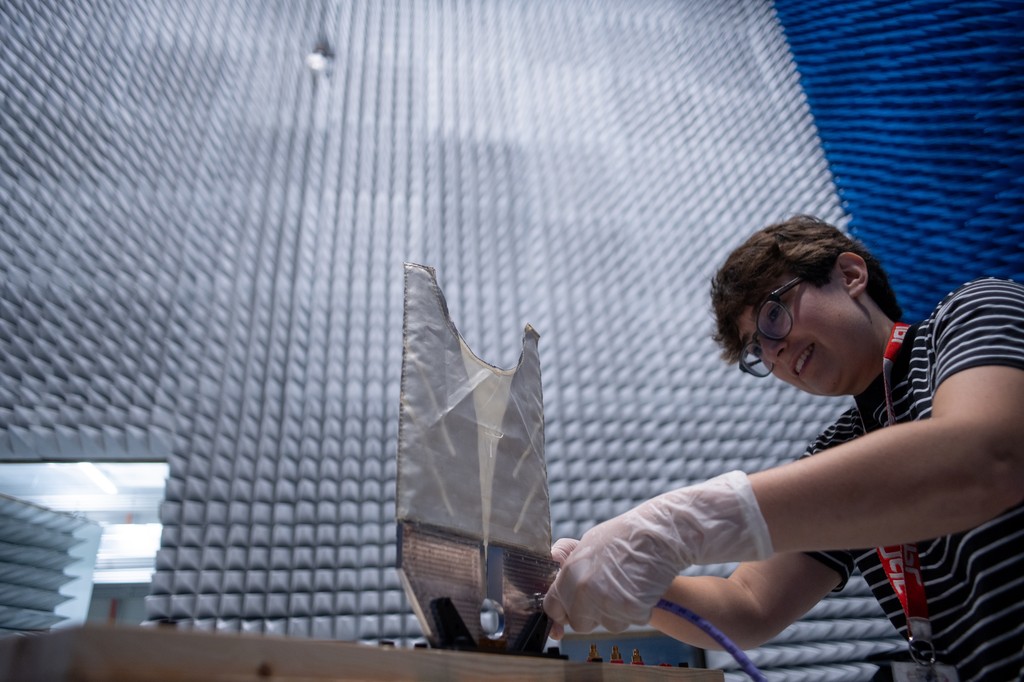
A radar engineer at NASA JPL works to test the antenna on the SkyFall helicopter. (Image credit: NASA/JPL-Caltech)
To make these little capes capable of withstanding incredible feats on another world, the engineers behind the helicopters covered the antenna in layers of polyester and Vectran, a flexible (but incredibly strong) material that was previously used for the airbag that cushioned NASA's Spirit and Opportunity Mars rovers during their touchdowns in 2004. The antenna's shape is also reinforced with flexible fiberglass tape springs and a lightweight structure. In total, each antenna weighs a miniscule 5 ounces (142 grams).
But a crafty design isn't enough. Getting to Mars is no small feat, and NASA needs to be sure that these little helicopters and their gear are up to the challenge. So, in JPL's Environmental Test Laboratory, which recreates different elements of environments beyond Earth, the SkyFall team put the rotorcraft and its little radar antenna to the test. They bent and flexed the antenna over and over, recreating multiple landings on the surface, exposed the craft to extreme temperatures, and continually checked to make sure that, throughout this testing, the helicopter could still transmit and receive radar signals. At the end of this testing, the antenna had endured 200 simulated Mars landings and was still working just fine. That is more than twice the number of landings expected from the mission.
"This test checked every box it was supposed to and answered our biggest technical questions," Tang added. "While we still have work ahead of us before the antenna is fully flight-qualified, this was a major milestone, and the hardware performed exactly as expected."
The trio of SkyFall helicopters will put their radar capes to the ultimate test when they fly to Mars. NASA plans to launch this mission to the Red Planet in 2028 aboard NASA's Space Reactor-1 Freedom, the first nuclear fission-powered interplanetary spacecraft.