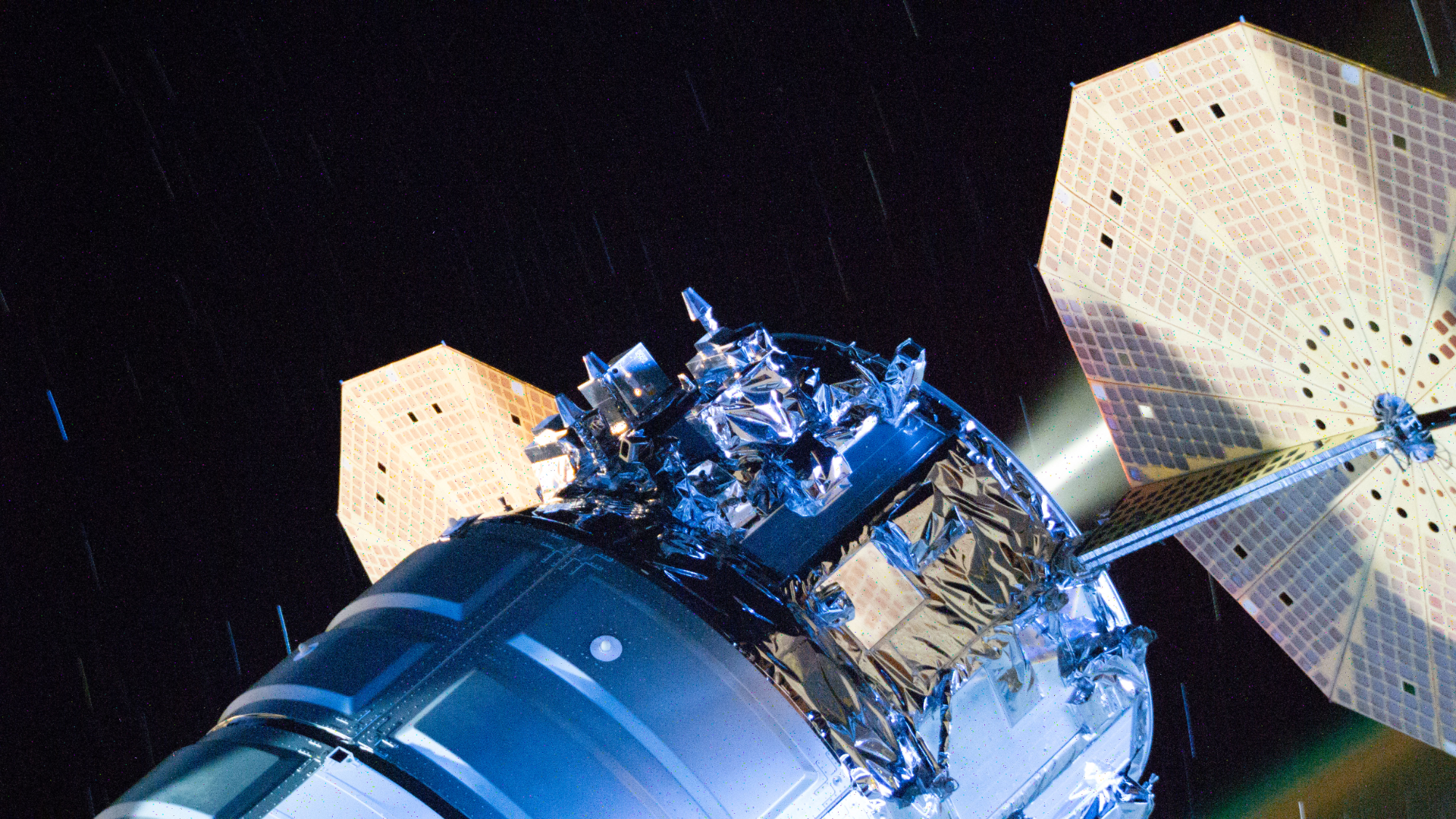
The engines fire on Northrop Grumman's Cygnus XL cargo spacecraft to lift up the International Space Station's orbit. (Image credit: NASA)
Everyone needs a helping hand from their friends now and again — even space stations. Recently, the International Space Station got an orbital boost from the docked Cygnus XL spacecraft, helping the station get to the correct altitude.
What is it?
On Aug. 27, while attached to the International Space Station's Unity module, Northrop Grumman's Cygnus XL cargo spacecraft turned its engines on and fired them.
This planned maneuver lifted the space station's orbit, pushing it into a higher altitude. This image snapped from orbit shows Cygnus, named for the swan constellation, as it's attached to the station for this planned push.
But why lift the space station to a higher altitude above Earth?
Next week, the space station will receive a new visitor: the Progress 96 resupply spacecraft. This altitude shift allowed the space station to shift into a position that will allow Progress 96, the 96th cargo mission in a series of Russian Progress cargo missions, to rendezvous and dock with the station.
Why is it incredible?
This maneuver was routine, but emblematic of the incredible progress we've made in space. Not only can we build spacecraft and send them into orbit, but we can control these spacecraft well enough that they help each other out, boosting each other when necessary.
And while Progress 96 might seem like a run-of-the-mill cargo ship carrying cargo like water, fuel, food, scientific instruments and additional supplies to the station, it is also the 96th Progress mission to a space station. In fact, the first Progress mission took place way before the International Space Station even existed. This first mission sent cargo to the Soviet Salyut 6 station all the way back in 1978 and with 96 on the verge of liftoff, the Russian Progress missions are going strong to this day.
Together, the combination of this lift maneuver and this 96th cargo mission show how incredibly well we as humans have worked together to build a sustainable presence in orbit and how that has happened with the aid of international collaboration between nations like the U.S. and Russia.
A dune field on Mars, as seen by the Mars Reconnaissance Orbiter. (Image credit: NASA/JPL-Caltech/University of Arizona)
Are those purple, wavy, alien thumbprints? Or perhaps an otherworldly ocean? Nope! It's actually a dune field on Mars, colored purple.
What is it?
Across the Martian surface are all sorts of unique features in the rocky, dusty surface material. In this false-color image, snapped by the HiRISE (High Resolution Imaging Science Experiment) camera on NASA's Mars Reconnaissance Orbiter, you can see the incredible and strange ripples of a dune field on Mars.
"Our science goal for this observation is to observe any changes from a previous image we acquired in 2011," a statement sharing the image reads. "For this footprint, the target enlarged and centered more over the dune field, which is located on the floor in the northern half of an unnamed impact crater."
Why is it incredible?
Spacecraft like MRO, with its HiRISE camera, have opened our eyes to the incredible features across the Martian surface.
From dune fields like we see here to craters and ancient riverbeds, these views have helped scientists piece together the planet's incredible, dynamic history. For decades, observations from orbit around Mars and by rovers on the planet's surface have helped to solve at least part of the mystery of what Mars was once like.
Researchers are still looking for signs that unequivocally point to life once existing on the planet. But so far, observations have showed that, billions of years in the past, Mars had abundant surface water — lakes, rivers perhaps even a huge ocean. In analyzing the material in and near ancient waterways on the planet with NASA's Perseverance rover, researchers have already found evidence that could possibly link to biosignatures.
While this image might look like a strange but beautiful purple-colored desktop background, photos like it this can be essential clues for scientists hunting for answers.
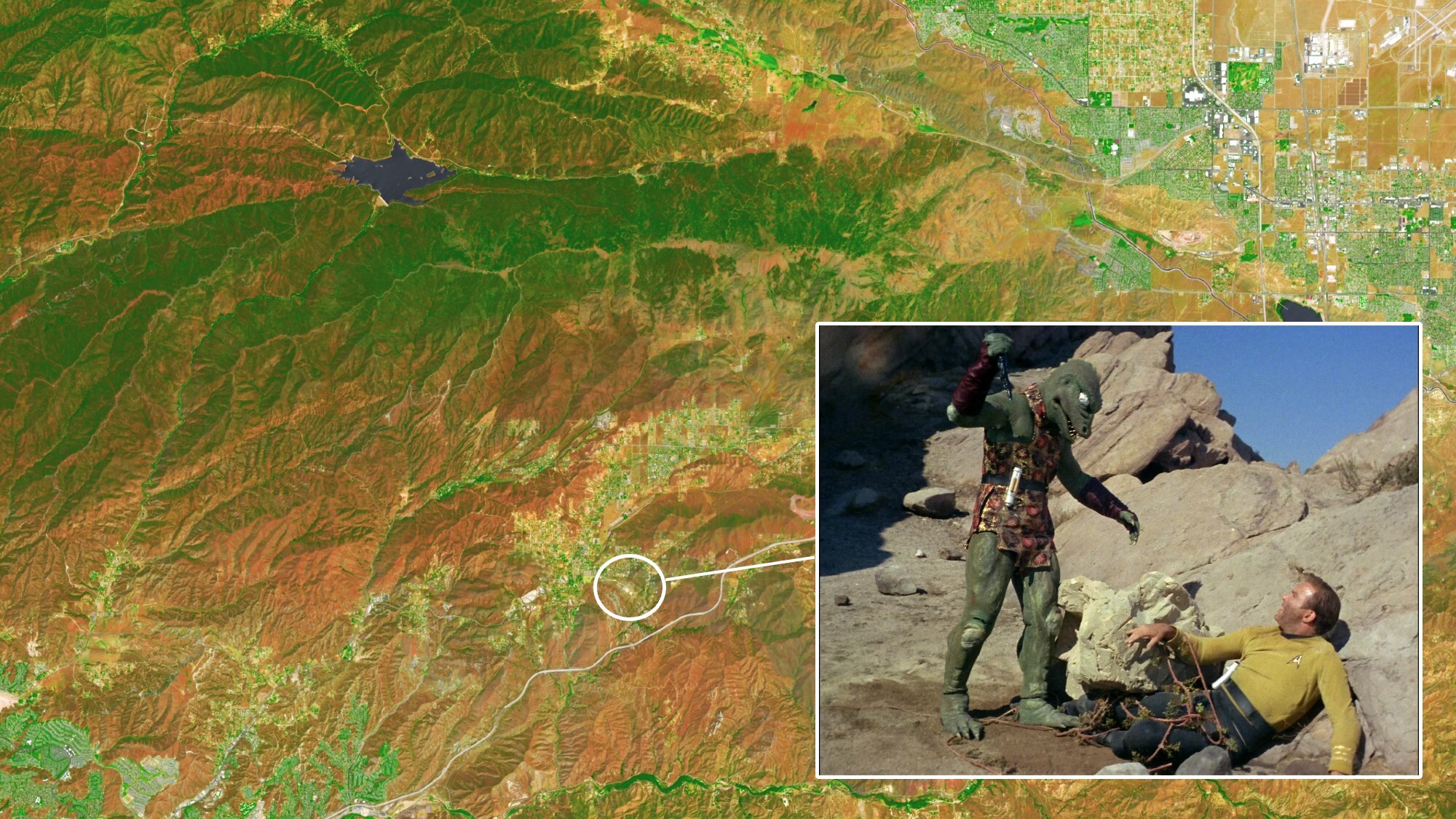
This new satellite image shows Vasquez Rocks in southern California, where Captain Kirk once faced off against the Gorn. (Image credit: NASA Earth Observatory/Michala Garrison/CBS via Getty Images)
Decades ago, Captain Kirk faced off against the Gorn on the uncharted desert planet Metron. But as we can see in new satellite imagery from NASA, that mysterious rocky world can actually be found right here on Earth in California.
What is it?
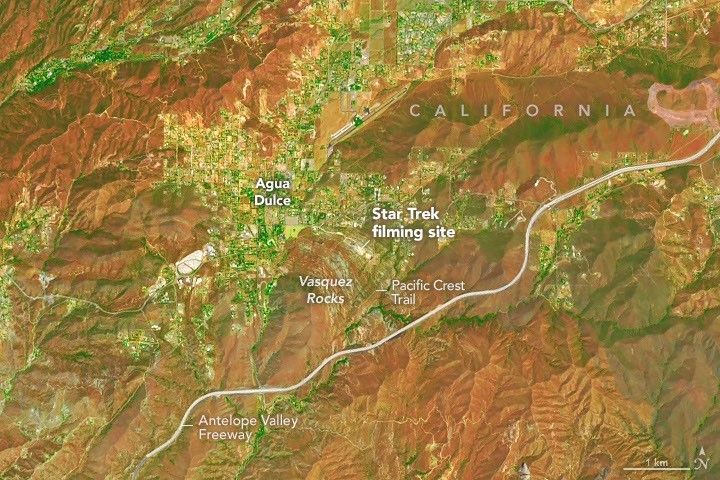
In this new image captured by the Operational Land Imager (OLI) on NASA's Landsat 9 satellite, you can see the wide variety of rock and vegetation in the area around Vasquez Rocks Natural Area County Park in southern California.
The 25-million-year-old Vasquez Rocks is a magnificent natural area with an incredible range of unique, large rocks jutting out of the ground. In this false-color image, you can see the area in shortwave-infrared and near-infrared wavelengths that show the differences in vegetation across the landscape.
And this location hides some amazing history. Not only is Vasquez Rocks home to incredible rock formations and desert vegetation, it is also where Captain Kirk fought the Gorn in Star Trek the Original Series. It's not a surprise the series chose this location for its infamous fight scene (among many other Trek scenes), as the massive, sun-bleached boulders pointing to the sky and barren landscape give it a distinctly alien feel.
A satellite view of the are around Vasquez Rocks. (Image credit: NASA Earth Observatory/Michala Garrison)
Why is it incredible?
While the rocky landscape of Vasquez Rocks is firmly fixed here on Earth, it has consistently made history as the backdrop to a whole host of iconic science fiction moments.
Indeed, Star Trek is one as Vasquez Rocks has been used for filming in a whole host of Trek episodes. It was even Spock's home world of Vulcan in the films Star Trek IV: The Voyage Home and Star Trek (2009).
But beyond Star Trek, the site has been used for filming sci-fi classics like Galaxy Quest, Battlestar Galactica and Planet of the Apes in addition to a whole host of cowboy movies and more.
It turns out that right here on Earth, we can find perfectly good alien worlds.
Global warming will soon cross a critical threshold, surpassing a dangerous limit set years ago, the United Nations Environment Programme (UNEP) has found. But experts say it's still possible to cool things back down, emphasizing that the stakes are too high to stop trying.
In 2015, 196 nations and territories signed the Paris Agreement, pledging to restrict the average rise of global temperatures to below 2 degrees Celsius (3.6 degrees Fahrenheit) above pre-industrial levels. Ideally, the rise was meant to be kept to 1.5 degrees C (2.7 degrees F) above those levels. However, according to a new report detailed by the UNEP, we are on track to cross that 1.5 C line — and soon.
"This summer's scorching heat, raging wildfires and deadly floods are a warning of what lies ahead. We must make the overshoot above 1.5 degrees as small and short as possible. That demands an overshoot of ambition," U.N. Secretary-General Antőnio Guterres said in a statement.
According to the new report, experts have found that if we as a planet continue with business as usual, not only will we pass 1.5 C, but it will happen within just a few years. The report, however, maintained a positive tone. Rather than simply predicting a doomsday plot, the main purpose of this release is to outline a pathway with the necessary steps to set things on the right track.
"As global temperature rise gets set to cross 1.5°C, pushing climate risks and impacts to dangerous new heights, the world must strive to return to below 1.5°C as soon as possible and simultaneously reduce the vulnerability of societies, communities and economies to climate impacts," the report, titled "Limiting Overshoot: Navigating exceedance of 1.5°C and pathways towards return," states in its abstract.
Climate change is primarily caused and driven by human activities like transportation, industrial manufacturing, agriculture and more. According to the report, the two main aspects of this work need to be: reducing emissions and enabling adaptations to protect people impacted by the effects of climate change.
The U.N. states in the report the necessity of both an immediate and sustained reduction in the emissions of greenhouse gases like methane and carbon dioxide. Not only do we need to find a way to cut emissions fairly immediately, but we also need to find a way to sustain that effort over time. The U.N. further states it is important to not only work toward removing carbon from the atmosphere, eventually reaching net-negative emissions where more emissions are removed by humans from the atmosphere than added to the atmosphere.
This sort of carbon capture technology is still fairly early in its development, but according to the U.N., it is essential we find ways to rapidly move toward a future where we can capture and store carbon from the air and therefore reduce the quantity of greenhouse gases around our planet.
In addition to these long-term emission reduction actions, in this report the U.N. has also asserted that this process will need to include "adaptation actions," or ways to support the many people and communities already affected by climate change.
Even if all of the world's nations start working immediately to drastically reduce emissions, we are already seeing the sometimes fatal and irreversible effects of climate change. From increasing the intensity of wildfire seasons to worsening natural disasters, climate change is far from a distant future. It's our reality, especially for those living in high-risk areas like coastlines. So, while the nations of the world need to work together to reduce emissions, it is also important that adaptations are found to reduce the existing and future impacts of climate change on our communities.
"There are no good outcomes if we remain above 1.5°C. Across the globe, extreme heatwaves are already proving that climate impacts will strike faster, hit harder, and last longer — costing more lives and causing deeper disruption," Inger Andersen, the Executive Director of UNEP, said in the same statement. "Now is the time we must double down on climate action. We can — and must — get on the right path. By cutting greenhouse gas emissions, strengthening resilience and adaptation, and ensuring exceedance of 1.5°C is as small and short as possible."
The Anak Krakatau volcano began erupting on Sept. 4, 2026, as seen here on Sept. 5 by the Landsat 8 satellite jointly operated between NASA and the U.S. Geological Survey (USGS) (Image credit: NASA Earth Observatory/Michala Garrison)
A volcano on an Indonesian archipelago began erupting on Sept. 4, and satellites in orbit have been watching closely.
What is it?
The volcano Anak Krakatau started spitting out ash and lava on Sept. 4. On an archipelago between Sumatra and Java, the island volcano's sudden eruption grounded flights, closed schools and even stopped fishing in the area.
The volcano launched ash into the air and into the city of Jakarta and the Lampung province during a 25-hour-long eruption. But even following this eruption, Anak Krakatau remained active throughout the weekend. In fact, the volcano is still so active that it could erupt again soon.
But it wasn't just people on Earth watching the volcano erupt this past weekend. The Landsat 8 satellite, operated by NASA and the U.S. Geological Survey (USGS), spotted a white plume of volcanic gas billowing into the atmosphere all the way from space. The white plumes of gas are thought to mainly contain water vapor, carbon dioxide and sulfur dioxide, while ash and debris make up the brown clouds surrounding the plumes.
Why is it incredible?
While Anak Krakatau simmers after this most recent eruption, this event isn't a major shock, as the volcano sits in what is known as the "Ring of Fire." This "ring" (a loose term, as it's not exactly a ring) snakes about 25,000 miles (40,000 kilometers) around the Pacific Ocean and includes over 750 volcanoes, some dormant and some active.
In fact, in Indonesia alone there are 500 volcanoes, and 127 of them are active, including Anak Krakatau. And this volcano has a particularly interesting story: It emerged from the sea in 1927, rising from the caldera formed by the 1883 eruption of Krakatau (also known as Krakotoa), which was one of the most famous and destructive volcanic events in history. (Anak Krakatau means "child of Krakatau" in the Indonesian language.)
While not all geologists agree on the exact margins of the Ring of Fire, it rests on a string of tectonic plates and has existed for over 35 million years. And not only is this ring home to hundreds of volcanoes, it's also a hot spot for earthquakes.
CAPE CANAVERAL, Fla. —President Trump interrupted a NASA press conference today (Aug. 30) to congratulate the Nancy Grace Roman Space Telescope team on a successful launch. Just a few years ago, however, the president tried to cancel this very mission.
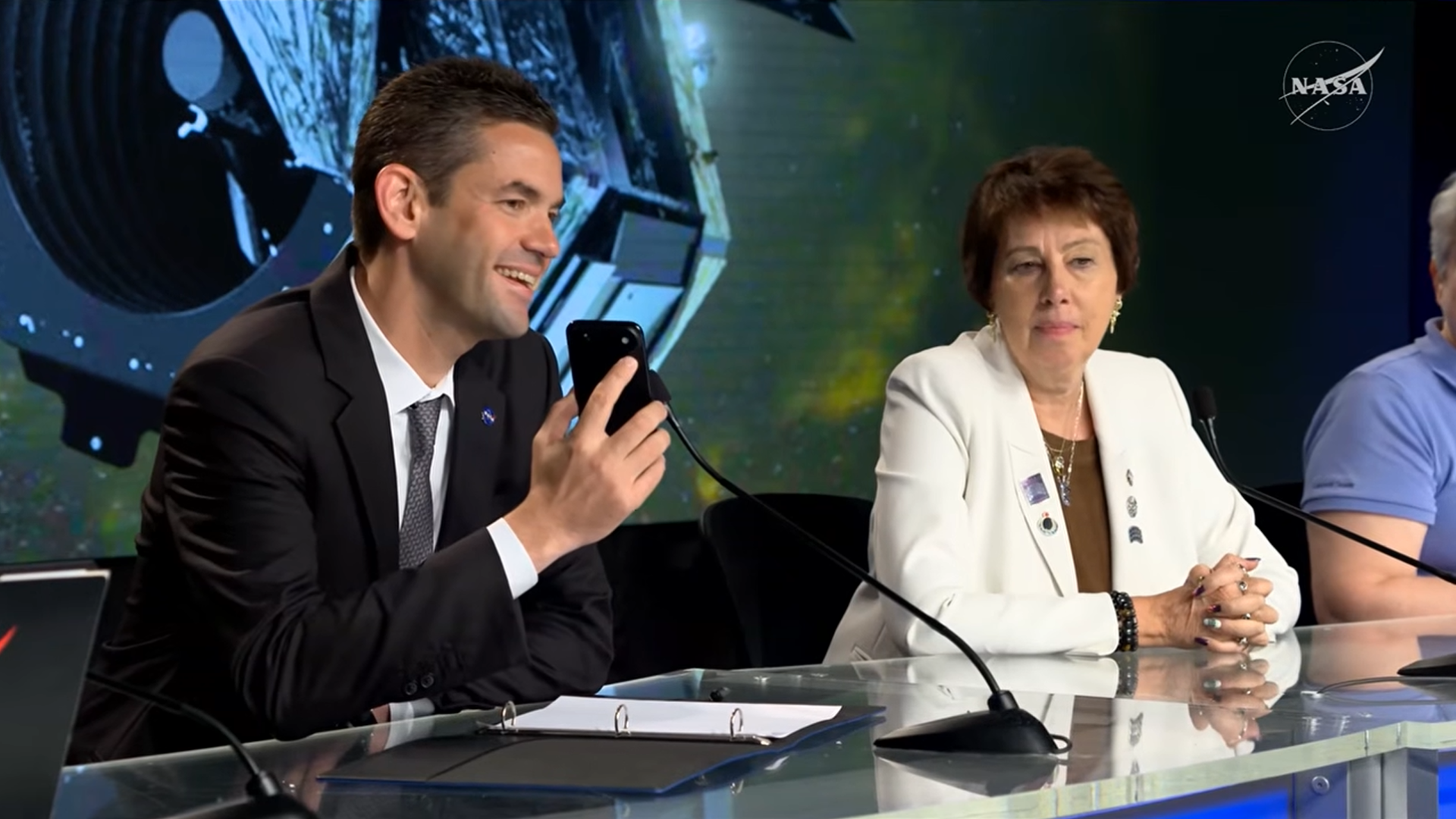
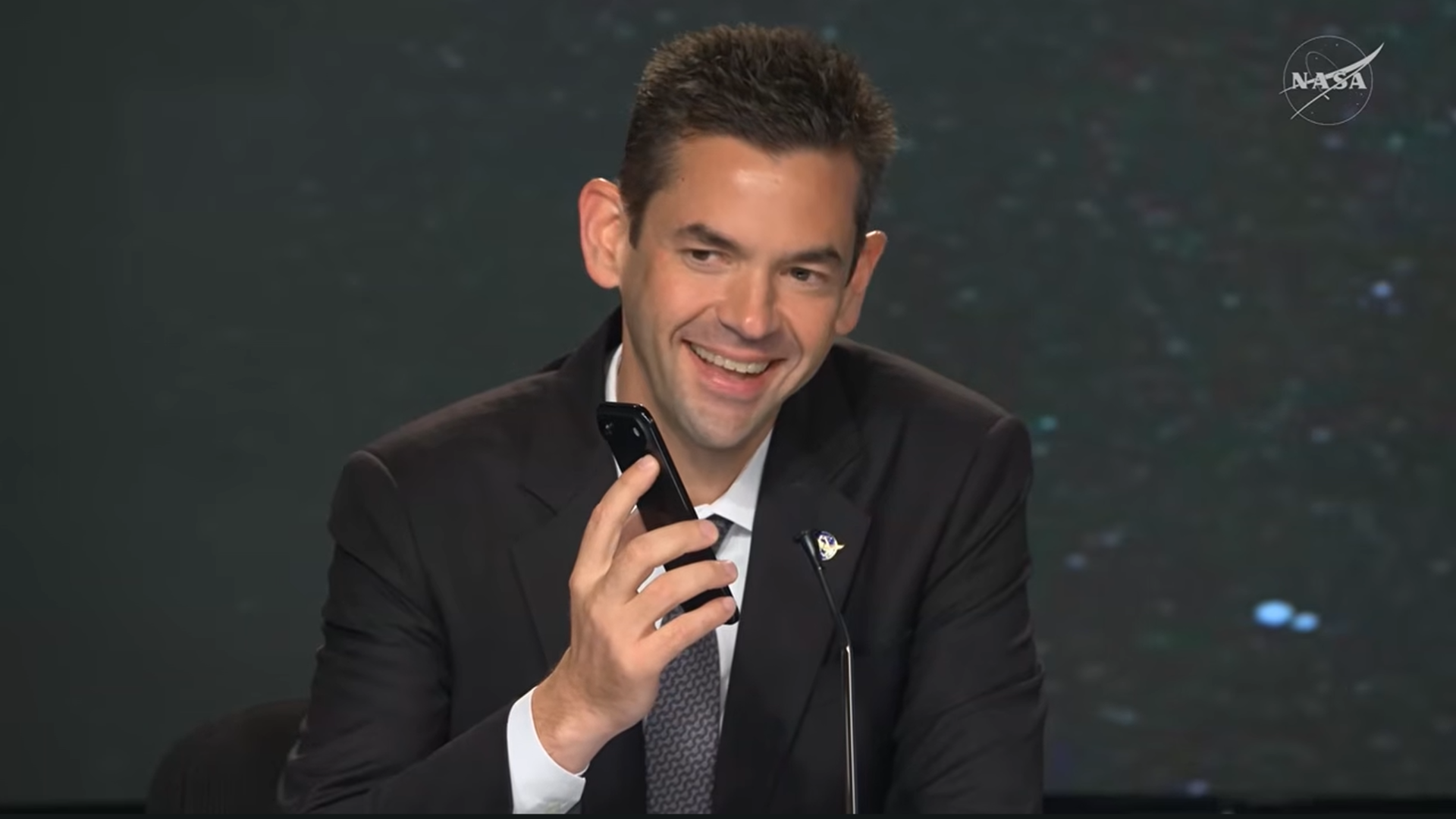
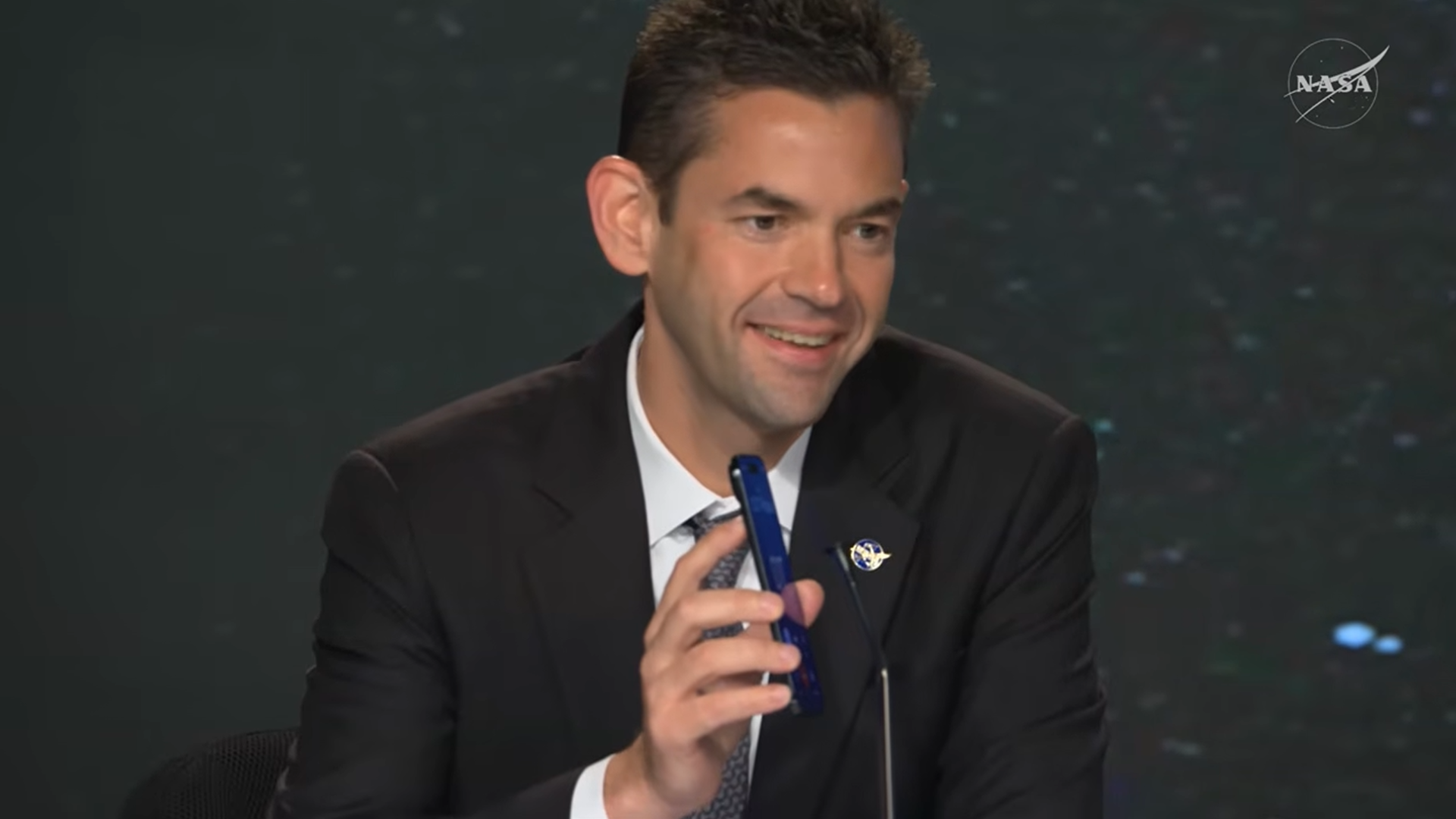
In today's briefing, mission leadership was going through the specifics of Roman's successful launch and the science the observatory is expected to deliver when NASA Administrator Jared Isaacman got a phone call. It was the president. The room fell silent, though I could hear Nicky Fox, NASA associate administrator for the Science Mission Directorate, say, "He's not kidding."
"Hello, sir," Isaacman said. He got up to take the call outside the room but came came back in a few moments later. "The president of the United States would like to address and congratulate everyone on this mission," he said. "You're live, Mr. President."
Jared Isaacman takes a surprise phone call from President Trump during the post-launch briefing following the launch of the Nancy Grace Roman Space Telescope on Aug. 30, 2026. (Image credit: NASA )
"I just want to thank everybody and congratulate you," Trump said on the phone, which Isaacman held up to the microphone and clearly displayed Trump's name. "Boy, it looked beautiful on television ... You are doing a fantastic job, and I'm supplying you all that money."
The president spoke for more than a minute while Isaacman smiled, holding the phone up to a microphone for everyone to hear, and the crowd of journalists listened intently. The call was mostly congratulatory, but Trump did go on a brief tangent, claiming that he has taken NASA to new heights.
Near the beginning of his first term in 2016, Trump said, he visited NASA's Kennedy Space Center (KSC) in Florida and saw that "grass was growing through the cracks in the runways, and there were a lot of cracks. And I looked; that place was closed ... It was just literally closed. And now, again, like we are with the country itself, we're the hottest there is. We're the hottest. You're the hottest in space, and we have the hottest country anywhere in the world."
(To clarify, KSC was only closed for two days in 2016, and that was because of Hurricane Matthew.)
President Trump's relationship with the Roman mission is more complicated than today's congratulatory call might suggest, however. Under the Trump administration, the White House has repeatedly tried to cancel or restrict funding for this mission.
Between 2019 and 2021, for example, the president proposed canceling Roman (then called WFIRST) three separate times in three different budget requests. Congress rejected those proposals and kept the mission funded. But then, in April 2025, reports emerged about initial "passback" budget documents that proposed slashing NASA science funding by about 50%. The proposed cuts were deep enough, experts suggested, that the Roman mission would end if they were passed. That didn't happen either, of course; Congress ended up passing a $24.4 billion NASA budget for fiscal year 2026, keeping the agency's funding relatively flat.
As Trump made his call today to a room packed with science journalists, this bit of recent budget history did not go unnoticed.
Jared Isaacman takes a phone call from President Trump to congratulate the Nancy Grace Roman Space Telescope mission team. NASA Donald Trump's name glows on Jared Isaacman's phone as he holds the phone up to a microphone during a surprise call during a post-launch briefing. NASA
A direct question
"Question for the administrator," SpaceNews reporter Jeff Foust asked Isaacman today following Trump's call. "It's great to hear the president call in and show us excitement about the Roman launch. I know the administration in past years, in its first term, proposed zeroing out Roman and also proposed a serious cut in Roman's budget just last year. What did you tell the administration, and the president, to change his mind and make him so excited about a mission that he once proposed to cancel?"
Isaacman did not directly address the question, focusing instead on the current climate, which he said is very positive.
"I'm incredibly grateful for his support, the space policy, the resources," Isaacman responded. "Sounds like from that call, maybe even more resources, which is also a great thing for more missions of science and discovery."
Nearly a decade ago, I found myself laughing alongside one of the most iconic women in astronomy. This week, a telescope bearing her name launches to the stars. So let's travel back in time and meet Nancy Grace Roman together.
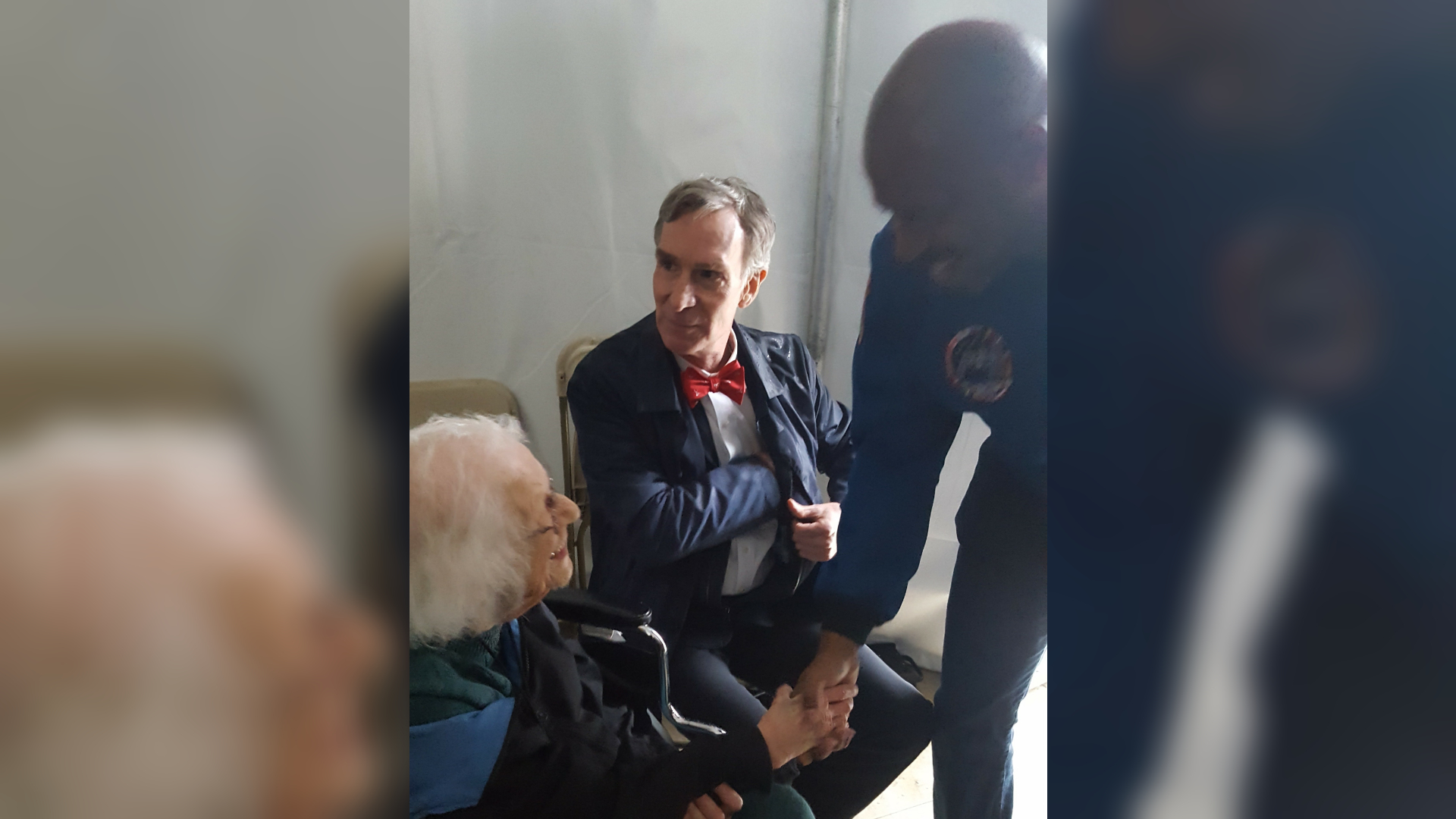
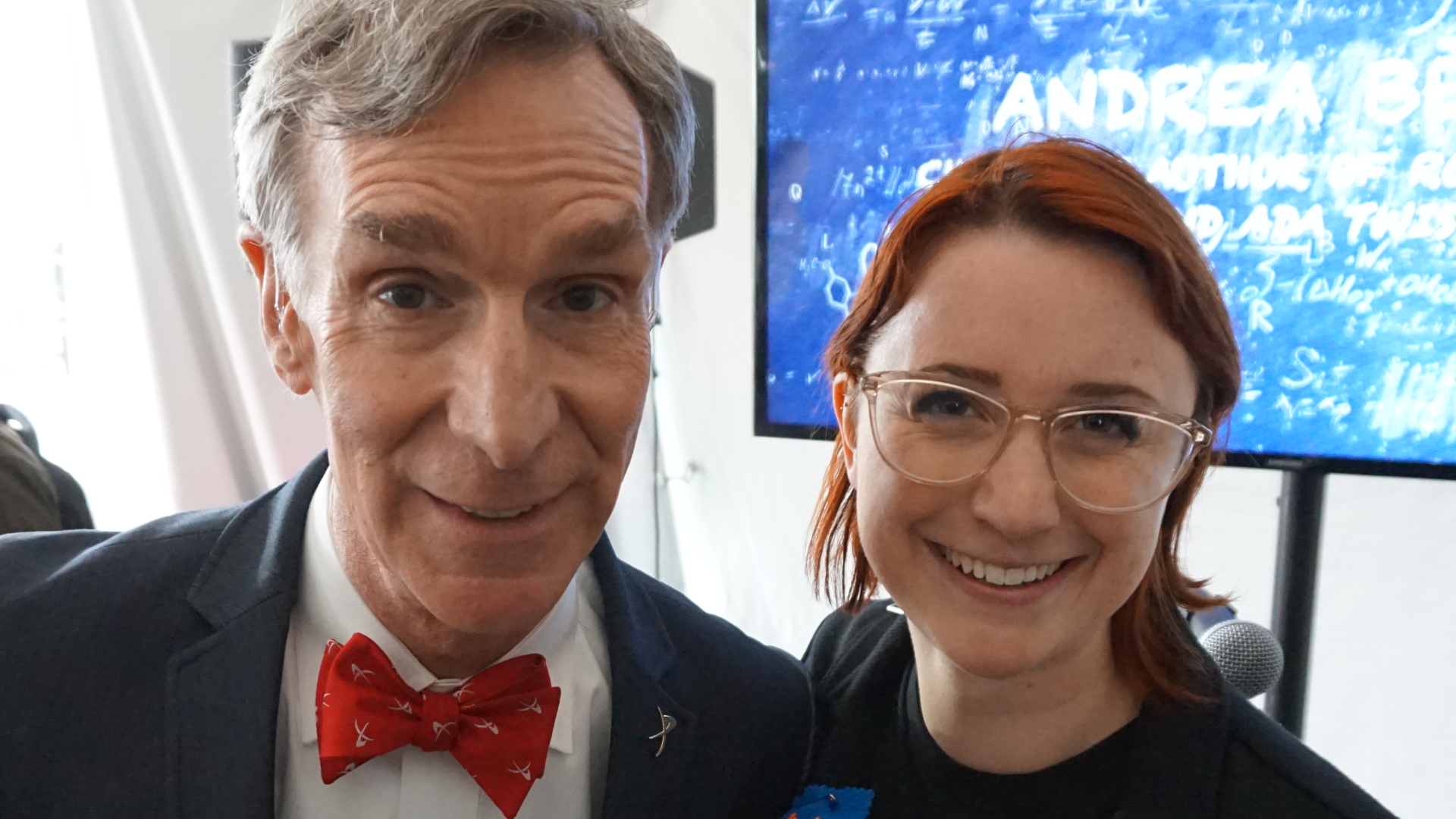
Standing under a tent in Washington D.C. at the 2017 inaugural "March for Science," a hodgepodge of scientists and reporters crowd together as the rain pours down outside. "That's Nancy Roman," I hear Bill Nye whisper to me as we stood on the outskirts of the tent. And as I struggled to keep my cool next to one of my childhood heroes, here he is pointing out another.
Looking across the room, I see her. There, in the corner of the tent, a woman with white hair wearing a "science not silence" pin sits by herself, soaking in the scenery. I hadn't noticed her before as, with the noise and crowd, it was tough to notice much of anything. But Bill was right. There she was, the "mother of Hubble." The woman who pioneered astronomy at NASA and pushed space science into the future.
A quick catch-up
If you're not too familiar with Nancy, let's speed run a little bit of information about the woman whose name was chosen to represent NASA's latest space telescope.
Nancy Grace Roman, born in 1925, was a pioneering astronomer and the first chief of astronomy at NASA. In creating and leading NASA's astronomy program, she was also the first woman in an executive position at the agency.
She earned the nickname "mother of Hubble," because of the critical role that she played in realizing the Hubble Space Telescope. She spent all 93 of her years exploring the universe.
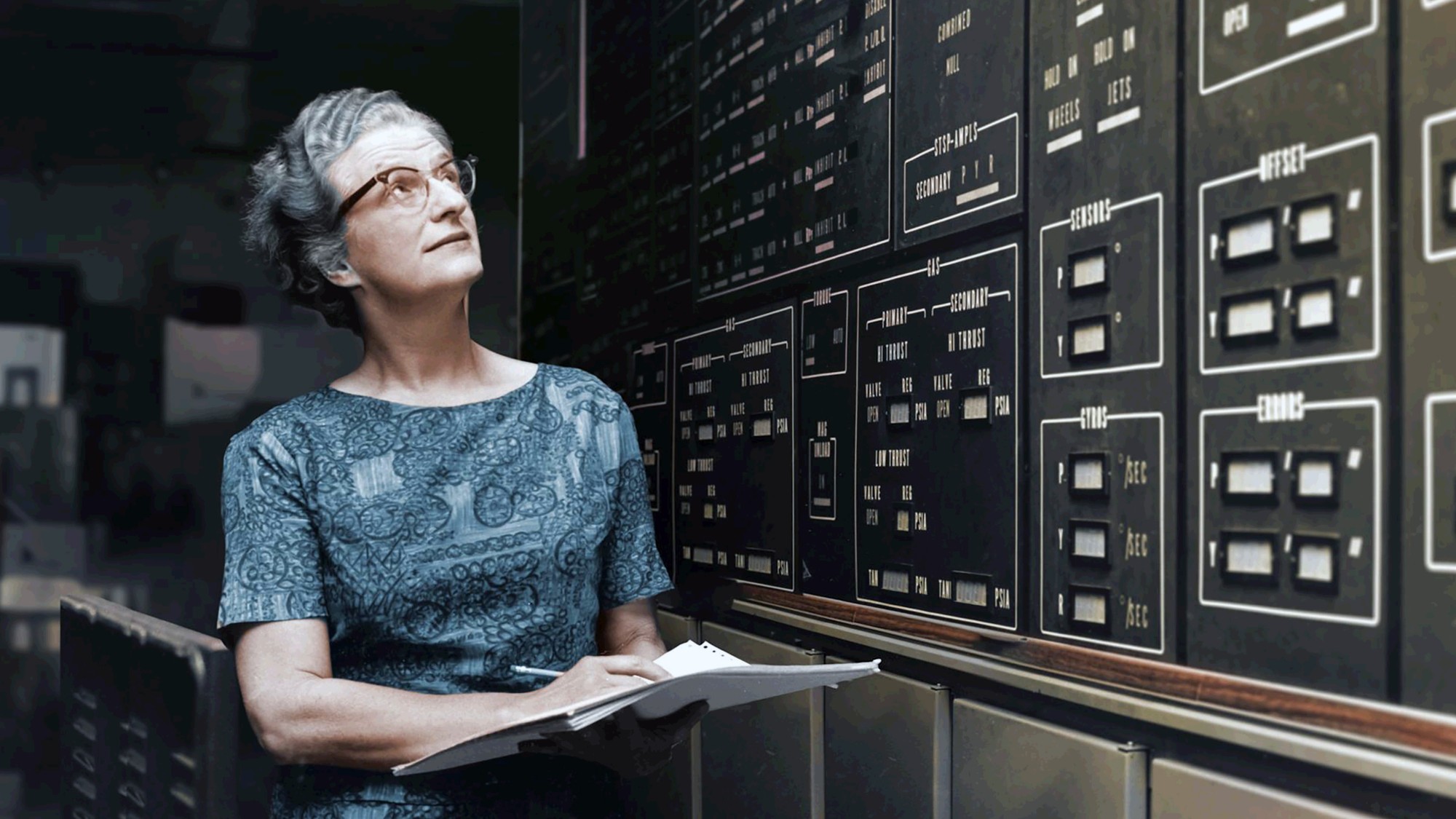
Portrait of American astronomer Nancy Grace Roman at NASA's Goddard Space Flight Center in Greenbelt, Maryland in the early 1970s. (Image credit: NASA/Interim Archives/Getty Images)
Meeting Nancy Grace Roman
Now, in this moment I'm already overwhelmed meeting Bill Nye for the first time. Unsurprisingly, I was a science-obsessed 90s kid who would wait my turn at the computer just to explore the lab in the Bill Nye CD-ROM game. But now, all of a sudden I'm also made aware that this woman who paved the way for modern astronomy is just sitting right there, mere feet away from me across the tent. And I knew I had to say hello.
So, walking over, I introduced myself.
"Hi, it's so nice to meet you," I offer, reaching out my hand to shake hers, unsure of what else to say. "I'm a bit starstruck."
And without missing a beat, she responds: "You know, I have a thing for stars," delivering the quip with a small laugh and a bright sparkle in her eye.
She holds my hand for a moment and we smile and giggle together. It's so brief, maybe just a few seconds, but for that moment I shared a cheeky inside joke with one of history's most important astronomers.
But just as the moment passes, I once again see Bill Nye, this time accompanied by NASA astronaut Leland Melvin, walking up to greet Nancy.
Bill Nye whispers something to Nancy Grace Roman.Chelsea Gohd/Space.comLeland Melvin shakes Nancy Grace Roman's hand while Bill Nye stands nearby. Chelsea Gohd/Space.comBill Nye with Space.com's Chelsea Gohd. Chelsea Gohd/Space.com
The pair are both incredibly accomplished icons in their own right. But in approaching Nancy, it was clear that I wasn't the only one starstruck. One by one, Bill and Leland leaned down and shared their own personal moments with Nancy, holding her hands just as I did and speaking with her in hushed tones as their eyes lit up with the same delight that I felt in mine.
Time seemed to stand still as the two spoke to Nancy; two legends in space and science meeting their own science hero. And just standing nearby, I felt the love and admiration for Nancy, whose impact on astronomy will be felt for many years still to come.
This entire meeting took place over the course of mere minutes. But still, 9 years later it sticks in my memory. About one year after this event, Nancy passed away at the age of 93. And today, her legacy lives on in Hubble, in the trail she blazed forward in astronomy and for women in science and now in the space telescope bearing her name.
Nancy always had a thing for stars, and even though she's gone, I like to think that with the Nancy Grace Roman Space Telescope, she'll finally get to be among them.
The Nancy Grace Roman Space Telescope is about to launch on an incredible adventure to help scientists explore the great mysteries of the universe. But who was Nancy Grace Roman?
You might have heard about the upcoming launch on Sunday morning (Aug. 30), which will send NASA's next flagship space telescope up to investigate everything from dark matter and dark energy to far-off worlds beyond our solar system. But do you know who the telescope is named for? This observatory will be an absolute powerhouse for astronomy, and its namesake is perfectly fitting.
Nancy Grace Roman was the first-ever chief astronomer at NASA and the agency's first female executive. She created NASA's space astronomy program in 1959, just one year after the agency was created. She laid the groundwork for modern astronomy and played a critical role in making missions like the Hubble Space Telescope happen, a feat that earned her the nickname the "mother of Hubble." In short, Nancy Grace Roman was a trailblazing scientist and leader whose work has made modern space science possible. But let's dig a little deeper.
Roman's early years
Roman was born on May 16, 1925. Her mother was a music teacher and her father was a geophysicist. Over the years, Roman would often attribute her early interest in science to influence from her parents.
"I teasingly have blamed my mother for getting me interested in astronomy, because I can remember up in Michigan she used to take me out at night and show me the constellations and the aurora and things like that. But she also showed me birds and trees and animals and plants and that sort of thing, so it wasn't just astronomy," Roman said in a 1980 interview with David DeVorkin. That conversation took place just a few years after Hubble formally began development and a decade before the space telescope would launch (though at this time, Hubble was still called the "Large Space Telescope").
Roman's passion for astronomy grew, and, at age 11, she started an astronomy club with classmates. In addition to getting her friends involved in her astronomical interests, she spent her time checking out books from her local library in a quest to learn as much as she could. As she put it, she "read everything I could get my hands on." And by junior high, Roman had already decided to become an astronomer.
"I can remember thinking, probably in junior high school or early high school days, that I wanted to go into astronomy," she said, adding that her parents were supportive of her early decision to study the stars.
At that time, not all colleges even allowed women to apply, so Roman had to look for a school that both accepted women and had a solid astronomy program. She eventually ended up choosing Swarthmore College in Pennsylvania, which she attended through the end of World War II. Roman would go on to graduate school at the University of Chicago, where she studied astronomy and worked at the Yerkes Observatory, where she was the first woman on the academic staff.
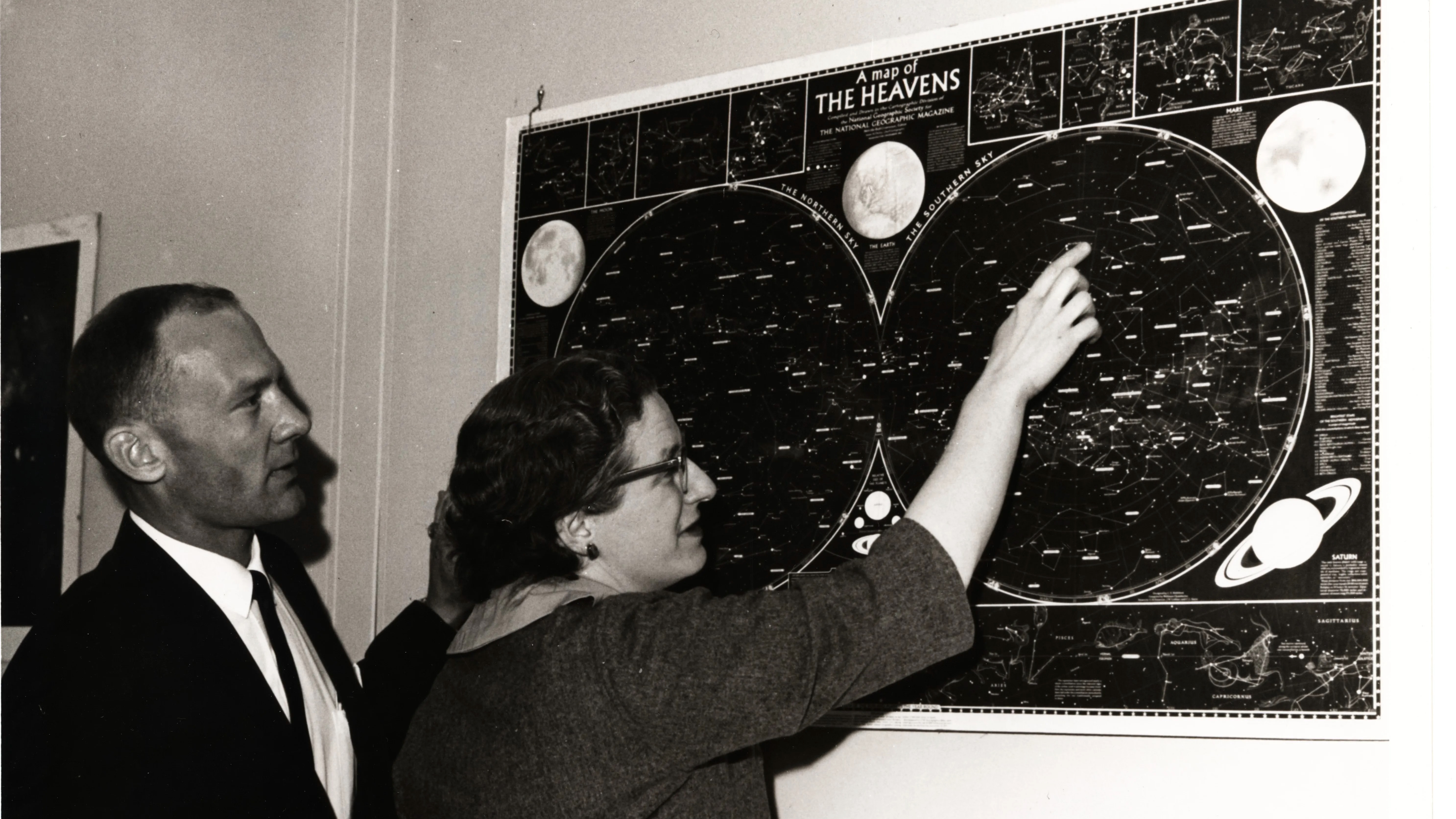
Nancy Grace Roman briefs Edwin (Buzz) Aldrin on celestial objects in Washington, D.C. in 1965. Aldrin would go on to complete three spacewalks and become the second person to walk on the moon. (Image credit: NASA)
Trailblazing at NASA
After spending her early-career years at academic institutions, Roman moved on to conduct astronomy research at the U.S. Naval Research Laboratory (NRL). She was building her career observing stars and galactic structure, bouncing radar off the moon, studying orbital mechanics and so much more.
Then, in 1959, a new opportunity arose. With her expertise and experience across astronomy, and with NASA just getting up and running, Roman was asked to join the new agency and create its first astronomy program. In stepping into this role, Roman became NASA's first-ever chief astronomer, as well as the agency's first female executive.
"The idea of coming in with an absolutely clean slate to set up a program that I thought was likely to influence astronomy for 50 years was just a challenge that I couldn't turn down," Roman told DeVorkin. She added that, when she started NASA's astronomy program, she spent a great deal of time visiting astronomy departments across the country, not just to communicate what NASA was doing but also to understand what astronomers wanted to accomplish with the agency. And it was at the 1959 American Astronomical Society meeting that Roman announced NASA's brand-new astronomy program.
While Roman had been heavily involved in research prior to joining NASA, her role expanded considerably when she began heading the agency's astronomy program. In addition to continuing her astronomy research outside of NASA, she was now leading NASA's early space missions. From finding astronomers to join NASA to working alongside engineers to proposing mission budgets and navigating the many convoluted channels of a government agency to make these missions happen, Roman worked across many areas of the field to lead astronomy at the agency.
A decade after she joined NASA, Apollo 11 landed the first humans on the moon. So, as Roman pushed for progress in science, crewed spaceflight missions were taking center stage. But Roman and her colleagues fought to continue astronomy at the agency alongside crewed spaceflight. This role required her not only to be an exceptional astronomer but also to understand the political landscape both within and surrounding NASA.
Roman realized "the importance of the politics in the scientific community," she said. "We do have to deal with it, even though we would like to make all of our decisions in a vacuum strictly on scientific and technical grounds."
'Mother of Hubble'
Roman had a hand in many missions, projects and research fields, and some of the work she did helped change humanity's understanding of the cosmos. The most notable example may be the Hubble Space Telescope.
The idea for a "Large Space Telescope" (an early name for Hubble) had been around since the 1940s. But there was heavy skepticism about how feasible it would be — and also how much it would cost. Leading astronomy at NASA, Roman really had to sell the importance of this telescope to Congress to receive the funding necessary to make it happen. She pitched the project, coordinating efforts across NASA to make sure that the message landed on Capitol Hill.
"It was Nancy in the old days, before the internet and before Google and email and all that stuff, who really helped to sell the Hubble Space Telescope, organize the astronomers, who eventually convinced Congress to fund it," Edward J. Weiler, Roman’s successor as chief scientist for Hubble, told the Voice of America in 2011.
Hubble opened our eyes to the cosmos, completely changing astronomy as we know it. The space telescope hasn't just collected incredible data; its images have also given the general public a new appreciation for the beauty and wonder of space. And so, in making Hubble happen, Roman didn't just advance scientific progress in astronomy; she also built an enduring bridge between the public and astronomy that continues to this day.
Roman won't get to see her namesake telescope launch into the heavens; she died on Dec. 25, 2018 at the age of 93. But its work will continue the legacy of NASA space science that she worked so hard establish and develop.
NASA took the guts out of old spy satellites to build the groundbreaking Nancy Grace Roman Space Telescope – but how? And why?
Years of hard work and anticipation are culminating as we sit on the verge of NASA's launch of its next-generation space telescope. Set to lift off this upcoming Sunday (Aug. 30) aboard a SpaceX Falcon Heavy rocket, the Roman Space Telescope will push astronomy into the future, exploring the mysteries of dark energy, studying far-off worlds and expanding our understanding of the universe around us. But to get to this point, NASA used some … unexpected technology.
At the core of the observatory lies the Optical Telescope Assembly. This houses the telescope's primary mirror, its main mechanism through which it surveys the cosmos, nine additional mirrors, supporting structures and various sorts of electronics. But where did all of this tech come from? The National Reconnaissance Office (NRO), which builds spy equipment for U.S. agencies like the CIA. That's where.
In 1999, the NRO stood up the multibillion-dollar "Future Imagery Architecture" program, which contracted out new spy satellites. The NRO contracted Boeing for the project, having the company design a whole suite of new optical and radar imaging reconnaissance satellites. They're basically spy satellites. In 2001, in a post-9/11 America, this effort continued to ramp up with national security concerns at an all-time-high. However, this flurry of spy satellite development was short-lived. And with billions of dollars in overrun costs from Boeing, the project closed in 2005.
At the time, the New York Times called the program "perhaps the most spectacular and expensive failure in the 50-year history of American spy satellite projects."
But one program's spectacular failure is another program's free space tech treasure.
Years later, in 2012, the NRO donated two unused space telescopes from this program to NASA. With optics said to be similar to the Hubble Space Telescope's, two free telescopes presented the agency with a tantalizing opportunity. This donation happened just a couple of years after Roman (then known as WFIRST) was originally proposed — and even though it would cost money to rework the hardware and build the rest of the space telescope out, this provided the possibility of a serious cost alleviation to the mission.
After considering the possibility, the team decided it was the right call. And in 2011, years before Roman (WFIRST) was even formally designated as a mission by NASA, the agency announced that they would be reusing this spy satellite technology. This decision followed the 2010 National Academy of Science Astronomy and Astrophysics Decadal Survey, which pointed to Roman as its highest priority.
While this donated spy satellite part came withtop-tier optics, it was also free. The most recent space telescope to launch was the James Webb Space Telescope (JWST), which lifted off in 2021 but was in development since the mid-1990s. The JWST garnered significant public attention and scrutiny for being both well behind schedule and way over budget, ultimately costing a whopping $10 billion.
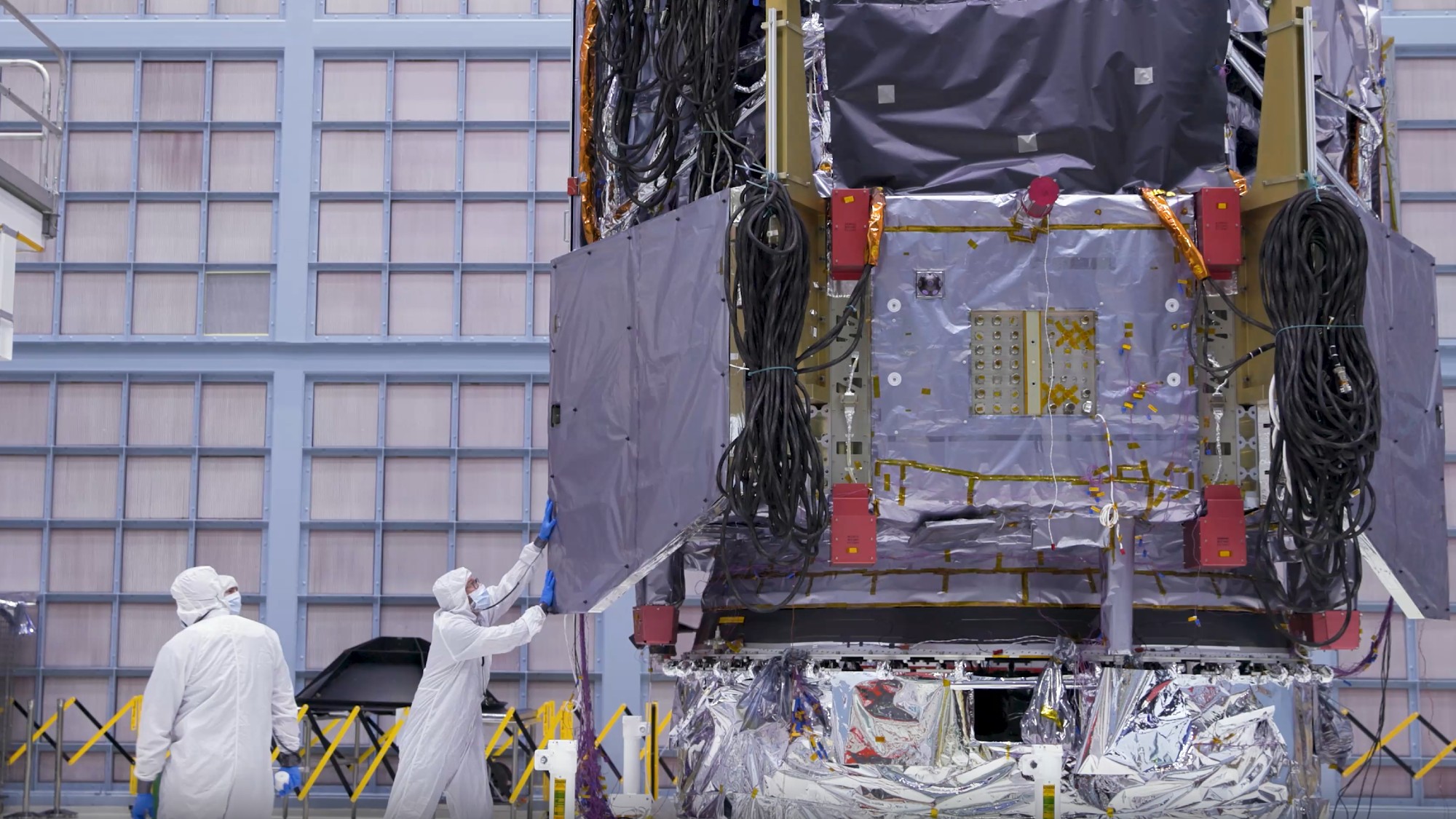
Scientists working on the Roman Space Telescope. (Image credit: NASA/Sophia Roberts)
As the JWST was grappling with these budget issues, Roman was already in development. So, it's not a shock that when a high-tech space telescope landed on their doorstep, NASA took full advantage of the opportunity, though the Roman team would still have to replace the electronics in the telescopes that the NRO removed. Thus, in the end, did the NRO telescopes actually save NASA money? It's not clear. Each donated telescope was said to beworth at least $250 million, but experts at the time of development were torn in their estimates for whether repurposing this old hardware would actually save or eat up costs in the end.
A few quirks also came with the free hardware. In addition to having to replace the electronics and rework a telescope someone else built, the Roman team had to learn about the telescope with some, well, restrictions. When the details about the telescopes were given to the mission team, there were large chunks of information fully blacked out, the Washington Post reported at the time. But while the Roman team was handed something quite strange to work with, the mission has remained about as on schedule and on budget as we've seen with a space telescope of this magnitude.
NASA still has the second telescope from the NRO, though the agency has not said what they might do with the equipment. However strange and unexpected this series of events may have been, it did result in a completed space telescope that now sits at the launch site, ready to uncover the mysteries of the universe. Join us this upcoming Sunday (Aug. 30) to see a telescope made with spy satellite tech travel beyond our planet.