NASA’s canceled Artemis hardware contracts reached $5.9 billion, audit finds

A new memo from NASA's Office of Inspector General has revealed how major pieces of Artemis program hardware became costly components of lunar missions that no longer align with the agency's new plans to return astronauts to the moon and have since been canceled.

NASA announced a major shakeup to its Artemis plans earlier this year at its "Ignition Day" event, restructuring its mission goals in order to streamline the return of astronauts to the lunar surface and simplify the architecture needed to get them there. Most notably, the program's first crewed moon landing was shifted from Artemis 3 to Artemis 4, and upgraded variations of NASA's Space Launch System (SLS) rocket were abandoned for a single uniform design. The Gateway space station planned for lunar orbit was also canceled in favor of a stronger focus on establishing a base on the moon's surface.

The switch-up left behind a trail of expensive hardware, including SLS's upgraded Exploration Upper Stage (EUS) and the adapter meant to fit it to the SLS rocket, a larger launch tower, and Gateway's Habitation and Logistics Outpost (HALO) module. Now, an interim Office of Inspector General (OIG) memo released June 24 offers a striking snapshot of just what NASA is walking away from. It calculates that NASA's final investment into the canceled hardware, which was originally contracted at a combined $2.9 billion, reached $5.9 billion by the time work was ceased, and concludes that, had NASA continued its support, costs and timelines would have continued to grow.

The report outlines rising costs and developmental delays for each of the aforementioned pieces of hardware, and shows how some Artemis systems were years late, billions of dollars over their original estimates and facing major technical problems. NASA is currently targeting 2028 for the program's first lunar landing on Artemis 4. Had the agency not restructured its mission plans, NASA's goal of landing astronauts on the moon before the end of the decade would have very likely been unobtainable.

Under the old Artemis plan, the Boeing-built EUS was intended for bigger, future versions of SLS, and would have increased the rocket's capabilities to send Orion and heavier cargo to the moon by 40%. Boeing is also responsible for developing and assembling the SLS core stage, and was selected to design and manufacture EUS in February 2017. EUS was added to Boeing's existing SLS contract, and folded into the work order to the tune of $962 million, with a delivery date set for March 2021.

In March 2026, after NASA announced its new Artemis plans, Boeing still had not delivered EUS, nor could it specify when it expected to do so and was issued a stop work order. By that time, the EUS allocations in Boeing's contract had risen to nearly $2 billion, with the company estimating that the number would rise to $3.7 billion by the project's completion. According to the OIG report's findings, Boeing wouldn't have been able to deliver the first flight-ready EUS to NASA until the end of 2028 — 7.5 years after its original due date.

Part of the continued EUS delays were a result of NASA's reprioritization of Boeing's efforts in 2018 to expedite completion of the SLS core stage, according to the OIG. The memo also cites the evolving design of Artemis missions, supply chain shortages and development issues that eroded the agency's confidence in Boeing. "NASA noted significant weaknesses related to EUS production efficiency, including unrealistic production schedules and the lack of a clear plan for improvement," the memo states.

four rocket engines propel a spacecraft above the Earth.

The Exploration Upper Stage (EUS) is a four-engine liquid hydrogen/liquid oxygen in-space stage on the Space Launch System (SLS) Block 1B and Block 2 rockets.  (Image credit: NASA)

Another scrapped component of the now-canceled SLS variants — and, perhaps, one of the most jaw-dropping, given the component's size and apparent simplicity — is the Universal Stage Adapter (USA). Designed by Dynetics, Inc., the USA was a conical section of SLS positioned to connect EUS to Orion and carry additional mission payloads. NASA contracted Dynetics to manufacture the USA for $131 million in 2017, and added another $9 million for the incorporation of the adapter's environmentally-controlled secondary payload deployment capability in 2022. That number had reached $353 million when NASA issued Dynetics' stop work order in February, and would have climbed to $497 million before the USA's completion, which the OIG report estimates would have been delayed to May 2030.

"The USA contract's cost and schedule estimates grew beyond original estimates due to both NASA directed modifications and Dynetics' performance issues," the OIG memo concluded, but notes that NASA's satisfaction with Dynetics steadily declined from "very good" in 2024, to "unsatisfactory" by the end of 2025.

tall scaffolding surrounds a white, conical structure in a hangar-like room.

test version of the universal stage adapter for NASA’s more powerful version of its SLS. (Image credit: NASA/Brandon Hancock)

Mobile Launcher 2 (ML-2), the huge tower connecting power and fuel umbilicals to SLS during assembly and prior to liftoff, followed a similar pattern. ML-2 was being constructed to support the taller SLS configurations that would have been incompatible with the current mobile launcher. That contract was awarded to Bechtel National, Inc. in June 2019 for $383 million.

NASA expected delivery in March 2023, but increasing cost evaluations from Bechtel delayed ML-2's completion and ballooned the contract to $1.6 billion by the start of 2026. The company was expected to complete ML-2 by this summer, but the OIG report estimates it would have been closer to December, with another one to two years of validation testing for NASA to ready the tower to support a launch, and costs reaching $2 billion.

The OIG asserts that Bechtel was unprepared for the intricacies of ML-2 design needs, and placed an additional financial burden on NASA during an extended development process. "Bechtel's reluctance to utilize NASA expertise, failure to track risks, challenges with managing the launcher's weight, and lack of a certified earned value management system impacted the contractor's cost, schedule, and performance," the report states.

A bit orange rocket rolls out of a giant white building, with an extra launch tower in the background.

The Artemis 2 SLS rolls out of NASA's Vehicle Assembly Building with construction of the Mobile Launcher 2 underway in the background, Jan. 17, 2026. (Image credit: Space.com / Josh Dinner)

The HALO module for the defunct Gateway space station was another casualty of NASA's altered Artemis plans, but had already incurred some injuries along the way. After its delivery to the United States from subcontractor Thales Alenia Space, in Turin, Italy in April 2025, Northrop Grumman discovered "widespread corrosion throughout the module," the OIG report says.

NASA's contract for HALO with Northrop Grumman Innovation Systems began as a $187 million sole-source acquisition in 2019, which had increased to $1.8 billion by September 2024. It reached $1.9 billion by the time NASA issued their stop work order in April, but was projected to continue to rise as delivery estimates were pushed to 2031.
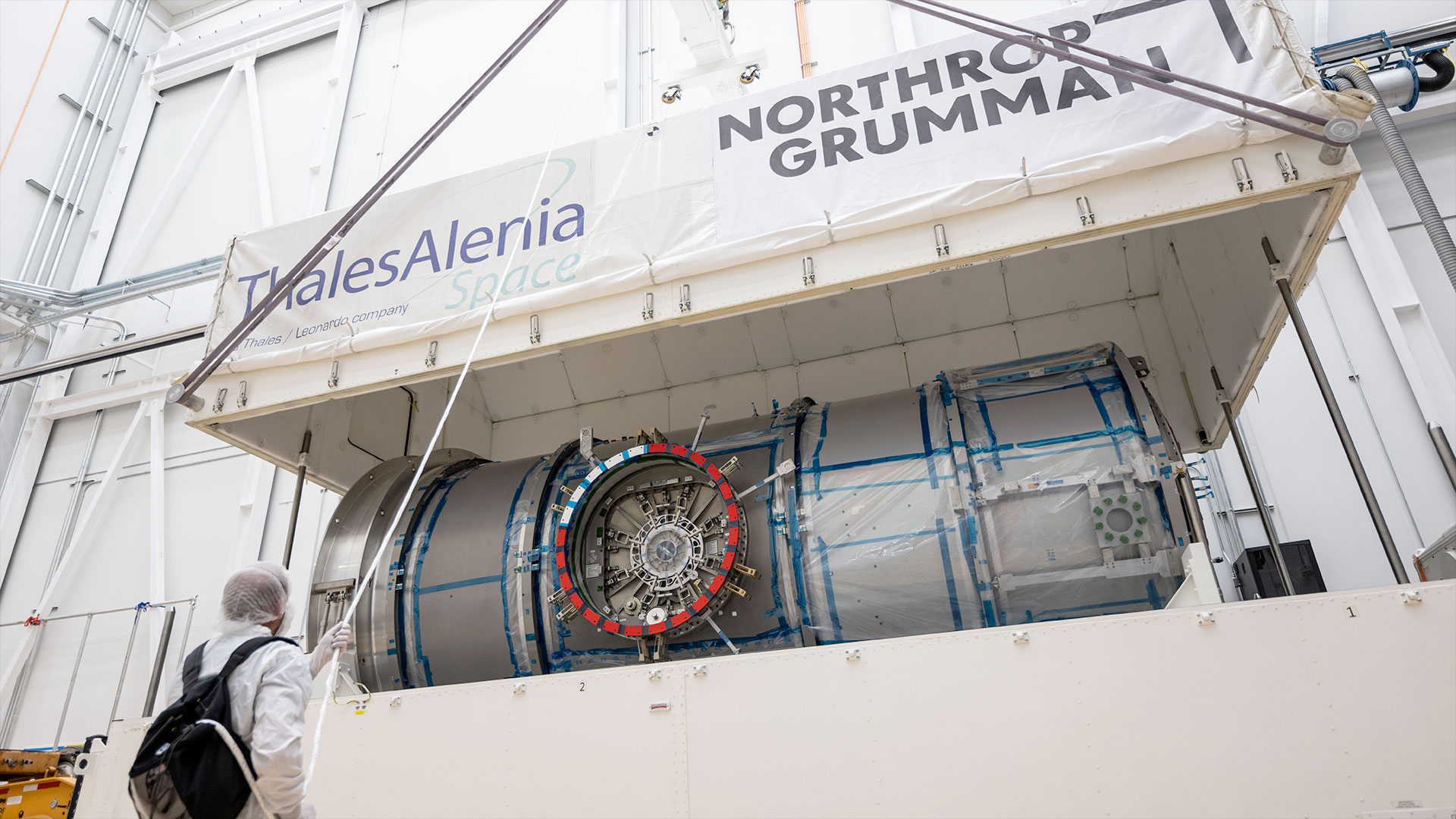
a white top half of a large shipping container is lifted by crane, exposing a metal cylindrical module inside.

HALO space station module. (Image credit: NASA/Josh Valcarcel)

Some of the blame for HALO's mismanagement falls on NASA, which the OIG memo says put unrealistic expectations on Northrop's progress. "Driven by the necessity to meet Artemis launch schedules, the Gateway Program worked toward unrealistic schedules throughout the life cycle of HALO," OIG's memo states, and cites a quote from Gateway's own independent Standing Review Board that says, "lack of schedule realism may be driving suboptimal engineering decisions during development."

The OIG report was issued amid an audit of "NASA's management of developed assets for programs and projects terminated prior to launch or operations," it says.

The OIG release included NASA's reply to a draft of the memo, acknowledging the role of shifting mission parameters, resource shortages and issues within each contractor that contributed to rising costs and ongoing delays, but maintained that the restructuring of Artemis was designed specifically to move the agency away from such costly practices.

"These projections rely on past performance under outdated architectural assumptions that do not reflect the Ignition Day principles of discipline, affordability, simplification, and speed," NASA's response says.

NASA’s aging infrastructure can’t handle Artemis launches without $1 billion in upgrades, watchdog warns

NASA's plan to return astronauts to the moon and bolster a rapidly growing commercial space industry is facing an infrastructure obstacle.

A new report from NASA's Office of Inspector General (OIG) warns that launch facilities at the Kennedy Space Center (KSC) in Florida and Wallops Flight Facility in Virginia are approaching capacity as demand accelerates across the agency and the private sector. Support infrastructure — such as roads, electricity, and gas and fuel pipelines that laid the foundation for KSC's network of launch pads built to support the Apollo program in the 1960s — are being increasingly stretched by the demands of NASA's Artemis missions, SpaceX, Blue Origin, United Launch Alliance (ULA) and other users.

"Based on current launch projections, Kennedy and Wallops are expected to operate near capacity in the 2028 to 2029 time frame," states the report, which was released on Monday (June 22). Though it credits NASA for already taking steps to address these issues, agency officials estimate it will take at least $1 billion to complete all the necessary upgrades, of which only $250 million was provided as part of NASA's funds allocated in last year's 2025 H.R.1 reconciliation bill.

On Florida's Space Coast, the assessment encompasses launch facilities at KSC as well as Cape Canaveral Space Force Station (CCSFS), which saw an increase of NASA-supported launches from 31 in 2020 to 109 in 2025, according to the report. Wallops, where there are fewer and smaller launch pads, doesn't traditionally see as many missions compared to KSC. But the Virginia site has experienced an even sharper jump, percentage-wise, over the same timeframe — from three launches in 2020 to 17 in 2025 (a 467% rise). By 2030, NASA expects traffic at both sites to increase by another 150% or so. And NASA officials told auditors that raw launch counts don't fully capture the strain on infrastructure, because launch campaigns require days or weeks of support activity before liftoff.

The report outlines launch infrastructure shortcomings at both facilities, but notes that Wallops' challenges have been partially mitigated by recent upgrades across its seven active launch sites. Wallops generally hosts small and medium-lift launch vehicles, like Northrop Grumman’s Antares rocket and Rocket Lab's Electron, but has taken steps to support Rocket Lab's upcoming Neutron, as well as Firefly Aerospace's Alpha rocket, which is expected to launch from the site sometime this year.

The major launch pads in question at KSC and CCSFS include Launch Complex-39A (LC-39A) and LC-39B, used by SpaceX and NASA, respectively; Space Launch Complex-40 (SLC-40), also used by SpaceX; SLC-41, used by ULA's Atlas and Vulcan rockets; and SLC-36, used by Blue Origin's New Glenn rocket.

SpaceX has transitioned to launching its Falcon 9 rocket primarily from SLC-40 and has reserved LC-39A for Falcon Heavy launches while construction of the first Florida launch tower for its Starship rocket is underway at the same pad. SpaceX hopes to start launching Starship from this pad before the end of 2026.

The company also has plans for a second Space Coast pad for Starship, at SLC-37. Once Starship, which is still under development at SpaceX's Starbase, Texas, facility, becomes fully operational, the company expects up to 44 launches a year from KSC, with an additional 76 launches per year projected from SLC-37 at CCSFS. That equals about one Starship launch every eight days for LC-39A, but a higher cadence will be needed to successfully support NASA's Artemis program.

a map with arrows pointing to launchpad locations.

Major launch pads on Florida's Space Coast. (Image credit: NASA OIG)

Artemis missions utilize NASA's Orion spacecraft to transport astronauts from the Earth to the moon, and the agency has contracted Starship, as well as Blue Origin's Blue Moon lander, to be the program's crewed lunar landers. All of these vehicles require heavy-lift rockets.

Orion launches on NASA's Space Launch System (SLS) rocket from LC-39B. For Artemis 4, currently scheduled for 2028, NASA plans to dock Orion with Starship in Earth orbit, and use Starship to propel the two spacecraft to orbit around the moon. Starship will then undock from Orion, carry a set of astronauts down to the lunar surface, and then launch them back to orbit around the moon to rendezvous and dock again with Orion.

To accomplish this, Starship will require at least 15 refueling flights to top off its tanks before its initial burn for the moon, which would fly in addition to the company's projected eight-day launch cadence, according to the report.

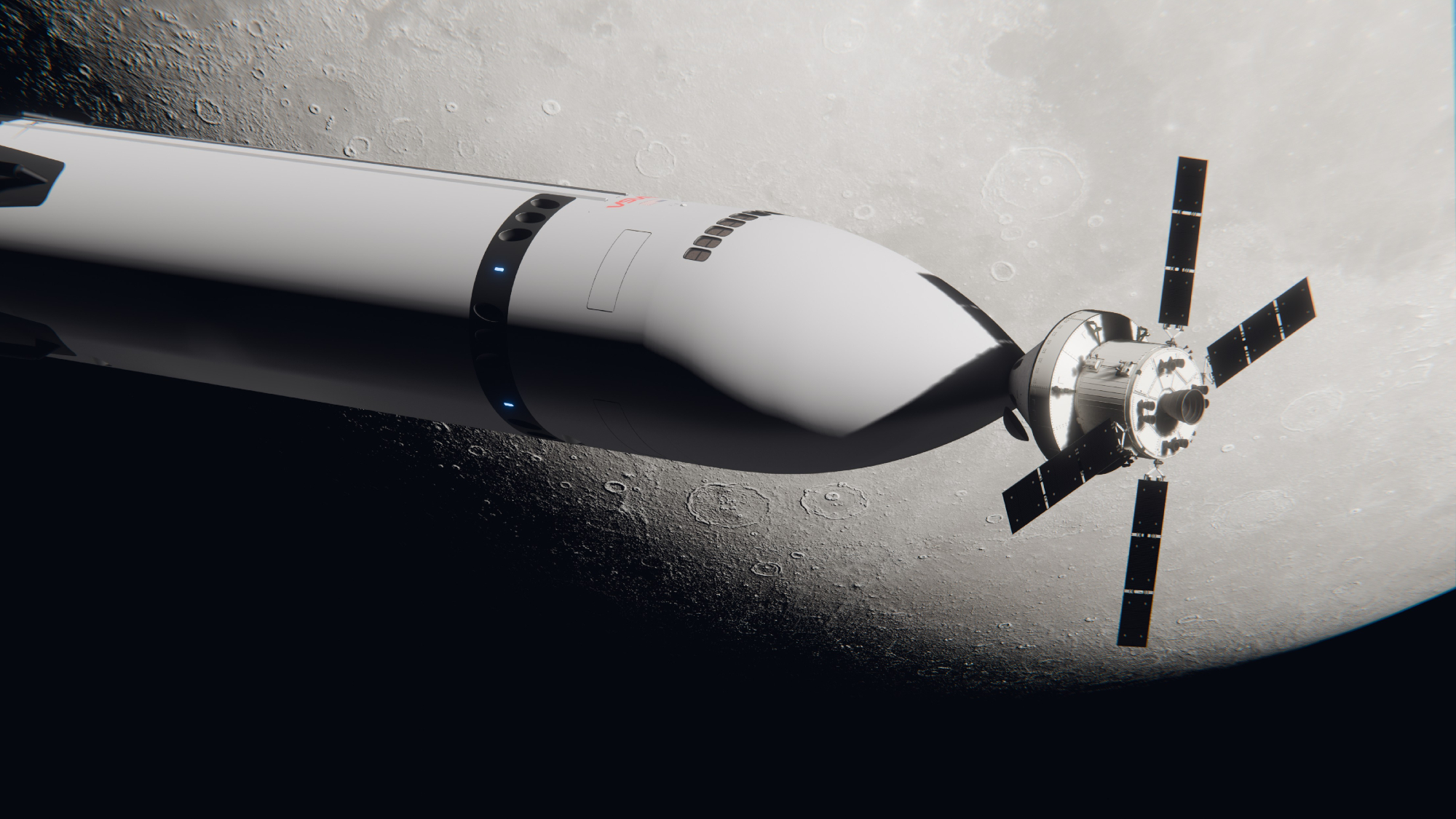
A NASA Orion spacecraft docked to a giant Starship moon lander artist concept

Render of SpaceX's Starship docked with the Orion spacecraft. (Image credit: SpaceX)

Growing demand for heavy-lift rockets is also increasing pressure to find additional launch sites. Blue Moon is designed to launch on New Glenn, and will also require refueling launches to reach the moon. Setting aside the fact that New Glenn recently exploded during a fueling test that severely damaged SLC-36, the report indicates that Blue Origin officials have told NASA that the pad alone may not provide sufficient long-term capacity and resiliency for the company's future plans, and noted that the constraints have already forced the company to delay launches.

Much of the infrastructure between KSC and CCSFS facilities is considered "common-use," the report says, which puts added stress on available resources shared across different launch providers. That includes a massive electrical grid; 231 miles (372 kilometers) of roadway, much of which was paved in the 1960s without consideration for the weight and frequency of super heavy rocket stages being transported to and from launch pads; and more than 40 miles (64 km) of gaseous pipeline supporting nitrogen (GN2) and helium distribution, which is unable to supply high-flow operations from multiple users in its current state.

"This issue created a major scheduling challenge during preparation for the New Glenn-1 mission that launched in January 2025," the report says. It also anticipates further Artemis mission launch constraints if the issue is not addressed.

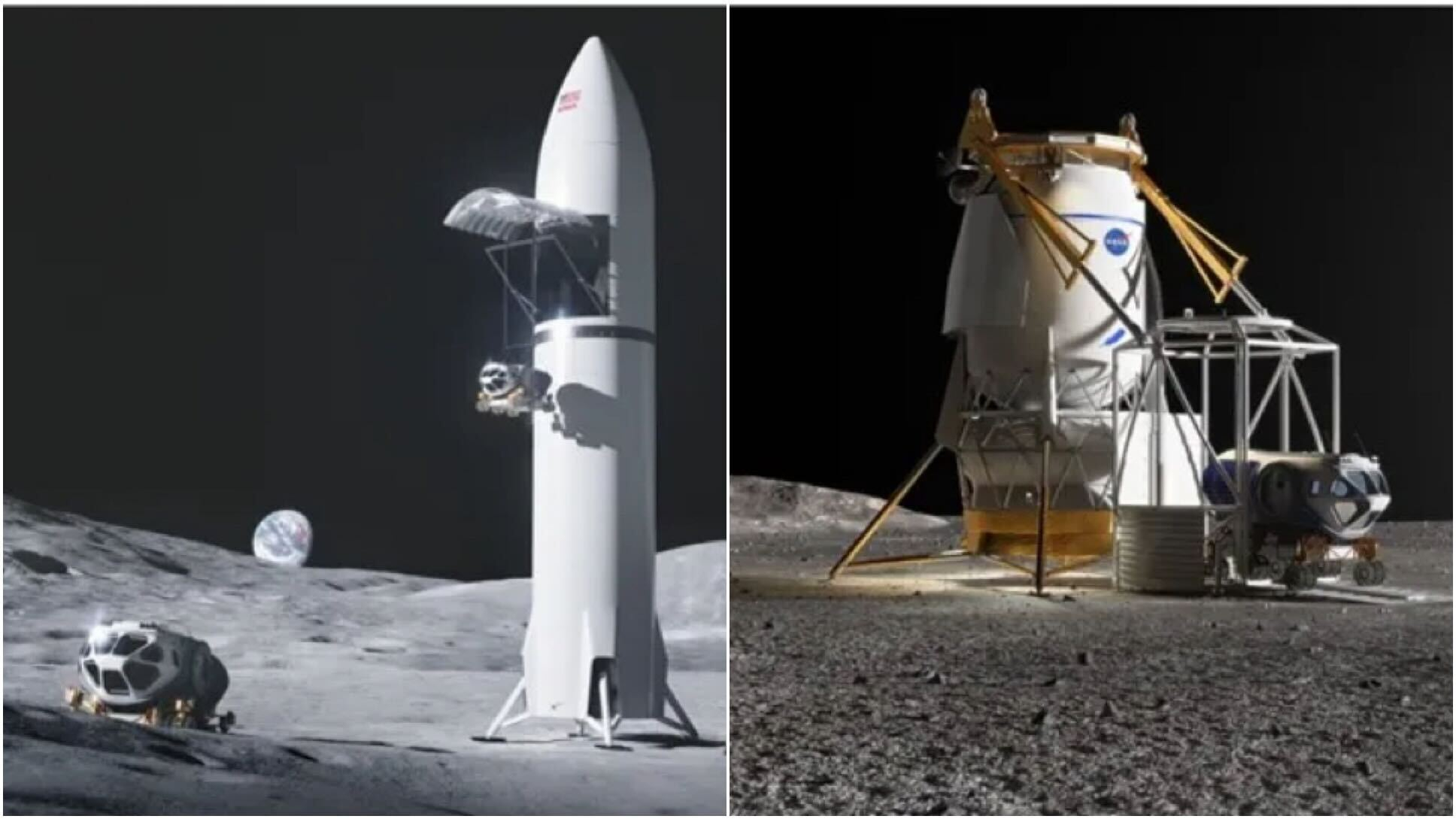
Side by side images show a tall white rocket landed on the moon on the left, with a rover on its left on the grey surface. Earth is setting on the horizon against the black of space. On the right, a shorter lander, cylindrical, with a lifting platform lowered to the surface with a rover aboard.

Renders of SpaceX's Starship (left) and Blue Origin's Blue Moon (right). (Image credit: SpaceX/Blue Origin)

Artemis 3, targeted for 2027, will require launches of SLS, New Glenn and multiple Starships all within a small handful of days. The mission will see both private landers — if they're both ready — rendezvous with Orion to practice docking maneuvers in low Earth orbit over the course of about two weeks, but the OIG report calls the feasibility of those back-to-back launches into question.

"Kennedy will be unable to provide GN2 for future Space Launch System launches for Artemis from LC 39B while simultaneously supporting Blue Origin's New Glenn launch vehicle launching from Space Launch Complex 36 at CCSFS," the report says. It projects a possible one- to two-month blackout period of GN2 availability as a result of future SLS launches.

The report further found that NASA has struggled to maintain and modernize its launch infrastructure, partially due to declining maintenance budgets and poor funding structures that prevent an equitable recoupment of costs from commercial providers leasing the launch facilities. "Significant statutory funding barriers prevent the Agency from receiving money directly from commercial partners for use of the Agency’s launch infrastructure," the report says. And, as it currently stands, any commercial investment in NASA's infrastructure is deducted from the agency's budget appropriation, in addition to being a violation of the Antideficiency Act, which prohibits the agency from spending federal funds without Congressional approval.

Ultimately, the report recommends prioritizing improvements to NASA's transportation networks, utility systems and resource distribution infrastructure while exploring additional funding mechanisms to support future upgrades. It also suggests three key action items for the space agency:

  1. Perform an assessment and create a mitigation strategy to address roadway degradation caused by the increased traffic from heavy-lift launch vehicle transportation and commercial providers.
  2. Prioritize the allocation of available funds for the maintenance of common-use launch infrastructure, including roads, electricity distribution, and gaseous pipelines and resource reserves.
  3. Explore alternative funding mechanisms and evaluate commercial partnership policies to charge an "Other Approved Indirect Rate" to contribute to upgrades necessary to maintain the aforementioned infrastructure.

"While NASA’s goal is to renew — replace, repair, or upgrade — its infrastructure every 66 years, the current renewal rate, based on the available budget, is over 260 years," the report says.

‘Everybody wanted to be the first’: Apollo astronauts were more competitive, Artemis 2 pilot says

A lot has changed since NASA last sent astronauts to the moon — including the attitudes of those space explorers.

That's the view of Victor Glover, the NASA astronaut who served as pilot on the Artemis 2 mission around the moon's far side this past April.

"When you look back on the Apollo missions, there was a lot more competition back in the office. Everybody wanted to be the first, and then everybody wanted to be the next," Glover told Angels Broadcast Television on June 12, shortly before he threw out the first pitch before a baseball game between the Los Angeles Angels and the Tampa Bay Rays.

"I think our office learned a lot from them," he added. "There are some good things about that. It makes you work really hard, but it also can create some unnecessary conflict. And so my office really wants to support everybody — wants you to be the guy that does it, and somebody just gets picked to do it, and that's OK."

Glover and his Artemis 2 crewmates — NASA's Reid Wiseman and Christina Koch and Jeremy Hansen of the Canadian Space Agency — did indeed seem to forge a very strong bond during their training and their time in space.

For example, shortly before Artemis 2's April 1 launch, Glover, Koch and Hansen came up with a plan to name a crater on the moon after Wiseman's wife Carroll, who died of cancer in 2020.

"They said the three of them had talked, and they would like to do this," Wiseman said on April 6, the day Artemis 2 looped around the moon and got farther from Earth than any crewed mission ever had. "That was an emotional moment for me. And I just thought that was just a total treasure, that they had thought through this, and they had offered this."

Wiseman, Artemis 2's commander, said he broke down when Hansen radioed mission control with the naming request. In fact, all four astronauts were overcome with emotion at that moment.

"That was, I think, where the four of us were the most forged, the most bonded, and we came out of that really focused on that day ahead," Wiseman said.

an astronaut in a white spacesuit descends from a gold-foil-wrapped spacecraft onto the gray lunar surface, with an american flag planted in the dirt nearby

This image taken by Buzz Aldrin of the Apollo 11 landing site is the only good picture of mission commander Neil Armstrong on the lunar surface. (Image credit: NASA)

The atmosphere was a bit different during the 1960s and early 1970s, as Glover noted; undercurrents of competition and rivalry reportedly ran through the Apollo crews.

For example, multiple people, including Apollo 17 astronaut Gene Cernan, have said that Buzz Aldrin lobbied to be the first person to set foot on the moon, an honor that eventually went to Apollo 11 crewmate Neil Armstrong. (Aldrin has disputed this version of events, saying he didn't want to be the first-ever moonwalker.)

There are other big differences between Artemis and Apollo, of course. Apollo was designed to get people to the moon before the Soviet Union could do so, a goal that was regarded as a national security imperative because it would demonstrate American technological supremacy. As a result of this need for speed, Apollo did not build anything permanent on the moon, leaving behind only flags, footprints and defunct spacecraft.

Artemis, on the other hand, aims to establish a permanent and sustainable presence on Earth's nearest neighbor. If all goes to plan, NASA will build one or more moon bases near the lunar south pole, then use the skills and knowledge gained from this endeavor to get astronauts even farther afield — to Mars.