NASA just found a planet ‘hiding’ in TESS spacecraft data, all thanks to Einstein

NASA's exoplanet-hunting spacecraft TESS (Transiting Exoplanet Survey Satellite) has a new method for detecting worlds beyond the solar system. The technique relies on a phenomenon introduced by Einstein in his 1915 theory of gravity, general relativity, called gravitational microlensing.

The exoplanet in question is called Gaia23bra b. The first hints of this exoplanet were found in 2023 by the now-retired Gaia space telescope via the slight brightening of a star caused by a microlensing event.

TESS usually spots planets by the tiny drop in the light output from their parent star as they cross, or transit, its face. This technique is most effective for very large gas giants that orbit close to their star, so it most likely wouldn't work for Gaia23bra b, which has 1.6 times Jupiter's mass but orbits its star at a similar distance to Jupiter's orbit around the sun. Additionally, the transit method employed by TESS usually has a search radius of around 150 light-years. Gaia23bra b, however, orbits an orange dwarf star about 80 percent the size of the sun that is located 40,000 light-years away. Thus, to confirm the existence of this world, TESS had to learn a new trick.

"When TESS launched, no one expected it to ever be capable of finding this kind of planet," team member Diana Dragomir of the University of New Mexico said in a statement. "The discovery implies that there are probably other so-called microlensing planets hiding in TESS's data that we hadn't previously thought to look for."

Microlensing and the hunt for exoplanets

To understand what microlensing is, first we have to consider what general relativity says about the effect of objects with mass on space itself. Mass causes the very fabric of space and time, united as 4-dimensional spacetime, to warp. Gravity arises from that curvature. The greater the mass, the more extreme the warping and thus the greater the force of gravity.

Here is the cool part: light usually travels in a straight line, but when the very fabric of spacetime is curved, it has to follow that path. So when light from a background object passes a foreground object, the light bends around it. The bigger the mass and the closer to that mass the light passes, the more its path is curved. That means light from the same source can reach our telescopes at different times. This causes an amplification of the background source.

This phenomenon of gravitational lensing has been used to great effect to study ancient galaxies that would usually be too distant and faint to see when they are gravitationally lensed by foreground galaxy clusters.
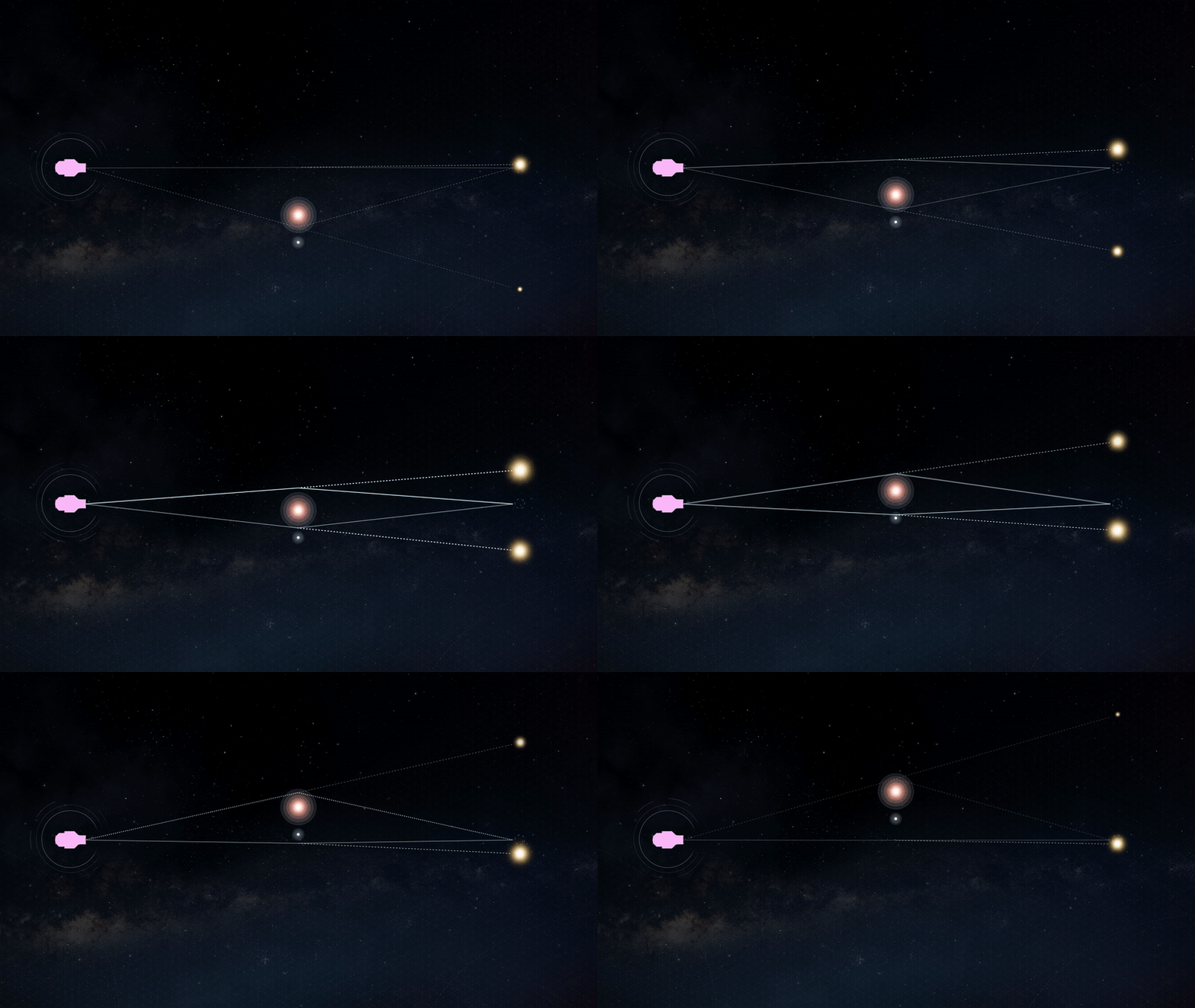
An animation showing microlensing in action

A diagram shows an exaggerated microlensing situation (Image credit: NASA’s Goddard Space Flight Center/CI Lab)

Obviously, planets have a heck of a lot less mass than clusters of galaxies, but they can still cause a slight gravitational lensing effect. That is micro-lensing, and it can be used to hunt planets.

Of the around 6,000 known exoplanets, only around 5 percent have thus far been discovered using microlensing. That is compared to around 75% found using the transit method TESS usually depends upon.

Gaia23bra b was first hinted at when it acted as a gravitational lens, passing between Earth and a background star, causing the ever-so-slight brightening of that star. The exciting thing about TESS successfully using microlensing is that this offers a complementary technique of exoplanet detection capable of detecting planets that the transit method might miss.

"With microlensing, we can find smaller planets with greater orbital distances, including worlds in the habitable zone of their star and even farther away," team member Mallory Harris of the University of New Mexico said. "Microlensing events happen once, and they're gone — they don't repeat. I like to joke that we'll probably find the first Earth analog with microlensing, and then wave at it as it goes by because we'll never see it again.
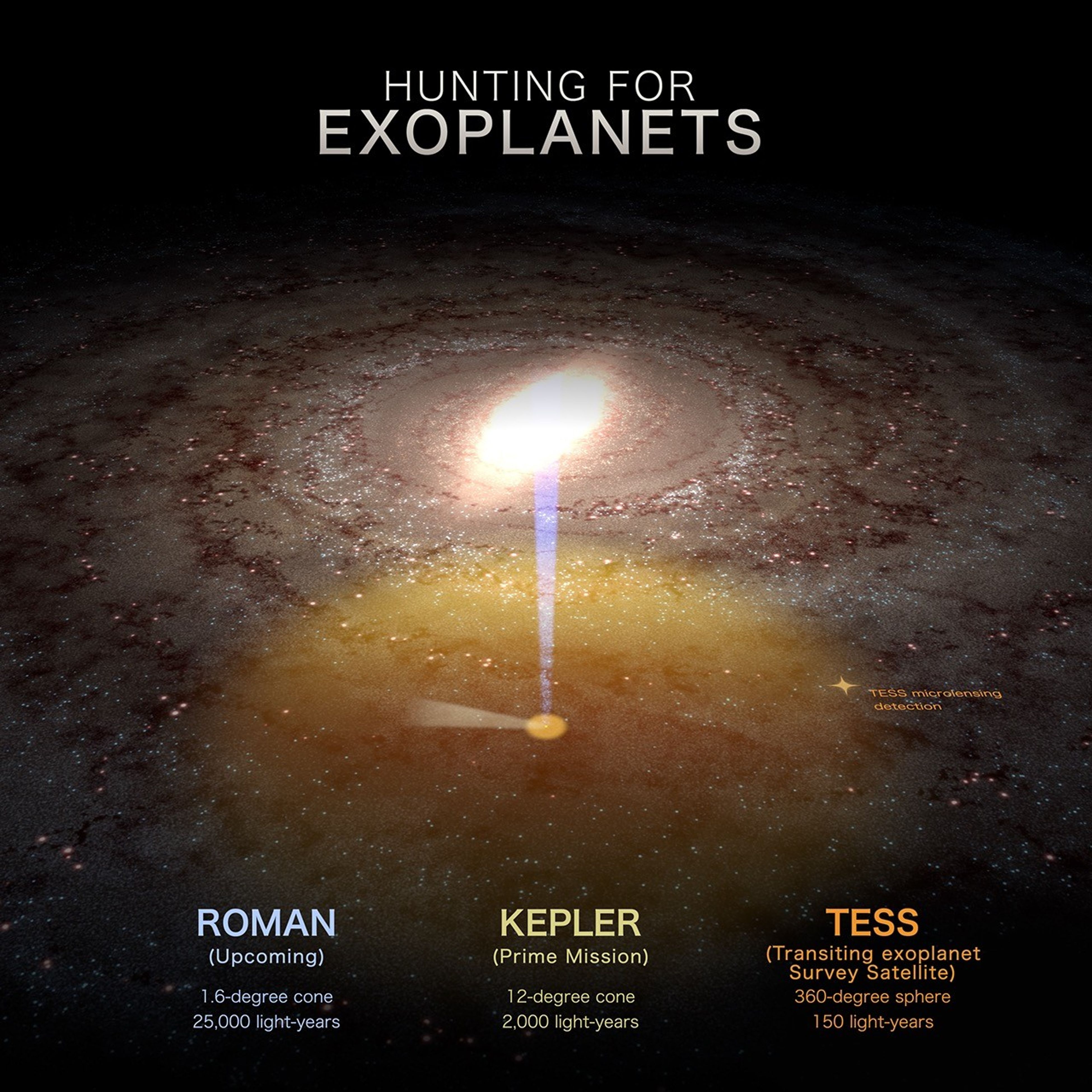
This graphic highlights the search areas of three planet-hunting missions: NASA’s upcoming Nancy Grace Roman Space Telescope, the retired Kepler Space Telescope, and NASA’s TESS

A diagram showing the search areas of three planet-hunting missions: NASA’s upcoming Nancy Grace Roman Space Telescope, the retired Kepler Space Telescope, and NASA’s TESS (Image credit: NASA’s Goddard Space Flight Center)

And, if you will excuse the pun, the future is bright for microlensing. That is because it is one of the techniques that NASA's next project, the Nancy Grace Roman Telescope, will use.

Roman will scour the very heart of the Milky Way where stars are tightly packed together, hunting microlensing events which should be common in such a dense stellar region. NASA scientists predict that this will lead to Roman discovering around 1,000 microlensing exoplanets on top of the estimated 100,000 transiting worlds it is predicted to detect.

"This is a bit like a preview of the microlensing NASA's Nancy Grace Roman Space Telescope will do. The key to Roman's microlensing survey is its dense time coverage targeting the galactic bulge," team member Michael Fausnaugh of Texas Tech University said. "The TESS mission uniquely provides these rapid observations for stars in other parts of the galaxy, and pairing the two opens up prospects for understanding planet formation in a diverse population of stars.

"Since microlensing finds solar system-like planets, this offers a new chance to understand how planetary systems like our own vary in different regions of the galaxy."

The team's research was published on July 1 in The Astrophysical Journal Letters.
Black holes buried in mysterious ‘little red dot’ galaxies could blast cosmic ghosts at Earth

Mysterious "little red dots" discovered in the early universe by the James Webb Space Telescope could harbor buried black holes that fire high-energy cosmic "ghost particles" through the cosmos.

Neutrinos are referred to as ghost particles because as chargeless and near-massless particles, hundreds of trillions of them stream through your body every second at nearly the speed of light. Plus, the source of high-energy neutrinos frequently detected on Earth is something of a mystery.

And another cosmic mystery is the existence of the "little red dots," which are galaxies that have been discovered by the James Webb Space Telescope (JWST). Though common around 600 million years after the Big Bang, these dots seem to disappear before the universe gets to 2 billion years old. Some researchers have theorized that these curious small galaxies could harbor black holes that are buried in thick shrouds of cosmic dust. If that is the case, then the dots could be a major contributor of high-energy neutrinos, linking these two mysteries.

Neutrinos are produced when other particles, such as protons, collide with particles of light, or photons, or with different sorts of matter. This usually occurs in gas-dense environments, but the ghost-like characteristics of neutrinos mean they have little trouble escaping into the universe at large.

Usually, the events that create high-energy neutrinos also give rise to high-energy photons called gamma-rays. However, neutrinos are so abundant as the second most common particles in the cosmos that if all sources of neutrinos also created gamma-rays, the gamma-ray background of our universe should be much greater than it actually is.

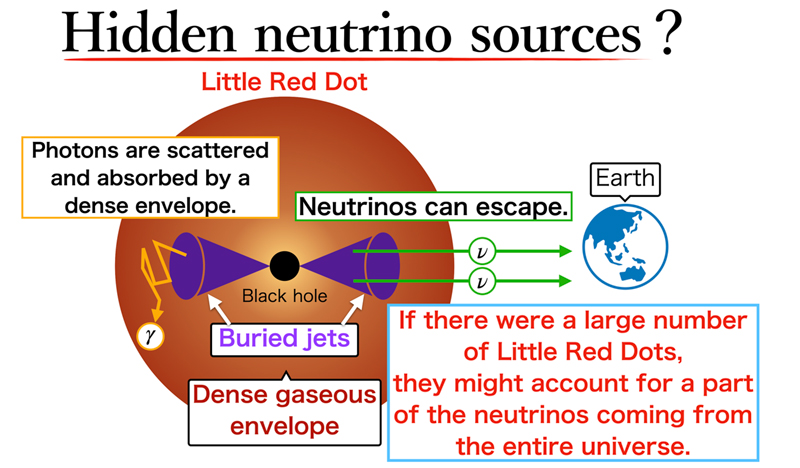
That means some sources of high-energy neutrinos must be located in environments from which gamma-rays can't readily escape — and that's where the little red dots enter the picture. These curious objects display very little emission associated with galactic jets or other outflows. This led this team to assume that the lack of these emissions, which should come in the form of X-rays and radio waves, is because the black holes and associated jets in Little Red Dots are buried in dense halos of dust and gas.

A diagram showing how neutrinos could escape from the dense gaseous envelope around a black hole with buried jets and head toward Earth.

A Little Red Dot galaxy black hole surrounded by a thick outer gaseous envelope. Photons produced near the center are absorbed and scattered by the gas, while neutrinos can escape. (Image credit: KyotoU / Riku Kuze)

"In the scenario we considered, abundant photons and dense gas are expected to exist around the central black hole in a little red dot, which may allow such collisions to occur efficiently," team leader Riku Kuze of Kyoto University said in a statement.

Kuze and colleagues estimated the contribution that the little red dots could add to the universe's neutrino background. This revealed that, should particle acceleration be occurring in the buried black holes within the dots, these environments could produce high-energy neutrinos to contribute a significant fraction of the high-energy neutrino background observed on Earth. This would be while also suppressing gamma-ray escape.

"Although it is difficult to observe the individual objects directly, we believe this study is significant because it is the first to demonstrate that, given their abundance, these little red galaxies could account for a part of the observed high-energy neutrinos," said Kuze.

Neutrinos come in more than one type, or flavor; thus, the next step for the team will be to determine the ratio of neutrino flavors generated by buried black holes in the little red dots and to determine if this matches cosmic abundances witnessed.

The team's research was published in the journal Physical Review D.

Astronomers discover radio signals coming from rare ‘Blue Eye Pulsar’ after decades of silence

Silent neutron stars at the center of supernova blast sites may actually be whispering softly, following the detection of faint radio emissions coming from one such object for the first time. The discovery raises the prospect that there could be many more pulsars in our galaxy than we thought.

When a massive star explodes as a supernova, the devastation leads to the star's core collapsing under its own gravity to form either a neutron star or a black hole. When a neutron star is formed, it is born spinning and its magnetic field is usually powerful enough to whip up charged particles and beam them away in a jet moving at close to the speed of light. This jet emits radio waves, and as the neutron star spins we see this radio jet flashing in our direction. This makes it seem like the neutron star is pulsing, hence we call it a pulsar.

Puzzlingly, not all neutron stars at the center of supernova remnants are pulsars. About a dozen discovered so far have been dead quiet in radio waves, and astronomers call these quiet neutron stars 'central compact objects', or CCOs. One possible explanation for CCOs is that their magnetic fields are too weak to produce detectable radio jets. For decades, astronomers have tuned into them, finding only radio silence  — until now.

A team led by Zhang Lei of the National Astronomical Observatories of the Chinese Academy of Sciences tuned into one particular CCO, named 1E 1207.4-5209 with the MeerKAT radio telescope in South Africa. They discovered that the CCO is pulsing with radio waves after all, but very faintly, once every 424 milliseconds. This matches the known spin period of the pulsar – it's a veritable whirling dervish.

Found at the center of a supernova found 10,000 light years away within our Milky Way galaxy, 1E 1207.4-5209 has been nicknamed the "Blue Eye Pulsar" by Li Di, a professor of astronomy at Tsinghua University in China. Its name is a virtue of the fact that when the faint radio emission is combined with X-ray images that show the neutron star shining brightly, it looks like a blue eye.

The Blue Eye Pulsar has an intriguing history. The supernova that formed it exploded over 4,100 years ago. In 2015, X-ray observations noted that the pulsar had experienced a 'spin glitch', which is a small increase in rotation of a neutron star probably caused by some kind of disruption or shifting of material within the neutron star's dense interior.

Lei's team propose that this glitch either strengthened or reoriented, or both, the magnetic field of the Blue Eye Pulsar sufficiently to trigger radio emissions, or at least make feeble radio waves that were already there detectable.

Following a glitch, a neutron star's rotation rate gradually slows back down to its original rate, at which point we might expect the Blue Eye Pulsar's radio emission to switch back off. Lei's team suggests that continued monitoring of the Blue Eye Pulsar could answer this question.

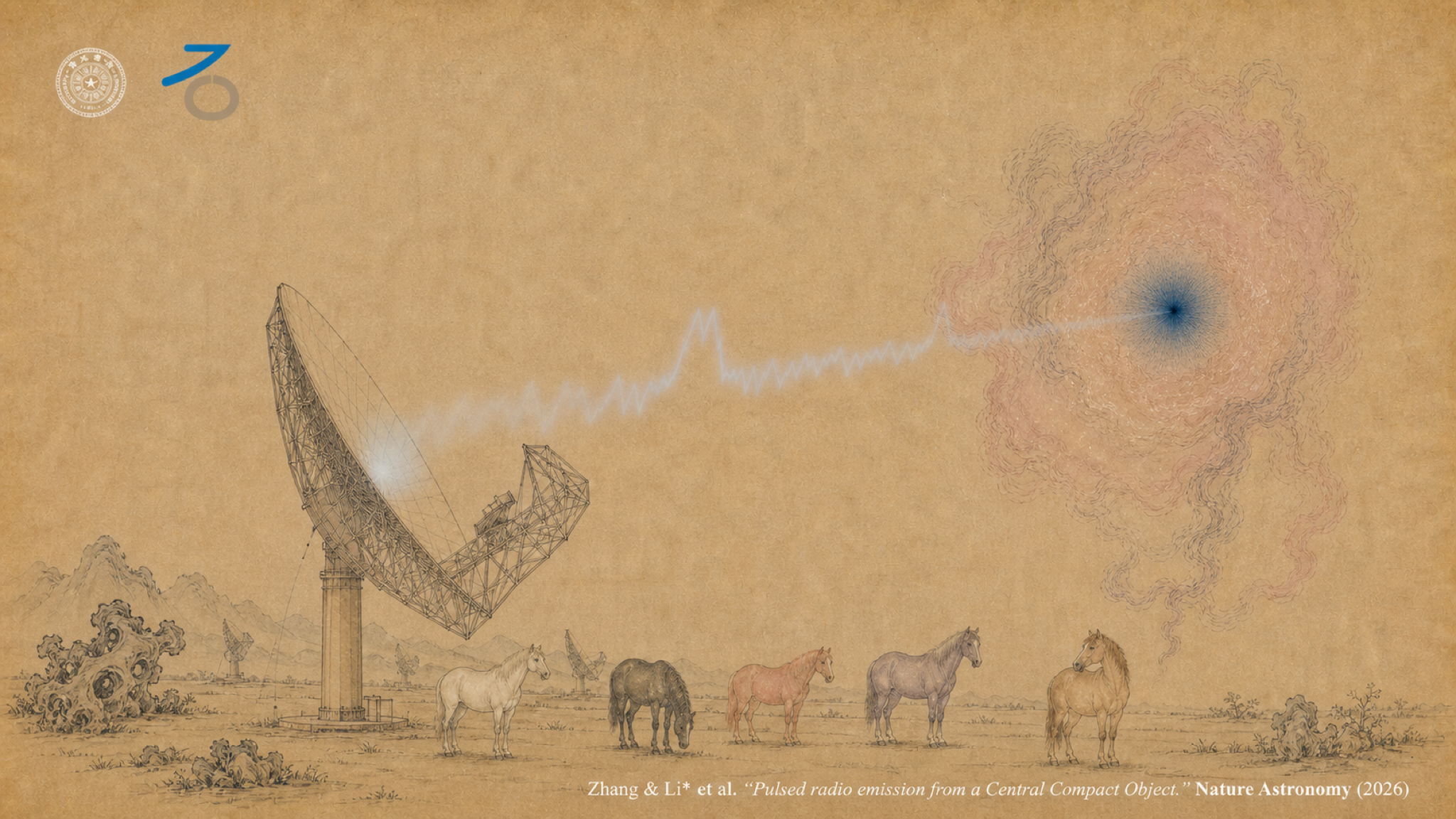
an illustration of a blue eye-like object in the sky beaming a jagged line towards a radio antenna on the ground near five horses

The Blue Eye Pulsar presented in the style of the classic painting "Five Horses" from the Song dynasty, back to which the first complete human record of a supernova explosion dates. (Image credit: Tsinghua University/Zhang & Li et al.)

If that answer is what Lei's team think it to be, then it could mean that there is a large population of very feeble pulsars that remain undetected in the galaxy. Old pulsars, which persist long after the supernova remnant they were born in has dissipated, are also fairly quiet radio emitters because they are slowing their spin rate over time. However, it is possible that we have misidentified some of these pulsars as being old when they could in fact be relatively young but softly radio emitting.

The findings may also explain why some supernova remnants seem to be missing pulsars. Key among them is the expanding cloud of debris formed from the explosion of supernova 1987A in the Large Magellanic Cloud. Although astronomers are pretty sure there is a neutron star in the heart of the remnant based on indirect evidence, no pulsar radio emissions have yet been detected.

The detection of radio waves from the Blue Eye Pulsar was reported June 25 in Nature Astronomy.

‘Once-in-a-millennium’ asteroid flyby will be visible to much of the world in 2029

Three years before the skyscraper-size asteroid Apophis makes its very close (but safe) flyby of Earth, scientists have already begun charting exactly when and where billions of people can watch it sweep across the sky.

Speaking at an "Apophis T-3 Years" workshop held earlier this month at the University of Padua in Italy, retired cartographer Michael Zeiler and astronomer Rick Fienberg shared detailed visibility maps charting the asteroid's passage across Earth's skies.

According to their calculations, roughly 90% of the world's population — about 7.6 billion people — lives in regions where Apophis could, in principle, be seen with the naked eye on April 13, 2029. The actual viewing success will depend more on earthly considerations, however, including cloud cover and the extent of light pollution.

Known formally as 99942 Apophis, the space rock will not resemble a blazing meteor tearing through the sky. Instead, scientists say it will appear as a point-like speck of light gliding steadily across, which, at its closest approach, will appear to move by about the apparent width of the full moon every minute.

"It will definitely be noticeable," Fienberg told Space.com. "It's going to be moving more slowly than a satellite — it will cross the sky in hours, rather than minutes, and it will just be a point."

According to the new maps, the asteroid should remain visible to the naked eye for about seven hours, beginning over Australia at 11:00 a.m. EDT (15:00 UTC) and concluding over the North Atlantic at 6:00 p.m. EDT (22:00 UTC).

At 4:35 p.m. EDT (20:35 UTC), Apophis is expected to reach its greatest apparent brightness as it passes over Cameroon, offering prime viewing to an estimated 3.9 billion people across Africa, Asia, eastern South America and parts of Europe.

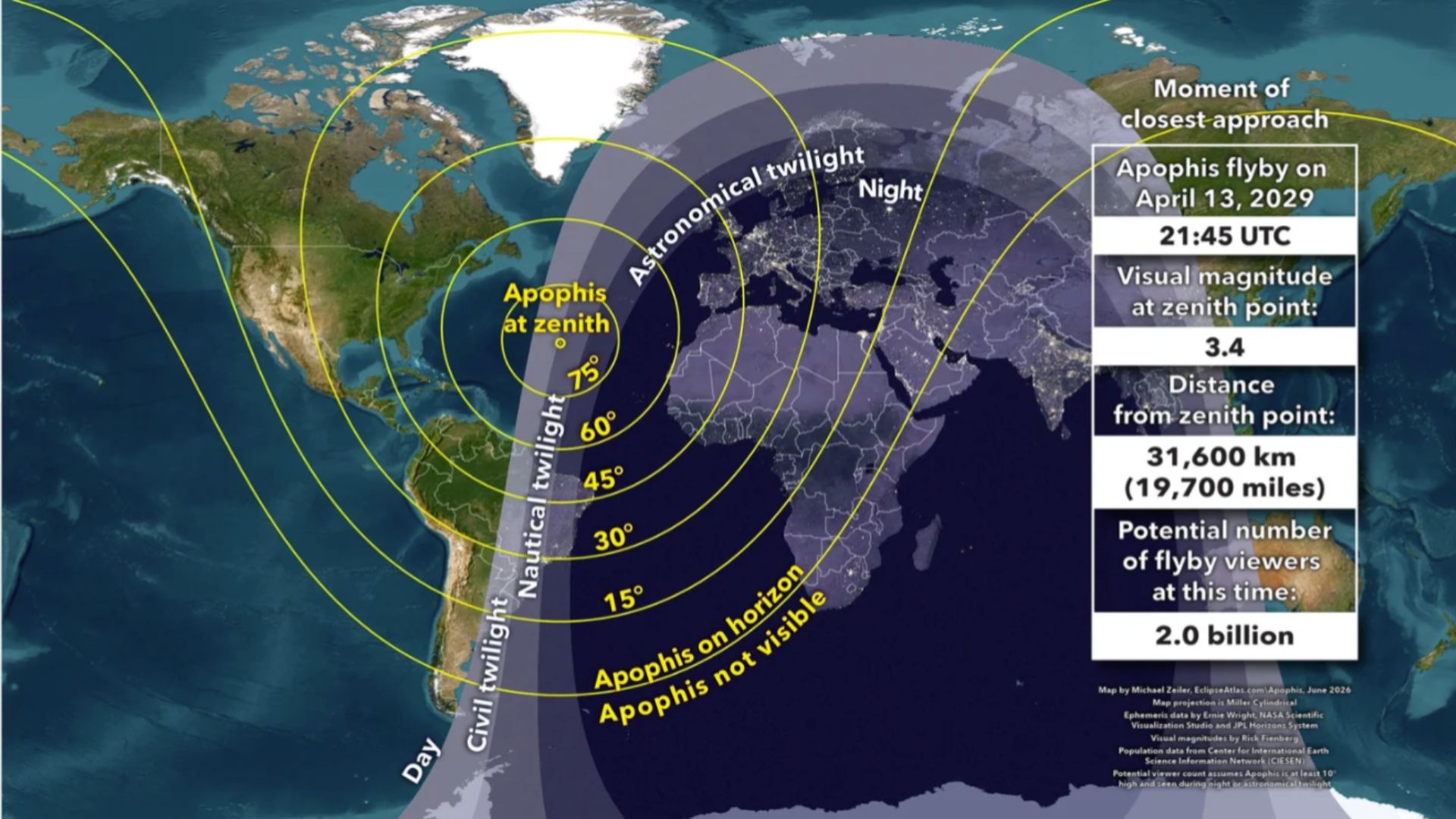
A diagram showing one of the points of peak brightness of Apophis.

One moment of peak brightness for Apophis (as seen from Earth) at the moment of closest approach at 5:45 p.m. EDT (21:45 UTC). The asteroid will be at a height lower than geosynchronous satellites. (Image credit: Eclipseatlas.com)

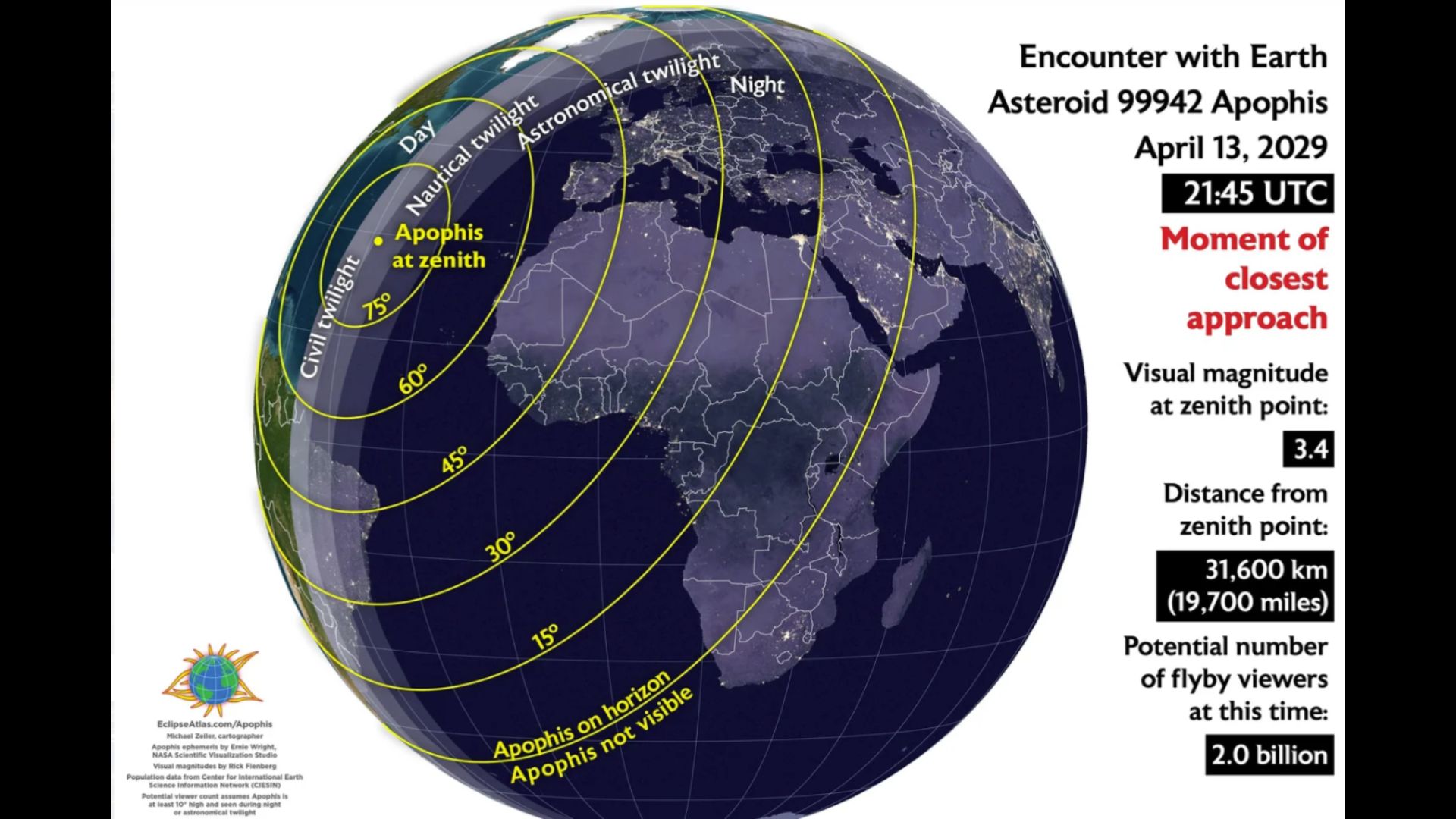
About an hour later, at 5:45 p.m. EDT (21:45 UTC), the asteroid will make its closest approach to Earth, passing about 19,700 miles (31,600 kilometers) above the North Atlantic — well inside the orbit of Earth's geostationary satellites. The event would be visible across much of South America, the United States, Africa and parts of Europe, reaching roughly 2 billion people.

"This is the first time we've been able to predict in human history an asteroid visibly passing by the Earth," Richard Binzel, a professor of planetary sciences at the Massachusetts Institute of Technology (MIT), said during the workshop. "That's part of a shared experience."

As excitement ramps up for the once-in-a-millennium spectacle, Binzel opened the workshop with three messages: "Apophis will safely pass the Earth. Apophis will safely pass the Earth. Apophis will safely pass the Earth."

That absolute certainty is the hard-won fruit of more than two decades of increasingly precise observations. When Apophis was discovered in 2004, early calculations suggested a 1-in-37 chance of an impact in 2029, making it the most potentially hazardous asteroid known at the time. Additional observations steadily refined the asteroid's orbit, eliminating any possibility of a collision in 2029 and also ruling out any impact threat for at least the next century, according to NASA.

With the impact threat removed, scientists now view the flyby as a rare opportunity to observe how Earth's gravity affects an asteroid during an exceptionally close encounter.

A diagram of the Earth showing a moment of closest approach.

A diagram of Earth showing where Apophis will be at the moment of closest approach on April 13, 2029. (Image credit: Eclipseatlas.com)

Our planet's gravity is expected to tug the asteroid into a new orbit around the sun without posing any future danger. During the flyby, however, those same gravitational forces may stretch and squeeze the asteroid enough to trigger landslides or expose pristine material hidden beneath its weathered surface. Or they may do almost nothing.

"We simply don't know what's going to happen," Binzel said during the workshop. "Apophis may go by and not care too much, or maybe we'll see something significant."

"That's why we have to look," he added. "We're gonna learn a lot either way."

At the workshop, scientists said they hope to monitor the flyby from observatories in Spain's Canary Islands, among other places, as its location in the Atlantic Ocean offers an ideal view of the asteroid's closest approach as well as favorable prospects for clear skies.

Human flight was still 7 years away in 1776. Now, we’re headed back to the moon

Humanity has likely dreamed of flight since the very beginning, marveling at birds soaring overhead and trying to puzzle out their seemingly magical secret.

We made some halting steps over the centuries — getting kites aloft in ancient China, for example, and drawing up ambitious but unrealized flying machines during the Renaissance — but our boots were still firmly rooted on the ground when the United States of America was born on July 4, 1776.

Things changed just a few years later, however. In November 1783, a hot-air balloon designed by the Montgolfier brothers carried two men on a 25-minute flight over Paris, beginning our species' exploration of the heavens.

Another 120 years passed before we managed to fly with a powered, heavier-than-air craft, a milestone notched by the Wright brothers in North Carolina on Dec. 17, 1903. Remarkably, it took us less than half that long to make the jump from the sky to the final frontier, which cosmonaut Yuri Gagarin did for the first time on April 12, 1961.

Eight years later, Apollo 11 astronauts Neil Armstrong and Buzz Aldrin walked on the moon — a remarkable achievement that was the climactic moment of the Cold War space race between the United States and the Soviet Union.

Over the next three and a half years, five more Apollo missions landed on Earth's nearest neighbor, leaving behind flags, footprints and defunct machinery. Now, more than half a century later, our species is gearing up to go back — but this time, in a much different way.

NASA wants to build a base near the moon's south pole over the next decade or so, an ambitious project the agency is undertaking via its Artemis program. And this is not an end in itself; NASA believes the knowledge gained from establishing such an outpost will help humanity make the next giant leap — to Mars.

The ball is rolling on Artemis, with two successful missions already in the books. Artemis I launched an uncrewed Orion capsule to lunar orbit and back in late 2022, and Artemis II sent four astronauts on a loop around the moon this past April. Next up is Artemis III, which will test docking procedures with one or both of the Artemis program's lunar landers (SpaceX's Starship and Blue Origin's Blue Moon) in Earth orbit in 2027. If all goes well with that flight, Artemis IV will put astronauts down near the lunar south pole, possibly as soon as 2028. (That timeline is far from guaranteed, however, as much development work remains. For example, neither Starship nor Blue Moon has yet reached Earth orbit or been cleared to carry humans.)

This is all happening in the context of a new space race, this time with China. The nation plans to land astronauts on the moon by 2030 and has been ticking boxes that keep this timeline within reach. And China aims to build a base of its own — also near the moon's south pole, which is thought to be rich in water ice — in collaboration with Russia and other partners.

What does all of this mean for the United States? Well, the nation came of age industrially after the Wright brothers' historic flight and has been a leader in aerospace tech and exploration ever since. The U.S. can accomplish amazing things in the final frontier, especially when pushed by a rival, so the years just after its 250th birthday may be quite eventful indeed. Stay tuned!

Space science has come a long way since July 4, 1776. Here’s a look back at the saga

On July 4, the United States of America celebrates its 250th birthday, marking the anniversary of the Declaration of Independence and becoming a sovereign nation.

Today, this relatively young country leads the way in our understanding of the universe. It's where many major players in space science, like NASA, the California Institute of Technology (Caltech), the Massachusetts Institute of Technology (MIT), and Northwestern University, to name just a few.

And to celebrate 250 years of the U.S. as an independent nation, Space.com takes you on a journey through some common misunderstandings of the universe through the years and the roles American scientists played in clearing up that cosmic confusion.

By 1776, Sir Isaac Newton's laws of motion had been around for about 89 years since the publication of Philosophiæ Naturalis Principia Mathematica (Mathematical Principles of Natural Philosophy) in 1687. Five of the solar system planets had been discovered by the Ancient Greeks long before the birth of the U.S. Also, after a long struggle and many attempts to stifle this knowledge, humans were made aware that the Earth orbits the sun rather than the other way around, with the final nail in this coffin of misunderstanding laid by Polish astronomer Nicolaus Copernicus in 1543 and Galileo Galilei in 1610, receiving an extra hammer blow from Newton in 1687.

Galileo had also delivered us to the understanding that not only was Earth's place in the solar system unique, but it wasn't even the only planet to possess moons, with the moons of Jupiter, Io, Europa, Ganymede and Callisto discovered in 1610.

Clearly, by the time the U.S. was born we were already beginning to understand the universe and our place within it, but some major misunderstandings still persisted. One of the largest of these surrounded the nature of the sun itself.

The sun as a burning lump of coal

America was formed during the "steam age," a period of industrialization that lasted from 1770 to 1914. This revolution was driven by coal, powering locomotives, ships, and factories, changing the shape of industry, transportation, and manufacturing. At this time, coal was the densest and most powerful fuel source known to humanity, so it is perhaps little wonder that many early scientists theorized the sun was actually a tremendously massive lump of burning coal.

Then, one of the oldest and most prominent scientific periodicals in the world, the U.S.-based Scientific American, wrote a 1863 article that first began the pushback against the sun as a burning lump of coal.

"If the sun were composed of coal, it would last at the present rate only 5,000 years. The sun, in all probability, is not a burning, but an incandescent, body. Its light is rather that of a glowing molten metal than that of a burning furnace. But it is impossible that the sun should constantly be giving out heat, without either losing heat or being supplied with new fuel," the Scientific American article stated. "Assuming that the heat of the sun has been kept up by meteoric bodies falling into it, it is possible from the mass of the solar system to determine approximately the period during which the sun has shone. The limits lie between 100 millions and 400 millions of years."

Though this estimate was still miles out, we now understand that the sun is around 4.6 billion years old; this development came at a time of a geological revolution that was uncovering evidence that our planet was much older than theological estimates of just a few thousand years.

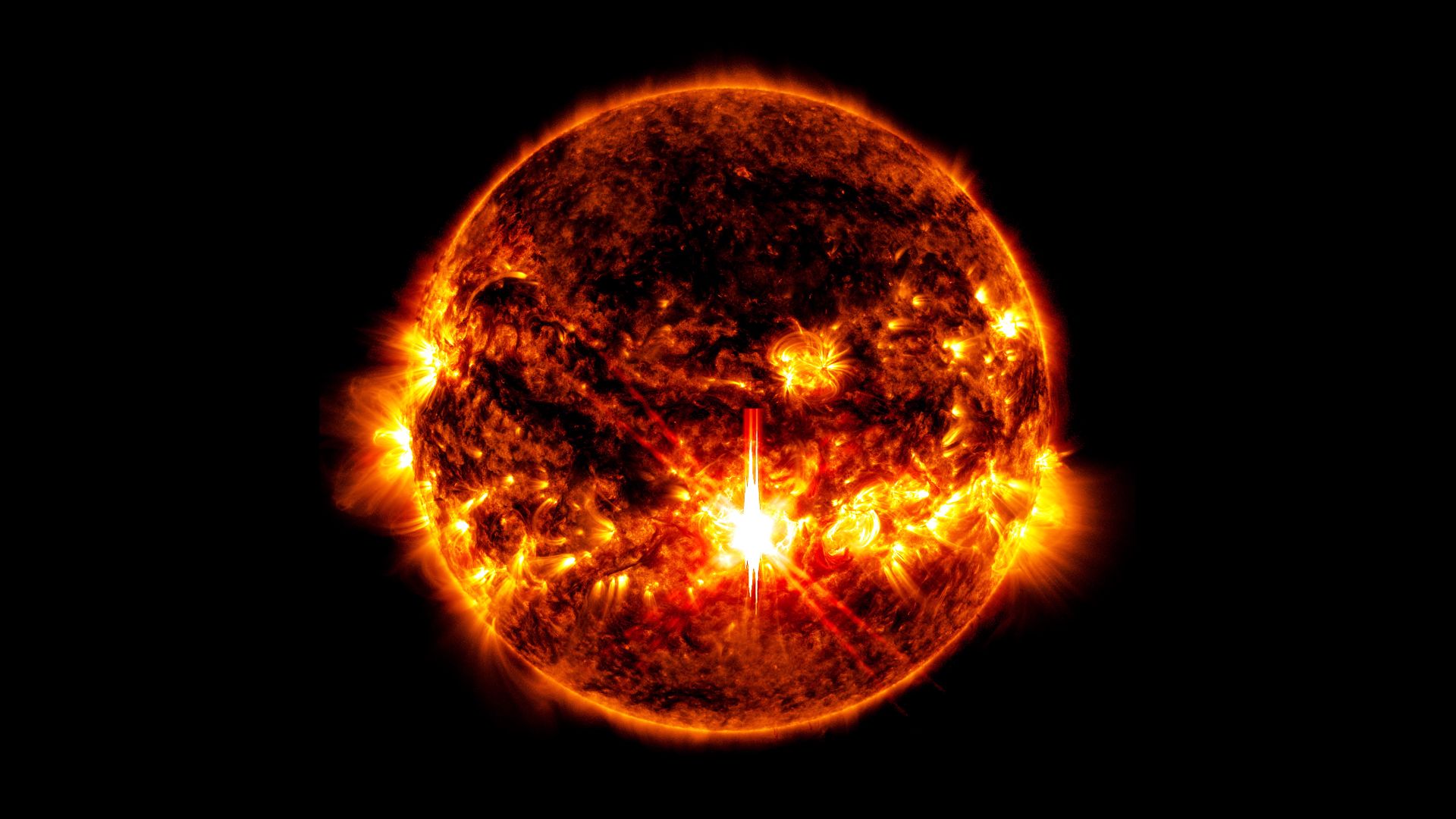
An image of a very violent looking sun against the darkness of space. In the center slightly toward the bottom there is a very bright spot.

A NASA image of the sun. (Image credit: NASA/SDO)

Around 57 years later in 1920, British scientist Arthur Eddington first suggested stars like the sun are actually powered by the nuclear fusion of hydrogen to helium. The idea was published by Eddington in his 1926 book, "The Internal Constitution of the Stars." Twelve years after this, nuclear physicist Hans Bethe formulated the first explanation of this nuclear fusion process, detailing the proton-proton chain reaction and the Carbon-Nitrogen-Oxygen (CNO) cycle.

The idea of the sun as a burning lump of coal finally burnt out 162 years after the formation of the U.S., a chain reaction kick-started by an American publication.

Ether or…?

During the infancy of the U.S. in the 1800s, scientists understood that light is a wave. Applying this to what they knew of other waves, it was logical to presume that light also needed a medium through which it could propagate. This medium would have to be ubiquitous and possess some unique properties to allow light to propagate through it at the speed of light.

Thus, it was proposed that space was filled with a medium called the luminiferous ether, with luminiferous meaning "light-bearing." The fact that this would have to be an invisible and infinite material that doesn't interact with physical objects made the existence of the luminiferous ether highly controversial.

We now know this medium doesn't exist, and that is thanks to two American physicists, Albert A. Michelson and Edward W. Morley, who in 1887 delivered the most important null result in the history of science: disproving the existence of the luminiferous ether.

Should the luminiferous ether exist, then scientists reasoned that as the Earth orbits the sun at around 66,000 miles per hour (106,216 kilometers per hour), our planet should be moving through the ether, which had been deemed to be stationary. That meant Earth must be moving with respect to the stationary ether. And if the ether is the medium through which light waves ripple, this should mean the speed of light differs ever so slightly in the direction Earth is traveling.

A black and white photo of a rectangular prism device in a brick wall room.

The Michelson Morley interferometer used to deliver the most important null result in the history of science. (Image credit: Case Western Reserve University)

Conducted in Cleveland, Ohio, the Michelson–Morley experiment used a piece of kit called a Michelson–Morley interferometer to test differences in speed for a wave of light traveling perpendicular to Earth and one traveling parallel to Earth. Michelson and Morley had expected to observe an interference pattern caused by the differing travel times of the light waves.

That is what happens when light of the same wavelength arrives at a detector at ever so slightly different times, meaning the peaks and troughs of the waves no longer perfectly align. However, to the surprise of the American physicists, no interference was detected. This meant no difference in the travel speed of light, essentially disproving the existence of the ether.

The negation of the luminiferous ether was of vital importance as it opened the door to Albert Einstein's theory of special relativity in 1905 and general relativity in 1915, the latter of which revised our understanding of gravity and led to our knowledge of black holes and gravitational waves well before the experimental observation of such objects.

Other galaxies!

Though scientists realized Earth isn't in the center of the solar system before the birth of the U.S., there was another glaring misconception. It was believed that the Milky Way, first proposed in Immanuel Kant's "Island Universe" theory in 1755, still occupied a unique position in the universe — with the existence of other galaxies a hotly debated topic. The solar system itself was also thought to be at the center of the Milky Way.

In 1785, astronomer William Herschel set about mapping our galaxy, correctly determining the disk-like shape of the Milky Way but incorrectly placing the solar system at its heart. This picture changed in 1918, when American astronomer Harlow Shapley determined that dense groups of stars called globular clusters are centered on a distant core in the direction of the Sagittarius constellation. This placed the solar system off-center in the galaxy. Today we've expanded upon this, moving our planetary system 27,000 light-years away from the Galactic Center and onto one of our galaxy's spiral arms.

It was five years later, in 1923, that the uniqueness of the Milky Way was shattered. Using the 100-inch (2.5-meter) Hooker telescope at the Mount Wilson Observatory, American astronomer Edwin Hubble imaged the Andromeda nebula (Messier 31) and determined that it was at least a million light-years away. Though we now know this distance is closer to 2.5 million light-years, it was still enough to place M31 outside the boundary of the Milky Way.

The fact that the Andromeda nebula is actually the Andromeda galaxy, a distant and separate galaxy from our own, was announced to the public via The New York Times in Nov. 1924. We were no longer alone galactically — but Hubble wasn't done.

The universe is not static

Another assumption at this time was that the universe was static, something supported by Einstein in 1917. However, in 1929, Hubble discovered that the light from distant galaxies was being redshifted. In other words, the wavelengths of light emanating from these sources were being stretched as those wavelengths traveled toward us. This indicated that these galaxies are moving away from us. Convinced of this, Einstein abandoned his model of the static universe.

American scientists weren't done revising our entire picture of the cosmos, however. In 1998, U.S. researchers like Saul Perlmutter, Adam Riess, and Robert Kirshner were part of two international teams of researchers that discovered that not only is the universe expanding, but this expansion is actually speeding up.

Dark energy was introduced as the mysterious force driving this accelerating expansion. It remains today one of the most pressing mysteries of the cosmos.

Possibly by the time the U.S. celebrates its 300th birthday, the mystery of dark matter will have been solved along with other cosmic puzzles such as the nature of dark matter. If this is the case, it is highly likely that U.S. projects like the Hubble Space Telescope, the James Webb Space Telescope, and the upcoming Nancy Grace Roman Space Telescope will put American innovators and scientists at the forefront of these developments, just as their predecessors have been for the last 250 years.

Infant stars celebrate their independence with cosmic fireworks| Space photo of the day for July 3, 2026

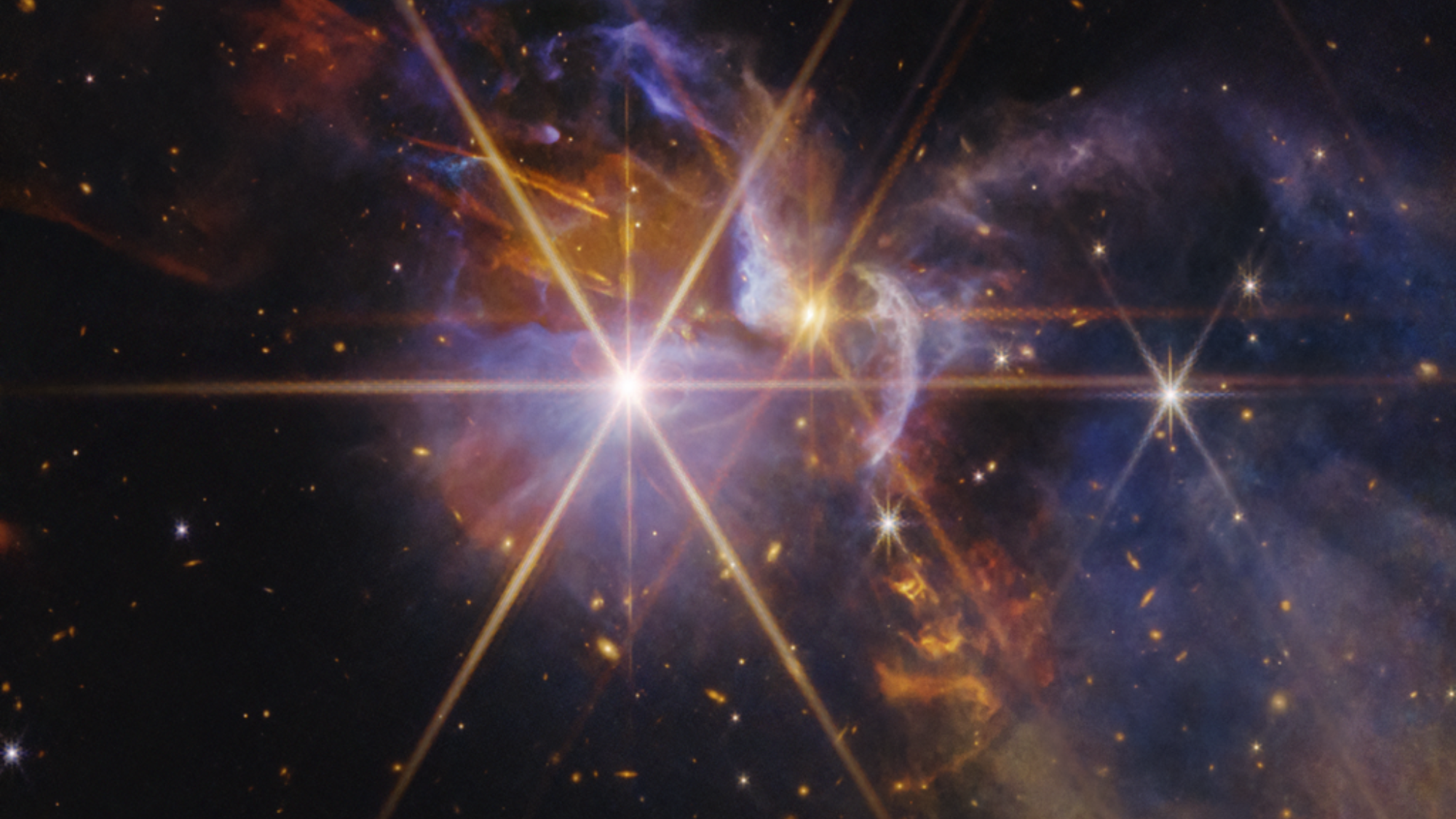
The protostars of the star system FS Tau as seen by the JWST (Image credit: NASA, ESA, CSA, STScI; Image Processing: Alyssa Pagan (STScI))

Infant stars or "protostars" celebrate their independence with cosmic fireworks in a stunning new image from the James Webb Space Telescope (JWST).

NASA released this image to celebrate the 250th anniversary of the birth of the U.S. It is a fitting tribute as the protostars break away from the molecular cloud in which they formed to become fully fledged stars in their own right.

Protostars are born when patches in vast molecular clouds cool and form clumps, collapsing under their gravity. Protostars continue to gather material from these prenatal clouds until they have enough mass to trigger the nuclear fusion of hydrogen into helium in their cores, the process that defines what a main-sequence star is.

What is it?

The protostars sit in a region known as FS Tau, located around 450 light-years away, which has become a popular target for astronomers aiming to study the evolution of low-mass stars.

Why is it incredible?

Though previously well studied, it has taken the incredible infrared observing power of the JWST to peer through the thick clouds of star-forming gas and dust in FS Tau and visualize the protostars of this region in great detail.

One of the aims of this research is to investigate the impact that radiation and outflows of material from low-mass stars have on their environment. The outflows occur as protostars gather matter from their surroundings, occasionally blasting out some of this matter.

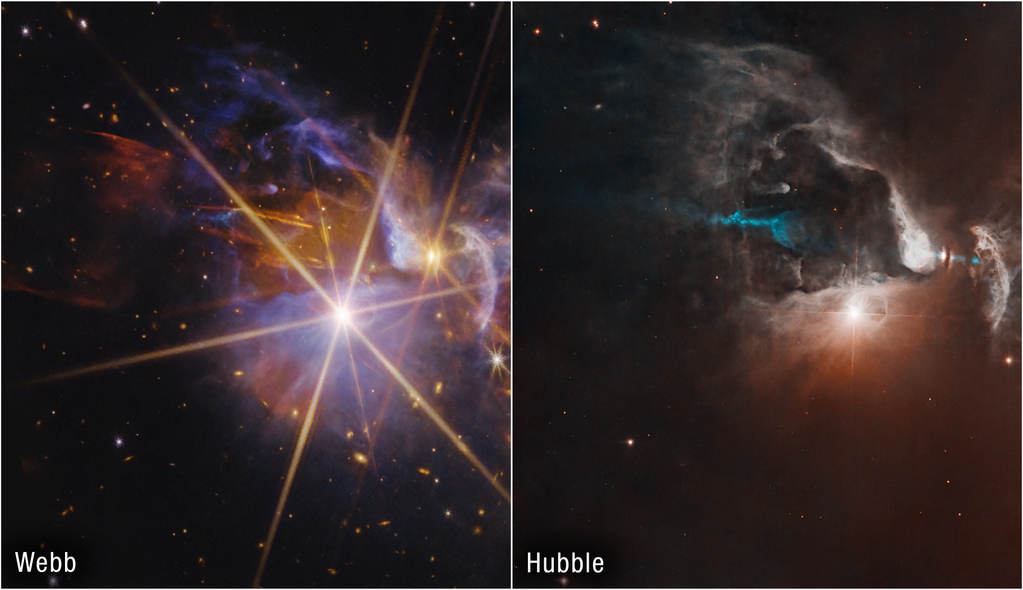
The JWST image of FS Tau reveals gaps between the outflows that support the theory that protostars gather or "accrete" matter in discrete episodes, between which they lie dormant.

A comparison between the observations of FS Tau by NASA’s Hubble and JWST. (Image credit: NASA, ESA, CSA, STScI; Image Processing: Alyssa Pagan (STScI))

The effect of protostar outflows on their environment can be seen in the JWST image via the prominent blue ridges. These represent gas that has been shunted by outflows, creating dense regions of matter that reflect light from proximate protostars.

The result is cosmic fireworks that put even the most impressive July 4 celebrations to shame. But at least we get hot dogs.

‘Stellar death is not the end’: James Webb Space Telescope glimpses the fate of the solar system in a weird exoplanet orbiting a dead star

Astronomers have used the James Webb Space Telescope (JWST) to observe an oddball gas giant exoplanet orbiting a dead star, a white dwarf, located some 80 light-years away. This "life after death" system gives scientists a portentous vision of what the solar system may look like in around 6 billion years after the sun has exhausted the hydrogen in its core, shed its outer layers, and left behind a smoldering white dwarf stellar remnant.

Prior to the final stages of that transformation, our star will have become a red giant, swelling out to many times its original radius, swallowing the inner rocky planets including Earth but leaving the outer planets  — although changing them irrevocably. Reflecting this, the white dwarf at the heart of this research is orbited by a Jupiter-sized exoplanet, designated WD 1856 b.

As WD 1856 b orbits its dead parent star, it crosses or "transits" the face of this white dwarf, known as WD 1856+534. By observing these transits with the JWST, the team was able to measure the mass and temperature of this Jupiter-like planet while also observing the composition of its atmosphere. To their surprise, they found WD 1856 b is hotter than expected. They also discovered how this planet came to have such an unusually tight orbit around its host white dwarf star.

"We're used to looking back in time when we use telescopes, but this is the first time we have been able to look forward to what might happen to the outer planets around the remnant of a sun-like star; it's like using a time machine to peer into the distant future of our solar system," team leader Ryan MacDonald from the University of St Andrews in Scotland said in a statement. "This is just the beginning of our exploration of planets orbiting dead stars with Webb, and the search for further planets orbiting white dwarfs is ongoing.

"Our results show that stellar death is not the end  — some planets experience a vibrant and lively future after the death of their star."

The team's research was published on Wednesday (July) in the journal Nature.

Survivor planet is a real oddball

The gas giant WD 1856 b was first discovered in 2020 by NASA's exoplanet-hunting spacecraft TESS (Transiting Exoplanet Survey Satellite) and the Spitzer Space Telescope. TESS detects exoplanets using the tiny dips in starlight they cause as they transit their host stars, blocking starlight.

This was the first intact planet ever discovered closely orbiting a white dwarf. What immediately stood out about WD 1856 b was how close its orbit is to its white dwarf host. The orbit is around 2% the size of Earth's orbit around the sun and takes just 1.4 Earth days to complete.

"The planet is quite the oddball. It's about the size of Jupiter, but the white dwarf it orbits is the size of Earth, so the planet is seven times larger than its star," MacDonald said.

The planet couldn't have always been in such a close orbit to its star. If it had, it would have been obliterated when the star transformed into a red giant before shedding its puffy outer layers and leaving behind a white dwarf.

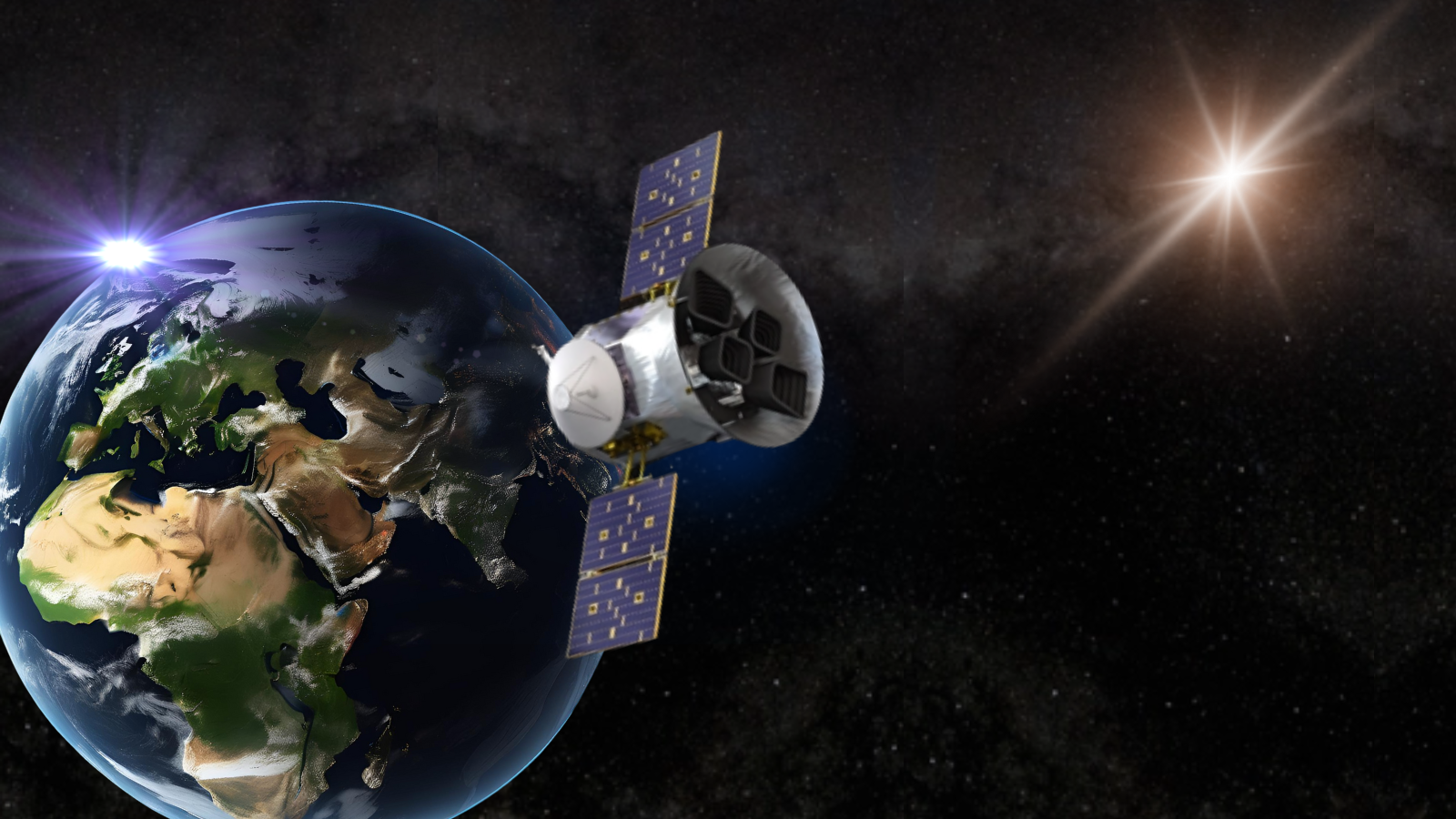
An illustration showing NASA's exoplanet hunter TESS which could be assisted by a binary star

An illustration showing NASA's exoplanet hunter TESS. (Image credit: Robert Lea (created with Canva))

"The big question is how WD 1856 b ended up where it is today, and there are two theories," team member Christopher O'Connor of Northwestern University said. "One is that the planet was swallowed by the host star as it was dying, and managed to survive on the inside. The other is that the migration took place due to the gravitational effect of other objects in the system. The white dwarf is part of a triple star system, and the outer companion stars could have influenced WD 1856 b's orbit."

The clue that allowed the team to differentiate between these migration mechanisms was the temperature of WD 1856 b, which at 260 degrees Fahrenheit (127 degrees Celsius) is about 240 degrees hotter than it would be if its only source of heat were the light from its white dwarf parent star.

With no energy available to warm the planet to these temperatures, the team reasoned that the temperature must be a residual effect of prior warming either from being engulfed by the red giant or during an inward migration. Using observations of the planet's mass of between four and 11 times that of Jupiter, the team was able to model how it would have cooled over time.

WD 1856 b watches from a safe distance as its parent star transforms into a red giant and destroys its inner planetary system

WD 1856 b watches from a safe distance as its parent star transforms into a red giant and destroys its inner planetary system (Image credit: Robert Lea (Created with Canva))

MacDonald and colleagues determined that WD 1856 b was likely heated up around 3 billion to 5.5 billion years ago. Its host star has been a white dwarf for longer than that, which means the exoplanet was safe during the star's destructive red giant phase, and moved into its tight orbit afterwards.

"As the planet moved inwards, its interactions with the strong gravity of the white dwarf will have caused it to warm up considerably, and it has been cooling ever since," O'Connor said.

The results indicate that Jupiter could move closer to the sun after the violent drama of its red giant phase and the destruction of the inner solar system. The findings also demonstrate the incredible observing power of the JWST and how the $10 billion space telescope is still discovering things no other instrument can.

"White dwarfs like WD 1856 are exceptionally dim compared to the planet-hosting stars we normally observe with the JWST," team member Victoria Boehm of Cornell University said.

"To make things even harder, the planet's transit only lasts 8 minutes, so it's very much if you blink you miss it! Capturing enough light to see WD 1856's spectrum, while also doing so quickly enough to not miss the transit, is something only Webb can do."

Astronomers discover a potentially habitable planet just 25 light-years away. ‘This one is exciting’

A potentially habitable rocky world has been found in the habitable zone around a red dwarf just 25 light-years from us.

However, faced with a hostile wind of radiation from its host star, it remains unclear whether this new exoplanet supports an atmosphere, or the possibility of life. Nevertheless, astronomers are celebrating the discovery.

"This one's exciting," said Paul Robertson of the University of California, Irvine, in a statement. "It's one of our closest cosmic neighbors. Twenty-five light years sounds like a long way, but the Milky Way is about 100,000 light years across, so in that respect it's our next-door neighbor."

The planet, designated GJ 3378b, orbits the faint red dwarf star in the constellation of Camelopardalis, the Giraffe. It was discovered in 2024 by French astronomers using the Canada–France–Hawaii Telescope in Mauna Kea, but American astronomers have revised those initial findings, revealing that the planet is possibly more like Earth than we realized.

All we know for sure is the mass and the orbit of GJ 3378b. We do not yet know whether it is like Earth or not – it could have land and sea and clouds and life, or it could be airless and cratered.

The planet is not seen to transit, or pass in front of its star, blocking its light from our vantage point. Instead, GJ 3378b was detected by the effects of its gravity tugging on its parent star. This causes the star to wobble around the center of mass that it shares with the planet, a wobbling that is betrayed by a Doppler shift in the star's light that can be measured by its spectra, the wavelengths of light that it emits.

When it was discovered in 2024, its mass was measured to be 5.26 times the mass of Earth, putting it in mini-Neptune territory of being a larger, mostly gaseous world. However, by taking a second look at the planet using two different telescopes, Robertson's team was able to show that the planet's true mass is 2.3 times the mass of Earth. This means that it is closer to being a rocky super-Earth instead.

Furthermore, the same observations found that GJ 3378b's orbital period is 21 days, not the 25 days that had originally been measured. This means that the planet is closer to the star than had been thought, sitting comfortably within the habitable zone where temperatures will be suitable for liquid water on the surface of a planet with an atmosphere. So from that point of view, the chance of GJ 3378b being habitable, if not inhabited, seems fair.

"This super-Earth gets about 90% of the radiation from its host star that Earth gets from its sun, so it's right in the sweet spot," said Robertson.

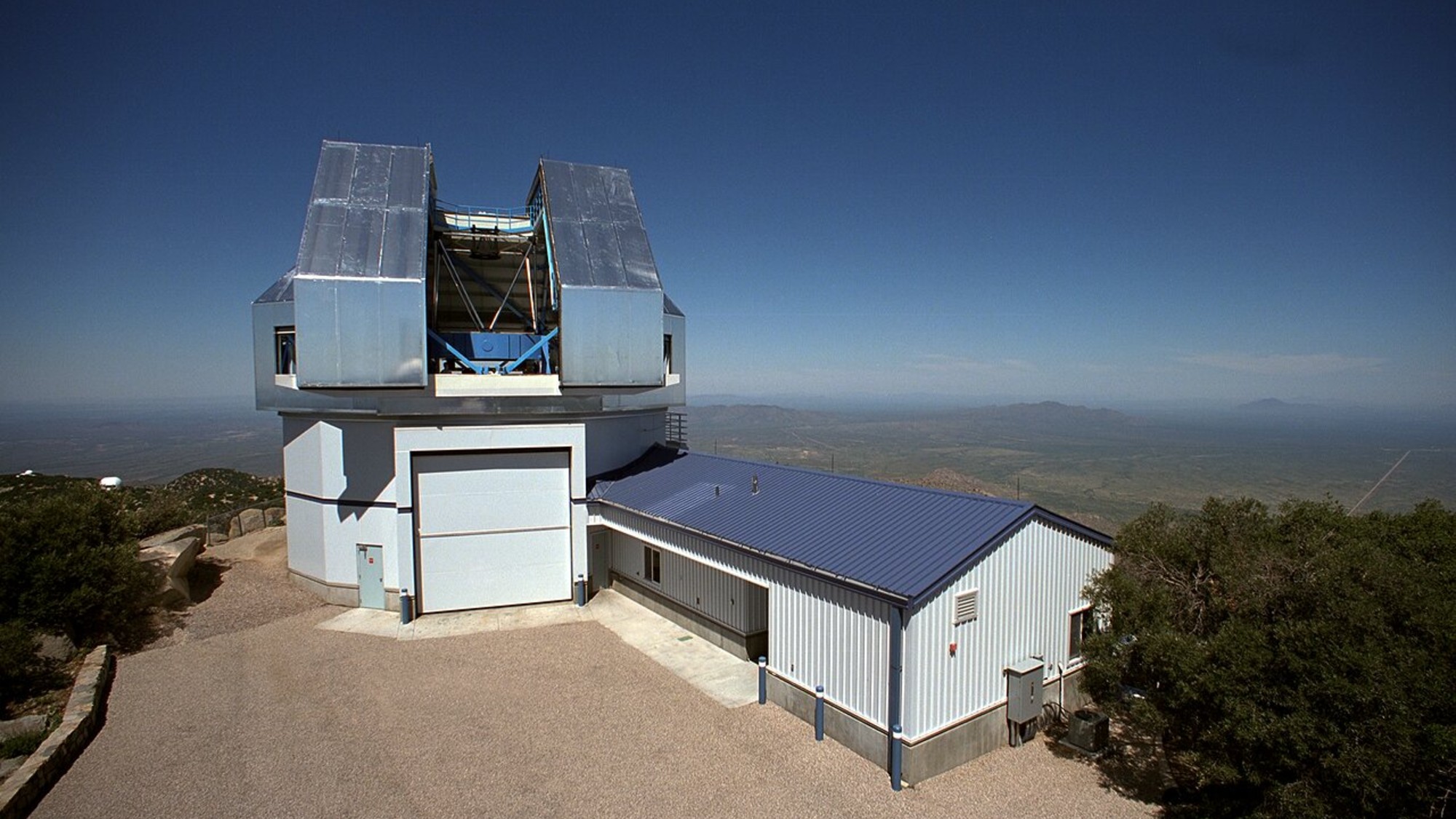
a domed building with a clamshell opening on a mountaintop

The WIYN 3.5-meter telescope at the Kitt Peak National Observatory near Tucson, Arizona, one of the two telescopes used to discover exoplanet GJ 3378b. (Image credit: NOIRLAB/NSF/AURA)

One significant problem, however, is that red dwarfs spit out harmful torrents of radiation in fierce gusts of their stellar winds, which can strip away a planet's atmosphere. This raises the question, does GJ 3378b even have an atmosphere?

Currently there is no way to tell. The James Webb Space Telescope (JWST) has been probing for atmospheres around other rocky worlds orbiting red dwarfs, such as those in the TRAPPIST-1 system. It does so by transit spectroscopy, where an atmosphere wrapped around a planet absorbs some of the star's light filtering through it, leaving dark absorption lines in the star's spectrum.

Unfortunately, GJ 3378b does not transit its star. This means that astronomers will have to wait until the 2040s, when NASA's Habitable Worlds Observatory will hopefully launch, to answer the question of whether GJ 3378b really does have an atmosphere or not.

Still, astronomers are hopeful. GJ 3378b is right on the edge of the zone where planets are expected to be seriously battered by radiation, meaning it could have escaped the worst. If so, there might be more than just an atmosphere for the Habitable Worlds Observatory to discover.

"The ultimate goal is biosignatures," said University of Texas at Austin astronomer Michael Endl in a separate statement. "We really want to know, are we alone in the universe? We are still in the reconnaissance phase of our solar neighborhood, trying to find the planets around the nearest stars because those will be the easiest ones to detect a biosignature on."

"This planet brings us one step closer to knowing all of our neighbors and, ultimately, which might be hospitable for life."

The findings were reported on June 30 in The Astrophysical Journal.

In 1776, the moon was a clock, a calendar and a streetlight — and it was 31 feet closer to Earth

After Americans declared independence on July 4, 1776, a waning gibbous moon rose in the night sky. To the people celebrating the birth of a new nation, it would have looked much the same as the moon we see today. But there was one subtle difference: 250 years ago, the moon was about 31 feet (9.4 meters) closer to Earth than it is now.

"The moon is currently drifting away from Earth at a rate of about 3.8 centimeters [1.5 inches] per year, which is coincidentally roughly the same speed at which human fingernails grow," says Seth McGowan, president of the Adirondack Sky Center & Observatory in Tupper Lake, New York.

That 31 feet may sound significant, but against the moon's average distance from Earth of 238,855 miles (384,400 km), it's effectively nothing. In fact, the moon's elliptical orbit causes its distance from Earth to vary by about 26,000 miles (43,000 km) every month as it moves between perigee, its closest point to Earth, and apogee, its farthest. "The tiny 31-foot shift over 250 years is entirely swallowed up by that massive monthly variance," says McGowan. But while the moon itself looked much as it does today, the world beneath it was very different.

How Americans used the moon in 1776

Colonial Americans depended on the moon in ways that are easy to forget in an age of electric light and digital clocks. Travelers planned journeys around how much moonlight would be available on a given night. Farmers and Indigenous peoples consulted lunar cycles to anticipate seasonal changes. Mariners tracked the moon's pull on the tides. Even military planners considered lunar illumination — during the Revolutionary War, a moonlit night could aid troop movement and navigation, but it could also expose an army's position to enemy forces. The moon helped people organize their activities in an era when daily life remained closely tied to the natural world.

One of the most popular publications of the colonial era was the almanac. Long before weather apps — or even standardized timekeeping — Americans turned to these annual guides for practical information about moon phases, moonrise and moonset times, eclipses, tides, and seasonal events. Publications such as Benjamin Franklin's "Poor Richard's Almanack" helped popularize the format decades before independence, while later titles, such as "The Old Farmer's Almanac," first published in 1792, continued the tradition.

What astronomers knew about the moon in 1776

By the time the Declaration of Independence was signed, astronomers already understood a surprising amount about Earth's nearest neighbor. More than 160 years earlier, Galileo's telescopic observations had revealed mountains, valleys, and craters on the lunar surface, overturning the ancient notion that heavenly bodies were perfect spheres. Isaac Newton's laws of motion and gravitation had since explained why the moon orbited Earth and why tides occurred.

While astronomers could predict eclipses and chart the moon's movements with impressive accuracy, they had never seen the moon's far side, had no idea how it formed, and couldn't say with confidence what it was made of. All of that would come centuries later — and there are still many lunar unknowns today.

How Apollo astronauts revealed the moon's slow escape

During the Apollo missions, we learned an extraordinary amount of new information about the moon, including the rate at which it's moving away from Earth. Apollo astronauts installed retroreflectors — special mirrors designed to bounce light directly back toward its source—on the lunar surface. Scientists then fired lasers at those reflectors to measure how long it takes the light to return, allowing them to calculate the Earth-moon distance with extraordinary precision. (Fun fact: We continue to use the retroreflectors today!) Those measurements revealed that the moon is receding from Earth at about 1.5 inches (3.8 cm) per year.

"The moon's gravity pulls on Earth's oceans, creating a tidal bulge," says McGowan. "Because Earth rotates faster than the moon orbits us, that ocean bulge pulls slightly ahead of the moon, acting like a cosmic gravitational leash that accelerates the moon into a higher, wider orbit. In doing so, the Earth's rotation slows ever so slightly — about 2.3 milliseconds per century. "Back in 1776, a day on Earth was about 5.75 milliseconds shorter than it is now," says McGowan.

This effect is imperceptible on human timescales, but over millions of years, it will have dramatic consequences. Eventually, the moon will appear too small in Earth's sky to completely cover the sun, ending the era of total solar eclipses and leaving only annular, or "ring of fire," eclipses in their place. The moon will never completely free itself from Earth, though — physics dictates that the drift will stop after about 15 billion years. And well before that, in about 5 billion years, the sun will expand into a red giant, consuming both the Earth and the moon entirely.