Hot Jupiters are some of the most extreme planets in the universe, blazing gas giants like Jupiter or Saturn that exist so close to their stars that they complete orbits in a matter of days. Now, new research may rewrite the definition of these planets that make the solar system look a little bit mundane.
The extrasolar planet, orexoplanet, at the heart of this rethink is CoRoT-2 b, a world with 3.5 times the mass of Jupiter and 1.5 times the size of our solar system's largest planet, located around 696 light-years away. It orbits its star in just 41 hours or so.
What is so strange about CoRoT-2 b? Mosthot Jupiters are tidally locked, meaning they have one side that permanently faces their stars, a "dayside," and a "nightside" that faces out into space in perpetuity. However, a new investigation of CoRoT-2 b seems to show that this hot Jupiter isn't tidally locked, and that is a big surprise, one that challenges all our assumptions about these extreme exoplanets.
"I really like looking at the weird ones — finding planets that don't fit the standard picture — and doing some mystery solving," team leader Aurora Kesseli of the NASA Exoplanet Science Institute (NExScI) said in a statement.
"Now we can see that a one-size-fits-all model does not work, even for planets that we've been studying for a long time. Every time we look at another hot Jupiter, we learn something new to help refine our models, which are useful for understanding not only hot Jupiters, but for all types of exoplanets."
The cosmic dance of hot Jupiters
For rocky planets, tidal locking would result in an incredibly hot dayside and a much cooler nightside, divided by a perpetual sunset. However, the situation for gas giants is somewhat more complicated because of their swirling atmospheres.
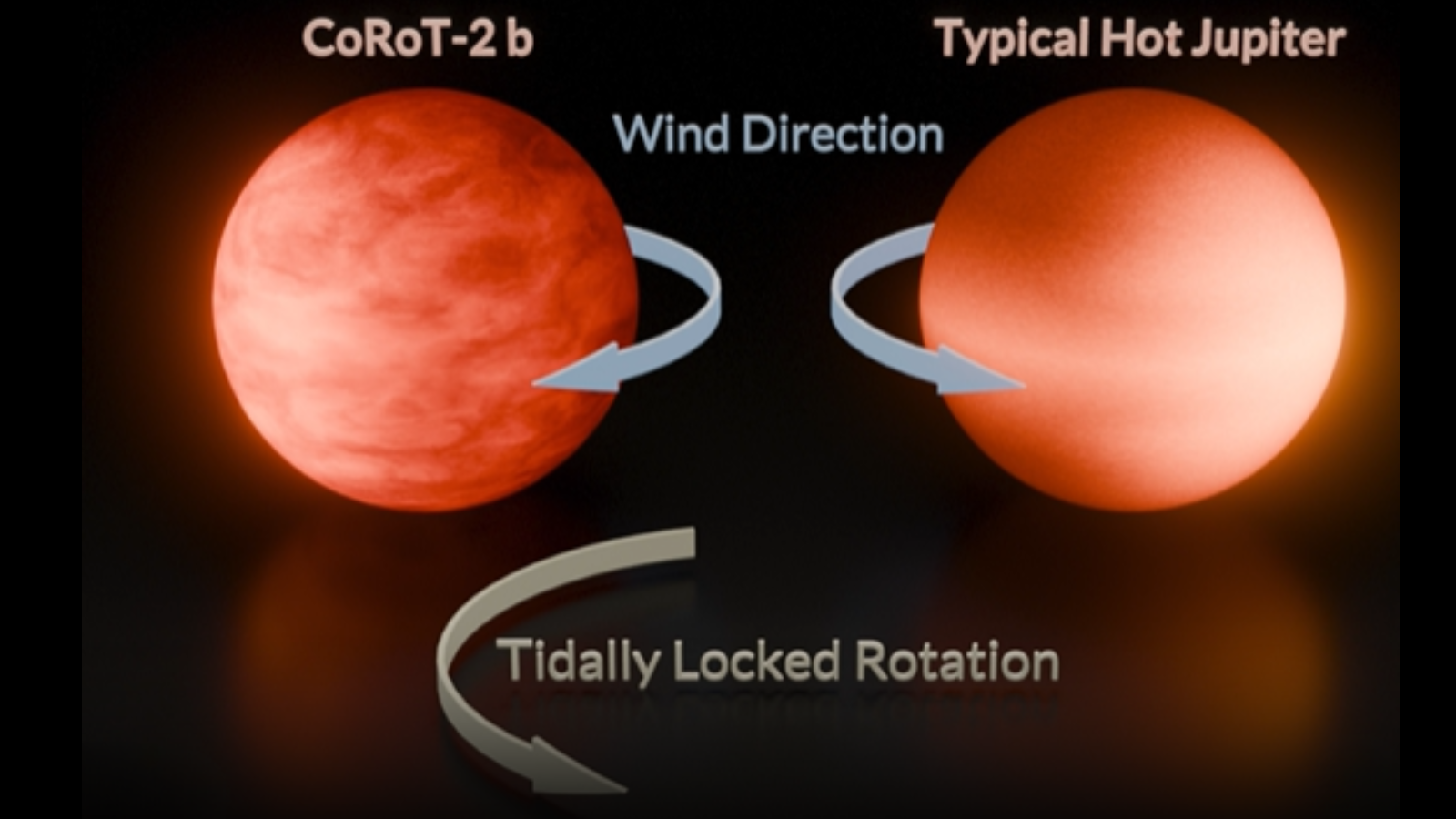
This means while hot Jupiters have day and night sides, they usually possess large hot spots on the dayside, shifted slightly towards the direction of their rotation and their orbit around the host star. CoRoT 2b defies this expectation too, possessing a hotspot in the opposite direction of its orbit. Kesseli and the team investigated three possible reasons for this abnormality.
"The conditions for tidal locking are important for astronomers to understand because the habitable zone for planets around M dwarfs is within the tidal locking zone, where we expect tidal locking to happen pretty quickly," Kesseli said. "The way that a planet rotates greatly affects how the planet distributes its heat, and therefore affects its habitability, so for a planet that is tidally locked, the temperatures, winds, and climates are going to look completely different than those of a planet that is not tidally locked."
An illustration shows the non-tidally locked planet CoRot 2 b rotating in the opposite direction compared to a tidally locked hot Jupiter (Image credit: Keith Miller (Caltech/IPAC - SELab).)
Measuring the velocity of CoRoT-2 b, Kesseli and colleagues found that one day on this hot Jupiter is about three Earth days, which is almost twice as long as its year which lasts around 1.5 Earth days. This means that its day is much shorter than its year; by the time CoRoT-2 b completes one rotation, it has made almost two orbits of its parent star. "I was very pleasantly surprised when I tried a bunch of methods, and I was like, 'Aha! This is actually like one of the three hypotheses!' Seeing the data pretty clearly pointing towards one of them was just really exciting," Kesseli said.
The next step for Kesseli is to discover what is causing the slow rotation of CoRoT-2 b.
"Hot Jupiters are the first type of planet where we have been able to really explore and refine our models of their climates," said Kesseli. "With the next generation of telescopes like the Habitable Worlds Observatory and the Extremely Large Telescope, we’ll be able to do more in-depth measurements across more planets, maybe even potentially habitable ones."
The team's research was presented at the 248th meeting of the American Astronomical Society in Pasadena, California, and has been published on the paper repository site arXiv.
If the number of satellites in Earth's orbit exceeds 100,000, humanity may lose its ability to study the universe from the planet's surface.
That's the conclusion of a study conducted by astronomers from the European Southern Observatory (ESO) which warns that if existing plans to deploy a million orbiting data centers and tens of thousands sun-reflecting mirrors were to come to fruition, the world's most cutting-edge astronomical telescopes may as well be mothballed.
"We can reach conditions where basically, there is no point in operating the telescopes anymore because all the data will be corrupted. All. 100 percent," Olivier Hainaut, the director of operations at ESO and lead author of the study, told Space.com.
Hainaut used computer modelling to understand the effect of varying numbers of satellites of different brightness levels on astronomical observations. The modelling showed that if 100,000 satellites were to orbit the planet and all were barely visible to the naked eye, astronomy could cope. If those satellites were brighter, however, around magnitude 7 or below in astronomical terms, astronomical research would become more difficult and costly.
"If you increase the light pollution, it means that you will see fewer natural stars and you will see more of these satellites," said Hainaut . "For telescopes that means increasing exposure times. If you have a 10 percent increase in light pollution, you have to increase all the exposure times by 10 percent. It scales directly. For a 100 percent increase in light pollution, you have to increase all the exposures by 100 percent."
The exposure time increases mean that less science gets done and every observation becomes more expensive. The International Astronomical Union says that an increase in light pollution by more than 10 percent compared to natural dark sky conditions is an astronomy killer.
As light pollution has spread with urban development over the past two centuries, astronomers have increasingly been retreating into ever more remote locations. Many of the world's most expensive telescopes, including the Vera C. Rubin Observatory and the ESO's Very Large Telescope and Extremely Large Telescope, are located in Chile's Atacama Desert where the night sky is still nearly perfectly dark.
But while it is possible to retreat from the city lights, there will be no escape from satellite light pollution, Hainaut warns. You may be visiting a tiny village in Africa, camping in the Australian outback, or on an expedition to Antarctica or the Amazon rain forest, and your sky would still be brightened by the satellites.
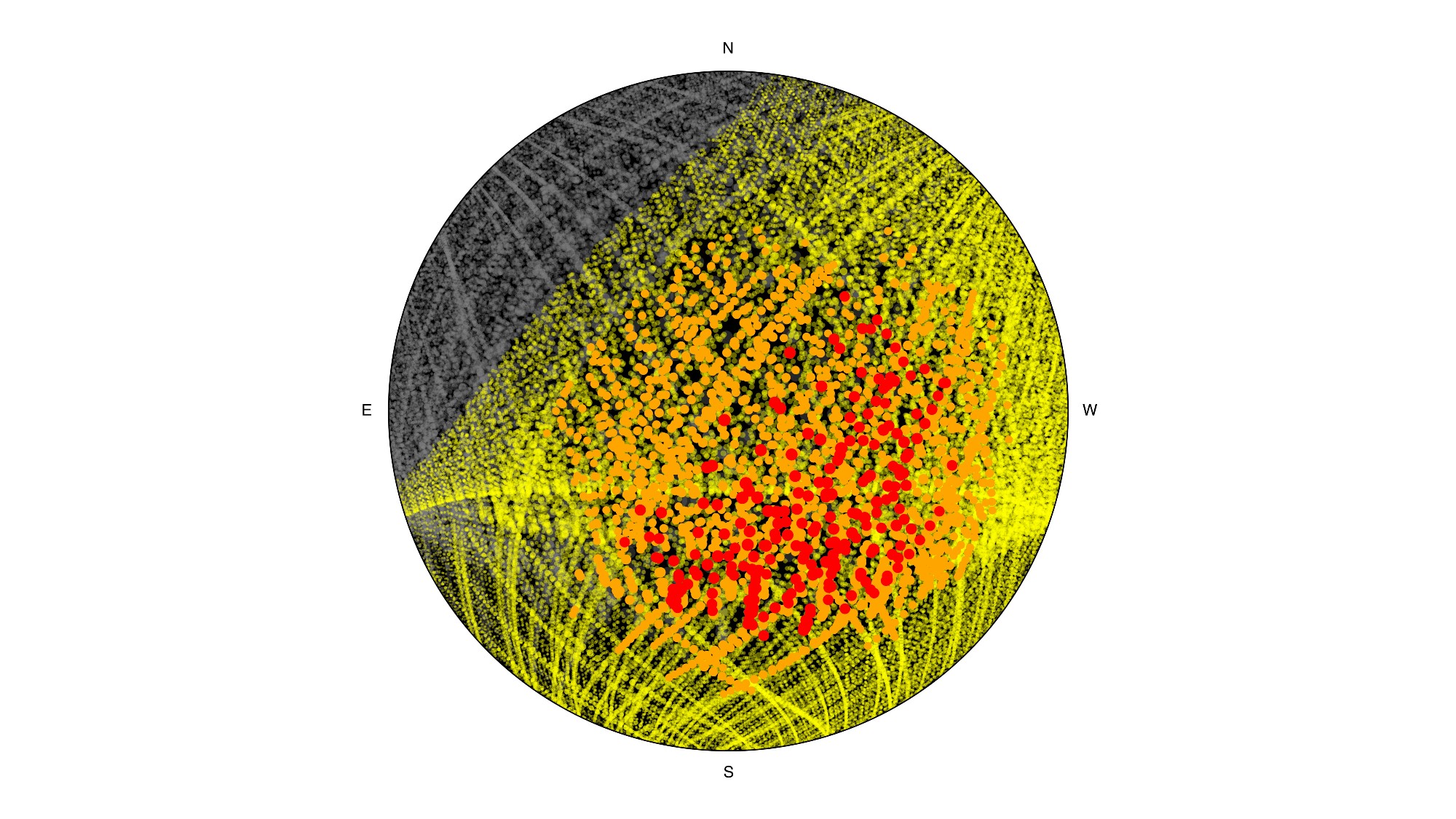
This diagram shows the number of satellites that would be visible above ESO's Very Large Telescope (VLT) if SpaceX launches their planned constellation of 1 million satellites. (Image credit: ESO/O. Hainaut)
"What they propose would make our observations close to impossible"
What is worse, if plans to launch thousands of sun-reflecting mirrors, as proposed by the U.S. company Reflect Orbital, were to come to fruition, the sky would transform completely.
Headquartered in Hawthorne, California, Reflect Orbital's vision is to deliver light on demand to solar power plants at night and to illuminate warzones and areas struck by natural disasters. The company has applied to the Federal Communications Commission (FCC) to launch a demonstration space mirror into orbit later this year.
The satellite, called Eärendil-1, is 59 by 59 feet (18 by 18 meters) in size, and should be the first in a constellation of 50,000, if things were to go according to Reflect Orbital's plan. "Reflect Orbital is really bad," said Hainaut.
"What they propose would make our observations close to impossible. These are super bright satellites."
Astronomers have calculated that each Reflect Orbital space mirror would be brighter than the full moon if observed from the area where its beam is aiming. But the satellites would be visible regardless of where their beams are aiming to everybody around the world.
"Even outside the beam, the satellite will appear brighter than the planet Venus, which is the brightest object in the night sky after the moon," said Hainaut. "If they were to launch 50,000 of these space mirrors, there would be many hundred or even a few thousand of these super bright objects visible to observers anywhere on Earth."
Reflect Orbital, meanwhile, says that they have been engaging with the astronomy community throughout the company's development and that the company is currently commissioning independent, third-party research on the impacts of their satellites.
"Every spot of light we deliver will be requested, approved and contained," a company spokesperson told Space.com. "We will only provide redirected sunlight when it is signed off by the appropriate authorities in the relevant jurisdiction."
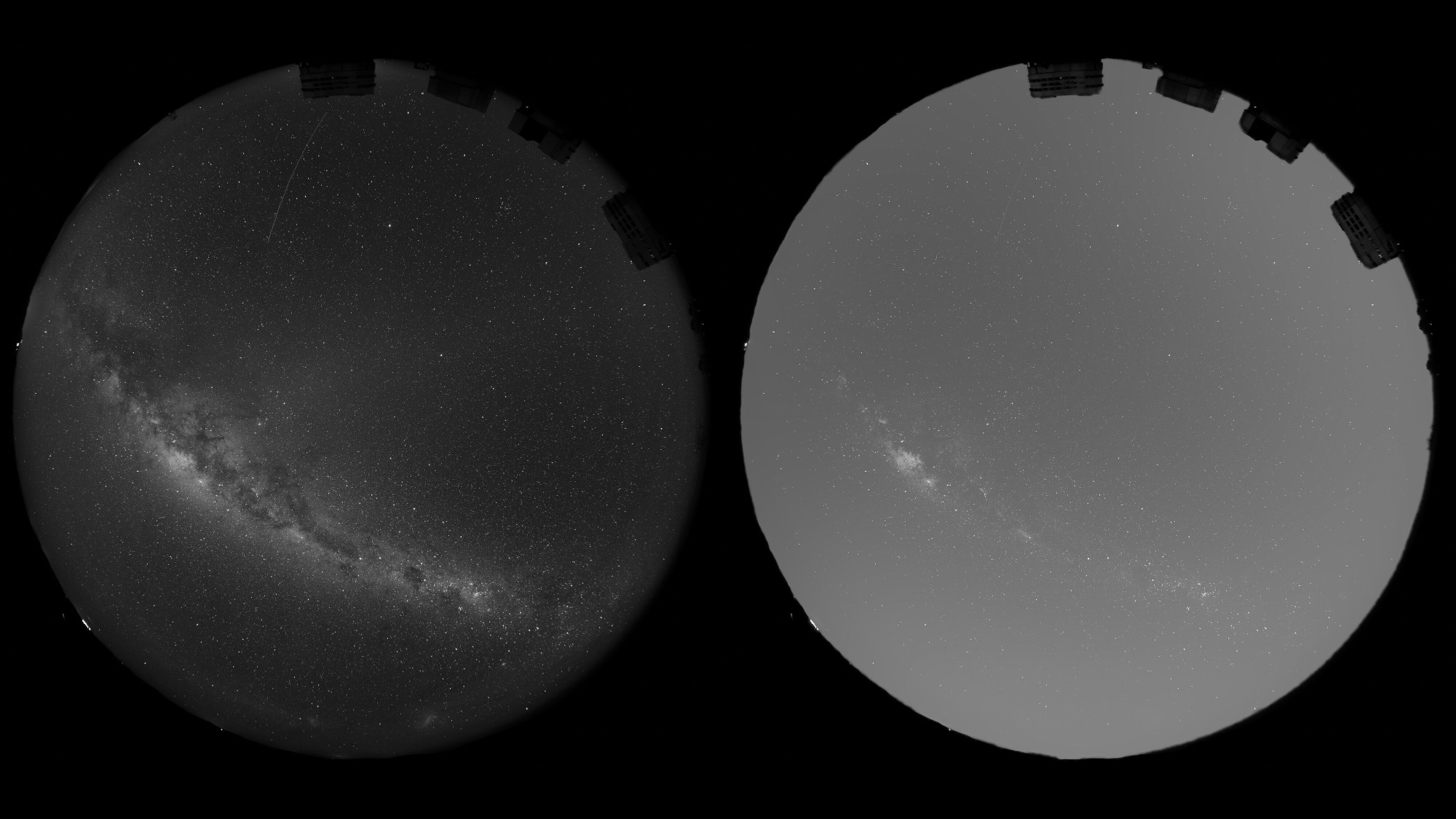
An image illustrating how sunlight scattered by Reflect Orbital’s space mirrors would increase the overall brightness of the sky above ESO’s Very Large Telescope (VLT). (Image credit: ESO/O. Hainaut)
Today, in areas with relatively low levels of light pollution, one can only see a few hundred bright stars in the sky. That means there would be more satellites than stars visible in the sky anywhere in the world with the full Reflect Orbital constellation in orbit. The constellation would also brighten the night sky by up to 300 percent, Hanuit calculated.
"If you increase the light pollution, it means that you will see fewer natural stars," said Hainaut. "And you will see more of these satellites."
Hainaut said that SpaceX's planned orbital data centers, despite the fact that they feature 230-foot-wide (70 m) solar panels, would be much dimmer and about as visible as Starlink satellites.
"From the available information, we see that these satellites have been optimized to minimize the impact as seen from the ground," Hainaut said. "The reflective surfaces are tilted away from Earth and the satellite itself is very narrow, pointing to Earth with its small end."
Still, overall, satellites operated by all operators around the world should remain below 100,000 satellites combined if astronomy is not to suffer, scientists caution. SpaceX is currently awaiting FCC's decision on its application to launch one million orbital data centers.
Currently, some 14,000 satellites orbit the planet.
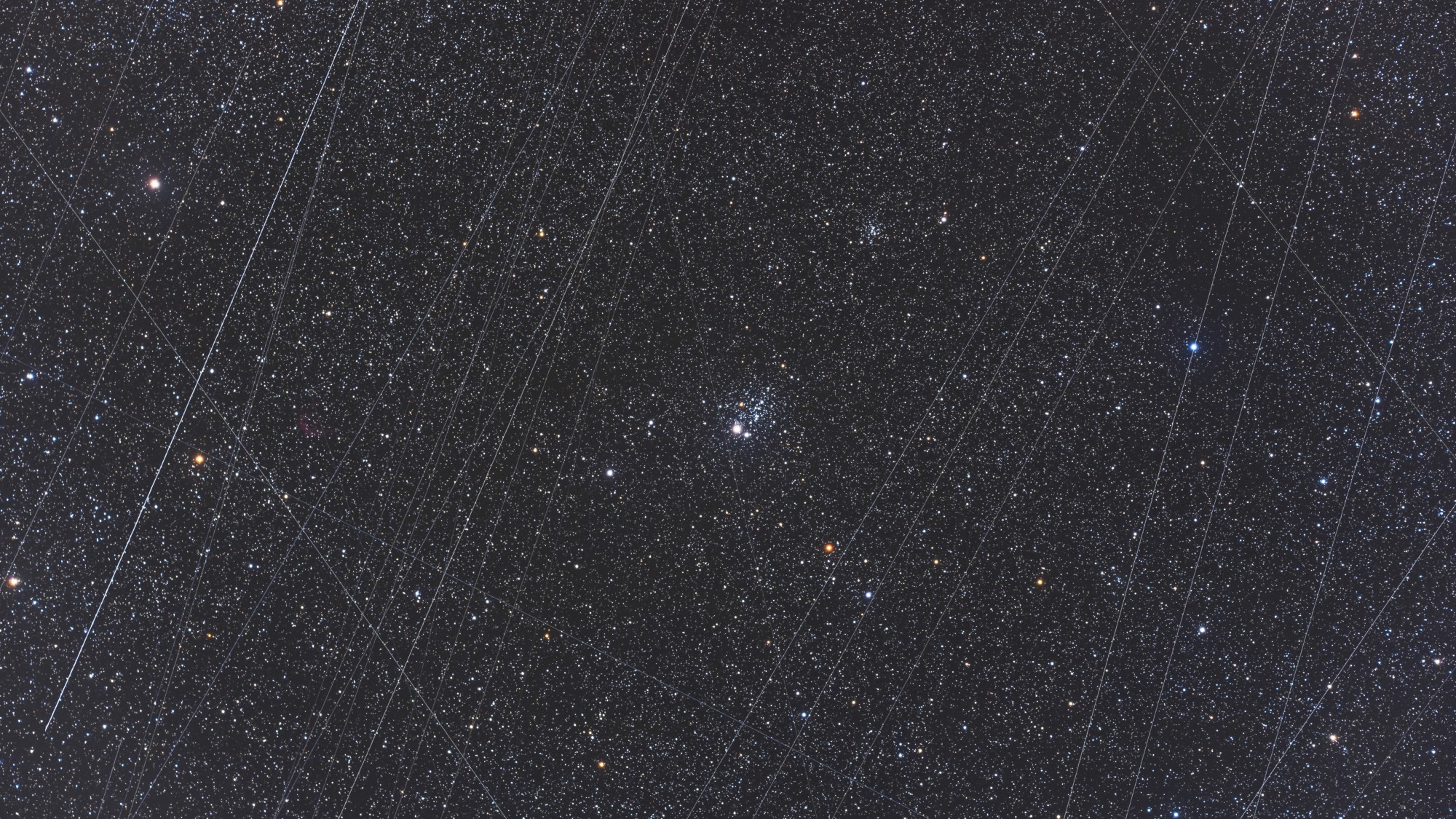
NGC 457, the Owl Cluster in Cassiopeia, in a stack of images showing the total number of satellite trails recorded over 36 minutes of total exposure in October 2022. (Image credit: Alan Dyer/VW Pics/Universal Images Group via Getty Images)
"For astronomy, this would obviously be catastrophic."
Robert Massey, the Deputy Executive Director of the Royal Astronomical Society, said Hainaut's findings were "not hugely surprising."
"For astronomy, this would obviously be catastrophic," Massey told Space.com. "It's very difficult to imagine how you could mitigate that on this scale. But I am also concerned about the public impact. The public has not signed up for having an entirely transformed sky."
Massey pointed out that based on the international law governing space activities, it is perfectly legal for a U.S. organization to be single-handedly deciding on something that would impact the entire world.
"If it's agreed by the FCC, this will be deeply regrettable," Massey said. "This will say that we are in a world where large corporations can determine the view of the sky above our heads, just as they can transform the environment on Earth. But the transformation of the environment on Earth is subject to pretty tight regulations."
The Trump administration has been taking steps to reduce the burden for satellite operators to prove their projects will have no negative environmental impacts. Currently, no environmental review has to be undertaken by the FCC or private companies before satellite applications go for approval.
Betty Kioko, an institutional affairs adviser at ESO, said the United Nations Outer Space Treaty, signed in 1967, states that the responsibility for space launches is with the nation states where those space objects are registered. She, however, added that the Treaty requires states to use space "for the common good of humankind."
"We now have to wait for the FCC to decide, because ultimately, the Outer Space Treaty was written at a time before we envisioned access to space by private entities."
ESO is among hundreds of organizations from around the world that have filed objections to the SpaceX and Reflect Orbital applications.
The study has been published in the journal Astronomy & Astrophysics.
Editor's note: This story was updated on July 2 to include comments from a Reflect Orbital spokesperson.
Jared Isaacman is doing his best to spur his country on to sporting glory.
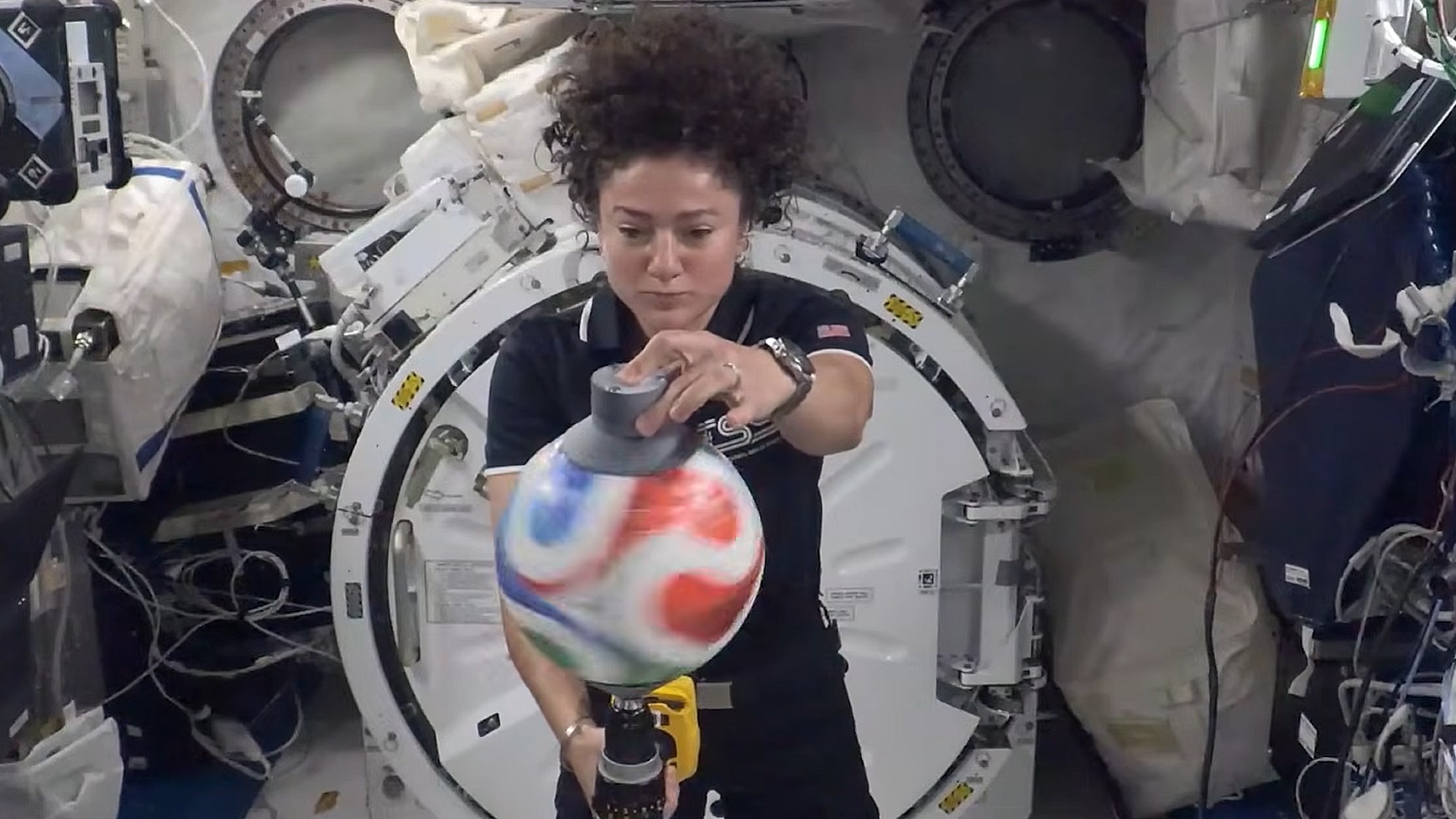
The NASA chief announced on Tuesday (June 30) that the agency will send a FIFA World Cup 2026 soccer ball to the moon if the U.S. men's national team manages to win the tournament, which is going on right now.
"So, a little bit of motivation for the United States here on this one," Isaacman said during a livestreamed press event on Tuesday. "We're going to one-up Alan Shepard in the golf game on the lunar surface, and we're going to get the soccer ball there."
Shepard famously smuggled two golf balls and an improvised club onto the Apollo 14 mission, which he commanded. On Feb. 6, 1971, the NASA astronaut hit those balls on the moon, becoming the first person ever to play a sport on another world.
The soccer-ball plan, by contrast, would be a sanctioned affair; Isaacman and Carlos García-Galán, manager of NASA's Moon Base program, are both behind it.
"I don't know which lander it'll wind up going in," Isaacman said during Tuesday's event, the second of the agency's monthly updates about its plans to build a crewed outpost near the lunar south pole via its Artemis program.
Turning to García-Galán, he added, "I'll leave that to you guys, to handle the payload."
"We will take on that challenge," García-Galán replied. "It will be super exciting to do that if they win. Good luck."
NASA astronaut Jessica Meir spins a FIFA World Cup 2026 soccer ball in microgravity aboard the ISS. (Image credit: NASA)
The U.S. men's team will probably need some luck to win the World Cup, an every-four-year event that's currently being jointly hosted by the U.S., Canada and Mexico. The American men have won just two knockout-round games in the entire history of the tournament, and one of those came in 1930, during the first-ever World Cup.
The 2026 team has performed better than most of its predecessors to this point, however; the Americans won their four-team group to advance to the single-elimination stage, beating both Paraguay and Australia before losing a meaningless game to Turkiye. (The U.S. had already clinched the group win at that point.)
The U.S. plays Bosnia-Herzegovina in a Round of 32 match on Wednesday (July 1). To hoist the World Cup trophy, the Americans would have to win that game, then four more after that, likely against some perennial soccer powers.
If they make it to the quarterfinals, for example, they'll likely face Spain, which won the World Cup in 2010 — a potential matchup flagged by García-Galán, who's from Málaga.
The U.S. women's soccer team has enjoyed a great deal more success at the international level, winning four of the nine FIFA Women's World Cups to date. (The women's tournament, which is also held every four years, was first played in 1991.)
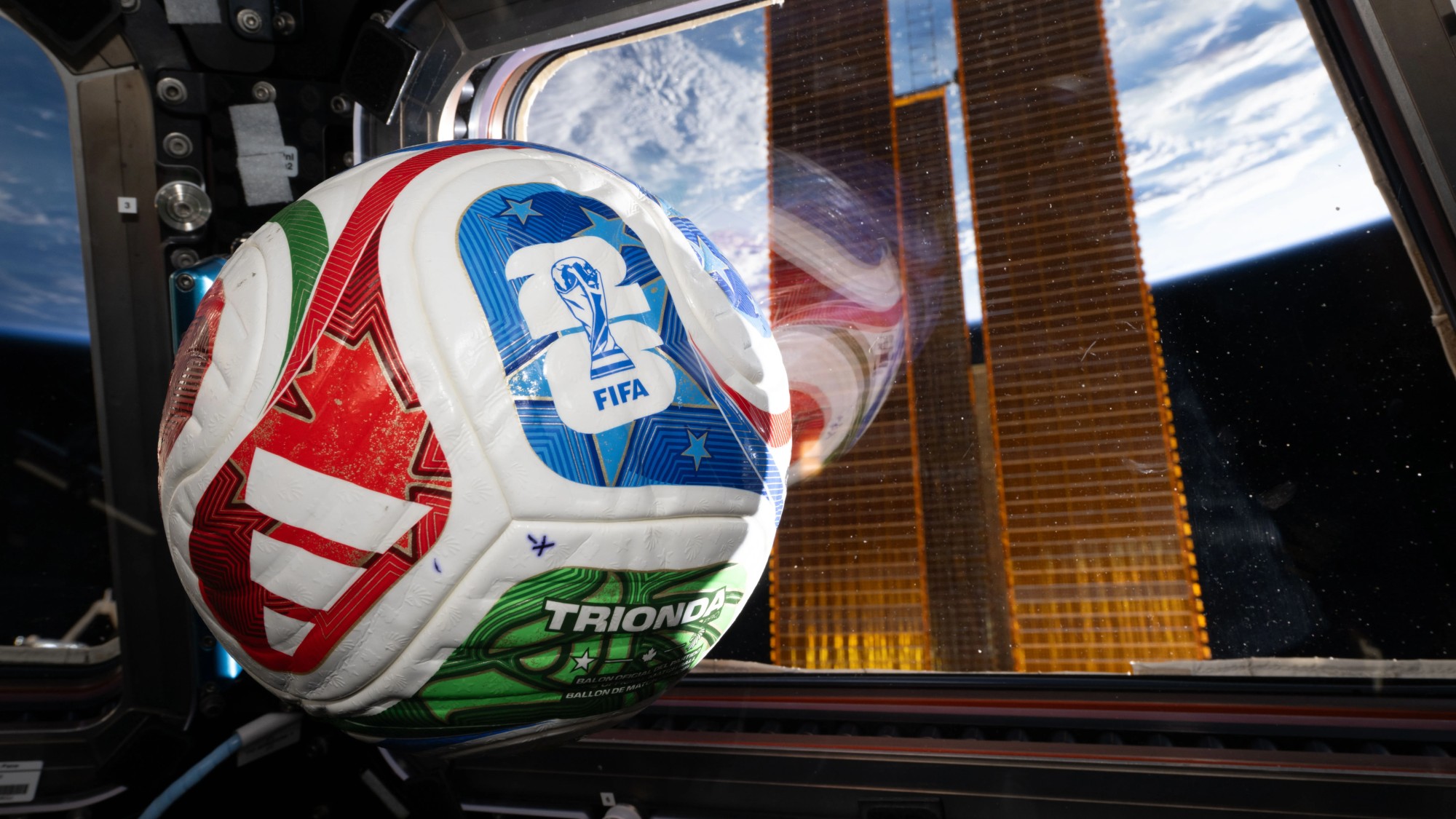
The FIFA World Cup 2026 soccer ball on the International Space Station. (Image credit: NASA)
"We're working to inspire the next generation by showing how space exploration inspires innovation in sports science — and everyday life," the agency said via X on June 20, in a post that included video of the off-Earth action.
Swirls of wildfire smoke can be seen over Canada. (Image credit: NASA)
Wildfires across the globe can be seen all the way from space. And one unexpected tool has come in handy to spot plumes of wildfire smoke: a satellite designed to study Earth's oceans.
What is it?
In this photo, we can see swirls of wildfire smoke over the Great Lakes in Canada. Fluffy white clouds float over the land and lakes, in contrast to the wisps of gray smoke, which float out from massive wildfires that ripped through North America.
The photo was snapped in May of last year by NASA's PACE (Plankton, Aerosol, Cloud, and ocean Ecosystem) satellite. This seems logical, as it is an Earth-monitoring satellite, but what's surprising is that the orbiting spacecraft was actually designed to study and monitor Earth's oceans and atmosphere. In fact, the image itself was captured by PACE's Ocean Color Instrument, which does "hyperspectral" imaging, meaning that it observes the planet in hundreds of different wavelengths of light (in visible, near-infrared and ultraviolet).
Why is it incredible?
This image, among others, shows the incredible versatility of space technologies like PACE. While wildfire monitoring isn't its explicit purpose, images and data from this mission could be incredibly helpful in deepening our understanding of wildfires and how they spread.
"The PACE satellite observes land too, and does it really well," Skye Caplan, terrestrial lead for the PACE mission at NASA's Goddard Space Flight Center in Maryland, said in a statement. "There is so much to explore with a new hyperspectral data set."
In fact, in addition to capturing wildfire smoke, as we can see in this image, PACE's Ocean Color Instrument can also spot changes in vegetation, burn scars and the charred aftermath of a wildfire. Images in the instrument's hundreds of wavelengths can reveal a variety of detailed information, such as how stressed, dry or even pigmented plants are on Earth's surface. This type of information could also be beneficial in identifying dry areas that could be at a higher risk of wildfires sparking.
NASA's Chandra X-ray Observatory has released four stunning images of cosmic wonders, depicted in red, white and blue to coincide with the United States' 250th anniversary on July 4.
The four images reveal superheated gas in a distant galaxy cluster, the swirling spiral galaxy known as Messier 94, a glowing nebula found in our own Milky Way galaxy, and the Cassiopeia A supernova remnant, respectively.
Along with the colorful cosmic images, the Chandra team produced sonifications in which the data collected by the powerful X-ray telescope was translated into sound. In this case, the sonifications turn these images into celestial music, mapping X-ray data into different audio frequencies and musical instrument sounds.
Galaxy cluster ZwCl 0024+1652
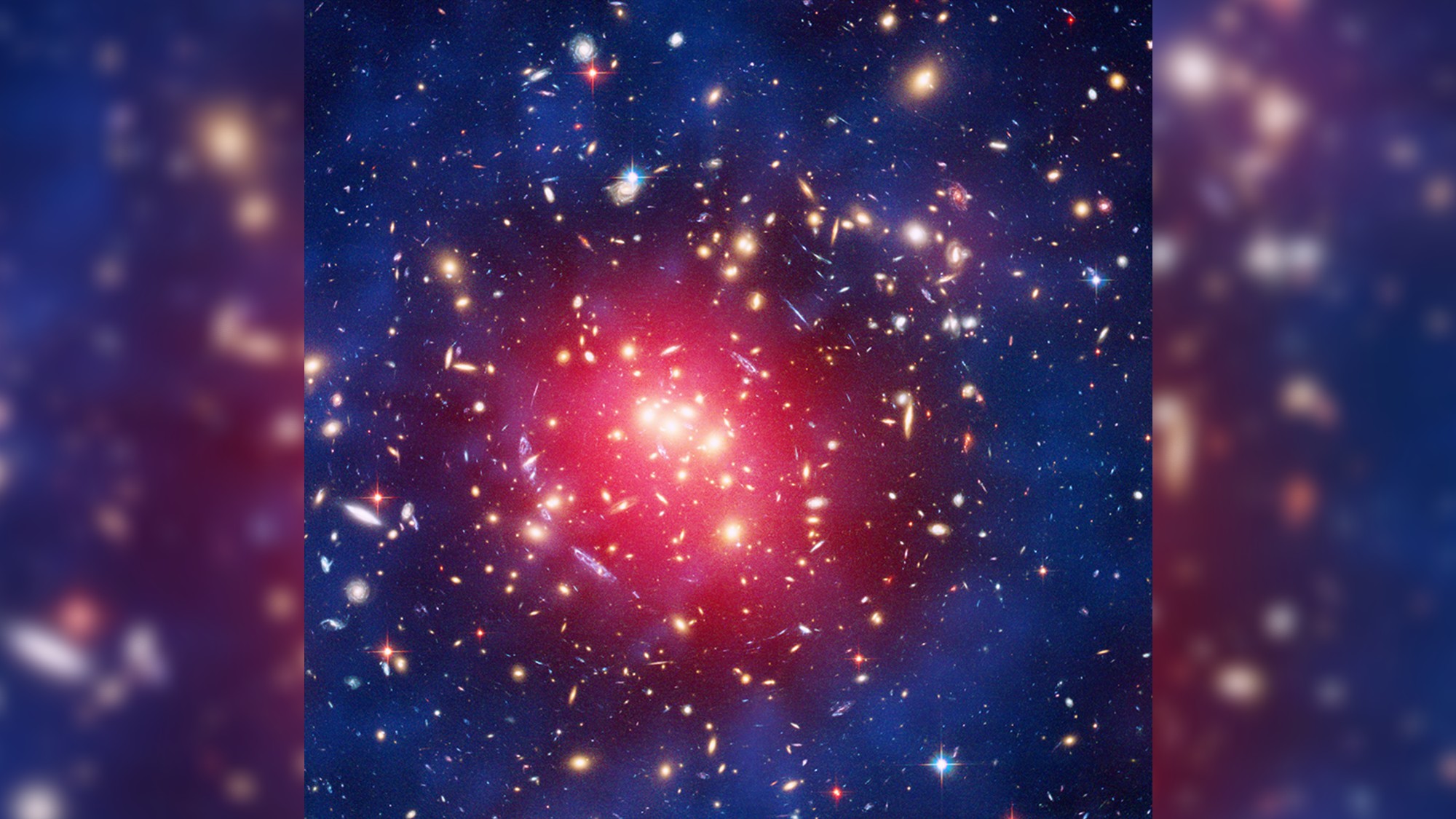
In this image, the galaxy cluster ZwCl 0024+1652 comes alive in vibrant blues and reds. The red in the image is produced from X-ray data collected by Chandra, revealing vast amounts of superheated gas surrounding these galaxies, found some 4 billion light-years from Earth in the Pisces constellation.
This image combines X-ray data from Chandra along with optical data from the Hubble Space Telescope, depicted here in blue. The Hubble data reveals the presence of dark matter, according to a statement from NASA.
Because dark matter does not interact with light, astronomers can't image it directly; its presence can be detected through the gravitational influence it has on surrounding matter that does interact with light.
An image of galaxy cluster ZwCl 0024+1652 that combines X-ray data from Chandra along with optical data from the Hubble Space Telescope. (Image credit: NASA/CXC/SAO; Optical and Dark Matter: NASA/ESA/M.J. Jee; Image Processing: NASA/CXC/SAO/L. Frattare)
Messier 94
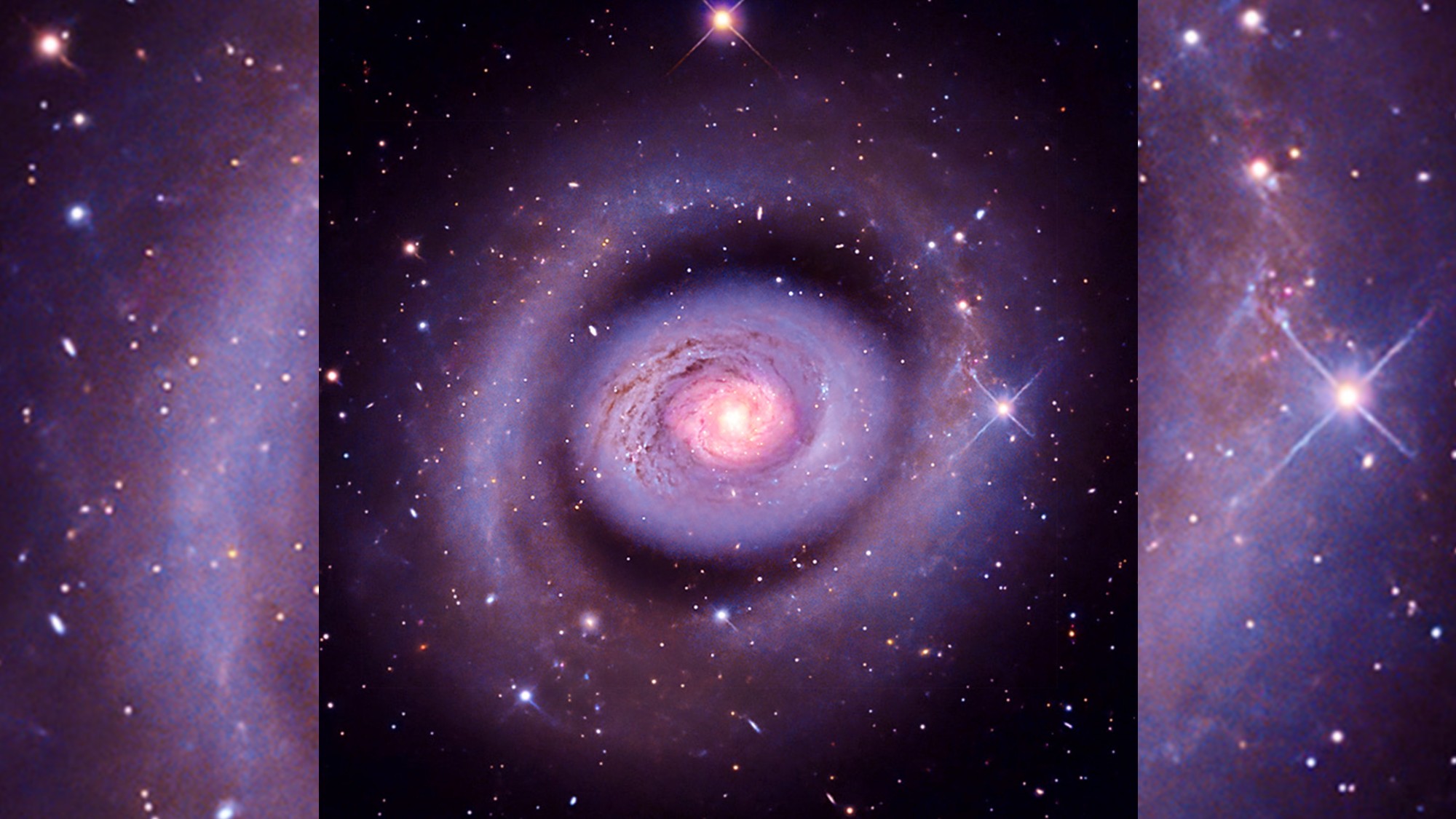
Chandra also peered deep into the 'eye' of the spiral galaxy Messier 94 (M94, or NGC 4736), sometimes colloquially referred to as the Cat's Eye Galaxy. This galaxy is found some 16 million light-years away in the constellation Canes Venatici, the "Hunting Dogs."
In this swirling image, X-ray data collected in space by Chandra was combined with visible light photography taken by telescopes here on Earth. The images show the distinctive inner region of Messier 94, known as a starburst ring, in which new stars are being born.
M94 is also notable for its curious lack of dark matter, according to NASA. "Astronomers do not know why it lacks the normal amount of dark matter, but the galaxy has been the subject of extensive study as a result," the agency wrote in a statement.
An image of galaxy NGC 4736, also known as Messier 94, produced through a combination of visible light telescope imagery and data collected by NASA's Chandra X-ray observatory. (Image credit: X-ray: NASA/CXC/SAO; Optical:Brian Brennan and Remi Lacasse; Image Processing: NASA/CXC/SAO/L. Frattare and K. Arcand)
Nebula NGC 3603
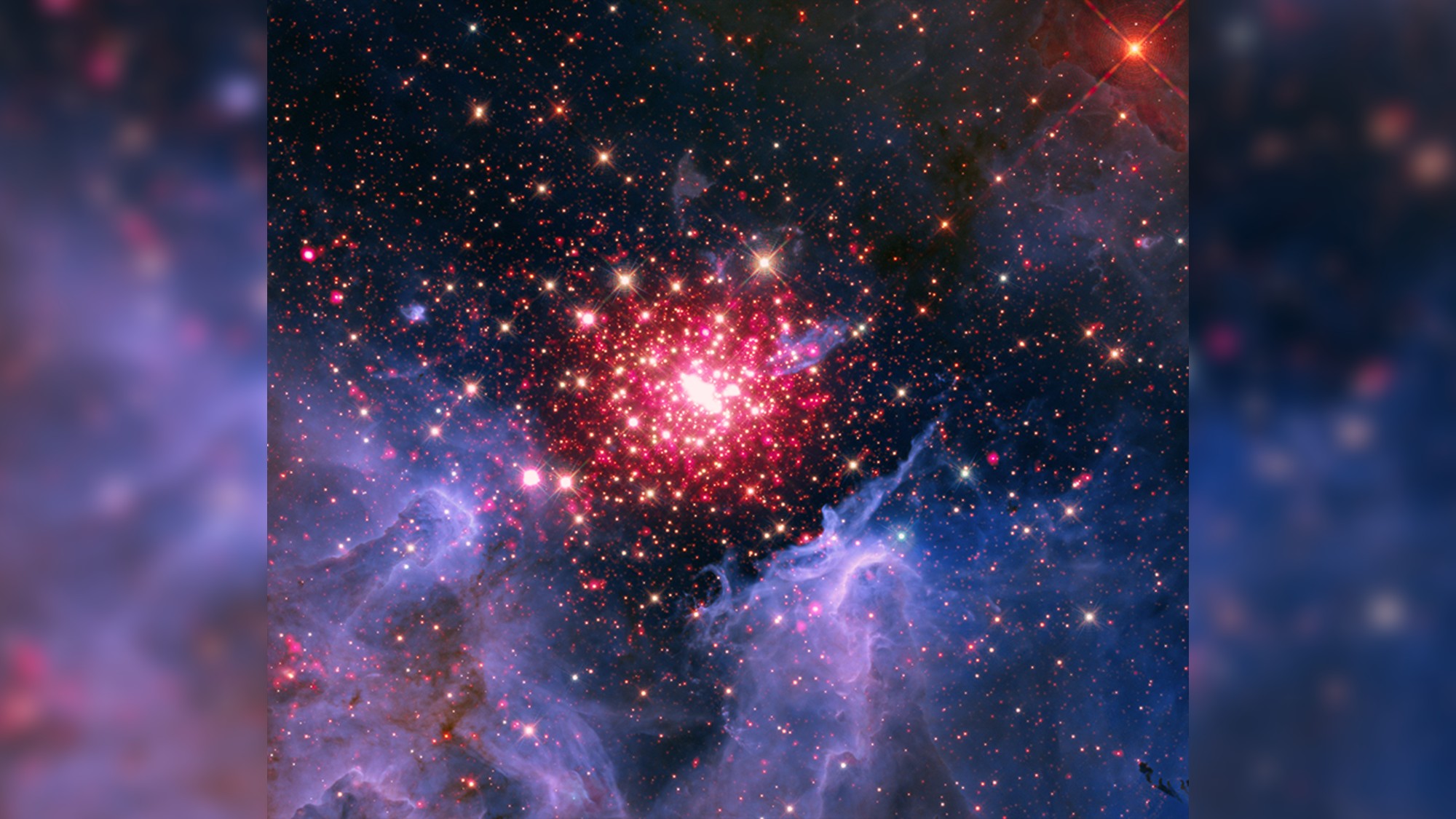
This image combines X-ray data from Chandra with optical, infrared, and ultraviolet light from NASA's Hubble Space Telescope to reveal the twinkling cluster of gases and thousands of stars known as NGC 3603.
This nebula, found in our own Milky Way galaxy, is a vast region of gas and dust surrounding a dense concentration of massive stars. NGC 3603 is located 20,000 light-years away from our solar system in the Carina constellation, a Southern Hemisphere constellation named after the Latin word for a ship's keel.
NGC 3603 contains some of the most massive stars in the known universe, according to NASA. "These huge stars live fast and die young, burning through their hydrogen fuel quickly and ultimately ending their lives in supernova explosions," the agency pointed out in a prior statement about the nebula.
An image of the nebula known as NGC 3603, combining X-ray data from NASA's Chandra X-ray observatory with optical, infrared, and ultraviolet light from NASA's Hubble Space Telescope. (Image credit: NASA/CXC/SAO; Optical and Dark Matter: NASA/ESA/M.J. Jee; Image Processing: NASA/CXC/SAO/L. Frattare)
Cassiopeia A
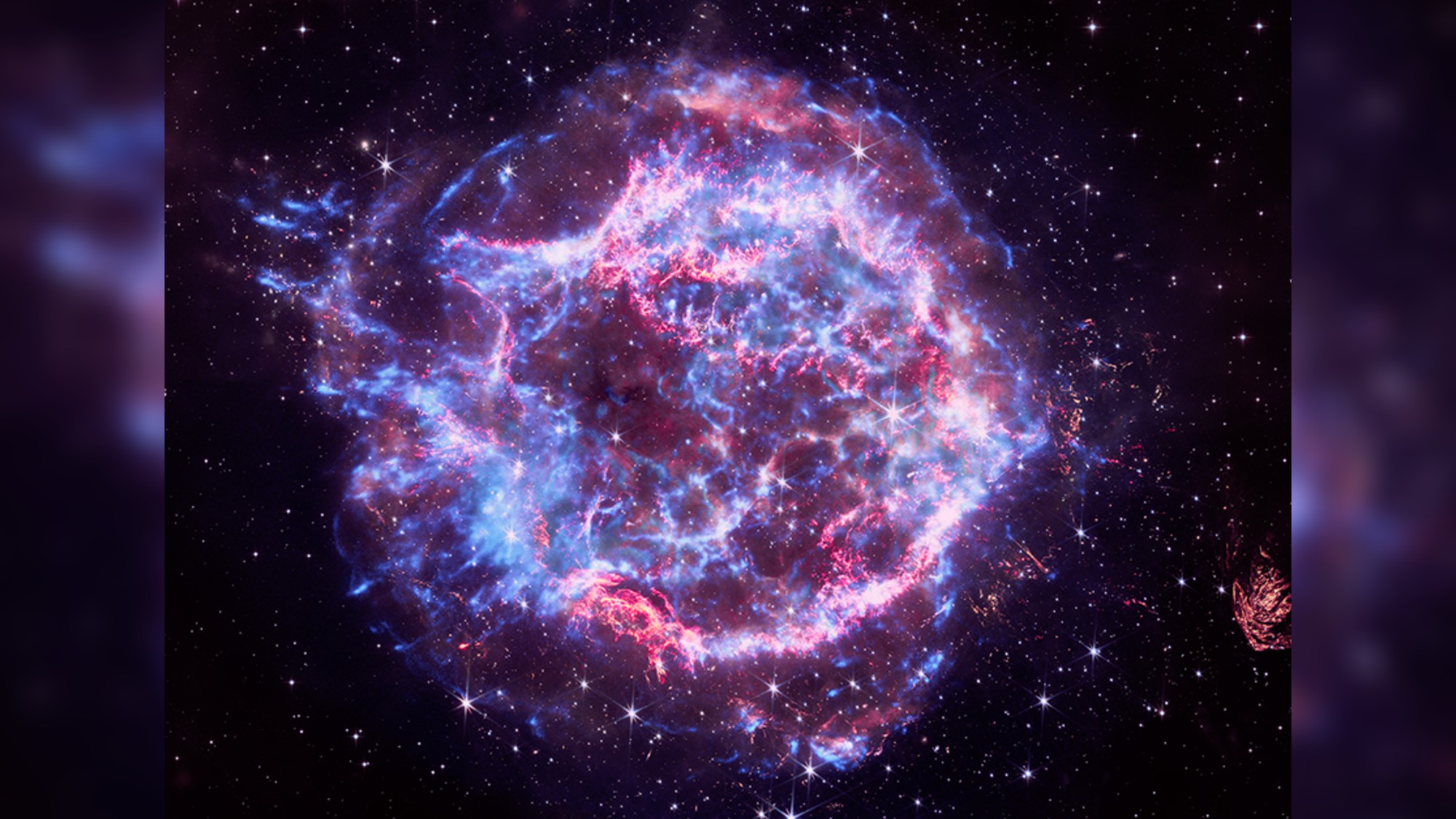
When some stars die, they explode in massive events known as supernovas. The light from one of the most well-known examples of a supernova reached Earth in the 17th century, appearing as a bright point of light in the Cassiopeia constellation. But because this exploded star is located some 11,000 light-years away from Earth, it means that the supernova actually occurred over 10,000 years ago, according to NASA.
Today, the leftover gases from that supernova are known as Cassiopeia A. Astronomers believe the star that produced the supernova was somewhere in the neighborhood of 15 to 25 times more massive than the sun.
In the image below, Chandra's X-ray data was combined with infrared light gathered by the James Webb Space Telescope to help visualize the luminous shell of gas in reds, whites and blues.
A new image of the supernova remnant Cassiopeia A produced by combining infrared light gathered by the James Webb Space Telescope with X-ray data produced by NASA's Chandra X-ray observatory. (Image credit: NASA/CXC/SAO; IR: NASA/ESA/CSA/STScI; Image Processing: NASA/CXC/SAO/L. Frattare and K. Arcand)
Over the past 250 years, the number of "planets" in our solar system has ranged from six to nine — and, briefly, even 11 — depending on what astronomers knew at the time and how they defined a planet. As the United States prepares to celebrate its 250th anniversary, that changing tally offers a unique lens on humanity's evolving understanding of the cosmos since 1776.
Throughout history, astronomers have discovered new worlds, identified entirely new classes of celestial objects and repeatedly revised the very definition of a planet. The result is a surprisingly complicated answer to one of astronomy's most basic questions: How many planets are there in our solar system?
"The change in the number of recognized planets well represents how science is done," Kevin Schindler, historian and public information officer at Lowell Observatory, told Space.com. "Scientists discover something — a planet, dinosaur fossil, or beetle, for example — study it and classify it. With further study, and by studying more examples, scientists learn more and update their understanding of the thing, sometimes reclassifying it."
When the United States declared independence in 1776, astronomers recognized just six planets: Mercury, Venus, Earth, Mars, Jupiter and Saturn. That changed only five years later when William Herschel discovered Uranus in 1781, expanding the known solar system and increasing the planet count to seven.
The tally grew again in 1801 with the discovery of Ceres, a world orbiting between Mars and Jupiter. Three similar objects were found soon afterward, and for a time astronomers considered all of them planets, briefly bringing the total to 11. However, as additional objects were discovered, scientists realized they represented a distinct population and those objects were reclassified as asteroids, reducing the planet count down to seven, Schindler explained.
Neptune's discovery in 1846 raised the total to eight, while Clyde Tombaugh's discovery of Pluto at Lowell Observatory in 1930 established the familiar nine-planet solar system. This changing planet count underscores a broader pattern in humanity's journey of exploration and discovery over the past 250 years.
"I think it shows that exploration and the thirst to understand the universe around us is ingrained in us, it's part of our DNA and we continue to want to learn," Schindler said. "Our founding fathers established the United States based on scientific principles such as reason and logic, observation, evidence-based analysis, and openness to debate different points of view and be open to change."
For much of the 20th century, the answer seemed settled: The solar system had nine planets. However, beginning in the late 1950s, advancing spacecraft technology allowed scientists to study planets, moons and smaller bodies up close, revealing worlds far more diverse and dynamic than could be seen through telescopes alone. Then, in the early 1990s, astronomers began discovering a growing population of icy worlds beyond Neptune.
"The discovery of Trans-Neptunian Objects (TNOs) — numerous objects similar to Pluto but with orbits extending much farther away from the sun — tells us a lot about our 'local' environment," astronomer Kyler Kuehn, director of science, technology and operations at Lowell Observatory, told Space.com in an email, emphasizing the impact discovering TNOs has had on the classification of Pluto.
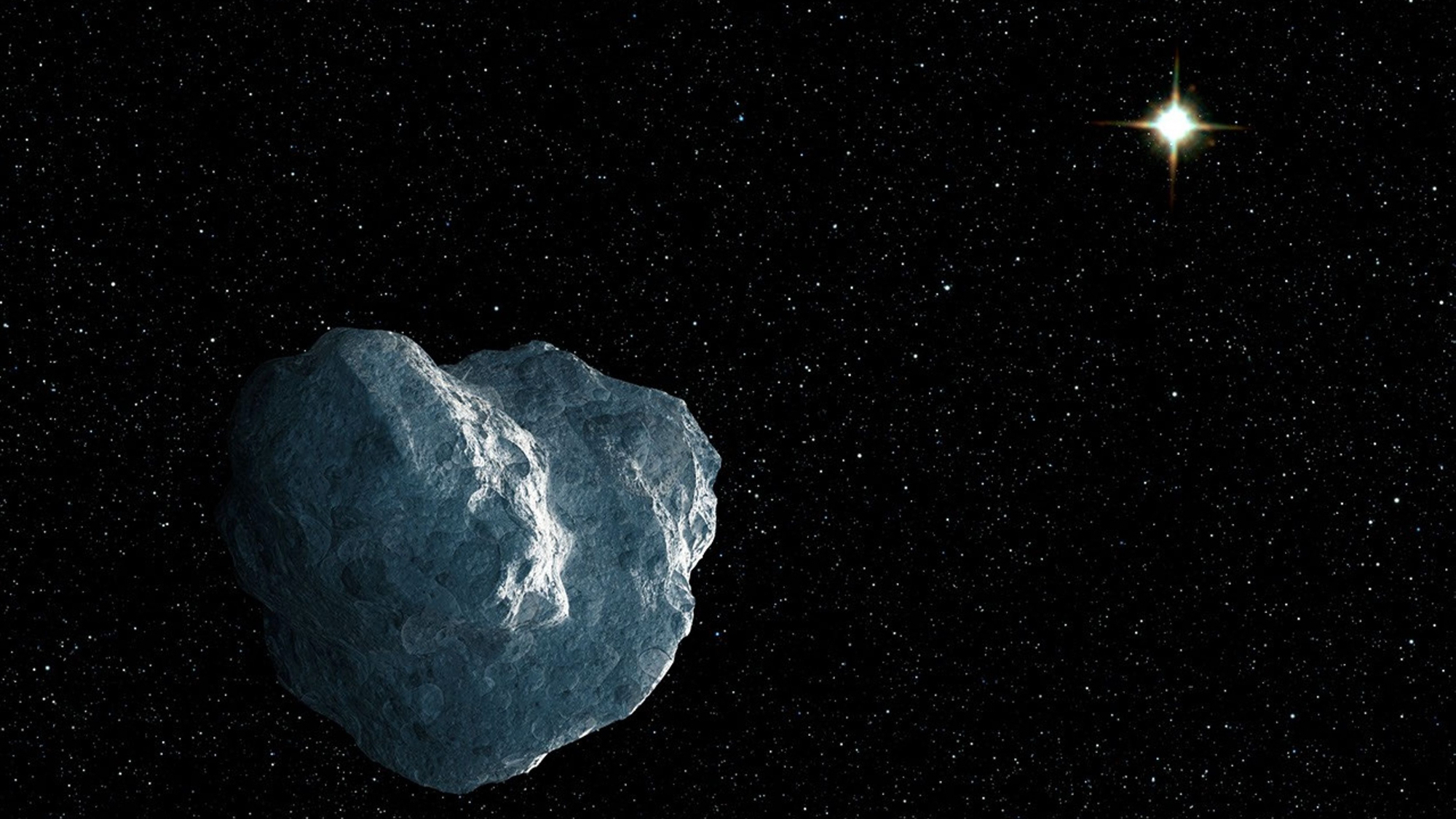
An artist's interpretation of a trans-Neptunian object. (Image credit: Artwork: NASA, ESA, and G. Bacon (STScI); Science: NASA, ESA, and C. Fuentes (Harvard-Smithsonian Center for Astrophysics))
"While Pluto was the first TNO to be discovered, the fact that there could be millions of similar objects populating the outskirts of the solar system naturally leads to the question 'Why should we treat Pluto differently than any of the others?'" Kuehn said.
The growing number of TNO discoveries ultimately established that Pluto was part of the Kuiper Belt, a vast reservoir of icy bodies extending beyond Neptune's orbit. As a result, Pluto was no longer viewed as a unique outlier, but rather one member of a much larger population. This dramatically reshaped astronomers' understanding of the solar system, exposing a far more complex outer frontier than anyone in 1776 could have imagined.
"It doesn't fit into the relatively tidy structure of the solar system as understood in 1776," Schindler said. For 18th-century astronomers, "it likely wouldn't be a surprise to find new planets or a new class of planet-like bodies (asteroids), but the discovery of an entire new zone of bodies, which was more [chaotic], probably would have been a surprise, showing that the solar system is not nearly as tidy and stable as believed."
The debate surrounding Pluto's classification culminated in 2006, when the International Astronomical Union adopted a formal definition of a planet. Under that definition, a planet must orbit the sun, be massive enough to become nearly round under its own gravity and have "cleared the neighborhood" around its orbit. While Pluto met the first two requirements, it did not meet the third and was reclassified as a dwarf planet, dropping the official planet count from nine back down to eight.
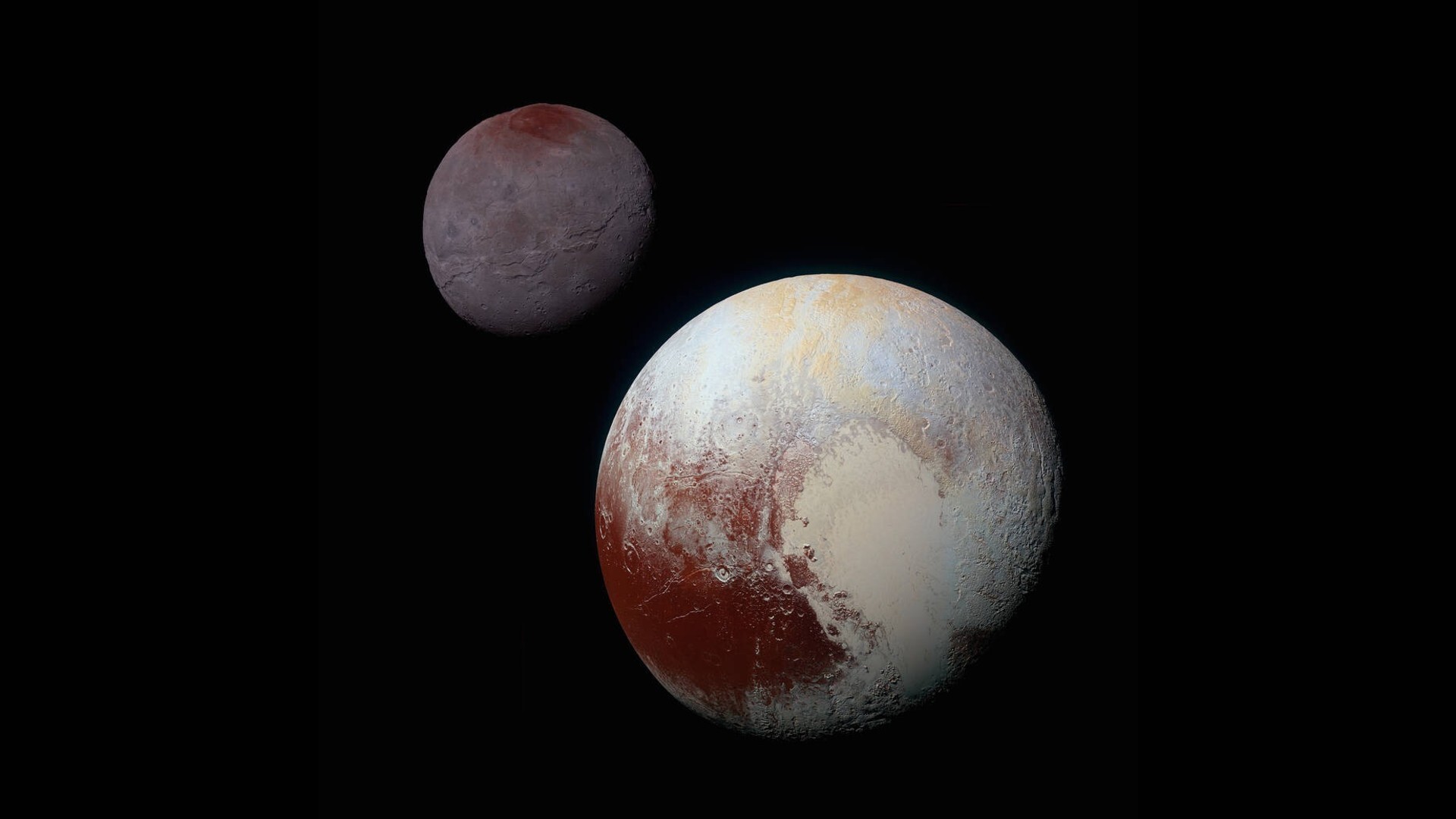
Controversy over Pluto's classification continues today. Schindler said scientists who oppose Pluto's planethood typically favor a dynamical definition focused on how a body interacts with and dominates its orbital environment. Meanwhile, those who favor Pluto's return to planetary status generally support a geophysical definition based on an object's physical properties. In fact, Pluto's 2015 flyby by NASA's New Horizons spacecraft further fueled the debate by revealing a surprisingly complex world with mountains, glaciers and active geology.
"There has not been any resolution between the two sides," Schindler said, noting that public interest has also helped keep the debate alive.
Most recently, NASA Administrator Jared Isaacman added his voice to the conversation by saying he believes Pluto should once again be considered a planet and that the scientific community should revisit its classification.
A close up of Pluto (a red and white planet in the front) and its moon Charon (a darker reddish sphere) in the back in the darkness of space. (Image credit: NASA/JHUAPL/SwRI)
"Arguing about the technical definition of 'planet' doesn't actually change anything about the (dwarf) planet itself, but how we classify things can be extremely important to the kinds of questions we even think to ask, " Kuehn added. "Scientific definitions have changed and will continue to change over the course of decades and centuries as we learn more."
The changing planet count demonstrates the foundations of how science works. Schindler compared Pluto's reclassification to the dinosaur Brontosaurus, which was renamed Apatosaurus after further study before later regaining its original classification as scientists refined their understanding.
Therefore, future discoveries, both within our solar system and beyond it, could further reshape scientists' understanding of planetary systems and how planets are classified.
"That might lead us to a more useful definition of planet than anything we are even considering now," Kuehn said. Looking forward, "I think we will learn a lot more about the extreme edges of our solar system — we have barely scratched the surface."
Two hundred and fifty years ago, astronomers knew of only six planets. Today, the official count in our solar system stands at eight, as the debate continues over whether that number tells the whole story.
As the United States marks its 250th anniversary, the changing planet count serves as a reminder that discovery is never finished. Every new observation has the potential to reshape our understanding of the cosmos — just as it has since America's founding — and perhaps even change the answer to one of astronomy's oldest questions: How many planets are there in our solar system?
NASA provided an Artemis update today (June 30), announcing new lunar landing contracts for its Moon Base initiative and a surprise new possible rover mission that could be headed to the moon's south pole.
During the second monthly update that NASA has provided for its moon base plans, the agency named Astrobotic, Firefly Aerospace and Intuitive Machines as the providers of four robotic landers that will deliver scientific payloads to the surface of the moon, as NASA tests and expands the technologies needed for a permanent human outpost.
"This is this drawing on the playbook that worked very well for NASA during the 1960s," NASA Administrator Jared Isaacman said during the livestreamed update, explaining the experiential approach to a crewed lunar return. "We didn't just jump right to Apollo 11."
Isaacman also announced the potential repurposing of an engineering development model built to mirror the agency's Perseverance and Curiosity rovers on Mars. "There is another," Isaacman said, quoting Yoda's line from "Star Wars: The Empire Strikes Back."
That test rover is called PROMISE, short for "Polar Rover for Observation, Mapping, and In-Situ Exploration" (though it was formerly known as Optimism). PROMISE was developed at NASA's Jet Propulsion Laboratory (JPL) in Southern California, where it has been used as a test platform for fixes or commands that engineers want to try on the ground before permanently sending them to Perseverance and Curiosity. Now, NASA wants to send PROMISE on a mission of its own.
Though sending PROMISE to the moon would leave Perseverance and Curiosity — both of which remain active on Mars — without an Earth-based testbed, Isaacman thinks it would be worth it.
"We've had years now of experience operating the two rovers on the surface of Mars, and we've got this hardware that the taxpayers have invested a lot in," he said. "So the question was posed: 'What if we send it to the moon?'"
With a little refurbishment, PROMISE would help advance NASA's lunar plans, Isaacman added. Like Perseverance and Curiosity, the test rover is powered by a radioisotope thermoelectric generator (RTG), which converts heat from naturally decaying radioactive material into electricity. So it wouldn't require sunlight to operate — a real benefit on the moon, where most locations experience long stretches of darkness. (NASA plans to build its Artemis base near the moon's south pole, which is thought to harbor an abundance of water ice and also has a relatively complex lighting environment.)
The other robots currently in the works to launch on future missions to the moon, including the landers announced during today's update, are all solar powered. Through 2029, NASA hopes to launch up to 20 such missions as part of the CLPS (Commercial Lunar Payload Services) initiative to support the first phase of the agency's moon base plans, and the landers announced today will be some of the first in that lineup.
Already expected this year was Blue Origin's Blue Moon Mark 1 cargo lander. It's slated to launch on the company's New Glenn rocket, which exploded last month during an engine test. That anomaly has complicated the Blue Moon timeline, though Blue Origin CEO Dave Limp has voiced confidence that New Glenn will launch again this year.
Two lunar deliveries were awarded to Astrobotic's Griffin 1 lander, one of which will fly Astrolab's FLIP rover the surface of the moon in the second half of 2026. Contracts to Firefly and Intuitive Machines call for the use of their Blue Ghost and Nova C landers, respectively, on CLPS missions in the next few years.
Three artist renderings depict commercial lunar landers from Astrobotic, Intuitive Machines, and Firefly on the moon. NASA announced June 30 that the landers will deliver more NASA science investigations and technology demonstrations to the lunar surface for NASA’s Moon Base Program. (Image credit: Astrobotic/Intuitive Machines/Firefly)
Each CLPS lander mission will carry at least three NASA payloads. The Stereo Camera for Lunar Plume Surface Studies (SCALPSS) array will study lander engine exhaust plume effects on lunar dust, to better predict landing requirements and prevent erosion and dangerous ejecta; a Laser Retroreflector Array (LRA) will test landers' ability to determine positioning and navigate using lasers and reflectors; and a Linear Energy Transfer Spectrometer (LETS) will measure radiation in the space around the moon and different areas on its surface.
"We know a lot about the moon, some of the south pole, but nothing like what we need to learn before we send humans there and we actually build a moon base," Carlos Garcia-Golan, NASA's Moon Base program manager, said during today's event. "So putting different assets on the surface, prospecting, understanding the environment and the places where we want to go [is] super critical."
Garcia-Golan is on board with the PROMISE moon plan as well. While it might sound crazy to send a spare Mars rover to the moon, it's the kind of crazy that NASA should be doing, he said. After all, JPL's motto is "Dare mighty things."
"We are in the business of the near impossible, so why not?" Garcia-Golan said.
Deep oceans of magma once sloshed about inside the crust of Mars, seismic measurements taken by NASA's InSight mission suggest.
The marsquakes detected by InSight show a boundary 15 miles (24 kilometers) deep between two different types of rock that were formed by enormous pools of magma. The presence of these magma pools could completely change what we thought we knew about the early development of Mars.
Already, scientists say the discovery could change what we know about the history of Mars. "One of the big questions in planetary science is whether Earth is unique," said the University of Oxford's Jon Wade in a statement. "If Mars could develop this kind of complex crust without plate tectonics, then maybe the conditions needed for habitability can emerge on more planets than we realized, including those previously dismissed based on size or their apparent lack of tectonic activity."
Earth is shaped by plate tectonics, the shifting of giant slabs of the planet's crust above our planet's molten mantle in a motion that generates earthquakes and volcanoes, but which also creates new land and regulates atmospheric carbon by drawing it out of the atmosphere and re-releasing it though volcanic eruptions. This constant reprocessing results in a fairly complex crust with multiple layers.
However, no convincing evidence has been found that the Red Planet has ever had plate tectonics. Instead, it is what we call a 'stagnant lid' planet, where the entire crust is one unbroken layer. Beneath this solid lid, all the way down to the mantle 23.6 miles (38 km) below the Martian surface, was considered to be fairly homogenous.
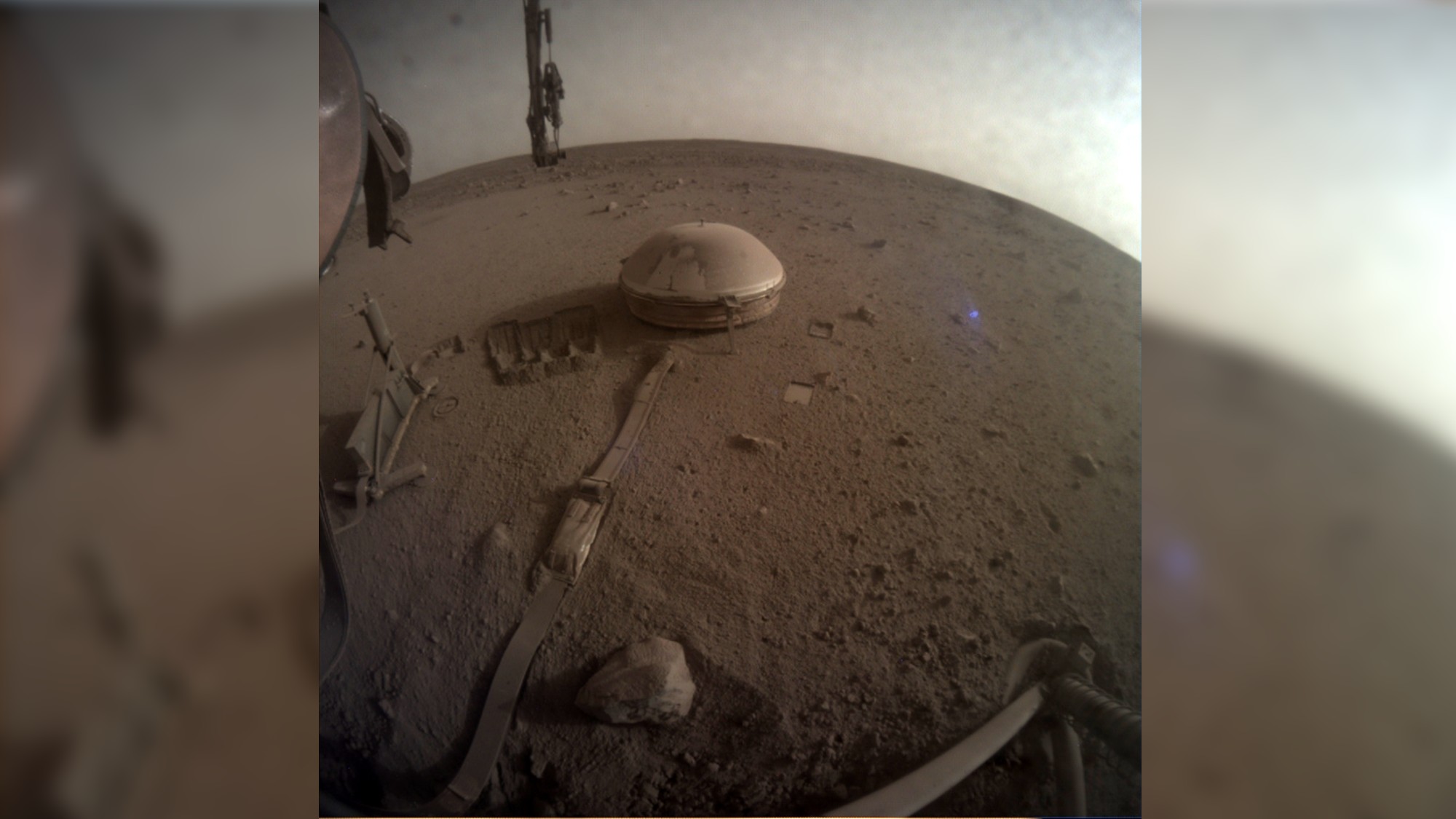
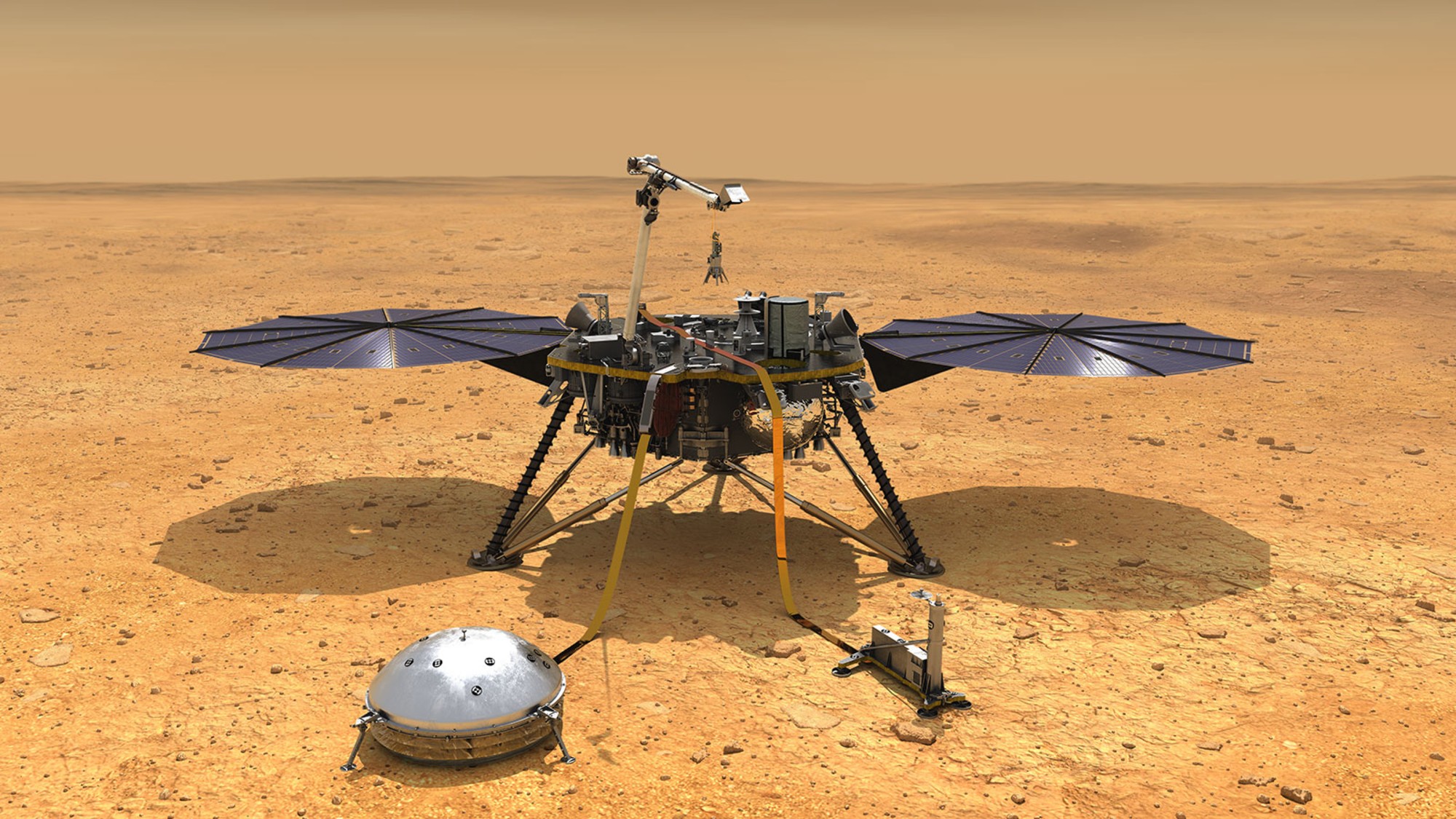
But NASA's InSight (Interior Exploration using Seismic Investigations, Geodesy and Heat Transport) mission, which operated on Mars's surface between 2018 and 2022, put this to the test. InSight's seismometer was designed to detect tremors from marsquakes triggered by meteorite impacts or shifts in the planet's interior. These seismic tremors would reverberate through Mars, and InSight could learn about the interior structure of the Red Planet based on how they reached the lander.
InSight's seismometer on the Martian surface. (Image credit: NASA/JPL–Caltech)
Thanks to the way these tremors passed through Mars's interior after traveling at different velocities through different kinds of rock, InSight discovered a boundary between two layers of crust, but its existence has not been explained until now.
Researchers at the University of Oxford tasked themselves with figuring it out. Using geothermal models and statistics, the Oxford team identified the two types of rock that best matched the seismic data. They conclude that above 15 miles (24 km) deep is a thick layer of mafic rock, which is rich in iron, magnesium and silica. Below this depth is denser, crystalline ultramafic rock, which contains iron and magnesium but is depleted in silica and which descends a further 8.7 miles (14 kilometers) to the boundary between the crust and the mantle.
It seems as though the rock has become differentiated – the denser material having settled out below the lighter mafic rock. This could only have happened in huge pools of magma that once resided in giant pockets within Mars's crust. Like oil separating from water, the mafic and ultramafic rock separated over time, in a process called differentiation, before the magma cooled and froze the layers in place.
The pockets of magma could have extended for hundreds and possibly even thousands of kilometers around the planet, each pool linked to the others. Giant volcanic systems on Mars such as Olympus Mons and the Tharsis volcanoes would not have been isolated hotspots, but would have been interconnected beneath the surface.
This is something of a surprise – this kind of 'transcrustal magmatism' has only ever been found on Earth before. It's evidence that even though Mars lacked plate tectonics, it could still have undergone a degree of geochemical evolution and deep, complex geology.
This geology could even have supported a habitable environment by regurgitating carbon back into the atmosphere to maintain a greenhouse effect. Because of its small size and therefore low gravity and lack of magnetic field, Mars's atmosphere is notoriously leaky, and over its history, much of its atmosphere – including large quantities of its precious water – has escaped into space.
Large-scale volcanism, powered by interconnected chambers of magma, could have belched greenhouse gases back into the atmosphere, thickening the Martian atmosphere and maintaining warmer temperatures for longer.
An illustration of InSight on Mars. (Image credit: NASA/JPL–Caltech)
But where did the magma come from? The Oxford team points the finger at upwelling from Mars' deep mantle, and with that magma came waves of heat that partially melted the crust, creating more magma. Both these processes took place on Earth during the Archaean Eon, which spanned between 4 and 2.5 billion years ago. On Earth, these processes contributed to the formation of the continents, although Mars' lack of plate tectonics and continents suggest that these processes were not as developed on the Red Planet.
Even so, some models suggest that mantle upwelling contributed to Mars' north–south dichotomy where the north contains mostly lowlands, which could have facilitated a large ocean, and the south is dominated by highlands.
"We've traditionally assumed that volcanism on Mars was relatively simple compared to that on Earth, but this discovery suggests that the planet could sustain massive, long-lived magmatic systems capable of evolving and reprocessing molten rock throughout the crust," said the study's lead author, Tobermory Mackay-Champion, who was previously at Oxford during the research but is now at the University of Bristol.
Mackay–Champion also highlights how this reprocessing of Mars's crust could have left metal deposits nearer the surface than had been thought.
"Mars may hold significantly more near-surface mineral wealth than previously recognized, boosting its potential for future mining, crewed missions and, eventually, permanent settlements," said Mackay-Champion.
While undoubtedly useful for a future outpost on Mars, this does raise the specter of companies pillaging and exploiting the Red Planet for its resources.
The universe is ready for its close-up! That's because today marks the day that the Vera C. Rubin Observatory begins it's 10-year mission to shoot the greatest cosmic move ever created.
The decade-long project officially known as the Legacy Survey of Space and Time(LSST) is set to revolutionize our view of the universe. That means June 30, 2026 marks the beginning of a new era for astronomy.
"Today, we begin filming the greatest cosmic movie ever made," U.S. National Science Foundation (NSF) director Brian Stone said in a statement. "Every night, NSF–Department of Energy (DOE) Rubin Observatory will expand the frontiers of knowledge and strengthen America's global leadership in science and innovation."
The LSST will see Rubin use its 3200-megapixel camera, the largest digital camera ever created, to repeatedly scan the entire sky over the southern hemisphere every few nights. Over the next decade, each point in the sky will be covered 800 times; this will result in an ultra-wide, ultra-high-definition time-lapse record of the cosmos, the scale of which will put any Sci-Fi epic to shame.
And that includes the daring voyage of discovery present in any great Sci-Fi story. Astronomers teaming with Rubin will dive headfirst into the dark universe. That means the dual mysteries of dark energy — the force driving the accelerating expansion of the universe — and dark matter — which secretly seems to be holding galaxies together. Both are invisible to us, yet integral to the universe.
"With the launch of the ten-year Legacy Survey of Space and Time, NSF–DOE Rubin Observatory is opening a new window on the universe. It is embarking on a mission that will redefine modern cosmology and astrophysics," Darío Gil, Under Secretary for Science at the DOE said in the statement. “With its world-class design and tools, Rubin Observatory will capture the dynamic nature of our cosmos and reveal unimagined insights into our universe's biggest mysteries, from our own solar system to the very structure of the universe.
"By seeking to understand the enigmatic phenomena of dark energy and dark matter, we are not just observing the stars; we are striving to grasp the fundamental laws that govern our existence."
Combining multiple exposures reveals far more detail than a single exposure. Adding together many Rubin images of the same field, amplifies fainter objects (Image credit: NSF–DOE Vera C. Rubin Observatory/NOIRLab/SLAC/AURA)
The main actors in this LSST production will be a cast of pulsating stars, supernovaexplosions and fossil records of galaxies. This will not only provide clues as to the nature of dark matter and dark energy, but could also reveal hitherto undiscovered cosmic phenomena.
Rubin will also make an impact on astronomy within the solar system, not just at the vast cosmic distances.
For instance, Rubin is expected to discover millions of new asteroids and comets in our cosmic backyard, becoming the most powerful solar system discovery machine ever created. It is already living up to this potential.
In its first few months of operations, Rubin, which sits atop a mountain in northern Chile, has already discovered 11,000 never-before-seen asteroids, including 33 near-Earth objects and 380 icy minor planets and dwarf planets out past the orbit of Neptune, referred to astrans-Neptunian objects.
A map that shows what Rubin will observe during the LSST over the course of just one week (Image credit: NSF–DOE Vera C. Rubin Observatory/NOIRLab/SLAC/AURA)
It is estimated that the final LSST dataset will contain billions of objects, and its results will be available to all scientists and the general public — truly sparking a new age of cosmic discovery.
"It's taken 20 years of hard science, engineering, and more to get to the point where we can call 'action' as we start rolling on this blockbuster movie of the universe," Phil Marshall, Deputy Director of Rubin Operations for SLAC, said. "Millions of alerts in just the last couple of months show that Rubin is up and running as a discovery machine. Now we're putting it all together."
BOULDER, Colorado — After Earth's moon and Mars, where could humans plant their footprints?
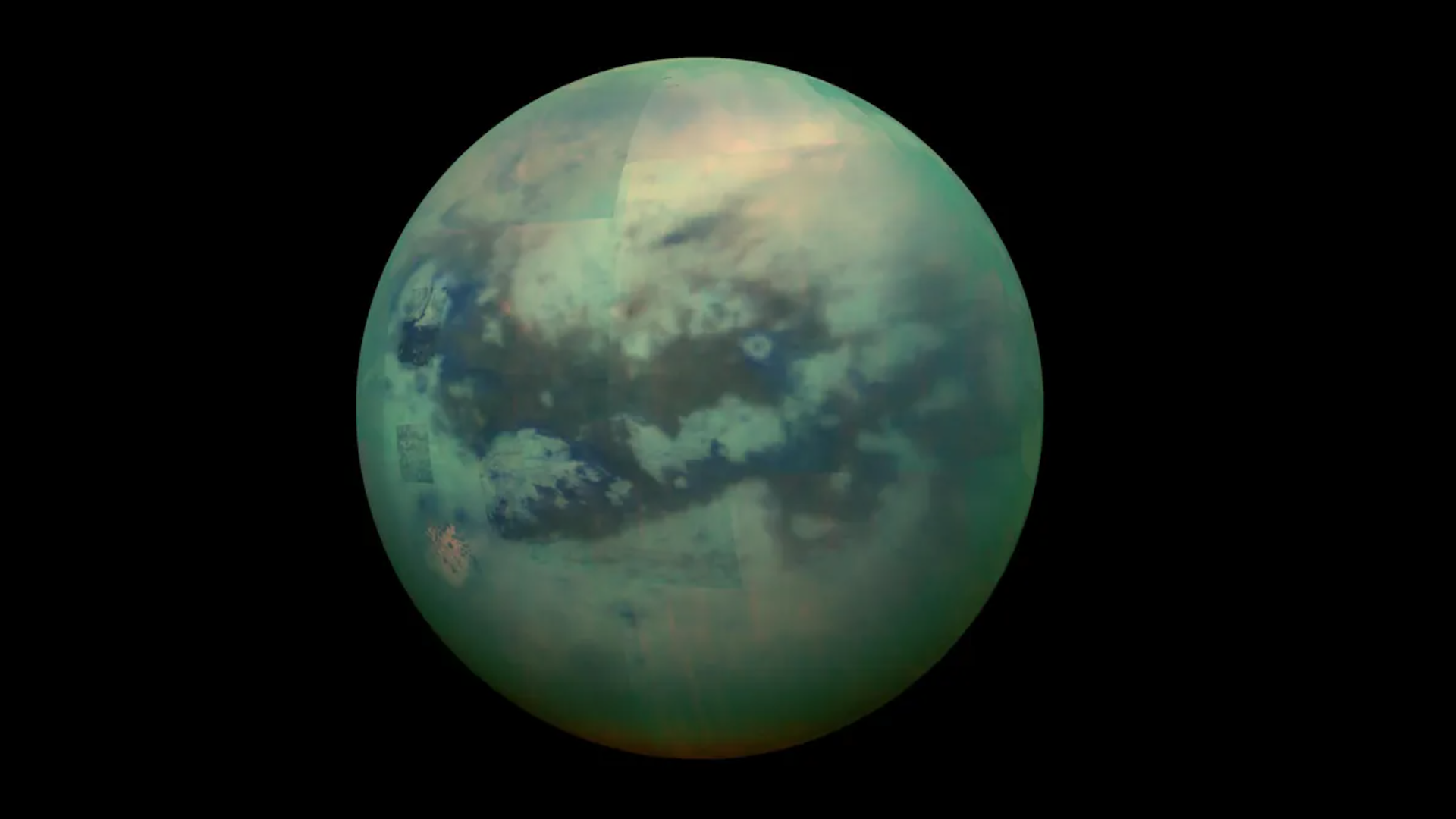
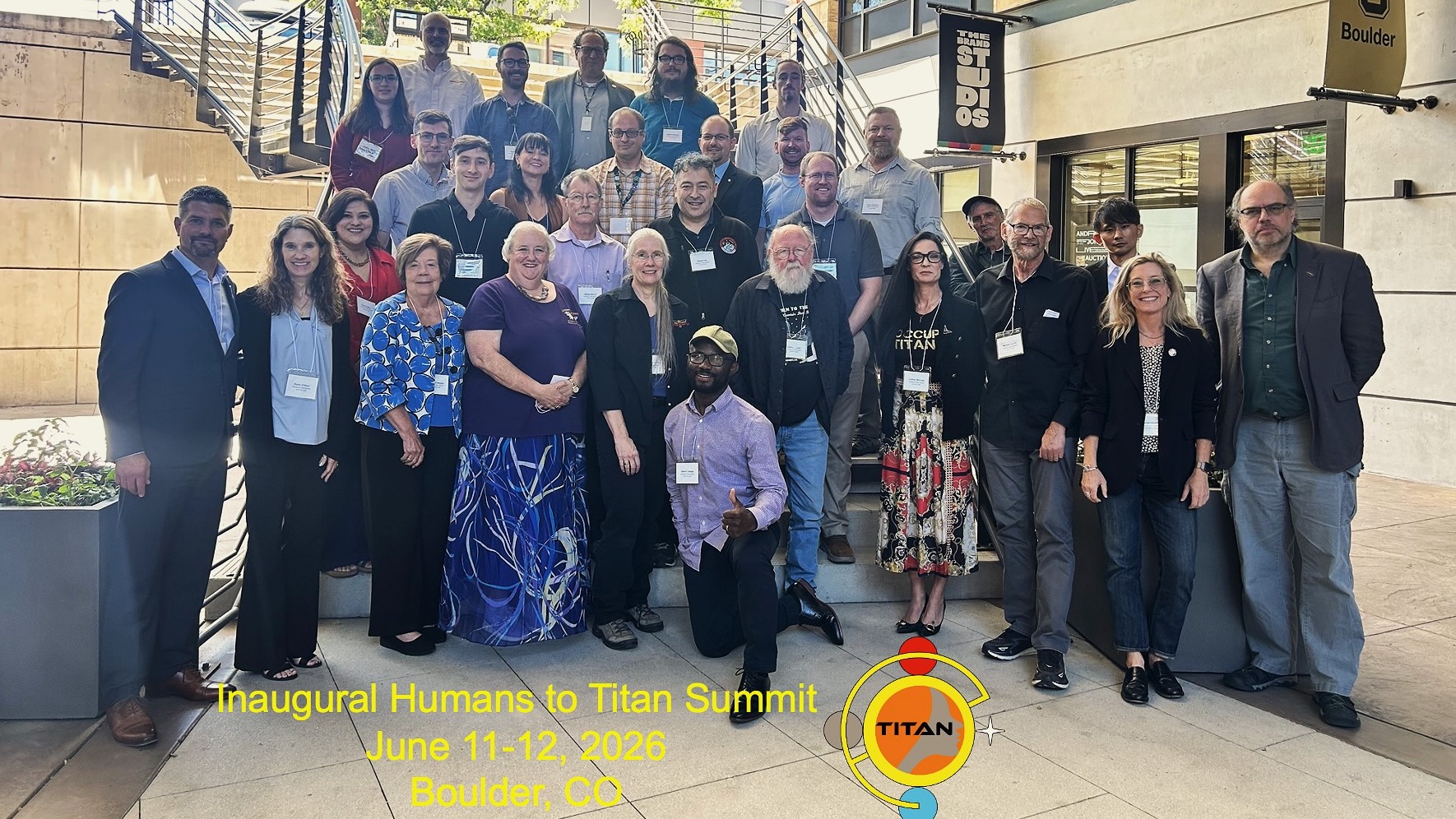
The "Humans to Titan Summit 2026" was held here on June 11 and June 12 to explore the concept of Titan, the largest moon of Saturn, as the next human exploration destination, post-Mars.
Researchers looked into how demanding such a trek could be and what would be required to make it, along with next steps to further that ambitious goal.
A NASA image of Saturn's largest moon, Titan. (Image credit: NASA/JPL-Caltech)
Normalizing the idea
As a first-of-its-kind gathering of experts, the Humans to Titan Summit 2026 was invigorating, taking seriously the prospect of one day sending humans to Titan, said Amanda Hendrix, director of the Planetary Science Institute, which is headquartered in Tucson, Arizona.
Hendrix is also president of the advocacy group Explore Titan and co-author of "Beyond Earth: Our Path to a New Home in the Planets" (Pantheon Books, 2016).
"Everyone recognizes that the reality of this is a long way off," Hendrix told Space.com, "but normalizing the idea — that Titan is actually a very reasonable destination for humans — is important."
Taking this goal seriously means that "we can have a next destination in our minds, after Mars," she added. "That keeps the momentum going."
Dense atmosphere
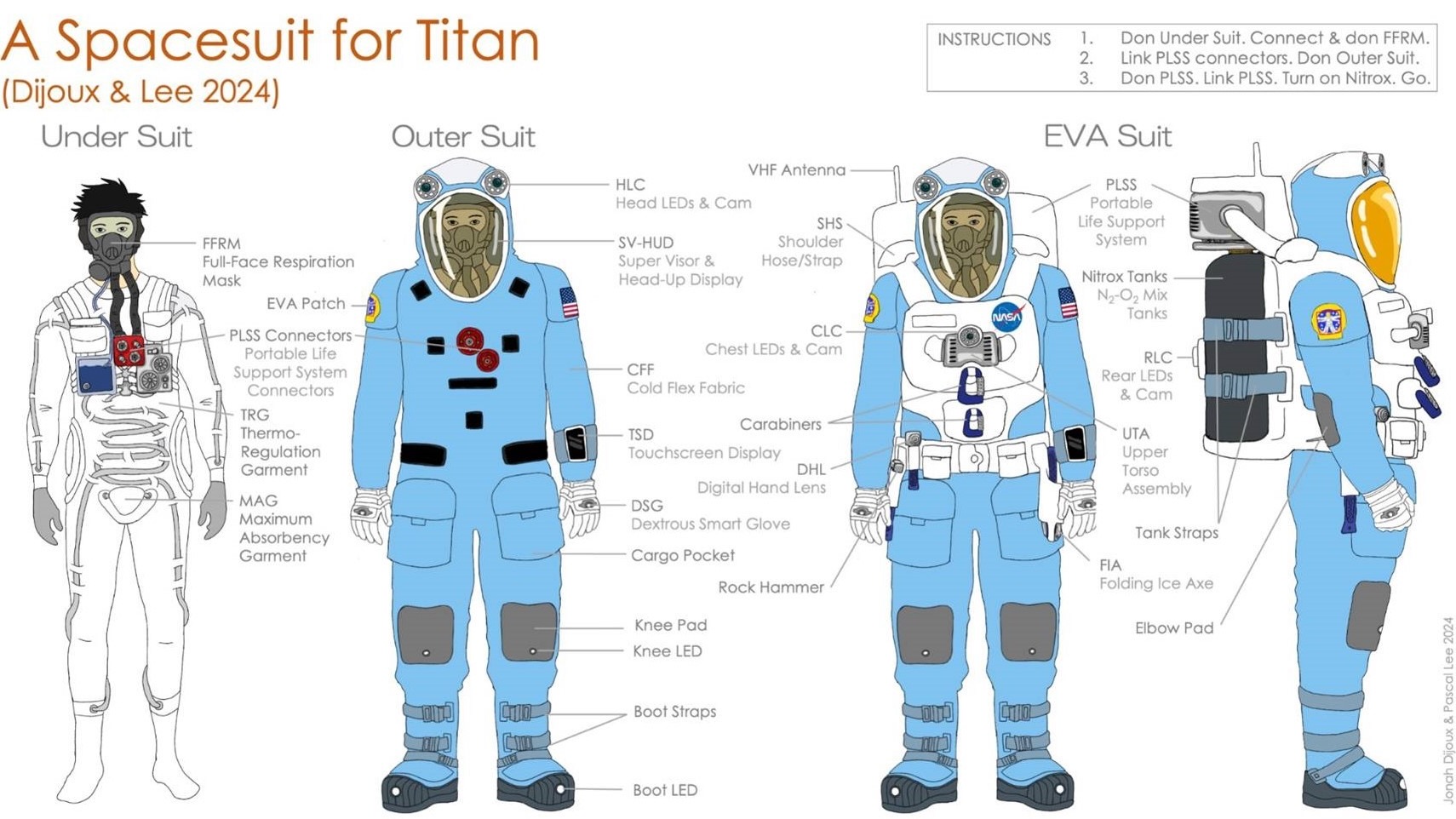
The assembly of experts explored an array of Titan topics, from spacesuits and modes of transportation, habitat designs and airlock concepts to light levels and possible encounters with monsoons and floods on the frigid, exotic moon, which has a weather system based on hydrocarbons rather than water.
Additionally, making use of Titan as a hub for launching sample-return missions to other moons within the Saturn system, like Enceladus, was viewed as a big plus.
So too was utilizing the moon's rich bounty of resources — like methane, nitrogen and oxygen — to fuel expansive, far-deeper exploration beyond Titan itself.
"We've got a lot of planning to do," said Hendrix, "but we have time!"
A top priority is figuring out how to either shorten the trip time to Titan or accommodate it and mitigate the negative effects on astronauts, Hendrix said.
"The top reason in my mind that Titan is such a good spot for humans is the dense atmosphere," Hendrix said. That nitrogen-dominated atmosphere provides natural shielding from harmful radiation of many types.
The first "Humans to Titan Summit" drew a unique cadre of experts. (Image credit: Explore Titan)
Precursor missions
Appreciation of what human visitors will face on the moon was boosted by the European Space Agency's robotic Huygens probe, which touched down on Titan on Jan. 14, 2005 as part of the NASA-ESA Cassini-Huygens mission to Saturn.
Next up for setting down on Titan is NASA's nuclear-powered Dragonfly, now projected to launch no earlier than 2028 for a six-year voyage to the faraway moon.
During its over three-year surface mission, Dragonfly's rotors will carry it for miles across Titan's surface, auto-piloting its way to a variety of areas. The vehicle is designed to snag samples of surface material for analysis inside the rotorcraft by scientific instruments.
Amanda Hendrix, director of the Planetary Science Institute and president of Explore Titan, an advocacy group. (Image credit: Barbara David/Future)
Extraordinarily ambitious
Taking part in the two-day gathering was Scot Rafkin, director of the Department of Space Studies at the Southwest Research Institute (SwRI) and a planetary and atmospheric scientist. The summit was held at SwRI's Solar System Science & Exploration Division facilities.
"Everyone recognized that sending humans to Titan is extraordinarily ambitious. But history shows that the greatest achievements in exploration begin when people are willing to pursue goals that seem beyond reach," said Rafkin. Sharing with Space.com his own personal thoughts, he said the summit marked "the beginning of a long-term effort to imagine and ultimately achieve something transformative."
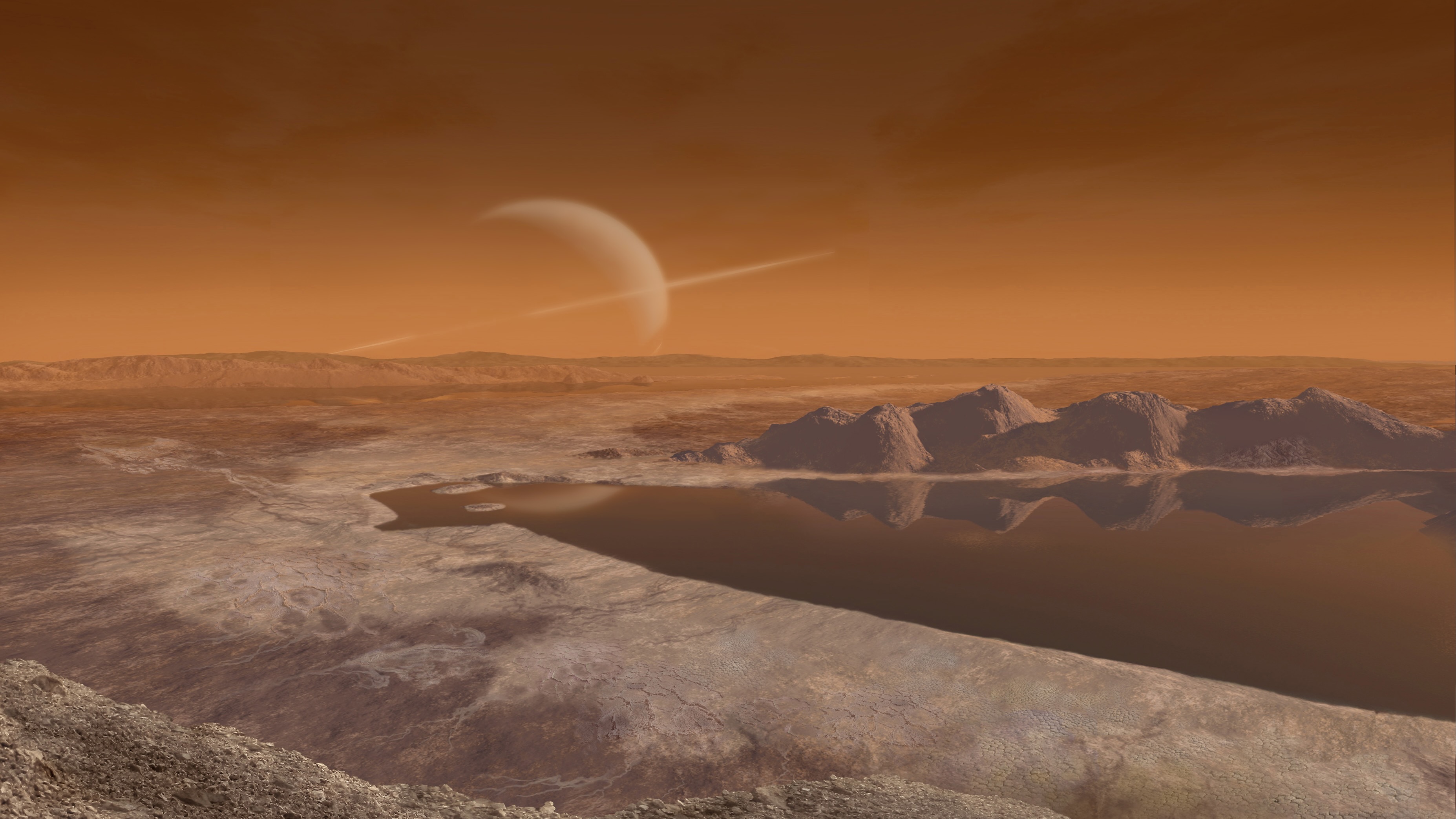
Titan is one of the most compelling worlds in the solar system, Rafkin said; it's a place with rivers, lakes, weather, dunes and complex chemistry unlike anywhere else we know of. Pursuing human exploration of Titan, he said, creates a long-term framework and provides a scientific purpose that transcends the moon and Mars.
What the best-dressed Titan explorer may wear. (Image credit: Dijoux and Lee)
'Not a question of physics'
Rafkin said that targeting Titan will also accelerate technologies needed not only for exploring that moon but for voyaging throughout the solar system.
"Human exploration of Titan is not a question of physics," said Rafkin. "It is a question of time, technology, and commitment. We understand most of the major challenges. We know many of the critical science and engineering gaps that remain."
Every advance in propulsion, power systems, manufacturing, robotics, computing, life support and communications, Rafkin said, brings Titan closer while simultaneously enabling exploration throughout the solar system.
Not every solution exists today, Rafkin continued, but the path forward is increasingly clear.
"Some steps can be taken now, such as sending an orbiter to better characterize the Titan system," said Rafkin. "Other capabilities will require decades or even generations of development. The challenge is immense, but it is achievable."
Rafkin said that the summit was not about planning a mission.
"It was about starting a movement. If space exploration has taught us anything, it is that ambitious goals accelerate innovation in ways we cannot fully predict. The destination is Titan, but the investment is in ourselves," Rafkin concluded.
A second Humans to Titan Summit, said Hendrix, is slated around the launch date in 2028 of the NASA Dragonfly mission.